Revision of past simple tense and the irregular verbs
Vocabulary: Activities and occupations in the past
Grade 8th
Age 13-14
Duration 40 minutes
Aims: 1. To revise the past simple tense and the forming of questions and negatives with
(did/didn’t) so that students can use freely the past simple tense without any mistakes.
2. To revise the irregular verbs, so that students can use them more easily.
3. To learn new vocabulary connected with the topic of activities and occupations in the past.
Stage1: Introducing ourselves-1-2 min
The teacher greets the students and has a small talk with the class (e.g. checking attendance,
talking about how they feel)
Interaction pattern: T-SS
Stage 2: Checking homework – 2-3 min
Interaction pattern: T-SS
Stage 3: The teacher writes ten declarative sentences on the white board in past simple and
gives the verb in brackets, so that the students have to put them in the correct form. Then from
these declarative sentences, the students have to form questions and negative sentences using
did/didn’t. Example: He……. a movie yesterday. (watch); Did he watch a movie yesterday? He
didn’t watch a movie yesterday. 8-10min
Aim: To revise the past simple tense and to reduce the number of mistakes students make,
typically connected with the fact that they don’t use the infinitive form of the verb after
did/didn’t.
Interaction pattern: T-SS
Stage 4: Interactive computer-based exercise in the form of a game – the class is divided in two
teams which compete who will score the best result. The students are asked to choose the correct
form of the verb in the past in order to score a goal. The team with the highest result wins the
game. 4-5min.
Aim: Students can revise the verbs they already know, and learn the past simple form of verbs
they don’t know.
Interaction pattern: T-SS
Stage 5 Introducing the topic of the ancient Egypt. The teacher tells the class about the recent
excavations of the newly discovered ancient city of Luxor in Egypt. Then asks what they know
about the ancient Egyptians. 2-3min.
Aim: To raise students’ interest in the topic.
Interaction pattern: T-SS
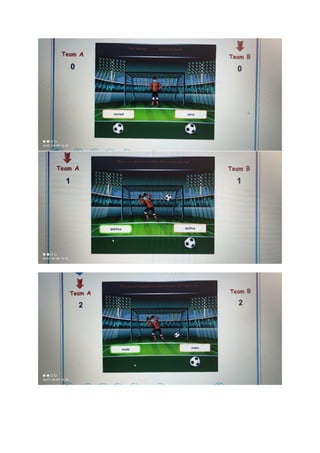
Stage 6: The new vocabulary is introduced with a picture exercise in the textbook. The students
write the new words in their notebooks and they listen and repeat the correct pronunciation. 5-
8 min.
Aim: To help students remember the new vocabulary more easily.
Interaction pattern: T-SS
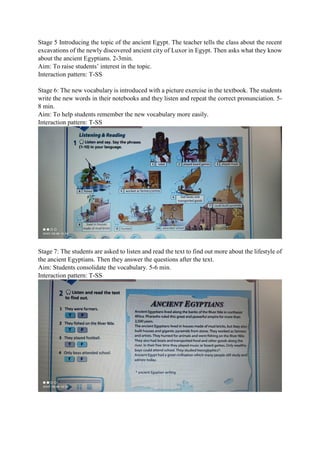
Stage 7: The students are asked to listen and read the text to find out more about the lifestyle of
the ancient Egyptians. Then they answer the questions after the text.
Aim: Students consolidate the vocabulary. 5-6 min.
Interaction pattern: T-SS
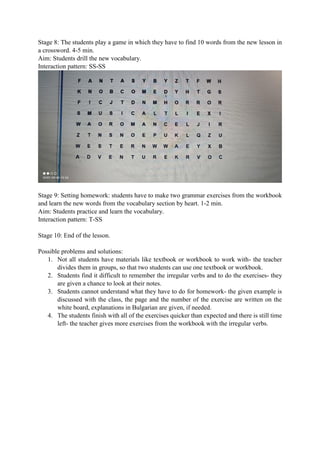
Stage 8: The students play a game in which they have to find 10 words from the new lesson in
a crossword. 4-5 min.
Aim: Students drill the new vocabulary.
Interaction pattern: SS-SS
Stage 9: Setting homework: students have to make two grammar exercises from the workbook
and learn the new words from the vocabulary section by heart. 1-2 min.
Aim: Students practice and learn the vocabulary.
Interaction pattern: T-SS
Stage 10: End of the lesson.
Possible problems and solutions:
1. Not all students have materials like textbook or workbook to work with- the teacher
divides them in groups, so that two students can use one textbook or workbook.
2. Students find it difficult to remember the irregular verbs and to do the exercises- they
are given a chance to look at their notes.
3. Students cannot understand what they have to do for homework- the given example is
discussed with the class, the page and the number of the exercise are written on the
white board, explanations in Bulgarian are given, if needed.
4. The students finish with all of the exercises quicker than expected and there is still time
left- the teacher gives more exercises from the workbook with the irregular verbs.

English lesson Bulgaria

  • 1.
    Revision of pastsimple tense and the irregular verbs Vocabulary: Activities and occupations in the past Grade 8th Age 13-14 Duration 40 minutes Aims: 1. To revise the past simple tense and the forming of questions and negatives with (did/didn’t) so that students can use freely the past simple tense without any mistakes. 2. To revise the irregular verbs, so that students can use them more easily. 3. To learn new vocabulary connected with the topic of activities and occupations in the past. Stage1: Introducing ourselves-1-2 min The teacher greets the students and has a small talk with the class (e.g. checking attendance, talking about how they feel) Interaction pattern: T-SS Stage 2: Checking homework – 2-3 min Interaction pattern: T-SS Stage 3: The teacher writes ten declarative sentences on the white board in past simple and gives the verb in brackets, so that the students have to put them in the correct form. Then from these declarative sentences, the students have to form questions and negative sentences using did/didn’t. Example: He……. a movie yesterday. (watch); Did he watch a movie yesterday? He didn’t watch a movie yesterday. 8-10min Aim: To revise the past simple tense and to reduce the number of mistakes students make, typically connected with the fact that they don’t use the infinitive form of the verb after did/didn’t. Interaction pattern: T-SS Stage 4: Interactive computer-based exercise in the form of a game – the class is divided in two teams which compete who will score the best result. The students are asked to choose the correct form of the verb in the past in order to score a goal. The team with the highest result wins the game. 4-5min. Aim: Students can revise the verbs they already know, and learn the past simple form of verbs they don’t know. Interaction pattern: T-SS
  • 3.
    Stage 5 Introducingthe topic of the ancient Egypt. The teacher tells the class about the recent excavations of the newly discovered ancient city of Luxor in Egypt. Then asks what they know about the ancient Egyptians. 2-3min. Aim: To raise students’ interest in the topic. Interaction pattern: T-SS Stage 6: The new vocabulary is introduced with a picture exercise in the textbook. The students write the new words in their notebooks and they listen and repeat the correct pronunciation. 5- 8 min. Aim: To help students remember the new vocabulary more easily. Interaction pattern: T-SS Stage 7: The students are asked to listen and read the text to find out more about the lifestyle of the ancient Egyptians. Then they answer the questions after the text. Aim: Students consolidate the vocabulary. 5-6 min. Interaction pattern: T-SS
  • 4.
    Stage 8: Thestudents play a game in which they have to find 10 words from the new lesson in a crossword. 4-5 min. Aim: Students drill the new vocabulary. Interaction pattern: SS-SS Stage 9: Setting homework: students have to make two grammar exercises from the workbook and learn the new words from the vocabulary section by heart. 1-2 min. Aim: Students practice and learn the vocabulary. Interaction pattern: T-SS Stage 10: End of the lesson. Possible problems and solutions: 1. Not all students have materials like textbook or workbook to work with- the teacher divides them in groups, so that two students can use one textbook or workbook. 2. Students find it difficult to remember the irregular verbs and to do the exercises- they are given a chance to look at their notes. 3. Students cannot understand what they have to do for homework- the given example is discussed with the class, the page and the number of the exercise are written on the white board, explanations in Bulgarian are given, if needed. 4. The students finish with all of the exercises quicker than expected and there is still time left- the teacher gives more exercises from the workbook with the irregular verbs.