ENGLISH HANDOUT

     Análisis y producción de funciones comunicativas (Tiempos Verbales)

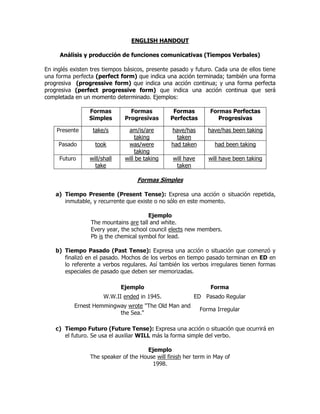
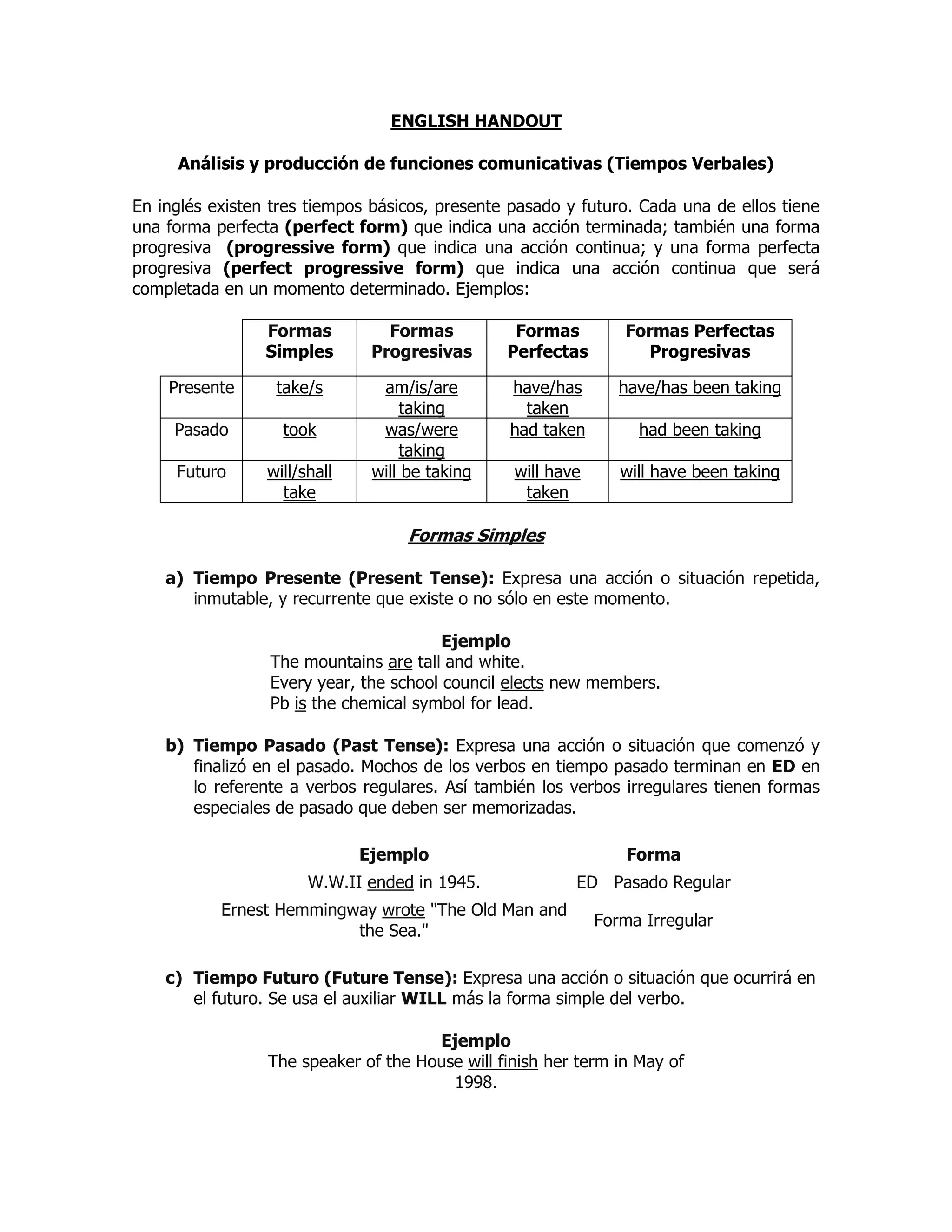
En inglés existen tres tiempos básicos, presente pasado y futuro. Cada una de ellos tiene
una forma perfecta (perfect form) que indica una acción terminada; también una forma
progresiva (progressive form) que indica una acción continua; y una forma perfecta
progresiva (perfect progressive form) que indica una acción continua que será
completada en un momento determinado. Ejemplos:

                 Formas          Formas          Formas         Formas Perfectas
                 Simples       Progresivas      Perfectas          Progresivas

    Presente      take/s        am/is/are        have/has       have/has been taking
                                   taking          taken
     Pasado        took         was/were         had taken        had been taking
                                   taking
     Futuro      will/shall    will be taking    will have      will have been taking
                   take                           taken

                                    Formas Simples

    a) Tiempo Presente (Present Tense): Expresa una acción o situación repetida,
       inmutable, y recurrente que existe o no sólo en este momento.

                                        Ejemplo
                 The mountains are tall and white.
                 Every year, the school council elects new members.
                 Pb is the chemical symbol for lead.

    b) Tiempo Pasado (Past Tense): Expresa una acción o situación que comenzó y
       finalizó en el pasado. Mochos de los verbos en tiempo pasado terminan en ED en
       lo referente a verbos regulares. Así también los verbos irregulares tienen formas
       especiales de pasado que deben ser memorizadas.

                              Ejemplo                            Forma
                       W.W.II ended in 1945.             ED Pasado Regular
           Ernest Hemmingway wrote "The Old Man and
                                                             Forma Irregular
                          the Sea."

    c) Tiempo Futuro (Future Tense): Expresa una acción o situación que ocurrirá en
       el futuro. Se usa el auxiliar WILL más la forma simple del verbo.

                                      Ejemplo
                 The speaker of the House will finish her term in May of
                                        1998.
El futuro también se puede formar usando AM, IS o ARE con el GOING TO para
  expresar futuro inmediato o cercano.
                                   Ejemplo
            The surgeon is going to perform the first bypass in Minnesota.


  Debemos tomar en cuenta que podemos utilizar adverbios para denotar o dar
  énfasis a la construcción que se escribe

                                 Ejemplo
                          The president speaks tomorrow.
                     (Tomorrow es un advebio de tiempo futuro.)

                             Formas Progresivas

d) Tiempo Presente Progresivo (Present Progressive Tense): Describe una
   acción que está sucediendo en el mismo momento que se dice o escríbela oración.
   Se forma con AM, IS o ARE con el verbo terminado en ING

                                     Ejemplo
                   The sociologist is examining the effects that racial
                             discrimination has on society.

e) Tiempo Pasado Progresivo (Past Progressive Tense): Describe una acción
   que estaba sucediendo cuando otra acción ocurrió. Se forma con WAS, WERE
   con el verbo terminado en ING

                                   Ejemplo
       The explorer was explaining the latest discovery in Egypt when protests
       began on the streets.

f) Tiempo Futuro Progresivo (Future Progressive Tense): Describe una acción
   continua que sucederá en el futuro. Se forma usando el WILL BE con el verbo
   terminado en ING

                                    Ejemplo
              Dr. Jones will be presenting ongoing research on sexist
              language next week.

                              Formas Perfectas

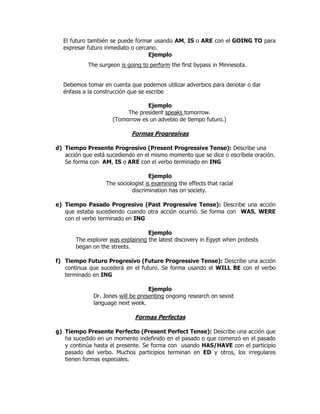
g) Tiempo Presente Perfecto (Present Perfect Tense): Describe una acción que
   ha sucedido en un momento indefinido en el pasado o que comenzó en el pasado
   y continúa hasta el presente. Se forma con usando HAS/HAVE con el participio
   pasado del verbo. Muchos participios terminan en ED y otros, los irregulares
   tienen formas especiales.
Ejemplo                                      Significa
The researchers have traveled to many countries in order to collect   En un momento
                      more significant data.                             indefinido
                                                                      Continúa hasta el
     Women have voted in presidential elections since 1921.
                                                                          presente

  h) Tiempo Pasado Perfecto (Past Perfect Tense): Describe una acción que ha
     sucedido en un momento en el pasado antes de otra acción en pasado. Se forma
     con HAD más el participio pasado del verbo.

                                       Ejemplo
                       By the time the troops arrived, the war had
                       ended.

  i) Tiempo Futuro Perfecto (Future Perfect Tense): Describe una acción que
     sucederá en el futuro antes de cualquier otra acción. Se forma con WILL HAVE
     más el participio pasado del verbo.


                                        Ejemplo
        By the time the troops arrive, the combat group will have spent several weeks
                                            waiting.


                          Formas Perfectas Progresivas

  j) Tiempo Presente Perfecto Progresivo (Present Perfect Progressive
     Tense): Describe una acción que comenzó en el pasado, continúa en el presnte y
     puede continuar en el futuro. Se forma con HAS/HAVE BEEN más el verbo
     terminado en ING.

                                     Ejemplo
      The CEO has been considering a transfer to the state of Texas where profits would
                                         be larger.

  k) Tiempo Pasado Perfecto Progresivo (Past Perfect Progressive Tense):
     Describe una acción continua en pasado que se completó antes que otra acción.
     Se forma con HAD BEEN con el verbo terminado en ING.

                                      Ejemplo
     Before the budget cuts, the students had been participating in many extracurricular
                                         activities.

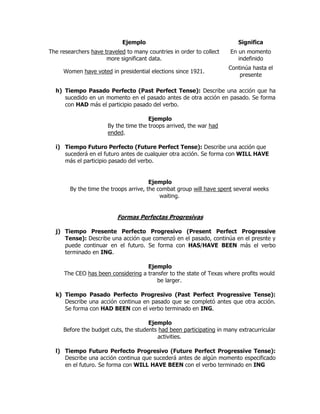
  l) Tiempo Futuro Perfecto Progresivo (Future Perfect Progressive Tense):
     Describe una acción continua que sucederá antes de algún momento especificado
     en el futuro. Se forma con WILL HAVE BEEN con el verbo terminado en ING
Ejemplo
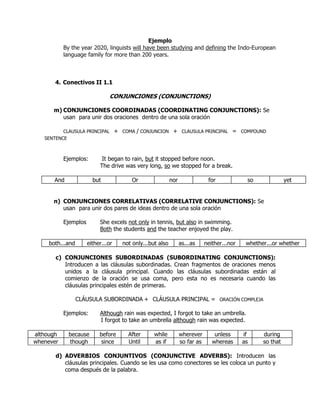
           By the year 2020, linguists will have been studying and defining the Indo-European
           language family for more than 200 years.


       4. Conectivos II 1.1

                               CONJUNCIONES (CONJUNCTIONS)

      m) CONJUNCIONES COORDINADAS (COORDINATING CONJUNCTIONS): Se
         usan para unir dos oraciones dentro de una sola oración

          CLAUSULA PRINCIPAL        + COMA / CONJUNCION + CLAUSULA PRINCIPAL = COMPOUND
   SENTENCE


           Ejemplos:        It began to rain, but it stopped before noon.
                           The drive was very long, so we stopped for a break.

      And               but               Or                nor                for             so              yet


      n) CONJUNCIONES CORRELATIVAS (CORRELATIVE CONJUNCTIONS): Se
         usan para unir dos pares de ideas dentro de una sola oración

           Ejemplos        She excels not only in tennis, but also in swimming.
                           Both the students and the teacher enjoyed the play.

    both...and        either...or     not only...but also         as...as     neither...nor    whether...or whether

       c) CONJUNCIONES SUBORDINADAS (SUBORDINATING CONJUNCTIONS):
          Introducen a las cláusulas subordinadas. Crean fragmentos de oraciones menos
          unidos a la cláusula principal. Cuando las cláusulas subordinadas están al
          comienzo de la oración se usa coma, pero esta no es necesaria cuando las
          cláusulas principales estén de primeras.

                 CLÁUSULA SUBORDINADA + CLÁUSULA PRINCIPAL = ORACIÓN COMPLEJA

           Ejemplos:       Although rain was expected, I forgot to take an umbrella.
                           I forgot to take an umbrella although rain was expected.

although     because       before       After      while          wherever        unless      if     during
whenever     though         since       Until      as if          so far as      whereas      as     so that

       d) ADVERBIOS CONJUNTIVOS (CONJUNCTIVE ADVERBS): Introducen las
          cláusulas principales. Cuando se les usa como conectores se les coloca un punto y
          coma después de la palabra.
CLÁUSULA PRINCIPAL + PUNTO Y COMA / ADVERBIO CONJUNTIVO + CLÁUSULA
       PRINCIPAL = ORACIÓN COMPUESTA

              Ejemplos: We missed the bus; therefore, we had to walk to school.
                        The course was difficult; however, I was pleased with my final grade.

thus    Hence     therefore    however      otherwise       nevertheless     furthermore   consequently
then    Indeed    moreover     besides       likewise       nonetheless       meanwhile     accordingly

       Tipos de relación II 1.3

           La relación entre las oraciones, Conectores Lógicos (Logical Connectors) se usa para
       unir dos ideas que tienen una relación en particular. Esta relación puede ser: Secuencial
       (de Tiempo), de razón y propósito, oposición y/o resultados inesperados.

       a. Secuencial (de tiempo)

 Conjunción         Until/After/ Before/When/While/Since/Once/Whenever/As soon as/As long as By the
Subordinada                                               time/
Preposiciones                              During/After/Before/Since/Until/Upon
 Conjunción
 Adverbial y      Then/Next/After that/Following that/Before that/Afterwards/Meanwhile/Beforehand
 Transitorios
 Conjunción                                                And then

       b. Causal (Razón y Propósito; Causa y Efecto)

                  Because/As/Since/Inasmuch as/Now that/As long as/Such...that/[such a/an + adjetivo
 Conjunción
                  +sustan + that]/So...that/[so +adjetivo or adverbio + that]/[so much/many/little/few
Subordinada
                  + noun + that] Expresar Propósito: So that/In order that/
Preposiciones                                 Because of/Due to/In order to
 Conjunción
 Adverbial y                                      Therefore/Consequently
 Transitorios
 Conjunción                                                    So

       c. Adversativo (Resultado Inesperado, Contraste, Oposición)

  Conjunción
                      Even though/Although/Though/In spite of the fact that/While/Whereas/Where
Subordinada
Preposiciones                                          Despite/In spite of
 Conjunción
 Adverbial y        However/Nonetheless/Nevertheless/On the other hand/In contrast on the contrary
 Transitorios
 Conjunción                                 But...anyway/But...still/Yet...still/But
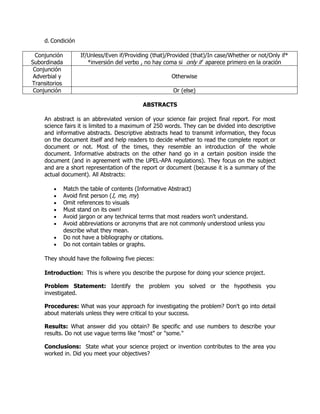
d. Condición

  Conjunción         If/Unless/Even if/Providing (that)/Provided (that)/In case/Whether or not/Only if*
Subordinada             *inversión del verbo , no hay coma si only if aparece primero en la oración
 Conjunción
 Adverbial y                                            Otherwise
Transitorios
 Conjunción                                              Or (else)

                                             ABSTRACTS

     An abstract is an abbreviated version of your science fair project final report. For most
     science fairs it is limited to a maximum of 250 words. They can be divided into descriptive
     and informative abstracts. Descriptive abstracts head to transmit information, they focus
     on the document itself and help readers to decide whether to read the complete report or
     document or not. Most of the times, they resemble an introduction of the whole
     document. Informative abstracts on the other hand go in a certain position inside the
     document (and in agreement with the UPEL-APA regulations). They focus on the subject
     and are a short representation of the report or document (because it is a summary of the
     actual document). All Abstracts:

               Match the table of contents (Informative Abstract)
               Avoid first person (I, me, my)
               Omit references to visuals
               Must stand on its own!
               Avoid jargon or any technical terms that most readers won't understand.
               Avoid abbreviations or acronyms that are not commonly understood unless you
               describe what they mean.
               Do not have a bibliography or citations.
               Do not contain tables or graphs.

     They should have the following five pieces:

     Introduction: This is where you describe the purpose for doing your science project.

     Problem Statement: Identify the problem you solved or the hypothesis you
     investigated.

     Procedures: What was your approach for investigating the problem? Don't go into detail
     about materials unless they were critical to your success.

     Results: What answer did you obtain? Be specific and use numbers to describe your
     results. Do not use vague terms like "most" or "some."

     Conclusions: State what your science project or invention contributes to the area you
     worked in. Did you meet your objectives?
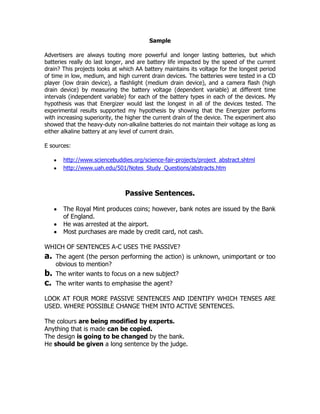
Sample

Advertisers are always touting more powerful and longer lasting batteries, but which
batteries really do last longer, and are battery life impacted by the speed of the current
drain? This projects looks at which AA battery maintains its voltage for the longest period
of time in low, medium, and high current drain devices. The batteries were tested in a CD
player (low drain device), a flashlight (medium drain device), and a camera flash (high
drain device) by measuring the battery voltage (dependent variable) at different time
intervals (independent variable) for each of the battery types in each of the devices. My
hypothesis was that Energizer would last the longest in all of the devices tested. The
experimental results supported my hypothesis by showing that the Energizer performs
with increasing superiority, the higher the current drain of the device. The experiment also
showed that the heavy-duty non-alkaline batteries do not maintain their voltage as long as
either alkaline battery at any level of current drain.

E sources:

       http://www.sciencebuddies.org/science-fair-projects/project_abstract.shtml
       http://www.uah.edu/501/Notes_Study_Questions/abstracts.htm


                                Passive Sentences.

       The Royal Mint produces coins; however, bank notes are issued by the Bank
       of England.
       He was arrested at the airport.
       Most purchases are made by credit card, not cash.

WHICH OF SENTENCES A-C USES THE PASSIVE?
a.   The agent (the person performing the action) is unknown, unimportant or too
     obvious to mention?
b.   The writer wants to focus on a new subject?
c.   The writer wants to emphasise the agent?

LOOK AT FOUR MORE PASSIVE SENTENCES AND IDENTIFY WHICH TENSES ARE
USED. WHERE POSSIBLE CHANGE THEM INTO ACTIVE SENTENCES.

The colours are being modified by experts.
Anything that is made can be copied.
The design is going to be changed by the bank.
He should be given a long sentence by the judge.
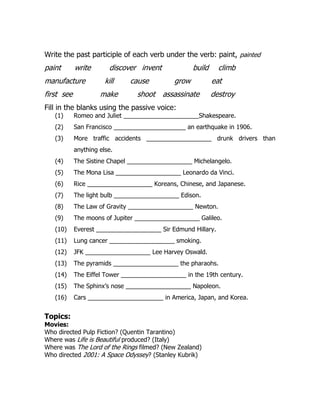
Write the past participle of each verb under the verb: paint, painted
paint       write        discover invent            build     climb
manufacture            kill    cause         grow           eat
first see            make        shoot assassinate          destroy
Fill in the blanks using the passive voice:
   (1)      Romeo and Juliet ______________________Shakespeare.
   (2)      San Francisco _____________________ an earthquake in 1906.
   (3)      More traffic accidents ___________________ drunk drivers than
            anything else.
   (4)      The Sistine Chapel ___________________ Michelangelo.
   (5)      The Mona Lisa ___________________ Leonardo da Vinci.
   (6)      Rice ___________________ Koreans, Chinese, and Japanese.
   (7)      The light bulb ___________________ Edison.
   (8)      The Law of Gravity ___________________ Newton.
   (9)      The moons of Jupiter ___________________ Galileo.
   (10)     Everest ___________________ Sir Edmund Hillary.
   (11)     Lung cancer ___________________ smoking.
   (12)     JFK ___________________ Lee Harvey Oswald.
   (13)     The pyramids ___________________ the pharaohs.
   (14)     The Eiffel Tower ___________________ in the 19th century.
   (15)     The Sphinx’s nose ___________________ Napoleon.
   (16)     Cars ______________________ in America, Japan, and Korea.


Topics:
Movies:
Who directed Pulp Fiction? (Quentin Tarantino)
Where was Life is Beautiful produced? (Italy)
Where was The Lord of the Rings filmed? (New Zealand)
Who directed 2001: A Space Odyssey? (Stanley Kubrik)
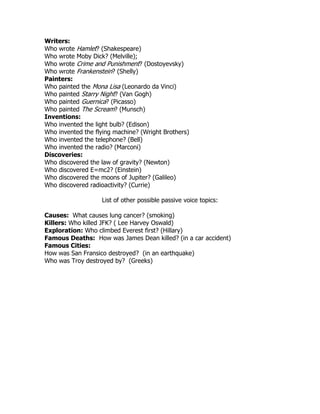
Writers:
Who wrote Hamlet? (Shakespeare)
Who wrote Moby Dick? (Melville);
Who wrote Crime and Punishment? (Dostoyevsky)
Who wrote Frankenstein? (Shelly)
Painters:
Who painted the Mona Lisa (Leonardo da Vinci)
Who painted Starry Night? (Van Gogh)
Who painted Guernica? (Picasso)
Who painted The Scream? (Munsch)
Inventions:
Who invented the light bulb? (Edison)
Who invented the flying machine? (Wright Brothers)
Who invented the telephone? (Bell)
Who invented the radio? (Marconi)
Discoveries:
Who discovered the law of gravity? (Newton)
Who discovered E=mc2? (Einstein)
Who discovered the moons of Jupiter? (Galileo)
Who discovered radioactivity? (Currie)

                   List of other possible passive voice topics:

Causes: What causes lung cancer? (smoking)
Killers: Who killed JFK? ( Lee Harvey Oswald)
Exploration: Who climbed Everest first? (Hillary)
Famous Deaths: How was James Dean killed? (in a car accident)
Famous Cities:
How was San Fransico destroyed? (in an earthquake)
Who was Troy destroyed by? (Greeks)

English handout 5to 2do lapso

  • 1.
    ENGLISH HANDOUT Análisis y producción de funciones comunicativas (Tiempos Verbales) En inglés existen tres tiempos básicos, presente pasado y futuro. Cada una de ellos tiene una forma perfecta (perfect form) que indica una acción terminada; también una forma progresiva (progressive form) que indica una acción continua; y una forma perfecta progresiva (perfect progressive form) que indica una acción continua que será completada en un momento determinado. Ejemplos: Formas Formas Formas Formas Perfectas Simples Progresivas Perfectas Progresivas Presente take/s am/is/are have/has have/has been taking taking taken Pasado took was/were had taken had been taking taking Futuro will/shall will be taking will have will have been taking take taken Formas Simples a) Tiempo Presente (Present Tense): Expresa una acción o situación repetida, inmutable, y recurrente que existe o no sólo en este momento. Ejemplo The mountains are tall and white. Every year, the school council elects new members. Pb is the chemical symbol for lead. b) Tiempo Pasado (Past Tense): Expresa una acción o situación que comenzó y finalizó en el pasado. Mochos de los verbos en tiempo pasado terminan en ED en lo referente a verbos regulares. Así también los verbos irregulares tienen formas especiales de pasado que deben ser memorizadas. Ejemplo Forma W.W.II ended in 1945. ED Pasado Regular Ernest Hemmingway wrote "The Old Man and Forma Irregular the Sea." c) Tiempo Futuro (Future Tense): Expresa una acción o situación que ocurrirá en el futuro. Se usa el auxiliar WILL más la forma simple del verbo. Ejemplo The speaker of the House will finish her term in May of 1998.
  • 2.
    El futuro tambiénse puede formar usando AM, IS o ARE con el GOING TO para expresar futuro inmediato o cercano. Ejemplo The surgeon is going to perform the first bypass in Minnesota. Debemos tomar en cuenta que podemos utilizar adverbios para denotar o dar énfasis a la construcción que se escribe Ejemplo The president speaks tomorrow. (Tomorrow es un advebio de tiempo futuro.) Formas Progresivas d) Tiempo Presente Progresivo (Present Progressive Tense): Describe una acción que está sucediendo en el mismo momento que se dice o escríbela oración. Se forma con AM, IS o ARE con el verbo terminado en ING Ejemplo The sociologist is examining the effects that racial discrimination has on society. e) Tiempo Pasado Progresivo (Past Progressive Tense): Describe una acción que estaba sucediendo cuando otra acción ocurrió. Se forma con WAS, WERE con el verbo terminado en ING Ejemplo The explorer was explaining the latest discovery in Egypt when protests began on the streets. f) Tiempo Futuro Progresivo (Future Progressive Tense): Describe una acción continua que sucederá en el futuro. Se forma usando el WILL BE con el verbo terminado en ING Ejemplo Dr. Jones will be presenting ongoing research on sexist language next week. Formas Perfectas g) Tiempo Presente Perfecto (Present Perfect Tense): Describe una acción que ha sucedido en un momento indefinido en el pasado o que comenzó en el pasado y continúa hasta el presente. Se forma con usando HAS/HAVE con el participio pasado del verbo. Muchos participios terminan en ED y otros, los irregulares tienen formas especiales.
  • 3.
    Ejemplo Significa The researchers have traveled to many countries in order to collect En un momento more significant data. indefinido Continúa hasta el Women have voted in presidential elections since 1921. presente h) Tiempo Pasado Perfecto (Past Perfect Tense): Describe una acción que ha sucedido en un momento en el pasado antes de otra acción en pasado. Se forma con HAD más el participio pasado del verbo. Ejemplo By the time the troops arrived, the war had ended. i) Tiempo Futuro Perfecto (Future Perfect Tense): Describe una acción que sucederá en el futuro antes de cualquier otra acción. Se forma con WILL HAVE más el participio pasado del verbo. Ejemplo By the time the troops arrive, the combat group will have spent several weeks waiting. Formas Perfectas Progresivas j) Tiempo Presente Perfecto Progresivo (Present Perfect Progressive Tense): Describe una acción que comenzó en el pasado, continúa en el presnte y puede continuar en el futuro. Se forma con HAS/HAVE BEEN más el verbo terminado en ING. Ejemplo The CEO has been considering a transfer to the state of Texas where profits would be larger. k) Tiempo Pasado Perfecto Progresivo (Past Perfect Progressive Tense): Describe una acción continua en pasado que se completó antes que otra acción. Se forma con HAD BEEN con el verbo terminado en ING. Ejemplo Before the budget cuts, the students had been participating in many extracurricular activities. l) Tiempo Futuro Perfecto Progresivo (Future Perfect Progressive Tense): Describe una acción continua que sucederá antes de algún momento especificado en el futuro. Se forma con WILL HAVE BEEN con el verbo terminado en ING
  • 4.
    Ejemplo By the year 2020, linguists will have been studying and defining the Indo-European language family for more than 200 years. 4. Conectivos II 1.1 CONJUNCIONES (CONJUNCTIONS) m) CONJUNCIONES COORDINADAS (COORDINATING CONJUNCTIONS): Se usan para unir dos oraciones dentro de una sola oración CLAUSULA PRINCIPAL + COMA / CONJUNCION + CLAUSULA PRINCIPAL = COMPOUND SENTENCE Ejemplos: It began to rain, but it stopped before noon. The drive was very long, so we stopped for a break. And but Or nor for so yet n) CONJUNCIONES CORRELATIVAS (CORRELATIVE CONJUNCTIONS): Se usan para unir dos pares de ideas dentro de una sola oración Ejemplos She excels not only in tennis, but also in swimming. Both the students and the teacher enjoyed the play. both...and either...or not only...but also as...as neither...nor whether...or whether c) CONJUNCIONES SUBORDINADAS (SUBORDINATING CONJUNCTIONS): Introducen a las cláusulas subordinadas. Crean fragmentos de oraciones menos unidos a la cláusula principal. Cuando las cláusulas subordinadas están al comienzo de la oración se usa coma, pero esta no es necesaria cuando las cláusulas principales estén de primeras. CLÁUSULA SUBORDINADA + CLÁUSULA PRINCIPAL = ORACIÓN COMPLEJA Ejemplos: Although rain was expected, I forgot to take an umbrella. I forgot to take an umbrella although rain was expected. although because before After while wherever unless if during whenever though since Until as if so far as whereas as so that d) ADVERBIOS CONJUNTIVOS (CONJUNCTIVE ADVERBS): Introducen las cláusulas principales. Cuando se les usa como conectores se les coloca un punto y coma después de la palabra.
  • 5.
    CLÁUSULA PRINCIPAL +PUNTO Y COMA / ADVERBIO CONJUNTIVO + CLÁUSULA PRINCIPAL = ORACIÓN COMPUESTA Ejemplos: We missed the bus; therefore, we had to walk to school. The course was difficult; however, I was pleased with my final grade. thus Hence therefore however otherwise nevertheless furthermore consequently then Indeed moreover besides likewise nonetheless meanwhile accordingly Tipos de relación II 1.3 La relación entre las oraciones, Conectores Lógicos (Logical Connectors) se usa para unir dos ideas que tienen una relación en particular. Esta relación puede ser: Secuencial (de Tiempo), de razón y propósito, oposición y/o resultados inesperados. a. Secuencial (de tiempo) Conjunción Until/After/ Before/When/While/Since/Once/Whenever/As soon as/As long as By the Subordinada time/ Preposiciones During/After/Before/Since/Until/Upon Conjunción Adverbial y Then/Next/After that/Following that/Before that/Afterwards/Meanwhile/Beforehand Transitorios Conjunción And then b. Causal (Razón y Propósito; Causa y Efecto) Because/As/Since/Inasmuch as/Now that/As long as/Such...that/[such a/an + adjetivo Conjunción +sustan + that]/So...that/[so +adjetivo or adverbio + that]/[so much/many/little/few Subordinada + noun + that] Expresar Propósito: So that/In order that/ Preposiciones Because of/Due to/In order to Conjunción Adverbial y Therefore/Consequently Transitorios Conjunción So c. Adversativo (Resultado Inesperado, Contraste, Oposición) Conjunción Even though/Although/Though/In spite of the fact that/While/Whereas/Where Subordinada Preposiciones Despite/In spite of Conjunción Adverbial y However/Nonetheless/Nevertheless/On the other hand/In contrast on the contrary Transitorios Conjunción But...anyway/But...still/Yet...still/But
  • 6.
    d. Condición Conjunción If/Unless/Even if/Providing (that)/Provided (that)/In case/Whether or not/Only if* Subordinada *inversión del verbo , no hay coma si only if aparece primero en la oración Conjunción Adverbial y Otherwise Transitorios Conjunción Or (else) ABSTRACTS An abstract is an abbreviated version of your science fair project final report. For most science fairs it is limited to a maximum of 250 words. They can be divided into descriptive and informative abstracts. Descriptive abstracts head to transmit information, they focus on the document itself and help readers to decide whether to read the complete report or document or not. Most of the times, they resemble an introduction of the whole document. Informative abstracts on the other hand go in a certain position inside the document (and in agreement with the UPEL-APA regulations). They focus on the subject and are a short representation of the report or document (because it is a summary of the actual document). All Abstracts: Match the table of contents (Informative Abstract) Avoid first person (I, me, my) Omit references to visuals Must stand on its own! Avoid jargon or any technical terms that most readers won't understand. Avoid abbreviations or acronyms that are not commonly understood unless you describe what they mean. Do not have a bibliography or citations. Do not contain tables or graphs. They should have the following five pieces: Introduction: This is where you describe the purpose for doing your science project. Problem Statement: Identify the problem you solved or the hypothesis you investigated. Procedures: What was your approach for investigating the problem? Don't go into detail about materials unless they were critical to your success. Results: What answer did you obtain? Be specific and use numbers to describe your results. Do not use vague terms like "most" or "some." Conclusions: State what your science project or invention contributes to the area you worked in. Did you meet your objectives?
  • 7.
    Sample Advertisers are alwaystouting more powerful and longer lasting batteries, but which batteries really do last longer, and are battery life impacted by the speed of the current drain? This projects looks at which AA battery maintains its voltage for the longest period of time in low, medium, and high current drain devices. The batteries were tested in a CD player (low drain device), a flashlight (medium drain device), and a camera flash (high drain device) by measuring the battery voltage (dependent variable) at different time intervals (independent variable) for each of the battery types in each of the devices. My hypothesis was that Energizer would last the longest in all of the devices tested. The experimental results supported my hypothesis by showing that the Energizer performs with increasing superiority, the higher the current drain of the device. The experiment also showed that the heavy-duty non-alkaline batteries do not maintain their voltage as long as either alkaline battery at any level of current drain. E sources: http://www.sciencebuddies.org/science-fair-projects/project_abstract.shtml http://www.uah.edu/501/Notes_Study_Questions/abstracts.htm Passive Sentences. The Royal Mint produces coins; however, bank notes are issued by the Bank of England. He was arrested at the airport. Most purchases are made by credit card, not cash. WHICH OF SENTENCES A-C USES THE PASSIVE? a. The agent (the person performing the action) is unknown, unimportant or too obvious to mention? b. The writer wants to focus on a new subject? c. The writer wants to emphasise the agent? LOOK AT FOUR MORE PASSIVE SENTENCES AND IDENTIFY WHICH TENSES ARE USED. WHERE POSSIBLE CHANGE THEM INTO ACTIVE SENTENCES. The colours are being modified by experts. Anything that is made can be copied. The design is going to be changed by the bank. He should be given a long sentence by the judge.
  • 8.
    Write the pastparticiple of each verb under the verb: paint, painted paint write discover invent build climb manufacture kill cause grow eat first see make shoot assassinate destroy Fill in the blanks using the passive voice: (1) Romeo and Juliet ______________________Shakespeare. (2) San Francisco _____________________ an earthquake in 1906. (3) More traffic accidents ___________________ drunk drivers than anything else. (4) The Sistine Chapel ___________________ Michelangelo. (5) The Mona Lisa ___________________ Leonardo da Vinci. (6) Rice ___________________ Koreans, Chinese, and Japanese. (7) The light bulb ___________________ Edison. (8) The Law of Gravity ___________________ Newton. (9) The moons of Jupiter ___________________ Galileo. (10) Everest ___________________ Sir Edmund Hillary. (11) Lung cancer ___________________ smoking. (12) JFK ___________________ Lee Harvey Oswald. (13) The pyramids ___________________ the pharaohs. (14) The Eiffel Tower ___________________ in the 19th century. (15) The Sphinx’s nose ___________________ Napoleon. (16) Cars ______________________ in America, Japan, and Korea. Topics: Movies: Who directed Pulp Fiction? (Quentin Tarantino) Where was Life is Beautiful produced? (Italy) Where was The Lord of the Rings filmed? (New Zealand) Who directed 2001: A Space Odyssey? (Stanley Kubrik)
  • 9.
    Writers: Who wrote Hamlet?(Shakespeare) Who wrote Moby Dick? (Melville); Who wrote Crime and Punishment? (Dostoyevsky) Who wrote Frankenstein? (Shelly) Painters: Who painted the Mona Lisa (Leonardo da Vinci) Who painted Starry Night? (Van Gogh) Who painted Guernica? (Picasso) Who painted The Scream? (Munsch) Inventions: Who invented the light bulb? (Edison) Who invented the flying machine? (Wright Brothers) Who invented the telephone? (Bell) Who invented the radio? (Marconi) Discoveries: Who discovered the law of gravity? (Newton) Who discovered E=mc2? (Einstein) Who discovered the moons of Jupiter? (Galileo) Who discovered radioactivity? (Currie) List of other possible passive voice topics: Causes: What causes lung cancer? (smoking) Killers: Who killed JFK? ( Lee Harvey Oswald) Exploration: Who climbed Everest first? (Hillary) Famous Deaths: How was James Dean killed? (in a car accident) Famous Cities: How was San Fransico destroyed? (in an earthquake) Who was Troy destroyed by? (Greeks)