Classification
of mental disorders
Istvan Bitter
17 October, 2016
Purpose of Diagnosis in Psychiatry
1. Order and Structure
2. Communication
3. Predict Outcome
4. Decide Appropriate Treatment
5. Research: Assist in the search for
pathophysiology and etiology
Procedural considerations for
Assessment
• Classification and diagnosis usually follow
clinical interviewing to determine diagnosis
– A diagnostic interview is the most widely
used assessment tool in clinical psychiatry.
Assessments
• Psychological:
– Clinical interviews and reports
– Tests (psychological incl. neuropsychological)
• Biological:
– Scanning brain function (e.g. CT, CT, MRI, fMRI,
EEG, PET)
– Neurochemical
– Genetic
– Psychohysiological measures
Components of Psychiatric
Assessment
• Identifying data
• Chief Complaint
• History of Present Illness
• Past Psychiatric History
• Past Medical History
• Family History
• Social History
• Mental Status Exam
• Assessment: Main diagnosis and comorbidities (psychiatric and
somatic)
Mental status examination incl.
– General appearance
– Consciousness
– Orientation
– Speech and thought (speed, content)
– Perception
– Mood
– Anxiety
– Attention/concentration
– Memory
– Insight and judgement
– Intelligence/higher intellectual functioning
– Suicidality
General Appearance and
Behavior
• Describe appearance/behavior
• Grooming, hygiene, facial expressions
• Jewelry, tattoos,
• Attitude towards examiner
• Does pt look stated age?
Psychomotor Activity
• Posture
• Describe motor activity
• Does s/he seat quietly or agitated?
• Note abnormal movements
– Tics
– EPS (extrapyramidal symptoms)
– mannerisms
– catatonia
– TD (tardive dyskinesia)
Speech
• Note patient’s speech
– RRR (regular in rate and rhythm)
– Pressured, slow, normal
– Loud, soft
– Poverty of speech/content of speech
– Latent
– Echolalia
– Aphasia
Thought Form
• Describe thought process—this is inferred by
pattern of speech
– Slow vs. fast
– Logical and goal directed
– Concrete
– Preservative
– Circumstantial, tangential
– Thought blocking
Thought Content
• Describe Content of Thought
– Delusions
– Ideas of Reference
– Obsessions and Compulsions
– Phobia
– Distorted body image
– Poverty of content
– Passive death wish
– Suicidal/Self Harm/Homicidal Ideation
Mood
• Mood is an emotional attitude that is relatively
sustained (based on patient’s report)
– Euthymic
– Depressed
– Hyperthymic (English: euphoric – however
„phoria” is not aequivalent to „thymia” . Which is
mood!)
– Irritable (mixed states – suicidality!)
Affect
• Affect refers to way pt conveys her/his
emotional state (based on observation)
– Appropriate vs inappropriate
– Full
– blunted
– flat
Sensorium and Cognition 1.
• Mini Mental Status Exam covers most of
the components
• Describe level of alertness
• Orientation (time, space, self and others)
• Memory
– Very short term: repeat 3 items
– Short term: recall 3 items
– Long term: events that occurred in past
Sensorium and Cognitive
Function 2.
• General Information
– List 5 past presidents, current events
• Calculations
• Serial 7’s vs 3’s, spell WORLD backwards
• Capacity to Read and Write
• Read text, write a sentence
• Visuospatial Ability
– Copy design
• Proverbs
Insight and Judgment
• Insight: does the patient understand
her/his illness, the need for treatment?
• Judgment: does the person make good
choices?
PANSS:
Positive and Negative Syndrome Scale
• Copyright protected
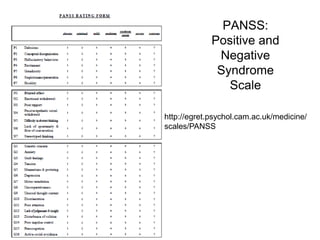
PANSS:
Positive and
Negative
Syndrome
Scale
http://egret.psychol.cam.ac.uk/medicine/
scales/PANSS
The Mini Mental State Examination (MMSE)
Permission is hereby granted to reproduce this
material for not-for-profit educational purposes only,
provided
The Hartford Institute for Geriatric Nursing, Division of
Nursing, New York University is cited as the source.
Available on the internet at www.hartfordign.org. E-mail
notification of usage to: hartford.ign@nyu.edu.
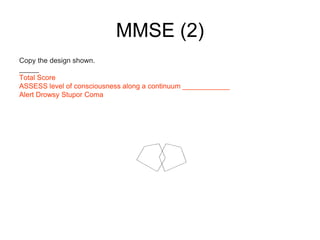
MMSE (2)
Copy the design shown.
_____
Total Score
ASSESS level of consciousness along a continuum ____________
Alert Drowsy Stupor Coma
Clock test
Please draw a clock which shows quarter to 3.
Diagnostic Manuals
• Diagnostic and Statistical Manual of Mental
Disorders, (5th Edition 2013) – DSM-5,
American Psychiatric Association
• International Statistical Classification of
Diseases, Injuries and Causes of Death (10th
version - 1993) – ICD-10, World Health
Organization
History of DSM
• DSM I (1952)
– established mainly by psychoanalysts to
distinguish groups of psychoneurotic
disorders, such as anxiety.
– Interpretations of psychoneurotic disorders
were mainstream Freudian (defense
mechanisms).
– Discourses of ‘reactions’ predominated.
DSM II (1968)
• 1950’s - 1960’s - psychoanalysis still dominated.
Psychoneurotic problems became defined as
‘neurotic’ disturbances (e.g. hysteria)
• In 1973, homosexuality was removed, replaced
by ‘sexual orientation disturbance’
• There was little in the way of clear descriptions
of ‘disorders’. All ‘symptoms’ were defined as
‘symbolic’ (of unconscious processes)
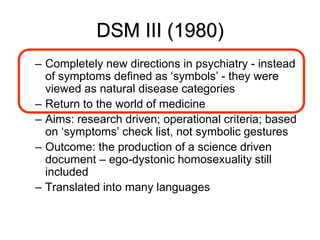
DSM III (1980)
– Completely new directions in psychiatry - instead
of symptoms defined as ‘symbols’ - they were
viewed as natural disease categories
– Return to the world of medicine
– Aims: research driven; operational criteria; based
on ‘symptoms’ check list, not symbolic gestures
– Outcome: the production of a science driven
document – ego-dystonic homosexuality still
included
– Translated into many languages
ICD – 11 in 2018?
• http://apps.who.int/classifications/icd11/bro
wse/f/en
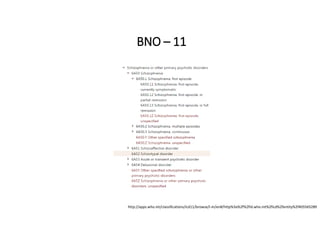
http://apps.who.int/classifications/icd11/browse/l-m/en#/http%3a%2f%2fid.who.int%2ficd%2fentity%2f405565289
BNO – 11
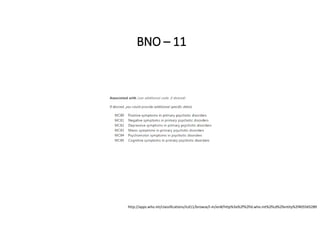
http://apps.who.int/classifications/icd11/browse/l-m/en#/http%3a%2f%2fid.who.int%2ficd%2fentity%2f405565289
BNO – 11
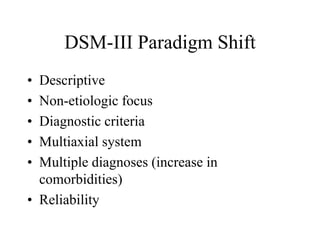
DSM-III Paradigm Shift
• Descriptive
• Non-etiologic focus
• Diagnostic criteria
• Multiaxial system
• Multiple diagnoses (increase in
comorbidities)
• Reliability
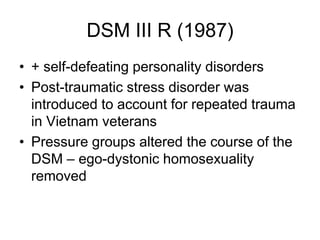
DSM III R (1987)
• + self-defeating personality disorders
• Post-traumatic stress disorder was
introduced to account for repeated trauma
in Vietnam veterans
• Pressure groups altered the course of the
DSM – ego-dystonic homosexuality
removed
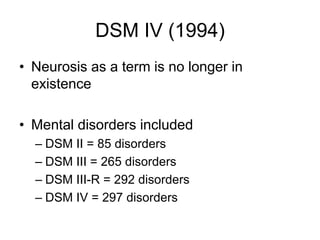
DSM IV (1994)
• Neurosis as a term is no longer in
existence
• Mental disorders included
– DSM II = 85 disorders
– DSM III = 265 disorders
– DSM III-R = 292 disorders
– DSM IV = 297 disorders
DSM-IV TR, 2000
• Minor changes
DSM-IV: Multi-Axial Classification System
• Axis I lists the majority of mental disorders.
• Axis II is reserved for persistent or chronic
conditions (e.g. personality disorders)
– The separation was intended to assure that
more chronic conditions are not overlooked.
• Axis III is designed to present general
medical information
DSM-IV: Multi-Axial
Classification System
• Axis IV is designed to present specific
information about the client’s current
psychosocial environment.
– A number of global categories of problems
are suggested in the DSM text.
– Practitioners are encouraged to include
specific information on Axis IV in addition to
such global characterizations.
Multi-Axial Classification System
• Global Assessment Functioning (GAF) score is
listed on Axis V.
– This 100-point scale is presented in DSM-IV.
– In some situations, an individual’s functioning can be
at very different levels depending on which aspect is
emphasized.
– It is recommended that in those instances, the client’s
potential for danger to self or others should take
precedence in determining the GAF score.
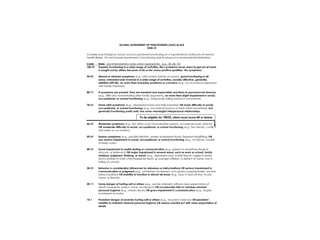
Global Assessment of
Functioning Scale
GAF – DSM IV
Copyright protected
DSM-5, 2013
• Controversies about both the process of
creating DSM-5 and about its content as
well.
• Two out of the major challengers:
– 1. Thomas Insel, Director of the National
Institute of Mental Health
– 2. Allan Frances, Chair of the DSM-IV Task
Force of the American Psychiatric Association
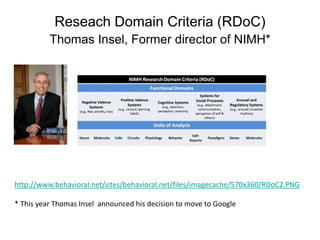
Reseach Domain Criteria (RDoC)
Thomas Insel, Former director of NIMH*
http://www.behavioral.net/sites/behavioral.net/files/imagecache/570x360/RDoC2.PNG
* This year Thomas Insel announced his decision to move to Google
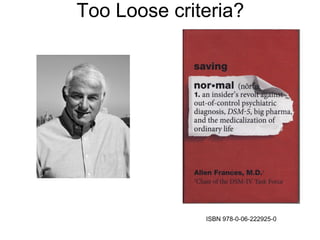
Too Loose criteria?
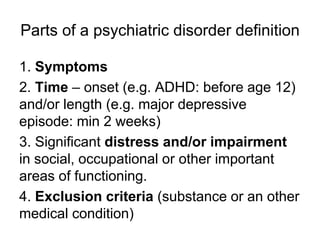
Parts of a psychiatric disorder definition
1. Symptoms
2. Time – onset (e.g. ADHD: before age 12)
and/or length (e.g. major depressive
episode: min 2 weeks)
3. Significant distress and/or impairment
in social, occupational or other important
areas of functioning.
4. Exclusion criteria (substance or an other
medical condition)
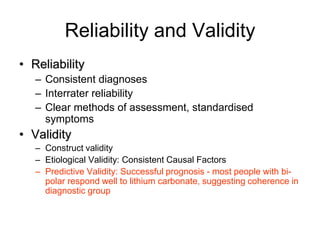
Reliability and Validity
• Reliability
– Consistent diagnoses
– Interrater reliability
– Clear methods of assessment, standardised
symptoms
• Validity
– Construct validity
– Etiological Validity: Consistent Causal Factors
– Predictive Validity: Successful prognosis - most people with bi-
polar respond well to lithium carbonate, suggesting coherence in
diagnostic group
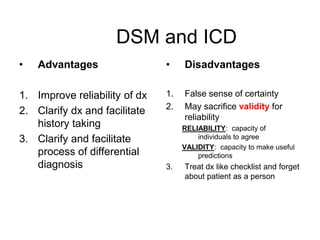
DSM and ICD
• Advantages
1. Improve reliability of dx
2. Clarify dx and facilitate
history taking
3. Clarify and facilitate
process of differential
diagnosis
• Disadvantages
1. False sense of certainty
2. May sacrifice validity for
reliability
RELIABILITY: capacity of
individuals to agree
VALIDITY: capacity to make useful
predictions
3. Treat dx like checklist and forget
about patient as a person

Engl classification-md

  • 1.
  • 2.
    Purpose of Diagnosisin Psychiatry 1. Order and Structure 2. Communication 3. Predict Outcome 4. Decide Appropriate Treatment 5. Research: Assist in the search for pathophysiology and etiology
  • 3.
    Procedural considerations for Assessment •Classification and diagnosis usually follow clinical interviewing to determine diagnosis – A diagnostic interview is the most widely used assessment tool in clinical psychiatry.
  • 4.
    Assessments • Psychological: – Clinicalinterviews and reports – Tests (psychological incl. neuropsychological) • Biological: – Scanning brain function (e.g. CT, CT, MRI, fMRI, EEG, PET) – Neurochemical – Genetic – Psychohysiological measures
  • 5.
    Components of Psychiatric Assessment •Identifying data • Chief Complaint • History of Present Illness • Past Psychiatric History • Past Medical History • Family History • Social History • Mental Status Exam • Assessment: Main diagnosis and comorbidities (psychiatric and somatic)
  • 6.
    Mental status examinationincl. – General appearance – Consciousness – Orientation – Speech and thought (speed, content) – Perception – Mood – Anxiety – Attention/concentration – Memory – Insight and judgement – Intelligence/higher intellectual functioning – Suicidality
  • 7.
    General Appearance and Behavior •Describe appearance/behavior • Grooming, hygiene, facial expressions • Jewelry, tattoos, • Attitude towards examiner • Does pt look stated age?
  • 8.
    Psychomotor Activity • Posture •Describe motor activity • Does s/he seat quietly or agitated? • Note abnormal movements – Tics – EPS (extrapyramidal symptoms) – mannerisms – catatonia – TD (tardive dyskinesia)
  • 9.
    Speech • Note patient’sspeech – RRR (regular in rate and rhythm) – Pressured, slow, normal – Loud, soft – Poverty of speech/content of speech – Latent – Echolalia – Aphasia
  • 10.
    Thought Form • Describethought process—this is inferred by pattern of speech – Slow vs. fast – Logical and goal directed – Concrete – Preservative – Circumstantial, tangential – Thought blocking
  • 11.
    Thought Content • DescribeContent of Thought – Delusions – Ideas of Reference – Obsessions and Compulsions – Phobia – Distorted body image – Poverty of content – Passive death wish – Suicidal/Self Harm/Homicidal Ideation
  • 12.
    Mood • Mood isan emotional attitude that is relatively sustained (based on patient’s report) – Euthymic – Depressed – Hyperthymic (English: euphoric – however „phoria” is not aequivalent to „thymia” . Which is mood!) – Irritable (mixed states – suicidality!)
  • 13.
    Affect • Affect refersto way pt conveys her/his emotional state (based on observation) – Appropriate vs inappropriate – Full – blunted – flat
  • 14.
    Sensorium and Cognition1. • Mini Mental Status Exam covers most of the components • Describe level of alertness • Orientation (time, space, self and others) • Memory – Very short term: repeat 3 items – Short term: recall 3 items – Long term: events that occurred in past
  • 15.
    Sensorium and Cognitive Function2. • General Information – List 5 past presidents, current events • Calculations • Serial 7’s vs 3’s, spell WORLD backwards • Capacity to Read and Write • Read text, write a sentence • Visuospatial Ability – Copy design • Proverbs
  • 16.
    Insight and Judgment •Insight: does the patient understand her/his illness, the need for treatment? • Judgment: does the person make good choices?
  • 17.
    PANSS: Positive and NegativeSyndrome Scale • Copyright protected
  • 18.
  • 19.
    The Mini MentalState Examination (MMSE) Permission is hereby granted to reproduce this material for not-for-profit educational purposes only, provided The Hartford Institute for Geriatric Nursing, Division of Nursing, New York University is cited as the source. Available on the internet at www.hartfordign.org. E-mail notification of usage to: hartford.ign@nyu.edu.
  • 20.
    MMSE (2) Copy thedesign shown. _____ Total Score ASSESS level of consciousness along a continuum ____________ Alert Drowsy Stupor Coma
  • 21.
    Clock test Please drawa clock which shows quarter to 3.
  • 22.
    Diagnostic Manuals • Diagnosticand Statistical Manual of Mental Disorders, (5th Edition 2013) – DSM-5, American Psychiatric Association • International Statistical Classification of Diseases, Injuries and Causes of Death (10th version - 1993) – ICD-10, World Health Organization
  • 23.
    History of DSM •DSM I (1952) – established mainly by psychoanalysts to distinguish groups of psychoneurotic disorders, such as anxiety. – Interpretations of psychoneurotic disorders were mainstream Freudian (defense mechanisms). – Discourses of ‘reactions’ predominated.
  • 24.
    DSM II (1968) •1950’s - 1960’s - psychoanalysis still dominated. Psychoneurotic problems became defined as ‘neurotic’ disturbances (e.g. hysteria) • In 1973, homosexuality was removed, replaced by ‘sexual orientation disturbance’ • There was little in the way of clear descriptions of ‘disorders’. All ‘symptoms’ were defined as ‘symbolic’ (of unconscious processes)
  • 25.
    DSM III (1980) –Completely new directions in psychiatry - instead of symptoms defined as ‘symbols’ - they were viewed as natural disease categories – Return to the world of medicine – Aims: research driven; operational criteria; based on ‘symptoms’ check list, not symbolic gestures – Outcome: the production of a science driven document – ego-dystonic homosexuality still included – Translated into many languages
  • 26.
    ICD – 11in 2018? • http://apps.who.int/classifications/icd11/bro wse/f/en
  • 27.
  • 28.
  • 29.
    DSM-III Paradigm Shift •Descriptive • Non-etiologic focus • Diagnostic criteria • Multiaxial system • Multiple diagnoses (increase in comorbidities) • Reliability
  • 30.
    DSM III R(1987) • + self-defeating personality disorders • Post-traumatic stress disorder was introduced to account for repeated trauma in Vietnam veterans • Pressure groups altered the course of the DSM – ego-dystonic homosexuality removed
  • 31.
    DSM IV (1994) •Neurosis as a term is no longer in existence • Mental disorders included – DSM II = 85 disorders – DSM III = 265 disorders – DSM III-R = 292 disorders – DSM IV = 297 disorders
  • 32.
    DSM-IV TR, 2000 •Minor changes
  • 33.
    DSM-IV: Multi-Axial ClassificationSystem • Axis I lists the majority of mental disorders. • Axis II is reserved for persistent or chronic conditions (e.g. personality disorders) – The separation was intended to assure that more chronic conditions are not overlooked. • Axis III is designed to present general medical information
  • 34.
    DSM-IV: Multi-Axial Classification System •Axis IV is designed to present specific information about the client’s current psychosocial environment. – A number of global categories of problems are suggested in the DSM text. – Practitioners are encouraged to include specific information on Axis IV in addition to such global characterizations.
  • 35.
    Multi-Axial Classification System •Global Assessment Functioning (GAF) score is listed on Axis V. – This 100-point scale is presented in DSM-IV. – In some situations, an individual’s functioning can be at very different levels depending on which aspect is emphasized. – It is recommended that in those instances, the client’s potential for danger to self or others should take precedence in determining the GAF score.
  • 36.
    Global Assessment of FunctioningScale GAF – DSM IV Copyright protected
  • 38.
    DSM-5, 2013 • Controversiesabout both the process of creating DSM-5 and about its content as well. • Two out of the major challengers: – 1. Thomas Insel, Director of the National Institute of Mental Health – 2. Allan Frances, Chair of the DSM-IV Task Force of the American Psychiatric Association
  • 39.
    Reseach Domain Criteria(RDoC) Thomas Insel, Former director of NIMH* http://www.behavioral.net/sites/behavioral.net/files/imagecache/570x360/RDoC2.PNG * This year Thomas Insel announced his decision to move to Google
  • 40.
  • 41.
    Parts of apsychiatric disorder definition 1. Symptoms 2. Time – onset (e.g. ADHD: before age 12) and/or length (e.g. major depressive episode: min 2 weeks) 3. Significant distress and/or impairment in social, occupational or other important areas of functioning. 4. Exclusion criteria (substance or an other medical condition)
  • 42.
    Reliability and Validity •Reliability – Consistent diagnoses – Interrater reliability – Clear methods of assessment, standardised symptoms • Validity – Construct validity – Etiological Validity: Consistent Causal Factors – Predictive Validity: Successful prognosis - most people with bi- polar respond well to lithium carbonate, suggesting coherence in diagnostic group
  • 43.
    DSM and ICD •Advantages 1. Improve reliability of dx 2. Clarify dx and facilitate history taking 3. Clarify and facilitate process of differential diagnosis • Disadvantages 1. False sense of certainty 2. May sacrifice validity for reliability RELIABILITY: capacity of individuals to agree VALIDITY: capacity to make useful predictions 3. Treat dx like checklist and forget about patient as a person