Crafting a Successful
Engineering Career
- Asankhaya Sharma
Engineering as a Career
• What is your Goal in life ?
• Why did you join Engineering ?
Some reasons for joining Engineering
• “Parents wanted me to be an engineer”
• “After 12th either you become doctor or Engineer I was
not cut out for doctor so I choose engineering . Nor did
I want to do BSc.”
• Challenges, Curiosity, Excitement
• Money, Travel, Status
• To make a difference in the world, to change the way
things work
• Want a job in big company
• “I want to start something of my own
(entrepreneurship)”
How do YOU define Success ?
• Do you want to get rich ?
• Do you just want a job with decent pay ?
• Do you want to change the world ?
• You may go 10-20 years without answering
these questions but eventually you have to
• Set yourself for Success according to your own
metrics from the start
No one formula for Success
• Engineering is a field that requires many
people with different skills to work together to
solve complex problems in a simple way.
• Like best engineering problems, there’s no
single algorithm to follow
– But there are “Best Practices”
– There are Things To Avoid
• Do not make all mistakes yourself
– Learning from other’s errors is much better
Getting Started
• What are you passionate about? Do that.
– Mere competence will never trump real passion
– Match your skills, interest to what world wants
• Your answers will change with time
– Let career evolve
– You can find career value in any job
• Just do outstanding work no matter the task
• It is mostly the choice you make not talent or IQ
Which Job to Take ?
• Look 20 years out & place your career as a bet
– Which technologies or business domains are most
powerful/promising?
– Biotech, IT, Clean Energy, Health Care, Telecom,
Micro Finance
• Which line up with your personal belief
system?
– Defense, medicine, consumer, corporate,
academia
Startups v/s Big Corporates
• Good idea to do both over course of your career
• Startups are easier when you’re young
– More time, more energy, less to lose
– Startups can sometimes change world explosively
• But most fail
• Less overall stability
• Big companies have more opportunities to change world
incrementally
– Remember that those increments can add up over time
– More stable, but sometimes that also means boring
• Both can be exhilarating, and both can be very frustrating
Getting Hired
• Where to work
– Weight these factors heavily:
• Do you believe in the mission
• How outstanding is the team
• How well-run is the company
• Would this position leverage your strengths yet
demand intellectual growth
• Geography, local culture, educational opportunities
• Then consider salary, bonuses, stock, benefits
Your First Job
• No matter what it is, become best in world at it
– Plan on 2-3 years to get really comfortable & productive
• Work as hard as you can
– You are setting your own reputation & trajectory
– Only Top Performers have choice of options for next
project
– Find mentors & role models (don’t struggle in silence)
• Don’t Let Your Team Down
– Know when to stand your ground v/s which battles aren’t
worth fighting
• Settle for nothing less than outstanding work.
@
Building your Career
• Focus on YOU
– Know your career path
• Individual Contributor v/s Management
– Technology changes rapidly, keep yourself
updated
• Look for trainings, attend workshops
• Focus on the Company
– Align your career to what the company cares
about
Building your Career - Resources
• Your Alma Matter – stay connected
• IEEE/ACM – Participate and Network
• Books – Read outside your specialty
• Balancing Work and Home
Getting Ahead in Your Job
• Communications = Influence = Promotions
– Writing
– Presentations
• Corporate/team culture
– Overpromising v/s over delivering
– Team play v/s getting what’s yours
– Detecting /avoiding burnout
– Use existing solutions where possible, innovate where
necessary
• Legal Stuff
– Take patents, IP very seriously; wording matters
Getting Ahead in Your Career
• Do outstanding work and trust that rewards
will follow
– How ?Work with people who do outstanding work
• Be visible outside your own company
– Good for company, good for industry, good for you
– Write papers, attend conferences, do peer reviews
– Be active in IEEE/ACM
Technical Leadership
• Take on hard challenging problems at work
• Be a go-to person
• Gain depth in technology / business domain at
your job
Leadership
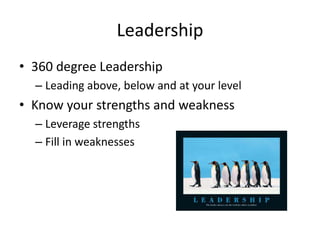
• 360 degree Leadership
– Leading above, below and at your level
• Know your strengths and weakness
– Leverage strengths
– Fill in weaknesses
Dealing with Failures
• If you never fail you aren’t trying hard enough
• Not all failures equally forgivable
– Well-conceived risks: good
• Learn from your failures
– Do not blame others
– Own up and take responsiblity
Education
• B.Tech, M.Tech/MBA, PhD
– PhD required for research
• Stay viable & current
– Ongoing education/training
– Go to conferences, monitor what universities are
working on
– IEEE membership & participation
• Review papers, submit papers, attend conferences, be
active in local organizations (networking & cont. educ.)
• Don’t give up your non-engineering interests
– They will inform your engineering
– They’ll keep you connected to the non-techie world
– They’ll keep you from burning out
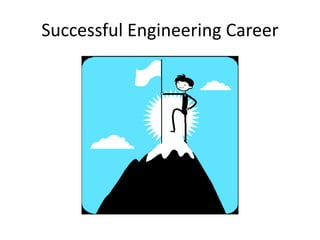
Successful Engineering Career
Thank You !
• Q & A
• Contact Info
– Twitter : @asankhaya
– Email : asankhaya@yahoo.com

CraftingaSuccessfulEngineeringCareer.ppt

  • 1.
    Crafting a Successful EngineeringCareer - Asankhaya Sharma
  • 2.
    Engineering as aCareer • What is your Goal in life ? • Why did you join Engineering ?
  • 3.
    Some reasons forjoining Engineering • “Parents wanted me to be an engineer” • “After 12th either you become doctor or Engineer I was not cut out for doctor so I choose engineering . Nor did I want to do BSc.” • Challenges, Curiosity, Excitement • Money, Travel, Status • To make a difference in the world, to change the way things work • Want a job in big company • “I want to start something of my own (entrepreneurship)”
  • 4.
    How do YOUdefine Success ? • Do you want to get rich ? • Do you just want a job with decent pay ? • Do you want to change the world ? • You may go 10-20 years without answering these questions but eventually you have to • Set yourself for Success according to your own metrics from the start
  • 5.
    No one formulafor Success • Engineering is a field that requires many people with different skills to work together to solve complex problems in a simple way. • Like best engineering problems, there’s no single algorithm to follow – But there are “Best Practices” – There are Things To Avoid • Do not make all mistakes yourself – Learning from other’s errors is much better
  • 6.
    Getting Started • Whatare you passionate about? Do that. – Mere competence will never trump real passion – Match your skills, interest to what world wants • Your answers will change with time – Let career evolve – You can find career value in any job • Just do outstanding work no matter the task • It is mostly the choice you make not talent or IQ
  • 7.
    Which Job toTake ? • Look 20 years out & place your career as a bet – Which technologies or business domains are most powerful/promising? – Biotech, IT, Clean Energy, Health Care, Telecom, Micro Finance • Which line up with your personal belief system? – Defense, medicine, consumer, corporate, academia
  • 8.
    Startups v/s BigCorporates • Good idea to do both over course of your career • Startups are easier when you’re young – More time, more energy, less to lose – Startups can sometimes change world explosively • But most fail • Less overall stability • Big companies have more opportunities to change world incrementally – Remember that those increments can add up over time – More stable, but sometimes that also means boring • Both can be exhilarating, and both can be very frustrating
  • 9.
    Getting Hired • Whereto work – Weight these factors heavily: • Do you believe in the mission • How outstanding is the team • How well-run is the company • Would this position leverage your strengths yet demand intellectual growth • Geography, local culture, educational opportunities • Then consider salary, bonuses, stock, benefits
  • 10.
    Your First Job •No matter what it is, become best in world at it – Plan on 2-3 years to get really comfortable & productive • Work as hard as you can – You are setting your own reputation & trajectory – Only Top Performers have choice of options for next project – Find mentors & role models (don’t struggle in silence) • Don’t Let Your Team Down – Know when to stand your ground v/s which battles aren’t worth fighting • Settle for nothing less than outstanding work. @
  • 11.
    Building your Career •Focus on YOU – Know your career path • Individual Contributor v/s Management – Technology changes rapidly, keep yourself updated • Look for trainings, attend workshops • Focus on the Company – Align your career to what the company cares about
  • 12.
    Building your Career- Resources • Your Alma Matter – stay connected • IEEE/ACM – Participate and Network • Books – Read outside your specialty • Balancing Work and Home
  • 13.
    Getting Ahead inYour Job • Communications = Influence = Promotions – Writing – Presentations • Corporate/team culture – Overpromising v/s over delivering – Team play v/s getting what’s yours – Detecting /avoiding burnout – Use existing solutions where possible, innovate where necessary • Legal Stuff – Take patents, IP very seriously; wording matters
  • 14.
    Getting Ahead inYour Career • Do outstanding work and trust that rewards will follow – How ?Work with people who do outstanding work • Be visible outside your own company – Good for company, good for industry, good for you – Write papers, attend conferences, do peer reviews – Be active in IEEE/ACM
  • 15.
    Technical Leadership • Takeon hard challenging problems at work • Be a go-to person • Gain depth in technology / business domain at your job
  • 16.
    Leadership • 360 degreeLeadership – Leading above, below and at your level • Know your strengths and weakness – Leverage strengths – Fill in weaknesses
  • 17.
    Dealing with Failures •If you never fail you aren’t trying hard enough • Not all failures equally forgivable – Well-conceived risks: good • Learn from your failures – Do not blame others – Own up and take responsiblity
  • 18.
    Education • B.Tech, M.Tech/MBA,PhD – PhD required for research • Stay viable & current – Ongoing education/training – Go to conferences, monitor what universities are working on – IEEE membership & participation • Review papers, submit papers, attend conferences, be active in local organizations (networking & cont. educ.) • Don’t give up your non-engineering interests – They will inform your engineering – They’ll keep you connected to the non-techie world – They’ll keep you from burning out
  • 19.
  • 20.
    Thank You ! •Q & A • Contact Info – Twitter : @asankhaya – Email : asankhaya@yahoo.com