Wave Optics: Chapter 3-
Polarization
D R . M . A . S U T A R - D Y P C O E
1
• Fundamentals of Polarization
• Law of Malus
• Double Refraction (Birefringence)
• Application-LCD
Session 1-Polarization
D R . M . A . S U T A R - D Y P C O E
2
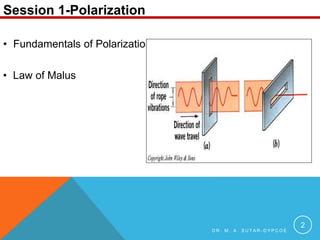
• Fundamentals of Polarization
• Law of Malus
Concepts to be Recalled
D R . M . A . S U T A R - D Y P C O E
3
• Concept of wave and direction of vibration
• Resolution of vector along X and Y axis
Objectives:
D R . M . A . S U T A R - D Y P C O E
4
At the end of this session, you will be able to:
• Concept of polarization and compare Un-polarized light and polarized
light.
• Discriminate among PPL, CPL, EPL
• Describe Law of Malus
D R . M . A . S U T A R - D Y P C O E 5
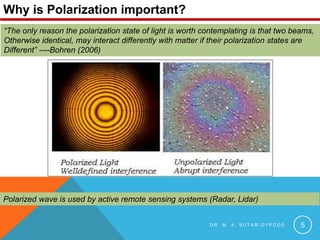
Why is Polarization important?
“The only reason the polarization state of light is worth contemplating is that two beams,
Otherwise identical, may interact differently with matter if their polarization states are
Different” ----Bohren (2006)
Polarized wave is used by active remote sensing systems (Radar, Lidar)
D R . M . A . S U T A R - D Y P C O E 6
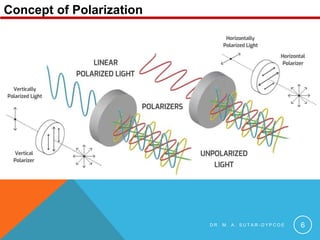
Concept of Polarization
D R . M . A . S U T A R - D Y P C O E 7
Plane Polarized light- (Vertically
Polarized)
D R . M . A . S U T A R - D Y P C O E 8
Types of Polarization
Light
Unpolarized
Polarized
Plane
Polarized
Circularly
Polarized
Elliptically
Polarized
D R . M . A . S U T A R - D Y P C O E 9
• Unpolarized light (UPL)
– Natural light is generally unpolarized, all planes of propagation being equally
probable
Types of Polarization
D R . M . A . S U T A R - D Y P C O E 10
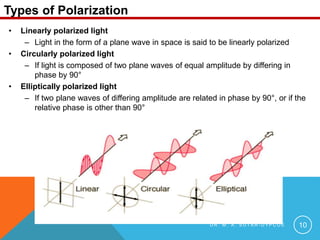
• Linearly polarized light
– Light in the form of a plane wave in space is said to be linearly polarized
• Circularly polarized light
– If light is composed of two plane waves of equal amplitude by differing in
phase by 90°
• Elliptically polarized light
– If two plane waves of differing amplitude are related in phase by 90°, or if the
relative phase is other than 90°
Types of Polarization
D R . M . A . S U T A R - D Y P C O E 11
Types of Polarization
Plane polarized light Elliptically polarized light
Circularly polarized light
In PPL vibrations are confined to one direction.
In UPL vibrations are in all possible directions.
D R . M . A . S U T A R - D Y P C O E
13
How to produce Polarized Light ?
UPL PPL PPL
Polariser Analyser
Analyser
Polariser
UPL PPL
No Light
I. Parallel Axes
II. Perpendicular Axes
Max. Light
D R . M . A . S U T A R - D Y P C O E 14
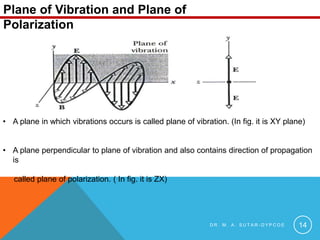
Plane of Vibration and Plane of
Polarization
• A plane in which vibrations occurs is called plane of vibration. (In fig. it is XY plane)
• A plane perpendicular to plane of vibration and also contains direction of propagation
is
called plane of polarization. ( In fig. it is ZX)
D R . M . A . S U T A R - D Y P C O E
15
Law of Malus
Polariser
Analyser
Em=Amplitude of PPL incident on analyzer
E= Amplitude of PPL emerging from analyzer
θ= Angle between plane of transmission of polarizer and analyzer
Component of PPL along axis of Analyzer is, Emcosθ which will be emerging out.
𝐸 = 𝐸𝑚𝑐𝑜𝑠𝜃
Intensity is, I=E2
𝐼 = 𝐼𝑚𝑐𝑜𝑠2𝜃
Analyser
Polariser
UPL PPL
Em
E
θ
Em
Emcosθ
I α cos2θ
This is Law of Malus
Emsinθ
D R . M . A . S U T A R - D Y P C O E 16
Summary
• Polarized light has unidirectional vibrations
• For well-defined analysis of Interference or diffraction pattern polarized light is
must.
• Polarizer is used to produce the PPL and analyzer is used to test whether the light
is UPL or PPL.
• When transmission planes of both polarizer and analyzer are parallel to each other
then full light will be transmitted through the analyzer. However, if we keep on
rotating analyzer, the intensity of the emerging light gradually decreases and
becomes zero when angle reaches to 90o.
• Law of Malus states that intensity of emerging polarized light is proportional to
square of cosine of angle between axes of polarizer and anayzer.

Engineering physics polarization topic 1

  • 1.
    Wave Optics: Chapter3- Polarization D R . M . A . S U T A R - D Y P C O E 1 • Fundamentals of Polarization • Law of Malus • Double Refraction (Birefringence) • Application-LCD
  • 2.
    Session 1-Polarization D R. M . A . S U T A R - D Y P C O E 2 • Fundamentals of Polarization • Law of Malus
  • 3.
    Concepts to beRecalled D R . M . A . S U T A R - D Y P C O E 3 • Concept of wave and direction of vibration • Resolution of vector along X and Y axis
  • 4.
    Objectives: D R .M . A . S U T A R - D Y P C O E 4 At the end of this session, you will be able to: • Concept of polarization and compare Un-polarized light and polarized light. • Discriminate among PPL, CPL, EPL • Describe Law of Malus
  • 5.
    D R .M . A . S U T A R - D Y P C O E 5 Why is Polarization important? “The only reason the polarization state of light is worth contemplating is that two beams, Otherwise identical, may interact differently with matter if their polarization states are Different” ----Bohren (2006) Polarized wave is used by active remote sensing systems (Radar, Lidar)
  • 6.
    D R .M . A . S U T A R - D Y P C O E 6 Concept of Polarization
  • 7.
    D R .M . A . S U T A R - D Y P C O E 7 Plane Polarized light- (Vertically Polarized)
  • 8.
    D R .M . A . S U T A R - D Y P C O E 8 Types of Polarization Light Unpolarized Polarized Plane Polarized Circularly Polarized Elliptically Polarized
  • 9.
    D R .M . A . S U T A R - D Y P C O E 9 • Unpolarized light (UPL) – Natural light is generally unpolarized, all planes of propagation being equally probable Types of Polarization
  • 10.
    D R .M . A . S U T A R - D Y P C O E 10 • Linearly polarized light – Light in the form of a plane wave in space is said to be linearly polarized • Circularly polarized light – If light is composed of two plane waves of equal amplitude by differing in phase by 90° • Elliptically polarized light – If two plane waves of differing amplitude are related in phase by 90°, or if the relative phase is other than 90° Types of Polarization
  • 11.
    D R .M . A . S U T A R - D Y P C O E 11 Types of Polarization Plane polarized light Elliptically polarized light Circularly polarized light
  • 12.
    In PPL vibrationsare confined to one direction. In UPL vibrations are in all possible directions.
  • 13.
    D R .M . A . S U T A R - D Y P C O E 13 How to produce Polarized Light ? UPL PPL PPL Polariser Analyser Analyser Polariser UPL PPL No Light I. Parallel Axes II. Perpendicular Axes Max. Light
  • 14.
    D R .M . A . S U T A R - D Y P C O E 14 Plane of Vibration and Plane of Polarization • A plane in which vibrations occurs is called plane of vibration. (In fig. it is XY plane) • A plane perpendicular to plane of vibration and also contains direction of propagation is called plane of polarization. ( In fig. it is ZX)
  • 15.
    D R .M . A . S U T A R - D Y P C O E 15 Law of Malus Polariser Analyser Em=Amplitude of PPL incident on analyzer E= Amplitude of PPL emerging from analyzer θ= Angle between plane of transmission of polarizer and analyzer Component of PPL along axis of Analyzer is, Emcosθ which will be emerging out. 𝐸 = 𝐸𝑚𝑐𝑜𝑠𝜃 Intensity is, I=E2 𝐼 = 𝐼𝑚𝑐𝑜𝑠2𝜃 Analyser Polariser UPL PPL Em E θ Em Emcosθ I α cos2θ This is Law of Malus Emsinθ
  • 16.
    D R .M . A . S U T A R - D Y P C O E 16 Summary • Polarized light has unidirectional vibrations • For well-defined analysis of Interference or diffraction pattern polarized light is must. • Polarizer is used to produce the PPL and analyzer is used to test whether the light is UPL or PPL. • When transmission planes of both polarizer and analyzer are parallel to each other then full light will be transmitted through the analyzer. However, if we keep on rotating analyzer, the intensity of the emerging light gradually decreases and becomes zero when angle reaches to 90o. • Law of Malus states that intensity of emerging polarized light is proportional to square of cosine of angle between axes of polarizer and anayzer.