Motion in Two and Three
Dimensions
Chapter 4
Copyright © 2014 John Wiley & Sons, Inc. All rights reserved.
4-1 Position and Displacement
4.01 Draw two-dimensional
and three-dimensional
position vectors for a particle,
indicating the components
along the axes of a
coordinate system.
4.02 On a coordinate system,
determine the direction and
magnitude of a particle's
position vector from its
components, and vice versa.
4.03 Apply the relationship
between a particle's
displacement vector and its
initial and final position
vectors.
Learning Objectives
© 2014 John Wiley & Sons, Inc. All rights reserved.
4-1 Position and Displacement
 A position vector locates a particle in space
o Extends from a reference point (origin) to the particle
Example
o Position vector (-3m, 2m, 5m)
Eq. (4-1)
Figure 4-1
© 2014 John Wiley & Sons, Inc. All rights reserved.
4-1 Position and Displacement
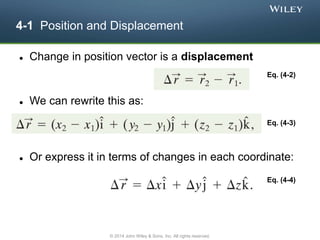
 Change in position vector is a displacement
 We can rewrite this as:
 Or express it in terms of changes in each coordinate:
Eq. (4-2)
Eq. (4-3)
Eq. (4-4)
© 2014 John Wiley & Sons, Inc. All rights reserved.
4-2 Average Velocity and Instantaneous Velocity
4.04 Identify that velocity is a
vector quantity and thus has
both magnitude and direction
and also has components.
4.05 Draw two-dimensional
and three-dimensional
velocity vectors for a particle,
indicating the components
along the axes of the
coordinate system.
4.06 In magnitude-angle and
unit-vector notations, relate a
particle's initial and final
position vectors, the time
interval between those
positions, and the particle’s
average velocity vector.
4.07 Given a particle’s position
vector as a function of time,
determine its (instantaneous)
velocity vector.
Learning Objectives
© 2014 John Wiley & Sons, Inc. All rights reserved.
4-2 Average Velocity and Instantaneous Velocity
 Average velocity is
o A displacement divided by its time interval
 We can write this in component form:
Example
o A particle moves through displacement (12 m)i + (3.0 m)k in
2.0 s:
Eq. (4-8)
Eq. (4-9)
© 2014 John Wiley & Sons, Inc. All rights reserved.
4-2 Average Velocity and Instantaneous Velocity
 Instantaneous velocity is
o The velocity of a particle at a single point in time
o The limit of avg. velocity
as the time interval shrinks to 0
 Visualize displacement and instantaneous velocity:
Eq. (4-10)
Figure 4-4
Figure 4-3
© 2014 John Wiley & Sons, Inc. All rights reserved.
4-2 Average Velocity and Instantaneous Velocity
 In unit-vector form, we write:
 Which can also be written:
 Note: a velocity vector does not extend from one point
to another, only shows direction and magnitude
Eq. (4-11)
Eq. (4-12)
© 2014 John Wiley & Sons, Inc. All rights reserved.
4-2 Average Velocity and Instantaneous Velocity
Answer: (a) Quadrant I (b) Quadrant III
© 2014 John Wiley & Sons, Inc. All rights reserved.
4-3 Average Acceleration and Instantaneous
Acceleration
4.08 Identify that acceleration
is a vector quantity, and thus
has both magnitude and
direction.
4.09 Draw two-dimensional
and three-dimensional
acceleration vectors for a
particle, indicating the
components.
4.10 Given the initial and final
velocity vectors of a particle
and the time interval,
determine the average
acceleration vector.
4.11 Given a particle's velocity
vector as a function of time,
determine its (instantaneous)
acceleration vector.
4.12 For each dimension of
motion, apply the constant-
acceleration equations
(Chapter 2) to relate
acceleration, velocity,
position, and time.
Learning Objectives
© 2014 John Wiley & Sons, Inc. All rights reserved.
4-3 Average Acceleration and Instantaneous
Acceleration
 Average acceleration is
o A change in velocity divided by its time interval
 Instantaneous acceleration is again the limit t → 0:
 We can write Eq. 4-16 in unit-vector form:
Eq. (4-15)
Eq. (4-16)
© 2014 John Wiley & Sons, Inc. All rights reserved.
4-3 Average Acceleration and Instantaneous
Acceleration
 We can rewrite as:
 To get the components of acceleration, we differentiate
the components of velocity with respect to time
Eq. (4-17)
Eq. (4-18)
Figure 4-6
© 2014 John Wiley & Sons, Inc. All rights reserved.
4-3 Average Acceleration and Instantaneous
Acceleration
 Note: as with velocity, an acceleration vector does not
extend from one point to another, only shows direction
and magnitude
Answer: (1) x:yes, y:yes, a:yes (3) x:yes, y:yes, a:yes
(2) x:no, y:yes, a:no (4) x:no, y:yes, a:no
© 2014 John Wiley & Sons, Inc. All rights reserved.
4-4 Projectile Motion
4.13 On a sketch of the path
taken in projectile motion,
explain the magnitudes and
directions of the velocity and
acceleration components
during the flight.
4.14 Given the launch velocity
in either magnitude-angle or
unit-vector notation, calculate
the particle's position,
displacement, and velocity at
a given instant during the
flight.
4.15 Given data for an instant
during the flight, calculate the
launch velocity.
Learning Objectives
© 2014 John Wiley & Sons, Inc. All rights reserved.
4-4 Projectile Motion
 A projectile is
o A particle moving in the vertical plane
o With some initial velocity
o Whose acceleration is always free-fall acceleration (g)
 The motion of a projectile is projectile motion
 Launched with an initial velocity v0
Eq. (4-19)
Eq. (4-20)
© 2014 John Wiley & Sons, Inc. All rights reserved.
4-4 Projectile Motion
 Therefore we can decompose two-dimensional motion
into 2 one-dimensional problems
Figure 4-10
Answer: Yes. The y-velocity is negative, so the ball is now falling.
© 2014 John Wiley & Sons, Inc. All rights reserved.
4-4 Projectile Motion
 Horizontal motion:
o No acceleration, so velocity is constant (recall Eq. 2-15):
 Vertical motion:
o Acceleration is always -g (recall Eqs. 2-15, 2-11, 2-16):
Eq. (4-21)
Eq. (4-22)
Eq. (4-23)
Eq. (4-24)
© 2014 John Wiley & Sons, Inc. All rights reserved.
4-4 Projectile Motion
 The projectile's trajectory is
o Its path through space (traces a parabola)
o Found by eliminating time between Eqs. 4-21 and 4-22:
 The horizontal range is:
o The distance the projectile travels in x by the time it returns
to its initial height
Eq. (4-25)
Eq. (4-26)
© 2014 John Wiley & Sons, Inc. All rights reserved.
4-4 Projectile Motion
 In these calculations we assume air resistance is
negligible
 In many situations this is a poor assumption:
Table 4-1
Figure 4-13
© 2014 John Wiley & Sons, Inc. All rights reserved.
4-4 Projectile Motion
Answer: (a) is unchanged (b) decreases (becomes negative)
(c) 0 at all times (d) -g (-9.8 m/s2) at all times
© 2014 John Wiley & Sons, Inc. All rights reserved.
4-5 Uniform Circular Motion
4.16 Sketch the path taken in
uniform circular motion and
explain the velocity and
acceleration vectors
(magnitude and direction)
during the motion.
4.17 Apply the relationships
between the radius of the
circular path, the period, the
particle's speed, and the
particle's acceleration
magnitude.
Learning Objectives
© 2014 John Wiley & Sons, Inc. All rights reserved.
4-5 Uniform Circular Motion
 A particle is in uniform circular motion if
o It travels around a circle or circular arc
o At a constant speed
 Since the velocity changes, the particle is accelerating!
 Velocity and acceleration have:
o Constant magnitude
o Changing direction
Figure 4-16
© 2014 John Wiley & Sons, Inc. All rights reserved.
4-5 Uniform Circular Motion
 Acceleration is called centripetal acceleration
o Means “center seeking”
o Directed radially inward
 The period of revolution is:
o The time it takes for the particle go around the closed path
exactly once
Eq. (4-34)
Eq. (4-35)
© 2014 John Wiley & Sons, Inc. All rights reserved.
4-5 Uniform Circular Motion
Answer: (a) -(4 m/s)i (b) -(8 m/s2)j
© 2014 John Wiley & Sons, Inc. All rights reserved.
4-6 Relative Motion in One Dimension
4.18 Apply the relationship between a particle's position,
velocity, and acceleration as measured from two reference
frames that move relative to each other at a constant velocity
and along a single axis.
Learning Objectives
© 2014 John Wiley & Sons, Inc. All rights reserved.
4-6 Relative Motion in One Dimension
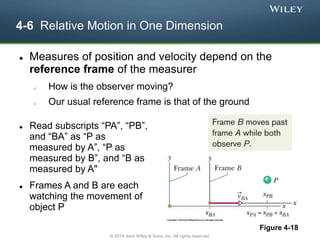
 Measures of position and velocity depend on the
reference frame of the measurer
o How is the observer moving?
o Our usual reference frame is that of the ground
Figure 4-18
 Read subscripts “PA”, “PB”,
and “BA” as “P as
measured by A”, “P as
measured by B”, and “B as
measured by A"
 Frames A and B are each
watching the movement of
object P
© 2014 John Wiley & Sons, Inc. All rights reserved.
4-6 Relative Motion in One Dimension
 Positions in different frames are related by:
 Taking the derivative, we see velocities are related by:
 But accelerations (for non-accelerating reference
frames, aBA = 0) are related by
Eq. (4-40)
Eq. (4-41)
Eq. (4-42)
© 2014 John Wiley & Sons, Inc. All rights reserved.
4-6 Relative Motion in One Dimension
Example
Frame A: x = 2 m, v = 4 m/s
Frame B: x = 3 m, v = -2 m/s
P as measured by A: xPA = 5 m, vPA = 2 m/s, a = 1 m/s2
So P as measured by B:
o xPB = xPA + xAB = 5 m + (2m – 3m) = 4 m
o vPB = vPA + vAB = 2 m/s + (4 m/s – -2m/s) = 8 m/s
o a = 1 m/s2
© 2014 John Wiley & Sons, Inc. All rights reserved.
4-7 Relative Motion in Two Dimensions
4.19 Apply the relationship between a particle's position,
velocity, and acceleration as measured from two reference
frames that move relative to each other at a constant velocity
and in two dimensions.
Learning Objectives
© 2014 John Wiley & Sons, Inc. All rights reserved.
4-7 Relative Motion in Two Dimensions
 The same as in one dimension, but now with vectors:
 Positions in different frames are related by:
 Velocities:
 Accelerations (for non-accelerating reference frames):
 Again, observers in different frames will see the same
acceleration
Eq. (4-43)
Eq. (4-44)
Eq. (4-45)
© 2014 John Wiley & Sons, Inc. All rights reserved.
4-7 Relative Motion in Two Dimensions
Figure 4-19
 Frames A and B are both observing the motion of P
© 2014 John Wiley & Sons, Inc. All rights reserved.
Position Vector
 Locates a particle in 3-space
Displacement
 Change in position vector
Average and
Instantaneous Accel.
Average and
Instantaneous Velocity
Eq. (4-2)
Eq. (4-8) Eq. (4-15)
4 Summary
Eq. (4-1)
Eq. (4-3)
Eq. (4-4)
Eq. (4-10) Eq. (4-16)
© 2014 John Wiley & Sons, Inc. All rights reserved.
Projectile Motion
 Flight of particle subject only
to free-fall acceleration (g)
 Trajectory is parabolic path
 Horizontal range:
Uniform Circular Motion
 Magnitude of acceleration:
 Time to complete a circle:
Relative Motion
 For non-accelerating reference
frames
Eq. (4-34)
Eq. (4-44)
4 Summary
Eq. (4-22)
Eq. (4-23)
Eq. (4-25)
Eq. (4-26)
Eq. (4-35)
Eq. (4-45)
© 2014 John Wiley & Sons, Inc. All rights reserved.
Problems
© 2014 John Wiley & Sons, Inc. All rights reserved.
Problems
1. A watermelon seed has the following coordinates: x = -5.0 m, y= -8.0 m, and z = 0 m. Find its
position vector (a) in unit-vector notation and as (b) a magnitude and (c) an angle relative to
the positive direction of the x axis. (d) Sketch the vector on a right-handed coordinate system.
If the seed is moved to the xyz coordinates (3.00 m, 0 m, 0 m), what is its displacement (e) in
unit-vector notation and as (f) a magnitude and (g) an angle relative to the positive x direction?
© 2014 John Wiley & Sons, Inc. All rights reserved.
Problems
© 2014 John Wiley & Sons, Inc. All rights reserved.
2. The minute hand of a wall clock measures 10 cm from its tip to the axis about which it rotates. The
magnitude and angle of the displacement vector of the tip are to be determined for three time
intervals. What are the (a) magnitude and (b) angle from a quarter after the hour to half past, the (c)
magnitude and (d) angle for the next half hour, and the (e) magnitude and (f) angle for the hour after
that?
Continue Problem 2
© 2014 John Wiley & Sons, Inc. All rights reserved.
Problems
3. The position vector 𝑟 = 5𝑡𝑖 + 𝑒𝑡 + 𝑓𝑡2
𝑗 locates a particle as a function of time t. Vector is in meters, t is
in seconds, and factors e and f are constants. Fig. gives the angle 𝜃 of the particle’s direction of travel as a
function of t (𝜃 is measured from the positive x direction). What are (a) e and (b) f, including units?
Problems
4. A particle moves so that its position (in meters) as a function of time (in seconds) is 𝒓 = 𝒊 + 𝟒𝒕𝟐
𝒋 + 𝒕𝒋.
Write expression for (a) its velocity and (b) its acceleration as functions of time.
Problems
5. A particle leaves the origin with an initial velocity 𝒗 = 𝟑𝒊 𝒎/𝒔 and a constant
acceleration 𝒂 = −𝟏𝒊 − 𝟓𝒋 𝒎/𝒔𝟐 When it reaches its maximum x coordinate, what are
its (a) velocity and (b) position vector?
Solution: Given the initial velocity and acceleration of a particle, we’re interested in finding its
velocity and position at a later time
Problems
© 2014 John Wiley & Sons, Inc. All rights reserved.
Problems
6. The velocity 𝒗 of a particle moving in the xy plane is given by 𝒗 = 𝟔𝐭 − 𝟒𝒕𝟐
𝒊 + 𝟖𝒋 with 𝒗
in meters per second and 𝒕 > 𝟎 in seconds. (a) What is the acceleration when t=3.0 s? (b)
When (if ever) is the acceleration zero? (c) When (if ever) is the velocity zero? (d) When
(if ever) does the speed equal 10 m/s?
Problems
© 2014 John Wiley & Sons, Inc. All rights reserved.

Engineering Physics chapter ch04-10e.pptx

  • 1.
    Motion in Twoand Three Dimensions Chapter 4 Copyright © 2014 John Wiley & Sons, Inc. All rights reserved.
  • 2.
    4-1 Position andDisplacement 4.01 Draw two-dimensional and three-dimensional position vectors for a particle, indicating the components along the axes of a coordinate system. 4.02 On a coordinate system, determine the direction and magnitude of a particle's position vector from its components, and vice versa. 4.03 Apply the relationship between a particle's displacement vector and its initial and final position vectors. Learning Objectives © 2014 John Wiley & Sons, Inc. All rights reserved.
  • 3.
    4-1 Position andDisplacement  A position vector locates a particle in space o Extends from a reference point (origin) to the particle Example o Position vector (-3m, 2m, 5m) Eq. (4-1) Figure 4-1 © 2014 John Wiley & Sons, Inc. All rights reserved.
  • 4.
    4-1 Position andDisplacement  Change in position vector is a displacement  We can rewrite this as:  Or express it in terms of changes in each coordinate: Eq. (4-2) Eq. (4-3) Eq. (4-4) © 2014 John Wiley & Sons, Inc. All rights reserved.
  • 5.
    4-2 Average Velocityand Instantaneous Velocity 4.04 Identify that velocity is a vector quantity and thus has both magnitude and direction and also has components. 4.05 Draw two-dimensional and three-dimensional velocity vectors for a particle, indicating the components along the axes of the coordinate system. 4.06 In magnitude-angle and unit-vector notations, relate a particle's initial and final position vectors, the time interval between those positions, and the particle’s average velocity vector. 4.07 Given a particle’s position vector as a function of time, determine its (instantaneous) velocity vector. Learning Objectives © 2014 John Wiley & Sons, Inc. All rights reserved.
  • 6.
    4-2 Average Velocityand Instantaneous Velocity  Average velocity is o A displacement divided by its time interval  We can write this in component form: Example o A particle moves through displacement (12 m)i + (3.0 m)k in 2.0 s: Eq. (4-8) Eq. (4-9) © 2014 John Wiley & Sons, Inc. All rights reserved.
  • 7.
    4-2 Average Velocityand Instantaneous Velocity  Instantaneous velocity is o The velocity of a particle at a single point in time o The limit of avg. velocity as the time interval shrinks to 0  Visualize displacement and instantaneous velocity: Eq. (4-10) Figure 4-4 Figure 4-3 © 2014 John Wiley & Sons, Inc. All rights reserved.
  • 8.
    4-2 Average Velocityand Instantaneous Velocity  In unit-vector form, we write:  Which can also be written:  Note: a velocity vector does not extend from one point to another, only shows direction and magnitude Eq. (4-11) Eq. (4-12) © 2014 John Wiley & Sons, Inc. All rights reserved.
  • 9.
    4-2 Average Velocityand Instantaneous Velocity Answer: (a) Quadrant I (b) Quadrant III © 2014 John Wiley & Sons, Inc. All rights reserved.
  • 10.
    4-3 Average Accelerationand Instantaneous Acceleration 4.08 Identify that acceleration is a vector quantity, and thus has both magnitude and direction. 4.09 Draw two-dimensional and three-dimensional acceleration vectors for a particle, indicating the components. 4.10 Given the initial and final velocity vectors of a particle and the time interval, determine the average acceleration vector. 4.11 Given a particle's velocity vector as a function of time, determine its (instantaneous) acceleration vector. 4.12 For each dimension of motion, apply the constant- acceleration equations (Chapter 2) to relate acceleration, velocity, position, and time. Learning Objectives © 2014 John Wiley & Sons, Inc. All rights reserved.
  • 11.
    4-3 Average Accelerationand Instantaneous Acceleration  Average acceleration is o A change in velocity divided by its time interval  Instantaneous acceleration is again the limit t → 0:  We can write Eq. 4-16 in unit-vector form: Eq. (4-15) Eq. (4-16) © 2014 John Wiley & Sons, Inc. All rights reserved.
  • 12.
    4-3 Average Accelerationand Instantaneous Acceleration  We can rewrite as:  To get the components of acceleration, we differentiate the components of velocity with respect to time Eq. (4-17) Eq. (4-18) Figure 4-6 © 2014 John Wiley & Sons, Inc. All rights reserved.
  • 13.
    4-3 Average Accelerationand Instantaneous Acceleration  Note: as with velocity, an acceleration vector does not extend from one point to another, only shows direction and magnitude Answer: (1) x:yes, y:yes, a:yes (3) x:yes, y:yes, a:yes (2) x:no, y:yes, a:no (4) x:no, y:yes, a:no © 2014 John Wiley & Sons, Inc. All rights reserved.
  • 14.
    4-4 Projectile Motion 4.13On a sketch of the path taken in projectile motion, explain the magnitudes and directions of the velocity and acceleration components during the flight. 4.14 Given the launch velocity in either magnitude-angle or unit-vector notation, calculate the particle's position, displacement, and velocity at a given instant during the flight. 4.15 Given data for an instant during the flight, calculate the launch velocity. Learning Objectives © 2014 John Wiley & Sons, Inc. All rights reserved.
  • 15.
    4-4 Projectile Motion A projectile is o A particle moving in the vertical plane o With some initial velocity o Whose acceleration is always free-fall acceleration (g)  The motion of a projectile is projectile motion  Launched with an initial velocity v0 Eq. (4-19) Eq. (4-20) © 2014 John Wiley & Sons, Inc. All rights reserved.
  • 16.
    4-4 Projectile Motion Therefore we can decompose two-dimensional motion into 2 one-dimensional problems Figure 4-10 Answer: Yes. The y-velocity is negative, so the ball is now falling. © 2014 John Wiley & Sons, Inc. All rights reserved.
  • 17.
    4-4 Projectile Motion Horizontal motion: o No acceleration, so velocity is constant (recall Eq. 2-15):  Vertical motion: o Acceleration is always -g (recall Eqs. 2-15, 2-11, 2-16): Eq. (4-21) Eq. (4-22) Eq. (4-23) Eq. (4-24) © 2014 John Wiley & Sons, Inc. All rights reserved.
  • 18.
    4-4 Projectile Motion The projectile's trajectory is o Its path through space (traces a parabola) o Found by eliminating time between Eqs. 4-21 and 4-22:  The horizontal range is: o The distance the projectile travels in x by the time it returns to its initial height Eq. (4-25) Eq. (4-26) © 2014 John Wiley & Sons, Inc. All rights reserved.
  • 19.
    4-4 Projectile Motion In these calculations we assume air resistance is negligible  In many situations this is a poor assumption: Table 4-1 Figure 4-13 © 2014 John Wiley & Sons, Inc. All rights reserved.
  • 20.
    4-4 Projectile Motion Answer:(a) is unchanged (b) decreases (becomes negative) (c) 0 at all times (d) -g (-9.8 m/s2) at all times © 2014 John Wiley & Sons, Inc. All rights reserved.
  • 21.
    4-5 Uniform CircularMotion 4.16 Sketch the path taken in uniform circular motion and explain the velocity and acceleration vectors (magnitude and direction) during the motion. 4.17 Apply the relationships between the radius of the circular path, the period, the particle's speed, and the particle's acceleration magnitude. Learning Objectives © 2014 John Wiley & Sons, Inc. All rights reserved.
  • 22.
    4-5 Uniform CircularMotion  A particle is in uniform circular motion if o It travels around a circle or circular arc o At a constant speed  Since the velocity changes, the particle is accelerating!  Velocity and acceleration have: o Constant magnitude o Changing direction Figure 4-16 © 2014 John Wiley & Sons, Inc. All rights reserved.
  • 23.
    4-5 Uniform CircularMotion  Acceleration is called centripetal acceleration o Means “center seeking” o Directed radially inward  The period of revolution is: o The time it takes for the particle go around the closed path exactly once Eq. (4-34) Eq. (4-35) © 2014 John Wiley & Sons, Inc. All rights reserved.
  • 24.
    4-5 Uniform CircularMotion Answer: (a) -(4 m/s)i (b) -(8 m/s2)j © 2014 John Wiley & Sons, Inc. All rights reserved.
  • 25.
    4-6 Relative Motionin One Dimension 4.18 Apply the relationship between a particle's position, velocity, and acceleration as measured from two reference frames that move relative to each other at a constant velocity and along a single axis. Learning Objectives © 2014 John Wiley & Sons, Inc. All rights reserved.
  • 26.
    4-6 Relative Motionin One Dimension  Measures of position and velocity depend on the reference frame of the measurer o How is the observer moving? o Our usual reference frame is that of the ground Figure 4-18  Read subscripts “PA”, “PB”, and “BA” as “P as measured by A”, “P as measured by B”, and “B as measured by A"  Frames A and B are each watching the movement of object P © 2014 John Wiley & Sons, Inc. All rights reserved.
  • 27.
    4-6 Relative Motionin One Dimension  Positions in different frames are related by:  Taking the derivative, we see velocities are related by:  But accelerations (for non-accelerating reference frames, aBA = 0) are related by Eq. (4-40) Eq. (4-41) Eq. (4-42) © 2014 John Wiley & Sons, Inc. All rights reserved.
  • 28.
    4-6 Relative Motionin One Dimension Example Frame A: x = 2 m, v = 4 m/s Frame B: x = 3 m, v = -2 m/s P as measured by A: xPA = 5 m, vPA = 2 m/s, a = 1 m/s2 So P as measured by B: o xPB = xPA + xAB = 5 m + (2m – 3m) = 4 m o vPB = vPA + vAB = 2 m/s + (4 m/s – -2m/s) = 8 m/s o a = 1 m/s2 © 2014 John Wiley & Sons, Inc. All rights reserved.
  • 29.
    4-7 Relative Motionin Two Dimensions 4.19 Apply the relationship between a particle's position, velocity, and acceleration as measured from two reference frames that move relative to each other at a constant velocity and in two dimensions. Learning Objectives © 2014 John Wiley & Sons, Inc. All rights reserved.
  • 30.
    4-7 Relative Motionin Two Dimensions  The same as in one dimension, but now with vectors:  Positions in different frames are related by:  Velocities:  Accelerations (for non-accelerating reference frames):  Again, observers in different frames will see the same acceleration Eq. (4-43) Eq. (4-44) Eq. (4-45) © 2014 John Wiley & Sons, Inc. All rights reserved.
  • 31.
    4-7 Relative Motionin Two Dimensions Figure 4-19  Frames A and B are both observing the motion of P © 2014 John Wiley & Sons, Inc. All rights reserved.
  • 32.
    Position Vector  Locatesa particle in 3-space Displacement  Change in position vector Average and Instantaneous Accel. Average and Instantaneous Velocity Eq. (4-2) Eq. (4-8) Eq. (4-15) 4 Summary Eq. (4-1) Eq. (4-3) Eq. (4-4) Eq. (4-10) Eq. (4-16) © 2014 John Wiley & Sons, Inc. All rights reserved.
  • 33.
    Projectile Motion  Flightof particle subject only to free-fall acceleration (g)  Trajectory is parabolic path  Horizontal range: Uniform Circular Motion  Magnitude of acceleration:  Time to complete a circle: Relative Motion  For non-accelerating reference frames Eq. (4-34) Eq. (4-44) 4 Summary Eq. (4-22) Eq. (4-23) Eq. (4-25) Eq. (4-26) Eq. (4-35) Eq. (4-45) © 2014 John Wiley & Sons, Inc. All rights reserved.
  • 34.
    Problems © 2014 JohnWiley & Sons, Inc. All rights reserved.
  • 35.
    Problems 1. A watermelonseed has the following coordinates: x = -5.0 m, y= -8.0 m, and z = 0 m. Find its position vector (a) in unit-vector notation and as (b) a magnitude and (c) an angle relative to the positive direction of the x axis. (d) Sketch the vector on a right-handed coordinate system. If the seed is moved to the xyz coordinates (3.00 m, 0 m, 0 m), what is its displacement (e) in unit-vector notation and as (f) a magnitude and (g) an angle relative to the positive x direction? © 2014 John Wiley & Sons, Inc. All rights reserved.
  • 36.
    Problems © 2014 JohnWiley & Sons, Inc. All rights reserved. 2. The minute hand of a wall clock measures 10 cm from its tip to the axis about which it rotates. The magnitude and angle of the displacement vector of the tip are to be determined for three time intervals. What are the (a) magnitude and (b) angle from a quarter after the hour to half past, the (c) magnitude and (d) angle for the next half hour, and the (e) magnitude and (f) angle for the hour after that?
  • 37.
    Continue Problem 2 ©2014 John Wiley & Sons, Inc. All rights reserved.
  • 38.
    Problems 3. The positionvector 𝑟 = 5𝑡𝑖 + 𝑒𝑡 + 𝑓𝑡2 𝑗 locates a particle as a function of time t. Vector is in meters, t is in seconds, and factors e and f are constants. Fig. gives the angle 𝜃 of the particle’s direction of travel as a function of t (𝜃 is measured from the positive x direction). What are (a) e and (b) f, including units?
  • 39.
    Problems 4. A particlemoves so that its position (in meters) as a function of time (in seconds) is 𝒓 = 𝒊 + 𝟒𝒕𝟐 𝒋 + 𝒕𝒋. Write expression for (a) its velocity and (b) its acceleration as functions of time.
  • 40.
    Problems 5. A particleleaves the origin with an initial velocity 𝒗 = 𝟑𝒊 𝒎/𝒔 and a constant acceleration 𝒂 = −𝟏𝒊 − 𝟓𝒋 𝒎/𝒔𝟐 When it reaches its maximum x coordinate, what are its (a) velocity and (b) position vector? Solution: Given the initial velocity and acceleration of a particle, we’re interested in finding its velocity and position at a later time
  • 41.
    Problems © 2014 JohnWiley & Sons, Inc. All rights reserved.
  • 42.
    Problems 6. The velocity𝒗 of a particle moving in the xy plane is given by 𝒗 = 𝟔𝐭 − 𝟒𝒕𝟐 𝒊 + 𝟖𝒋 with 𝒗 in meters per second and 𝒕 > 𝟎 in seconds. (a) What is the acceleration when t=3.0 s? (b) When (if ever) is the acceleration zero? (c) When (if ever) is the velocity zero? (d) When (if ever) does the speed equal 10 m/s?
  • 43.
    Problems © 2014 JohnWiley & Sons, Inc. All rights reserved.