Motion Along a Straight Line
Chapter 2
Copyright © 2014 John Wiley & Sons, Inc. All rights reserved.
2-1 Position, Displacement, and Average Velocity
2.01 Identify that if all parts of
an object move in the same
direction at the same rate,
we can treat it as a (point-
like) particle.
2.02 Identify that the position of
a particle is its location on a
scaled axis.
2.03 Apply the relationship
between a particle's
displacement and its initial
and final positions.
2.04 Apply the relationship
between a particle's average
velocity, its displacement,
and the time interval.
2.05 Apply the relationship
between a particle's average
speed, the total distance it
moves, and the time interval.
2.06 Given a graph of a
particle's position versus
time, determine the average
velocity between two times.
Learning Objectives
© 2014 John Wiley & Sons, Inc. All rights reserved.
2-1 Position, Displacement, and Average Velocity
 Kinematics is the classification and comparison of
motions
 For this chapter, we restrict motion in three ways:
1. We consider motion along a straight line only
2. We discuss only the motion itself, not the forces that cause it
3. We consider the moving object to be a particle
 A particle is either:
 A point-like object (such as an electron)
 Or an object that moves such that each part travels in the
same direction at the same rate (no rotation or stretching)
© 2014 John Wiley & Sons, Inc. All rights reserved.
2-1 Position, Displacement, and Average Velocity
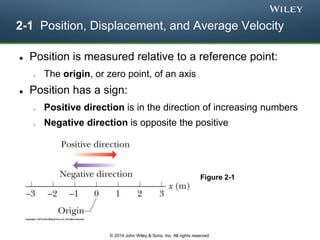
 Position is measured relative to a reference point:
o The origin, or zero point, of an axis
 Position has a sign:
o Positive direction is in the direction of increasing numbers
o Negative direction is opposite the positive
Figure 2-1
© 2014 John Wiley & Sons, Inc. All rights reserved.
2-1 Position, Displacement, and Average Velocity
 A change in position is called displacement
o ∆x is the change in x, (final position) – (initial position)
Eq. (2-1)
Examples A particle moves . . .
o From x = 5 m to x = 12 m: ∆x = 7 m (positive direction)
o From x = 5 m to x = 1 m: ∆x = -4 m (negative direction)
o From x = 5 m to x = 200 m to x = 5 m: ∆x = 0 m
 The actual distance covered is irrelevant
© 2014 John Wiley & Sons, Inc. All rights reserved.
2-1 Position, Displacement, and Average Velocity
 Displacement is therefore a vector quantity
o Direction: along a single axis, given by sign (+ or -)
o Magnitude: length or distance, in this case meters or feet
 Ignoring sign, we get its magnitude (absolute value)
o The magnitude of ∆x = -4 m is 4 m.
Answer: pairs (b) and (c)
(b) -7 m – -3 m = -4 m (c) -3 m – 7 m = -10 m
© 2014 John Wiley & Sons, Inc. All rights reserved.
2-1 Position, Displacement, and Average Velocity
 Average velocity is the ratio of:
o A displacement, ∆x
o To the time interval in which the displacement occurred, ∆t
Eq. (2-2)
 Average velocity has units of (distance) / (time)
o Meters per second, m/s
© 2014 John Wiley & Sons, Inc. All rights reserved.
2-1 Position, Displacement, and Average Velocity
 On a graph of x vs. t, the average velocity is the slope
of the straight line that connects two points
 Average velocity is therefore a vector quantity
o Positive slope means positive average velocity
o Negative slope means negative average velocity
Figure 2-4
© 2014 John Wiley & Sons, Inc. All rights reserved.
2-1 Position, Displacement, and Average Velocity
 Average speed is the ratio of:
o The total distance covered
o To the time interval in which the distance was covered, ∆t
 Average speed is always positive (no direction)
Example A particle moves from x = 3 m to x = -3 m in 2
seconds.
o Average velocity = -3 m/s; average speed = 3 m/s
Eq. (2-3)
© 2014 John Wiley & Sons, Inc. All rights reserved.
2-2 Instantaneous Velocity and Speed
2.07 Given a particle's position
as a function of time,
calculate the instantaneous
velocity for any particular
time.
2.08 Given a graph of a
particle's position versus
time, determine the
instantaneous velocity for
any particular time.
2.09 Identify speed as the
magnitude of instantaneous
velocity.
Learning Objectives
© 2014 John Wiley & Sons, Inc. All rights reserved.
2-2 Instantaneous Velocity and Speed
 Instantaneous velocity, or just velocity, v, is:
o At a single moment in time
o Obtained from average velocity by shrinking ∆t
o The slope of the position-time curve for a particle at an
instant (the derivative of position)
o A vector quantity with units (distance) / (time)
• The sign of the velocity represents its direction
Eq. (2-4)
© 2014 John Wiley & Sons, Inc. All rights reserved.
2-2 Instantaneous Velocity and Speed
 Speed is the magnitude of (instantaneous) velocity
Example A velocity of 5 m/s and -5 m/s both have an
associated speed of 5 m/s.
Answers:
(a) Situations 1 and 4 (zero)
(b) Situations 2 and 3
© 2014 John Wiley & Sons, Inc. All rights reserved.
2-2 Instantaneous Velocity and Speed
 The graph shows the
position and velocity of an
elevator cab over time.
 The slope of x(t), and so
also the velocity v, is zero
from 0 to 1 s, and from 9s
on.
 During the interval bc, the
slope is constant and
nonzero, so the cab moves
with constant velocity (4
m/s).
Example
Figure 2-6
© 2014 John Wiley & Sons, Inc. All rights reserved.
2-3 Acceleration
2.10 Apply the relationship
between a particle's average
acceleration, its change in
velocity, and the time interval
for that change.
2.11 Given a particle's velocity
as a function of time,
calculate the instantaneous
acceleration for any
particular time.
2.12 Given a graph of a
particle's velocity versus
time, determine the
instantaneous acceleration
for any particular time and
the average acceleration
between any two particular
times.
Learning Objectives
© 2014 John Wiley & Sons, Inc. All rights reserved.
2-3 Acceleration
 A change in a particle's velocity is acceleration
 Average acceleration over a time interval ∆t is
Eq. (2-7)
Eq. (2-8)
 Instantaneous acceleration (or just acceleration), a,
for a single moment in time is:
o Slope of velocity vs. time graph
© 2014 John Wiley & Sons, Inc. All rights reserved.
2-3 Acceleration
 Combining Eqs. 2-8 and 2-4:
Eq. (2-9)
 Acceleration is a vector quantity:
o Positive sign means in the positive coordinate direction
o Negative sign means the opposite
o Units of (distance) / (time squared)
© 2014 John Wiley & Sons, Inc. All rights reserved.
2-3 Acceleration
 Note: accelerations can be expressed in units of g
Eq. (2-10)
Example If a car with velocity v = -25 m/s is braked to a
stop in 5.0 s, then a = + 5.0 m/s2. Acceleration is
positive, but speed has decreased.
Answers: (a) + (b) - (c) - (d) +
© 2014 John Wiley & Sons, Inc. All rights reserved.
2-3 Acceleration
 The graph shows the velocity
and acceleration of an elevator
cab over time.
 When acceleration is 0 (e.g.
interval bc) velocity is constant.
 When acceleration is positive
(ab) upward velocity increases.
 When acceleration is negative
(cd) upward velocity decreases.
 Steeper slope of the velocity-
time graph indicates a larger
magnitude of acceleration: the
cab stops in half the time it
takes to get up to speed.
Example
Figure 2-6
© 2014 John Wiley & Sons, Inc. All rights reserved.
2.13 For constant acceleration,
apply the relationships
between position, velocity,
acceleration, and elapsed
time (Table 2-1).
2.14 Calculate a particle's
change in velocity by
integrating its acceleration
function with respect to time.
2.15 Calculate a particle's
change in position by
integrating its velocity
function with respect to time.
Learning Objectives
2-4 Constant Acceleration
© 2014 John Wiley & Sons, Inc. All rights reserved.
 In many cases
acceleration is constant,
or nearly so.
 For these cases, 5
special equations can
be used.
 Note that constant
acceleration means a
velocity with a constant
slope, and a position
with varying slope
(unless a = 0).
Figure 2-9
2-4 Constant Acceleration
© 2014 John Wiley & Sons, Inc. All rights reserved.
 First basic equation
o When the acceleration is constant, the average and
instantaneous accelerations are equal
o Rewrite Eq. 2-7 and rearrange
Eq. (2-11)
 This equation reduces to v = v0 for t = 0
 Its derivative yields the definition of a, dv/dt
2-4 Constant Acceleration
© 2014 John Wiley & Sons, Inc. All rights reserved.
 Second basic equation
o Rewrite Eq. 2-2 and rearrange
Eq. (2-15)
Eq. (2-12)
o Average = ((initial) + (final)) / 2:
o Substitute 2-11 into 2-13 Eq. (2-13)
Eq. (2-14)
o Substitute 2-14 into 2-12
2-4 Constant Acceleration
© 2014 John Wiley & Sons, Inc. All rights reserved.
 These two equations can be obtained by integrating a
constant acceleration
 Enough to solve any constant acceleration problem
o Solve as simultaneous equations
 Additional useful forms:
Eq. (2-18)
Eq. (2-17)
Eq. (2-16)
2-4 Constant Acceleration
© 2014 John Wiley & Sons, Inc. All rights reserved.
 Table 2-1 shows the 5
equations and the
quantities missing from
them.
Answer: Situations 1 (a = 0) and 4.
Table 2-1
2-4 Constant Acceleration
© 2014 John Wiley & Sons, Inc. All rights reserved.
 2.16 Identify that if a particle
is in free flight (whether
upward or downward) and if
we can neglect the effects of
air on its motion, the particle
has a constant downward
acceleration with a
magnitude g that we take to
be 9.8m/s2.
 2.17 Apply the constant
acceleration equations
(Table 2-1) to free-fall
motion.
Learning Objectives
Figure 2-12
2-5 Free-Fall Acceleration
© 2014 John Wiley & Sons, Inc. All rights reserved.
 Free-fall acceleration is the rate at which an object
accelerates downward in the absence of air
resistance
o Varies with latitude and elevation
o Written as g, standard value of 9.8 m/s2
o Independent of the properties of the object (mass,
density, shape, see Figure 2-12)
 The equations of motion in Table 2-1 apply to objects
in free-fall near Earth's surface
o In vertical flight (along the y axis)
o Where air resistance can be neglected
2-5 Free-Fall Acceleration
© 2014 John Wiley & Sons, Inc. All rights reserved.
 The free-fall acceleration is downward (-y direction)
o Value -g in the constant acceleration equations
Answers:
(a) The sign is positive (the ball moves upward); (b) The sign is negative
(the ball moves downward); (c) The ball's acceleration is always -9.8
m/s2 at all points along its trajectory
2-5 Free-Fall Acceleration
© 2014 John Wiley & Sons, Inc. All rights reserved.
2.18 Determine a particle's
change in velocity by
graphical integration on a
graph of acceleration versus
time.
2.19 Determine a particle's
change in position by
graphical integration on a
graph of velocity versus time.
Learning Objectives
2-6 Graphical Integration in Motion Analysis
© 2014 John Wiley & Sons, Inc. All rights reserved.
 Integrating acceleration:
o Given a graph of an object's acceleration a versus time t,
we can integrate to find velocity
 The Fundamental Theorem of Calculus gives:
 The definite integral on the right can be evaluated
from a graph:
Eq. (2-27)
Eq. (2-28)
2-6 Graphical Integration in Motion Analysis
© 2014 John Wiley & Sons, Inc. All rights reserved.
 Integrating velocity:
o Given a graph of an object's velocity v versus time t, we
can integrate to find position
 The Fundamental Theorem of Calculus gives:
 The definite integral on the right can be evaluated
from a graph:
Eq. (2-29)
Eq. (2-30)
2-6 Graphical Integration in Motion Analysis
© 2014 John Wiley & Sons, Inc. All rights reserved.
Example  The graph shows the
acceleration of a person's
head and torso in a whiplash
incident.
 To calculate the torso speed
at t = 0.110 s (assuming an
initial speed of 0), find the
area under the pink curve:
area A = 0
area B = 0.5 (0.060 s) (50 m/s2) = 1.5 m/s
area C = (0.010 s) (50 m/s2) = 0.50 m/s
total area = 2.0 m/s
2-6 Graphical Integration in Motion Analysis
© 2014 John Wiley & Sons, Inc. All rights reserved.
Position
 Relative to origin
 Positive and negative
directions
Displacement
 Change in position (vector)
Average Speed
 Distance traveled / time
Average Velocity
 Displacement / time (vector)
Eq. (2-1)
Eq. (2-2) Eq. (2-3)
2 Summary
© 2014 John Wiley & Sons, Inc. All rights reserved.
Instantaneous Velocity
 At a moment in time
 Speed is its magnitude
Average Acceleration
 Ratio of change in velocity to
change in time
Constant Acceleration
 Includes free-fall, where
a = -g along the vertical axis
Instantaneous Acceleration
 First derivative of velocity
 Second derivative of position
Eq. (2-4) Eq. (2-7)
Eq. (2-8) Tab. (2-1)
2 Summary
© 2014 John Wiley & Sons, Inc. All rights reserved.
Problems
1. Figure 2-16 gives the velocity of a particle moving on an x axis. What are (a) the initial and
(b) the final directions of travel? (c) Does the particle stop momentarily? (d) Is the
acceleration positive or negative? (e) Is it constant or varying?
© 2014 John Wiley & Sons, Inc. All rights reserved.
Problems
Problems
1. While driving a car at 90 km/h, how far do you move while your eyes shut for 0.50
s during a hard sneeze?
2. Compute your average velocity in the following two cases: (a) You walk 73.2 m at a
speed of 1.22 m/s and then run 73.2 m at a speed of 3.05 m/s along a straight track.
(b) You walk for 1.00 min at a speed of 1.22 m/s and then run for 1.00 min at 3.05
m/s along a straight track. (c) Graph x versus t for both cases and indicate how the
average velocity is found on the graph.
© 2014 John Wiley & Sons, Inc. All rights reserved.
Problems
© 2014 John Wiley & Sons, Inc. All rights reserved.
Problems
3. An automobile travels on a straight road for 40 km at 30 km/h. It then continues in the
same direction for another 40 km at 60 km/h. (a) What is the average velocity of the car
during the full 80 km trip? (Assume that it moves in the positive x direction.) (b) What is
the average speed? (c) Graph x versus t and indicate how the average velocity is found
on the graph.
© 2014 John Wiley & Sons, Inc. All rights reserved.
Continue…
© 2014 John Wiley & Sons, Inc. All rights reserved.
Continue…
© 2014 John Wiley & Sons, Inc. All rights reserved.
Problems
4. A car moves uphill at 40 km/h and then back downhill at 60 km/h.What is the average
speed for the round trip?
© 2014 John Wiley & Sons, Inc. All rights reserved.

Engineering Physics Lec 2 ch02-10e.pptx

  • 1.
    Motion Along aStraight Line Chapter 2 Copyright © 2014 John Wiley & Sons, Inc. All rights reserved.
  • 2.
    2-1 Position, Displacement,and Average Velocity 2.01 Identify that if all parts of an object move in the same direction at the same rate, we can treat it as a (point- like) particle. 2.02 Identify that the position of a particle is its location on a scaled axis. 2.03 Apply the relationship between a particle's displacement and its initial and final positions. 2.04 Apply the relationship between a particle's average velocity, its displacement, and the time interval. 2.05 Apply the relationship between a particle's average speed, the total distance it moves, and the time interval. 2.06 Given a graph of a particle's position versus time, determine the average velocity between two times. Learning Objectives © 2014 John Wiley & Sons, Inc. All rights reserved.
  • 3.
    2-1 Position, Displacement,and Average Velocity  Kinematics is the classification and comparison of motions  For this chapter, we restrict motion in three ways: 1. We consider motion along a straight line only 2. We discuss only the motion itself, not the forces that cause it 3. We consider the moving object to be a particle  A particle is either:  A point-like object (such as an electron)  Or an object that moves such that each part travels in the same direction at the same rate (no rotation or stretching) © 2014 John Wiley & Sons, Inc. All rights reserved.
  • 4.
    2-1 Position, Displacement,and Average Velocity  Position is measured relative to a reference point: o The origin, or zero point, of an axis  Position has a sign: o Positive direction is in the direction of increasing numbers o Negative direction is opposite the positive Figure 2-1 © 2014 John Wiley & Sons, Inc. All rights reserved.
  • 5.
    2-1 Position, Displacement,and Average Velocity  A change in position is called displacement o ∆x is the change in x, (final position) – (initial position) Eq. (2-1) Examples A particle moves . . . o From x = 5 m to x = 12 m: ∆x = 7 m (positive direction) o From x = 5 m to x = 1 m: ∆x = -4 m (negative direction) o From x = 5 m to x = 200 m to x = 5 m: ∆x = 0 m  The actual distance covered is irrelevant © 2014 John Wiley & Sons, Inc. All rights reserved.
  • 6.
    2-1 Position, Displacement,and Average Velocity  Displacement is therefore a vector quantity o Direction: along a single axis, given by sign (+ or -) o Magnitude: length or distance, in this case meters or feet  Ignoring sign, we get its magnitude (absolute value) o The magnitude of ∆x = -4 m is 4 m. Answer: pairs (b) and (c) (b) -7 m – -3 m = -4 m (c) -3 m – 7 m = -10 m © 2014 John Wiley & Sons, Inc. All rights reserved.
  • 7.
    2-1 Position, Displacement,and Average Velocity  Average velocity is the ratio of: o A displacement, ∆x o To the time interval in which the displacement occurred, ∆t Eq. (2-2)  Average velocity has units of (distance) / (time) o Meters per second, m/s © 2014 John Wiley & Sons, Inc. All rights reserved.
  • 8.
    2-1 Position, Displacement,and Average Velocity  On a graph of x vs. t, the average velocity is the slope of the straight line that connects two points  Average velocity is therefore a vector quantity o Positive slope means positive average velocity o Negative slope means negative average velocity Figure 2-4 © 2014 John Wiley & Sons, Inc. All rights reserved.
  • 9.
    2-1 Position, Displacement,and Average Velocity  Average speed is the ratio of: o The total distance covered o To the time interval in which the distance was covered, ∆t  Average speed is always positive (no direction) Example A particle moves from x = 3 m to x = -3 m in 2 seconds. o Average velocity = -3 m/s; average speed = 3 m/s Eq. (2-3) © 2014 John Wiley & Sons, Inc. All rights reserved.
  • 10.
    2-2 Instantaneous Velocityand Speed 2.07 Given a particle's position as a function of time, calculate the instantaneous velocity for any particular time. 2.08 Given a graph of a particle's position versus time, determine the instantaneous velocity for any particular time. 2.09 Identify speed as the magnitude of instantaneous velocity. Learning Objectives © 2014 John Wiley & Sons, Inc. All rights reserved.
  • 11.
    2-2 Instantaneous Velocityand Speed  Instantaneous velocity, or just velocity, v, is: o At a single moment in time o Obtained from average velocity by shrinking ∆t o The slope of the position-time curve for a particle at an instant (the derivative of position) o A vector quantity with units (distance) / (time) • The sign of the velocity represents its direction Eq. (2-4) © 2014 John Wiley & Sons, Inc. All rights reserved.
  • 12.
    2-2 Instantaneous Velocityand Speed  Speed is the magnitude of (instantaneous) velocity Example A velocity of 5 m/s and -5 m/s both have an associated speed of 5 m/s. Answers: (a) Situations 1 and 4 (zero) (b) Situations 2 and 3 © 2014 John Wiley & Sons, Inc. All rights reserved.
  • 13.
    2-2 Instantaneous Velocityand Speed  The graph shows the position and velocity of an elevator cab over time.  The slope of x(t), and so also the velocity v, is zero from 0 to 1 s, and from 9s on.  During the interval bc, the slope is constant and nonzero, so the cab moves with constant velocity (4 m/s). Example Figure 2-6 © 2014 John Wiley & Sons, Inc. All rights reserved.
  • 14.
    2-3 Acceleration 2.10 Applythe relationship between a particle's average acceleration, its change in velocity, and the time interval for that change. 2.11 Given a particle's velocity as a function of time, calculate the instantaneous acceleration for any particular time. 2.12 Given a graph of a particle's velocity versus time, determine the instantaneous acceleration for any particular time and the average acceleration between any two particular times. Learning Objectives © 2014 John Wiley & Sons, Inc. All rights reserved.
  • 15.
    2-3 Acceleration  Achange in a particle's velocity is acceleration  Average acceleration over a time interval ∆t is Eq. (2-7) Eq. (2-8)  Instantaneous acceleration (or just acceleration), a, for a single moment in time is: o Slope of velocity vs. time graph © 2014 John Wiley & Sons, Inc. All rights reserved.
  • 16.
    2-3 Acceleration  CombiningEqs. 2-8 and 2-4: Eq. (2-9)  Acceleration is a vector quantity: o Positive sign means in the positive coordinate direction o Negative sign means the opposite o Units of (distance) / (time squared) © 2014 John Wiley & Sons, Inc. All rights reserved.
  • 17.
    2-3 Acceleration  Note:accelerations can be expressed in units of g Eq. (2-10) Example If a car with velocity v = -25 m/s is braked to a stop in 5.0 s, then a = + 5.0 m/s2. Acceleration is positive, but speed has decreased. Answers: (a) + (b) - (c) - (d) + © 2014 John Wiley & Sons, Inc. All rights reserved.
  • 18.
    2-3 Acceleration  Thegraph shows the velocity and acceleration of an elevator cab over time.  When acceleration is 0 (e.g. interval bc) velocity is constant.  When acceleration is positive (ab) upward velocity increases.  When acceleration is negative (cd) upward velocity decreases.  Steeper slope of the velocity- time graph indicates a larger magnitude of acceleration: the cab stops in half the time it takes to get up to speed. Example Figure 2-6 © 2014 John Wiley & Sons, Inc. All rights reserved.
  • 19.
    2.13 For constantacceleration, apply the relationships between position, velocity, acceleration, and elapsed time (Table 2-1). 2.14 Calculate a particle's change in velocity by integrating its acceleration function with respect to time. 2.15 Calculate a particle's change in position by integrating its velocity function with respect to time. Learning Objectives 2-4 Constant Acceleration © 2014 John Wiley & Sons, Inc. All rights reserved.
  • 20.
     In manycases acceleration is constant, or nearly so.  For these cases, 5 special equations can be used.  Note that constant acceleration means a velocity with a constant slope, and a position with varying slope (unless a = 0). Figure 2-9 2-4 Constant Acceleration © 2014 John Wiley & Sons, Inc. All rights reserved.
  • 21.
     First basicequation o When the acceleration is constant, the average and instantaneous accelerations are equal o Rewrite Eq. 2-7 and rearrange Eq. (2-11)  This equation reduces to v = v0 for t = 0  Its derivative yields the definition of a, dv/dt 2-4 Constant Acceleration © 2014 John Wiley & Sons, Inc. All rights reserved.
  • 22.
     Second basicequation o Rewrite Eq. 2-2 and rearrange Eq. (2-15) Eq. (2-12) o Average = ((initial) + (final)) / 2: o Substitute 2-11 into 2-13 Eq. (2-13) Eq. (2-14) o Substitute 2-14 into 2-12 2-4 Constant Acceleration © 2014 John Wiley & Sons, Inc. All rights reserved.
  • 23.
     These twoequations can be obtained by integrating a constant acceleration  Enough to solve any constant acceleration problem o Solve as simultaneous equations  Additional useful forms: Eq. (2-18) Eq. (2-17) Eq. (2-16) 2-4 Constant Acceleration © 2014 John Wiley & Sons, Inc. All rights reserved.
  • 24.
     Table 2-1shows the 5 equations and the quantities missing from them. Answer: Situations 1 (a = 0) and 4. Table 2-1 2-4 Constant Acceleration © 2014 John Wiley & Sons, Inc. All rights reserved.
  • 25.
     2.16 Identifythat if a particle is in free flight (whether upward or downward) and if we can neglect the effects of air on its motion, the particle has a constant downward acceleration with a magnitude g that we take to be 9.8m/s2.  2.17 Apply the constant acceleration equations (Table 2-1) to free-fall motion. Learning Objectives Figure 2-12 2-5 Free-Fall Acceleration © 2014 John Wiley & Sons, Inc. All rights reserved.
  • 26.
     Free-fall accelerationis the rate at which an object accelerates downward in the absence of air resistance o Varies with latitude and elevation o Written as g, standard value of 9.8 m/s2 o Independent of the properties of the object (mass, density, shape, see Figure 2-12)  The equations of motion in Table 2-1 apply to objects in free-fall near Earth's surface o In vertical flight (along the y axis) o Where air resistance can be neglected 2-5 Free-Fall Acceleration © 2014 John Wiley & Sons, Inc. All rights reserved.
  • 27.
     The free-fallacceleration is downward (-y direction) o Value -g in the constant acceleration equations Answers: (a) The sign is positive (the ball moves upward); (b) The sign is negative (the ball moves downward); (c) The ball's acceleration is always -9.8 m/s2 at all points along its trajectory 2-5 Free-Fall Acceleration © 2014 John Wiley & Sons, Inc. All rights reserved.
  • 28.
    2.18 Determine aparticle's change in velocity by graphical integration on a graph of acceleration versus time. 2.19 Determine a particle's change in position by graphical integration on a graph of velocity versus time. Learning Objectives 2-6 Graphical Integration in Motion Analysis © 2014 John Wiley & Sons, Inc. All rights reserved.
  • 29.
     Integrating acceleration: oGiven a graph of an object's acceleration a versus time t, we can integrate to find velocity  The Fundamental Theorem of Calculus gives:  The definite integral on the right can be evaluated from a graph: Eq. (2-27) Eq. (2-28) 2-6 Graphical Integration in Motion Analysis © 2014 John Wiley & Sons, Inc. All rights reserved.
  • 30.
     Integrating velocity: oGiven a graph of an object's velocity v versus time t, we can integrate to find position  The Fundamental Theorem of Calculus gives:  The definite integral on the right can be evaluated from a graph: Eq. (2-29) Eq. (2-30) 2-6 Graphical Integration in Motion Analysis © 2014 John Wiley & Sons, Inc. All rights reserved.
  • 31.
    Example  Thegraph shows the acceleration of a person's head and torso in a whiplash incident.  To calculate the torso speed at t = 0.110 s (assuming an initial speed of 0), find the area under the pink curve: area A = 0 area B = 0.5 (0.060 s) (50 m/s2) = 1.5 m/s area C = (0.010 s) (50 m/s2) = 0.50 m/s total area = 2.0 m/s 2-6 Graphical Integration in Motion Analysis © 2014 John Wiley & Sons, Inc. All rights reserved.
  • 32.
    Position  Relative toorigin  Positive and negative directions Displacement  Change in position (vector) Average Speed  Distance traveled / time Average Velocity  Displacement / time (vector) Eq. (2-1) Eq. (2-2) Eq. (2-3) 2 Summary © 2014 John Wiley & Sons, Inc. All rights reserved.
  • 33.
    Instantaneous Velocity  Ata moment in time  Speed is its magnitude Average Acceleration  Ratio of change in velocity to change in time Constant Acceleration  Includes free-fall, where a = -g along the vertical axis Instantaneous Acceleration  First derivative of velocity  Second derivative of position Eq. (2-4) Eq. (2-7) Eq. (2-8) Tab. (2-1) 2 Summary © 2014 John Wiley & Sons, Inc. All rights reserved.
  • 34.
    Problems 1. Figure 2-16gives the velocity of a particle moving on an x axis. What are (a) the initial and (b) the final directions of travel? (c) Does the particle stop momentarily? (d) Is the acceleration positive or negative? (e) Is it constant or varying? © 2014 John Wiley & Sons, Inc. All rights reserved.
  • 35.
    © 2014 JohnWiley & Sons, Inc. All rights reserved. Problems
  • 36.
    Problems 1. While drivinga car at 90 km/h, how far do you move while your eyes shut for 0.50 s during a hard sneeze? 2. Compute your average velocity in the following two cases: (a) You walk 73.2 m at a speed of 1.22 m/s and then run 73.2 m at a speed of 3.05 m/s along a straight track. (b) You walk for 1.00 min at a speed of 1.22 m/s and then run for 1.00 min at 3.05 m/s along a straight track. (c) Graph x versus t for both cases and indicate how the average velocity is found on the graph. © 2014 John Wiley & Sons, Inc. All rights reserved.
  • 37.
    Problems © 2014 JohnWiley & Sons, Inc. All rights reserved.
  • 38.
    Problems 3. An automobiletravels on a straight road for 40 km at 30 km/h. It then continues in the same direction for another 40 km at 60 km/h. (a) What is the average velocity of the car during the full 80 km trip? (Assume that it moves in the positive x direction.) (b) What is the average speed? (c) Graph x versus t and indicate how the average velocity is found on the graph. © 2014 John Wiley & Sons, Inc. All rights reserved.
  • 39.
    Continue… © 2014 JohnWiley & Sons, Inc. All rights reserved.
  • 40.
    Continue… © 2014 JohnWiley & Sons, Inc. All rights reserved.
  • 41.
    Problems 4. A carmoves uphill at 40 km/h and then back downhill at 60 km/h.What is the average speed for the round trip? © 2014 John Wiley & Sons, Inc. All rights reserved.