Temperature, Heat, and the
First Law of Thermodynamics
Chapter 18
Copyright © 2014 John Wiley & Sons, Inc. All rights reserved.
18-1 Temperature
18.01 Identify the lowest
temperature as 0 on the
Kelvin scale (absolute zero).
18.02 Explain the zeroth law of
thermodynamics.
18.03 Explain the conditions for
the triple-point temperature.
18.04 Explain the conditions for
measuring a temperature
with a constant-volume gas
thermometer.
18.05 For a constant-volume
gas thermometer, relate the
pressure and temperature of
the gas in some given state
to the pressure and
temperature at the triple
point.
Learning Objectives
© 2014 John Wiley & Sons, Inc. All rights reserved.
18-1 Temperature
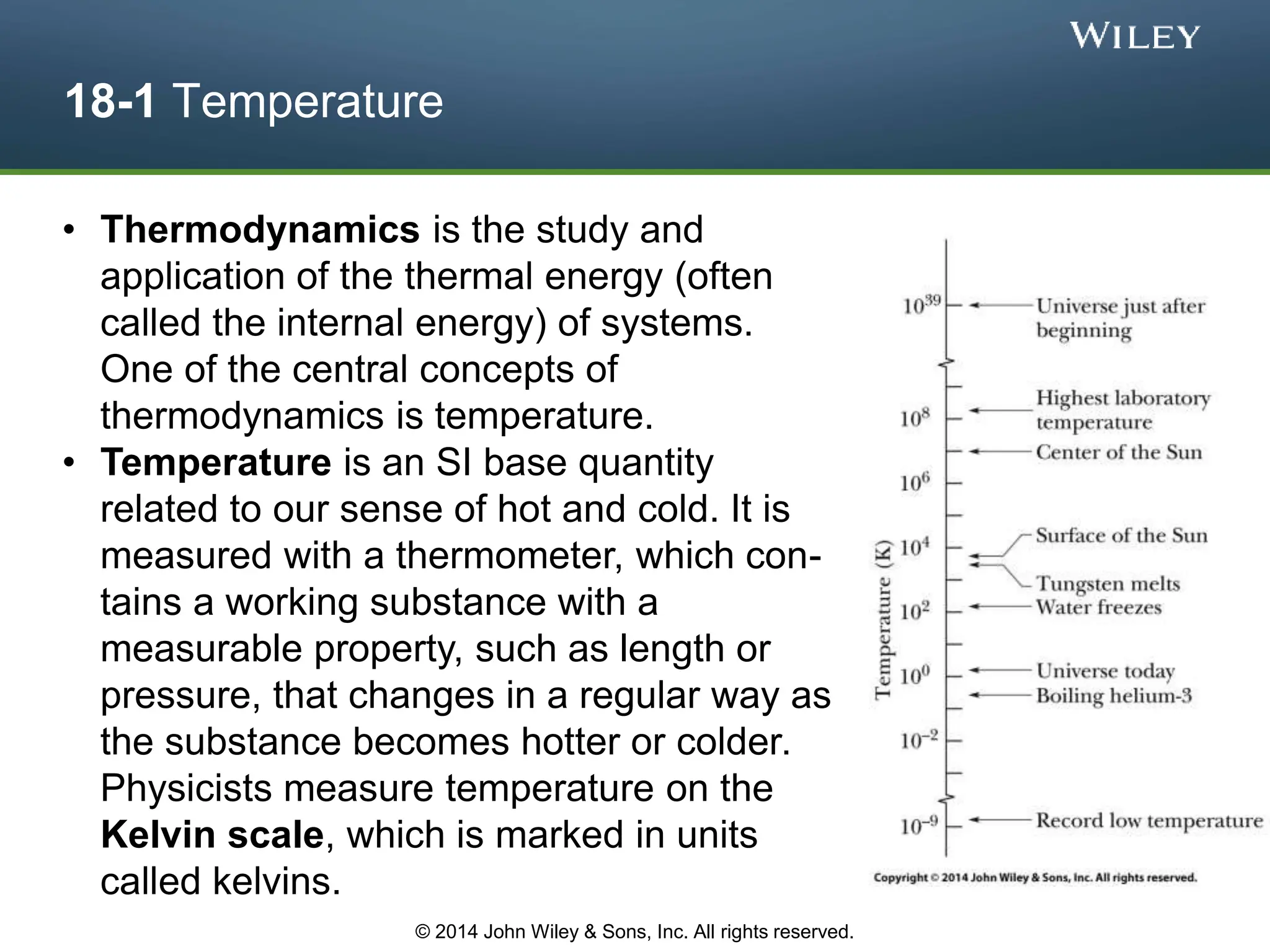
• Thermodynamics is the study and
application of the thermal energy (often
called the internal energy) of systems.
One of the central concepts of
thermodynamics is temperature.
• Temperature is an SI base quantity
related to our sense of hot and cold. It is
measured with a thermometer, which con-
tains a working substance with a
measurable property, such as length or
pressure, that changes in a regular way as
the substance becomes hotter or colder.
Physicists measure temperature on the
Kelvin scale, which is marked in units
called kelvins.
© 2014 John Wiley & Sons, Inc. All rights reserved.
18-1 Temperature
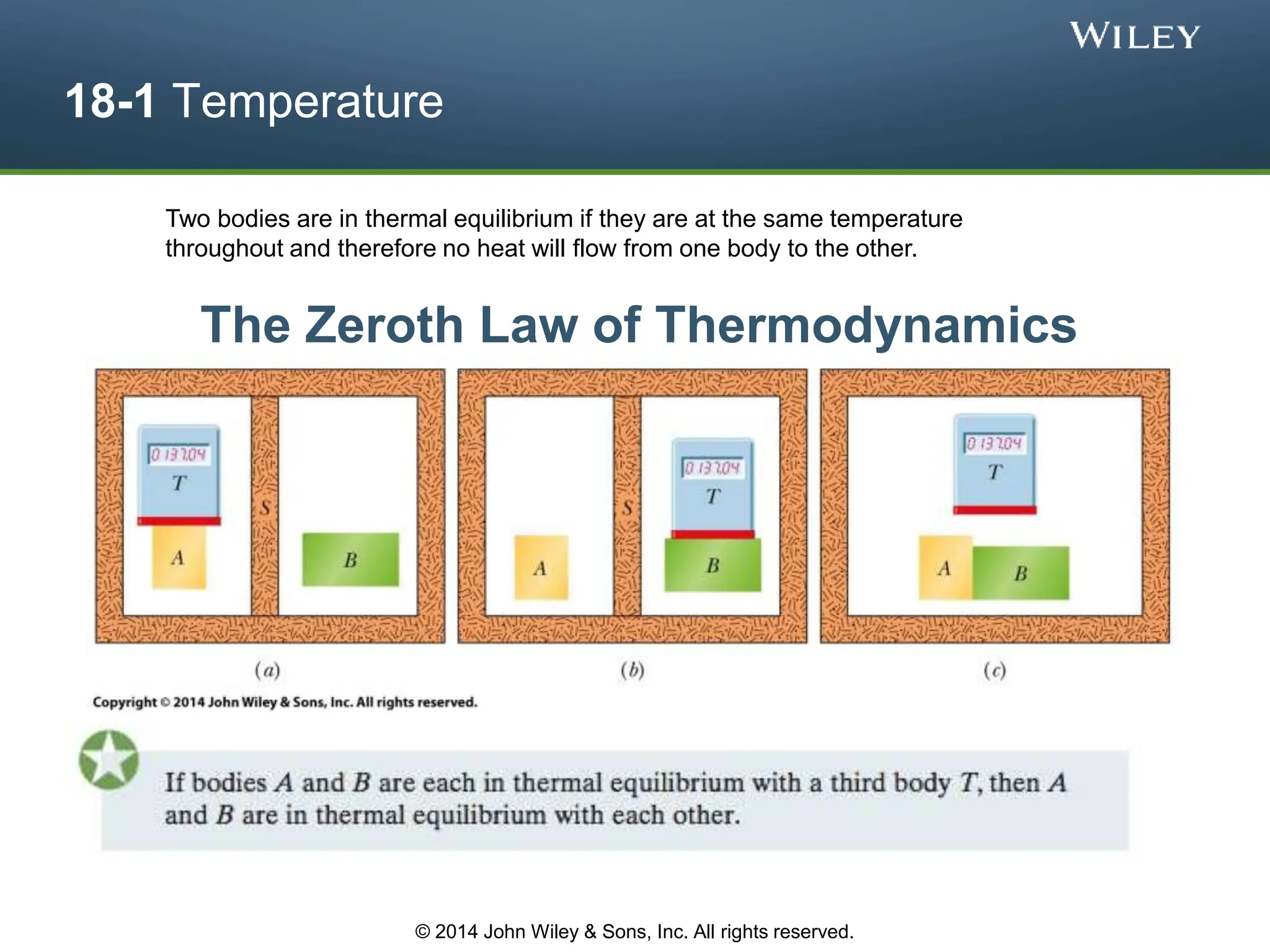
The Zeroth Law of Thermodynamics
Two bodies are in thermal equilibrium if they are at the same temperature
throughout and therefore no heat will flow from one body to the other.
© 2014 John Wiley & Sons, Inc. All rights reserved.
18-1 Temperature
Triple Point of Water
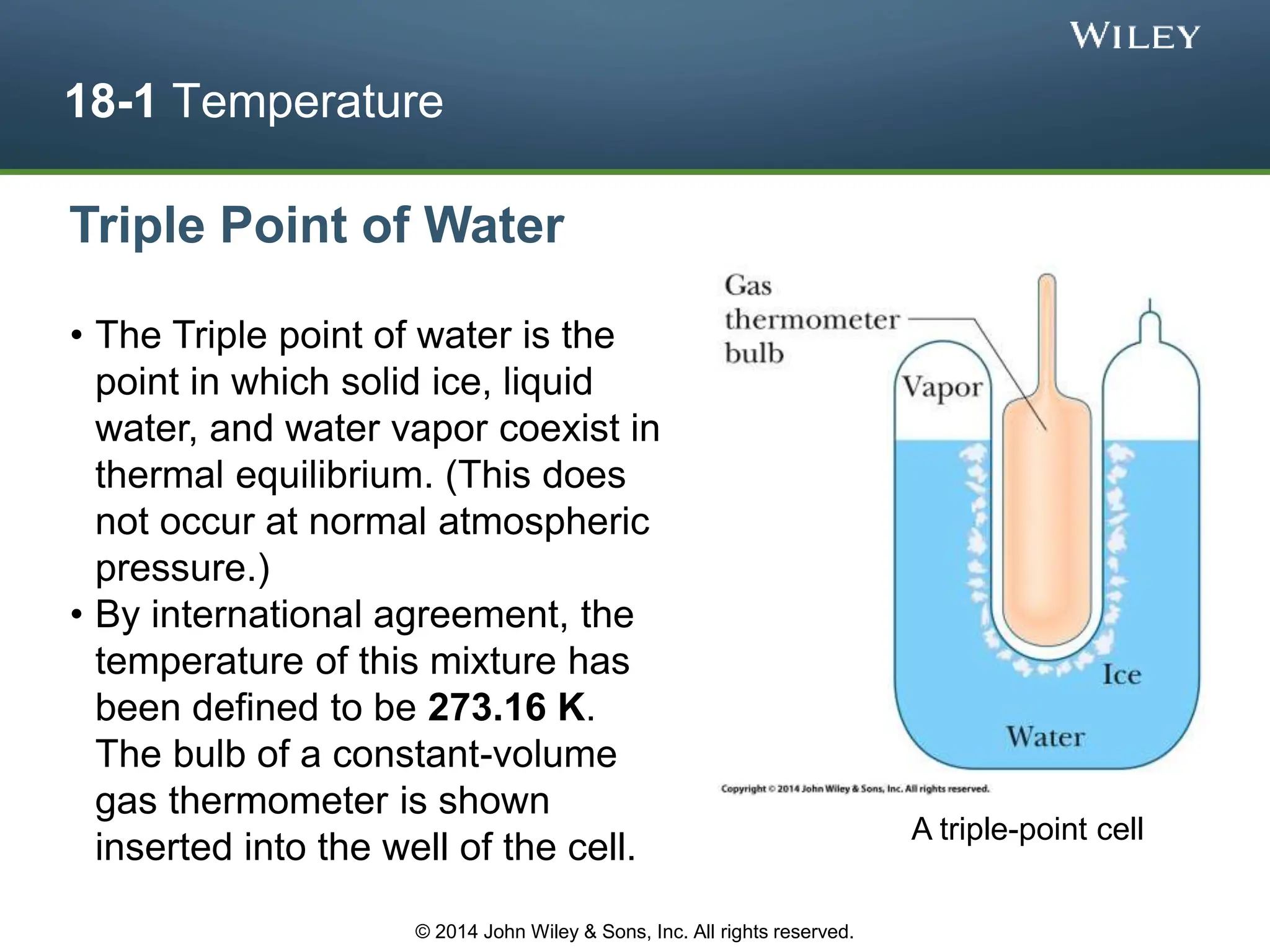
• The Triple point of water is the
point in which solid ice, liquid
water, and water vapor coexist in
thermal equilibrium. (This does
not occur at normal atmospheric
pressure.)
• By international agreement, the
temperature of this mixture has
been defined to be 273.16 K.
The bulb of a constant-volume
gas thermometer is shown
inserted into the well of the cell.
A triple-point cell
© 2014 John Wiley & Sons, Inc. All rights reserved.
18-1 Temperature
Constant-Volume Gas Thermometer
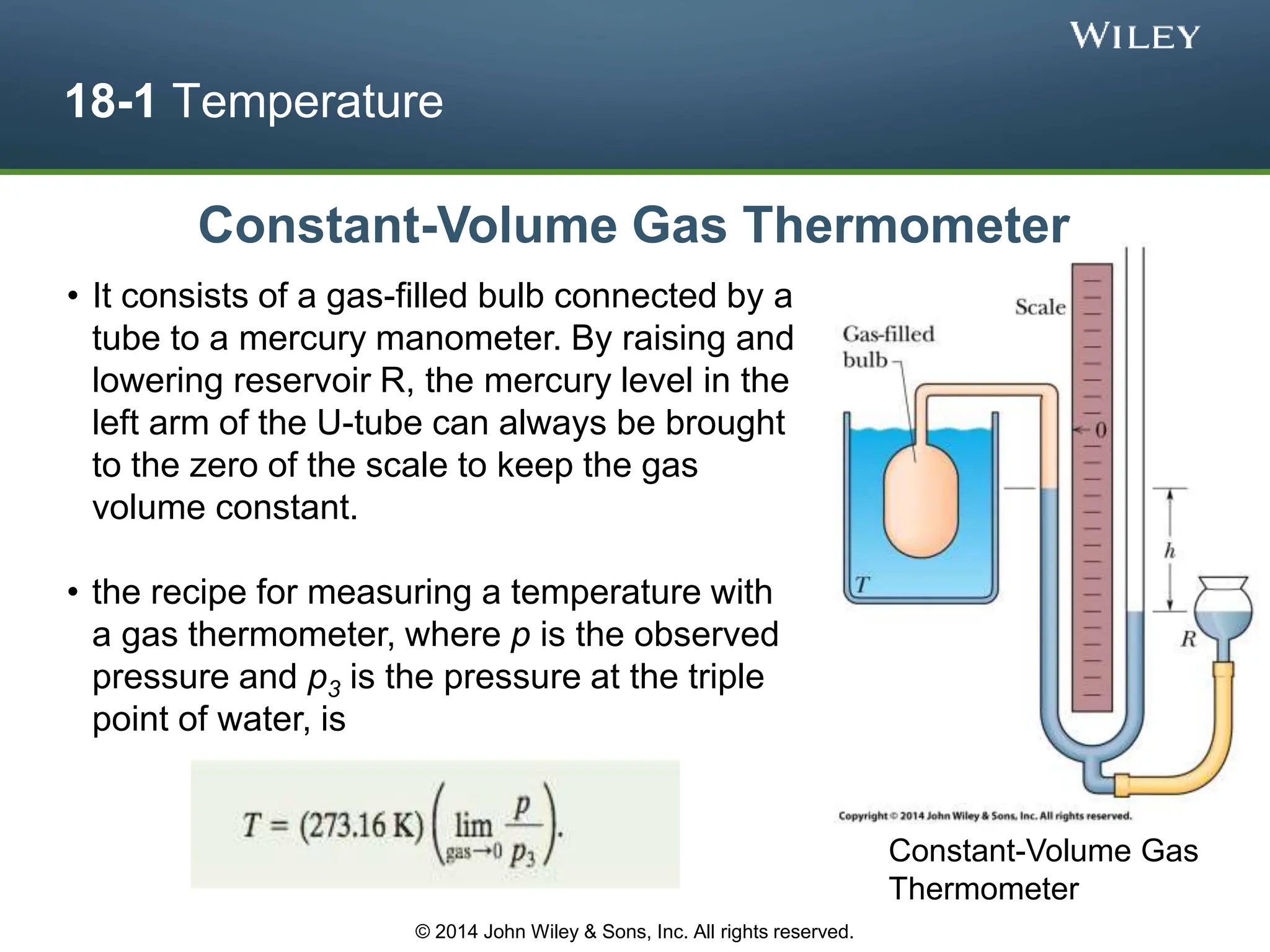
• It consists of a gas-filled bulb connected by a
tube to a mercury manometer. By raising and
lowering reservoir R, the mercury level in the
left arm of the U-tube can always be brought
to the zero of the scale to keep the gas
volume constant.
• the recipe for measuring a temperature with
a gas thermometer, where p is the observed
pressure and p3 is the pressure at the triple
point of water, is
Constant-Volume Gas
Thermometer
© 2014 John Wiley & Sons, Inc. All rights reserved.
18-2 The Celsius and Fahrenheit Scales
18.06 Convert a temperature
between any two (linear)
temperature scales,
including the Celsius,
Fahrenheit, and Kelvin
scales.
18.07 Identify that a change of
one degree is the same on
the Celsius and Kelvin
scales.
Learning Objectives
© 2014 John Wiley & Sons, Inc. All rights reserved.
18-2 The Celsius and Fahrenheit Scales
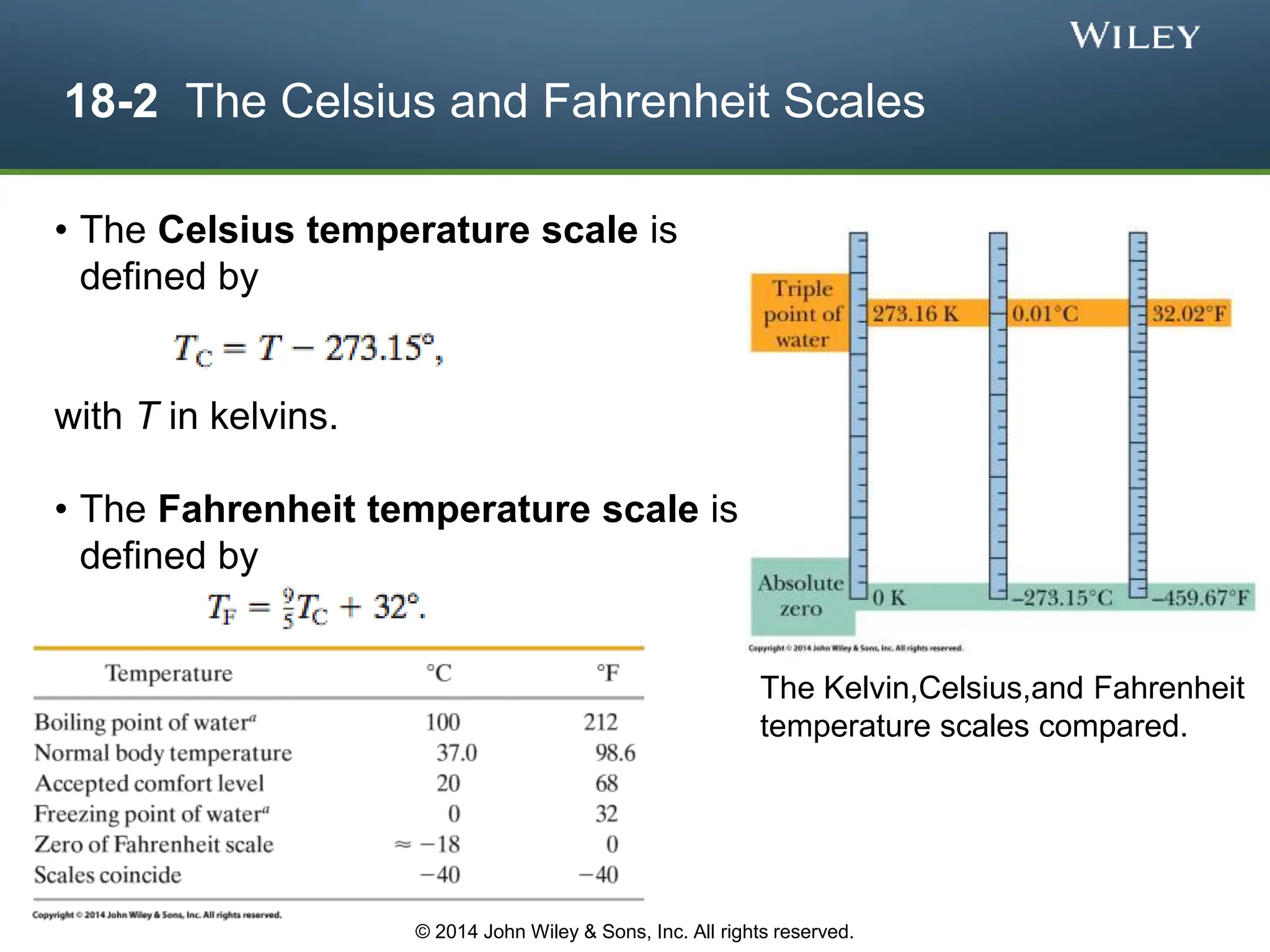
• The Celsius temperature scale is
defined by
with T in kelvins.
• The Fahrenheit temperature scale is
defined by
The Kelvin,Celsius,and Fahrenheit
temperature scales compared.
© 2014 John Wiley & Sons, Inc. All rights reserved.
18-3 Thermal Expansion
18.08 For one-dimensional
thermal expansion, apply the
relationship between the
temperature change ΔT, the
length change ΔL, the initial
length L, and the coefficient
of linear expansion .
18.09 For two-dimensional
thermal expansion, use one
dimensional thermal
expansion to find the change
in area.
18.10 For three-dimensional
thermal expansion, apply the
relationship between the
temperature change ΔT, the
volume change ΔV, the initial
volume V, and the coefficient
of volume expansion β.
Learning Objectives
© 2014 John Wiley & Sons, Inc. All rights reserved.
18-3 Thermal Expansion
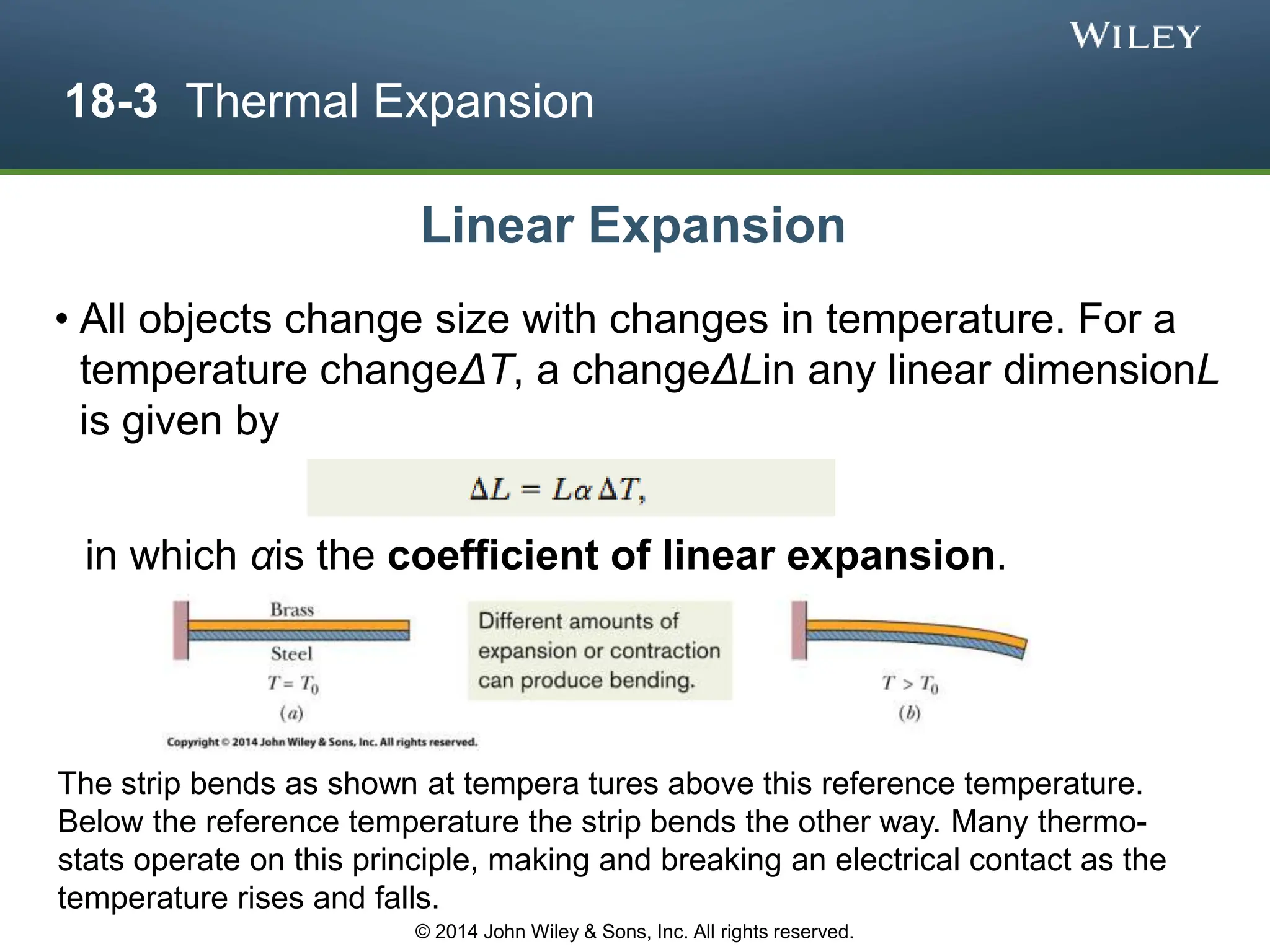
• All objects change size with changes in temperature. For a
temperature changeΔT, a changeΔLin any linear dimensionL
is given by
The strip bends as shown at tempera tures above this reference temperature.
Below the reference temperature the strip bends the other way. Many thermo-
stats operate on this principle, making and breaking an electrical contact as the
temperature rises and falls.
Linear Expansion
© 2014 John Wiley & Sons, Inc. All rights reserved.
in which αis the coefficient of linear expansion.
18-3 Thermal Expansion
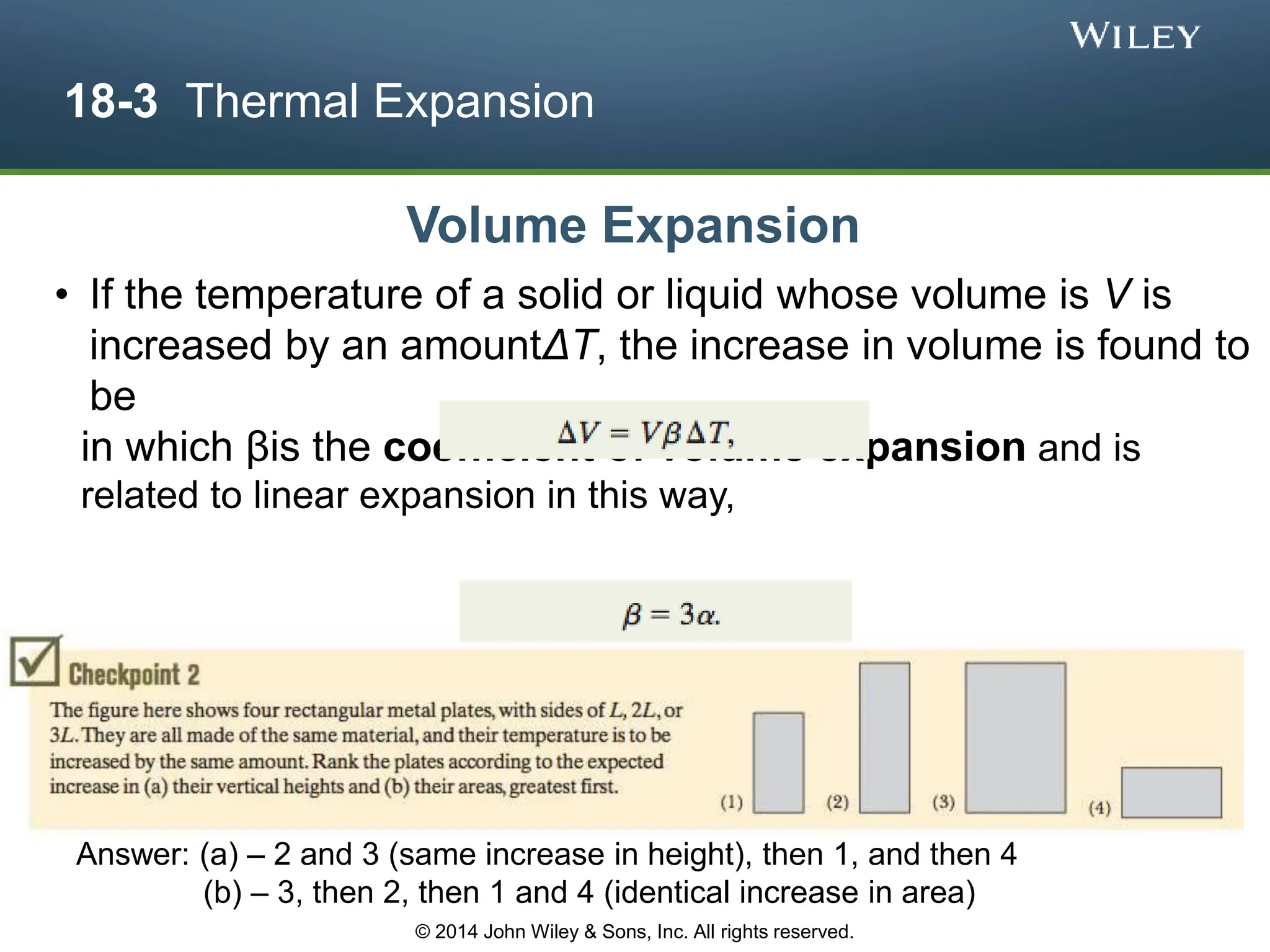
• If the temperature of a solid or liquid whose volume is V is
increased by an amountΔT, the increase in volume is found to
be
in which βis the coefficient of volume expansion and is
related to linear expansion in this way,
Volume Expansion
Answer: (a) – 2 and 3 (same increase in height), then 1, and then 4
(b) – 3, then 2, then 1 and 4 (identical increase in area)
© 2014 John Wiley & Sons, Inc. All rights reserved.
18-4 Absorption of Heat
18.11 Identify that thermal energy
is associated with the random
motions of the microscopic
bodies in an object.
18.12 Identify that heat Q is the
amount of transferred energy
(either to or from an object’s
thermal energy) due to a
temperature difference between
the object and its environment.
18.13 Convert energy units
between various measurement
systems.
18.14 Convert between
mechanical or electrical energy
and thermal energy.
18.15 For a temperature change
ΔT of a substance, relate the
change to the heat transfer Q
and the substance’s heat
capacity C.
18.16 For a temperature change
ΔT of a substance, relate the
change to the heat transfer Q
and the substance’s specific
heat c and mass m.
Learning Objectives
© 2014 John Wiley & Sons, Inc. All rights reserved.
18-4 Absorption of Heat
18.17 Identify the three phases of
matter.
18.18 For a phase change of a
substance, relate the heat
transfer Q, the heat of
transformation L, and the
amount of mass m transformed.
18.19 Identify that if a heat
transfer Q takes a substance
across a phase-change
temperature, the transfer must
be calculated in steps: (a) a
temperature change to reach
the phase-change temperature,
(b) the phase change, and then
(c) any temperature change that
moves the substance away from
the phase-change temperature.
Learning Objectives (continued…)
© 2014 John Wiley & Sons, Inc. All rights reserved.
18-4 Absorption of Heat
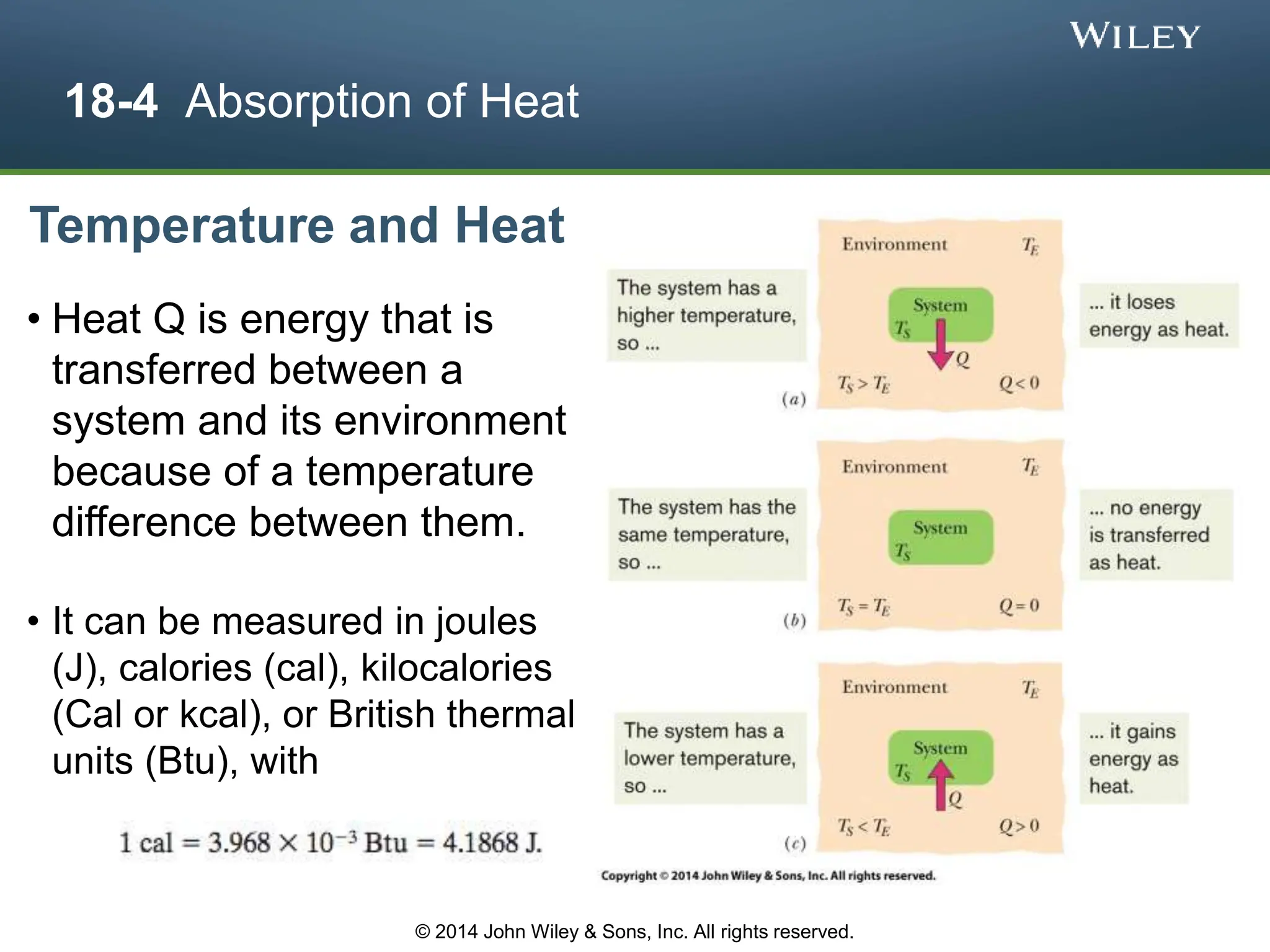
Temperature and Heat
• Heat Q is energy that is
transferred between a
system and its environment
because of a temperature
difference between them.
• It can be measured in joules
(J), calories (cal), kilocalories
(Cal or kcal), or British thermal
units (Btu), with
© 2014 John Wiley & Sons, Inc. All rights reserved.
18-4 Absorption of Heat
Absorption of Heat by Solids and Liquids
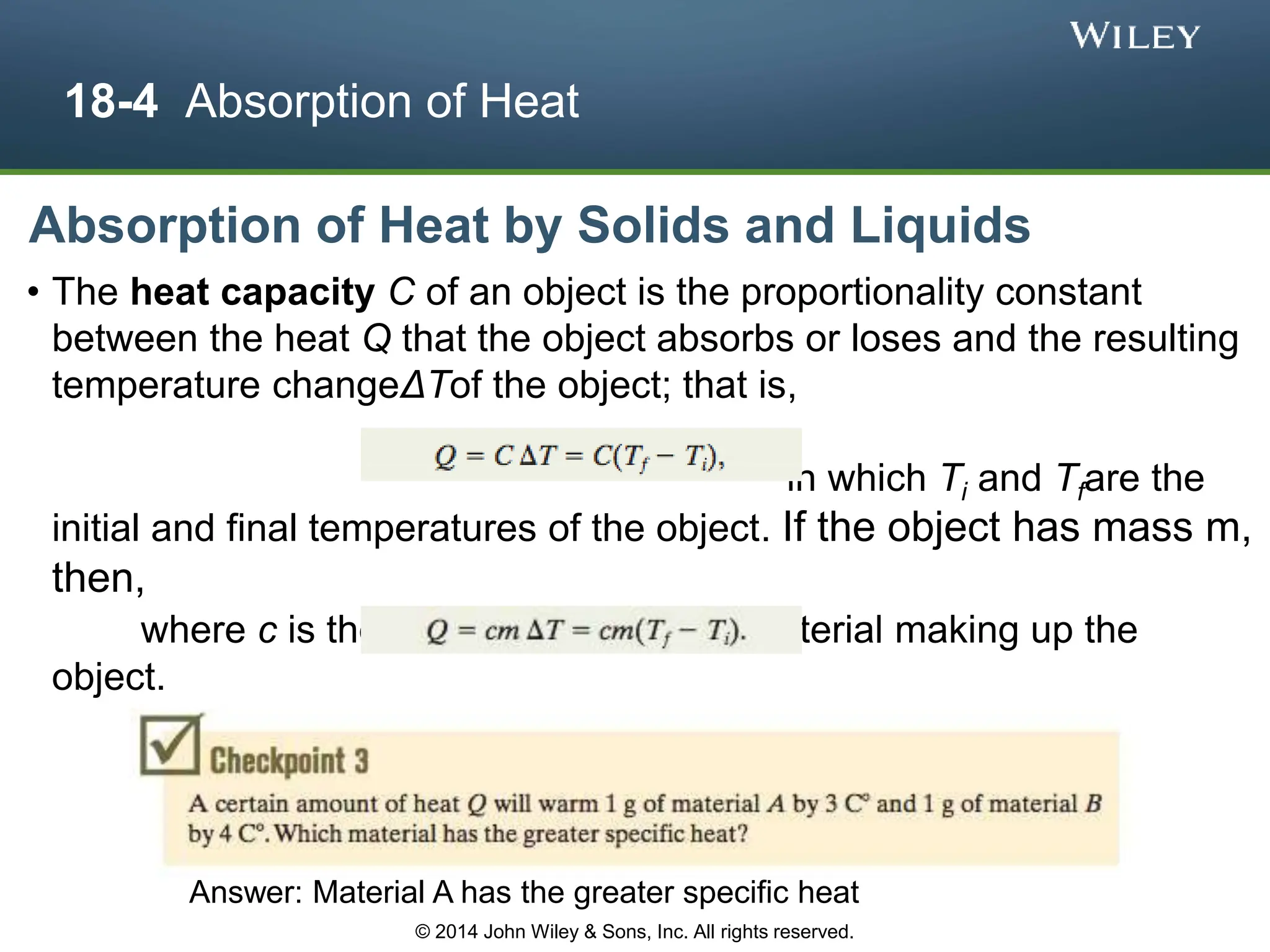
• The heat capacity C of an object is the proportionality constant
between the heat Q that the object absorbs or loses and the resulting
temperature changeΔTof the object; that is,
in which Ti and Tfare the
initial and final temperatures of the object. If the object has mass m,
then,
where c is the specific heat of the material making up the
object.
Answer: Material A has the greater specific heat
© 2014 John Wiley & Sons, Inc. All rights reserved.
18-4 Absorption of Heat
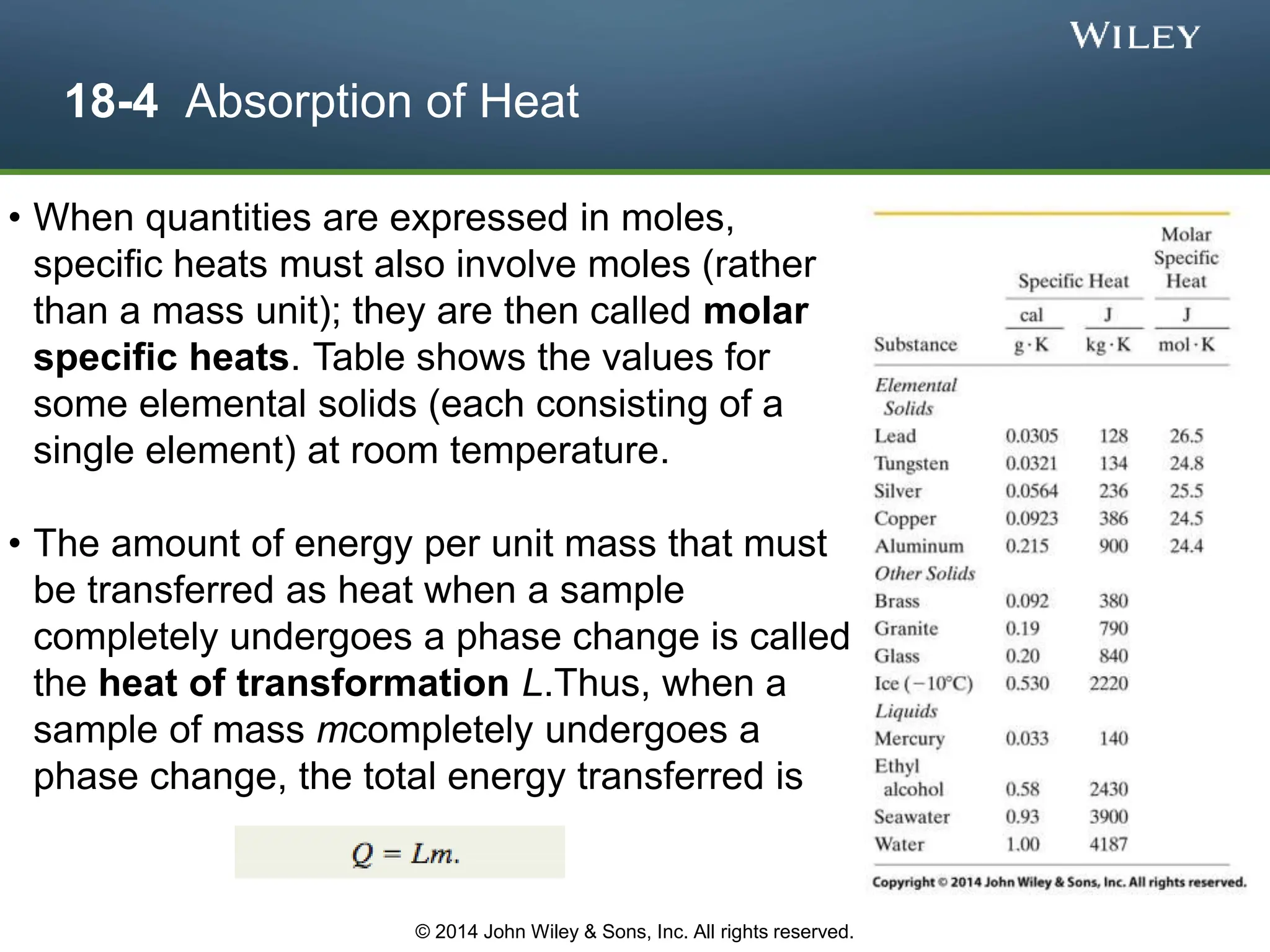
• When quantities are expressed in moles,
specific heats must also involve moles (rather
than a mass unit); they are then called molar
specific heats. Table shows the values for
some elemental solids (each consisting of a
single element) at room temperature.
• The amount of energy per unit mass that must
be transferred as heat when a sample
completely undergoes a phase change is called
the heat of transformation L.Thus, when a
sample of mass mcompletely undergoes a
phase change, the total energy transferred is
© 2014 John Wiley & Sons, Inc. All rights reserved.
18-5 The First Law of Thermodynamics
18.20 If an enclosed gas expands
or contracts, calculate the work
W done by the gas by integrating
the gas pressure with respect to
the volume of the enclosure.
18.21 Identify the algebraic sign of
work W associated with
expansion and contraction of a
gas.
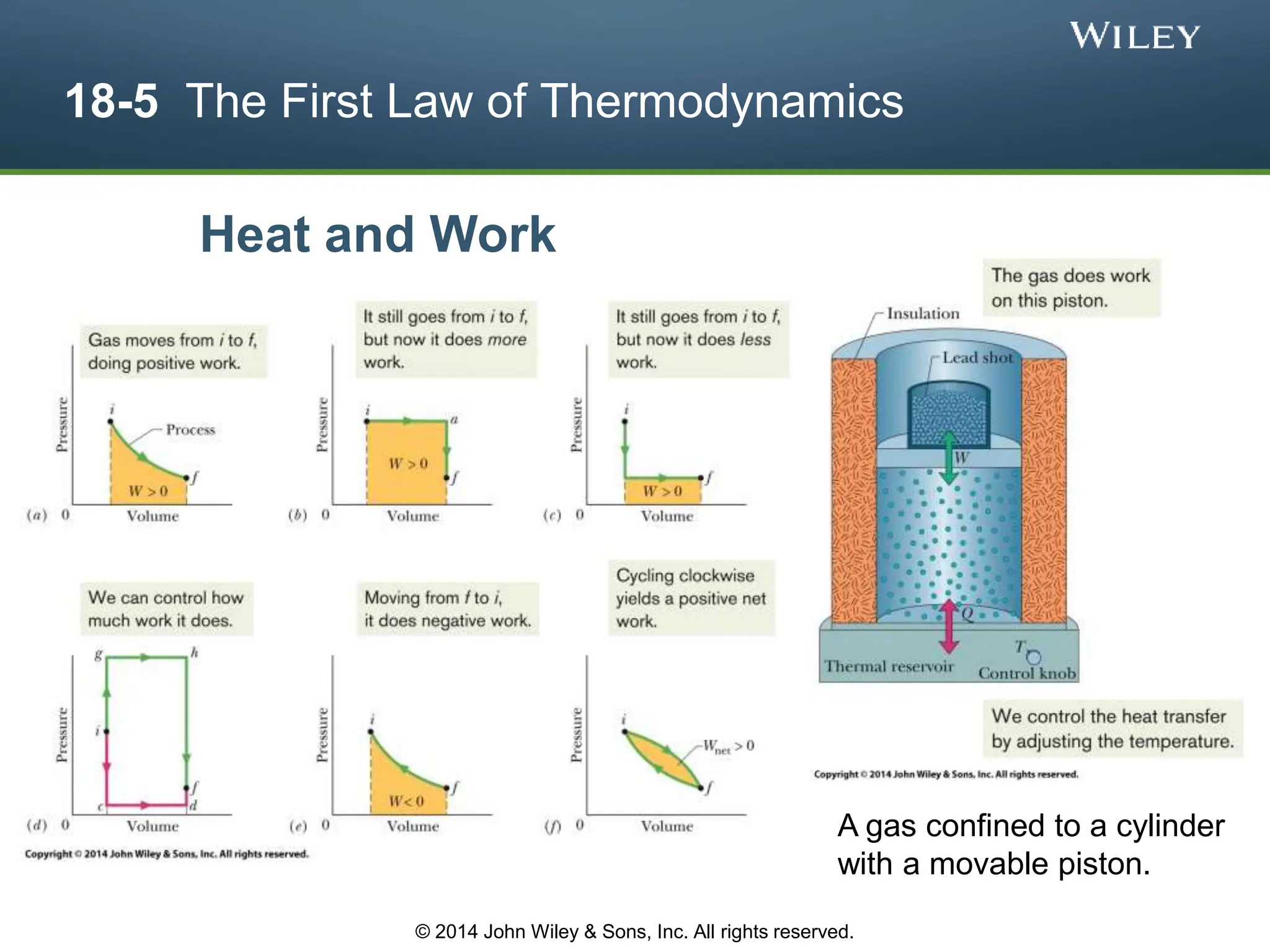
18.22 Given a p-V graph of
pressure versus volume for a
process, identify the starting
point (the initial state) and the
final point (the final state) and
calculate the work by using
graphical integration.
18.23 On a p-V graph of pressure
versus volume for a gas,
identify the algebraic sign of
the work associated with a
right-going process and a left-
going process.
18.24 Apply the first law of
thermodynamics to relate the
change in the internal energy
ΔEint of a gas, the energy Q
transferred as heat to or from
the gas, and the work W done
on or by the gas.
Learning Objectives
© 2014 John Wiley & Sons, Inc. All rights reserved.
18-5 The First Law of Thermodynamics
18.25 Identify the algebraic sign of
a heat transfer Q that is
associated with a transfer to a
gas and a transfer from the gas.
18.26 Identify that the internal
energy ΔEint of a gas tends to
increase if the heat transfer is to
the gas, and it tends to
decrease if the gas does work
on its environment.
18.27 Identify that in an adiabatic
process with a gas, there is no
heat transfer Q with the
environment.
18.28 Identify that in a constant-
volume process with a gas,
there is no work W done by the
gas.
18.29 Identify that in a cyclical
process with a gas, there is no
net change in the internal
energy ΔEint.
18.30 Identify that in a free
expansion with a gas, the heat
transfer Q, work done W, and
change in internal energy ΔEint
are each zero.
Learning Objectives (Continued)
© 2014 John Wiley & Sons, Inc. All rights reserved.
18-5 The First Law of Thermodynamics
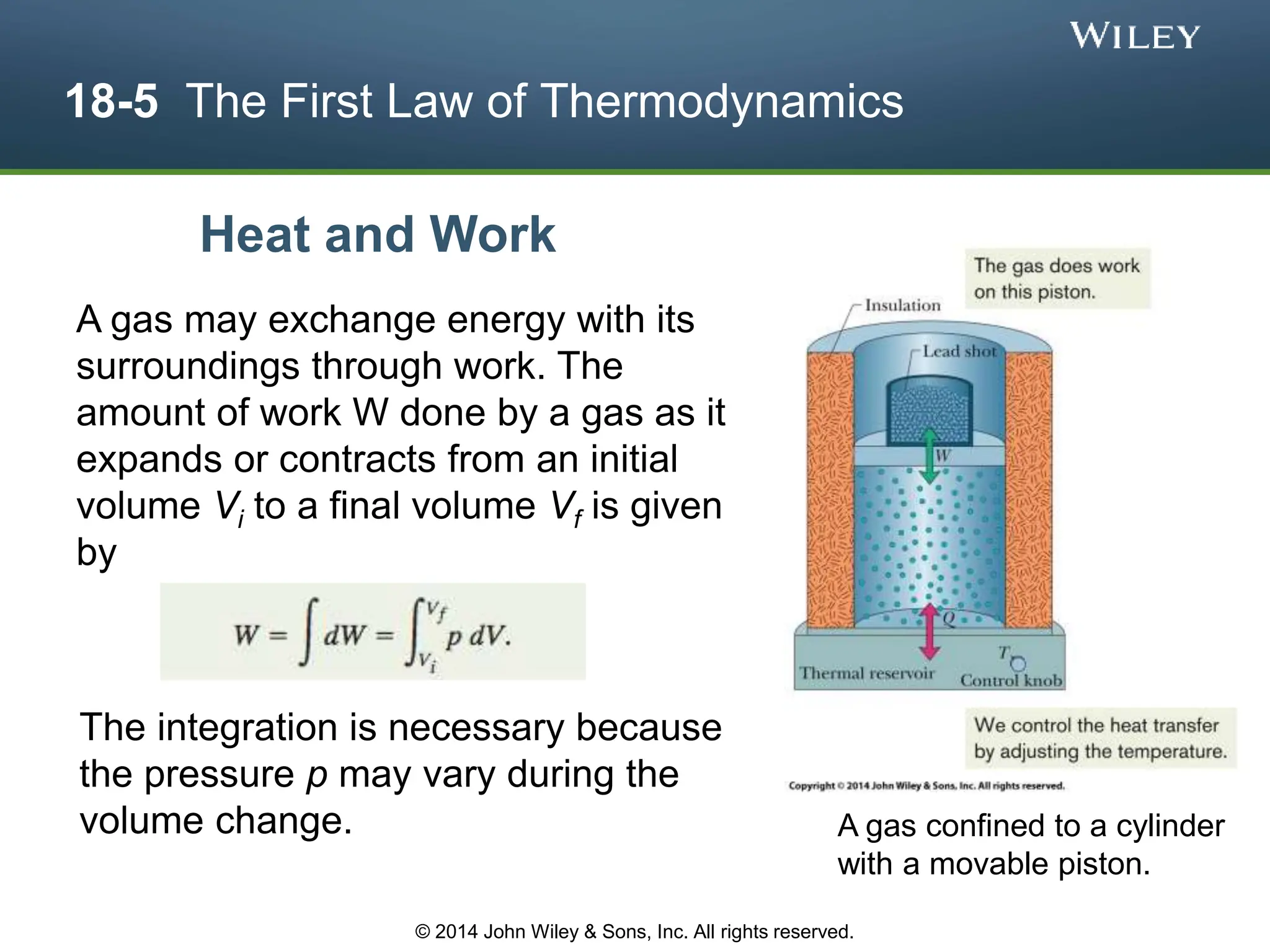
A gas may exchange energy with its
surroundings through work. The
amount of work W done by a gas as it
expands or contracts from an initial
volume Vi to a final volume Vf is given
by
The integration is necessary because
the pressure p may vary during the
volume change.
Heat and Work
A gas confined to a cylinder
with a movable piston.
© 2014 John Wiley & Sons, Inc. All rights reserved.
18-5 The First Law of Thermodynamics
Heat and Work
A gas confined to a cylinder
with a movable piston.
© 2014 John Wiley & Sons, Inc. All rights reserved.
18-5 The First Law of Thermodynamics
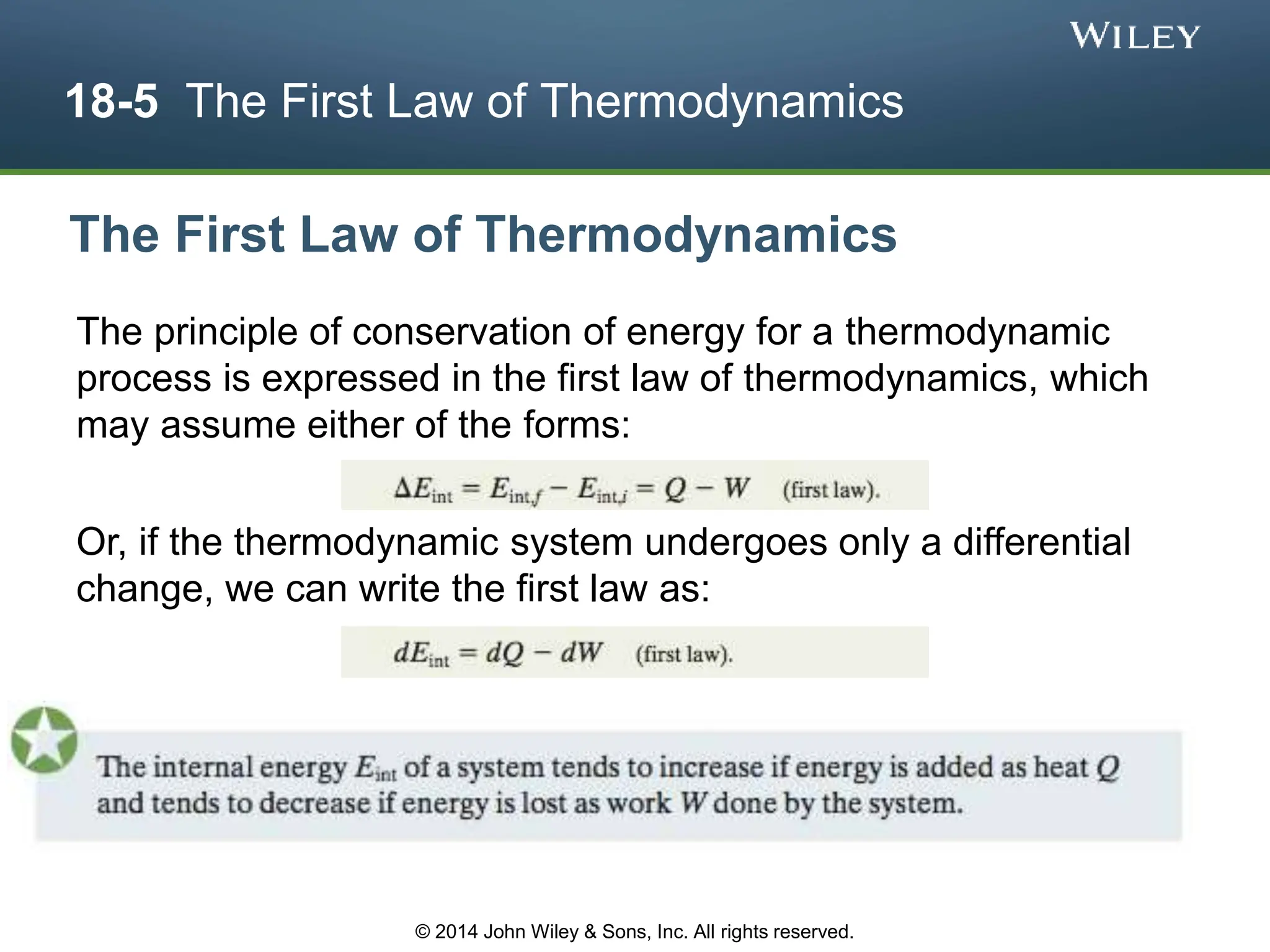
The principle of conservation of energy for a thermodynamic
process is expressed in the first law of thermodynamics, which
may assume either of the forms:
Or, if the thermodynamic system undergoes only a differential
change, we can write the first law as:
The First Law of Thermodynamics
© 2014 John Wiley & Sons, Inc. All rights reserved.
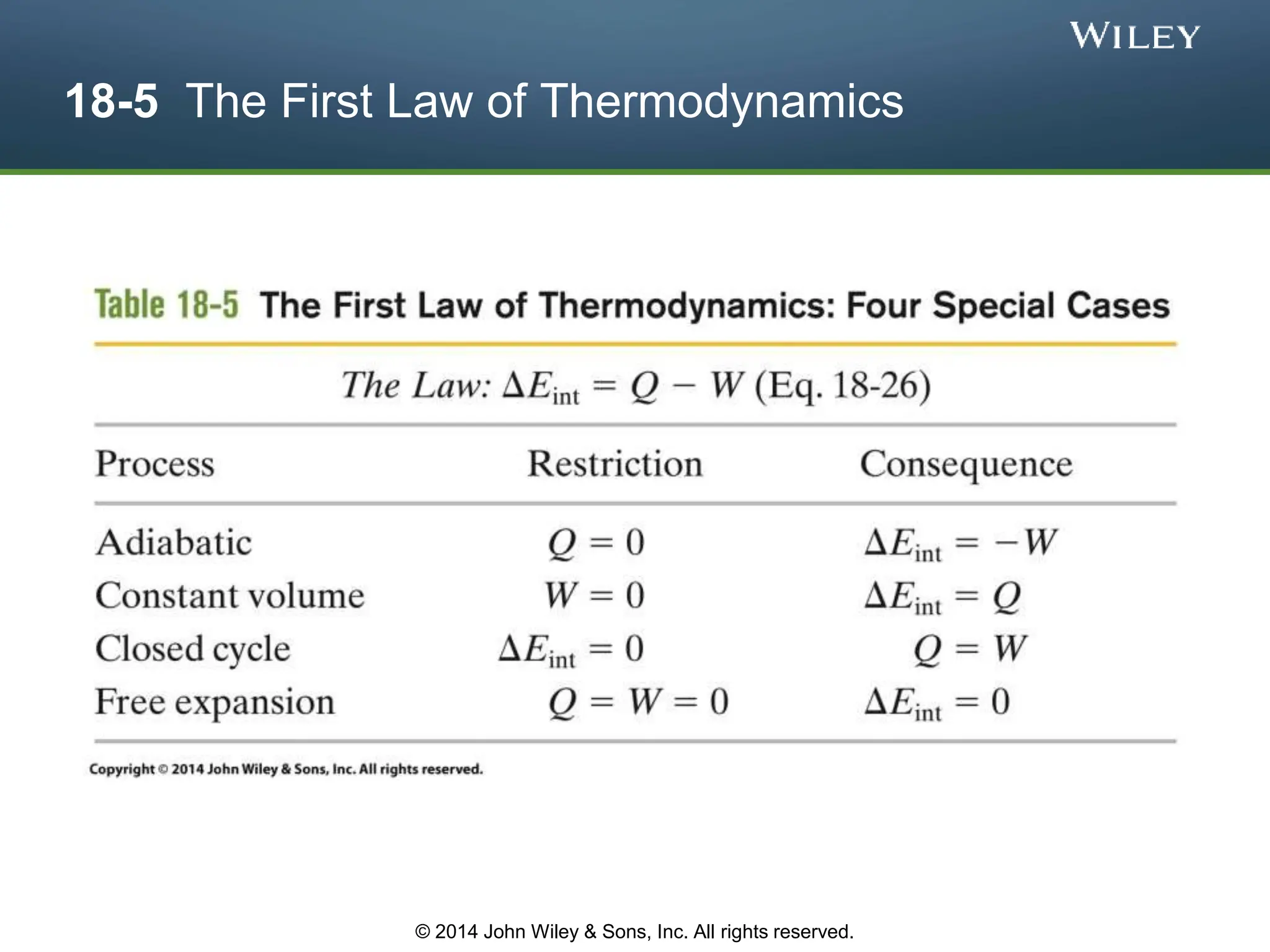
18-5 The First Law of Thermodynamics
© 2014 John Wiley & Sons, Inc. All rights reserved.
18-6 Heat Transfer Mechanisms
18.31 For thermal conduction
through a layer, apply the
relationship between the
energy-transfer rate Pcond and
the layer’s area A, thermal
conductivity k, thickness L, and
temperature difference ΔT
(between its two sides).
18.32 For a composite slab (two
or more layers) that has
reached the steady state in
which temperatures are no
longer changing, identify that
(by the conservation of energy)
the rates of thermal conduction
Pcond through the layers must
be equal.
18.33 For thermal conduction
through a layer, apply the
relationship between thermal
resistance R, thickness L, and
thermal conductivity k.
18.34 Identify that thermal energy
can be transferred by
convection, in which a warmer
fluid (gas or liquid) tends to rise
in a cooler fluid.
Learning Objectives
© 2014 John Wiley & Sons, Inc. All rights reserved.
18-6 Heat Transfer Mechanisms
18.35 In the emission of thermal
radiation by an object, apply the
relationship between the
energy-transfer rate Prad and
the object’s surface area A,
emissivity , and surface
temperature T (in kelvins).
18.36 In the absorption of thermal
radiation by an object, apply the
relationship between the
energy-transfer rate Pabs and
the object’s surface area A and
emissivity , and the
environmental temperature
T (in kelvins).
18.37 Calculate the net energy
transfer rate Pnet of an object
emitting radiation to its
environment and absorbing
radiation from that environment.
Learning Objectives (Continued)
© 2014 John Wiley & Sons, Inc. All rights reserved.
18-6 Heat Transfer Mechanisms
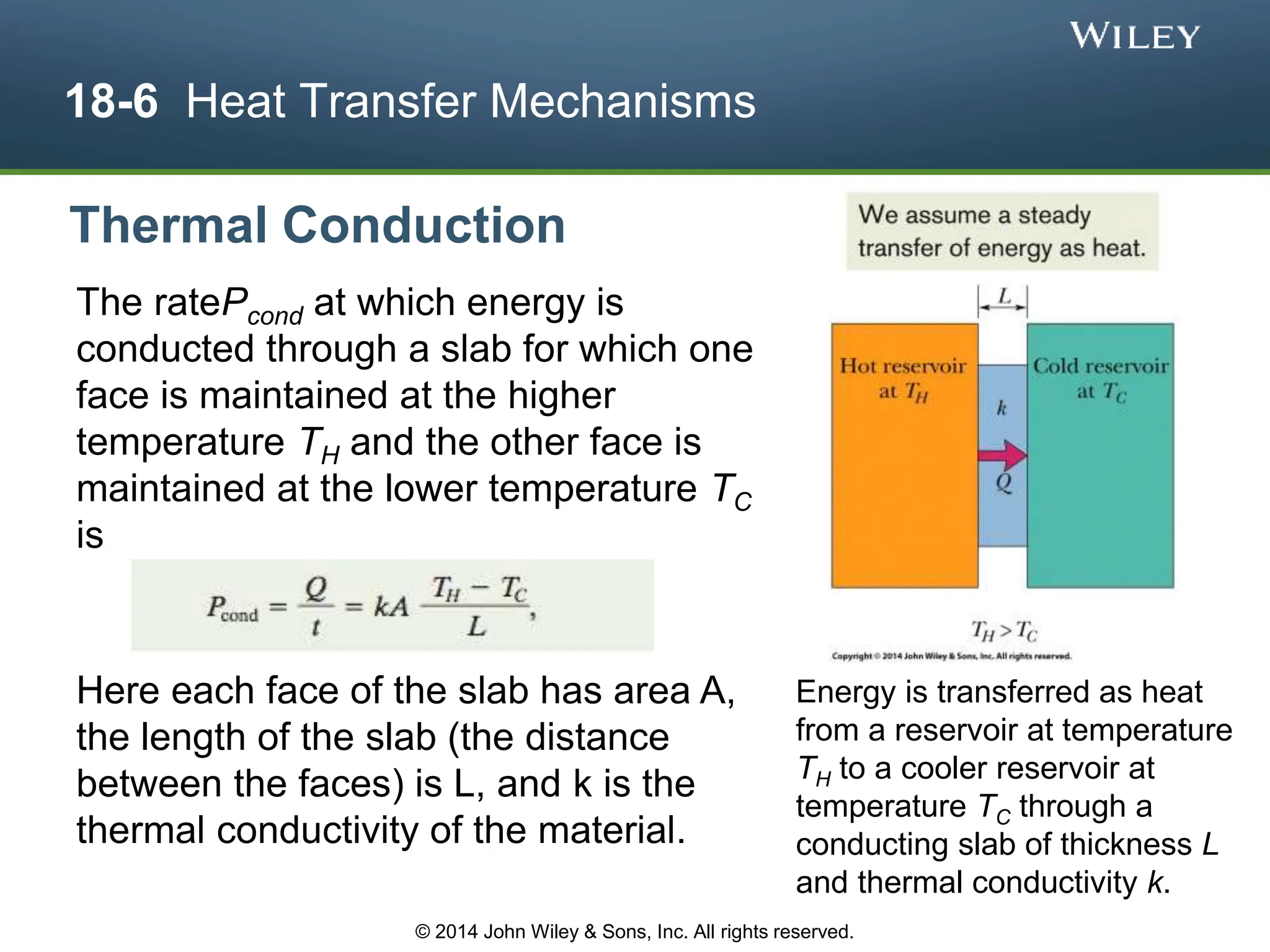
The ratePcond at which energy is
conducted through a slab for which one
face is maintained at the higher
temperature TH and the other face is
maintained at the lower temperature TC
is
Thermal Conduction
Here each face of the slab has area A,
the length of the slab (the distance
between the faces) is L, and k is the
thermal conductivity of the material.
© 2014 John Wiley & Sons, Inc. All rights reserved.
Energy is transferred as heat
from a reservoir at temperature
TH to a cooler reservoir at
temperature TC through a
conducting slab of thickness L
and thermal conductivity k.
18-6 Heat Transfer Mechanisms
• Convection occurs when temperature differences cause an
energy transfer by motion within a fluid.
• When you look at the flame of a candle or a match, you are
watching thermal energy being transported upward by
convection.
• Convection is part of many natural processes. Atmospheric
convection plays a fundamental role in determining global
climate patterns and daily weather vari- ations. Glider pilots
and birds alike seek rising thermals (convection currents of
warm air) that keep them aloft. Huge energy transfers take
place within the oceans by the same process.
Convection
© 2014 John Wiley & Sons, Inc. All rights reserved.
18-6 Heat Transfer Mechanisms
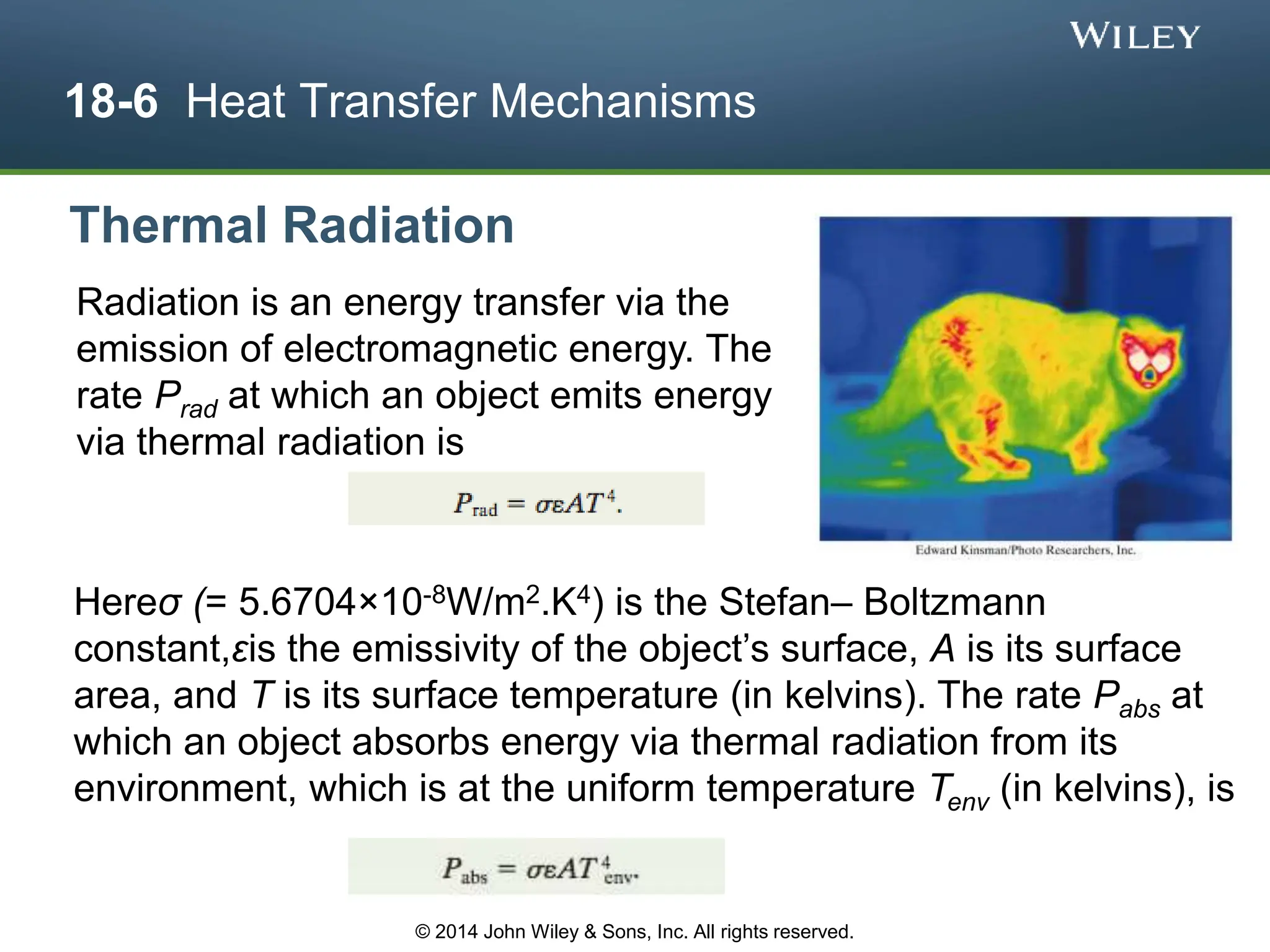
Radiation is an energy transfer via the
emission of electromagnetic energy. The
rate Prad at which an object emits energy
via thermal radiation is
Thermal Radiation
Hereσ (= 5.6704×10⁻⁸W/m2.K4) is the Stefan– Boltzmann
constant,εis the emissivity of the object’s surface, A is its surface
area, and T is its surface temperature (in kelvins). The rate Pabs at
which an object absorbs energy via thermal radiation from its
environment, which is at the uniform temperature Tenv (in kelvins), is
© 2014 John Wiley & Sons, Inc. All rights reserved.
18 Summary
Temperature and Thermometer
• SI base quantity related to our
sense of hot and cold.
• It is measured using thermometer
Zeroth Law of Thermodynamics
• If bodies A and B are each in
thermal equilibrium with a third body
C (the thermometer), then A and B
are in thermal equilibrium with each
other.
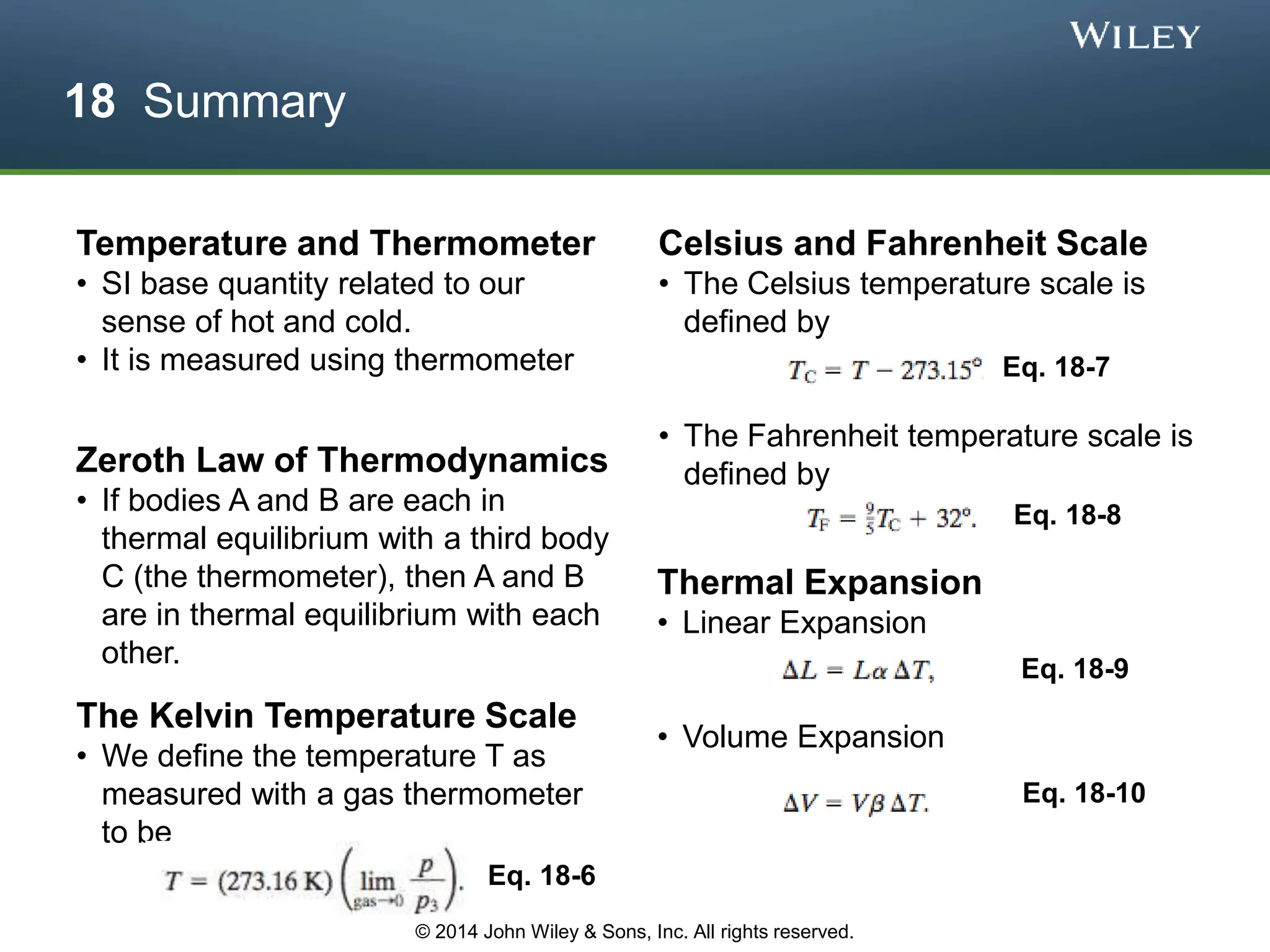
The Kelvin Temperature Scale
• We define the temperature T as
measured with a gas thermometer
to be
Eq. 18-6
Celsius and Fahrenheit Scale
• The Celsius temperature scale is
defined by
• The Fahrenheit temperature scale is
defined by
Eq. 18-7
Eq. 18-8
Thermal Expansion
• Linear Expansion
• Volume Expansion
Eq. 18-9
Eq. 18-10
© 2014 John Wiley & Sons, Inc. All rights reserved.
Engineering Physics chapter 18 ch18-10e.ppt

Engineering Physics chapter 18 ch18-10e.ppt

  • 1.
    Temperature, Heat, andthe First Law of Thermodynamics Chapter 18 Copyright © 2014 John Wiley & Sons, Inc. All rights reserved.
  • 2.
    18-1 Temperature 18.01 Identifythe lowest temperature as 0 on the Kelvin scale (absolute zero). 18.02 Explain the zeroth law of thermodynamics. 18.03 Explain the conditions for the triple-point temperature. 18.04 Explain the conditions for measuring a temperature with a constant-volume gas thermometer. 18.05 For a constant-volume gas thermometer, relate the pressure and temperature of the gas in some given state to the pressure and temperature at the triple point. Learning Objectives © 2014 John Wiley & Sons, Inc. All rights reserved.
  • 3.
    18-1 Temperature • Thermodynamicsis the study and application of the thermal energy (often called the internal energy) of systems. One of the central concepts of thermodynamics is temperature. • Temperature is an SI base quantity related to our sense of hot and cold. It is measured with a thermometer, which con- tains a working substance with a measurable property, such as length or pressure, that changes in a regular way as the substance becomes hotter or colder. Physicists measure temperature on the Kelvin scale, which is marked in units called kelvins. © 2014 John Wiley & Sons, Inc. All rights reserved.
  • 4.
    18-1 Temperature The ZerothLaw of Thermodynamics Two bodies are in thermal equilibrium if they are at the same temperature throughout and therefore no heat will flow from one body to the other. © 2014 John Wiley & Sons, Inc. All rights reserved.
  • 5.
    18-1 Temperature Triple Pointof Water • The Triple point of water is the point in which solid ice, liquid water, and water vapor coexist in thermal equilibrium. (This does not occur at normal atmospheric pressure.) • By international agreement, the temperature of this mixture has been defined to be 273.16 K. The bulb of a constant-volume gas thermometer is shown inserted into the well of the cell. A triple-point cell © 2014 John Wiley & Sons, Inc. All rights reserved.
  • 6.
    18-1 Temperature Constant-Volume GasThermometer • It consists of a gas-filled bulb connected by a tube to a mercury manometer. By raising and lowering reservoir R, the mercury level in the left arm of the U-tube can always be brought to the zero of the scale to keep the gas volume constant. • the recipe for measuring a temperature with a gas thermometer, where p is the observed pressure and p3 is the pressure at the triple point of water, is Constant-Volume Gas Thermometer © 2014 John Wiley & Sons, Inc. All rights reserved.
  • 7.
    18-2 The Celsiusand Fahrenheit Scales 18.06 Convert a temperature between any two (linear) temperature scales, including the Celsius, Fahrenheit, and Kelvin scales. 18.07 Identify that a change of one degree is the same on the Celsius and Kelvin scales. Learning Objectives © 2014 John Wiley & Sons, Inc. All rights reserved.
  • 8.
    18-2 The Celsiusand Fahrenheit Scales • The Celsius temperature scale is defined by with T in kelvins. • The Fahrenheit temperature scale is defined by The Kelvin,Celsius,and Fahrenheit temperature scales compared. © 2014 John Wiley & Sons, Inc. All rights reserved.
  • 9.
    18-3 Thermal Expansion 18.08For one-dimensional thermal expansion, apply the relationship between the temperature change ΔT, the length change ΔL, the initial length L, and the coefficient of linear expansion . 18.09 For two-dimensional thermal expansion, use one dimensional thermal expansion to find the change in area. 18.10 For three-dimensional thermal expansion, apply the relationship between the temperature change ΔT, the volume change ΔV, the initial volume V, and the coefficient of volume expansion β. Learning Objectives © 2014 John Wiley & Sons, Inc. All rights reserved.
  • 10.
    18-3 Thermal Expansion •All objects change size with changes in temperature. For a temperature changeΔT, a changeΔLin any linear dimensionL is given by The strip bends as shown at tempera tures above this reference temperature. Below the reference temperature the strip bends the other way. Many thermo- stats operate on this principle, making and breaking an electrical contact as the temperature rises and falls. Linear Expansion © 2014 John Wiley & Sons, Inc. All rights reserved. in which αis the coefficient of linear expansion.
  • 11.
    18-3 Thermal Expansion •If the temperature of a solid or liquid whose volume is V is increased by an amountΔT, the increase in volume is found to be in which βis the coefficient of volume expansion and is related to linear expansion in this way, Volume Expansion Answer: (a) – 2 and 3 (same increase in height), then 1, and then 4 (b) – 3, then 2, then 1 and 4 (identical increase in area) © 2014 John Wiley & Sons, Inc. All rights reserved.
  • 12.
    18-4 Absorption ofHeat 18.11 Identify that thermal energy is associated with the random motions of the microscopic bodies in an object. 18.12 Identify that heat Q is the amount of transferred energy (either to or from an object’s thermal energy) due to a temperature difference between the object and its environment. 18.13 Convert energy units between various measurement systems. 18.14 Convert between mechanical or electrical energy and thermal energy. 18.15 For a temperature change ΔT of a substance, relate the change to the heat transfer Q and the substance’s heat capacity C. 18.16 For a temperature change ΔT of a substance, relate the change to the heat transfer Q and the substance’s specific heat c and mass m. Learning Objectives © 2014 John Wiley & Sons, Inc. All rights reserved.
  • 13.
    18-4 Absorption ofHeat 18.17 Identify the three phases of matter. 18.18 For a phase change of a substance, relate the heat transfer Q, the heat of transformation L, and the amount of mass m transformed. 18.19 Identify that if a heat transfer Q takes a substance across a phase-change temperature, the transfer must be calculated in steps: (a) a temperature change to reach the phase-change temperature, (b) the phase change, and then (c) any temperature change that moves the substance away from the phase-change temperature. Learning Objectives (continued…) © 2014 John Wiley & Sons, Inc. All rights reserved.
  • 14.
    18-4 Absorption ofHeat Temperature and Heat • Heat Q is energy that is transferred between a system and its environment because of a temperature difference between them. • It can be measured in joules (J), calories (cal), kilocalories (Cal or kcal), or British thermal units (Btu), with © 2014 John Wiley & Sons, Inc. All rights reserved.
  • 15.
    18-4 Absorption ofHeat Absorption of Heat by Solids and Liquids • The heat capacity C of an object is the proportionality constant between the heat Q that the object absorbs or loses and the resulting temperature changeΔTof the object; that is, in which Ti and Tfare the initial and final temperatures of the object. If the object has mass m, then, where c is the specific heat of the material making up the object. Answer: Material A has the greater specific heat © 2014 John Wiley & Sons, Inc. All rights reserved.
  • 16.
    18-4 Absorption ofHeat • When quantities are expressed in moles, specific heats must also involve moles (rather than a mass unit); they are then called molar specific heats. Table shows the values for some elemental solids (each consisting of a single element) at room temperature. • The amount of energy per unit mass that must be transferred as heat when a sample completely undergoes a phase change is called the heat of transformation L.Thus, when a sample of mass mcompletely undergoes a phase change, the total energy transferred is © 2014 John Wiley & Sons, Inc. All rights reserved.
  • 17.
    18-5 The FirstLaw of Thermodynamics 18.20 If an enclosed gas expands or contracts, calculate the work W done by the gas by integrating the gas pressure with respect to the volume of the enclosure. 18.21 Identify the algebraic sign of work W associated with expansion and contraction of a gas. 18.22 Given a p-V graph of pressure versus volume for a process, identify the starting point (the initial state) and the final point (the final state) and calculate the work by using graphical integration. 18.23 On a p-V graph of pressure versus volume for a gas, identify the algebraic sign of the work associated with a right-going process and a left- going process. 18.24 Apply the first law of thermodynamics to relate the change in the internal energy ΔEint of a gas, the energy Q transferred as heat to or from the gas, and the work W done on or by the gas. Learning Objectives © 2014 John Wiley & Sons, Inc. All rights reserved.
  • 18.
    18-5 The FirstLaw of Thermodynamics 18.25 Identify the algebraic sign of a heat transfer Q that is associated with a transfer to a gas and a transfer from the gas. 18.26 Identify that the internal energy ΔEint of a gas tends to increase if the heat transfer is to the gas, and it tends to decrease if the gas does work on its environment. 18.27 Identify that in an adiabatic process with a gas, there is no heat transfer Q with the environment. 18.28 Identify that in a constant- volume process with a gas, there is no work W done by the gas. 18.29 Identify that in a cyclical process with a gas, there is no net change in the internal energy ΔEint. 18.30 Identify that in a free expansion with a gas, the heat transfer Q, work done W, and change in internal energy ΔEint are each zero. Learning Objectives (Continued) © 2014 John Wiley & Sons, Inc. All rights reserved.
  • 19.
    18-5 The FirstLaw of Thermodynamics A gas may exchange energy with its surroundings through work. The amount of work W done by a gas as it expands or contracts from an initial volume Vi to a final volume Vf is given by The integration is necessary because the pressure p may vary during the volume change. Heat and Work A gas confined to a cylinder with a movable piston. © 2014 John Wiley & Sons, Inc. All rights reserved.
  • 20.
    18-5 The FirstLaw of Thermodynamics Heat and Work A gas confined to a cylinder with a movable piston. © 2014 John Wiley & Sons, Inc. All rights reserved.
  • 21.
    18-5 The FirstLaw of Thermodynamics The principle of conservation of energy for a thermodynamic process is expressed in the first law of thermodynamics, which may assume either of the forms: Or, if the thermodynamic system undergoes only a differential change, we can write the first law as: The First Law of Thermodynamics © 2014 John Wiley & Sons, Inc. All rights reserved.
  • 22.
    18-5 The FirstLaw of Thermodynamics © 2014 John Wiley & Sons, Inc. All rights reserved.
  • 23.
    18-6 Heat TransferMechanisms 18.31 For thermal conduction through a layer, apply the relationship between the energy-transfer rate Pcond and the layer’s area A, thermal conductivity k, thickness L, and temperature difference ΔT (between its two sides). 18.32 For a composite slab (two or more layers) that has reached the steady state in which temperatures are no longer changing, identify that (by the conservation of energy) the rates of thermal conduction Pcond through the layers must be equal. 18.33 For thermal conduction through a layer, apply the relationship between thermal resistance R, thickness L, and thermal conductivity k. 18.34 Identify that thermal energy can be transferred by convection, in which a warmer fluid (gas or liquid) tends to rise in a cooler fluid. Learning Objectives © 2014 John Wiley & Sons, Inc. All rights reserved.
  • 24.
    18-6 Heat TransferMechanisms 18.35 In the emission of thermal radiation by an object, apply the relationship between the energy-transfer rate Prad and the object’s surface area A, emissivity , and surface temperature T (in kelvins). 18.36 In the absorption of thermal radiation by an object, apply the relationship between the energy-transfer rate Pabs and the object’s surface area A and emissivity , and the environmental temperature T (in kelvins). 18.37 Calculate the net energy transfer rate Pnet of an object emitting radiation to its environment and absorbing radiation from that environment. Learning Objectives (Continued) © 2014 John Wiley & Sons, Inc. All rights reserved.
  • 25.
    18-6 Heat TransferMechanisms The ratePcond at which energy is conducted through a slab for which one face is maintained at the higher temperature TH and the other face is maintained at the lower temperature TC is Thermal Conduction Here each face of the slab has area A, the length of the slab (the distance between the faces) is L, and k is the thermal conductivity of the material. © 2014 John Wiley & Sons, Inc. All rights reserved. Energy is transferred as heat from a reservoir at temperature TH to a cooler reservoir at temperature TC through a conducting slab of thickness L and thermal conductivity k.
  • 26.
    18-6 Heat TransferMechanisms • Convection occurs when temperature differences cause an energy transfer by motion within a fluid. • When you look at the flame of a candle or a match, you are watching thermal energy being transported upward by convection. • Convection is part of many natural processes. Atmospheric convection plays a fundamental role in determining global climate patterns and daily weather vari- ations. Glider pilots and birds alike seek rising thermals (convection currents of warm air) that keep them aloft. Huge energy transfers take place within the oceans by the same process. Convection © 2014 John Wiley & Sons, Inc. All rights reserved.
  • 27.
    18-6 Heat TransferMechanisms Radiation is an energy transfer via the emission of electromagnetic energy. The rate Prad at which an object emits energy via thermal radiation is Thermal Radiation Hereσ (= 5.6704×10⁻⁸W/m2.K4) is the Stefan– Boltzmann constant,εis the emissivity of the object’s surface, A is its surface area, and T is its surface temperature (in kelvins). The rate Pabs at which an object absorbs energy via thermal radiation from its environment, which is at the uniform temperature Tenv (in kelvins), is © 2014 John Wiley & Sons, Inc. All rights reserved.
  • 28.
    18 Summary Temperature andThermometer • SI base quantity related to our sense of hot and cold. • It is measured using thermometer Zeroth Law of Thermodynamics • If bodies A and B are each in thermal equilibrium with a third body C (the thermometer), then A and B are in thermal equilibrium with each other. The Kelvin Temperature Scale • We define the temperature T as measured with a gas thermometer to be Eq. 18-6 Celsius and Fahrenheit Scale • The Celsius temperature scale is defined by • The Fahrenheit temperature scale is defined by Eq. 18-7 Eq. 18-8 Thermal Expansion • Linear Expansion • Volume Expansion Eq. 18-9 Eq. 18-10 © 2014 John Wiley & Sons, Inc. All rights reserved.