The Energy Challenge and
      Introduction to Solar Cells
            Splash program for High School Students, MIT 2011


Burhan Saifaddin
Outline
•   The importance of Energy
•   The energy Challenge
•   Introduction to Solar Cells
•   Organic Photovoltaic Research
What is Energy !!

• Brain storm the importance of energy and its uses:
   Examples on the impact of energy :
   – Transportation
   – Housing
   – Industry
      • Materials
      • Manufacturing
   – Information Technology
   – Food
   – People and every living being

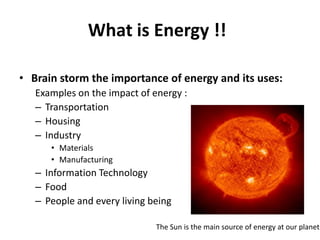
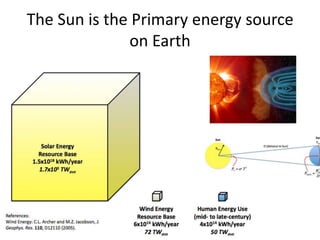
                              The Sun is the main source of energy at our planet.
What is Energy !!
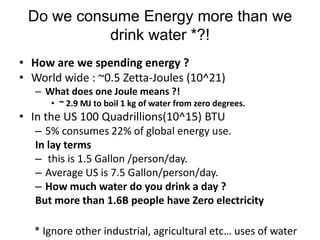
• Discovery of Energy.
• Matter is Energy. Everything is Energy.
   – The Big bang started the universe.
   – Biological Life is based on the consumption of energy.
   – Fire discovery ended Stone Age
   More recently :
   – Steam Engine started the industrial revolution
   – Electricity started communication, tranportation and
     information revolution
   – Nuclear energy started the nuclear age.
Do we consume Energy more than we
           drink water *?!
• How are we spending energy ?
• World wide : ~0.5 Zetta-Joules (10^21)
   – What does one Joule means ?!
      • ~ 2.9 MJ to boil 1 kg of water from zero degrees.
• In the US 100 Quadrillions(10^15) BTU
   – 5% consumes 22% of global energy use.
   In lay terms
   – this is 1.5 Gallon /person/day.
   – Average US is 7.5 Gallon/person/day.
   – How much water do you drink a day ?
   But more than 1.6B people have Zero electricity

  * Ignore other industrial, agricultural etc… uses of water
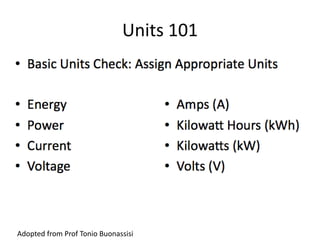
Units 101


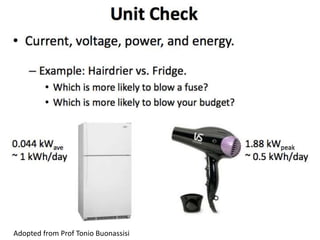
Adopted from Prof Tonio Buonassisi
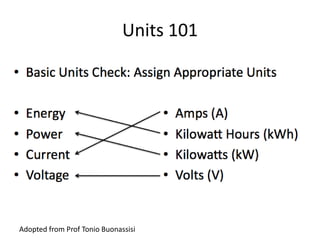
Units 101


Adopted from Prof Tonio Buonassisi
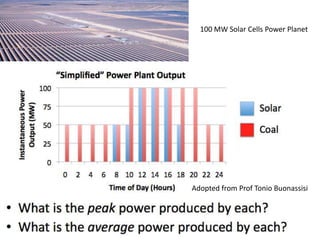
100 MW Solar Cells Power Planet


Adopted from Prof Tonio Buonassisi
The Energy Challenge
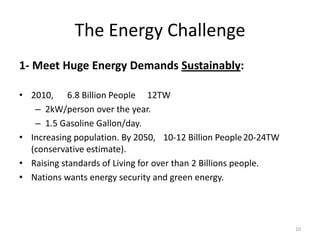
1- Meet Huge Energy Demands Sustainably:

• 2010, 6.8 Billion People 12TW
   – 2kW/person over the year.
   – 1.5 Gasoline Gallon/day.
• Increasing population. By 2050, 10-12 Billion People 20-24TW
  (conservative estimate).
• Raising standards of Living for over than 2 Billions people.
• Nations wants energy security and green energy.


                                                                 10
The Energy Challenge
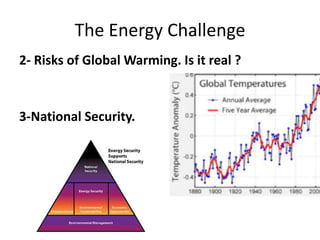
2- Risks of Global Warming. Is it real ?


3-National Security.
Why meet the Energy Challenge
• Meet Global Energy Demands in a sustainable
  way.
• Big economic growth: Energy is a Trillions of
  Dollars Industry.
  – 30% growth in photovoltaic market in the past 6
    years.
• Enable cheap and distributed power sources.
• Empower people around the world.
  – 25 % of humanity have no electricity.

                                                      12
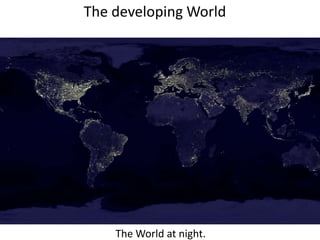
The developing World


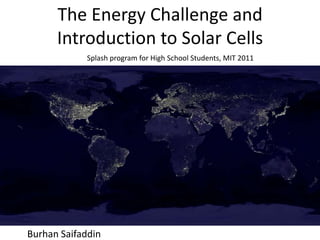
    The World at night.
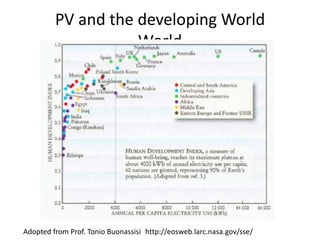
PV and the developing World
                    World


Adopted from Prof. Tonio Buonassisi http://eosweb.larc.nasa.gov/sse/
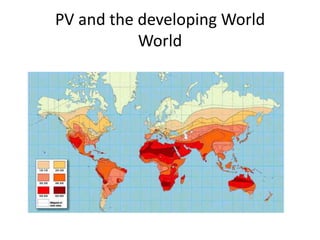
PV and the developing World
           World
The Sun is the Primary energy source
              on Earth
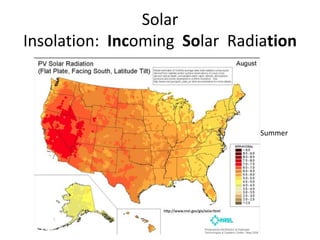
Solar
Insolation: Incoming Solar Radiation


                               Summer
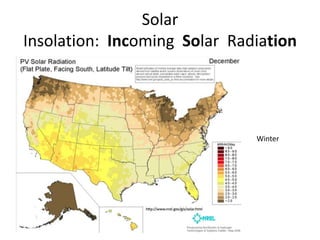
Solar
Insolation: Incoming Solar Radiation


                              Winter
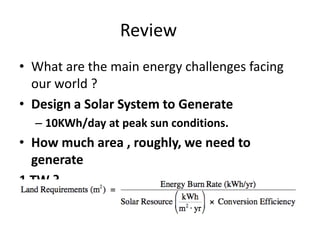
Review
• What are the main energy challenges facing
  our world ?
• Design a Solar System to Generate
  – 10KWh/day at peak sun conditions.
• How much area , roughly, we need to
  generate
1 TW ?
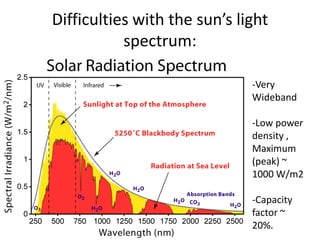
Difficulties with the sun’s light
           spectrum:

                              -Very
                              Wideband

                              -Low power
                              density ,
                              Maximum
                              (peak) ~
                              1000 W/m2

                              -Capacity
                              factor ~
                              20%.
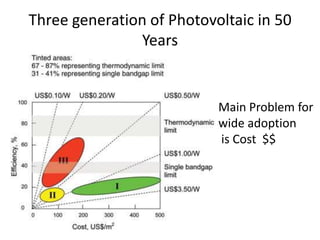
Three generation of Photovoltaic in 50
                Years


                           Main Problem for
                           wide adoption
                           is Cost $$
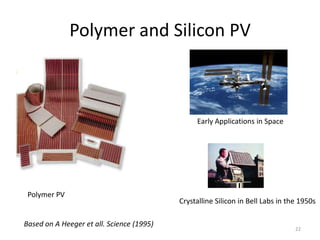
Polymer and Silicon PV
• TTwo


                                                Early Applications in Space


 Polymer PV
                                           Crystalline Silicon in Bell Labs in the 1950s

Based on A Heeger et all. Science (1995)
                                                                                 22
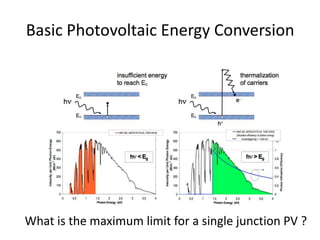
Basic Photovoltaic Energy Conversion


What is the maximum limit for a single junction PV ?
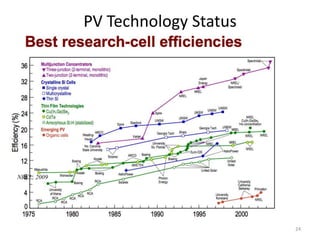
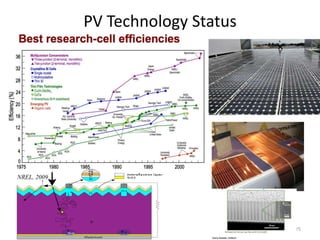
PV Technology Status


NREL, 2009


                                    24
PV Technology Status


NREL, 2009


                                    25
Motivation for Cheap Solar Cells
• Meet Global Energy Demands in a sustainable
  way.
• Big economic growth.
  – 30% growth in photovoltaic market in the past 6
    years.
• Enable cheap and distributed power sources.
• Empower people around the world.
  – 25 % of humanity have no electricity.

  Why Polymers or Organic Materials ?
                                                      26
Additionally Huge Economic
             Advantages.
• Big economic growth.
  – Potentially trillions of dollars market size.
  – 30% growth in photovoltaic market in the past 10
    years.
  – DOE expect grid parity for PV tech. in 2020.
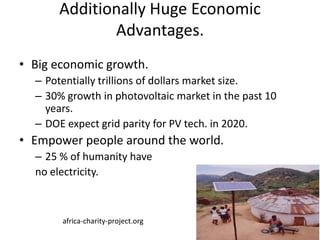
• Empower people around the world.
  – 25 % of humanity have
  no electricity.


       africa-charity-project.org
                                                       27
Basic Overview of the Organic PV
              Technology
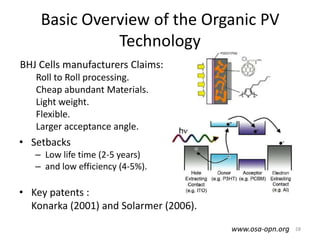
BHJ Cells manufacturers Claims:
   Roll to Roll processing.
   Cheap abundant Materials.
   Light weight.
   Flexible.
   Larger acceptance angle.
• Setbacks
   – Low life time (2-5 years)
   – and low efficiency (4-5%).

• Key patents :
  Konarka (2001) and Solarmer (2006).

                                        www.osa-opn.org   28
PV Researchers and entrepreneurs dream


• Covers large area of land with PV cells.
   – 1 % of US land to satisfy US electricity needs.
   – Spain size to satisfy 20TW increase in demand.
   – Small contribution to global warming , comparable to US
     black highways.
   – Reasonable fraction Targets by 2030 and by 2050.

• However to be competitive in the grid parity market
   – 5c/KWh at around 1$/W for the whole system.
   – Improve lifetime in outdoor conditions.


                                                               29
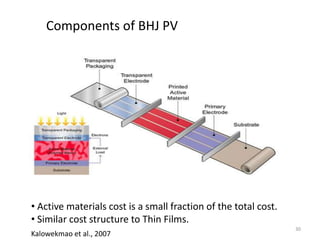
Components of BHJ PV


• Active materials cost is a small fraction of the total cost.
• Similar cost structure to Thin Films.
.                                                                30
Kalowekmao et al., 2007
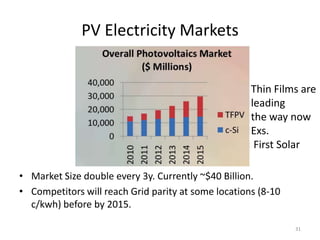
PV Electricity Markets


                                                     Thin Films are
                                                     leading
                                                     the way now
                                                     Exs.
                                                      First Solar

• Market Size double every 3y. Currently ~$40 Billion.
• Competitors will reach Grid parity at some locations (8-10
  c/kwh) before by 2015.

                                                               31
Solar systems cost
• Balance of System (>50%)
  – 1- Light weight plastic substrate.
  – Glass substrate
       • Cost is Different in developing nations
• Balance of Materials
  – In crystalline silicon materials cost is 10% , 2-3
    C/KWh(1).

  (1) Nathan S. Lewis. SCIENCE 9 FEB 2007 VOL 315.


                                                         32
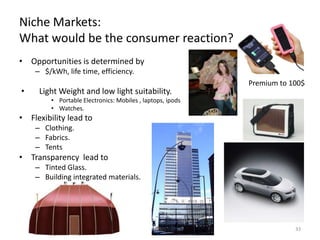
Niche Markets:
What would be the consumer reaction?
• Opportunities is determined by
    – $/kWh, life time, efficiency.
                                                            Premium to 100$
•    Light Weight and low light suitability.
         • Portable Electronics: Mobiles , laptops, ipods
         • Watches.
• Flexibility lead to
    – Clothing.
    – Fabrics.
    – Tents
• Transparency lead to
    – Tinted Glass.
    – Building integrated materials.
    – Automobiles.


                                                                        33

Energy pv splash

  • 1.
    The Energy Challengeand Introduction to Solar Cells Splash program for High School Students, MIT 2011 Burhan Saifaddin
  • 2.
    Outline • The importance of Energy • The energy Challenge • Introduction to Solar Cells • Organic Photovoltaic Research
  • 3.
    What is Energy!! • Brain storm the importance of energy and its uses: Examples on the impact of energy : – Transportation – Housing – Industry • Materials • Manufacturing – Information Technology – Food – People and every living being The Sun is the main source of energy at our planet.
  • 4.
    What is Energy!! • Discovery of Energy. • Matter is Energy. Everything is Energy. – The Big bang started the universe. – Biological Life is based on the consumption of energy. – Fire discovery ended Stone Age More recently : – Steam Engine started the industrial revolution – Electricity started communication, tranportation and information revolution – Nuclear energy started the nuclear age.
  • 5.
    Do we consumeEnergy more than we drink water *?! • How are we spending energy ? • World wide : ~0.5 Zetta-Joules (10^21) – What does one Joule means ?! • ~ 2.9 MJ to boil 1 kg of water from zero degrees. • In the US 100 Quadrillions(10^15) BTU – 5% consumes 22% of global energy use. In lay terms – this is 1.5 Gallon /person/day. – Average US is 7.5 Gallon/person/day. – How much water do you drink a day ? But more than 1.6B people have Zero electricity * Ignore other industrial, agricultural etc… uses of water
  • 6.
    Units 101 Adopted fromProf Tonio Buonassisi
  • 7.
    Units 101 Adopted fromProf Tonio Buonassisi
  • 8.
    Adopted from ProfTonio Buonassisi
  • 9.
    100 MW SolarCells Power Planet Adopted from Prof Tonio Buonassisi
  • 10.
    The Energy Challenge 1-Meet Huge Energy Demands Sustainably: • 2010, 6.8 Billion People 12TW – 2kW/person over the year. – 1.5 Gasoline Gallon/day. • Increasing population. By 2050, 10-12 Billion People 20-24TW (conservative estimate). • Raising standards of Living for over than 2 Billions people. • Nations wants energy security and green energy. 10
  • 11.
    The Energy Challenge 2-Risks of Global Warming. Is it real ? 3-National Security.
  • 12.
    Why meet theEnergy Challenge • Meet Global Energy Demands in a sustainable way. • Big economic growth: Energy is a Trillions of Dollars Industry. – 30% growth in photovoltaic market in the past 6 years. • Enable cheap and distributed power sources. • Empower people around the world. – 25 % of humanity have no electricity. 12
  • 13.
    The developing World The World at night.
  • 14.
    PV and thedeveloping World World Adopted from Prof. Tonio Buonassisi http://eosweb.larc.nasa.gov/sse/
  • 15.
    PV and thedeveloping World World
  • 16.
    The Sun isthe Primary energy source on Earth
  • 17.
  • 18.
  • 19.
    Review • What arethe main energy challenges facing our world ? • Design a Solar System to Generate – 10KWh/day at peak sun conditions. • How much area , roughly, we need to generate 1 TW ?
  • 20.
    Difficulties with thesun’s light spectrum: -Very Wideband -Low power density , Maximum (peak) ~ 1000 W/m2 -Capacity factor ~ 20%.
  • 21.
    Three generation ofPhotovoltaic in 50 Years Main Problem for wide adoption is Cost $$
  • 22.
    Polymer and SiliconPV • TTwo Early Applications in Space Polymer PV Crystalline Silicon in Bell Labs in the 1950s Based on A Heeger et all. Science (1995) 22
  • 23.
    Basic Photovoltaic EnergyConversion What is the maximum limit for a single junction PV ?
  • 24.
  • 25.
  • 26.
    Motivation for CheapSolar Cells • Meet Global Energy Demands in a sustainable way. • Big economic growth. – 30% growth in photovoltaic market in the past 6 years. • Enable cheap and distributed power sources. • Empower people around the world. – 25 % of humanity have no electricity. Why Polymers or Organic Materials ? 26
  • 27.
    Additionally Huge Economic Advantages. • Big economic growth. – Potentially trillions of dollars market size. – 30% growth in photovoltaic market in the past 10 years. – DOE expect grid parity for PV tech. in 2020. • Empower people around the world. – 25 % of humanity have no electricity. africa-charity-project.org 27
  • 28.
    Basic Overview ofthe Organic PV Technology BHJ Cells manufacturers Claims: Roll to Roll processing. Cheap abundant Materials. Light weight. Flexible. Larger acceptance angle. • Setbacks – Low life time (2-5 years) – and low efficiency (4-5%). • Key patents : Konarka (2001) and Solarmer (2006). www.osa-opn.org 28
  • 29.
    PV Researchers andentrepreneurs dream • Covers large area of land with PV cells. – 1 % of US land to satisfy US electricity needs. – Spain size to satisfy 20TW increase in demand. – Small contribution to global warming , comparable to US black highways. – Reasonable fraction Targets by 2030 and by 2050. • However to be competitive in the grid parity market – 5c/KWh at around 1$/W for the whole system. – Improve lifetime in outdoor conditions. 29
  • 30.
    Components of BHJPV • Active materials cost is a small fraction of the total cost. • Similar cost structure to Thin Films. . 30 Kalowekmao et al., 2007
  • 31.
    PV Electricity Markets Thin Films are leading the way now Exs. First Solar • Market Size double every 3y. Currently ~$40 Billion. • Competitors will reach Grid parity at some locations (8-10 c/kwh) before by 2015. 31
  • 32.
    Solar systems cost •Balance of System (>50%) – 1- Light weight plastic substrate. – Glass substrate • Cost is Different in developing nations • Balance of Materials – In crystalline silicon materials cost is 10% , 2-3 C/KWh(1). (1) Nathan S. Lewis. SCIENCE 9 FEB 2007 VOL 315. 32
  • 33.
    Niche Markets: What wouldbe the consumer reaction? • Opportunities is determined by – $/kWh, life time, efficiency. Premium to 100$ • Light Weight and low light suitability. • Portable Electronics: Mobiles , laptops, ipods • Watches. • Flexibility lead to – Clothing. – Fabrics. – Tents • Transparency lead to – Tinted Glass. – Building integrated materials. – Automobiles. 33

Editor's Notes

  • #11 Humanity is facing a great challenge of satisfying Energy Demands and growth for every able personIn 40 years energy consumption will doubleOil cost will increase, raises even more energy security and energy independence issues
  • #23 Konarka’s 250,000 sq. ft. manufacturing facility in New Bedford, MA, b•Low light sensitivity•Thin, lightweight & flexible•Easyinstallation•Organic•Roll to roll printed. Material thickness: 0.5mm+/-0.05mmFlexibilityRoll It. Wrap It. Hang It.AdaptabilityHarness energy even in low light — both indoors and out — at up to 70° off axis.ApplicabilityApplicable to a wide variety of uses. May be combined to provide greater power.VersatilityApply it to accessories, structures, cars, awnings, tents, and more.
  • #25 Include only the best lab cell not the averageIDoes not include cost
  • #26 Include only the best lab cell not the averageIDoes not include cost
  • #28 Photovoltaic technologies is easily scalable to be a Trillions of dollars industry if it can compete with coal in rural electrification. Many PV companies including polymers PV companies like KonarkanadSolarmer claims that to be possible in the next 10 years. Rural electrfication was voted by the aaas to be the most important technoligcal innovation in the past centry , more crucial thean pc , Internet , IC …
  • #31 They promised paradigm shift , they promised lower costs , they promised lower efficiencyAny way now they are focusing on niche marketsIn theory Roll to Roll can manufacture in a day what a typical Si Solar manufacture in one year at mouch cheaper cost.
  • #32 You need thirdgeneration materialsRR Process cheap and fast prod. Of modulus. Cheap as paper and plastic. .1% ($50B exist only because of subsdies ! Can current the fin crisis affect that ?) to 1% in 2020. (extrapolate current trend 33% !!)
  • #33 tirely due to small reflection losses, grid shading losses, and other losses at the 5 to 10% level that any practical system will have to some extent. Shipped PV modules now have efficiencies of 15 to 20% in many cases. At such an efficiency, if the cost of a module is ~$300/m2 (2), and if we take into account the accompanying fixed costs in the so-called “balance of systems” (such as the inverter, grid connection, etc., which add a factor of ~2 to the total installed system cost), then the sale price of grid-connected PV elec- tricity must be $0.25 to $0.30 per kilowatt-hour (kWh) to recover the initial capital investment and cost of money over the lifetime of the PV installation (2, 4). Currently, however, utility- scale electrical power generation costs are much less, with current and new installations costing ~$0.03 to $0.05 per kWh (1). Hence, for solar electricity to be cost-competitive with fossil- based electricity at utility scale, improvements in efficiency are helpful, but manufacturing costs must be substantially reduced.In current manufacturing schemes for Si- based solar cells, the cost of the processed and purified Si is only about 10% of the final cost of the PV module. Some of the Si is lost in cutting up boules into wafers, and other costs are incurred in polishing the wafers, making the diffused junction in the Si into a photovoltaic device, fabricating the conducting transparent glass, masking and making the electrical con- tacts, sealing the cells, connecting the cells together reliably into a module, and sealing the module for shipment. Hence, in such systems, the energy conversion efficiency is at a premium so as to better amortize these other fixed costs involved with making the final PV module
  • #34 Need good bussiness models