






Utility solar: and the next industrial revolution
 Sierra Club: San Carlos/Belmont Group, Sustainable Land Use Committee
 David F. Taggart, President/COO Belectric North America
 November 12, 2011
The next industrial revolution!

• The greatest economic revolutions were born from energy
  revolutions
• They mandated infrastructural and communicative
  changes, requiring industry and government collaboration
• This new paradigm is based on free fuel available to all,
  and distributed power at costs below conventional
• Integrated with the power of the internet, digital energy
  management, and clean transportation technologies, this
  revolution will profoundly change our world
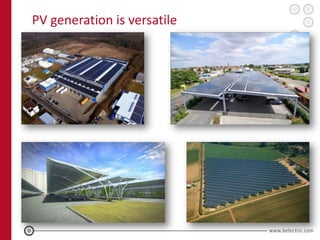
PV generation is versatile
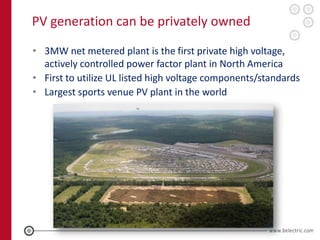
PV generation can be privately owned

• 3MW net metered plant is the first private high voltage,
  actively controlled power factor plant in North America
• First to utilize UL listed high voltage components/standards
• Largest sports venue PV plant in the world
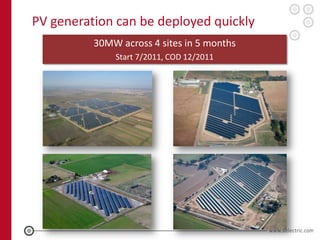
PV generation can be deployed quickly
          30MW across 4 sites in 5 months
              Start 7/2011, COD 12/2011
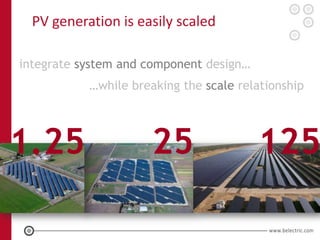
PV generation is easily scaled

integrate system and component design…
           …while breaking the scale relationship


1.25                  25                 125
How did we get here?
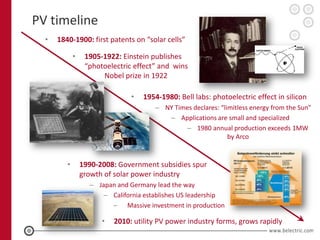
PV timeline
  •   1840-1900: first patents on “solar cells”

             •    1905-1922: Einstein publishes
                  “photoelectric effect” and wins
                       Nobel prize in 1922

                                •   1954-1980: Bell labs: photoelectric effect in silicon
                                       – NY Times declares: “limitless energy from the Sun”
                                          – Applications are small and specialized
                                               – 1980 annual production exceeds 1MW
                                                               by Arco


         •       1990-2008: Government subsidies spur
                 growth of solar power industry
                   – Japan and Germany lead the way
                       – California establishes US leadership
                         – Massive investment in production

                       •   2010: utility PV power industry forms, grows rapidly
What is behind the sudden growth of
utility PV power?
• Economies of scale
• Energy security concerns spurred investment
• Investment climate has improved from 2008 crisis
• Stable government incentive thru 2016: the ITC
• RPS requirements encourage investments
  – 20% renewables by 2013
  – 33% renewables by 2020
• Rapid increase in production capacity of polysilicon
  coincided with reduction in European incentives and
  economic crisis
• Installation of larger plants enables tremendous efficiencies
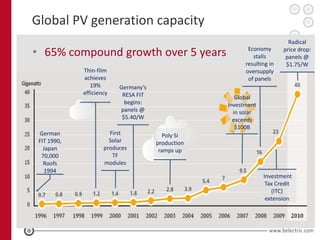
Global PV generation capacity
                                                                          Radical
• 65% compound growth over 5 years                        Economy
                                                            stalls
                                                                        price drop:
                                                                         panels @
                                                         resulting in    $1.75/W
             Thin-film                                   oversupply
             achieves                                     of panels
                19%       Germany’s
             efficiency    RESA FIT                   Global
                            begins:                investment
                          panels @                   in solar
                           $5.40/W                   exceeds
                                                      $100B
 German                First             Poly Si
 FIT 1990,             Solar          production
   Japan             produces          ramps up
  70,000                TF
   Roofs             modules
   1994
                                                                Investment
                                                                 Tax Credit
                                                                   (ITC)
                                                                 extension
US PV generation capacity                                 US Solar
                                                          capacity
                                        Federal ITC     increases by

• 800% increase since 2006               extension
                                         in face of
                                                        69%, exceeds
                                                         3GW, costs
                                         economic         drop 30%
                                           crisis


      CA $100M                  PV energy          Global
      Self-Gen:                  capacity         capacity
       >30kW                     doubles        quadruples
                                                 in 5 years

    CA
                                CA CSI $3B
  $112M
                    Federal     incentive:
   ERP
                  Investment      <1MW
  <30kW
                   Tax Credit
   1998
                     (ITC)
Module price history
• Prices drop by 18% for every
  doubling of production volume
    1955: $1300/Wp
      1965: $375/Wp
                            Subsidies
        1975: $80/Wp
                             spread
                             across
                            Eurozone


                                           Poly Si    Economy
                                        production      stalls,
                                         ramps up    oversupply
                                                                   65% drop
                                                                  from 2009
                Steady                                              to 2011
            improvement
            in production
             techniques,
              efficiency,
             and quality
                                         Today: $1.20/Wp
Global increase in PV power capacity

• Top PV power generators
What do we do now that we are here?
Demonstrate “bankability” of utility PV
• 25 year “revenue” lifetime certainty
• Long term module performance warranties
• Plant performance guarantees
• Power purchase agreements
• Sophisticated
   monitoring
• Efficiency
   across the
   board
Demonstrate cost performance of utility PV

• Utility PV can use orientation and
  tracking to mimic peak power needs
• In a 2011 PUC filing, SCE asks for
  approval of 20 PV projects generating
  567 GWh of electricity at prices less
  than natural gas fired generation
• Projects were between 5 and 20MW
  in size, not large central style projects
• To date, 4GW of PV plants contracted
  at prices below market price referent
• Utility PV solar is a natural hedge
  against rising energy costs
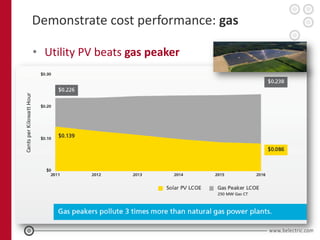
Demonstrate cost performance: gas

• Utility PV beats gas peaker
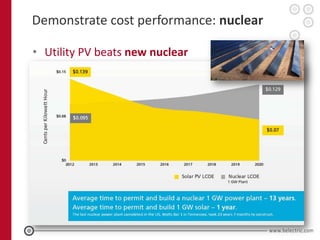
Demonstrate cost performance: nuclear

• Utility PV beats new nuclear
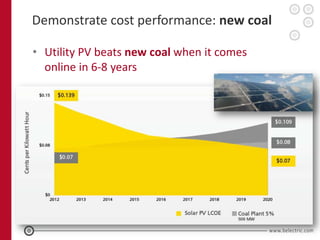
Demonstrate cost performance: new coal

• Utility PV beats new coal when it comes
  online in 6-8 years
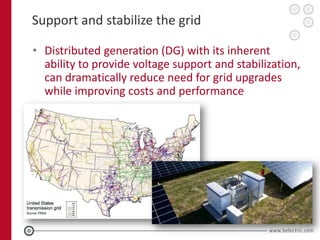
Support and stabilize the grid

• Distributed generation (DG) with its inherent
  ability to provide voltage support and stabilization,
  can dramatically reduce need for grid upgrades
  while improving costs and performance
Where do we go from here?
Everyone has equal access to the fuel
• Each day: Earth is bathed in 89 petawatts from the Sun
• Each day: all of humanity uses 15 terrawatts of power, or one
  six-thousandth as much
• In 88 minutes: the sun provides as much energy as humanity
  consumes in a year
• In 112 hours: the sun provides as much energy as is contained
  in all proven reserves of oil, coal, and natural gas on this planet
• If we captured only one tenth of one percent of the solar
  energy striking the earth we would have access to 6 times as
  much energy as we consume in all forms today, with almost no
  greenhouse gas emissions

 There are no borders to the sun’s power
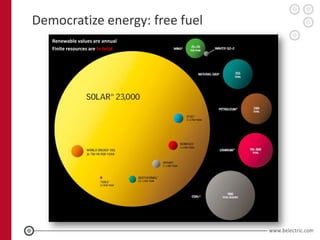
Democratize energy: free fuel
   Renewable values are annual
   Finite resources are in total
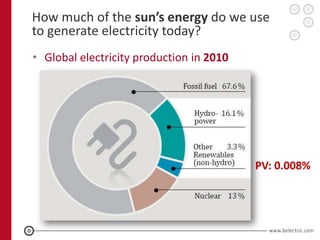
How much of the sun’s energy do we use
to generate electricity today?
• Global electricity production in 2010


                                          PV: 0.008%
Make solar electricity available to everyone

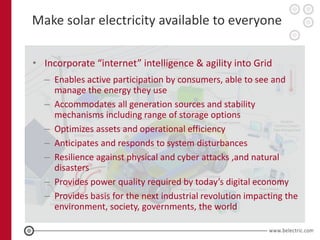
• Incorporate “internet” intelligence & agility into Grid
  – Enables active participation by consumers, able to see and
    manage the energy they use
  – Accommodates all generation sources and stability
    mechanisms including range of storage options
  – Optimizes assets and operational efficiency
  – Anticipates and responds to system disturbances
  – Resilience against physical and cyber attacks ,and natural
    disasters
  – Provides power quality required by today’s digital economy
  – Provides basis for the next industrial revolution impacting the
    environment, society, governments, the world
Integration of clean transportation
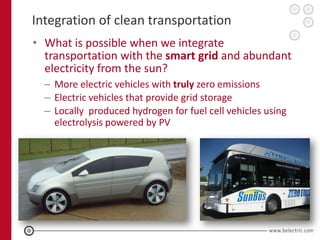
• What is possible when we integrate
  transportation with the smart grid and abundant
  electricity from the sun?
  – More electric vehicles with truly zero emissions
  – Electric vehicles that provide grid storage
  – Locally produced hydrogen for fuel cell vehicles using
    electrolysis powered by PV
The next industrial revolution…

• Many years of development, experimentation in
  subsidies, innovation, global production investments,
  and intense competition, has brought utility solar
  power to the point of supplanting conventional power
• Combining clean power from the sun with the digital
  world and clean transportation, provides profound
  benefits to societies, governments, and the
  environment
• Our passion is to make clean power from the sun
  available to everyone, and nurture the integration and
  availability of its manifold benefits
A Better Electric!
david.taggart@belectric-usa.com
www.belectric.com

The Solar Power Revolution

  • 1.
    Utility solar: andthe next industrial revolution Sierra Club: San Carlos/Belmont Group, Sustainable Land Use Committee David F. Taggart, President/COO Belectric North America November 12, 2011
  • 2.
    The next industrialrevolution! • The greatest economic revolutions were born from energy revolutions • They mandated infrastructural and communicative changes, requiring industry and government collaboration • This new paradigm is based on free fuel available to all, and distributed power at costs below conventional • Integrated with the power of the internet, digital energy management, and clean transportation technologies, this revolution will profoundly change our world
  • 3.
  • 4.
    PV generation canbe privately owned • 3MW net metered plant is the first private high voltage, actively controlled power factor plant in North America • First to utilize UL listed high voltage components/standards • Largest sports venue PV plant in the world
  • 5.
    PV generation canbe deployed quickly 30MW across 4 sites in 5 months Start 7/2011, COD 12/2011
  • 6.
    PV generation iseasily scaled integrate system and component design… …while breaking the scale relationship 1.25 25 125
  • 7.
    How did weget here?
  • 8.
    PV timeline • 1840-1900: first patents on “solar cells” • 1905-1922: Einstein publishes “photoelectric effect” and wins Nobel prize in 1922 • 1954-1980: Bell labs: photoelectric effect in silicon – NY Times declares: “limitless energy from the Sun” – Applications are small and specialized – 1980 annual production exceeds 1MW by Arco • 1990-2008: Government subsidies spur growth of solar power industry – Japan and Germany lead the way – California establishes US leadership – Massive investment in production • 2010: utility PV power industry forms, grows rapidly
  • 9.
    What is behindthe sudden growth of utility PV power? • Economies of scale • Energy security concerns spurred investment • Investment climate has improved from 2008 crisis • Stable government incentive thru 2016: the ITC • RPS requirements encourage investments – 20% renewables by 2013 – 33% renewables by 2020 • Rapid increase in production capacity of polysilicon coincided with reduction in European incentives and economic crisis • Installation of larger plants enables tremendous efficiencies
  • 10.
    Global PV generationcapacity Radical • 65% compound growth over 5 years Economy stalls price drop: panels @ resulting in $1.75/W Thin-film oversupply achieves of panels 19% Germany’s efficiency RESA FIT Global begins: investment panels @ in solar $5.40/W exceeds $100B German First Poly Si FIT 1990, Solar production Japan produces ramps up 70,000 TF Roofs modules 1994 Investment Tax Credit (ITC) extension
  • 11.
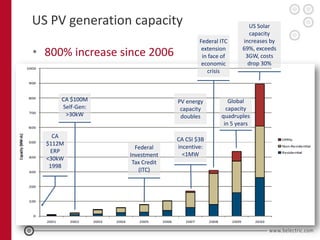
    US PV generationcapacity US Solar capacity Federal ITC increases by • 800% increase since 2006 extension in face of 69%, exceeds 3GW, costs economic drop 30% crisis CA $100M PV energy Global Self-Gen: capacity capacity >30kW doubles quadruples in 5 years CA CA CSI $3B $112M Federal incentive: ERP Investment <1MW <30kW Tax Credit 1998 (ITC)
  • 12.
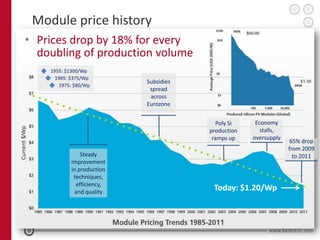
    Module price history •Prices drop by 18% for every doubling of production volume 1955: $1300/Wp 1965: $375/Wp Subsidies 1975: $80/Wp spread across Eurozone Poly Si Economy production stalls, ramps up oversupply 65% drop from 2009 Steady to 2011 improvement in production techniques, efficiency, and quality Today: $1.20/Wp
  • 13.
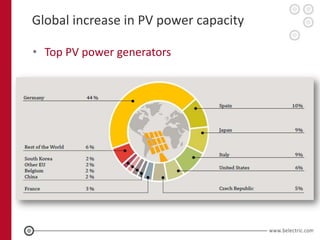
    Global increase inPV power capacity • Top PV power generators
  • 14.
    What do wedo now that we are here?
  • 15.
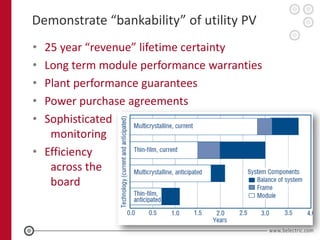
    Demonstrate “bankability” ofutility PV • 25 year “revenue” lifetime certainty • Long term module performance warranties • Plant performance guarantees • Power purchase agreements • Sophisticated monitoring • Efficiency across the board
  • 16.
    Demonstrate cost performanceof utility PV • Utility PV can use orientation and tracking to mimic peak power needs • In a 2011 PUC filing, SCE asks for approval of 20 PV projects generating 567 GWh of electricity at prices less than natural gas fired generation • Projects were between 5 and 20MW in size, not large central style projects • To date, 4GW of PV plants contracted at prices below market price referent • Utility PV solar is a natural hedge against rising energy costs
  • 17.
    Demonstrate cost performance:gas • Utility PV beats gas peaker
  • 18.
    Demonstrate cost performance:nuclear • Utility PV beats new nuclear
  • 19.
    Demonstrate cost performance:new coal • Utility PV beats new coal when it comes online in 6-8 years
  • 20.
    Support and stabilizethe grid • Distributed generation (DG) with its inherent ability to provide voltage support and stabilization, can dramatically reduce need for grid upgrades while improving costs and performance
  • 21.
    Where do wego from here?
  • 22.
    Everyone has equalaccess to the fuel • Each day: Earth is bathed in 89 petawatts from the Sun • Each day: all of humanity uses 15 terrawatts of power, or one six-thousandth as much • In 88 minutes: the sun provides as much energy as humanity consumes in a year • In 112 hours: the sun provides as much energy as is contained in all proven reserves of oil, coal, and natural gas on this planet • If we captured only one tenth of one percent of the solar energy striking the earth we would have access to 6 times as much energy as we consume in all forms today, with almost no greenhouse gas emissions There are no borders to the sun’s power
  • 23.
    Democratize energy: freefuel Renewable values are annual Finite resources are in total
  • 24.
    How much ofthe sun’s energy do we use to generate electricity today? • Global electricity production in 2010 PV: 0.008%
  • 25.
    Make solar electricityavailable to everyone • Incorporate “internet” intelligence & agility into Grid – Enables active participation by consumers, able to see and manage the energy they use – Accommodates all generation sources and stability mechanisms including range of storage options – Optimizes assets and operational efficiency – Anticipates and responds to system disturbances – Resilience against physical and cyber attacks ,and natural disasters – Provides power quality required by today’s digital economy – Provides basis for the next industrial revolution impacting the environment, society, governments, the world
  • 26.
    Integration of cleantransportation • What is possible when we integrate transportation with the smart grid and abundant electricity from the sun? – More electric vehicles with truly zero emissions – Electric vehicles that provide grid storage – Locally produced hydrogen for fuel cell vehicles using electrolysis powered by PV
  • 27.
    The next industrialrevolution… • Many years of development, experimentation in subsidies, innovation, global production investments, and intense competition, has brought utility solar power to the point of supplanting conventional power • Combining clean power from the sun with the digital world and clean transportation, provides profound benefits to societies, governments, and the environment • Our passion is to make clean power from the sun available to everyone, and nurture the integration and availability of its manifold benefits
  • 29.

Editor's Notes

  • #2 Thank you for inviting
  • #3 We are on the cusp of a revolution in energy: the democratization of clean power from the Sun
  • #7 For three very different projects sizes, we use the same components, same installation processes, and can achieve the same installation ratesSame component level approach, yet with very different project or system design parameters (southwest orientation, different anchorages, etc.)Transition: what about installation? How does that vary?
  • #9 US Department of Energy: “the history of solar”Sunlight Electric, Inc, “160 years of photovoltaic history”
  • #11 That 17 GW installed in 2010 is the equivalent of 17 nuclear power plants – manufactured, shipped and installed in one year. It can take decades just to install a nuclear plant. Mention that the period between polysi ramp up and $100B is where all the capacity for polysi production went in, to address the large expansion in the use of Xsi, but then the economy hit and the customer pull went away, resulting in massive oversupply, and thus the radical price drops.Key milestones sources: Chart source: Source: REN21 Renewables 2011 Global Status Report, http://www.ren21.net/REN21Activities/Publications/
  • #12 This shows the relationship between the early CA incentives and residential, then commercial applications, then how the CSI kicks off some enlarge applications, but it was the ITC and the massive expansion of global installed systems that got the price dropping, and thus the amount of utility solar in the US started to really take off.Sources: SEIA “the case for the solar investment tax credit”, Chart source: IREC 2011 “US solar market trends 2010” by Larry Sherwood, published June 2011
  • #13 Key millstone sources: variousEarly module pricing source: http://solarbuzz.com/facts-and-figures/retail-price-environment/module-priceshttp://solarbuzz.com/facts-and-figures/retail-price-environment/module-pricesI also created a spreadsheet using the solarbuzz data and combining the following figure http://www.powertripenergy.com/pv_hist.htm, to get the pricing from 1955 to the current time, its in the folder where this presentation is stored.Original source: www.thinkpogress.org, Dan Shugar and Tom DinwoodieSource: Clean Technical (http://s.tt/12DaJ)
  • #14 Source: REN21 Renewables 2011 Global Status Report, http://www.ren21.net/REN21Activities/Publications/
  • #16 Source for table, US department of energy, PV FAQS, what is the energy payback for pv?
  • #17 In sunny markets like California, solar is becoming competitive with large combined-cycle natural gas plants as well. According to Dinwoodie, there have been 4 GW of contracts for solar PV plants in California signed below the Market Price Referent – the projected price of a 500-MW combined cycle natural gas plant.Source: Clean Technical (http://s.tt/12DaJ)
  • #18 You can see that natural gas peaker plants, which sit idling most of the day, are an expensive option for utilities.Source: Clean Technical (http://s.tt/12DaJ)
  • #19 Here’s another important statistic: When SunPower built the 14-MW Nellis Air Force Base system in 2007, it cost $7 per watt. Today, commercial and utility systems are getting installed at around $3 per watt. In 2010 alone, the average installed cost of installing solar PV dropped 20%.It would appear that solar PV is also cheaper than new nuclear.This year, the U.S. industry may install 2 GW of solar. The last nuclear power plant to come online in the U.S., Watts Bar 1, has a capacity of 1.1 GW – but that took 23 years to complete, not two years.Source: Clean Technical (http://s.tt/12DaJ)
  • #20 Over the last few years, 153 coal plants have been abandoned, in large part due to uncertainty over environmental regulations. Dinwoodie and Shugar believe that by the time a new American coal facility is built in the next 6 years, solar PV in the sunniest regions can be competitive with those plants.Source: Clean Technical (http://s.tt/12DaJ)
  • #24 Comparing finite and renewable planetary energy reserves (Terawatt‐years). Total recoverable reserves are shown for the finite resources. Yearly potential is shown for the renewables.&quot; (source: Perez &amp; Perez, 2009a) Source: Clean Technical (http://s.tt/136aa)
  • #25 Source: REN21 Renewables 2011 Global Status Report, http://www.ren21.net/REN21Activities/Publications/The percentage of PV is based on 40GW globally out of 5,000GW of global electrical generating capacity