RENEWABLE SOURCES OF
ENERGY
Biomass
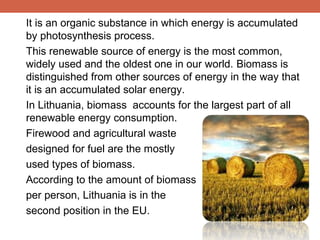
It is an organic substance in which energy is accumulated
by photosynthesis process.
This renewable source of energy is the most common,
widely used and the oldest one in our world. Biomass is
distinguished from other sources of energy in the way that
it is an accumulated solar energy.
In Lithuania, biomass accounts for the largest part of all
renewable energy consumption.
Firewood and agricultural waste
designed for fuel are the mostly
used types of biomass.
According to the amount of biomass
per person, Lithuania is in the
second position in the EU.
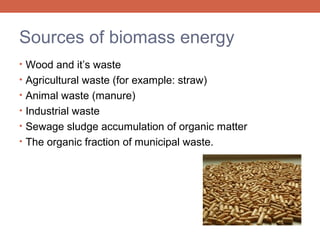
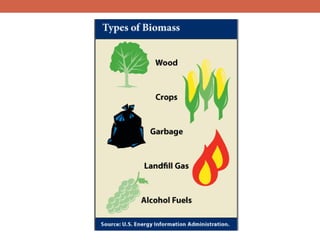
Sources of biomass energy
• Wood and it’s waste
• Agricultural waste (for example: straw)
• Animal waste (manure)
• Industrial waste
• Sewage sludge accumulation of organic matter
• The organic fraction of municipal waste.
Biomass can be used
Biomass as a fuel can be used in solid, liquid or gaseous
state. In the first case, it takes only the minimum of
machining, such as chopping. In order to get liquid or
gaseous fuel it is not enough to process the biomass
mechanically, it is also necessary to use a much more
complex thermal, chemical, biochemical and
microbiological processing techniques. In Lithuania, the
main problem why the use of biomass for heating is not
increasing rapidly is the lack of sufficient boiler-houses
suitable for biomass. In order to exploit the potential of
biomass, Lithuania needs to invest into developing of
biomass power plants.
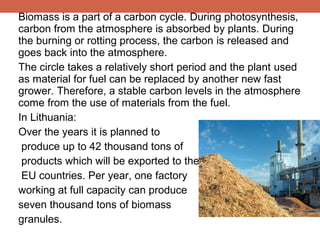
Biomass is a part of a carbon cycle. During photosynthesis,
carbon from the atmosphere is absorbed by plants. During
the burning or rotting process, the carbon is released and
goes back into the atmosphere.
The circle takes a relatively short period and the plant used
as material for fuel can be replaced by another new fast
grower. Therefore, a stable carbon levels in the atmosphere
come from the use of materials from the fuel.
In Lithuania:
Over the years it is planned to
produce up to 42 thousand tons of
products which will be exported to the
EU countries. Per year, one factory
working at full capacity can produce
seven thousand tons of biomass
granules.
Advantages
• Biomass is a renewable energy source that is easier taken than

other fuels and which can be exploited using less environmentalpolluting equipment.
• Waste from agriculture and forestry is the most common source of

biomass, which is processed in the form of briquettes and
granules and is used for heat production. The production of liquid
fuels, such as ethanol or biodiesel, from agricultural products
grows rapidly.
• It is favorable to use biomass in the energy production industry, as

the waste from the organic matter can be used as fuel. In most

cases biomass is associated with vegetation, which are used for
the production of biofuels, but the material of vegetable or animal
origin, can be used for the production of chemicals, heat or fibre.
RENEWABLE SOURCES OF
ENERGY
Trash
Waste
Waste is unwanted material which mainly
comes into existence due to the human
activities. It is not useful, often dangerous and
have no economic value. However, scientists say
that everything in nature is useful, and wastle
can be serviceable if we know how to use it.
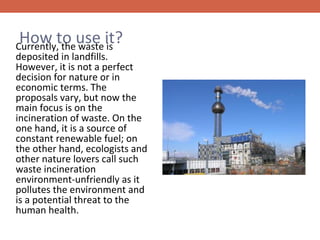
How to use it?

Currently, the waste is
deposited in landfills.
However, it is not a perfect
decision for nature or in
economic terms. The
proposals vary, but now the
main focus is on the
incineration of waste. On the
one hand, it is a source of
constant renewable fuel; on
the other hand, ecologists and
other nature lovers call such
waste incineration
environment-unfriendly as it
pollutes the environment and
is a potential threat to the
human health.
Methods
• Boiling layer method;
• Waste incineration in rotary kilns;
• Waste incineration on a moving grate.
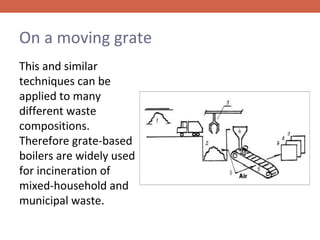
On a moving grate
This and similar
techniques can be
applied to many
different waste
compositions.
Therefore grate-based
boilers are widely used
for incineration of
mixed-household and
municipal waste.
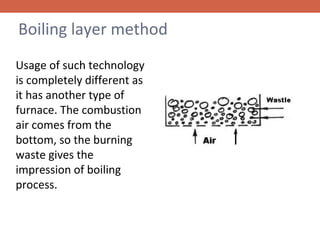
Boiling layer method
Usage of such technology
is completely different as
it has another type of
furnace. The combustion
air comes from the
bottom, so the burning
waste gives the
impression of boiling
process.
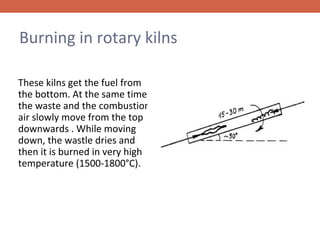
Burning in rotary kilns
These kilns get the fuel from
the bottom. At the same time,
the waste and the combustion
air slowly move from the top
downwards . While moving
down, the wastle dries and
then it is burned in very high
temperature (1500-1800°C).
RENEWABLE SOURCES OF
ENERGY
WATER ENERGY
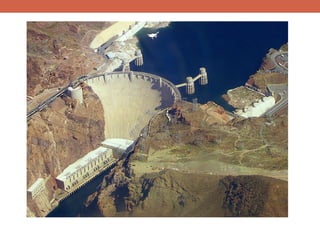
Flowing (running) water
•

Is one of the most useful renewable energy
sources;
• Dams and hydro-electric power stations are built
to get energy with the help of falling water;
• 25 % of water energy sources are used in the
world, while hydro-electric power stations
produce 20 % of energy;
• In 1903 the first Lithuanian hydro-electric power
station in which there was an electric generator
turned by a water wheel was founded.
Advantages and Disadvantages
• Energy of flowing water

never runs out
• Electricity production is
concidered to be clean
• Long hydro-electric
power plant working
time

• Installation of dams is

expensive and it takes a
long time to built them
• While the construction
of dams, ponds which
flood big areas form
• Agricultular land is lost,
animals and plants die.
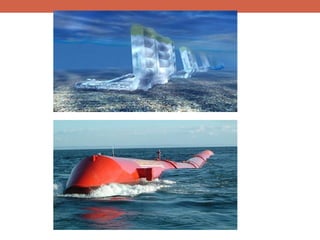
Waves Of The Sea
• Waves have a lot of energy, especially when strong wind blows
• To get energy from the sea, energy collectors are built
• However, to hold out on destructive force of waves and

convert it into the useful energy, very strong materials must
be used
• The produced energy was used to supply the sea lighthouses
The tide and ebb energy
• Is used only in the places where there is a big

amplitude of tides and ebbs.
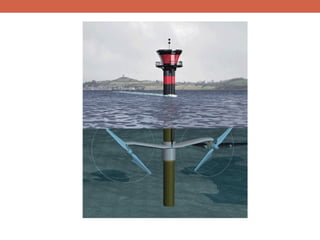
• The turbine blades are arranged in the way they can
be rotated by rising or refluent water, as well.
• It is clean and safe source of energy, but it’s blocking
fish spawning, inundating water floats wetlands.
• This technology has been tested and considered to be
paybable.
Sea currents
• Produce energy with less flush speed than ordinary

water turbines.
• Operate on vibration produced by whirls that occur
when water flows over variety of obstacles.
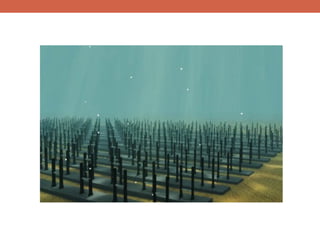
• Track and field stadium sized area of cylinders would
be sufficient to produce energy for about 0.0377
EUR/kWh, and that energy would be enough for
approximately 100,000 families.
• Scientists are looking for opportunities to start
building an experimental power-station.
RENEWABLE SOURCES OF
ENERGY
Solar energy
Solar energy
Solar energy is the energy released during the reactions
in the sun. The solar energy reaches the Earth,
determines its climate and sustains life.
The light and heat provided by tyhe sun are used as
renewable source of energy. However, modern
technologies are not adjusted to use this energy in an
effective way yet. In 2004, only 0.04% of the world's
electricity is produced from solar energy.
The sun is the most powerful renewable energy
source on Earth. It is estimted that the theoretical
annual global solar energy potential is 900 milion
TWh and it is about 60 times higher than the
theoretical annual global wind energy potential,
about 2200 times higher than the theoretical
annual geothermal energy potential, about 4500
times higher then biomass energy potential and
about 36000 times higher than anual theoretical
hydropower potential in the world.
Solar energetics in Lithuania
• During the year 2010, 2,4MWh of energy is produced . In

2011 Kruonis Pumped Storage Plant installed the biggest
solar power system in Lithuania, which is expected to
make 70 MWh power every year. Solar power in Lithuania
is mostly used for heating water in flats or vacuum solar
collectors during not-heating time.
• Lithuania has 40 small solar power-plants which provide
electricity for the company LESTO. In addition, a number
of private power-plans owned by farmers produce
electricity for their own needs.
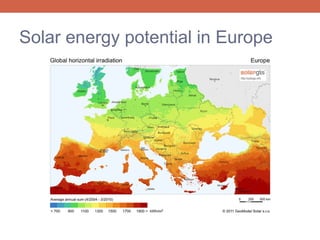
Solar energy potential in Europe
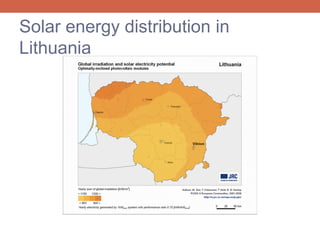
Solar energy distribution in
Lithuania
RENEWABLE SOURCES OF
ENERGY
Wind power
Wind power
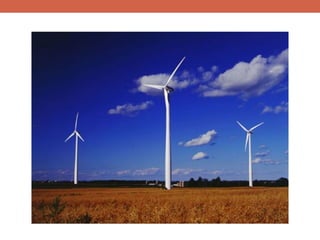
• Wind power is the conversion of wind energy into a

useful form of energy, such as using wind turbines to
make electrical power, windmills for mechanical power,
windpumps for water pumping or drainage, or sails to
propel ships.
Advantages of wind power
• The wind is free and with modern technology it can be

captured efficiently.
• Once the wind turbine is built the energy it produces does
not cause green house gases or other pollutants.
• Wind turbines have a role to play in both the developed
and third world.
• Wind turbines are available in a range of sizes which
means a vast range of people and businesses can use
them. Single households to small towns and villages can
make good use of range of wind turbines available today.
Wind power in Lithuania
• In 2003 in Lithuania‘s town Skuodas, a 160 kW wind

power – station from Denmark was built and incorporated
into the main electric system. Although it didn‘t operate for
a long time because of technical problems, it was the
beginning of Lithuania‘s wind energetics. On the 9th of
March, 2004 in Kretinga district, Vydmantai
demonstrative wind power – station was inserted into
Lithuania‘s electric system. That was a 600 kW wind
power – station of ultimate design produced by German
company „ENERCON GmbH“. It was an offspring of
collaboration between Kaišiadorys and Magdeburg
dioceses.
Lithuanian presentation in Hungary

Lithuanian presentation in Hungary

  • 1.
  • 2.
    It is anorganic substance in which energy is accumulated by photosynthesis process. This renewable source of energy is the most common, widely used and the oldest one in our world. Biomass is distinguished from other sources of energy in the way that it is an accumulated solar energy. In Lithuania, biomass accounts for the largest part of all renewable energy consumption. Firewood and agricultural waste designed for fuel are the mostly used types of biomass. According to the amount of biomass per person, Lithuania is in the second position in the EU.
  • 3.
    Sources of biomassenergy • Wood and it’s waste • Agricultural waste (for example: straw) • Animal waste (manure) • Industrial waste • Sewage sludge accumulation of organic matter • The organic fraction of municipal waste.
  • 4.
    Biomass can beused Biomass as a fuel can be used in solid, liquid or gaseous state. In the first case, it takes only the minimum of machining, such as chopping. In order to get liquid or gaseous fuel it is not enough to process the biomass mechanically, it is also necessary to use a much more complex thermal, chemical, biochemical and microbiological processing techniques. In Lithuania, the main problem why the use of biomass for heating is not increasing rapidly is the lack of sufficient boiler-houses suitable for biomass. In order to exploit the potential of biomass, Lithuania needs to invest into developing of biomass power plants.
  • 6.
    Biomass is apart of a carbon cycle. During photosynthesis, carbon from the atmosphere is absorbed by plants. During the burning or rotting process, the carbon is released and goes back into the atmosphere. The circle takes a relatively short period and the plant used as material for fuel can be replaced by another new fast grower. Therefore, a stable carbon levels in the atmosphere come from the use of materials from the fuel. In Lithuania: Over the years it is planned to produce up to 42 thousand tons of products which will be exported to the EU countries. Per year, one factory working at full capacity can produce seven thousand tons of biomass granules.
  • 7.
    Advantages • Biomass isa renewable energy source that is easier taken than other fuels and which can be exploited using less environmentalpolluting equipment. • Waste from agriculture and forestry is the most common source of biomass, which is processed in the form of briquettes and granules and is used for heat production. The production of liquid fuels, such as ethanol or biodiesel, from agricultural products grows rapidly. • It is favorable to use biomass in the energy production industry, as the waste from the organic matter can be used as fuel. In most cases biomass is associated with vegetation, which are used for the production of biofuels, but the material of vegetable or animal origin, can be used for the production of chemicals, heat or fibre.
  • 8.
  • 9.
    Waste Waste is unwantedmaterial which mainly comes into existence due to the human activities. It is not useful, often dangerous and have no economic value. However, scientists say that everything in nature is useful, and wastle can be serviceable if we know how to use it.
  • 10.
    How to useit? Currently, the waste is deposited in landfills. However, it is not a perfect decision for nature or in economic terms. The proposals vary, but now the main focus is on the incineration of waste. On the one hand, it is a source of constant renewable fuel; on the other hand, ecologists and other nature lovers call such waste incineration environment-unfriendly as it pollutes the environment and is a potential threat to the human health.
  • 11.
    Methods • Boiling layermethod; • Waste incineration in rotary kilns; • Waste incineration on a moving grate.
  • 12.
    On a movinggrate This and similar techniques can be applied to many different waste compositions. Therefore grate-based boilers are widely used for incineration of mixed-household and municipal waste.
  • 13.
    Boiling layer method Usageof such technology is completely different as it has another type of furnace. The combustion air comes from the bottom, so the burning waste gives the impression of boiling process.
  • 14.
    Burning in rotarykilns These kilns get the fuel from the bottom. At the same time, the waste and the combustion air slowly move from the top downwards . While moving down, the wastle dries and then it is burned in very high temperature (1500-1800°C).
  • 15.
  • 16.
    Flowing (running) water • Isone of the most useful renewable energy sources; • Dams and hydro-electric power stations are built to get energy with the help of falling water; • 25 % of water energy sources are used in the world, while hydro-electric power stations produce 20 % of energy; • In 1903 the first Lithuanian hydro-electric power station in which there was an electric generator turned by a water wheel was founded.
  • 17.
    Advantages and Disadvantages •Energy of flowing water never runs out • Electricity production is concidered to be clean • Long hydro-electric power plant working time • Installation of dams is expensive and it takes a long time to built them • While the construction of dams, ponds which flood big areas form • Agricultular land is lost, animals and plants die.
  • 19.
    Waves Of TheSea • Waves have a lot of energy, especially when strong wind blows • To get energy from the sea, energy collectors are built • However, to hold out on destructive force of waves and convert it into the useful energy, very strong materials must be used • The produced energy was used to supply the sea lighthouses
  • 21.
    The tide andebb energy • Is used only in the places where there is a big amplitude of tides and ebbs. • The turbine blades are arranged in the way they can be rotated by rising or refluent water, as well. • It is clean and safe source of energy, but it’s blocking fish spawning, inundating water floats wetlands. • This technology has been tested and considered to be paybable.
  • 23.
    Sea currents • Produceenergy with less flush speed than ordinary water turbines. • Operate on vibration produced by whirls that occur when water flows over variety of obstacles. • Track and field stadium sized area of cylinders would be sufficient to produce energy for about 0.0377 EUR/kWh, and that energy would be enough for approximately 100,000 families. • Scientists are looking for opportunities to start building an experimental power-station.
  • 25.
  • 26.
    Solar energy Solar energyis the energy released during the reactions in the sun. The solar energy reaches the Earth, determines its climate and sustains life.
  • 27.
    The light andheat provided by tyhe sun are used as renewable source of energy. However, modern technologies are not adjusted to use this energy in an effective way yet. In 2004, only 0.04% of the world's electricity is produced from solar energy.
  • 28.
    The sun isthe most powerful renewable energy source on Earth. It is estimted that the theoretical annual global solar energy potential is 900 milion TWh and it is about 60 times higher than the theoretical annual global wind energy potential, about 2200 times higher than the theoretical annual geothermal energy potential, about 4500 times higher then biomass energy potential and about 36000 times higher than anual theoretical hydropower potential in the world.
  • 29.
    Solar energetics inLithuania • During the year 2010, 2,4MWh of energy is produced . In 2011 Kruonis Pumped Storage Plant installed the biggest solar power system in Lithuania, which is expected to make 70 MWh power every year. Solar power in Lithuania is mostly used for heating water in flats or vacuum solar collectors during not-heating time. • Lithuania has 40 small solar power-plants which provide electricity for the company LESTO. In addition, a number of private power-plans owned by farmers produce electricity for their own needs.
  • 30.
  • 31.
  • 32.
  • 33.
    Wind power • Windpower is the conversion of wind energy into a useful form of energy, such as using wind turbines to make electrical power, windmills for mechanical power, windpumps for water pumping or drainage, or sails to propel ships.
  • 34.
    Advantages of windpower • The wind is free and with modern technology it can be captured efficiently. • Once the wind turbine is built the energy it produces does not cause green house gases or other pollutants. • Wind turbines have a role to play in both the developed and third world. • Wind turbines are available in a range of sizes which means a vast range of people and businesses can use them. Single households to small towns and villages can make good use of range of wind turbines available today.
  • 35.
    Wind power inLithuania • In 2003 in Lithuania‘s town Skuodas, a 160 kW wind power – station from Denmark was built and incorporated into the main electric system. Although it didn‘t operate for a long time because of technical problems, it was the beginning of Lithuania‘s wind energetics. On the 9th of March, 2004 in Kretinga district, Vydmantai demonstrative wind power – station was inserted into Lithuania‘s electric system. That was a 600 kW wind power – station of ultimate design produced by German company „ENERCON GmbH“. It was an offspring of collaboration between Kaišiadorys and Magdeburg dioceses.

Editor's Notes