RENEWABLE ENERGY
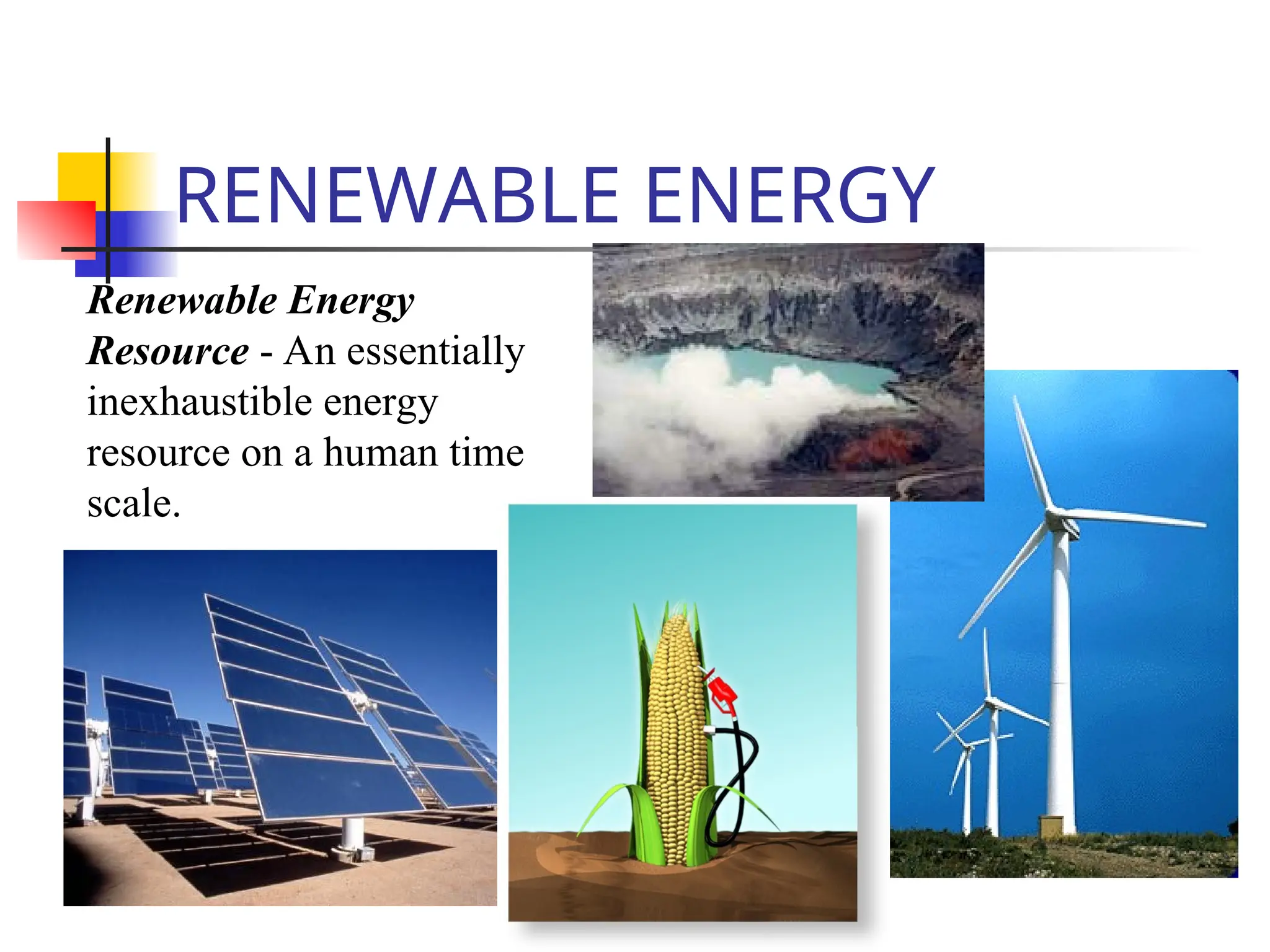
Renewable Energy
Resource - An essentially
inexhaustible energy
resource on a human time
scale.
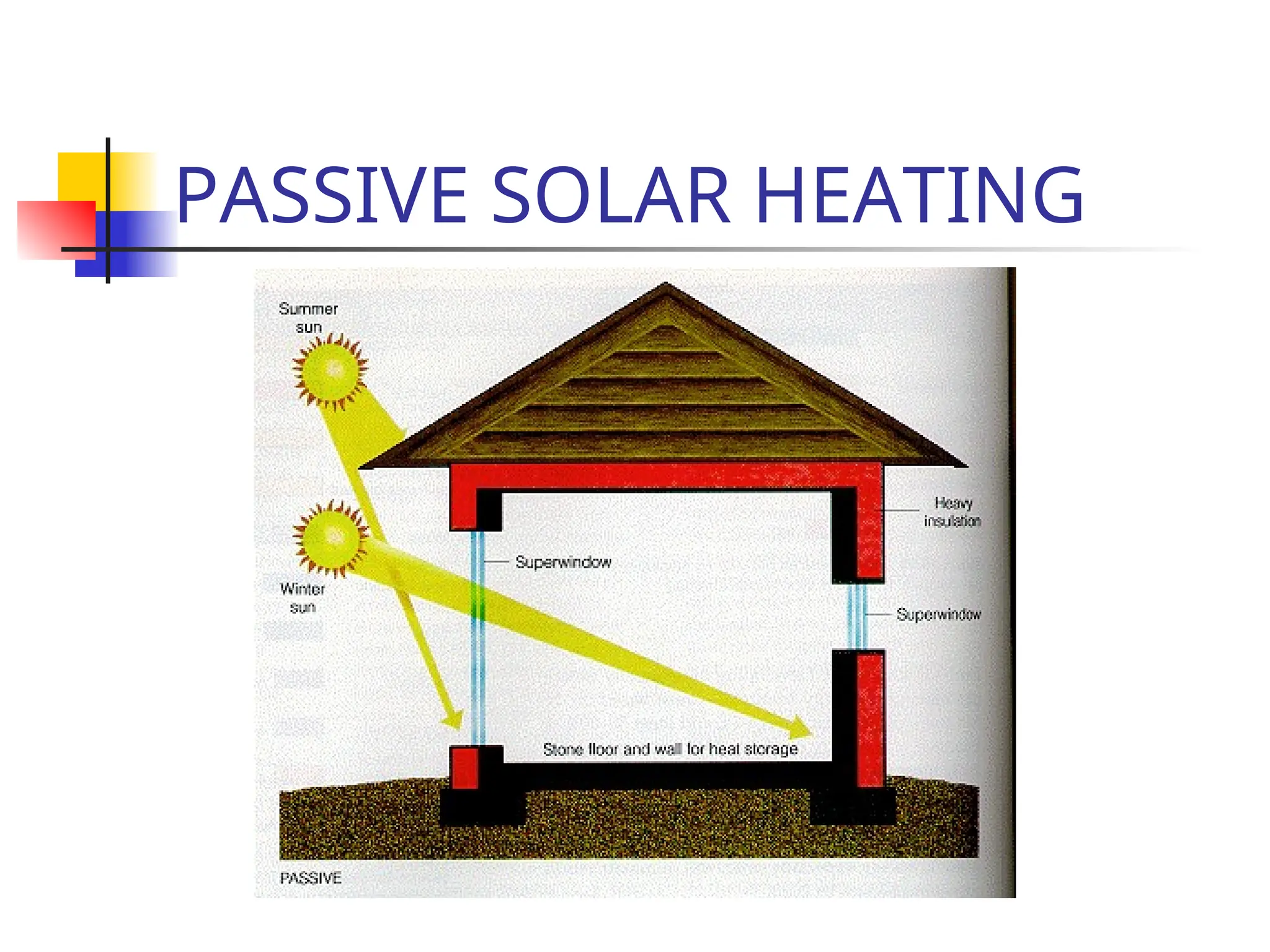
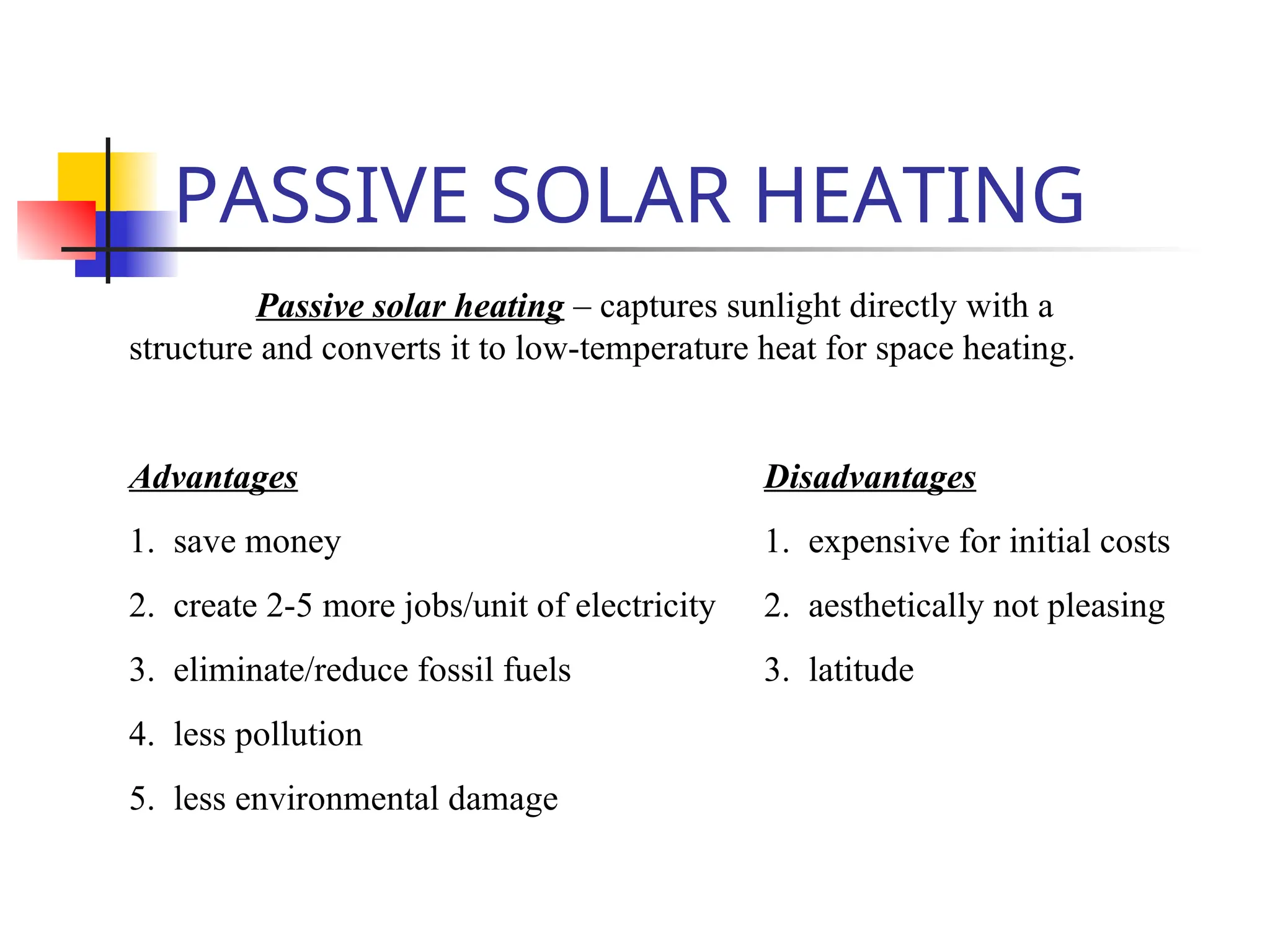
PASSIVE SOLAR HEATING
Passive solar heating – captures sunlight directly with a
structure and converts it to low-temperature heat for space heating.
Advantages Disadvantages
1. save money 1. expensive for initial costs
2. create 2-5 more jobs/unit of electricity 2. aesthetically not pleasing
3. eliminate/reduce fossil fuels 3. latitude
4. less pollution
5. less environmental damage
PASSIVE SOLAR HEATING
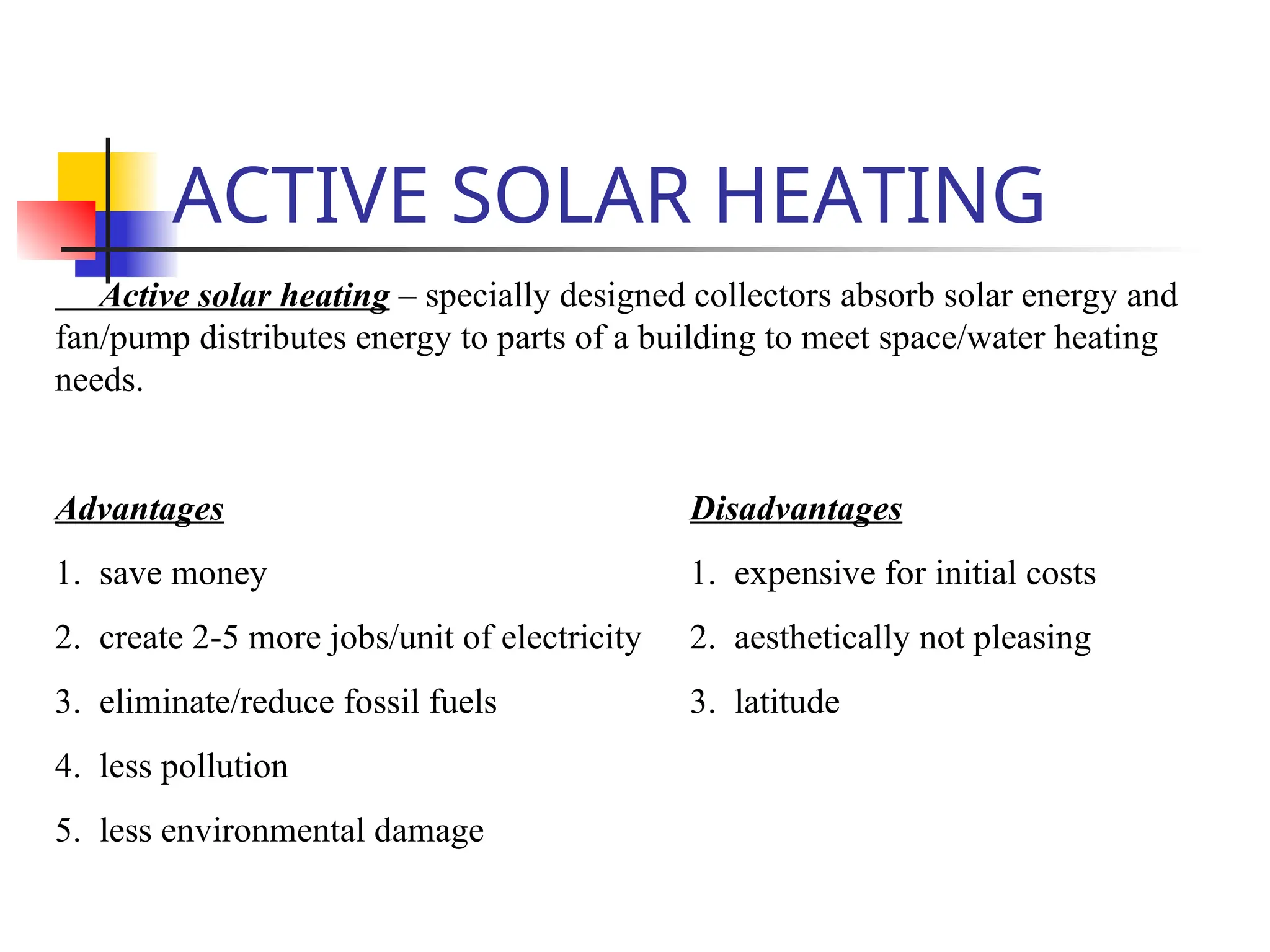
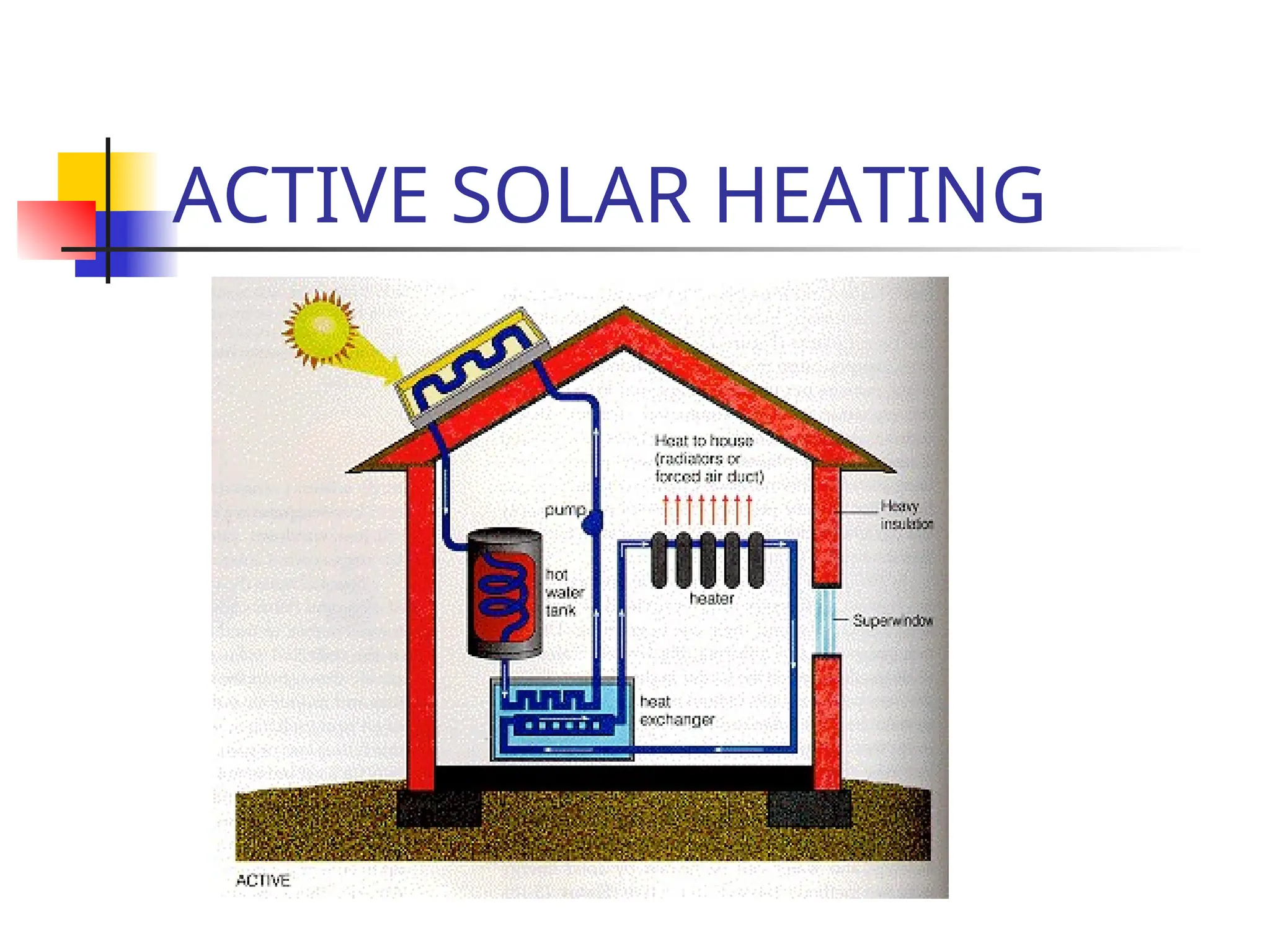
ACTIVE SOLAR HEATING
Active solar heating – specially designed collectors absorb solar energy and
fan/pump distributes energy to parts of a building to meet space/water heating
needs.
Advantages Disadvantages
1. save money 1. expensive for initial costs
2. create 2-5 more jobs/unit of electricity 2. aesthetically not pleasing
3. eliminate/reduce fossil fuels 3. latitude
4. less pollution
5. less environmental damage
ACTIVE SOLAR HEATING
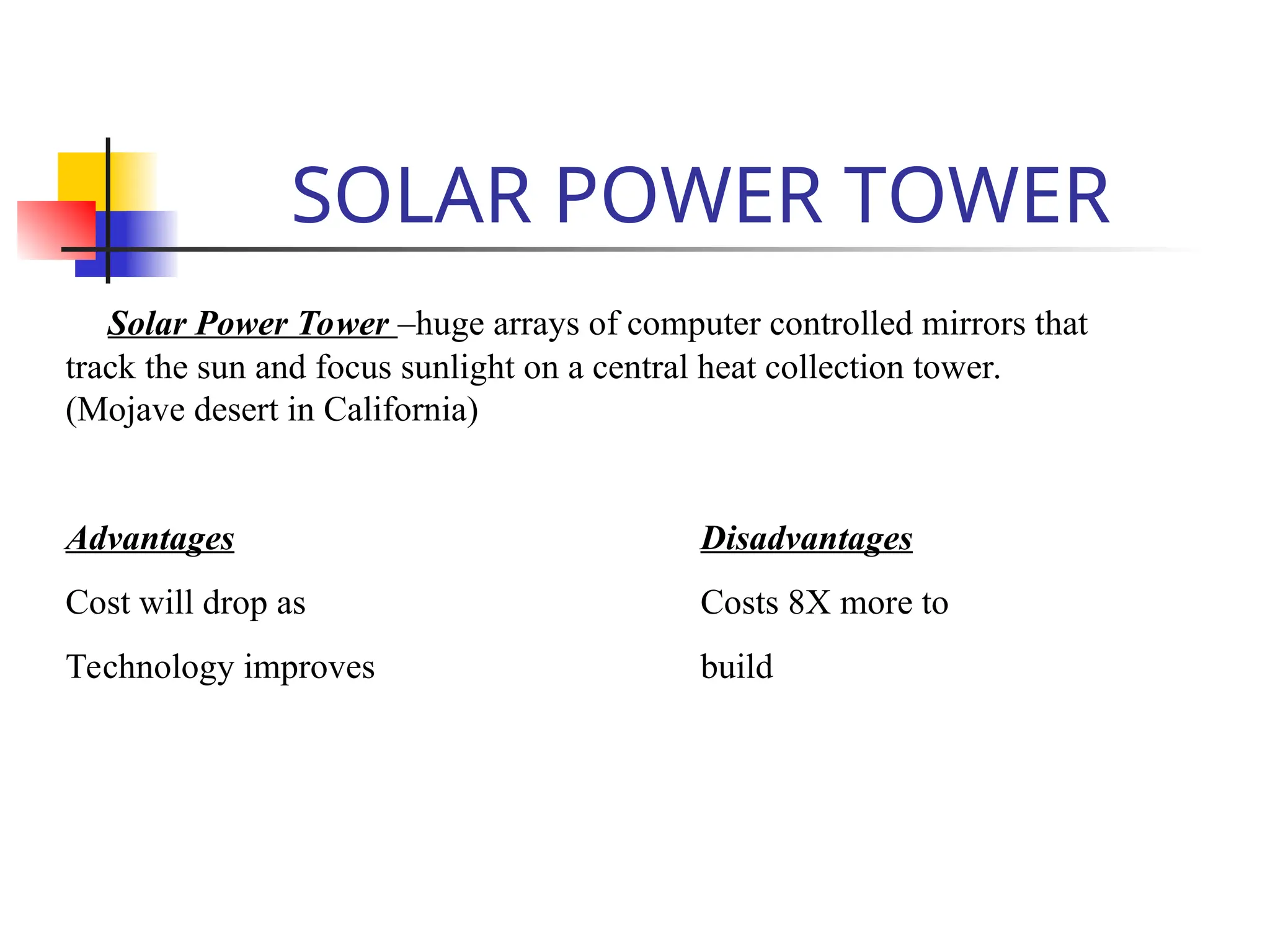
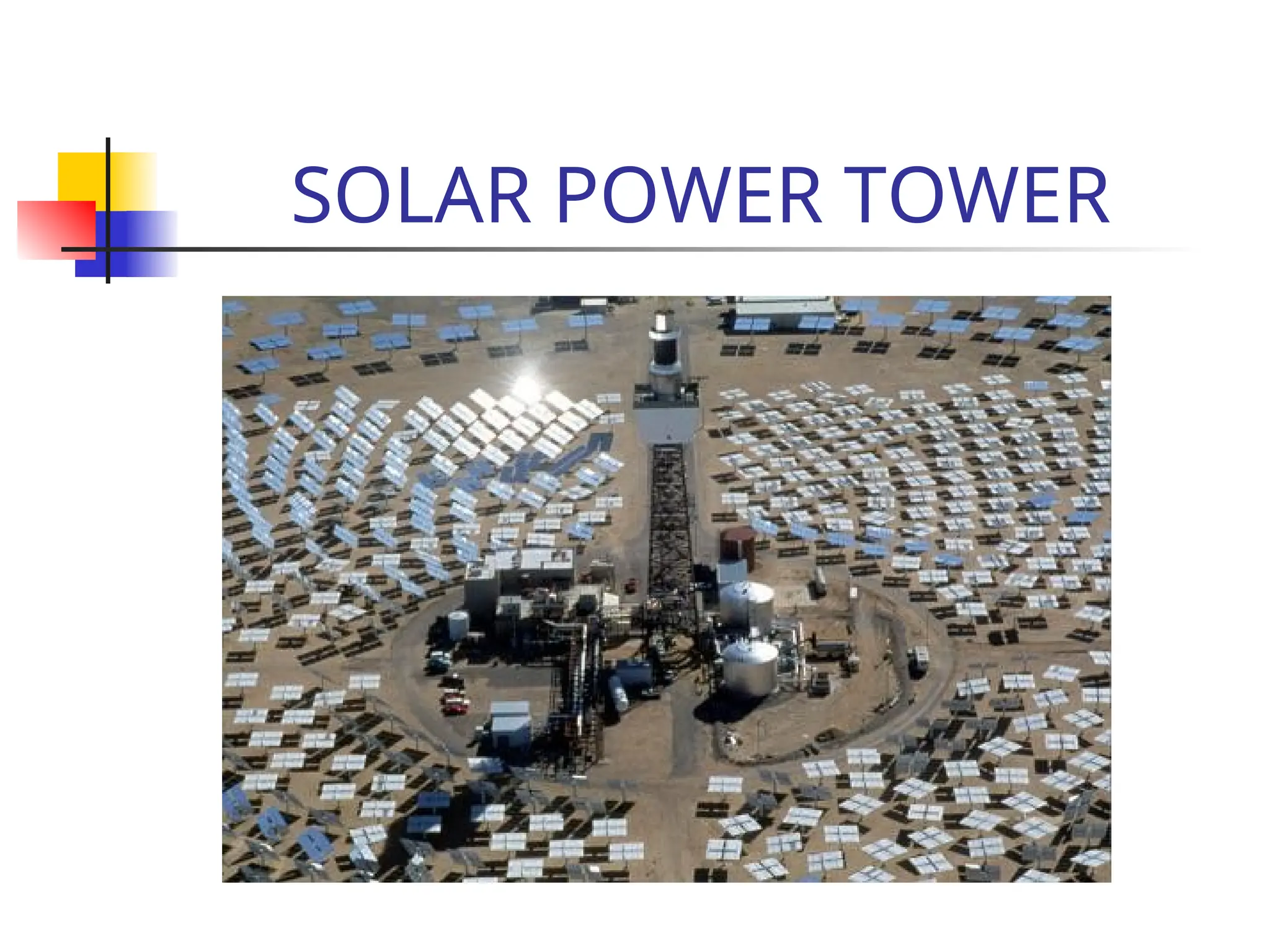
SOLAR POWER TOWER
Solar Power Tower –huge arrays of computer controlled mirrors that
track the sun and focus sunlight on a central heat collection tower.
(Mojave desert in California)
Advantages Disadvantages
Cost will drop as Costs 8X more to
Technology improves build
SOLAR POWER TOWER
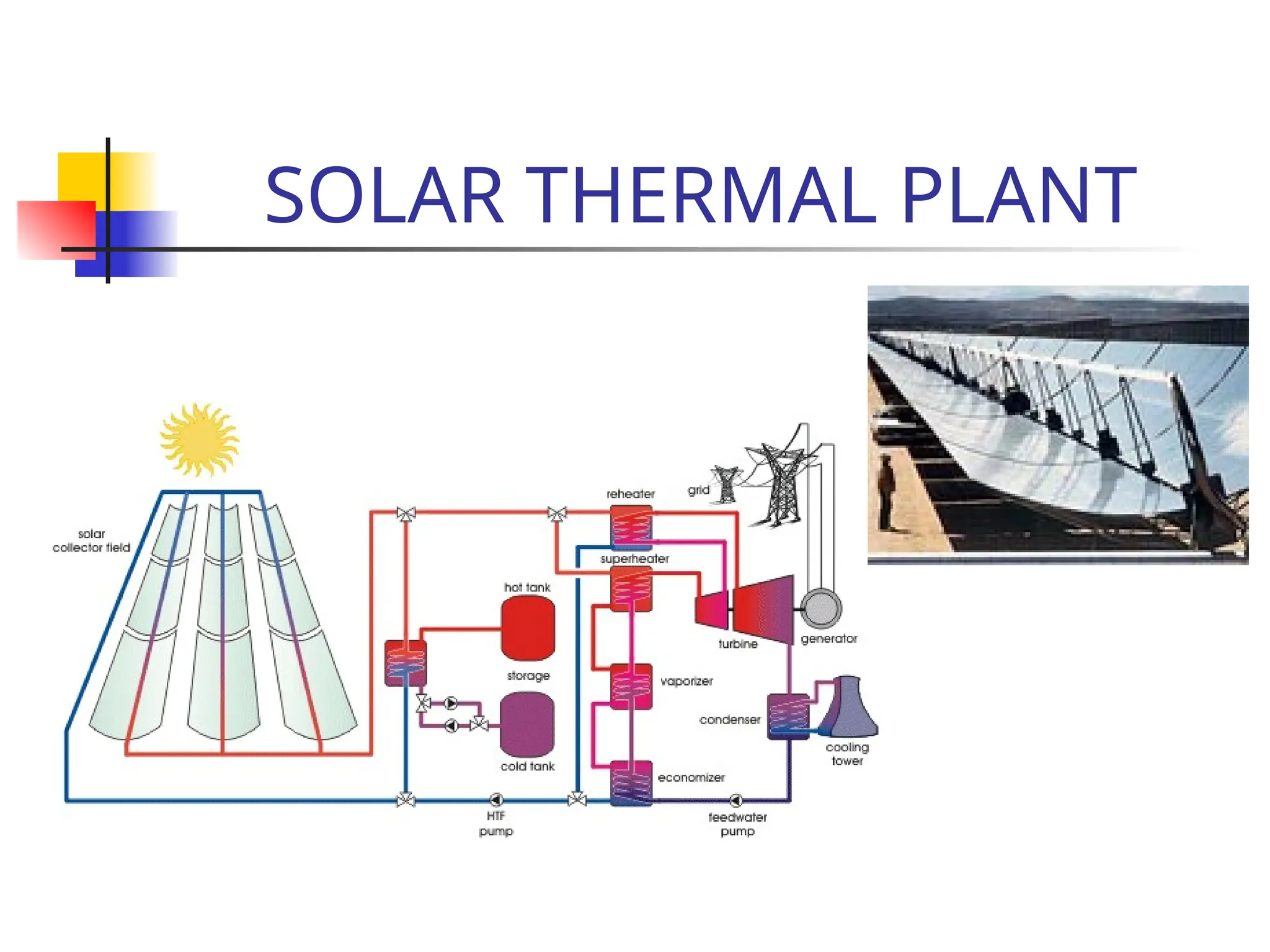
SOLAR THERMAL PLANT
1Solar Thermal Plant – sunlight is collected and focused on oil-filled pipes
that run through the middle of curved solar collectors.
Advantages Disadvantages
1. Can generate temperatures high 1. central receivers are
enough for industrial processes expensive to operate.
2. can supply back-up electricity
3. cheaper than nuclear
SOLAR THERMAL PLANT
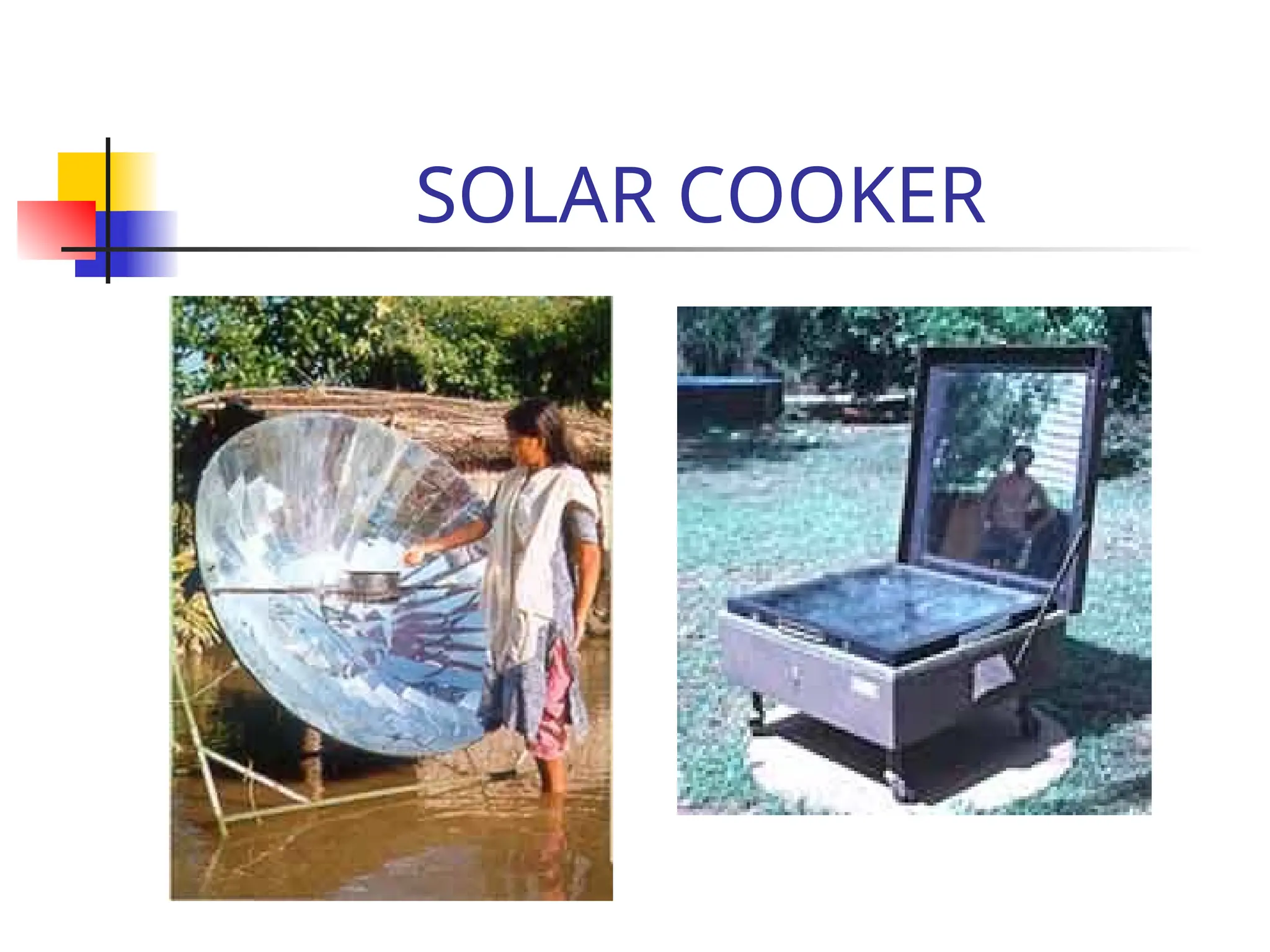
SOLAR COOKER
1Solar Cooker – focuses and concentrates sunlight in a box typically covered in
glass to trap infrared radiation waves to cook food in rural villages in developing
countries.
Advantages Disadvantages
Does not reduce deforestation 2-4 hours to cook average meal.
SOLAR COOKER
SOLAR HYDROGEN
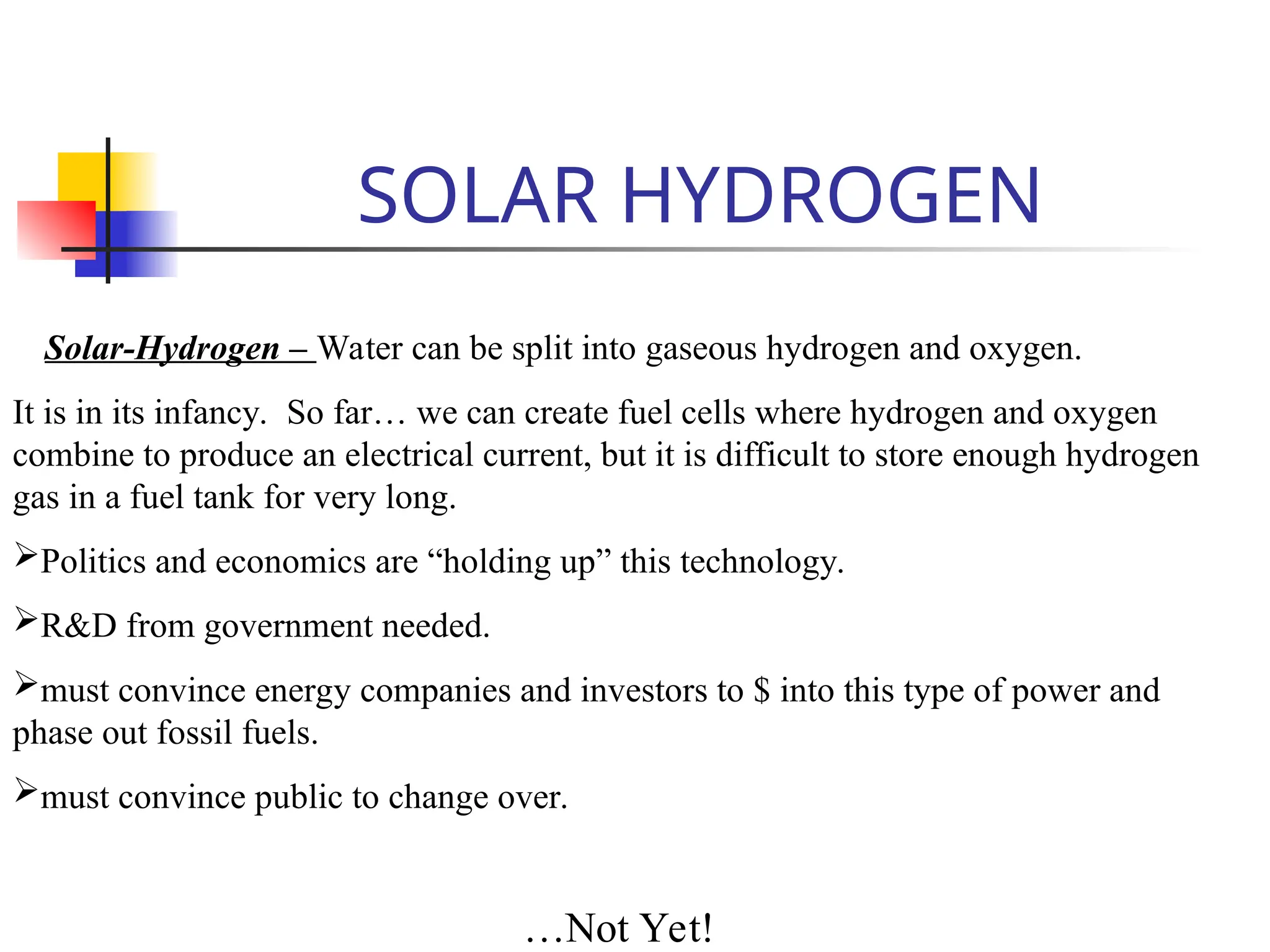
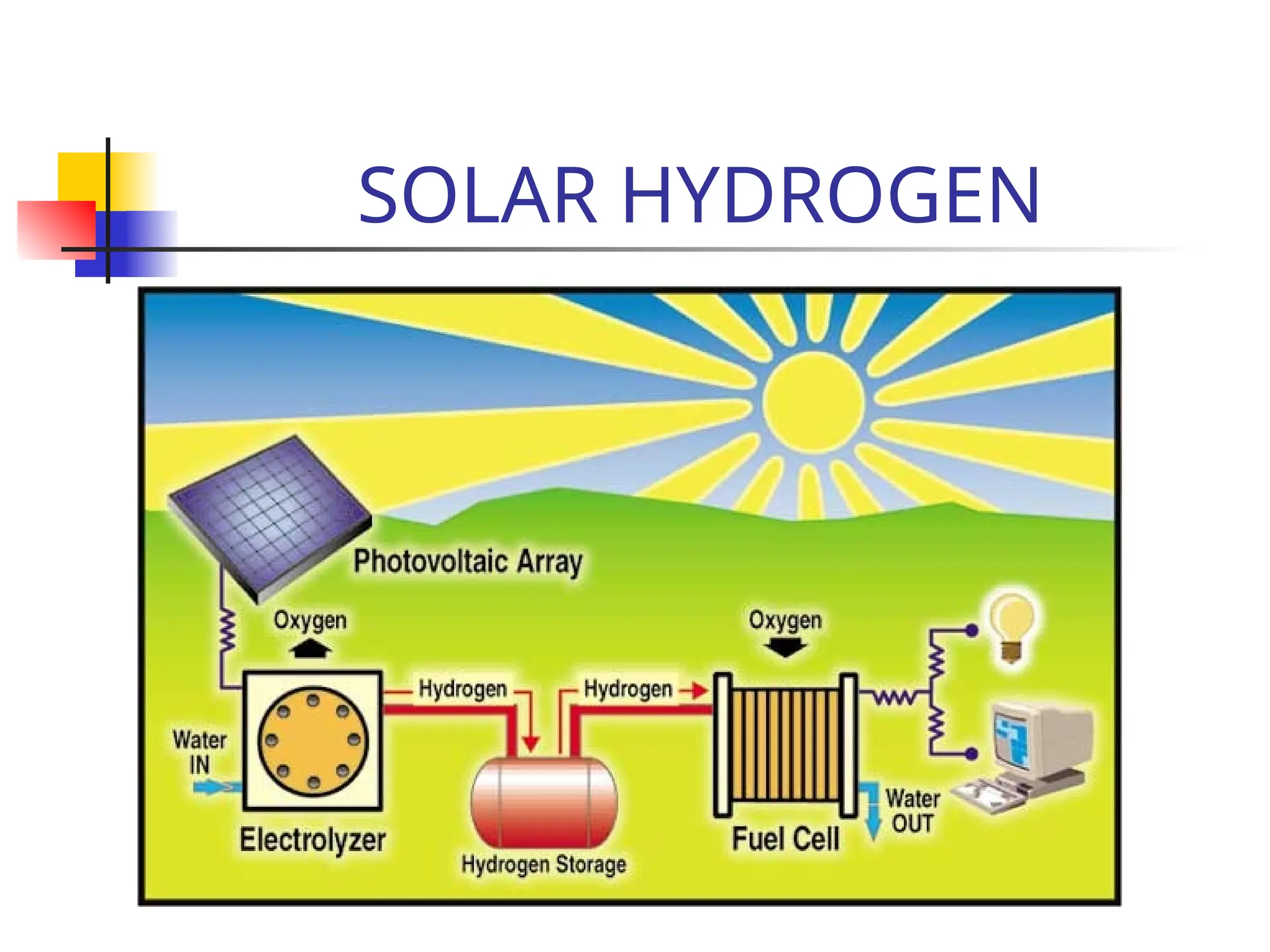
Solar-Hydrogen – Water can be split into gaseous hydrogen and oxygen.
It is in its infancy. So far… we can create fuel cells where hydrogen and oxygen
combine to produce an electrical current, but it is difficult to store enough hydrogen
gas in a fuel tank for very long.
Politics and economics are “holding up” this technology.
R&D from government needed.
must convince energy companies and investors to $ into this type of power and
phase out fossil fuels.
must convince public to change over.
…Not Yet!
SOLAR HYDROGEN
HYDROPOWER
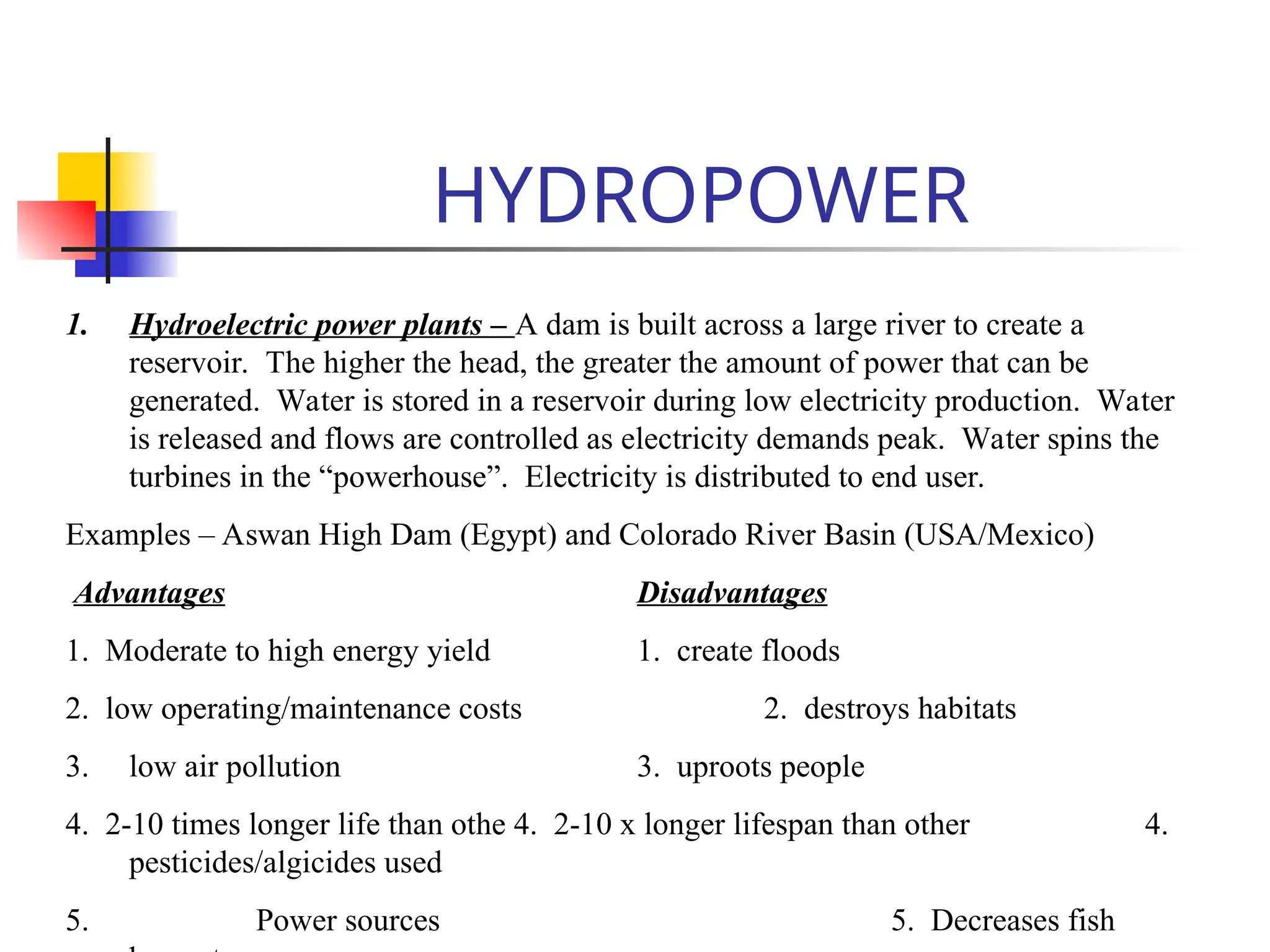
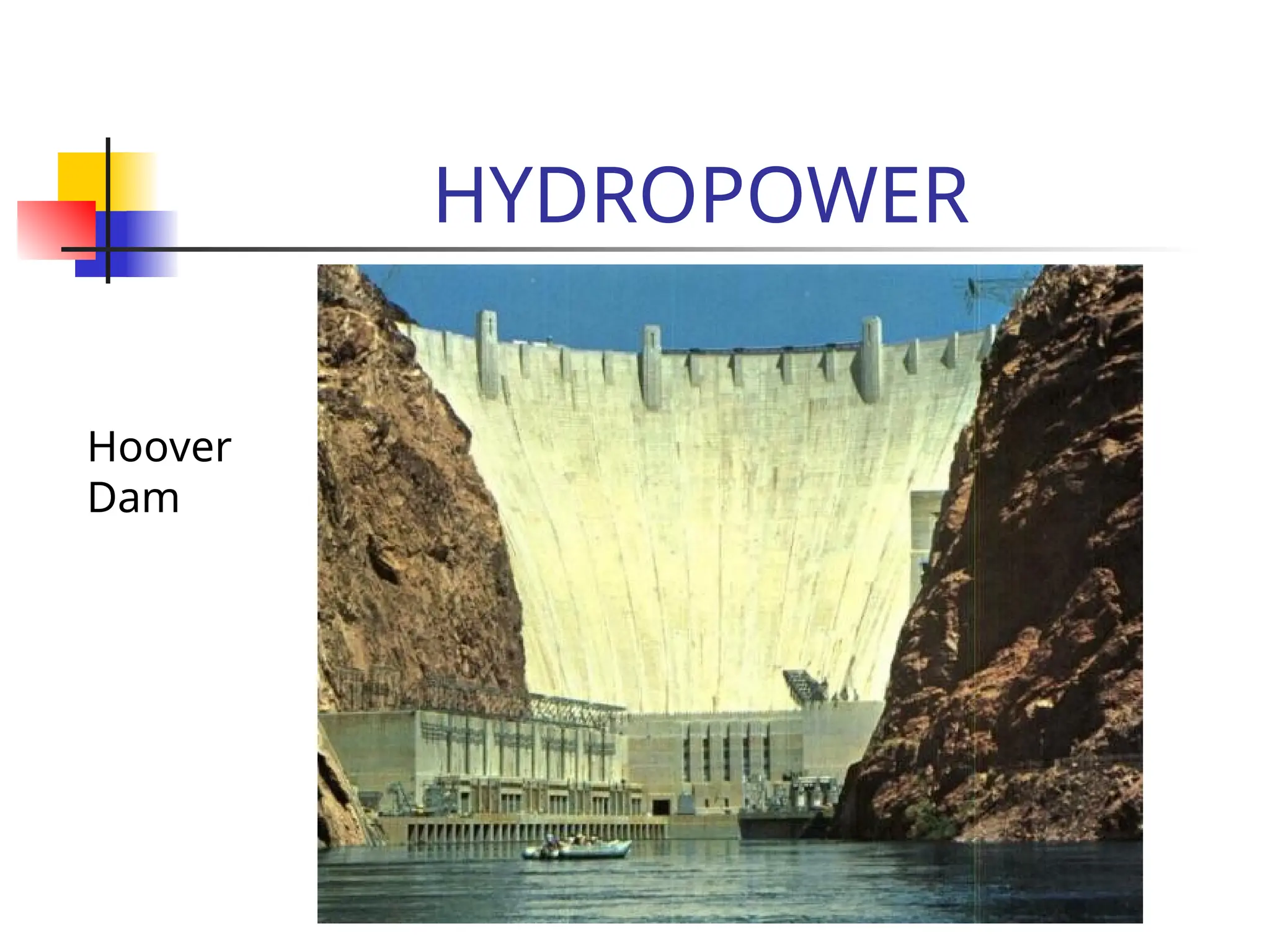
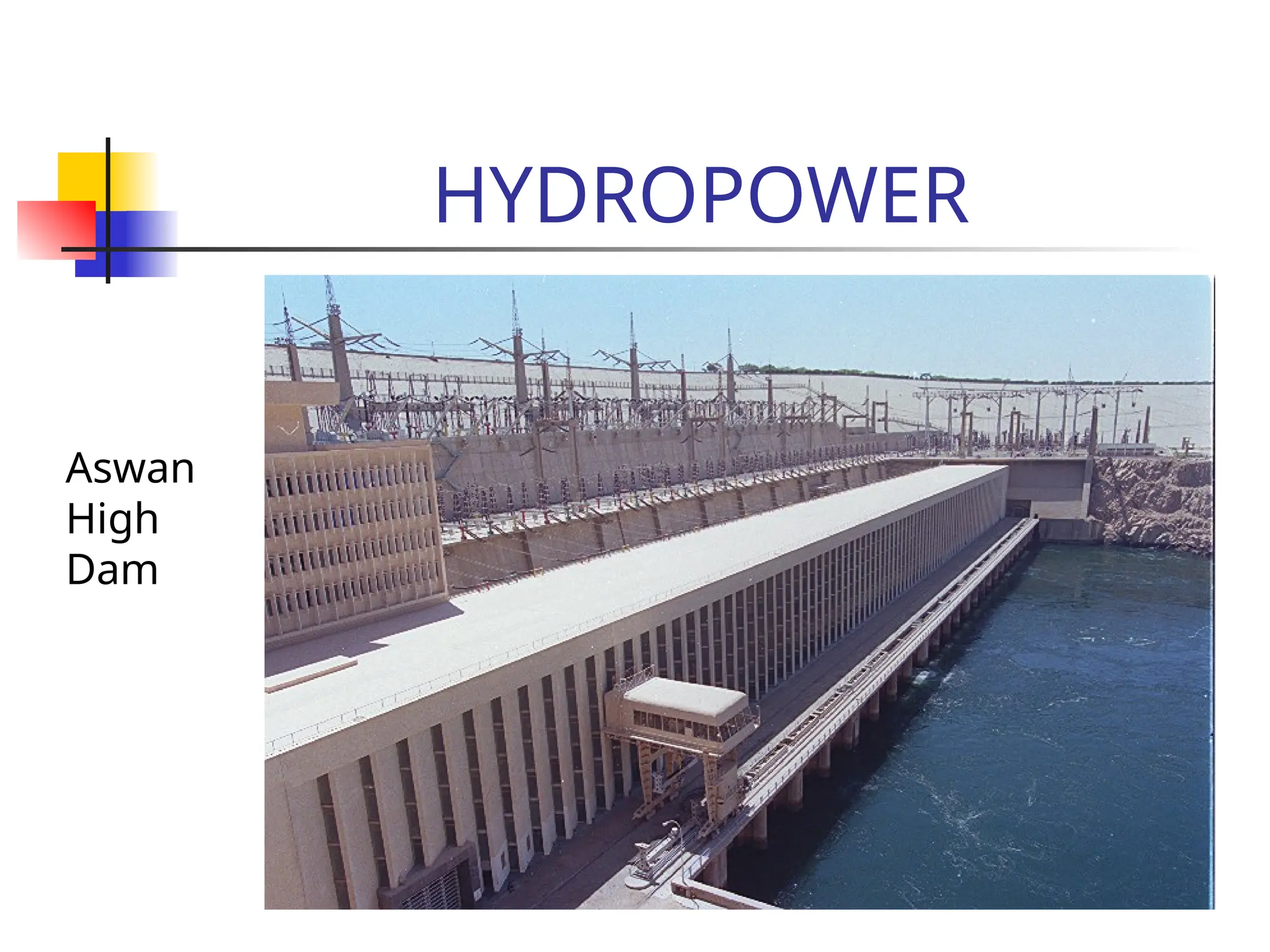
1. Hydroelectric power plants – A dam is built across a large river to create a
reservoir. The higher the head, the greater the amount of power that can be
generated. Water is stored in a reservoir during low electricity production. Water
is released and flows are controlled as electricity demands peak. Water spins the
turbines in the “powerhouse”. Electricity is distributed to end user.
Examples – Aswan High Dam (Egypt) and Colorado River Basin (USA/Mexico)
Advantages Disadvantages
1. Moderate to high energy yield 1. create floods
2. low operating/maintenance costs 2. destroys habitats
3. low air pollution 3. uproots people
4. 2-10 times longer life than othe 4. 2-10 x longer lifespan than other 4.
pesticides/algicides used
5. Power sources 5. Decreases fish
HYDROPOWER
Hoover
Dam
HYDROPOWER
Aswan
High
Dam
TIDAL POWER
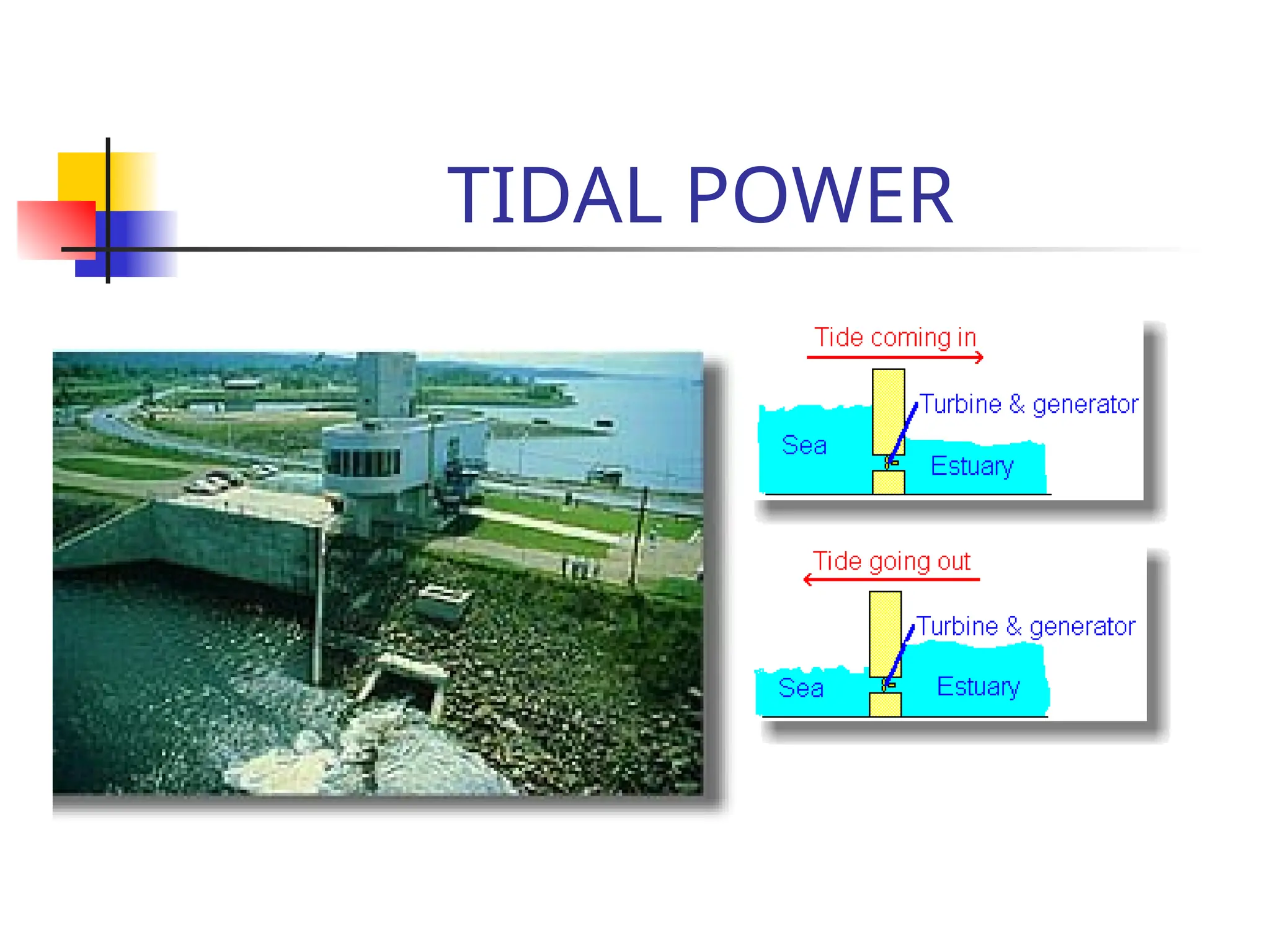
1Tidal Power- power created from tidal energy
Advantages Disadvantages
1. tidal energy spins turbines 1. few suitable sites
2. Construction costs high
TIDAL POWER
BIOMASS
Biomass – organic matter in plants produced through photosynthesis and can be burned
directly as a solid fuel or converted into a gas or liquid fuel.
1. Burning wood
2. Agricultural Waste
a. Bagasse (sugar cane residue)
b. Straw
3. Urban Waste (WTE)
a. burning garbage
4. Biofuels
a. Biogas – a mixture of 60% methane and 40% carbon dioxide.
b. Liquid ethanol- (grain alcohol) – sugar + grain; mix gasoline + ethanol = gasohol
which can burned in conventional gasoline engines (super-unleaded)
BIOMASS
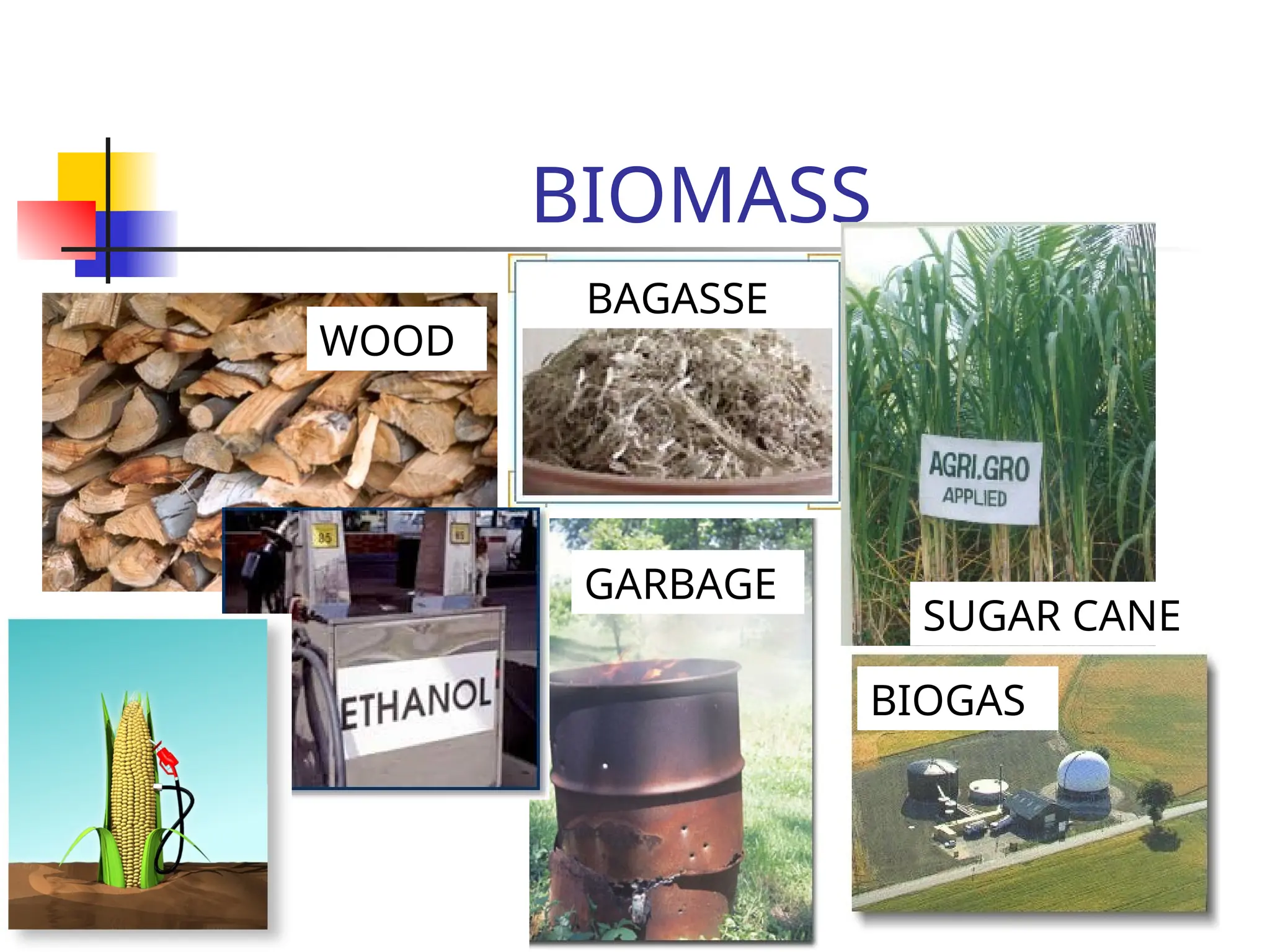
WOOD
GARBAGE
BIOGAS
BAGASSE
SUGAR CANE
BIOMASS
Advantages Disadvantages
1. potentially renewable resource 1. removal of trees depletes
soil nutrients
2. less air pollutants released 2. soil erosion (turbidity)
3. decrease in use of fossil fuels 3. flooding
4. moderate-high net energy yield 4. loss of wildlife habitats
5. large land areas needed
6. heavy pesticide/fertilizer use
7. reduces biodiversity
8. reduces ecological integrity
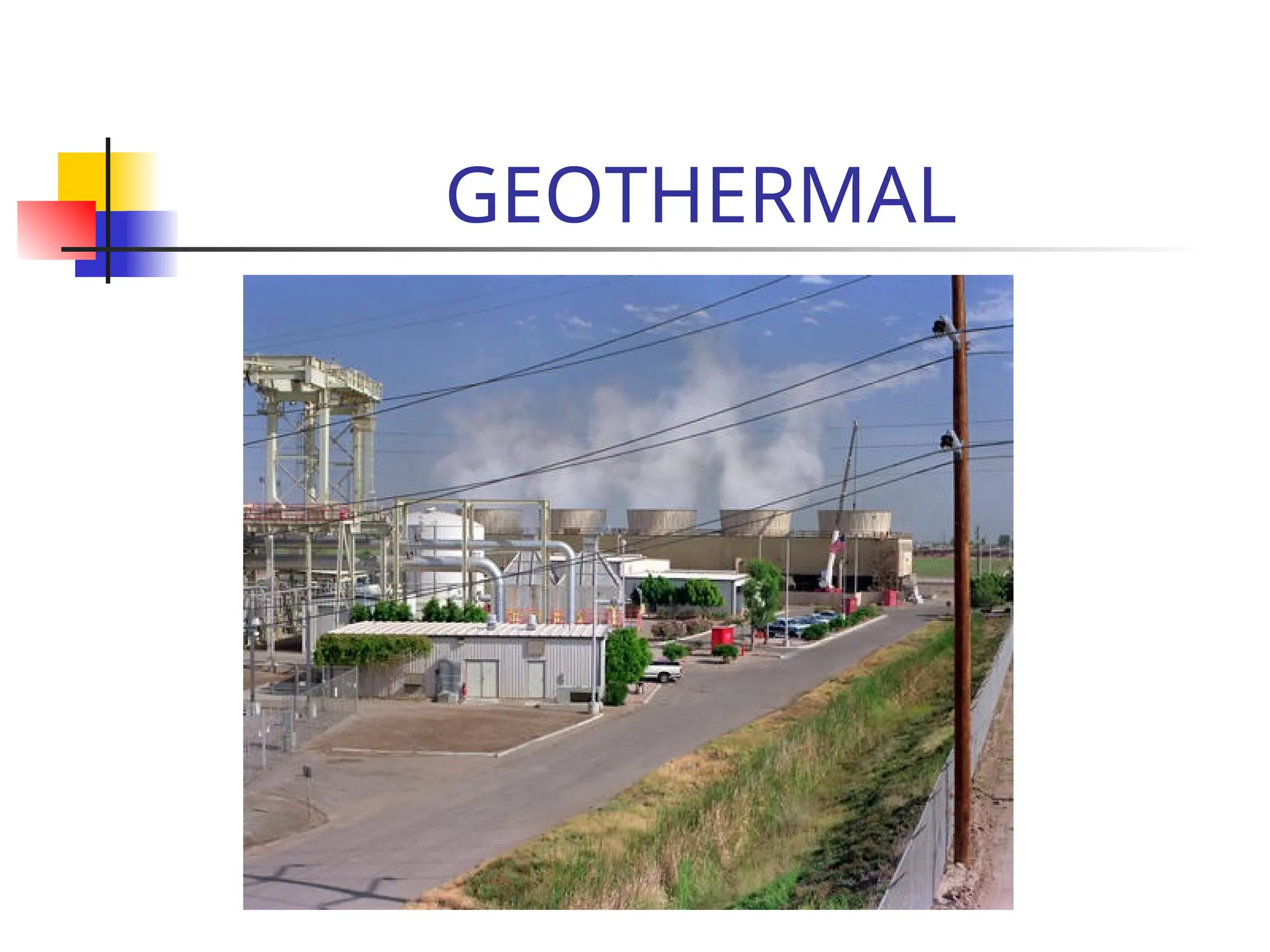
GEOTHERMAL
Geothermal Energy - Heat contained in underground rocks and
fluid that can be tapped for energy.
Extract dry steam, wet steam or hot water and can be used to heat
space or water.
“Potentially renewable resource”
22 countries currently use geothermal, it supplies 1% of world
energy. In the USA (44% geothermal energy produced worldwide)
geothermal electricity is produced mostly in Hawaii, California,
Nevada, and Utah.
GEOTHERMAL
Advantages Disadvantages
1. Reliable 1. Scarcity of
reservoirs
2. Renewable 2. Deforestation to
3. Moderate Net Energy Yield build plants
4. 96% less CO2 emitted 3. Land subsidence
5. Competitive Cost 4. Noise, odor
GEOTHERMAL
SOLUTIONS FOR
SUSTAINABLE ENERGY
Improve energy efficiency
Increase local availability of renewable energy resources
Find transitional resources (natural gas, nuclear)
Government must promote R&D for alternative renewable energy resources.
Educate the public
All energy resources should compete in an open, free-market with NO
government control!
Government needs to implement constructive subsidies not destructive subsidies
to promote change, this will lead to conservation of resources and less over-
consumption.
power point introduction for RENEWABLE ENERGY.ppt

  • 1.
    RENEWABLE ENERGY Renewable Energy Resource- An essentially inexhaustible energy resource on a human time scale.
  • 2.
    PASSIVE SOLAR HEATING Passivesolar heating – captures sunlight directly with a structure and converts it to low-temperature heat for space heating. Advantages Disadvantages 1. save money 1. expensive for initial costs 2. create 2-5 more jobs/unit of electricity 2. aesthetically not pleasing 3. eliminate/reduce fossil fuels 3. latitude 4. less pollution 5. less environmental damage
  • 3.
  • 4.
    ACTIVE SOLAR HEATING Activesolar heating – specially designed collectors absorb solar energy and fan/pump distributes energy to parts of a building to meet space/water heating needs. Advantages Disadvantages 1. save money 1. expensive for initial costs 2. create 2-5 more jobs/unit of electricity 2. aesthetically not pleasing 3. eliminate/reduce fossil fuels 3. latitude 4. less pollution 5. less environmental damage
  • 5.
  • 6.
    SOLAR POWER TOWER SolarPower Tower –huge arrays of computer controlled mirrors that track the sun and focus sunlight on a central heat collection tower. (Mojave desert in California) Advantages Disadvantages Cost will drop as Costs 8X more to Technology improves build
  • 7.
  • 8.
    SOLAR THERMAL PLANT 1SolarThermal Plant – sunlight is collected and focused on oil-filled pipes that run through the middle of curved solar collectors. Advantages Disadvantages 1. Can generate temperatures high 1. central receivers are enough for industrial processes expensive to operate. 2. can supply back-up electricity 3. cheaper than nuclear
  • 9.
  • 10.
    SOLAR COOKER 1Solar Cooker– focuses and concentrates sunlight in a box typically covered in glass to trap infrared radiation waves to cook food in rural villages in developing countries. Advantages Disadvantages Does not reduce deforestation 2-4 hours to cook average meal.
  • 11.
  • 12.
    SOLAR HYDROGEN Solar-Hydrogen –Water can be split into gaseous hydrogen and oxygen. It is in its infancy. So far… we can create fuel cells where hydrogen and oxygen combine to produce an electrical current, but it is difficult to store enough hydrogen gas in a fuel tank for very long. Politics and economics are “holding up” this technology. R&D from government needed. must convince energy companies and investors to $ into this type of power and phase out fossil fuels. must convince public to change over. …Not Yet!
  • 13.
  • 14.
    HYDROPOWER 1. Hydroelectric powerplants – A dam is built across a large river to create a reservoir. The higher the head, the greater the amount of power that can be generated. Water is stored in a reservoir during low electricity production. Water is released and flows are controlled as electricity demands peak. Water spins the turbines in the “powerhouse”. Electricity is distributed to end user. Examples – Aswan High Dam (Egypt) and Colorado River Basin (USA/Mexico) Advantages Disadvantages 1. Moderate to high energy yield 1. create floods 2. low operating/maintenance costs 2. destroys habitats 3. low air pollution 3. uproots people 4. 2-10 times longer life than othe 4. 2-10 x longer lifespan than other 4. pesticides/algicides used 5. Power sources 5. Decreases fish
  • 15.
  • 16.
  • 17.
    TIDAL POWER 1Tidal Power-power created from tidal energy Advantages Disadvantages 1. tidal energy spins turbines 1. few suitable sites 2. Construction costs high
  • 18.
  • 19.
    BIOMASS Biomass – organicmatter in plants produced through photosynthesis and can be burned directly as a solid fuel or converted into a gas or liquid fuel. 1. Burning wood 2. Agricultural Waste a. Bagasse (sugar cane residue) b. Straw 3. Urban Waste (WTE) a. burning garbage 4. Biofuels a. Biogas – a mixture of 60% methane and 40% carbon dioxide. b. Liquid ethanol- (grain alcohol) – sugar + grain; mix gasoline + ethanol = gasohol which can burned in conventional gasoline engines (super-unleaded)
  • 20.
  • 21.
    BIOMASS Advantages Disadvantages 1. potentiallyrenewable resource 1. removal of trees depletes soil nutrients 2. less air pollutants released 2. soil erosion (turbidity) 3. decrease in use of fossil fuels 3. flooding 4. moderate-high net energy yield 4. loss of wildlife habitats 5. large land areas needed 6. heavy pesticide/fertilizer use 7. reduces biodiversity 8. reduces ecological integrity
  • 22.
    GEOTHERMAL Geothermal Energy -Heat contained in underground rocks and fluid that can be tapped for energy. Extract dry steam, wet steam or hot water and can be used to heat space or water. “Potentially renewable resource” 22 countries currently use geothermal, it supplies 1% of world energy. In the USA (44% geothermal energy produced worldwide) geothermal electricity is produced mostly in Hawaii, California, Nevada, and Utah.
  • 23.
    GEOTHERMAL Advantages Disadvantages 1. Reliable1. Scarcity of reservoirs 2. Renewable 2. Deforestation to 3. Moderate Net Energy Yield build plants 4. 96% less CO2 emitted 3. Land subsidence 5. Competitive Cost 4. Noise, odor
  • 24.
  • 25.
    SOLUTIONS FOR SUSTAINABLE ENERGY Improveenergy efficiency Increase local availability of renewable energy resources Find transitional resources (natural gas, nuclear) Government must promote R&D for alternative renewable energy resources. Educate the public All energy resources should compete in an open, free-market with NO government control! Government needs to implement constructive subsidies not destructive subsidies to promote change, this will lead to conservation of resources and less over- consumption.