07.04.2015 Seite 1
EMIS – ENERGY MANAGEMENT
INFORMATION SYSTEM IN
PUBLIC BUILDINGS
April 2014
Page 2
Energy efficiency in RS –
legislative framework
Source: Law on Efficient Use of Energy, OG of RS 25/13
 The Law on Efficient Use of Energy regulates:
• The conditions and manner of efficient energy consumption in the sectors of
energy generation, transmission, distribution and consumption;
• Efficient energy consumption policies;
• Energy management system;
• Energy efficiency labeling of products which have impact on energy
consumption;
• Minimum requirements of energy efficiency in the generation, transmission
and distribution of electricity and heat energy and supplying of natural gas;
• Financing, incentives, and other measures in this field and other issues
relevant for the rights and obligations of natural and legal persons with
respect to efficient energy consumption.
Page 3
Energy efficiency policy
Source: Law on Efficient Use of Energy, OG of RS 25/13
 The key documents determining the policy of efficient energy
consumption include:
• Energy Sector Development Strategy of the RS;
• Programme for implementation of the Energy Sector
Development Strategy of the RS;
• National Action Plan for Energy Efficiency in the RS;
• Programs and plans of energy efficiency adopted by local
governments;
• Programs and plans of energy efficiency adopted by other
mandatory actors within the energy management system.
Page 4
Source: Law on Efficient Use of Energy, OG of RS 25/13
 Energy management:
• The subjects of the energy management system include: the
Government, the Ministry, the designated organizations of the
energy management system, energy managers and certified
energy auditors;
• The Government as a subject of the energy management system
adopts regulations in the field of efficient energy consumption,
at the proposal of the Ministry, and in accordance with the Law
on Efficient Use of Energy.
The Law on Efficient Use of Energy
Page 5
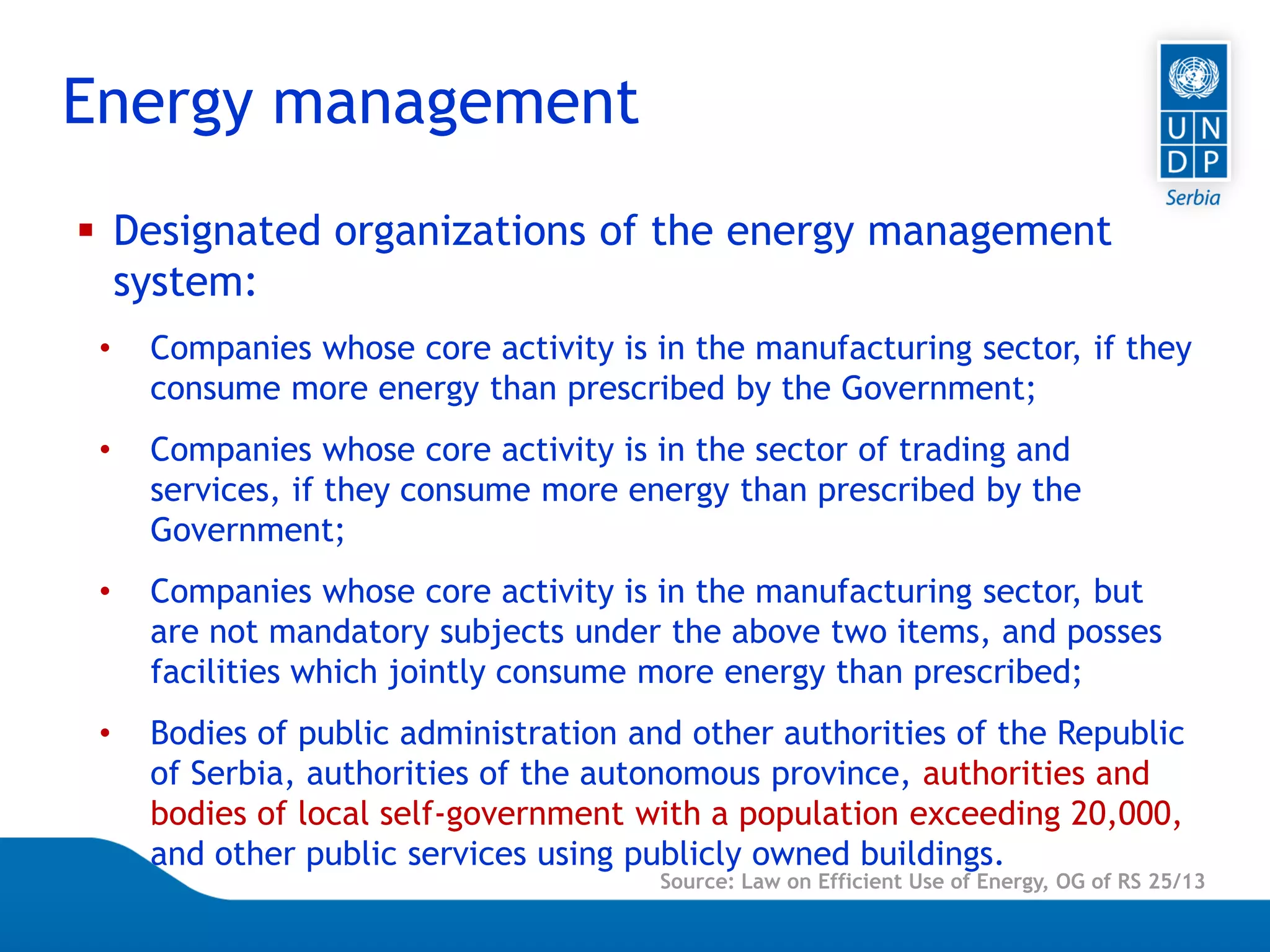
 Designated organizations of the energy management
system:
• Companies whose core activity is in the manufacturing sector, if they
consume more energy than prescribed by the Government;
• Companies whose core activity is in the sector of trading and
services, if they consume more energy than prescribed by the
Government;
• Companies whose core activity is in the manufacturing sector, but
are not mandatory subjects under the above two items, and posses
facilities which jointly consume more energy than prescribed;
• Bodies of public administration and other authorities of the Republic
of Serbia, authorities of the autonomous province, authorities and
bodies of local self-government with a population exceeding 20,000,
and other public services using publicly owned buildings.
Energy management
Source: Law on Efficient Use of Energy, OG of RS 25/13
Page 6
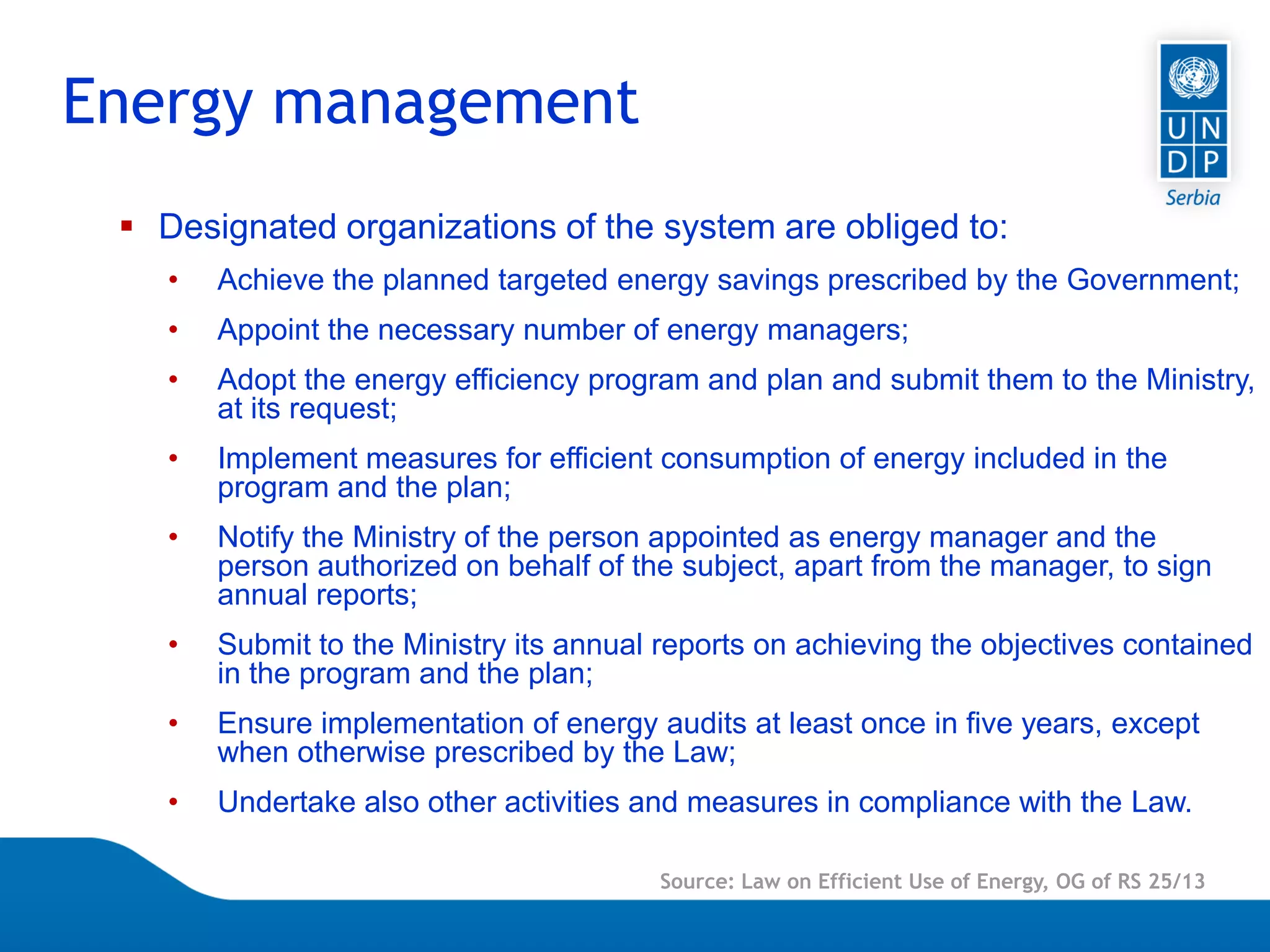
 Designated organizations of the system are obliged to:
• Achieve the planned targeted energy savings prescribed by the Government;
• Appoint the necessary number of energy managers;
• Adopt the energy efficiency program and plan and submit them to the Ministry,
at its request;
• Implement measures for efficient consumption of energy included in the
program and the plan;
• Notify the Ministry of the person appointed as energy manager and the
person authorized on behalf of the subject, apart from the manager, to sign
annual reports;
• Submit to the Ministry its annual reports on achieving the objectives contained
in the program and the plan;
• Ensure implementation of energy audits at least once in five years, except
when otherwise prescribed by the Law;
• Undertake also other activities and measures in compliance with the Law.
Energy management
Source: Law on Efficient Use of Energy, OG of RS 25/13
Page 7
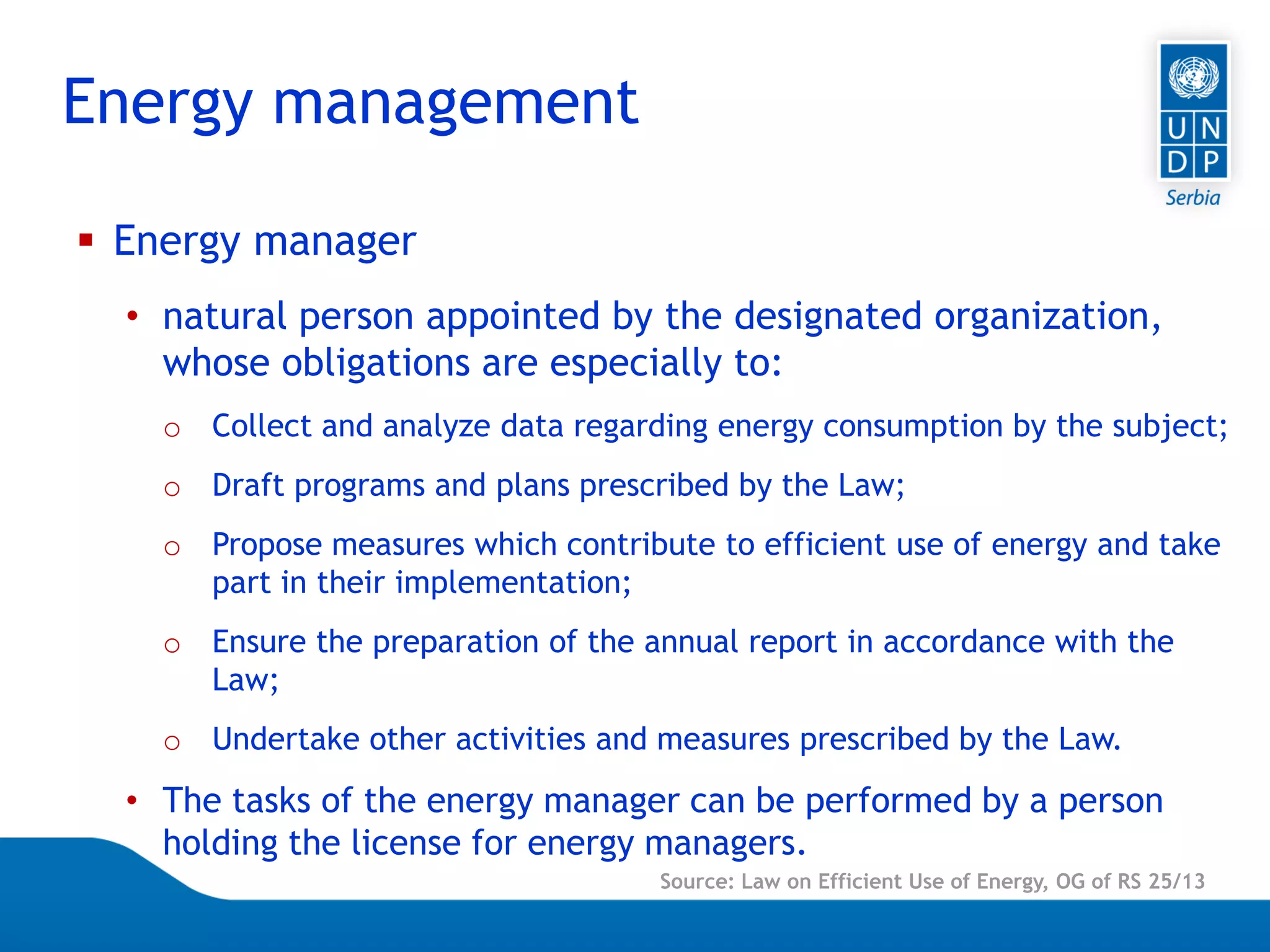
 Energy manager
• natural person appointed by the designated organization,
whose obligations are especially to:
o Collect and analyze data regarding energy consumption by the subject;
o Draft programs and plans prescribed by the Law;
o Propose measures which contribute to efficient use of energy and take
part in their implementation;
o Ensure the preparation of the annual report in accordance with the
Law;
o Undertake other activities and measures prescribed by the Law.
• The tasks of the energy manager can be performed by a person
holding the license for energy managers.
Energy management
Source: Law on Efficient Use of Energy, OG of RS 25/13
Page 8
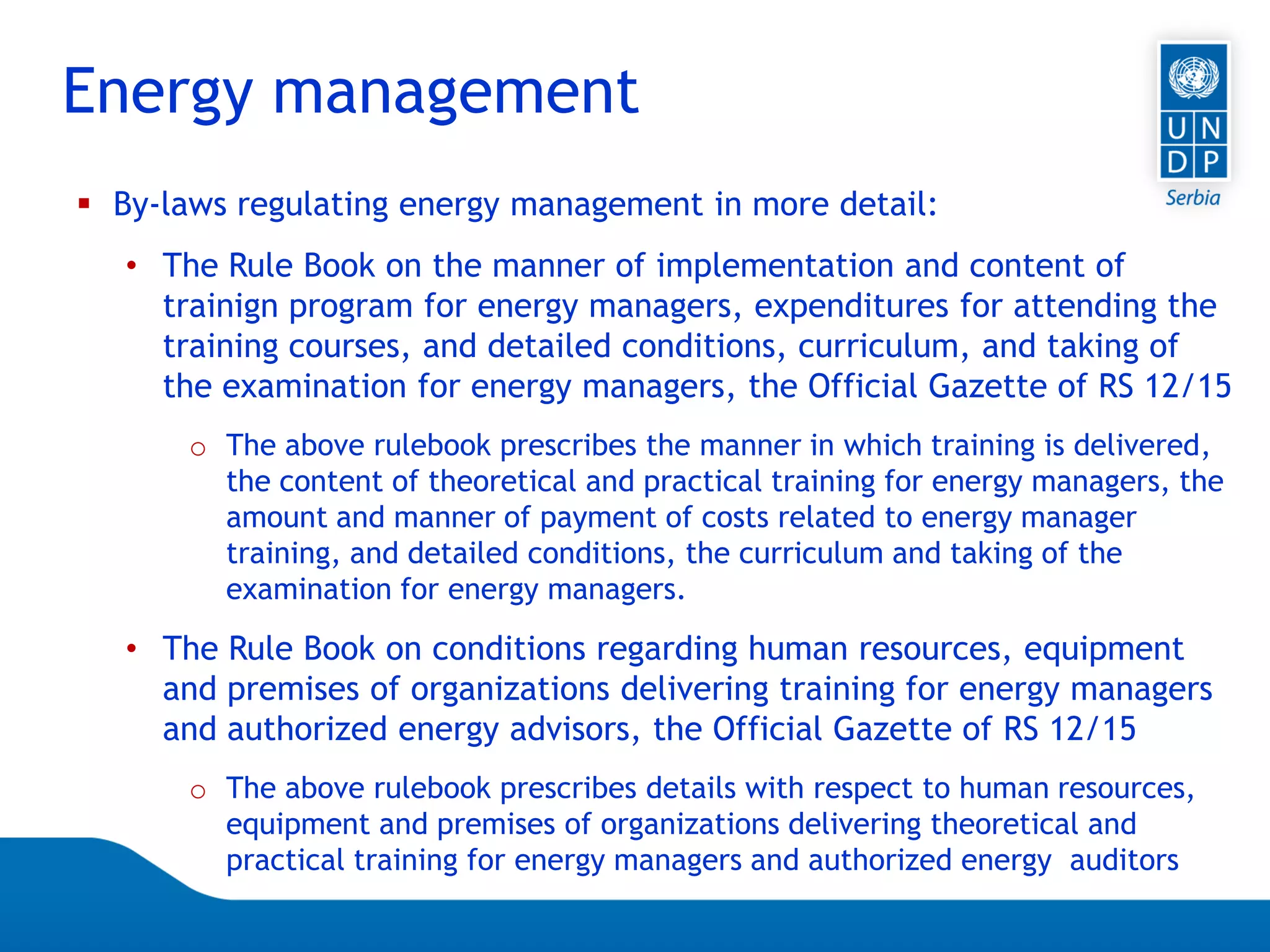
 By-laws regulating energy management in more detail:
• The Rule Book on the manner of implementation and content of
trainign program for energy managers, expenditures for attending the
training courses, and detailed conditions, curriculum, and taking of
the examination for energy managers, the Official Gazette of RS 12/15
o The above rulebook prescribes the manner in which training is delivered,
the content of theoretical and practical training for energy managers, the
amount and manner of payment of costs related to energy manager
training, and detailed conditions, the curriculum and taking of the
examination for energy managers.
• The Rule Book on conditions regarding human resources, equipment
and premises of organizations delivering training for energy managers
and authorized energy advisors, the Official Gazette of RS 12/15
o The above rulebook prescribes details with respect to human resources,
equipment and premises of organizations delivering theoretical and
practical training for energy managers and authorized energy auditors
Energy management
Page 9
About the Project
Introducing the Energy Management Information System -
EMIS (Serb. ISEM) in public buildings
 National partner: The Ministry of Mining and Energy
 UNDP donated the developed web-based software application for the
monitoring, analysis and reporting on energy and water consumption in
public buildings
 The Ministry provided the hardware and the system software and, in
cooperation with the UNDP, implemented the training for system
administrators and the first group of end users.
Page 10
About the Project
 Activities which preceded the Project:
• Providing the hardware, the system software and the hosting;
• ISEM installation;
• Training of system administrators;
 Project activities:
• Training the pilot group of end users. Training was delivered by the
national system administrators;
• Adjustments to the ISEM (in parallel with the training);
• Technical assistance to end users in collecting data;
• Anylysis of collected data and reporting;
• Detailed adjustments to the ISEM for long-term use in Serbia.
Page 11
Obligations of end users
 Obligations of end users of ISEM:
• Attending one-day training course;
• Establishing cooperation with the mentor who will allocate access
to ISEM for the user;
• Data collection:
o Each participant is expected to collect data about one public
building and data about consumption of energy, energy sources,
and water for the year 2014.
o Source of data: invoices for energy, energy sources, and water.
• Introducing ISEM for onward monitoring of consumption of energy,
energy sources, and water starting in January 2015.
Page 12
UNDP System administrators
 Maja Matejić, MSc.
Portfolio Manager - Energy
United Nations Development Programme
Tel. 011 2040 449
e-mail: maja.matejic@undp.org
 Miloš Krivokuća, BSc.
ICT Associate – Head of ICT Unit
United Nations Development Programme
Tel: 011 2040 488
e-mail: milos.krivokuca@undp.org
Support to end users
Page 13
ISEM
What is the purpose of ISEM?
It is the basic tool for energy management in public buildings
and municipalities
Basic function
 Collecting data on actual energy and water consumption in
public buildings
 Establishing a national data base on energy and water
consumption in public buildings
Page 14
How is data collected?
Manually
 By entering data from invoices for energy (electricity, gas,
district heating), energy sources (gas, coal, fuel-oil, crude,
firewood, etc.) and water;
 By entering data read from meters and counters;
Automatically
 By importing data from relevant meters and counters
equipped for remote reading.
ISEM
Page 15
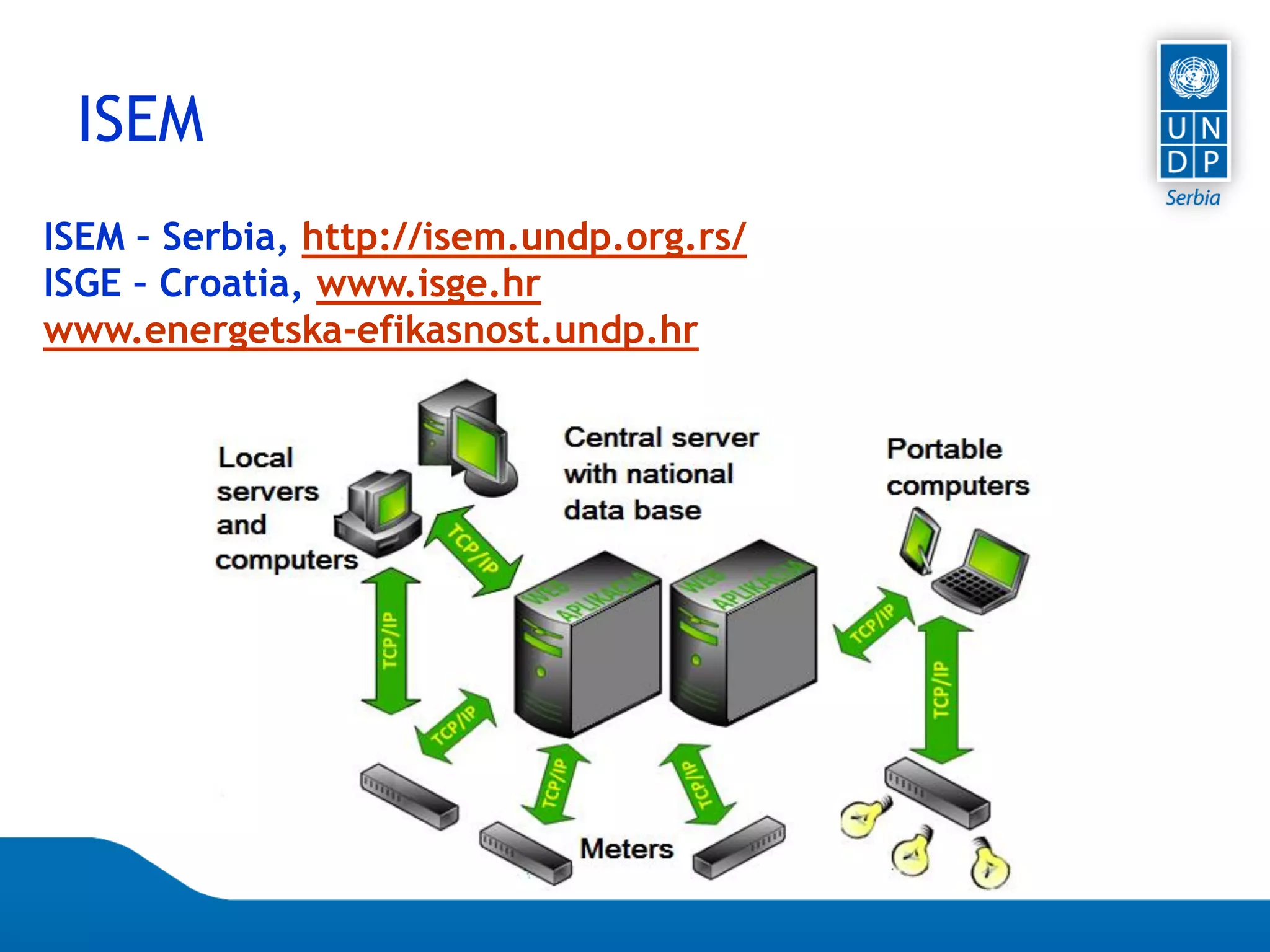
ISEM
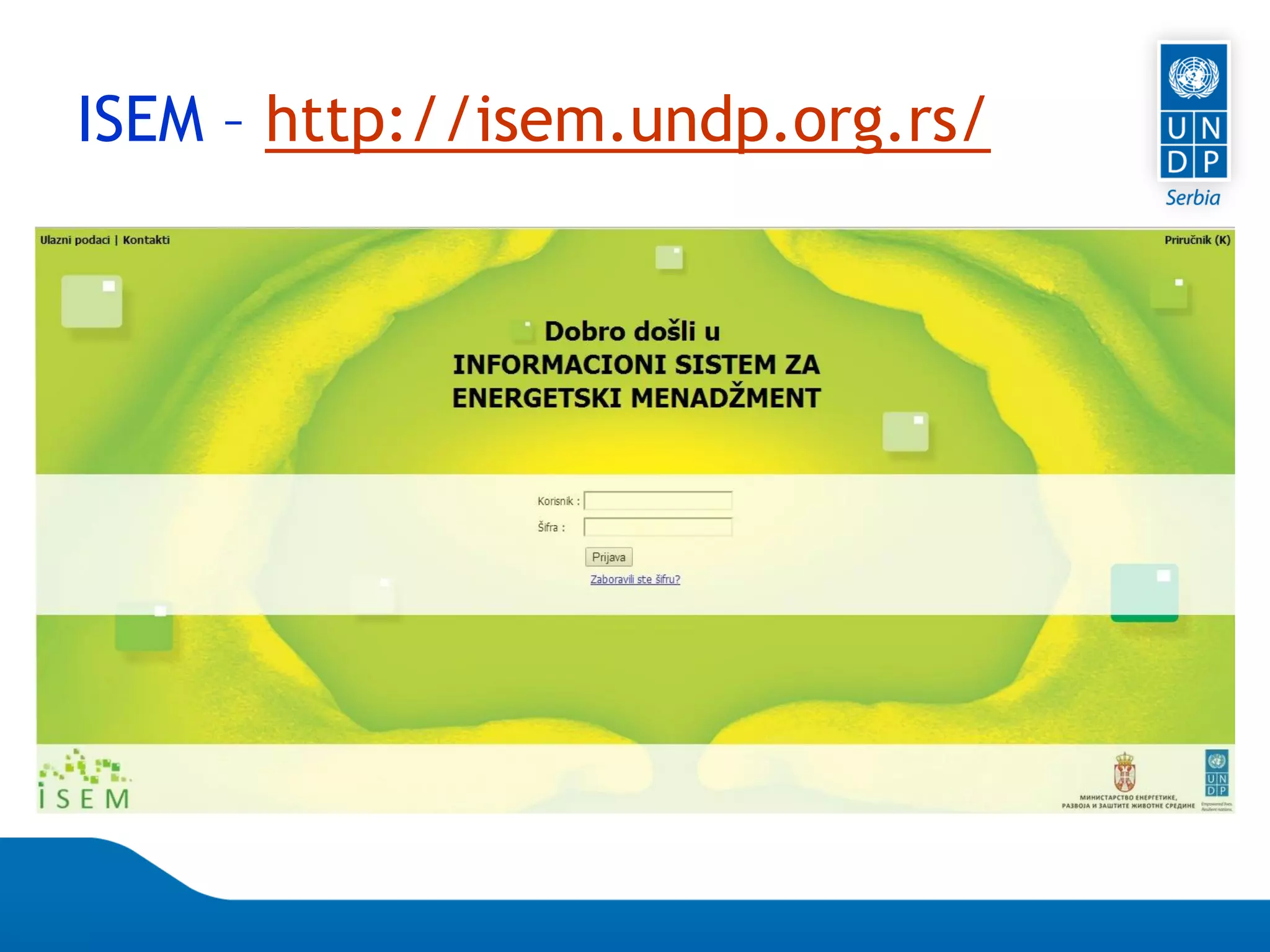
ISEM – Serbia, http://isem.undp.org.rs/
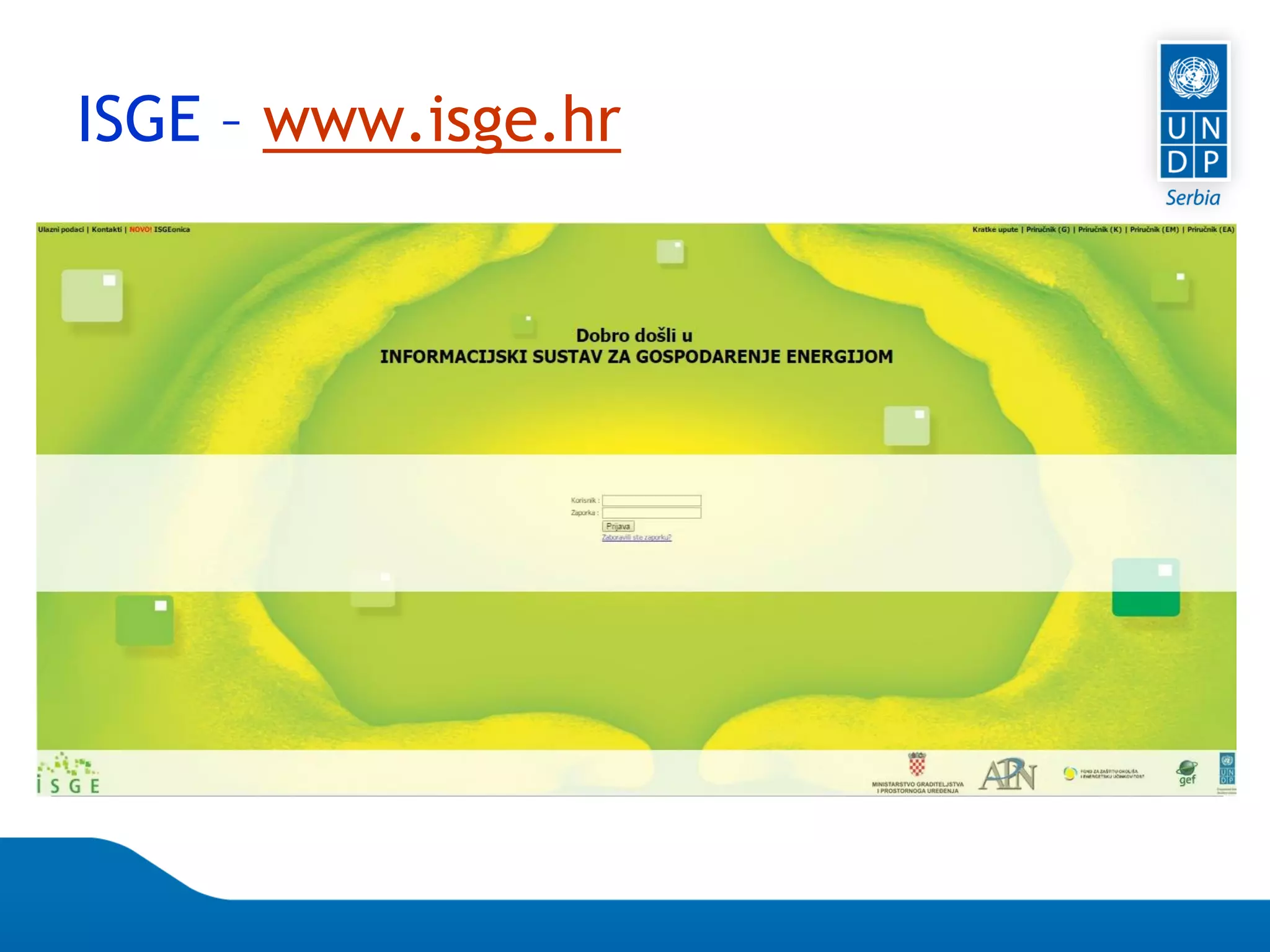
ISGE – Croatia, www.isge.hr
www.energetska-efikasnost.undp.hr
Page 16
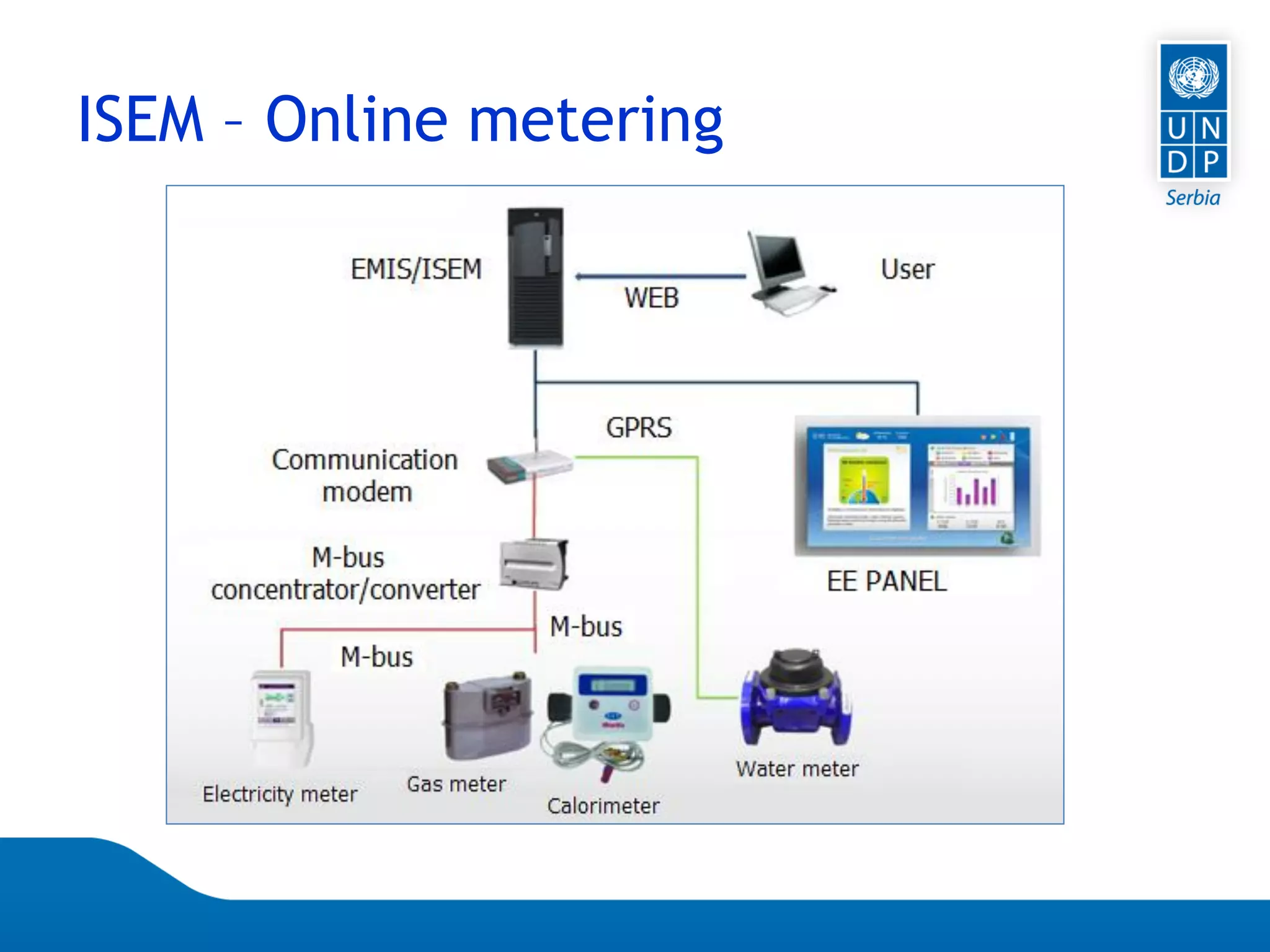
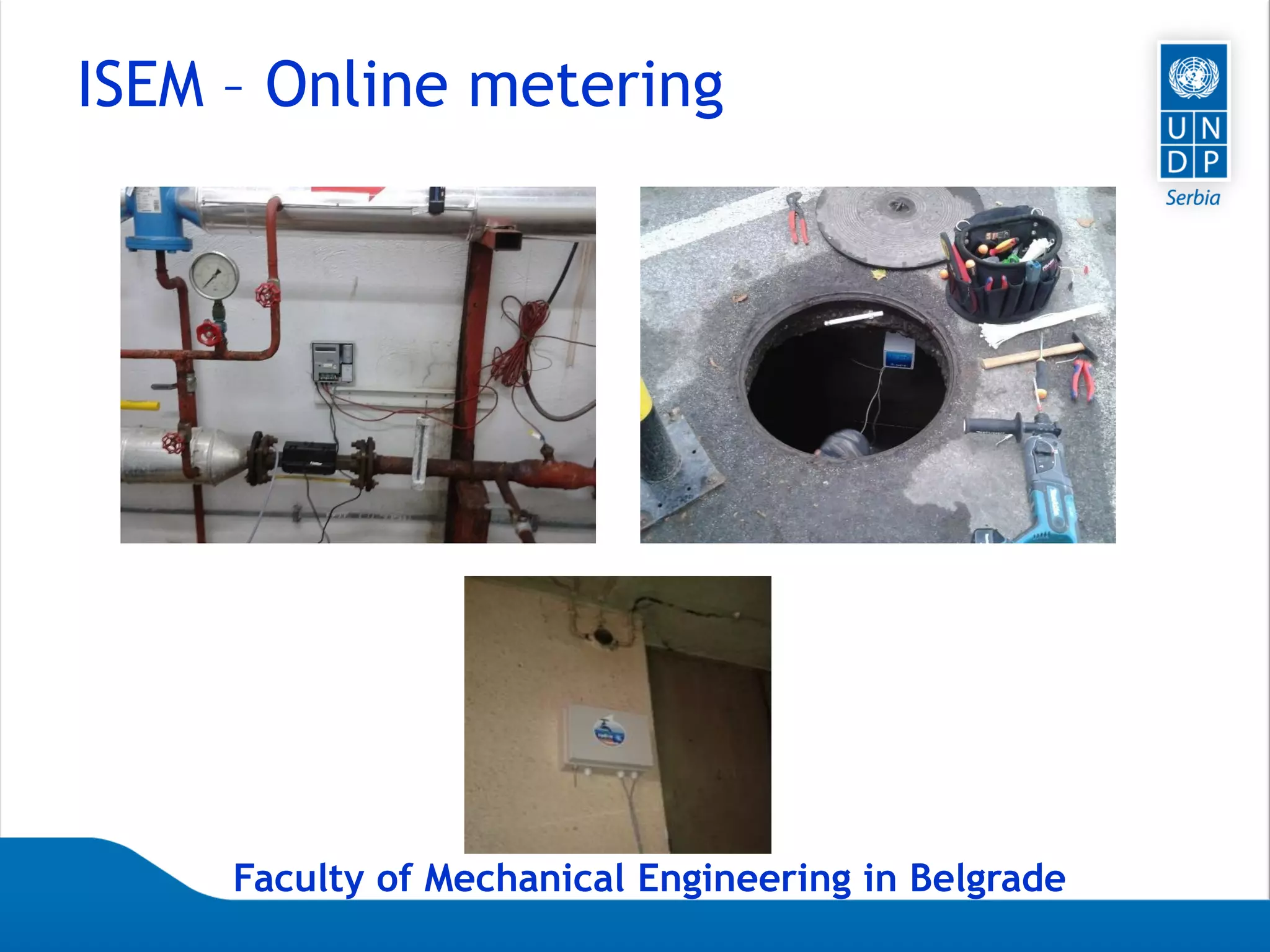
ISEM – Online metering
Page 17
ISEM – Online metering
Faculty of Mechanical Engineering in Belgrade
Page 18
ISEM
The purpose of ISEM?
 Recording public buildings and relevant data concerning
buildings;
 Analysis of energy and water consumption;
 Calculation of energy indicators for public buildings and
comparison with buildings of the same category in the country
and abroad;
 Recording undertaken energy efficiency measures in public
buildings and monitoring their actual performance;
 Identification of energy efficiency projects;
 Development of energy efficiency projects;
 Raising awareness of and promoting energy efficiency.
Page 19
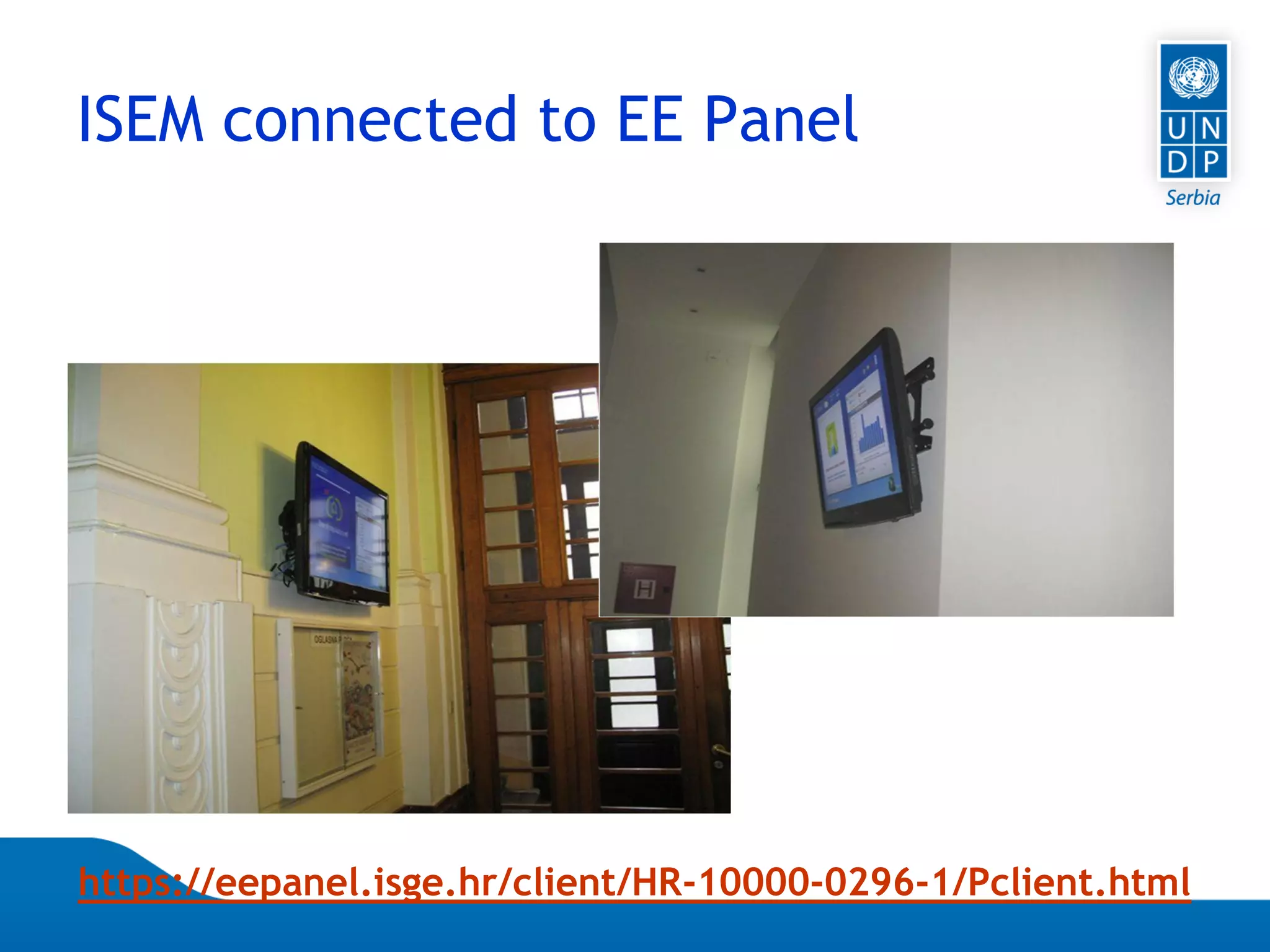
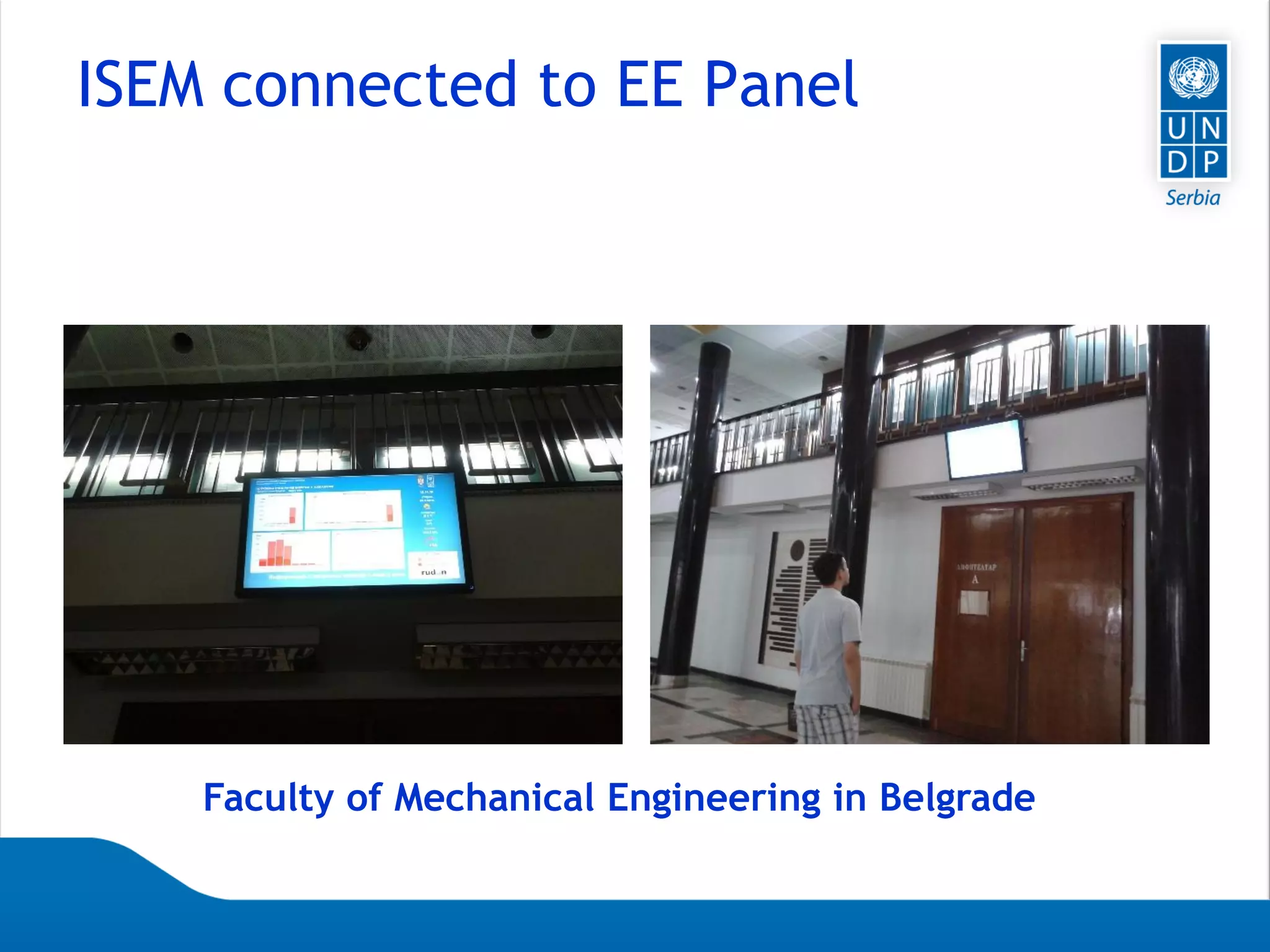
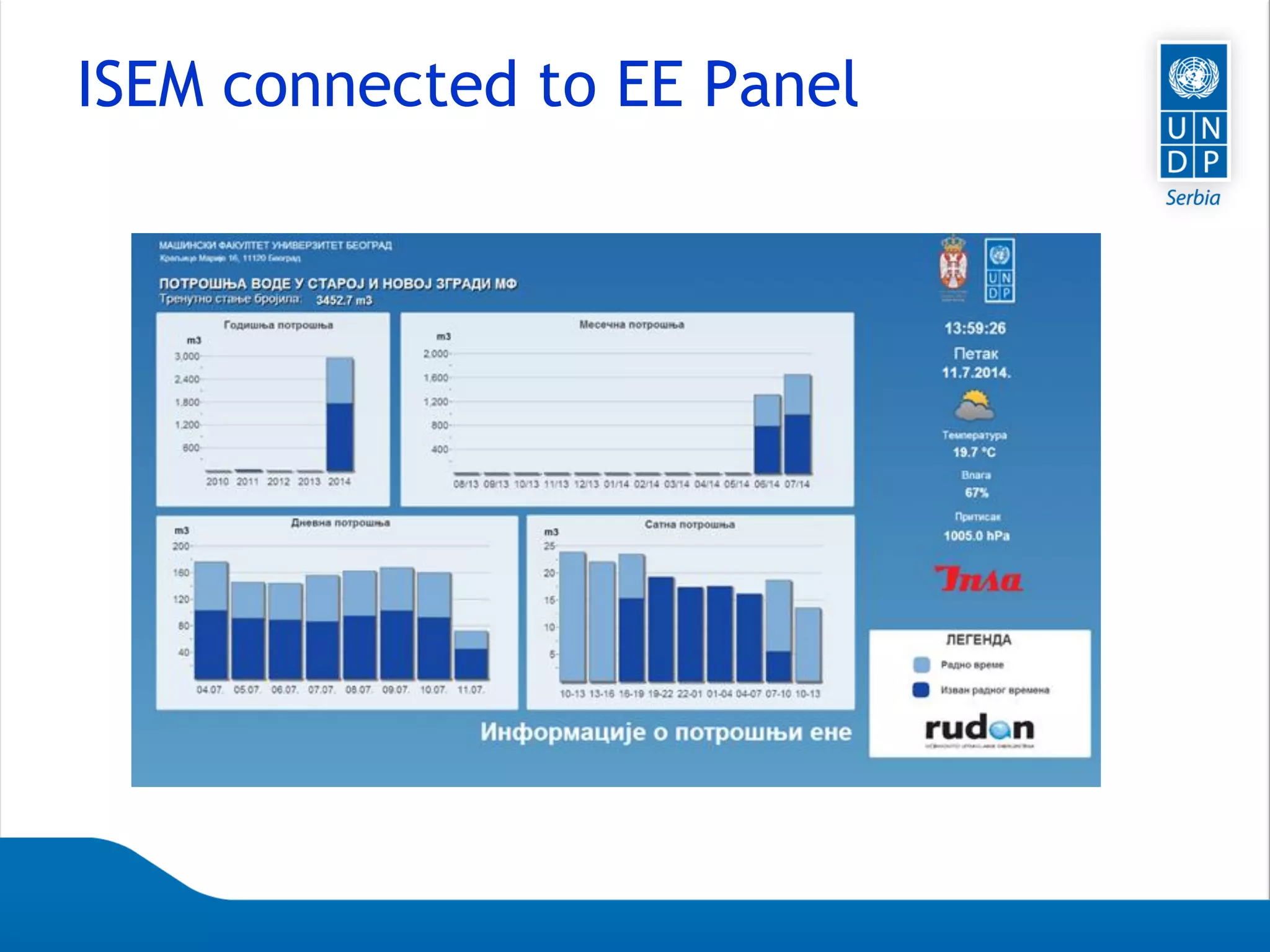
ISEM connected to EE Panel
https://eepanel.isge.hr/client/HR-10000-0296-1/Pclient.html
Page 20
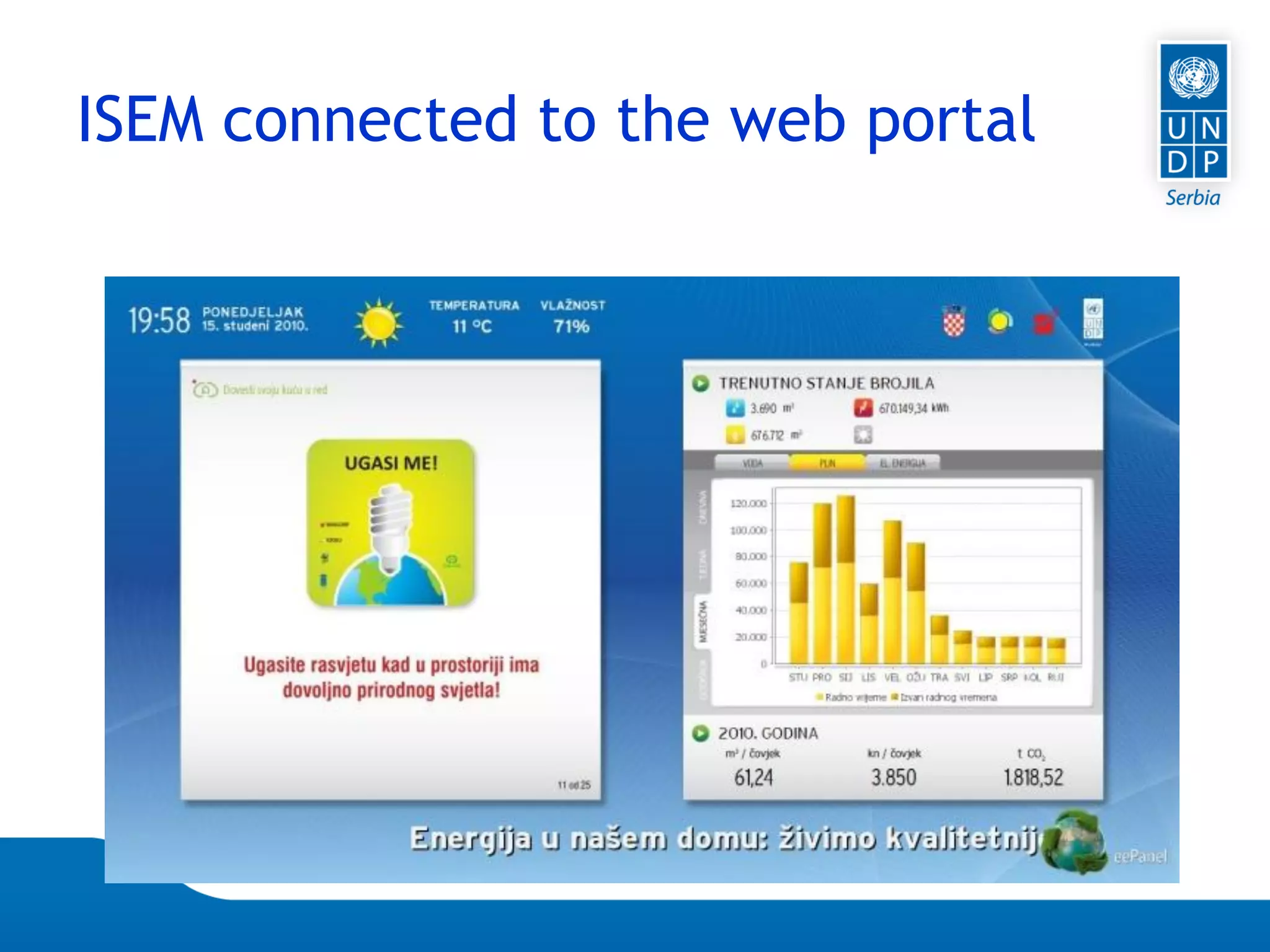
ISEM connected to the web portal
Page 21
ISEM connected to EE Panel
Faculty of Mechanical Engineering in Belgrade
Page 22
ISEM connected to EE Panel
Page 23
ISEM
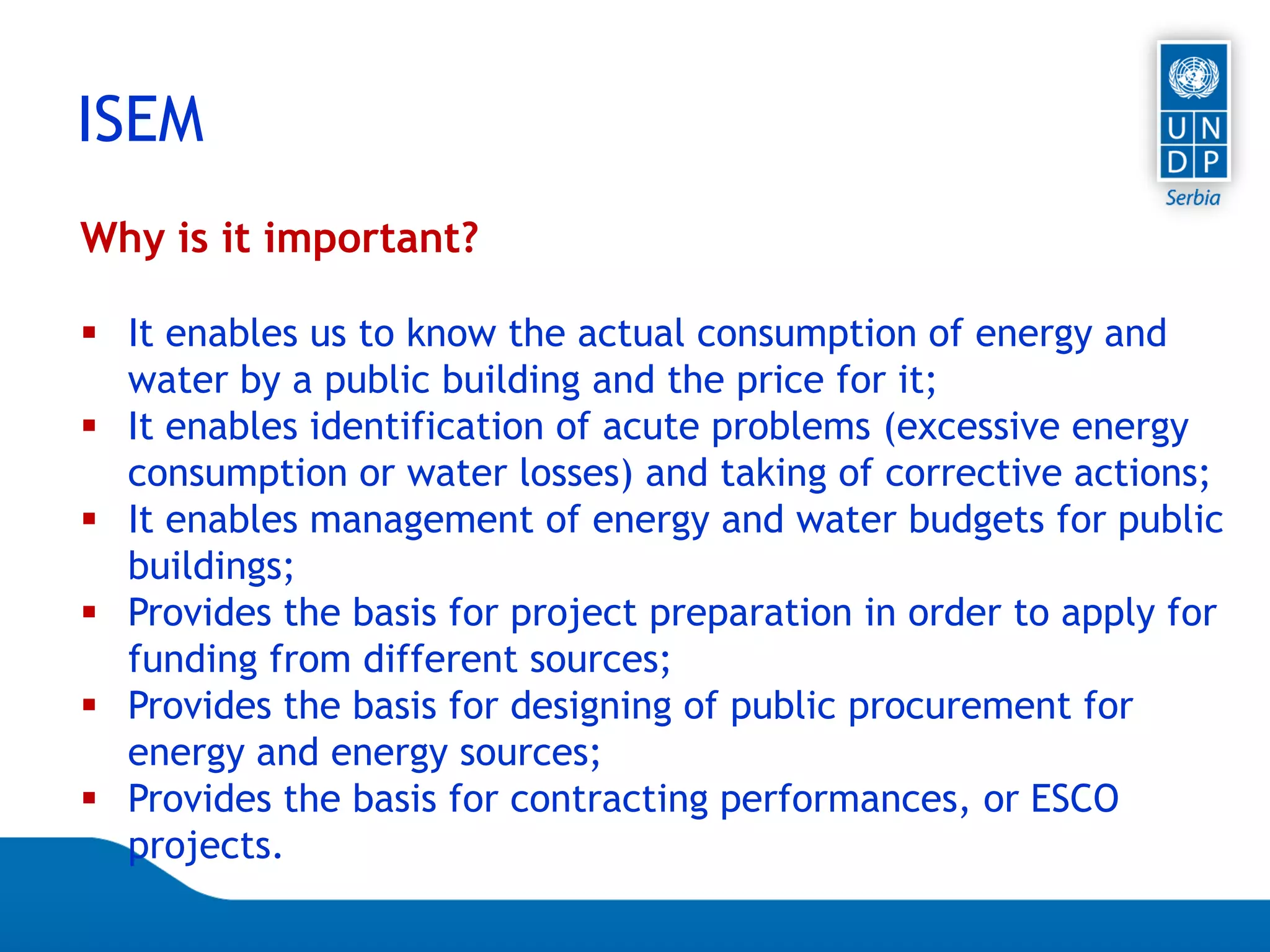
Why is it important?
 It enables us to know the actual consumption of energy and
water by a public building and the price for it;
 It enables identification of acute problems (excessive energy
consumption or water losses) and taking of corrective actions;
 It enables management of energy and water budgets for public
buildings;
 Provides the basis for project preparation in order to apply for
funding from different sources;
 Provides the basis for designing of public procurement for
energy and energy sources;
 Provides the basis for contracting performances, or ESCO
projects.
Page 24
Which buildings is ISEM intended for?
1. Buildings falling within the competences of local self-governments
(schools, kinder-gartnes, municipal administrative buildings, sports
centers, primary health care centers, PUC’s buildings, etc.);
2. Buildings falling within the competences of national authorities
(buildings of public administration, courts, hospitals, gerontology
centers, faculties, students’ dormitories, military barracks, prisons,
PUC’s buildings, etc.);
3. Buildings falling within the competences of indirect budget
beneficiaries;
4. Buildings falling within the competences of other organizations and
public companies;
5. ISEM can also be used for commercial buildings!!!
ISEM
Page 25
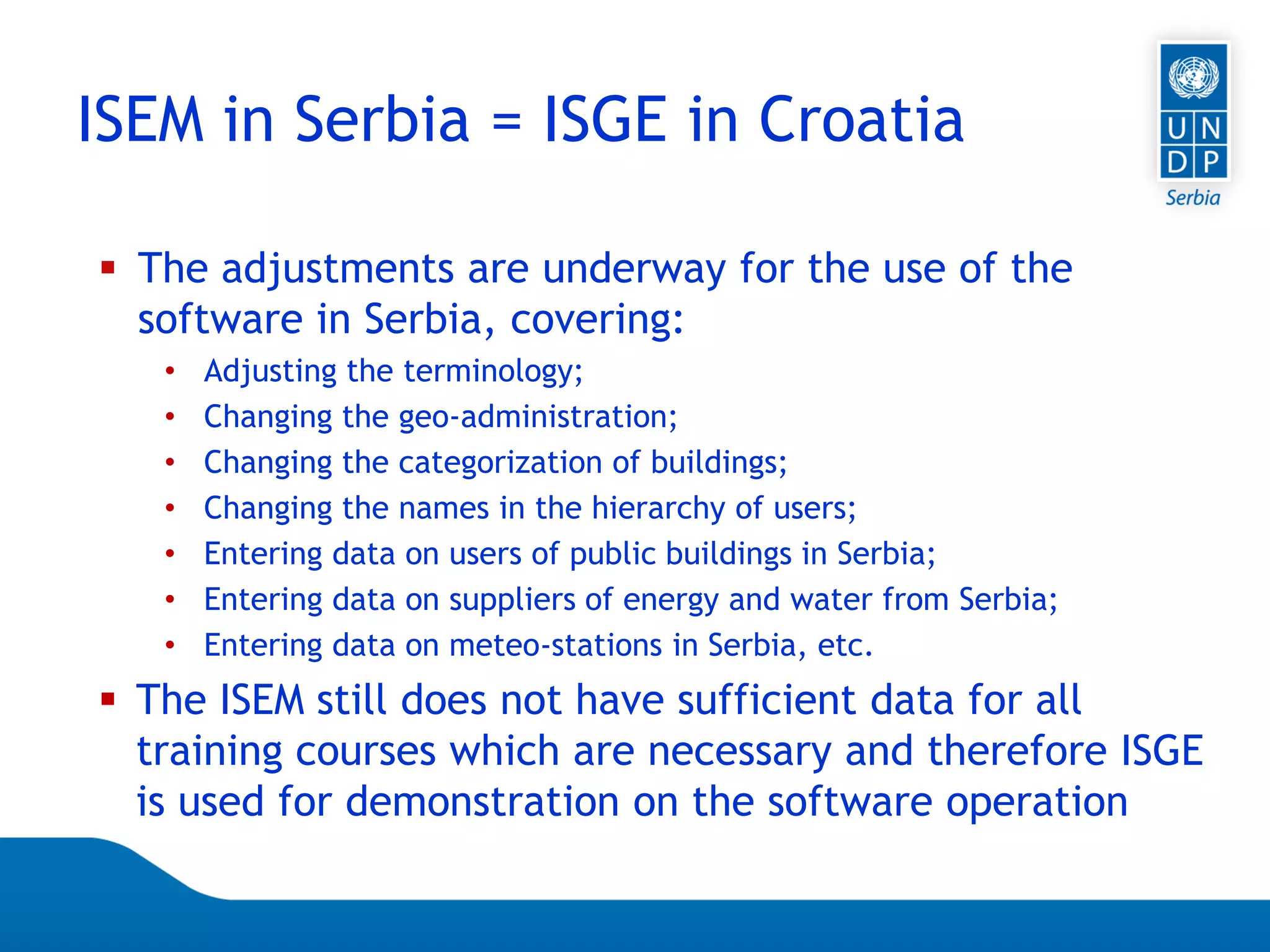
 The adjustments are underway for the use of the
software in Serbia, covering:
• Adjusting the terminology;
• Changing the geo-administration;
• Changing the categorization of buildings;
• Changing the names in the hierarchy of users;
• Entering data on users of public buildings in Serbia;
• Entering data on suppliers of energy and water from Serbia;
• Entering data on meteo-stations in Serbia, etc.
 The ISEM still does not have sufficient data for all
training courses which are necessary and therefore ISGE
is used for demonstration on the software operation
ISEM in Serbia = ISGE in Croatia
Page 26
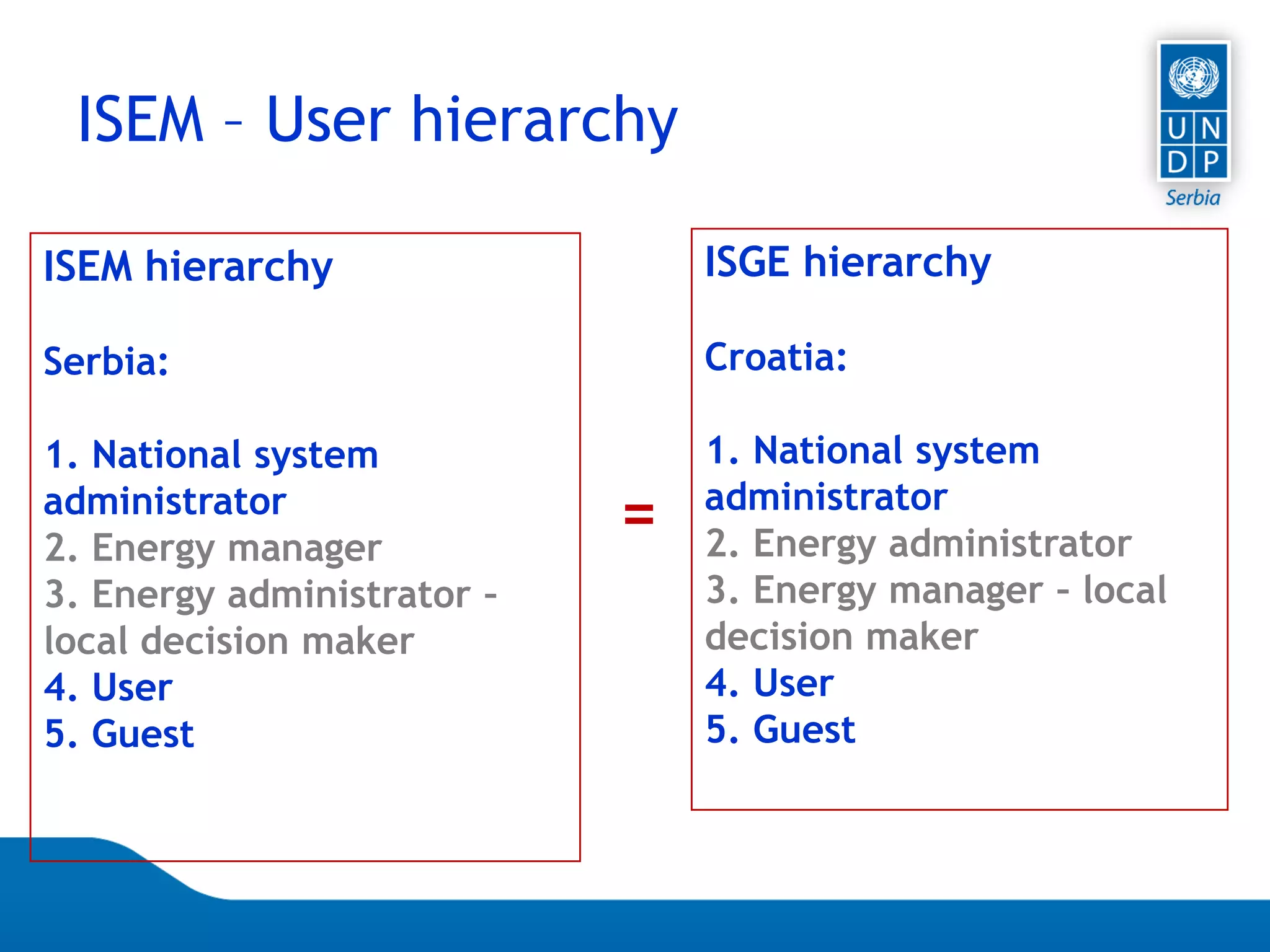
ISEM – User hierarchy
ISEM hierarchy
Serbia:
1. National system
administrator
2. Energy manager
3. Energy administrator –
local decision maker
4. User
5. Guest
ISGE hierarchy
Croatia:
1. National system
administrator
2. Energy administrator
3. Energy manager – local
decision maker
4. User
5. Guest
=
Page 27
ISEM – http://isem.undp.org.rs/
Page 28
ISGE – www.isge.hr
Page 29
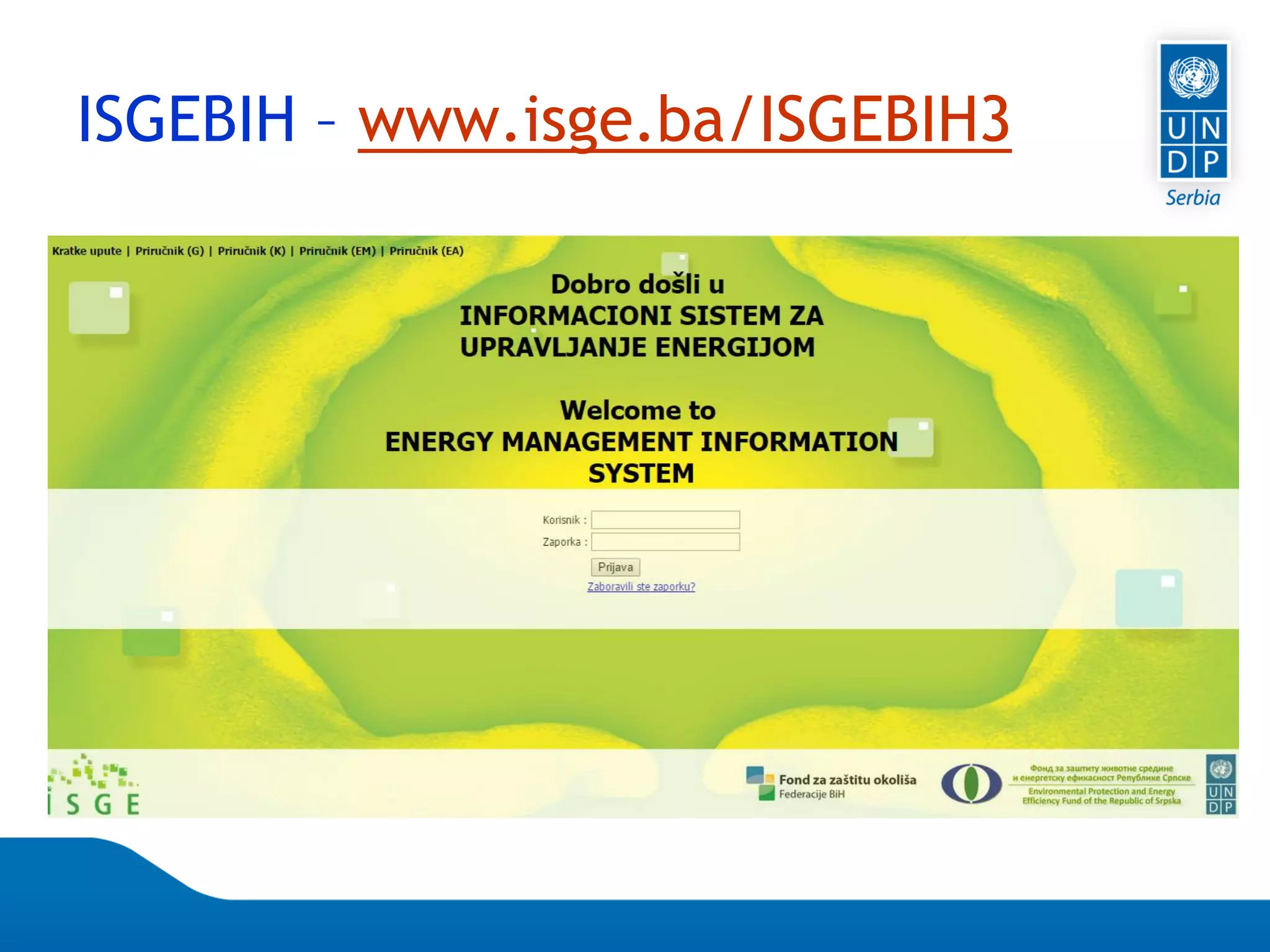
ISGEBIH – www.isge.ba/ISGEBIH3
Page 30
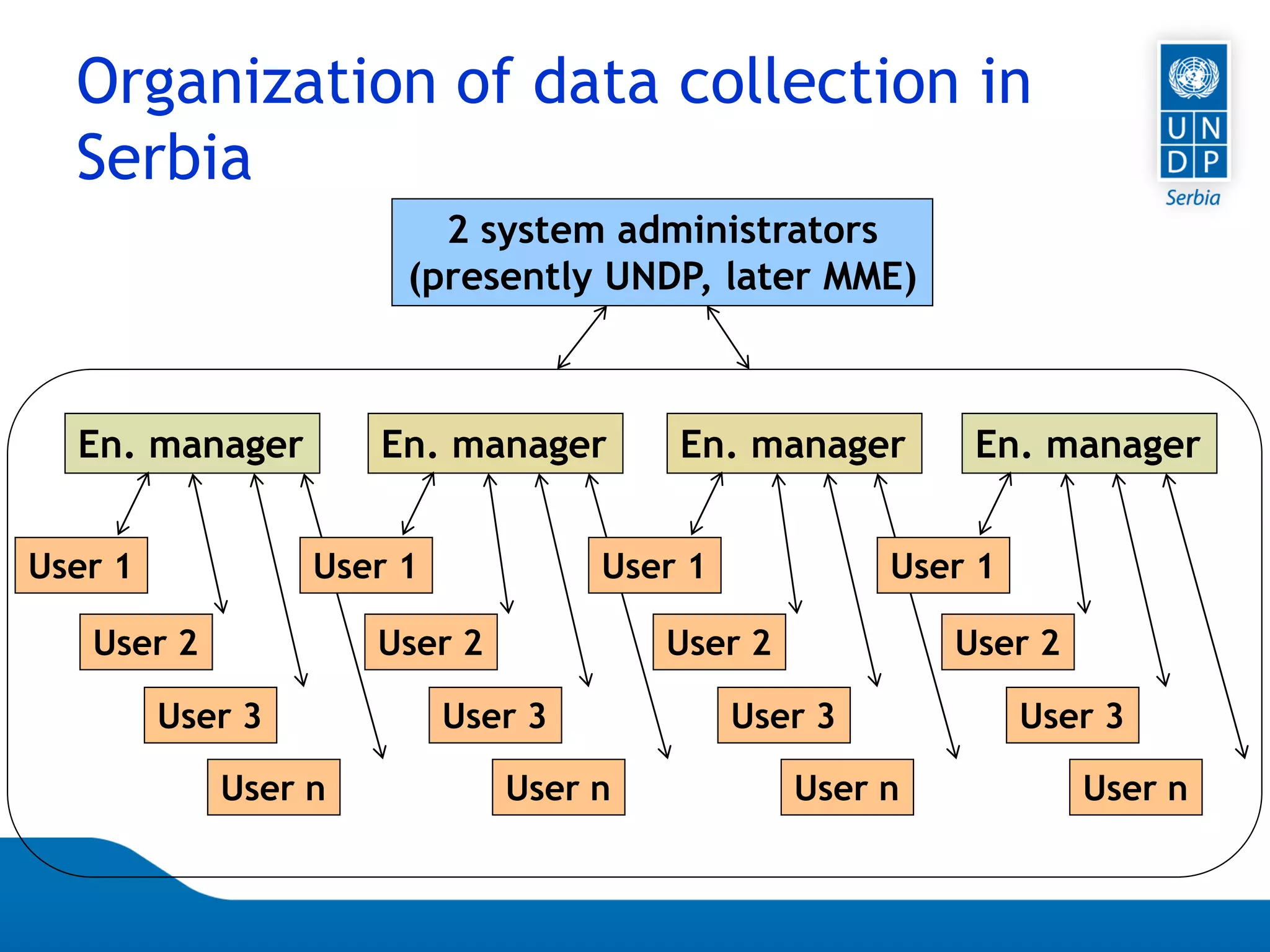
Organization of data collection in
Serbia
2 system administrators
(presently UNDP, later MME)
En. manager En. manager En. manager En. manager
User 1
User 2
User 3
User n
User 1
User 2
User 3
User n
User 1
User 2
User 3
User n
User 1
User 2
User 3
User n
Page 31
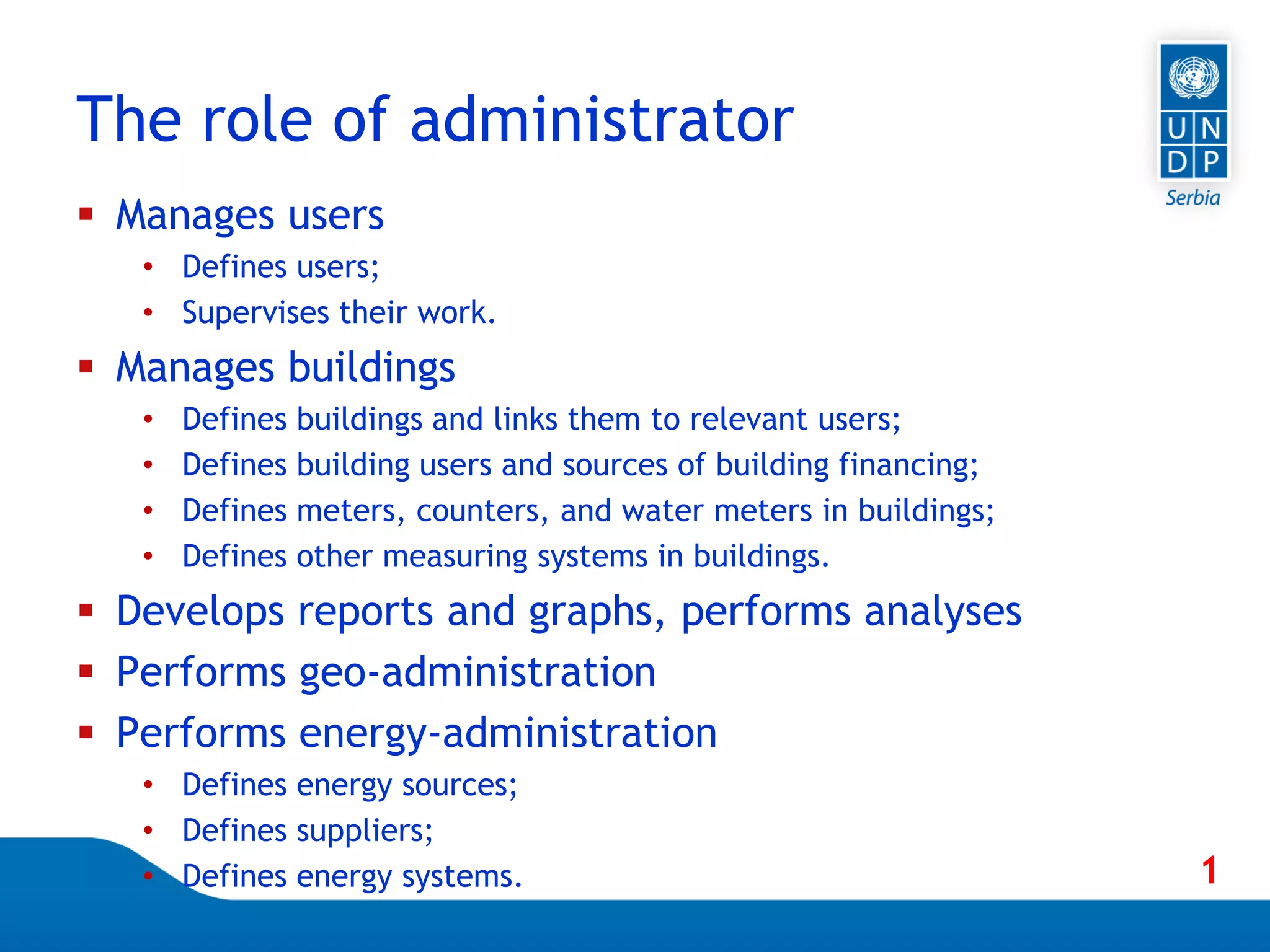
 Manages users
• Defines users;
• Supervises their work.
 Manages buildings
• Defines buildings and links them to relevant users;
• Defines building users and sources of building financing;
• Defines meters, counters, and water meters in buildings;
• Defines other measuring systems in buildings.
 Develops reports and graphs, performs analyses
 Performs geo-administration
 Performs energy-administration
• Defines energy sources;
• Defines suppliers;
• Defines energy systems.
The role of administrator
1
Page 32
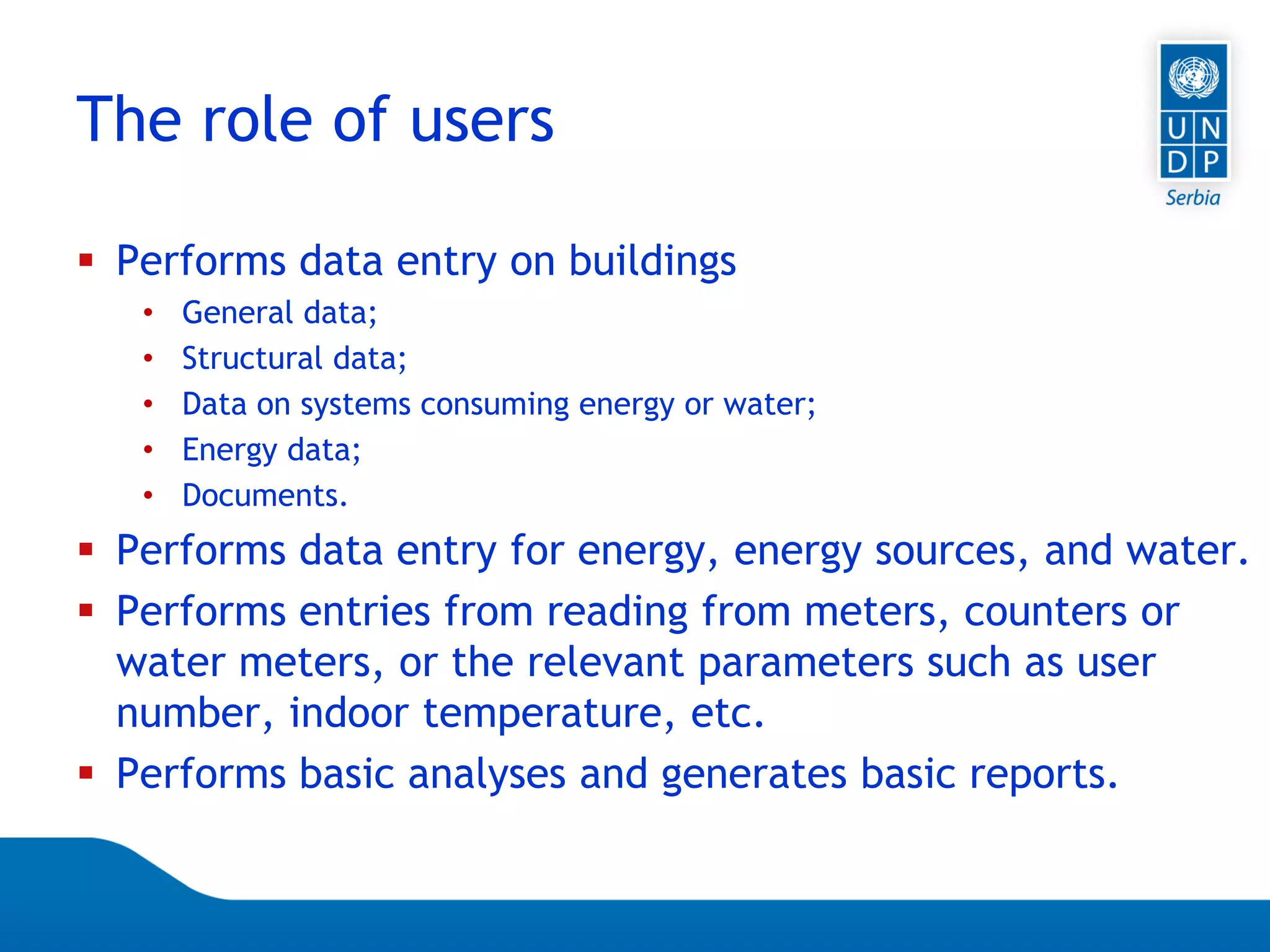
 Performs data entry on buildings
• General data;
• Structural data;
• Data on systems consuming energy or water;
• Energy data;
• Documents.
 Performs data entry for energy, energy sources, and water.
 Performs entries from reading from meters, counters or
water meters, or the relevant parameters such as user
number, indoor temperature, etc.
 Performs basic analyses and generates basic reports.
The role of users
Page 33
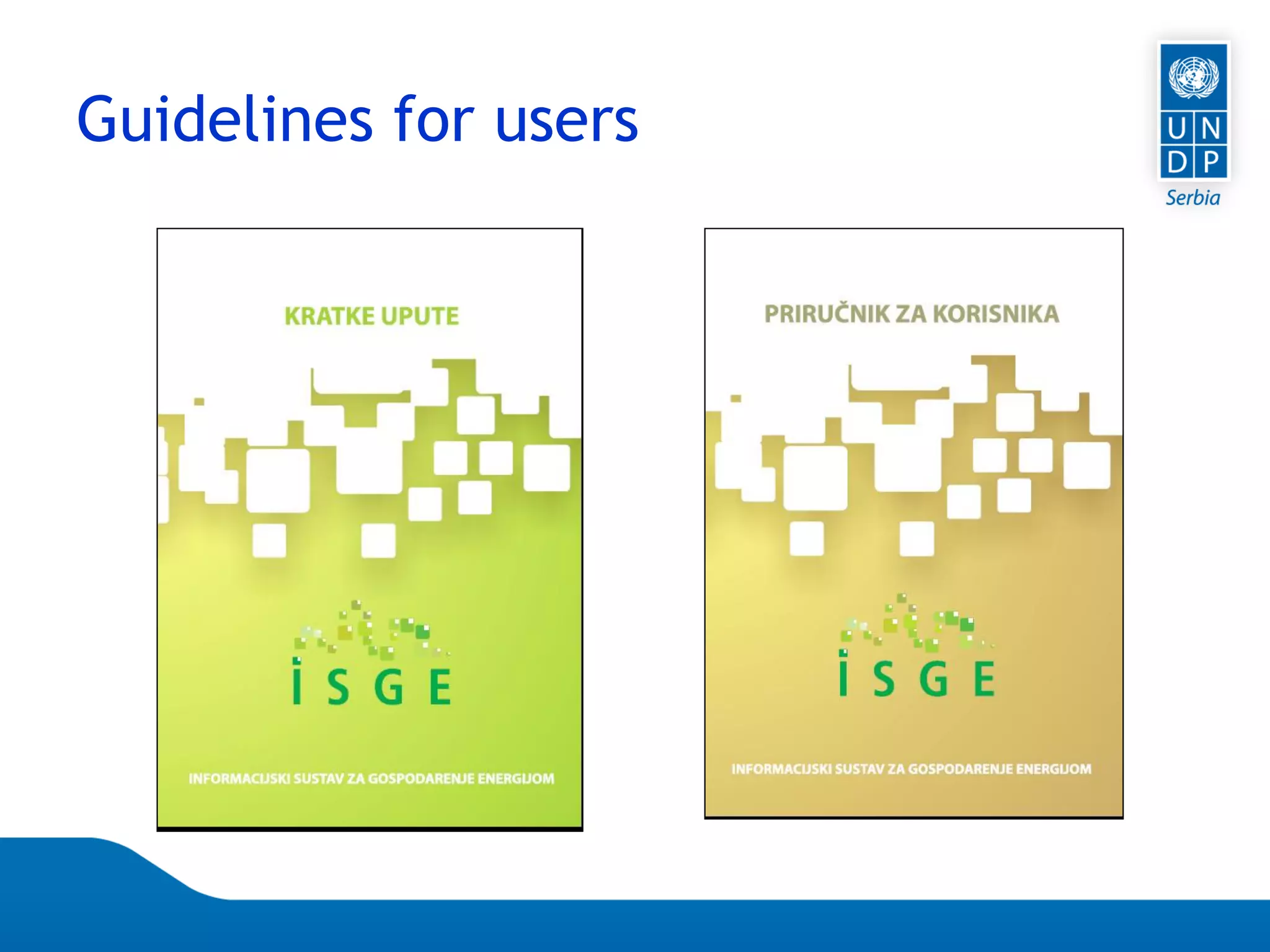
Guidelines for users
Page 34
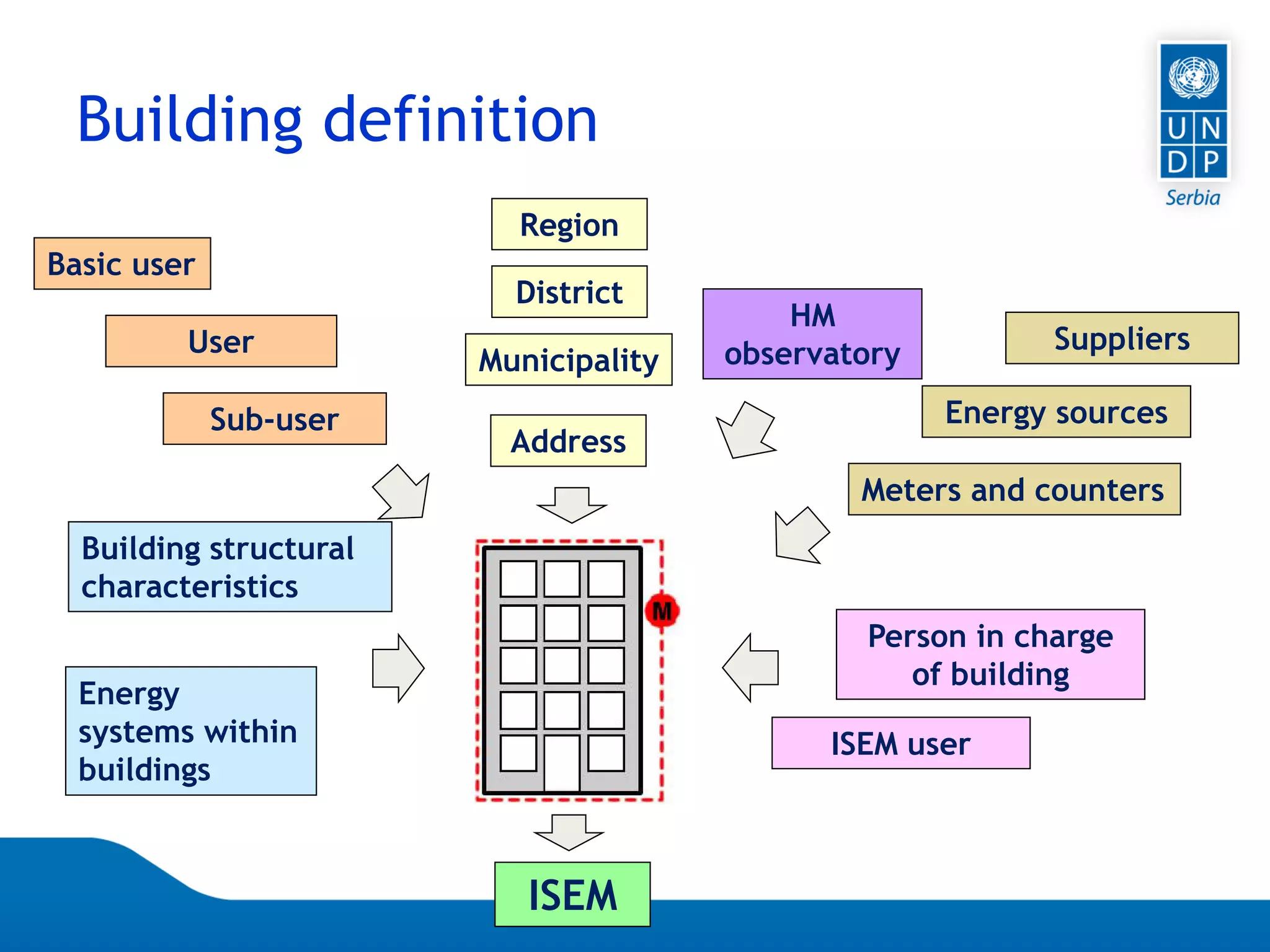
Building definition
Basic user
User
Sub-user
Region
District
Municipality
Meters and counters
Energy sources
Suppliers
HM
observatory
Address
Energy
systems within
buildings
Building structural
characteristics
Person in charge
of building
ISEM user
ISEM
Page 35
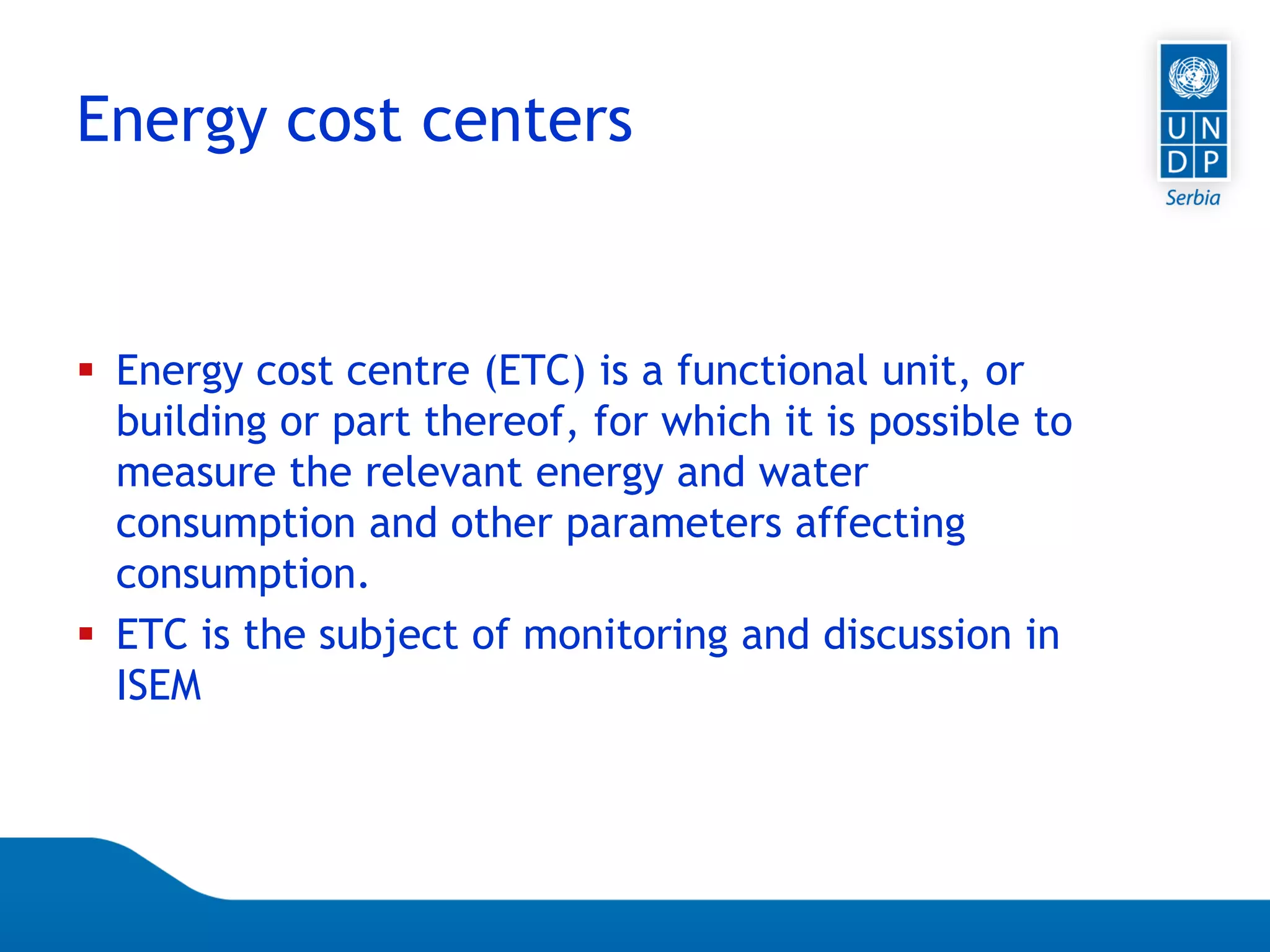
 Energy cost centre (ETC) is a functional unit, or
building or part thereof, for which it is possible to
measure the relevant energy and water
consumption and other parameters affecting
consumption.
 ETC is the subject of monitoring and discussion in
ISEM
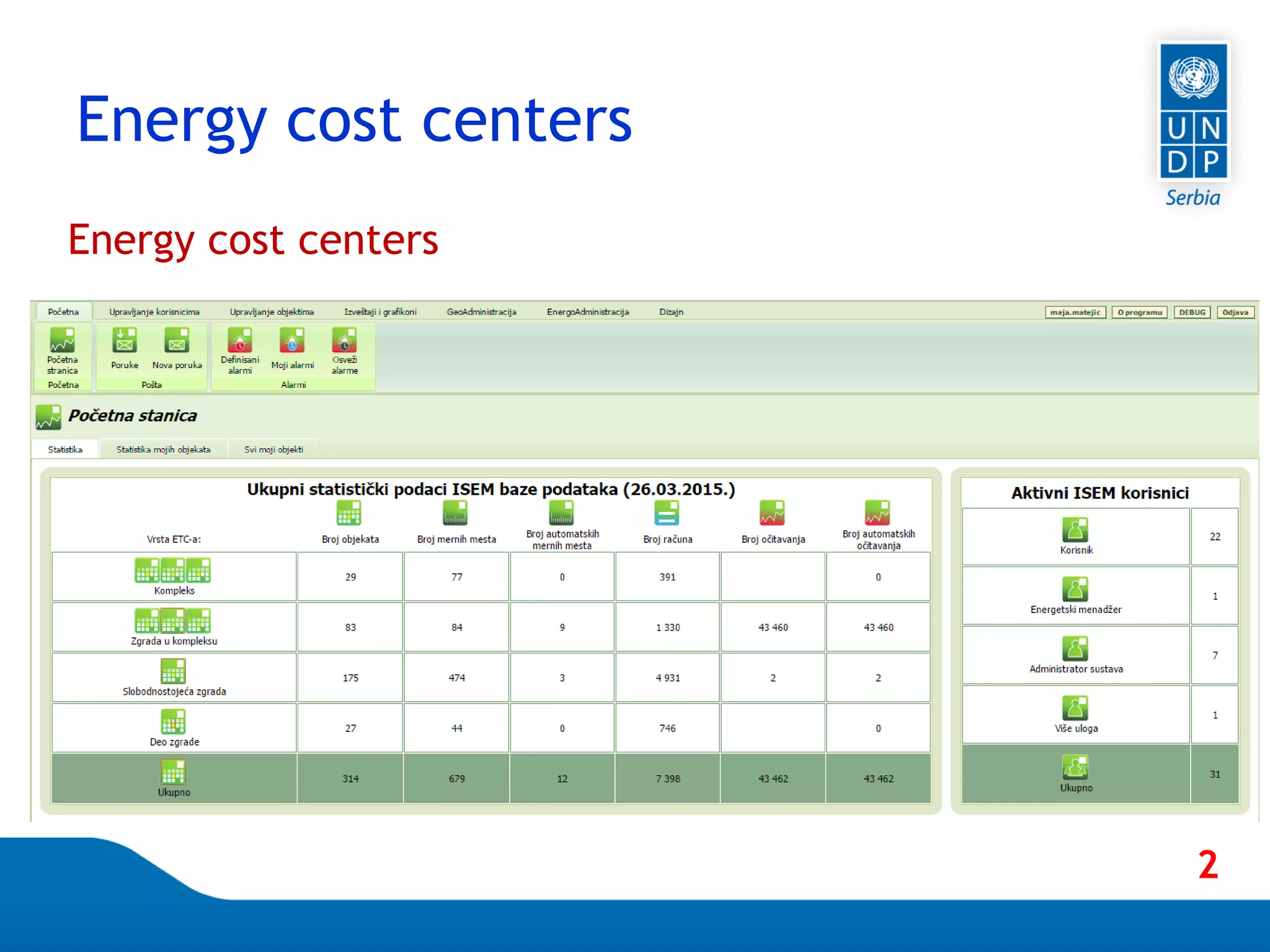
Energy cost centers
Page 36
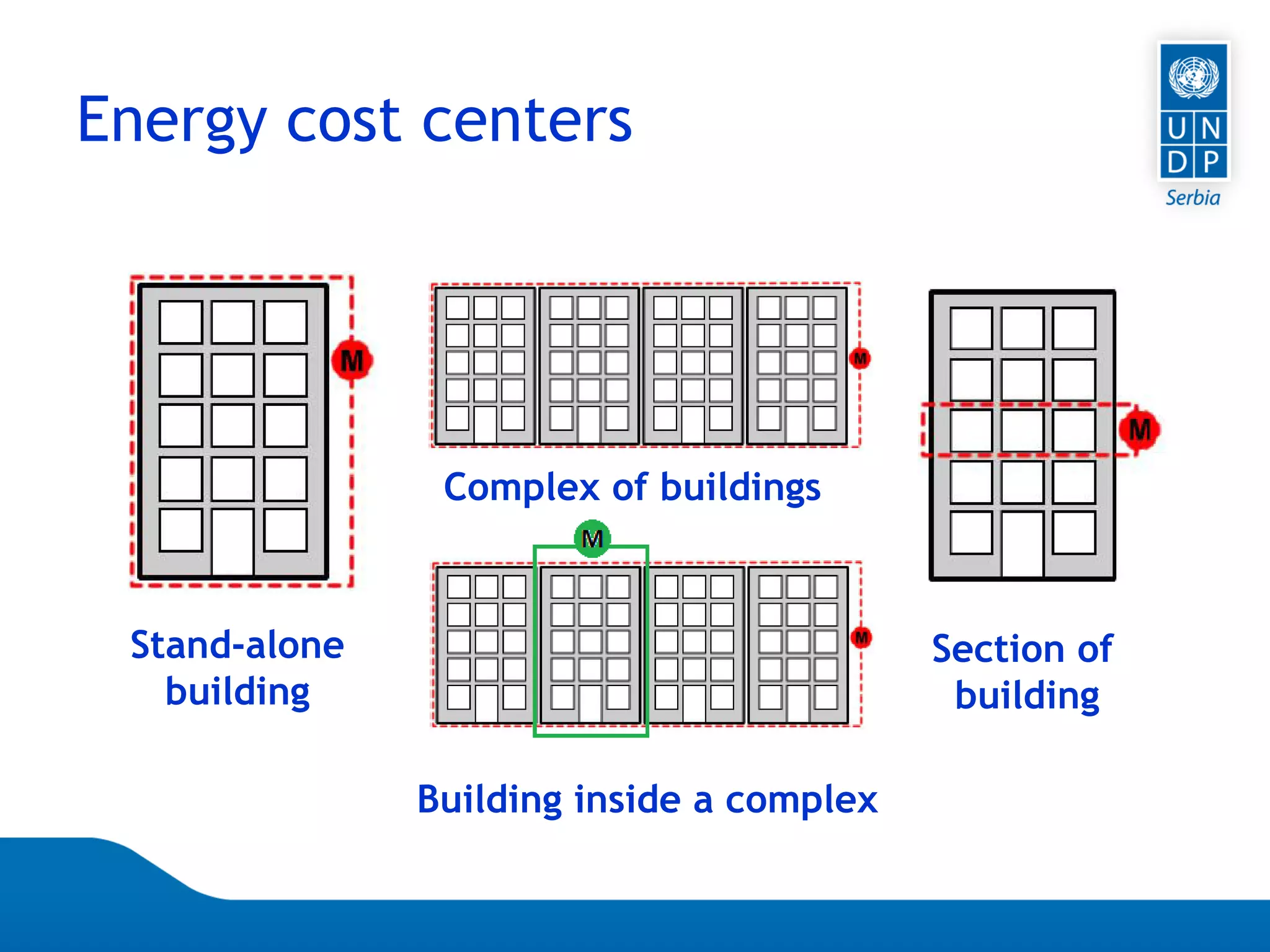
Energy cost centers
Stand-alone
building
Complex of buildings
Section of
building
Building inside a complex
Page 37
Energy cost centers
Energy cost centers
2
Page 38
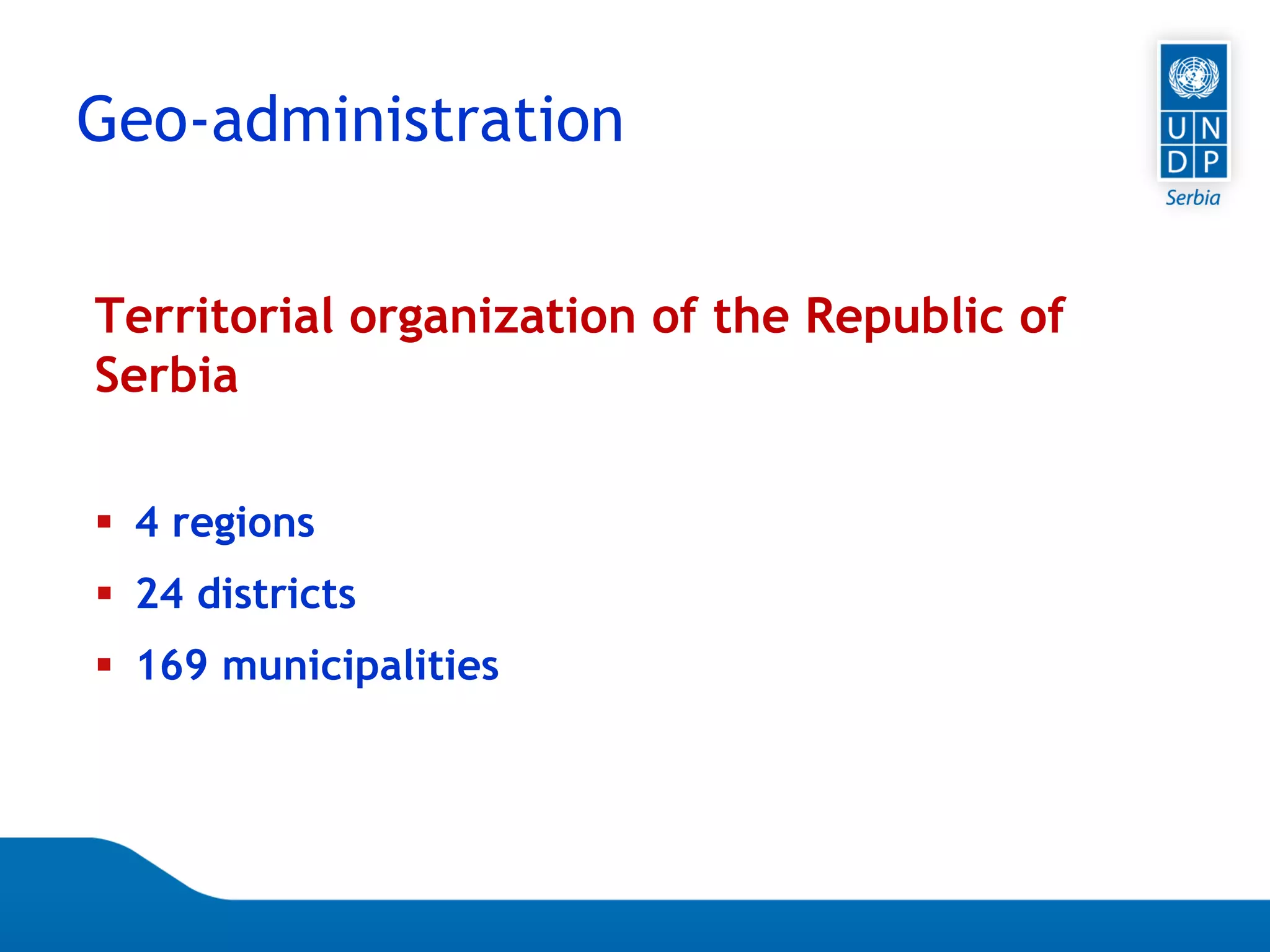
Territorial organization of the Republic of
Serbia
 4 regions
 24 districts
 169 municipalities
Geo-administration
Page 39
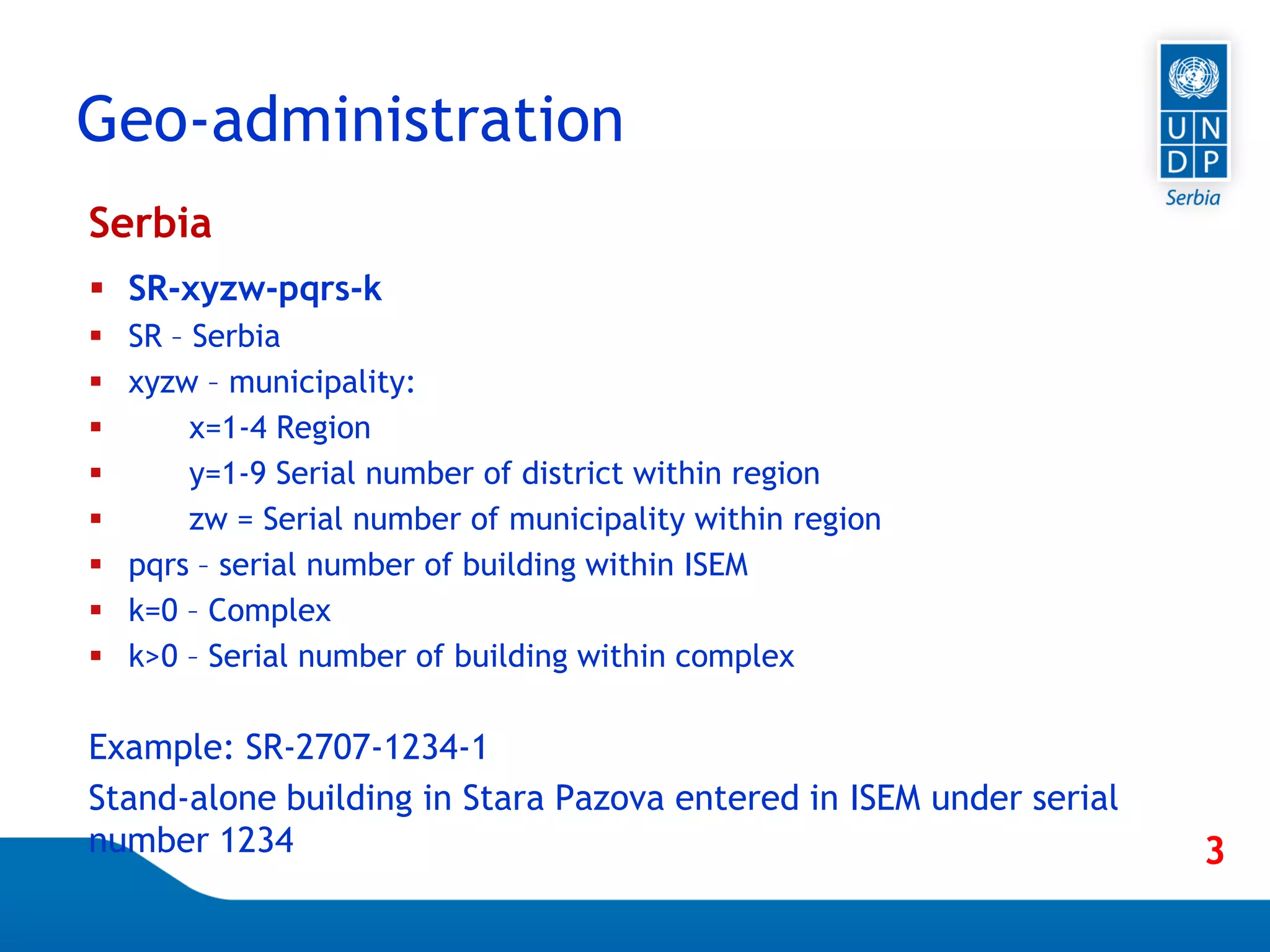
Serbia
 SR-xyzw-pqrs-k
 SR – Serbia
 xyzw – municipality:
 x=1-4 Region
 y=1-9 Serial number of district within region
 zw = Serial number of municipality within region
 pqrs – serial number of building within ISEM
 k=0 – Complex
 k>0 – Serial number of building within complex
Example: SR-2707-1234-1
Stand-alone building in Stara Pazova entered in ISEM under serial
number 1234
Geo-administration
3
Page 40
Geo-administration
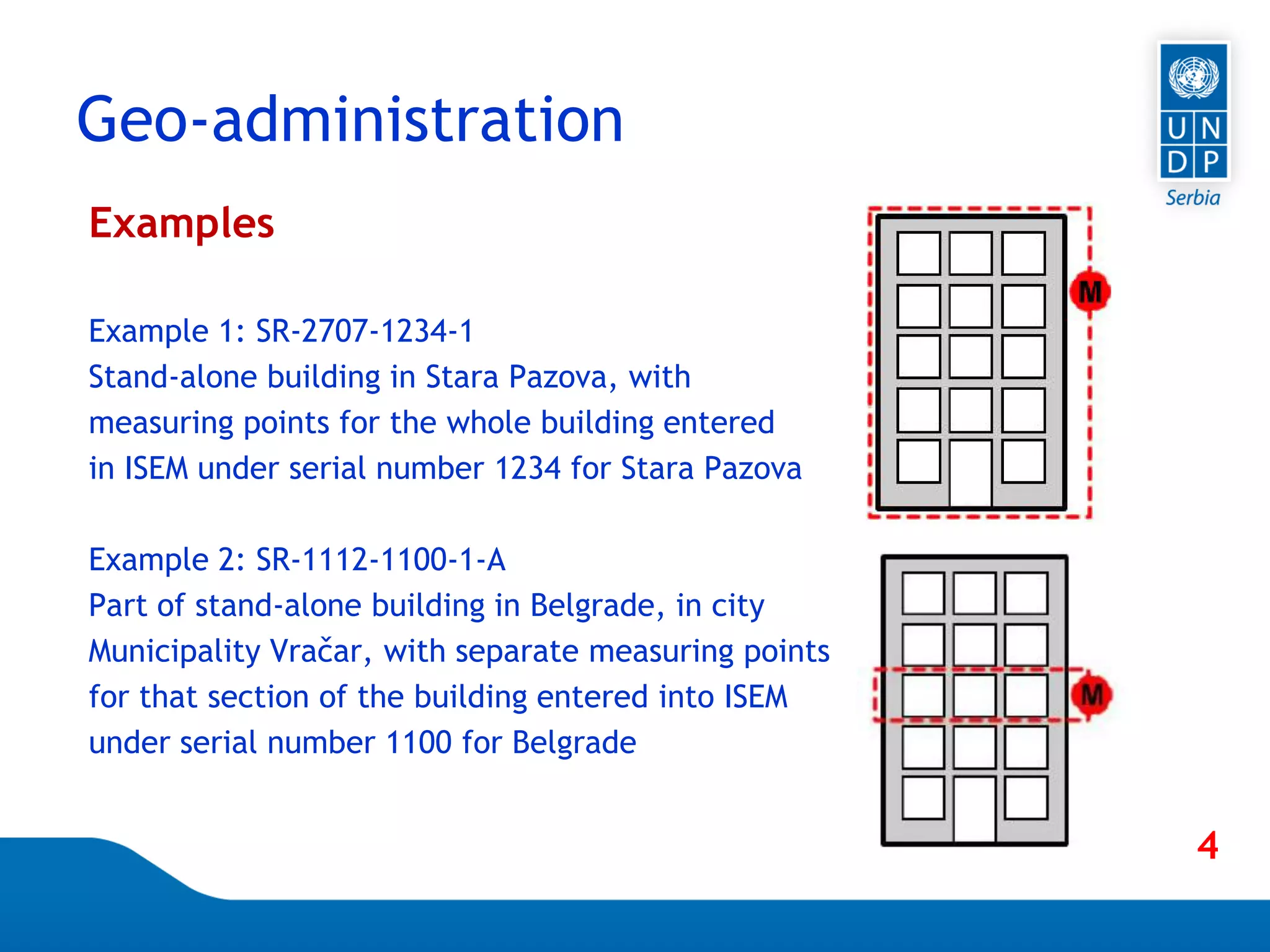
Examples
Example 1: SR-2707-1234-1
Stand-alone building in Stara Pazova, with
measuring points for the whole building entered
in ISEM under serial number 1234 for Stara Pazova
Example 2: SR-1112-1100-1-A
Part of stand-alone building in Belgrade, in city
Municipality Vračar, with separate measuring points
for that section of the building entered into ISEM
under serial number 1100 for Belgrade
4
Page 41
Geo-administration
Examples
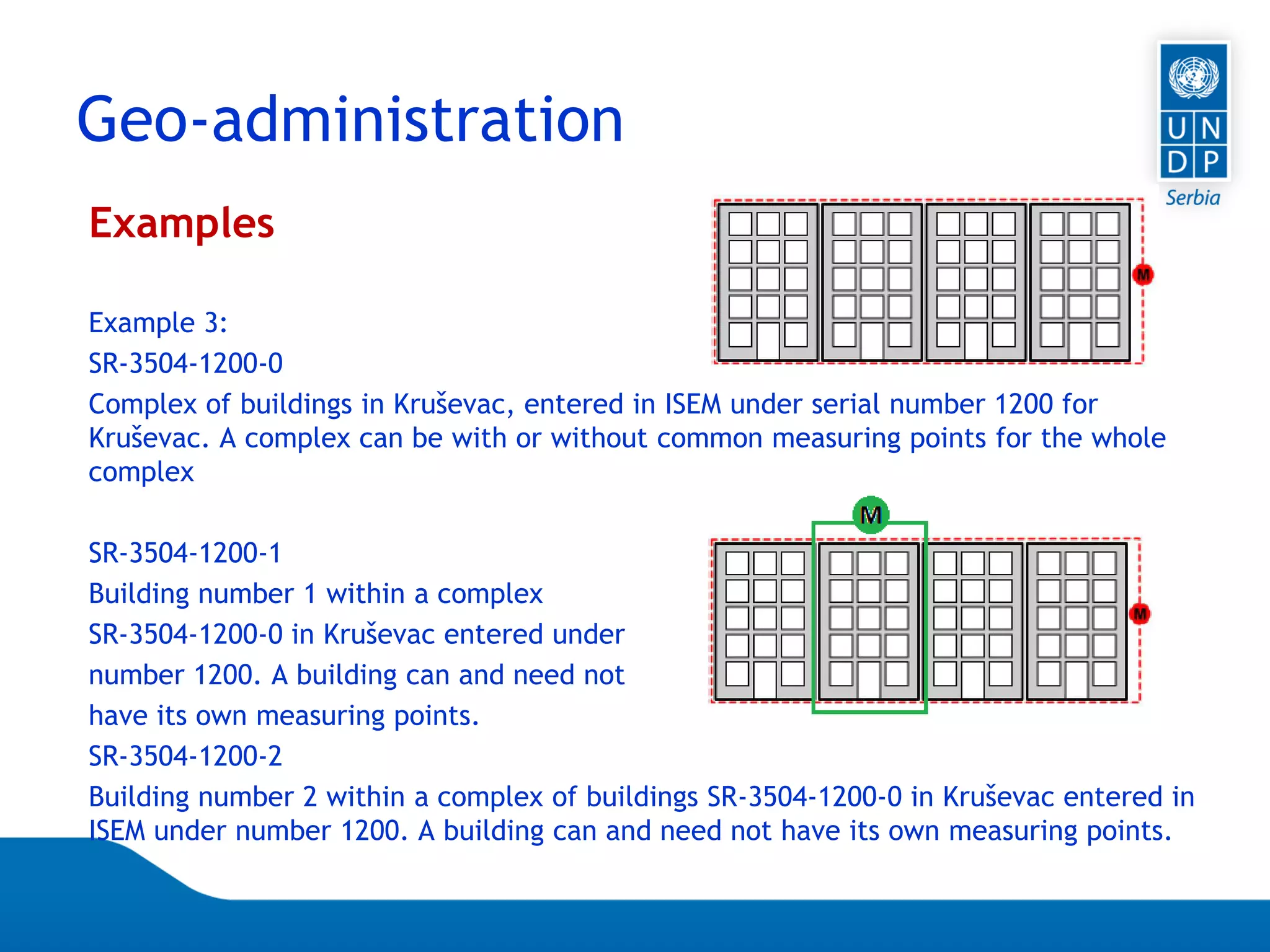
Example 3:
SR-3504-1200-0
Complex of buildings in Kruševac, entered in ISEM under serial number 1200 for
Kruševac. A complex can be with or without common measuring points for the whole
complex
SR-3504-1200-1
Building number 1 within a complex
SR-3504-1200-0 in Kruševac entered under
number 1200. A building can and need not
have its own measuring points.
SR-3504-1200-2
Building number 2 within a complex of buildings SR-3504-1200-0 in Kruševac entered in
ISEM under number 1200. A building can and need not have its own measuring points.
Page 42
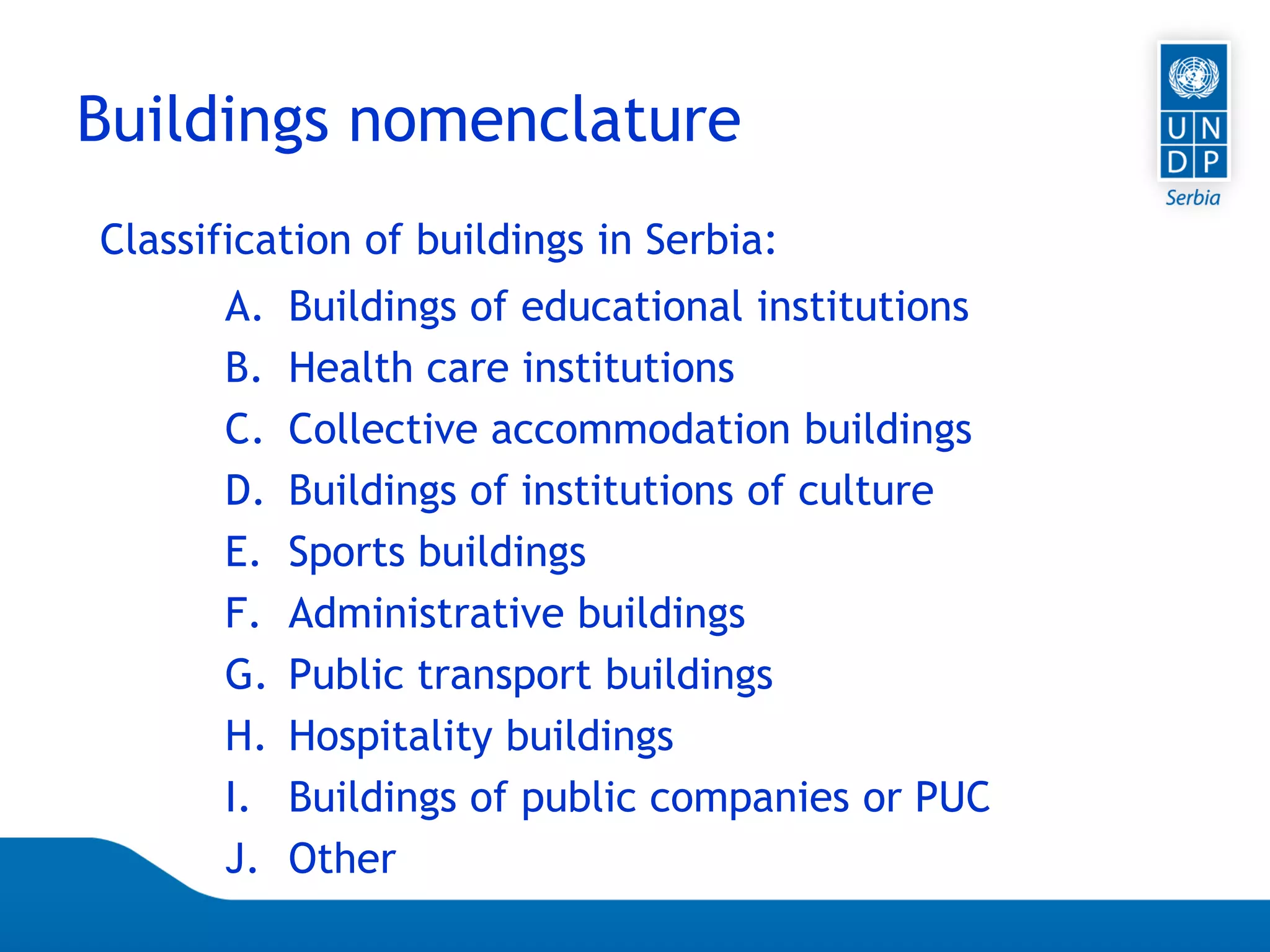
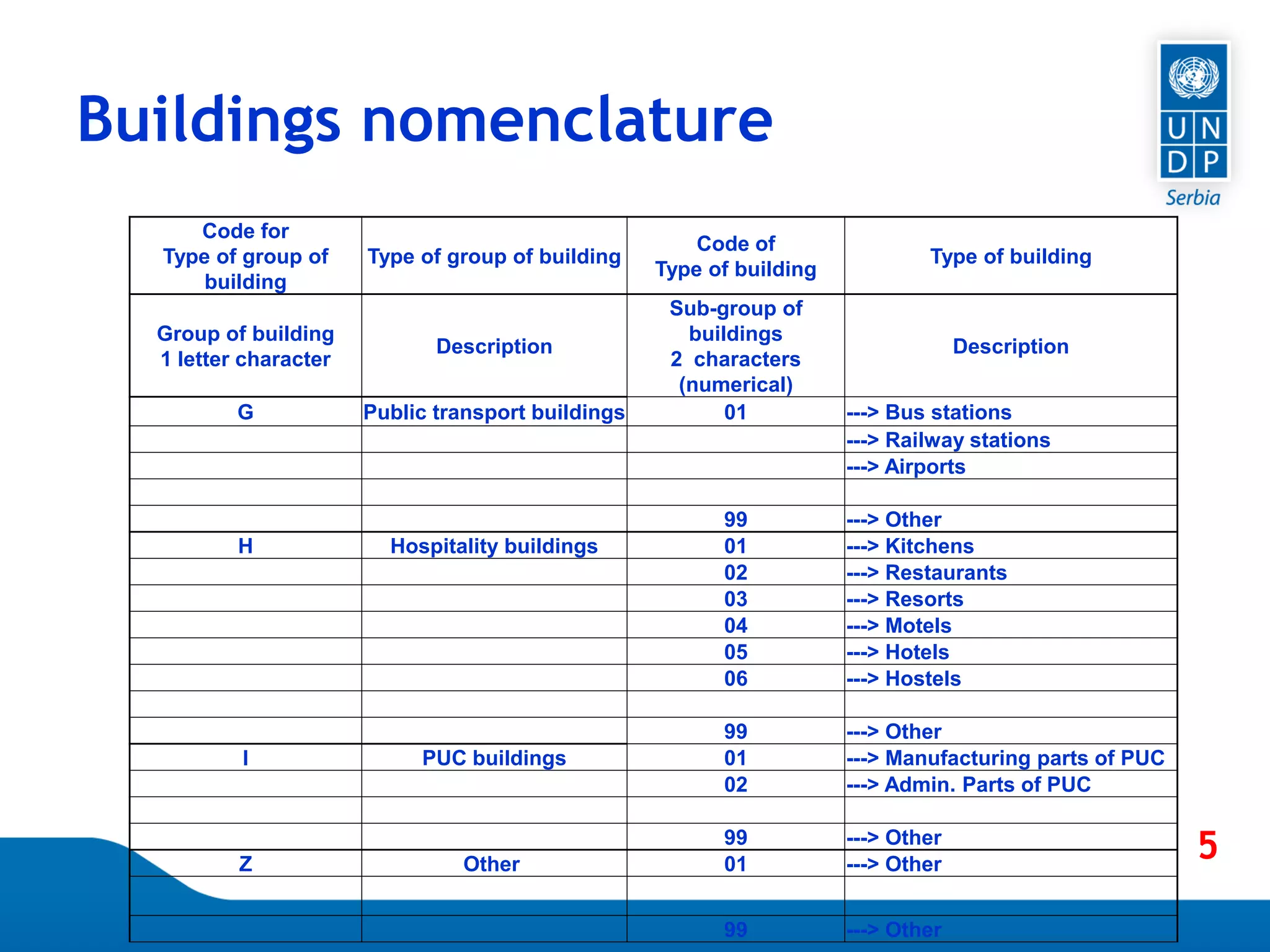
Buildings nomenclature
Classification of buildings in Serbia:
A. Buildings of educational institutions
B. Health care institutions
C. Collective accommodation buildings
D. Buildings of institutions of culture
E. Sports buildings
F. Administrative buildings
G. Public transport buildings
H. Hospitality buildings
I. Buildings of public companies or PUC
J. Other
Page 43
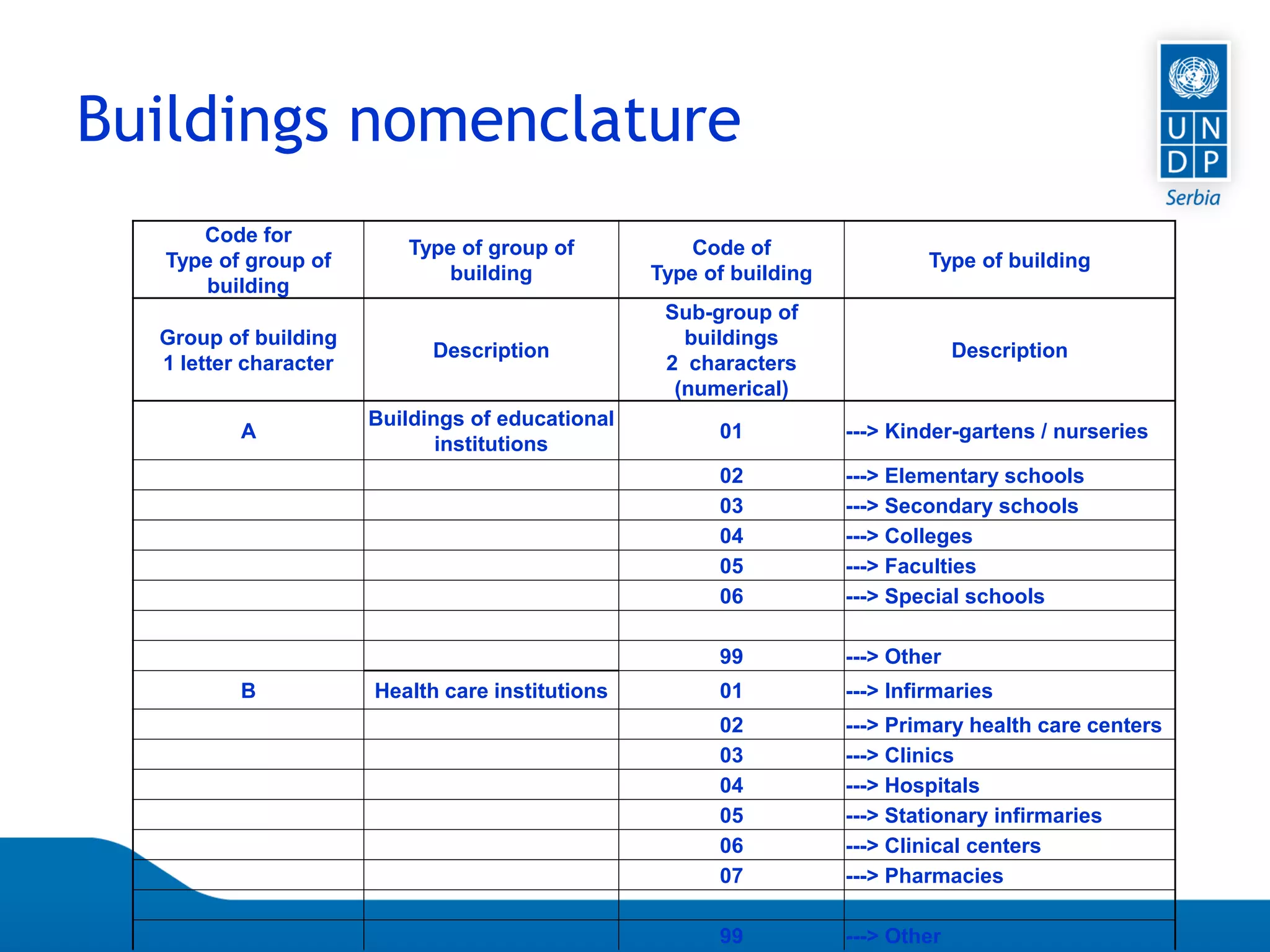
Buildings nomenclature
Code for
Type of group of
building
Type of group of
building
Code of
Type of building
Type of building
Group of building
1 letter character
Description
Sub-group of
buildings
2 characters
(numerical)
Description
A
Buildings of educational
institutions
01 ---> Kinder-gartens / nurseries
02 ---> Elementary schools
03 ---> Secondary schools
04 ---> Colleges
05 ---> Faculties
06 ---> Special schools
99 ---> Other
B Health care institutions 01 ---> Infirmaries
02 ---> Primary health care centers
03 ---> Clinics
04 ---> Hospitals
05 ---> Stationary infirmaries
06 ---> Clinical centers
07 ---> Pharmacies
99 ---> Other
Page 44
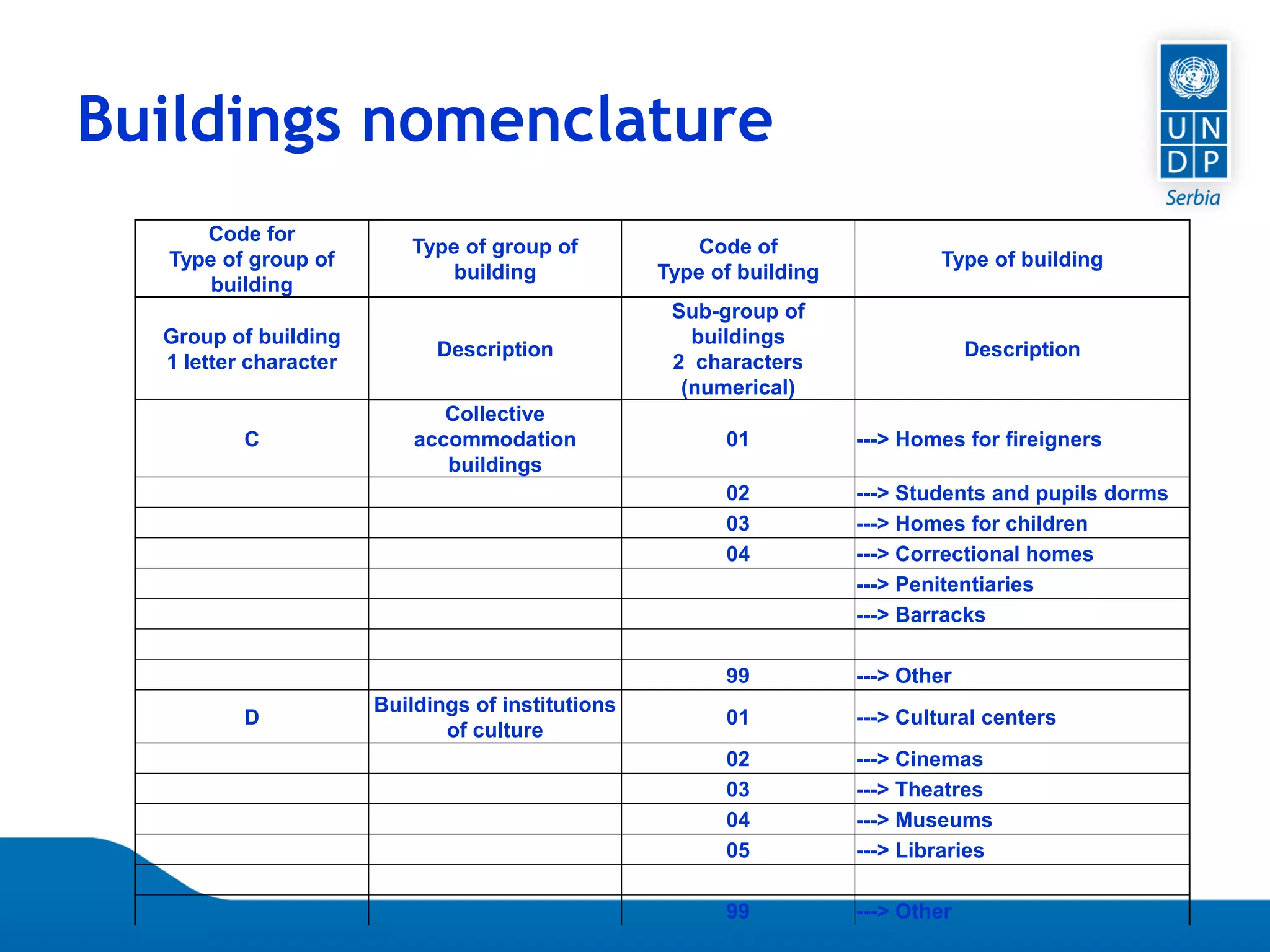
Buildings nomenclature
Code for
Type of group of
building
Type of group of
building
Code of
Type of building
Type of building
Group of building
1 letter character
Description
Sub-group of
buildings
2 characters
(numerical)
Description
C
Collective
accommodation
buildings
01 ---> Homes for fireigners
02 ---> Students and pupils dorms
03 ---> Homes for children
04 ---> Correctional homes
---> Penitentiaries
---> Barracks
99 ---> Other
D
Buildings of institutions
of culture
01 ---> Cultural centers
02 ---> Cinemas
03 ---> Theatres
04 ---> Museums
05 ---> Libraries
99 ---> Other
Page 45
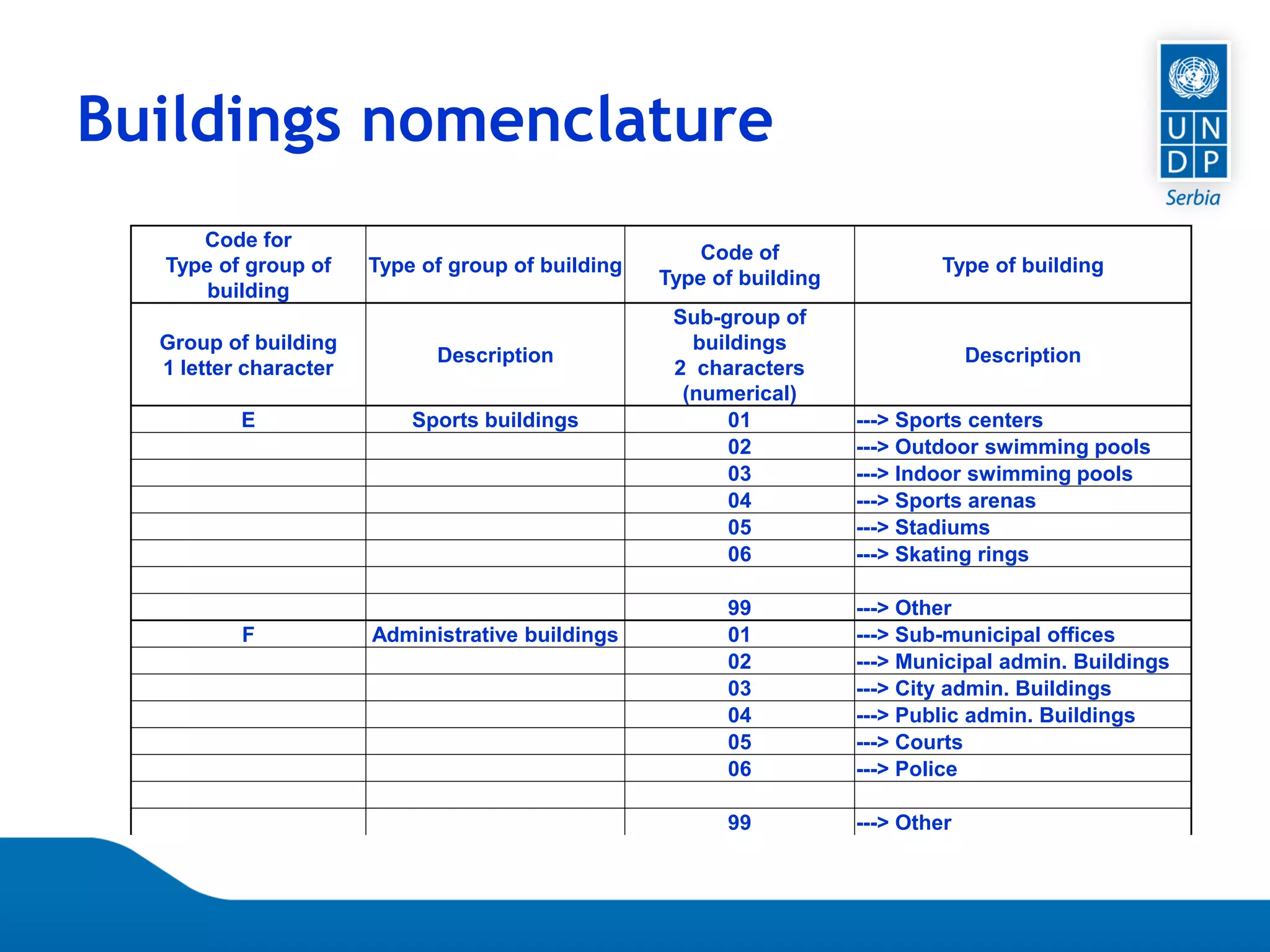
Buildings nomenclature
Code for
Type of group of
building
Type of group of building
Code of
Type of building
Type of building
Group of building
1 letter character
Description
Sub-group of
buildings
2 characters
(numerical)
Description
E Sports buildings 01 ---> Sports centers
02 ---> Outdoor swimming pools
03 ---> Indoor swimming pools
04 ---> Sports arenas
05 ---> Stadiums
06 ---> Skating rings
99 ---> Other
F Administrative buildings 01 ---> Sub-municipal offices
02 ---> Municipal admin. Buildings
03 ---> City admin. Buildings
04 ---> Public admin. Buildings
05 ---> Courts
06 ---> Police
99 ---> Other
Page 46
Buildings nomenclature
Code for
Type of group of
building
Type of group of building
Code of
Type of building
Type of building
Group of building
1 letter character
Description
Sub-group of
buildings
2 characters
(numerical)
Description
G Public transport buildings 01 ---> Bus stations
---> Railway stations
---> Airports
99 ---> Other
H Hospitality buildings 01 ---> Kitchens
02 ---> Restaurants
03 ---> Resorts
04 ---> Motels
05 ---> Hotels
06 ---> Hostels
99 ---> Other
I PUC buildings 01 ---> Manufacturing parts of PUC
02 ---> Admin. Parts of PUC
99 ---> Other
Z Other 01 ---> Other
99 ---> Other
5
Page 47
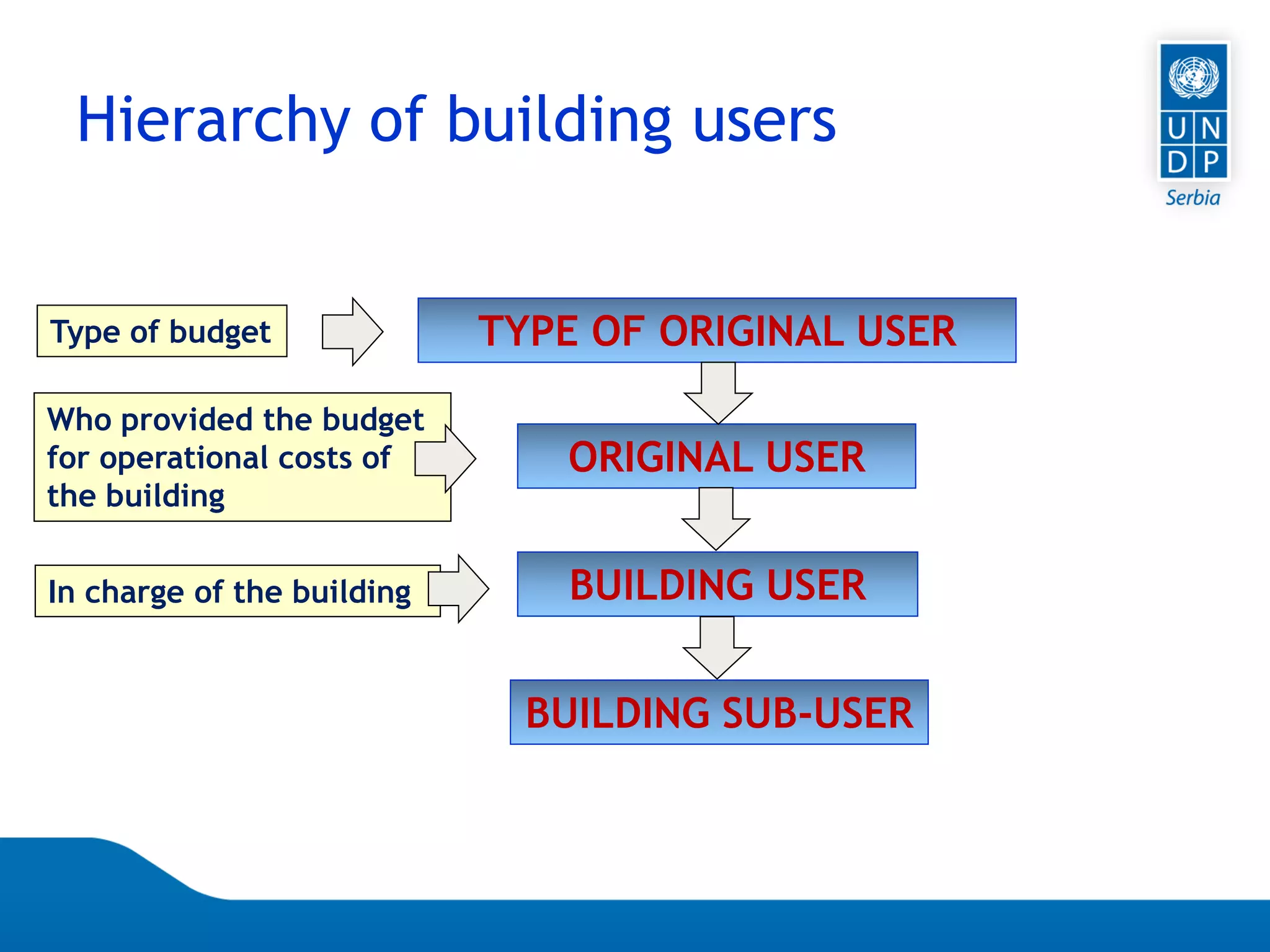
Hierarchy of building users
TYPE OF ORIGINAL USER
ORIGINAL USER
BUILDING USER
BUILDING SUB-USER
Who provided the budget
for operational costs of
the building
In charge of the building
Type of budget
Page 48
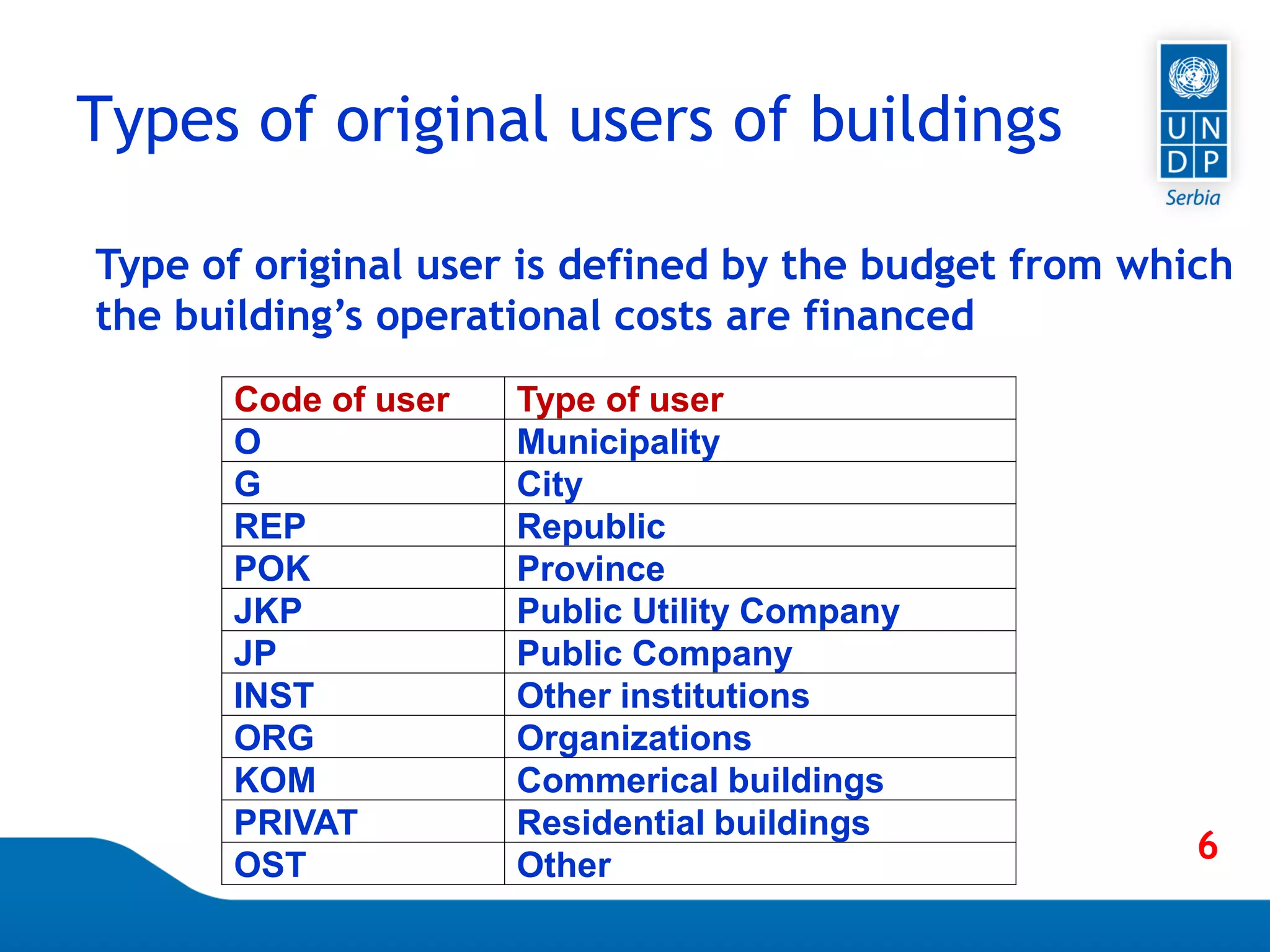
Types of original users of buildings
Code of user Type of user
O Municipality
G City
REP Republic
POK Province
JKP Public Utility Company
JP Public Company
INST Other institutions
ORG Organizations
KOM Commerical buildings
PRIVAT Residential buildings
OST Other
Type of original user is defined by the budget from which
the building’s operational costs are financed
6
Page 49
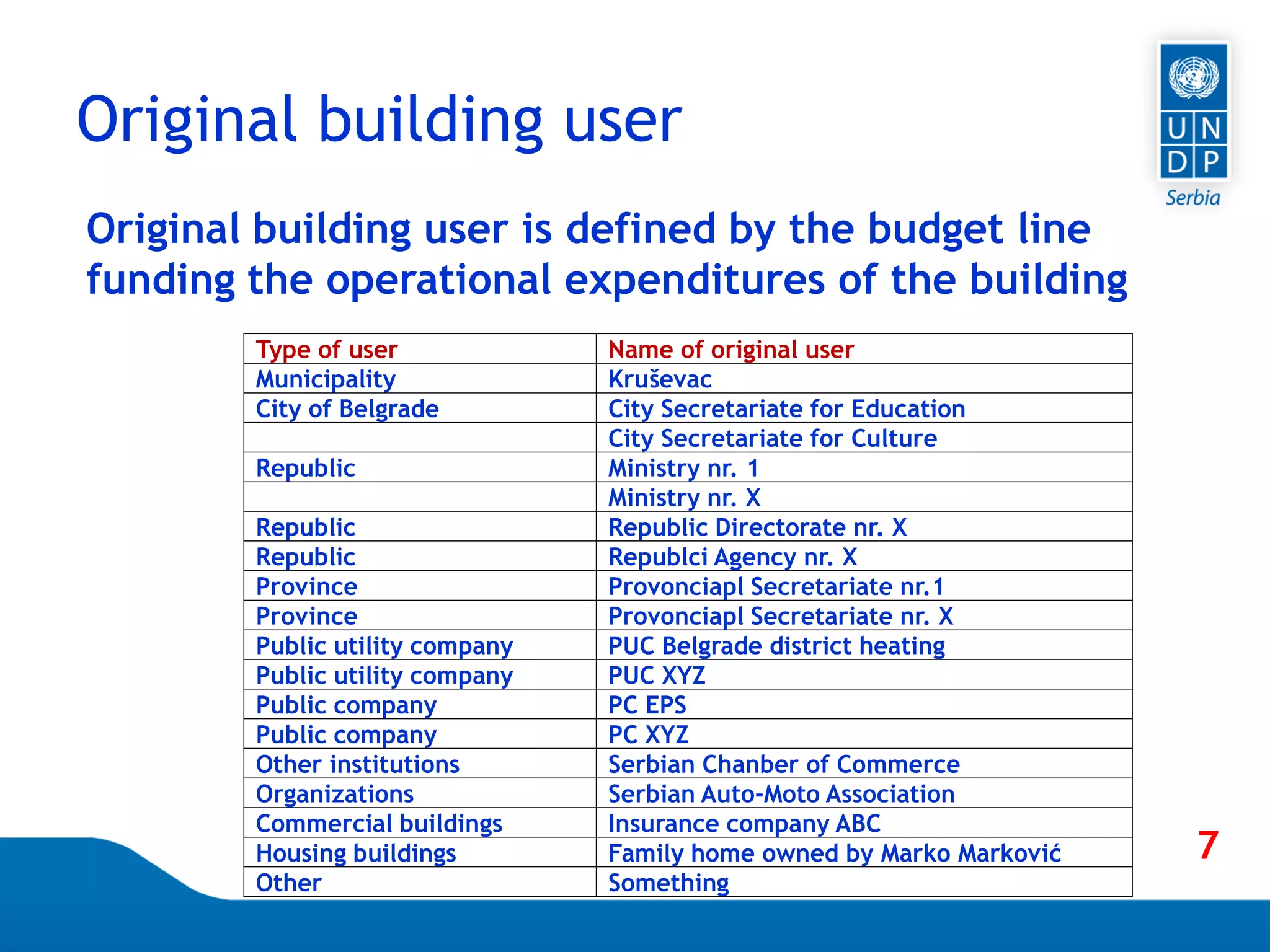
Original building user
Original building user is defined by the budget line
funding the operational expenditures of the building
Type of user Name of original user
Municipality Kruševac
City of Belgrade City Secretariate for Education
City Secretariate for Culture
Republic Ministry nr. 1
Ministry nr. X
Republic Republic Directorate nr. X
Republic Republci Agency nr. X
Province Provonciapl Secretariate nr.1
Province Provonciapl Secretariate nr. X
Public utility company PUC Belgrade district heating
Public utility company PUC XYZ
Public company PC EPS
Public company PC XYZ
Other institutions Serbian Chanber of Commerce
Organizations Serbian Auto-Moto Association
Commercial buildings Insurance company ABC
Housing buildings Family home owned by Marko Marković
Other Something
7
Page 50
Users and sub-users under original
buildings user
The building user is the actual user of the building, such as
Primary School “Ivo Andrić”, Faculty of Technology, Primary
health care centre “Vračar” etc.
Sub-use is the user of a part of the building or user of one
of the buildings belonging to the user. Example: regional
units of original schools, local health clinics, sub-municipal
administrative offices, local facilities of public companies,
or facilities leased by the user.
Page 51
1. Faculty of Mechanical Engineering Belgrade
Type of original user: the Republic
Original user: the Ministry of Education and Science
User: the Faculty of Mechanical Engineering Belgrade
Republic / Ministry of Education and Science / Faculty of
Mechanical Engineering
2. Elementary School “Vuk Karadžić” in Stepojevac, unit in village
Vrbovno
Type of original user: City of Belgrade
Original user: City Secretariat of Education
User: Elementary School “Vuk Karadžić”
Sub-User: Regional unit in village Vrbovno
City of Belgrade / City Secretariat of Education / Primary School
“Vuk Karadžić / unit Vrbovno
Examples of hierarchy of users
8
07.04.2015 Seite 52
Types of data:
Static – slow changing:
Specific, non-technical and technical data defining the building
Result:
 Inventory of public consumption buildings
Dynamic – fast changing:
Data on energy or energy sources consumption on monthly, weekly and daily
level and relevant data defining the intensity of operations in the building
Result:
 Energy balance of the specific public consumption building and
 Energy efficiency indicators of the specific public consumption building
Data collection, monitoring and analysis
07.04.2015 Seite 53
Example
Slow changing data:
 Region, district, municipality;
 Address of the building;
 Buildings within building;
 Building owner;
 Building user;
 Source of funding;
 Owner and user persons in charge;
 Contact person;
 ........... etc.
Non-technical data:
Data collection, monitoring and analysis
07.04.2015 Seite 54
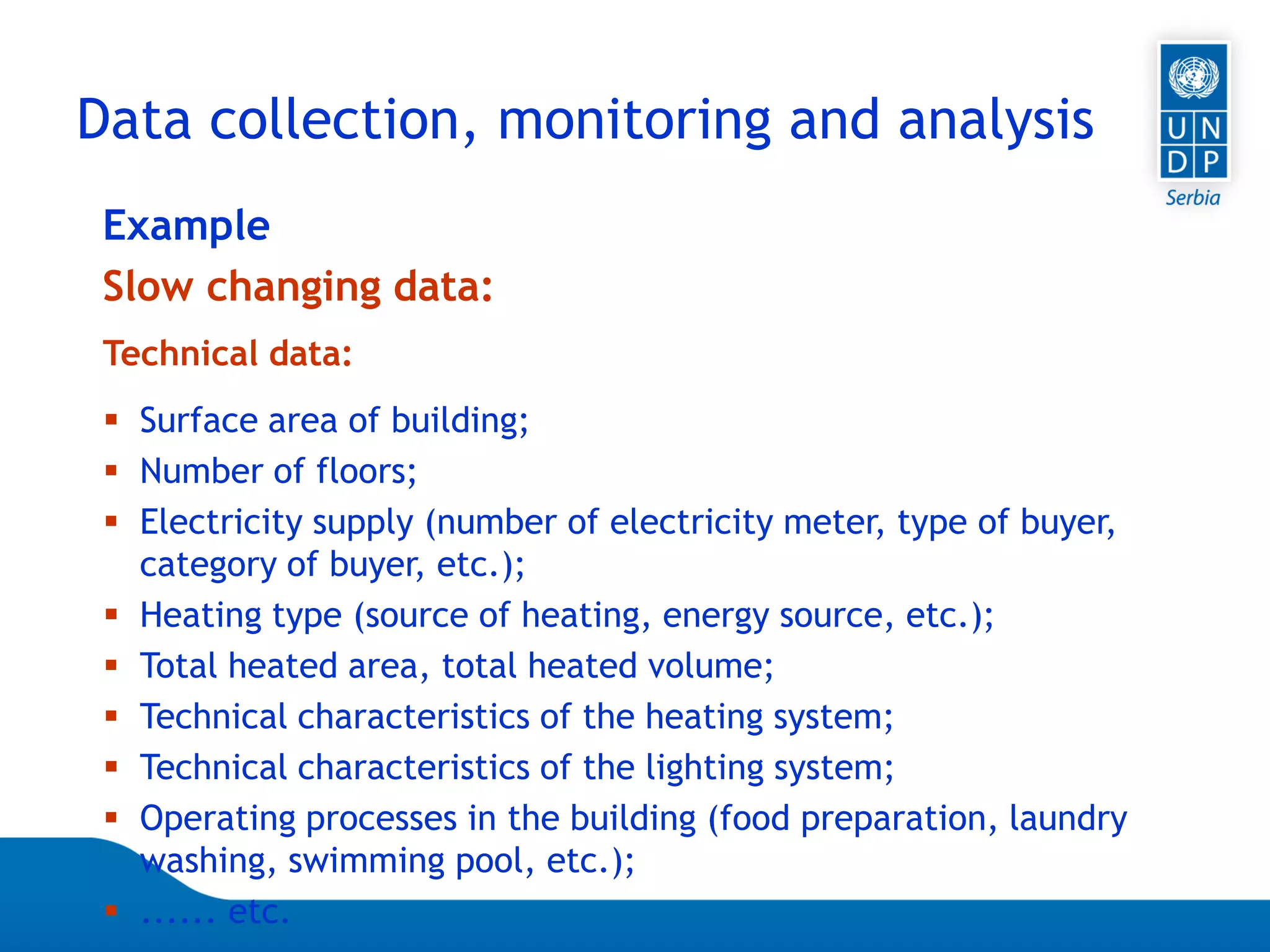
 Surface area of building;
 Number of floors;
 Electricity supply (number of electricity meter, type of buyer,
category of buyer, etc.);
 Heating type (source of heating, energy source, etc.);
 Total heated area, total heated volume;
 Technical characteristics of the heating system;
 Technical characteristics of the lighting system;
 Operating processes in the building (food preparation, laundry
washing, swimming pool, etc.);
 ...... etc.
Technical data:
Example
Slow changing data:
Data collection, monitoring and analysis
07.04.2015 Seite 55
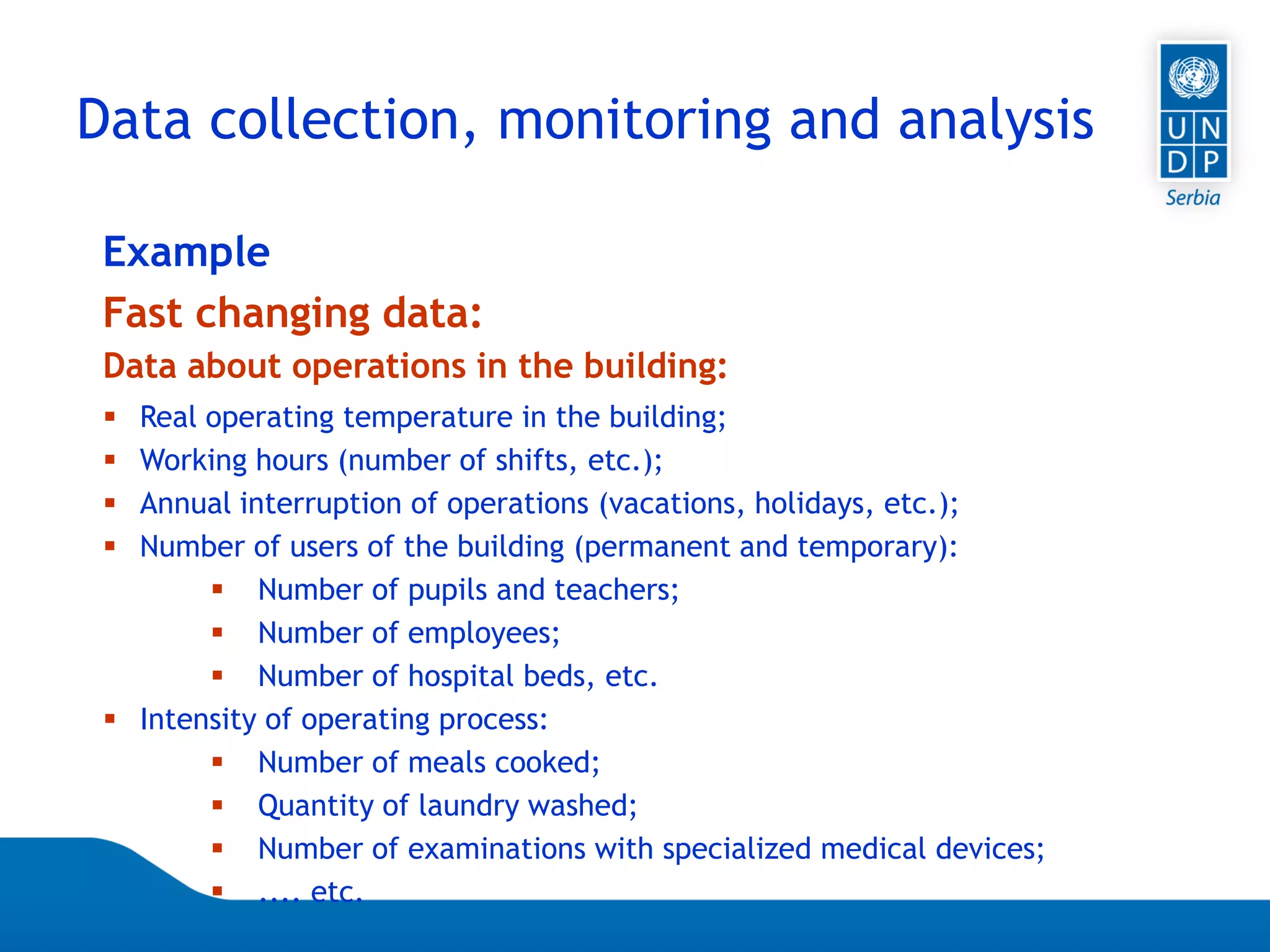
 Real operating temperature in the building;
 Working hours (number of shifts, etc.);
 Annual interruption of operations (vacations, holidays, etc.);
 Number of users of the building (permanent and temporary):
 Number of pupils and teachers;
 Number of employees;
 Number of hospital beds, etc.
 Intensity of operating process:
 Number of meals cooked;
 Quantity of laundry washed;
 Number of examinations with specialized medical devices;
 .... etc.
Data about operations in the building:
Example
Fast changing data:
Data collection, monitoring and analysis
07.04.2015 Seite 56
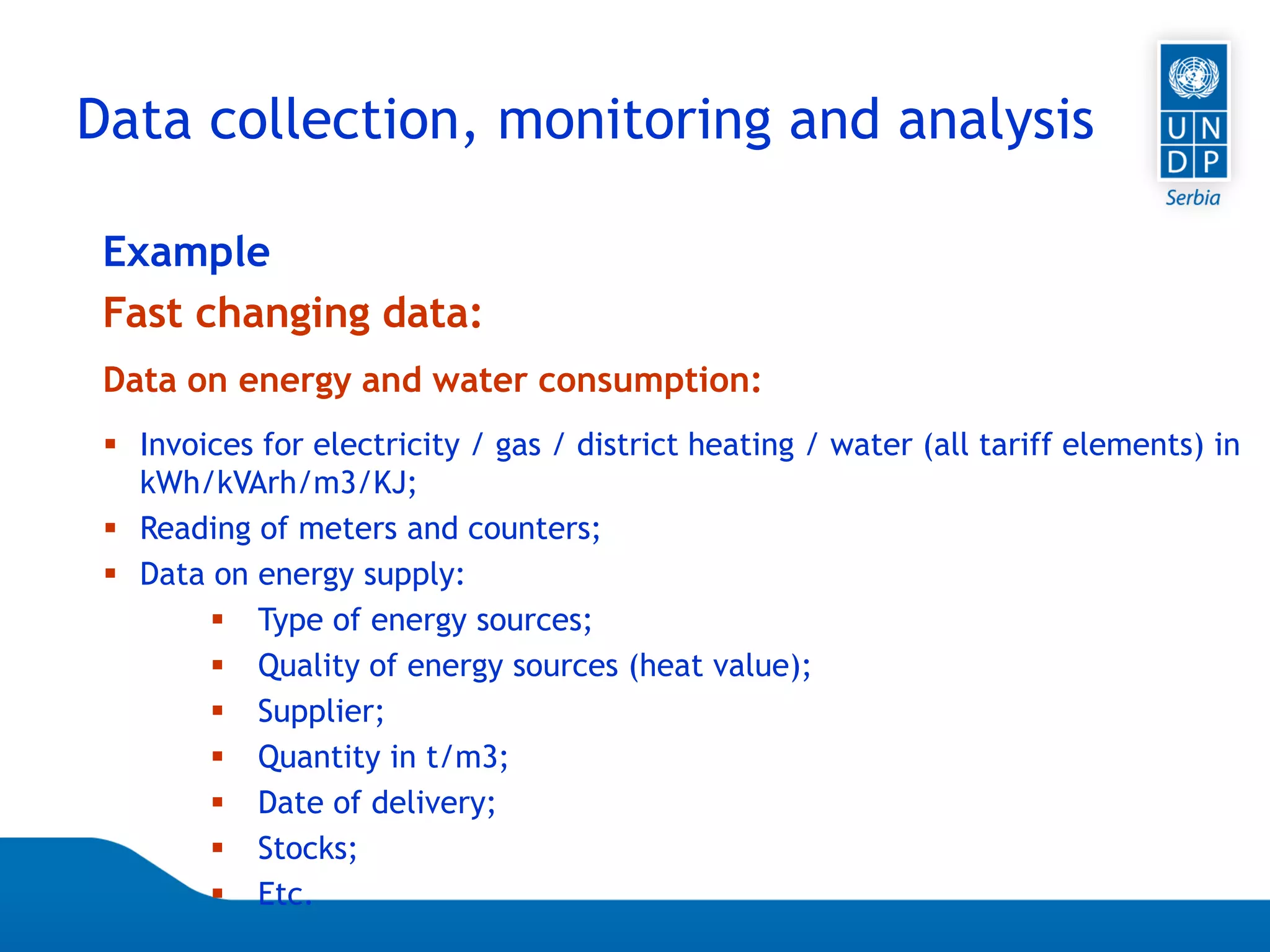
 Invoices for electricity / gas / district heating / water (all tariff elements) in
kWh/kVArh/m3/KJ;
 Reading of meters and counters;
 Data on energy supply:
 Type of energy sources;
 Quality of energy sources (heat value);
 Supplier;
 Quantity in t/m3;
 Date of delivery;
 Stocks;
 Etc.
Data on energy and water consumption:
Example
Fast changing data:
Data collection, monitoring and analysis
Page 57
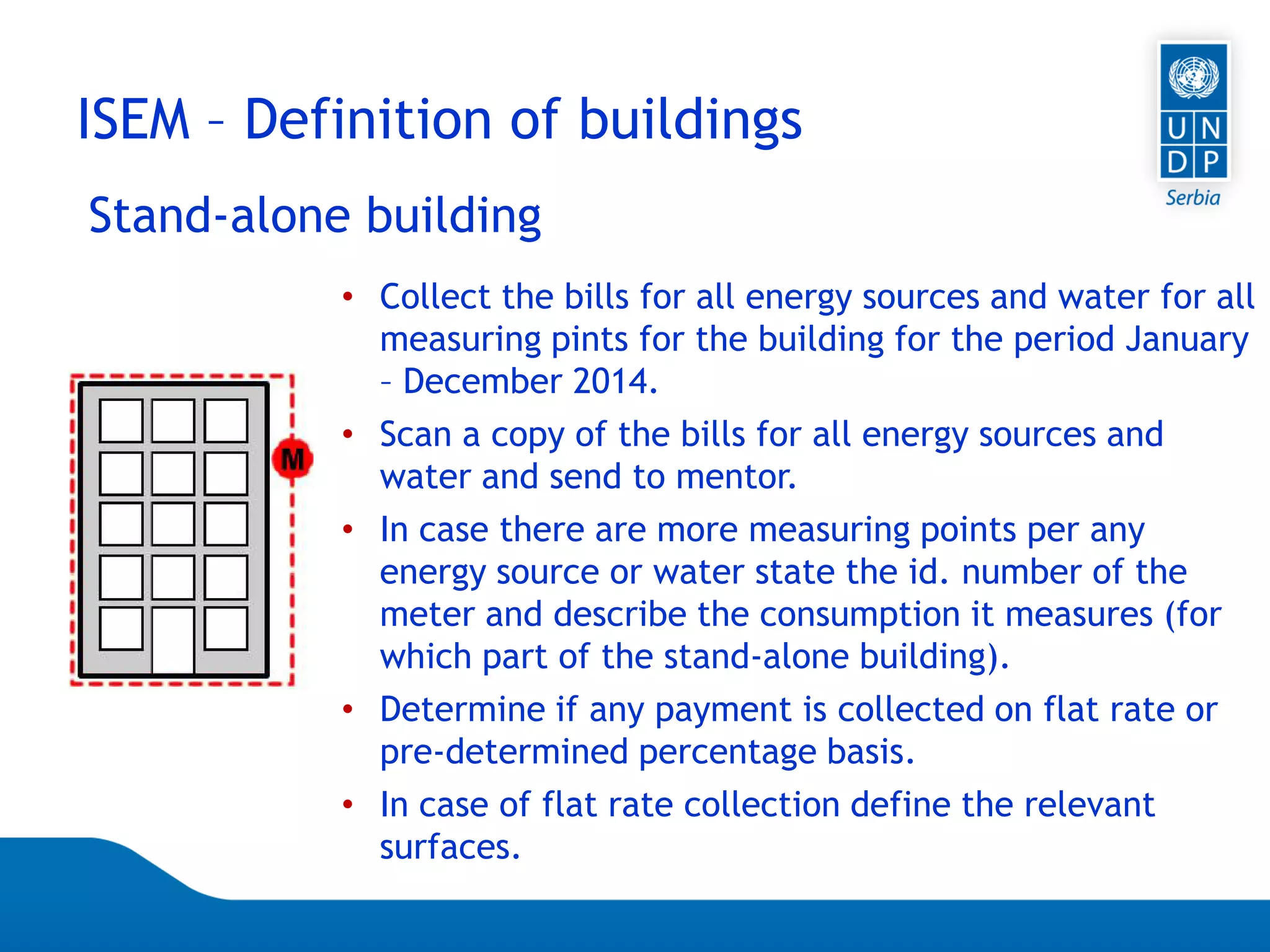
Stand-alone building
ISEM – Definition of buildings
• Collect the bills for all energy sources and water for all
measuring pints for the building for the period January
– December 2014.
• Scan a copy of the bills for all energy sources and
water and send to mentor.
• In case there are more measuring points per any
energy source or water state the id. number of the
meter and describe the consumption it measures (for
which part of the stand-alone building).
• Determine if any payment is collected on flat rate or
pre-determined percentage basis.
• In case of flat rate collection define the relevant
surfaces.
Page 58
ISEM – Definition of buildings
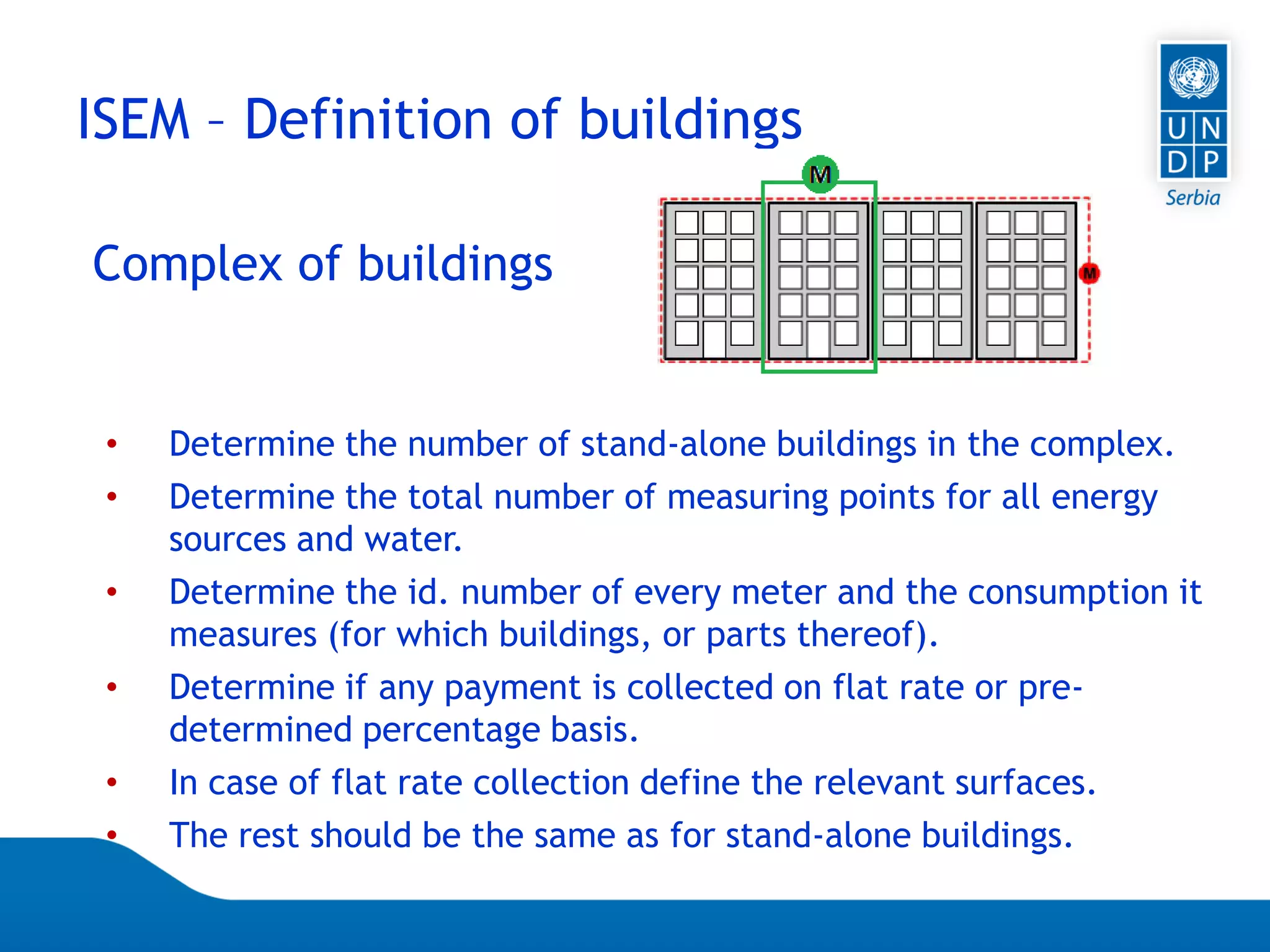
Complex of buildings
• Determine the number of stand-alone buildings in the complex.
• Determine the total number of measuring points for all energy
sources and water.
• Determine the id. number of every meter and the consumption it
measures (for which buildings, or parts thereof).
• Determine if any payment is collected on flat rate or pre-
determined percentage basis.
• In case of flat rate collection define the relevant surfaces.
• The rest should be the same as for stand-alone buildings.
Page 59
ISEM – Definition of buildings
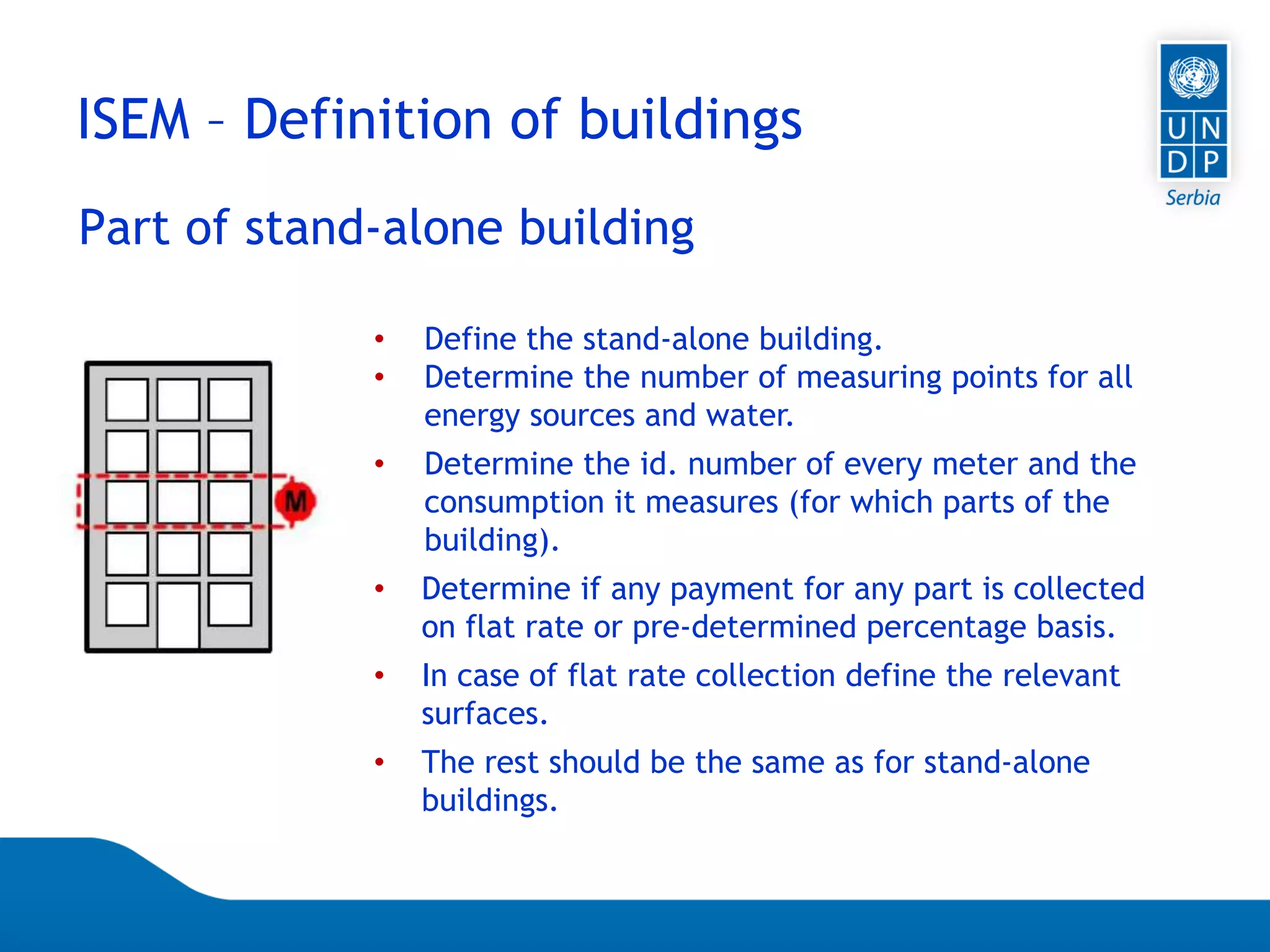
Part of stand-alone building
• Define the stand-alone building.
• Determine the number of measuring points for all
energy sources and water.
• Determine the id. number of every meter and the
consumption it measures (for which parts of the
building).
• Determine if any payment for any part is collected
on flat rate or pre-determined percentage basis.
• In case of flat rate collection define the relevant
surfaces.
• The rest should be the same as for stand-alone
buildings.
07.04.2015 Seite 60
Electricity
 As of 1 January 2013, only final consumers of electricity whose
buildings are connected to the distribution system are entitled to
public supply. Buyers connected to the transmission network are
no longer entitled to be supplied at regulated prices.
 As of 1 January 2014, only households and small buyers of
electricity are entitled to public supply. Apart from buyers
connected to the transmission network, also buyers connected to
the distribution system (except for households and small buyers)
are no longer entitled to be supplied at regulated prices.
 As of 1 January 2015, apart form the right to public supply,
households are entitled to freely choose the supplier on the
market.
07.04.2015 Seite 61
Electricity
 Small buyers of electricity are final buyers (legal persons and
entrepreneurs) if they have less than 50 employees, total annual
turnover up to Euro 10 million in RSD equivalent, and those whose
all buildings are connected to the electricity distribution system
of voltage up to 1kV.
 Public supply is the sale of electricity to households and small
buyers at regulated prices.
 Buyers who are not entitled to public supply shall buy electricity
from licensed suppliers in the free market.
 Currently in Serbia there are 89 licensed electricity suppliers.
07.04.2015 Seite 62
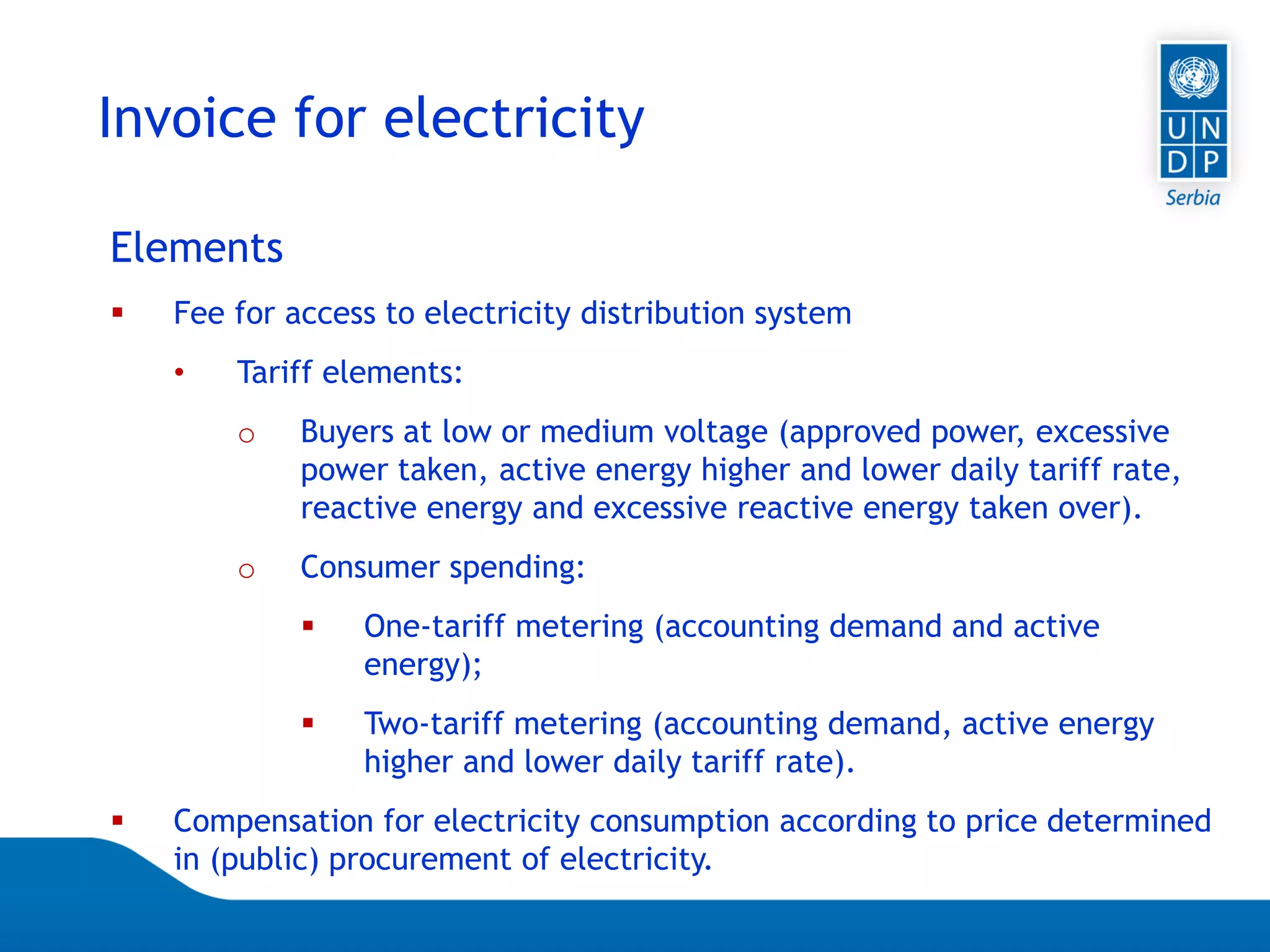
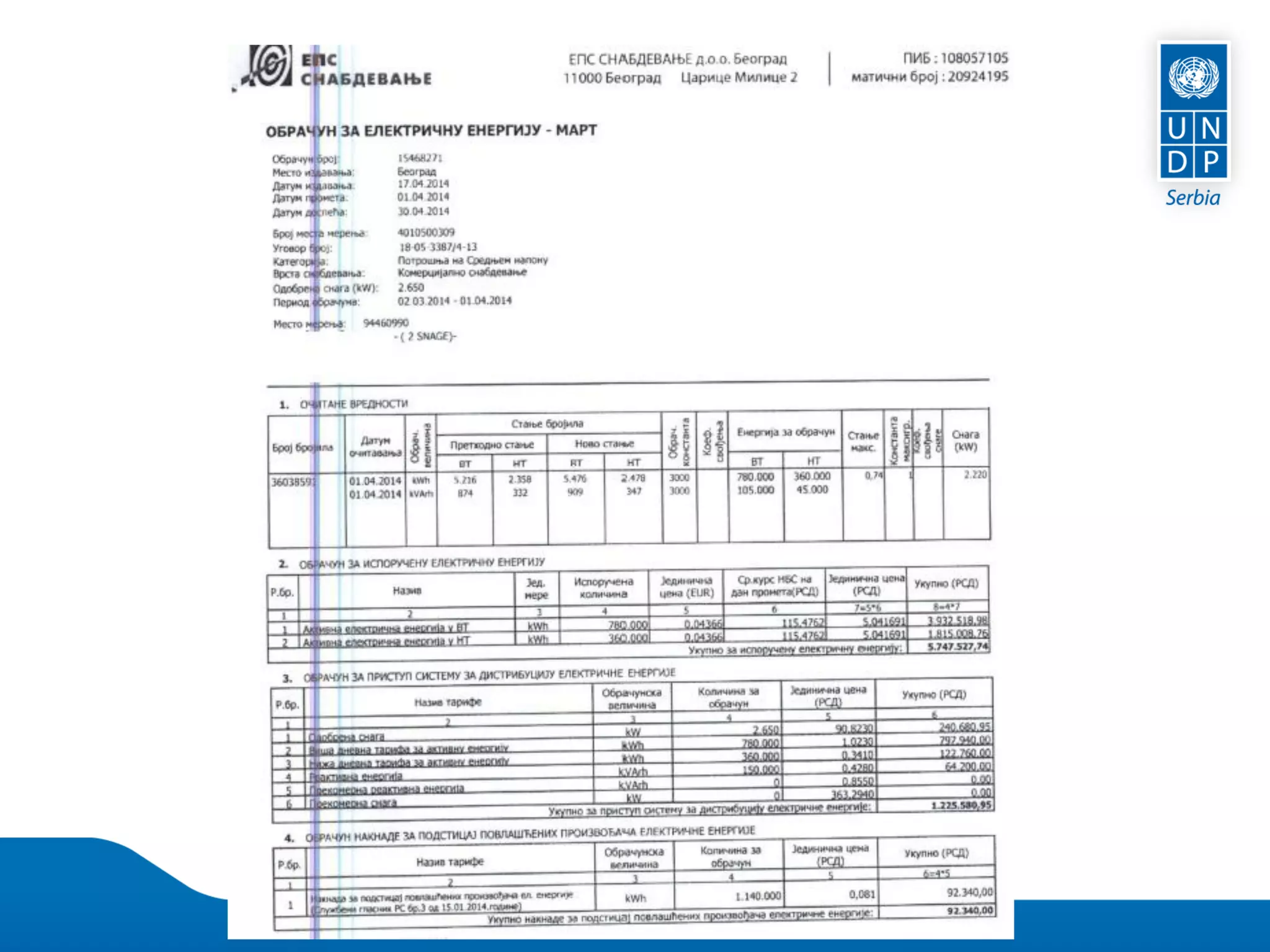
Invoice for electricity
Elements
 Fee for access to electricity distribution system
• Tariff elements:
o Buyers at low or medium voltage (approved power, excessive
power taken, active energy higher and lower daily tariff rate,
reactive energy and excessive reactive energy taken over).
o Consumer spending:
 One-tariff metering (accounting demand and active
energy);
 Two-tariff metering (accounting demand, active energy
higher and lower daily tariff rate).
 Compensation for electricity consumption according to price determined
in (public) procurement of electricity.
Page 63
07.04.2015 Seite 64
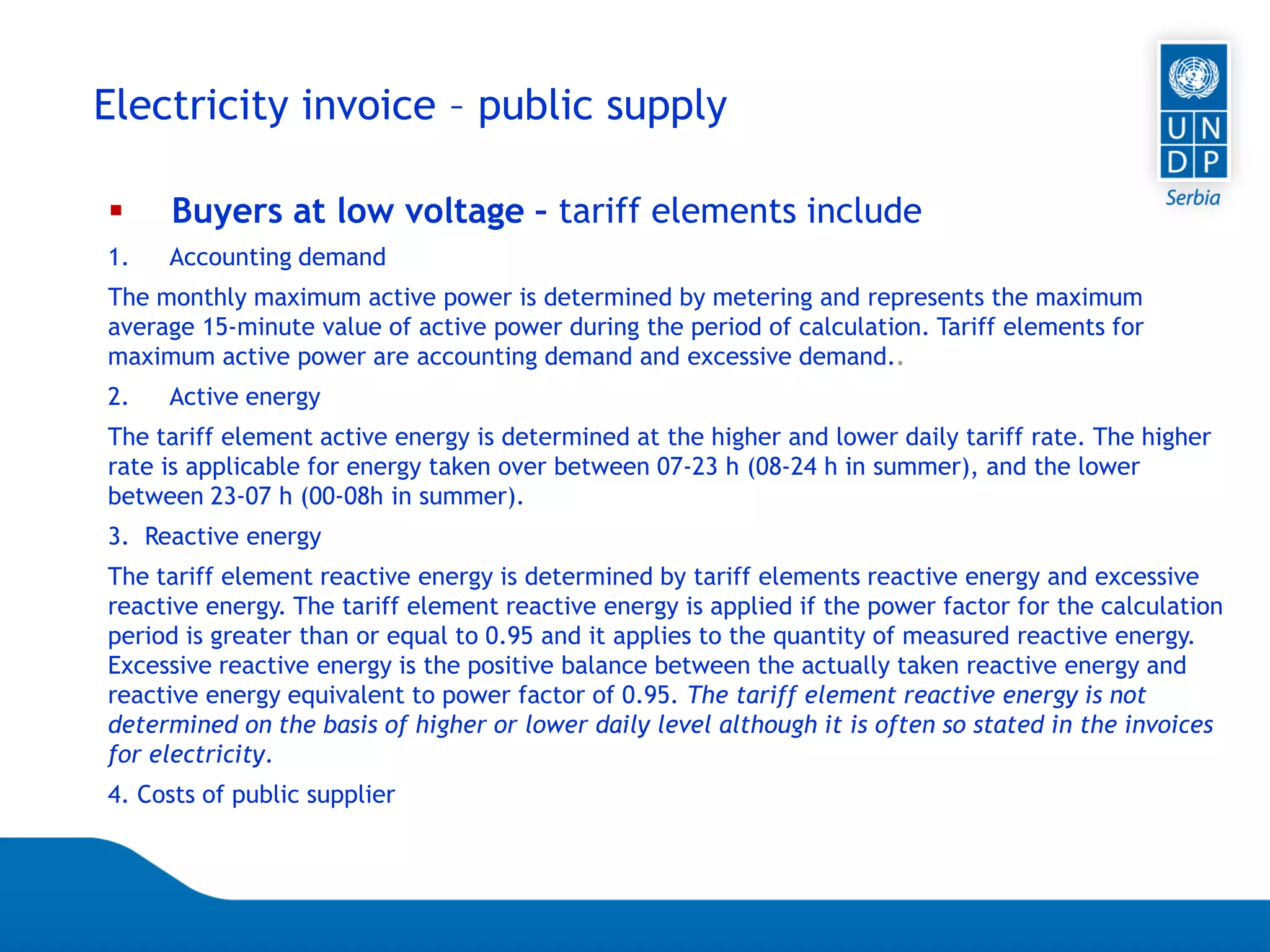
Electricity invoice – public supply
 Buyers at low voltage – tariff elements include
1. Accounting demand
The monthly maximum active power is determined by metering and represents the maximum
average 15-minute value of active power during the period of calculation. Tariff elements for
maximum active power are accounting demand and excessive demand..
2. Active energy
The tariff element active energy is determined at the higher and lower daily tariff rate. The higher
rate is applicable for energy taken over between 07-23 h (08-24 h in summer), and the lower
between 23-07 h (00-08h in summer).
3. Reactive energy
The tariff element reactive energy is determined by tariff elements reactive energy and excessive
reactive energy. The tariff element reactive energy is applied if the power factor for the calculation
period is greater than or equal to 0.95 and it applies to the quantity of measured reactive energy.
Excessive reactive energy is the positive balance between the actually taken reactive energy and
reactive energy equivalent to power factor of 0.95. The tariff element reactive energy is not
determined on the basis of higher or lower daily level although it is often so stated in the invoices
for electricity.
4. Costs of public supplier
07.04.2015 Seite 65
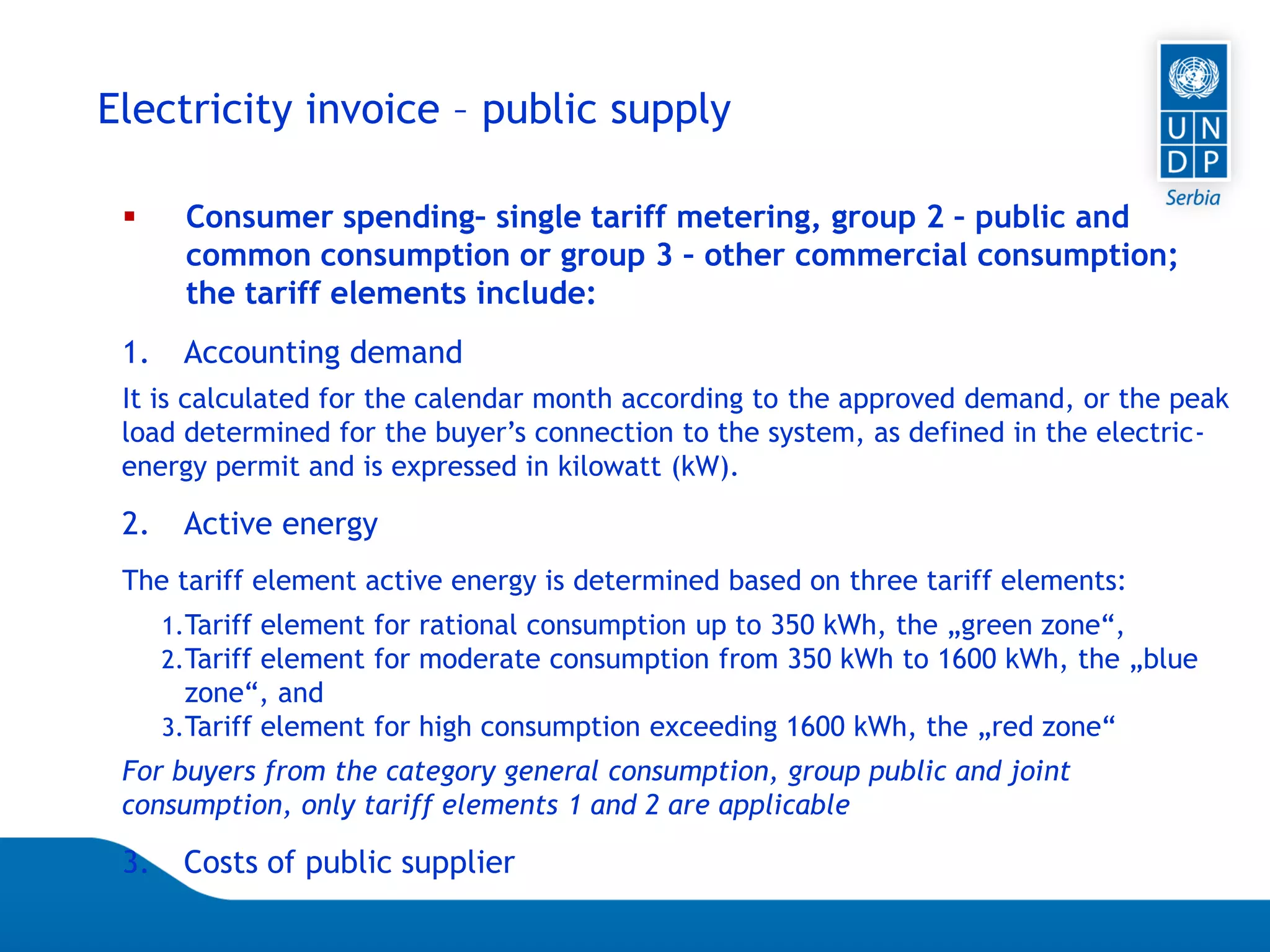
Electricity invoice – public supply
 Consumer spending– single tariff metering, group 2 – public and
common consumption or group 3 – other commercial consumption;
the tariff elements include:
1. Accounting demand
It is calculated for the calendar month according to the approved demand, or the peak
load determined for the buyer’s connection to the system, as defined in the electric-
energy permit and is expressed in kilowatt (kW).
2. Active energy
The tariff element active energy is determined based on three tariff elements:
1.Tariff element for rational consumption up to 350 kWh, the „green zone“,
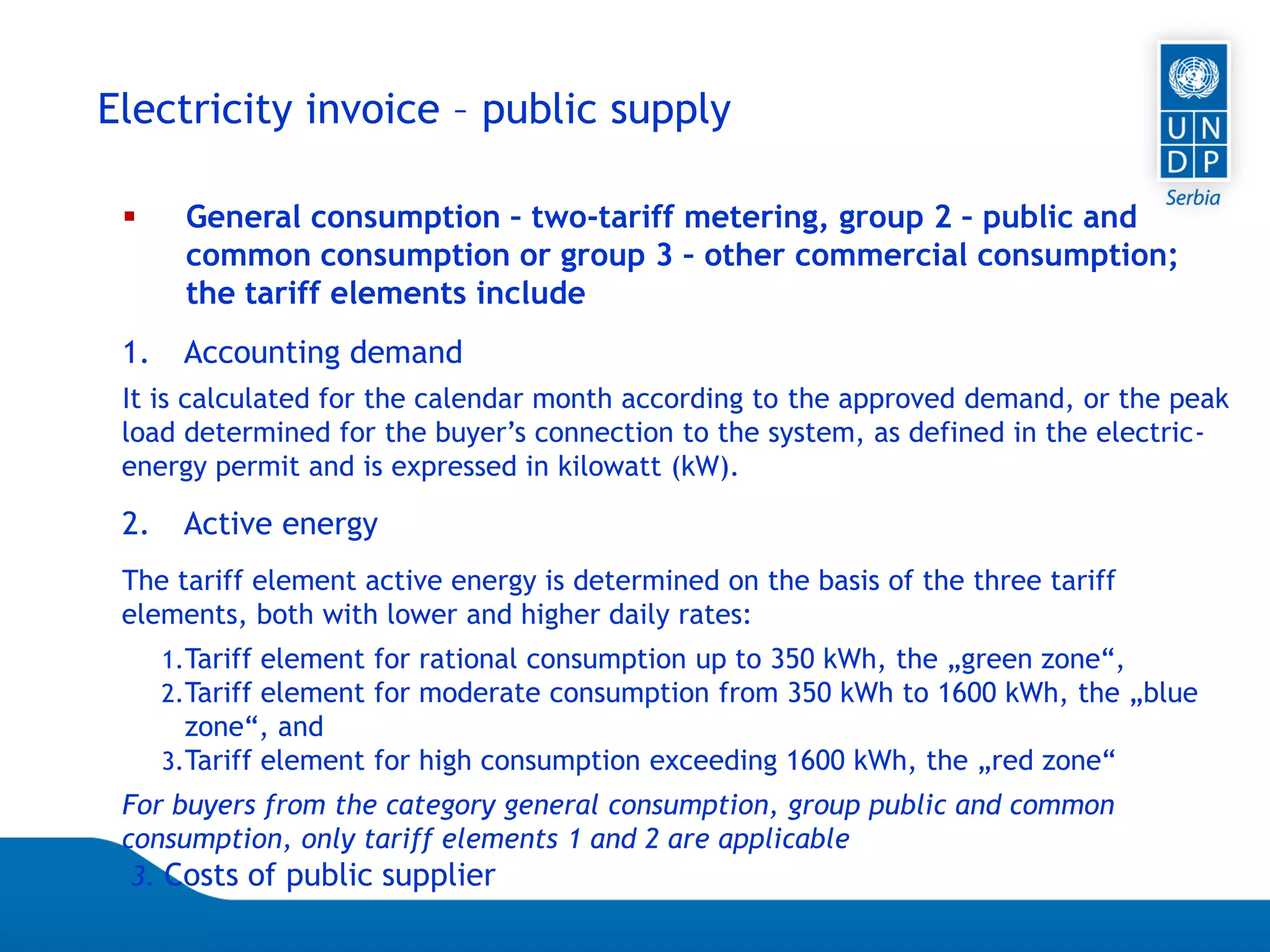
2.Tariff element for moderate consumption from 350 kWh to 1600 kWh, the „blue
zone“, and
3.Tariff element for high consumption exceeding 1600 kWh, the „red zone“
For buyers from the category general consumption, group public and joint
consumption, only tariff elements 1 and 2 are applicable
3. Costs of public supplier
07.04.2015 Seite 66
Electricity invoice – public supply
 General consumption – two-tariff metering, group 2 – public and
common consumption or group 3 – other commercial consumption;
the tariff elements include
1. Accounting demand
It is calculated for the calendar month according to the approved demand, or the peak
load determined for the buyer’s connection to the system, as defined in the electric-
energy permit and is expressed in kilowatt (kW).
2. Active energy
The tariff element active energy is determined on the basis of the three tariff
elements, both with lower and higher daily rates:
1.Tariff element for rational consumption up to 350 kWh, the „green zone“,
2.Tariff element for moderate consumption from 350 kWh to 1600 kWh, the „blue
zone“, and
3.Tariff element for high consumption exceeding 1600 kWh, the „red zone“
For buyers from the category general consumption, group public and common
consumption, only tariff elements 1 and 2 are applicable
3. Costs of public supplier
Page 67
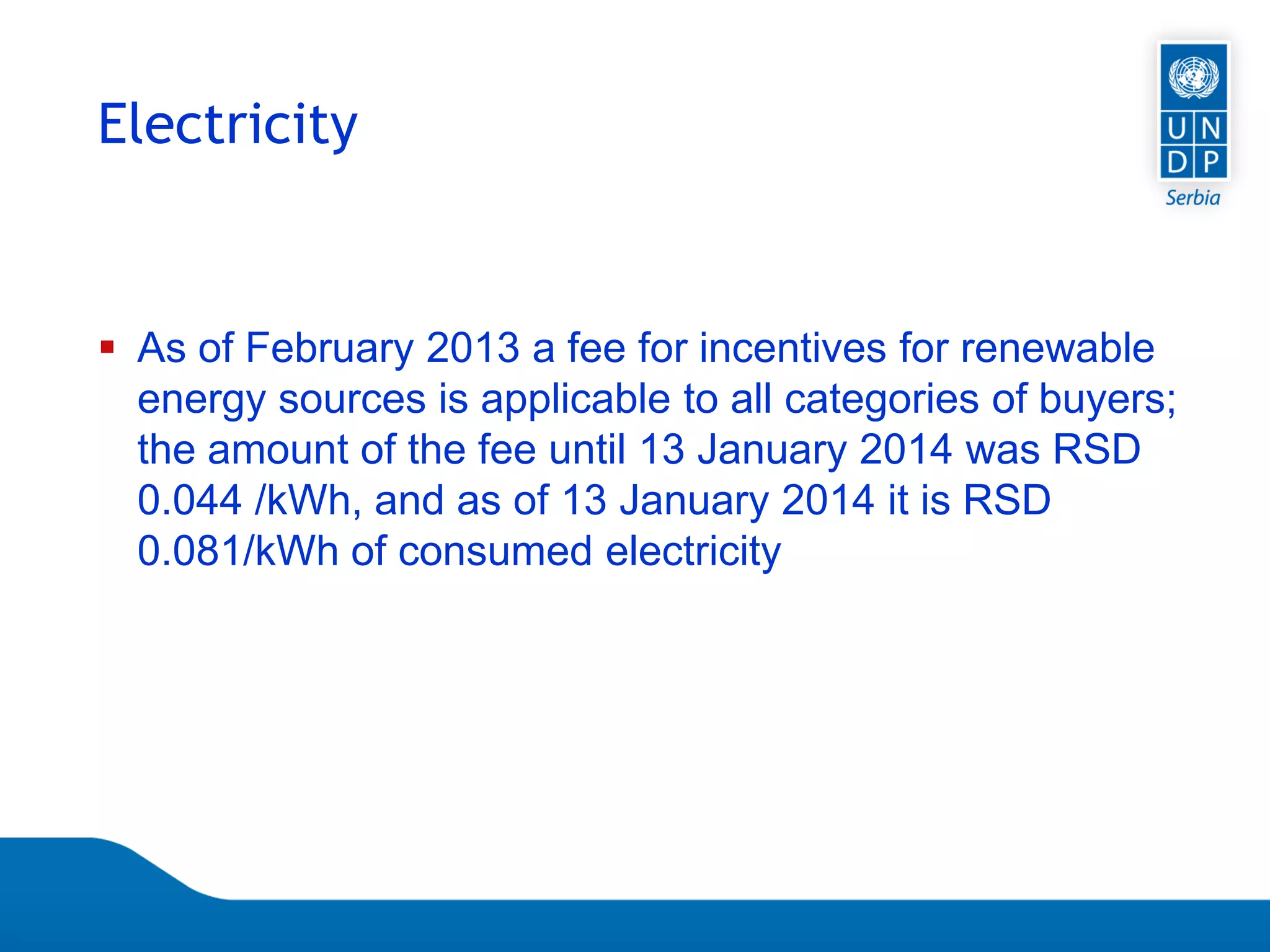
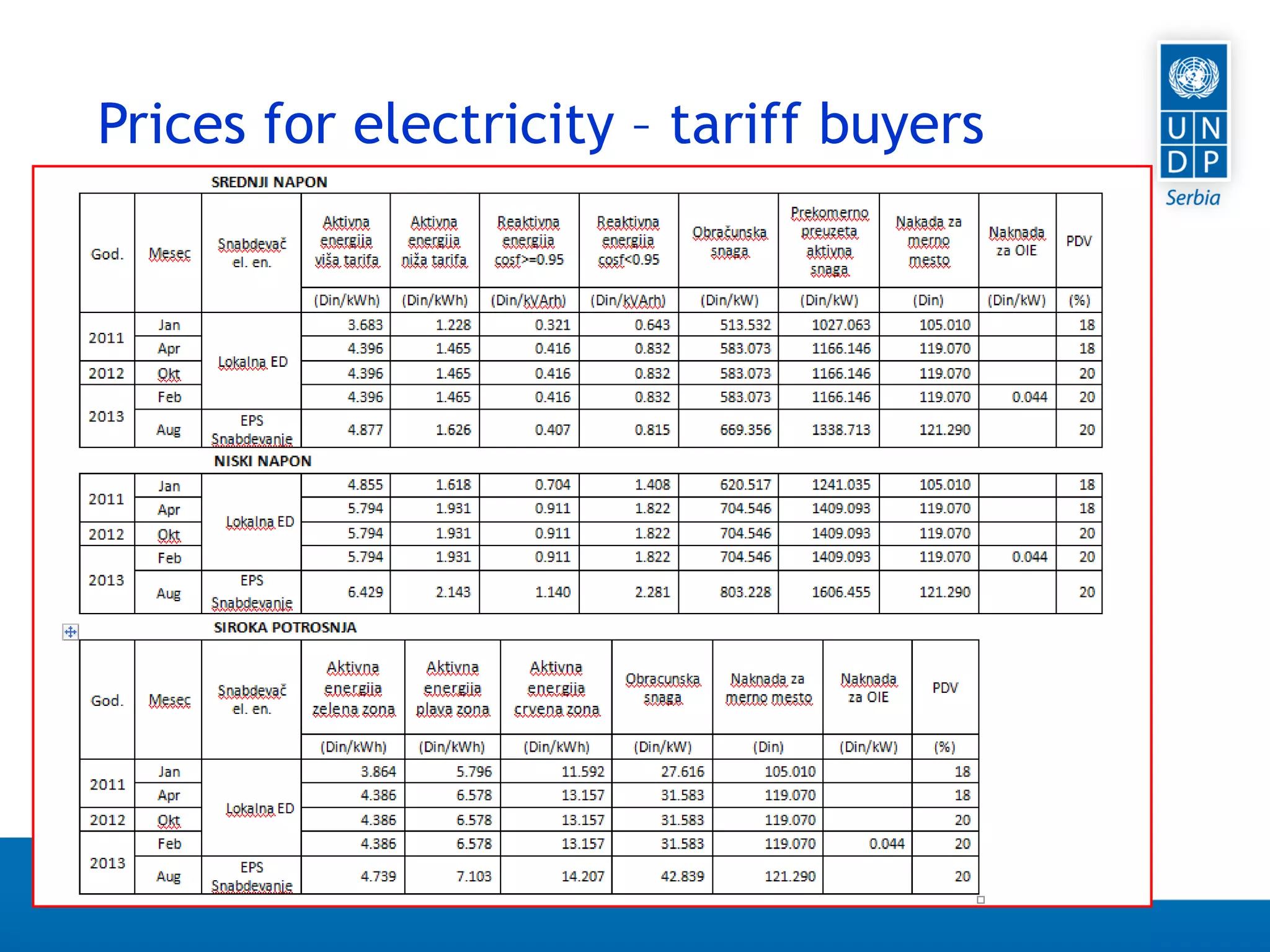
 As of February 2013 a fee for incentives for renewable
energy sources is applicable to all categories of buyers;
the amount of the fee until 13 January 2014 was RSD
0.044 /kWh, and as of 13 January 2014 it is RSD
0.081/kWh of consumed electricity
Electricity
Page 68
Prices for electricity – tariff buyers
07.04.2015 Seite 69
Gas supply
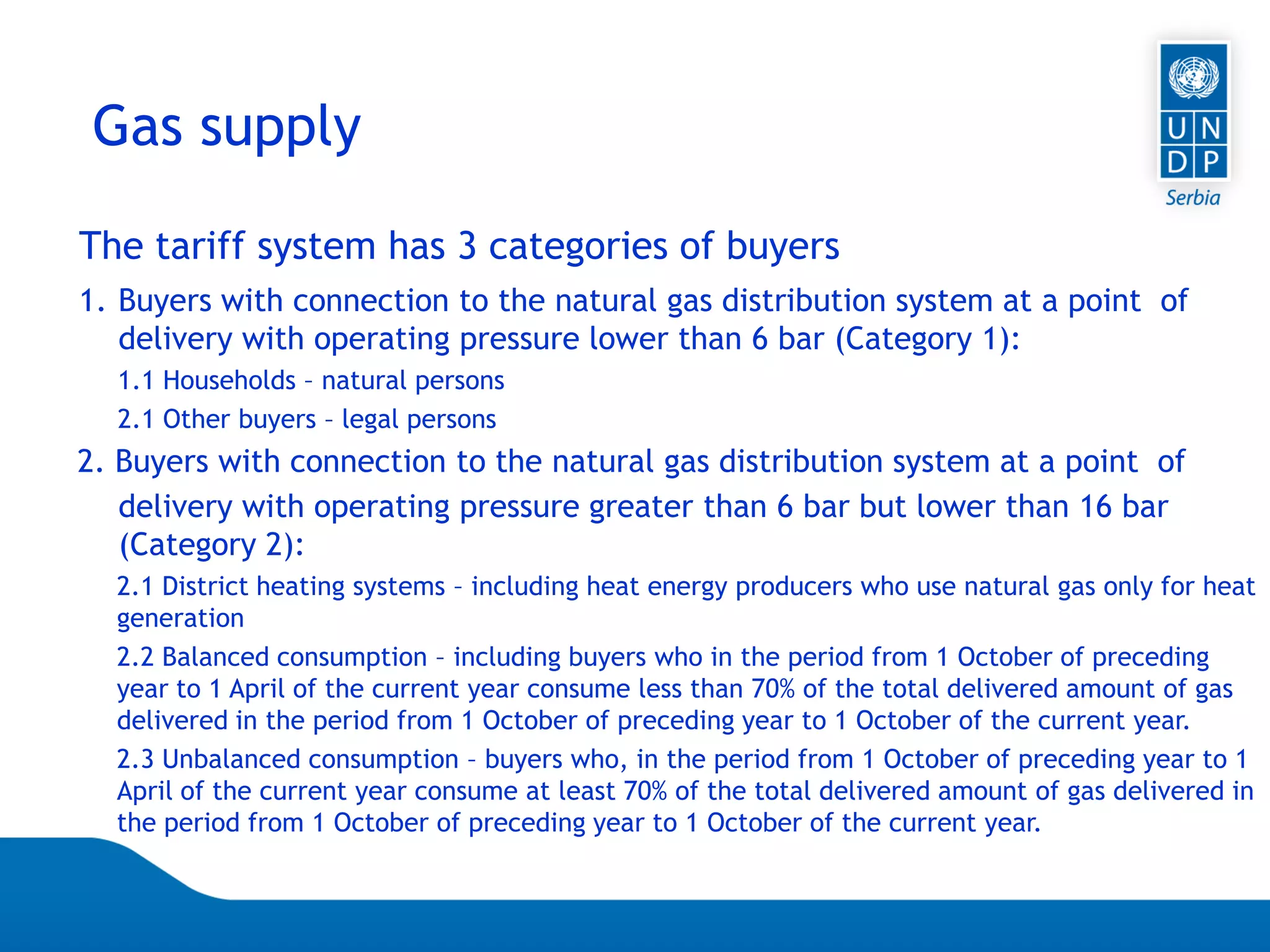
The tariff system has 3 categories of buyers
1. Buyers with connection to the natural gas distribution system at a point of
delivery with operating pressure lower than 6 bar (Category 1):
1.1 Households – natural persons
2.1 Other buyers – legal persons
2. Buyers with connection to the natural gas distribution system at a point of
delivery with operating pressure greater than 6 bar but lower than 16 bar
(Category 2):
2.1 District heating systems – including heat energy producers who use natural gas only for heat
generation
2.2 Balanced consumption – including buyers who in the period from 1 October of preceding
year to 1 April of the current year consume less than 70% of the total delivered amount of gas
delivered in the period from 1 October of preceding year to 1 October of the current year.
2.3 Unbalanced consumption – buyers who, in the period from 1 October of preceding year to 1
April of the current year consume at least 70% of the total delivered amount of gas delivered in
the period from 1 October of preceding year to 1 October of the current year.
07.04.2015 Seite 70
The tariff system has 3 categories of buyers
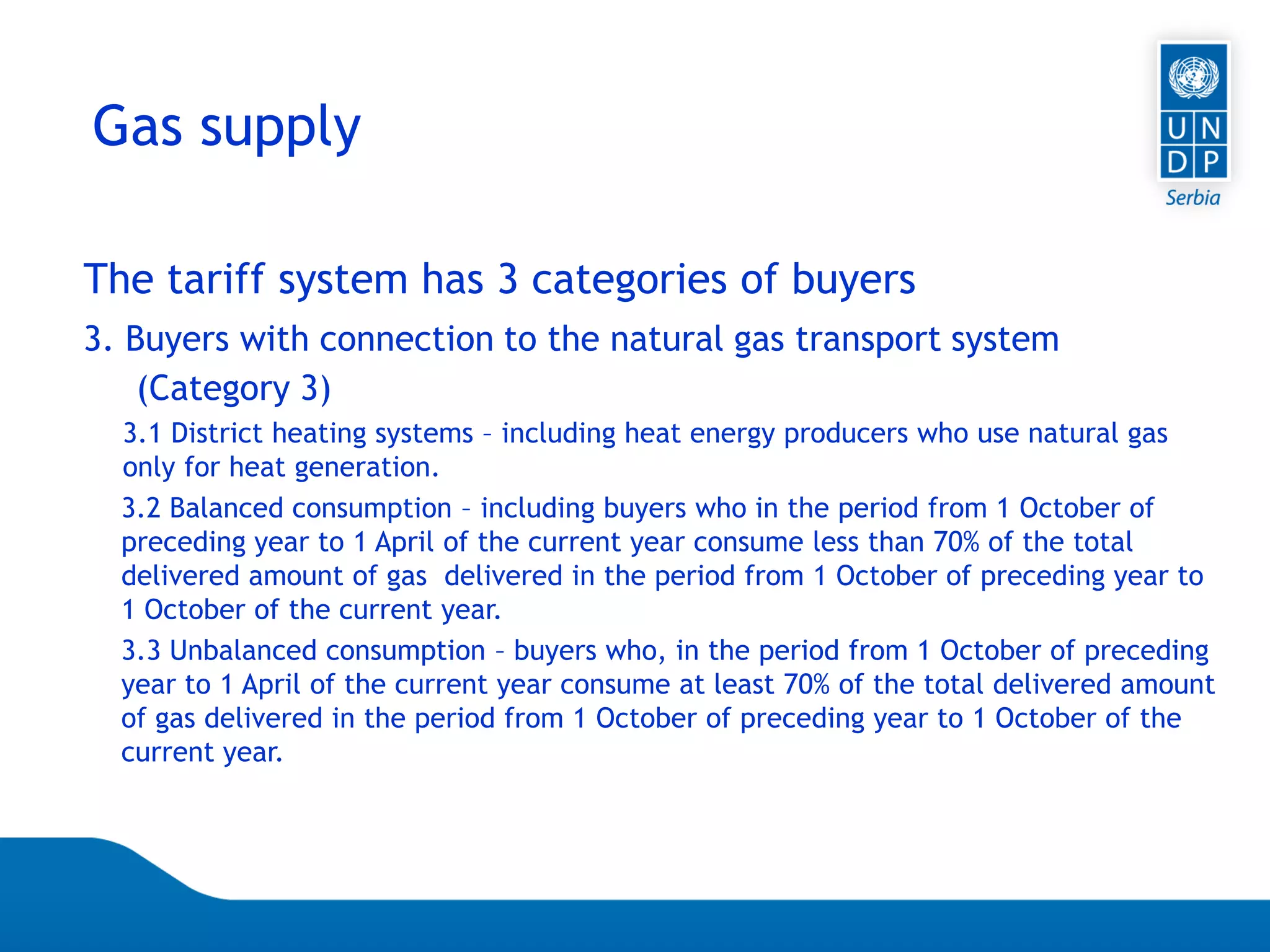
3. Buyers with connection to the natural gas transport system
(Category 3)
3.1 District heating systems – including heat energy producers who use natural gas
only for heat generation.
3.2 Balanced consumption – including buyers who in the period from 1 October of
preceding year to 1 April of the current year consume less than 70% of the total
delivered amount of gas delivered in the period from 1 October of preceding year to
1 October of the current year.
3.3 Unbalanced consumption – buyers who, in the period from 1 October of preceding
year to 1 April of the current year consume at least 70% of the total delivered amount
of gas delivered in the period from 1 October of preceding year to 1 October of the
current year.
Gas supply
07.04.2015 Seite 71
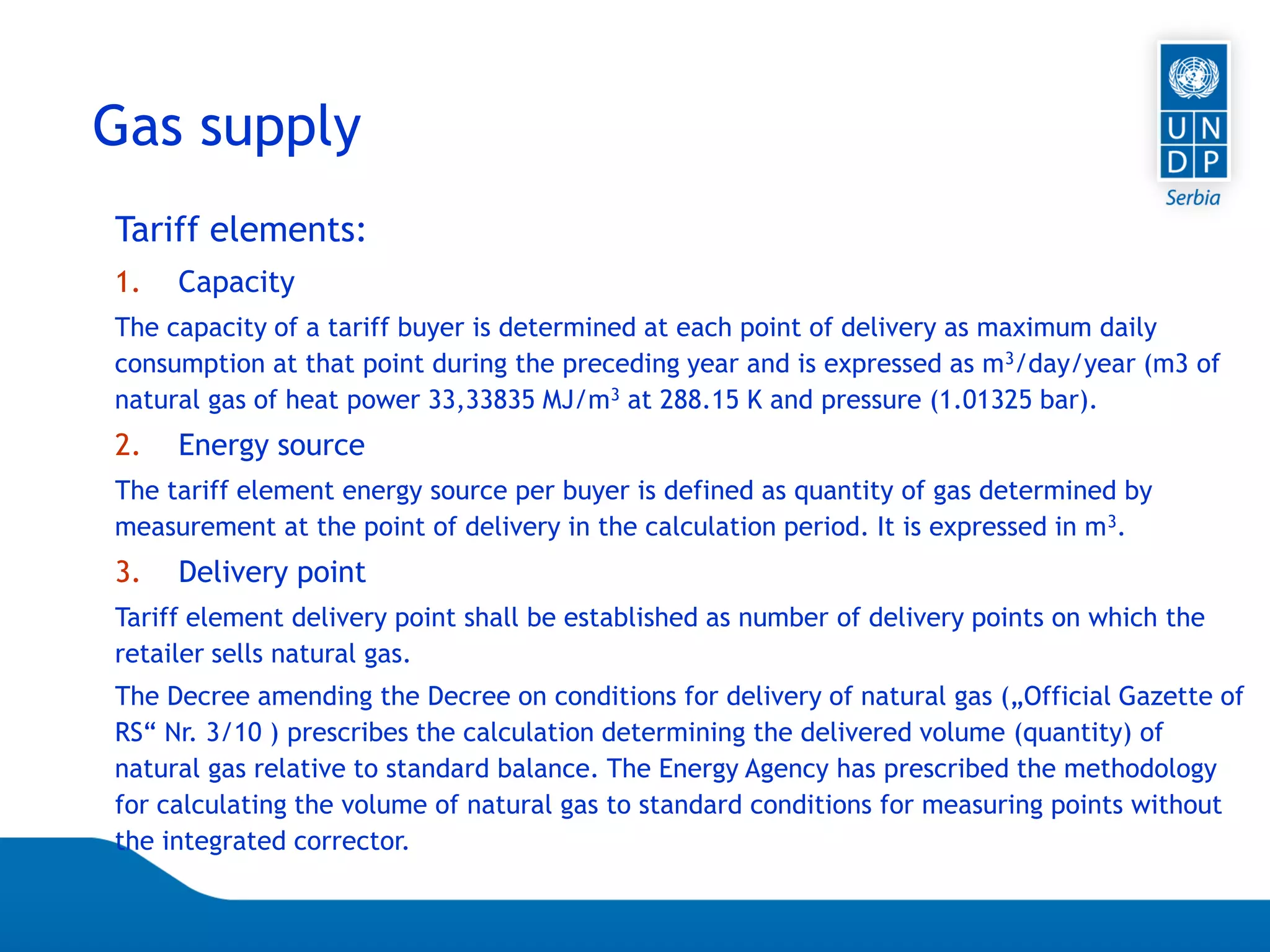
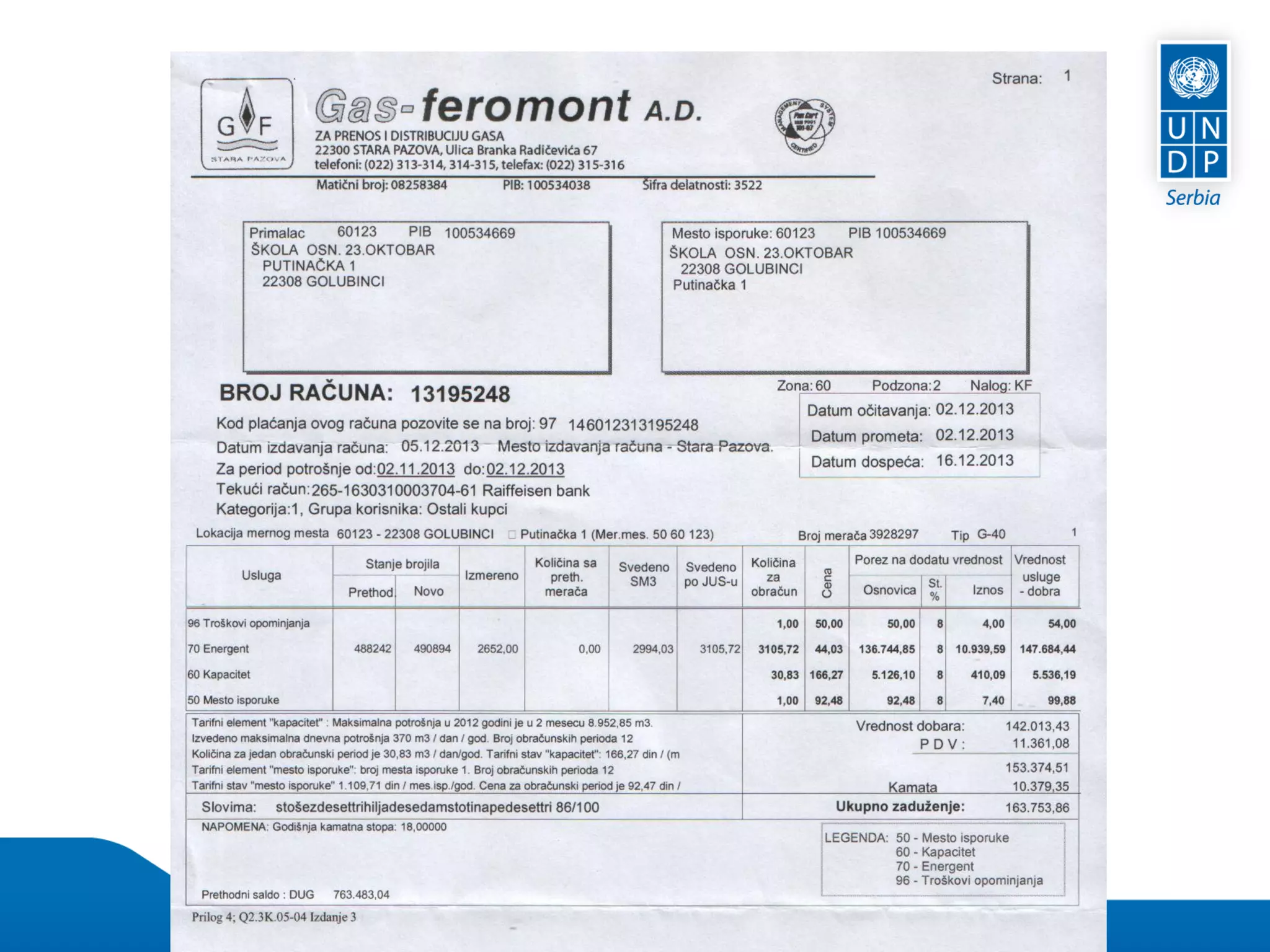
Tariff elements:
1. Capacity
The capacity of a tariff buyer is determined at each point of delivery as maximum daily
consumption at that point during the preceding year and is expressed as m3/day/year (m3 of
natural gas of heat power 33,33835 MJ/m3 at 288.15 K and pressure (1.01325 bar).
2. Energy source
The tariff element energy source per buyer is defined as quantity of gas determined by
measurement at the point of delivery in the calculation period. It is expressed in m3.
3. Delivery point
Tariff element delivery point shall be established as number of delivery points on which the
retailer sells natural gas.
The Decree amending the Decree on conditions for delivery of natural gas („Official Gazette of
RS“ Nr. 3/10 ) prescribes the calculation determining the delivered volume (quantity) of
natural gas relative to standard balance. The Energy Agency has prescribed the methodology
for calculating the volume of natural gas to standard conditions for measuring points without
the integrated corrector.
Gas supply
Page 72
Page 73
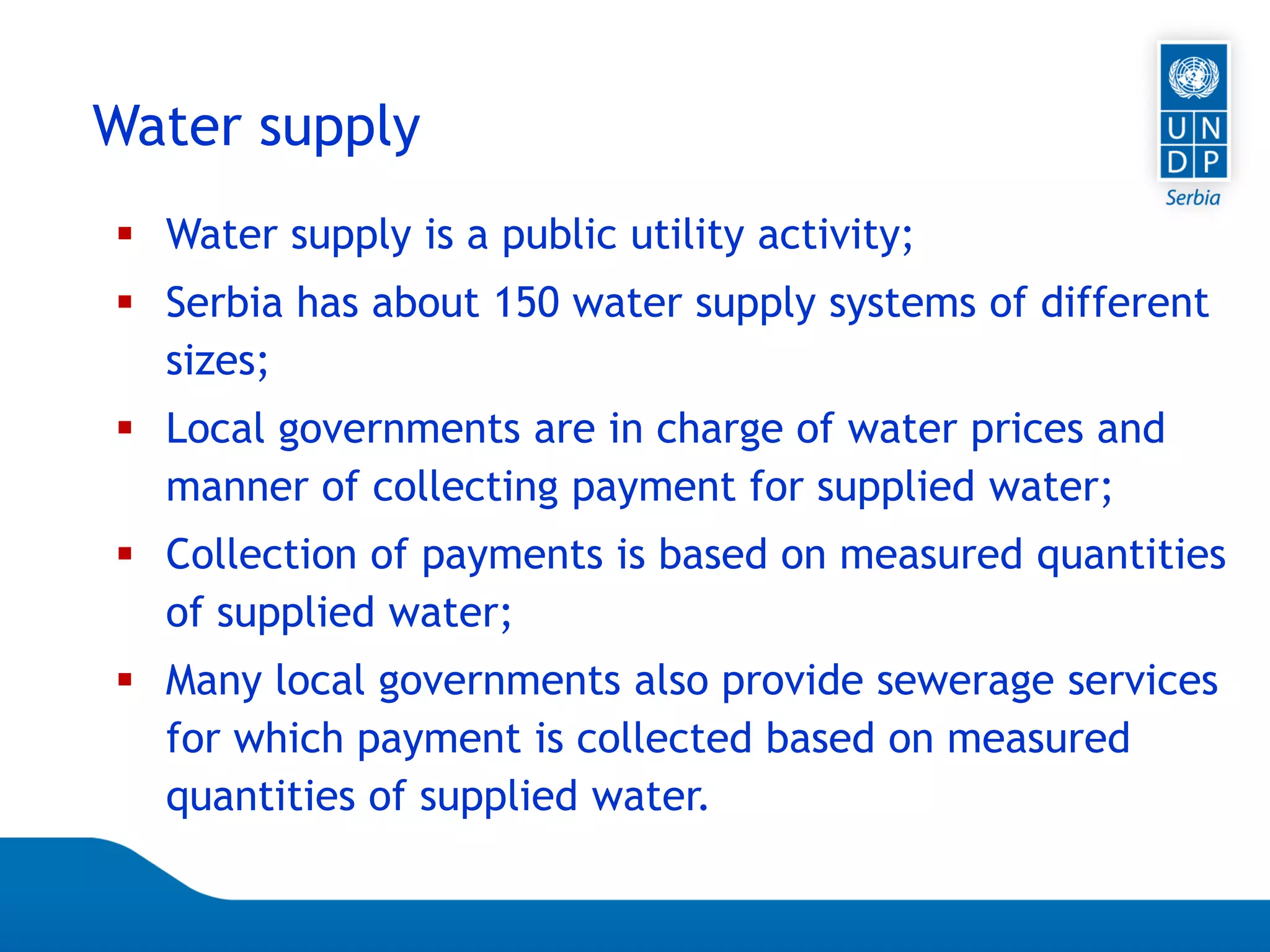
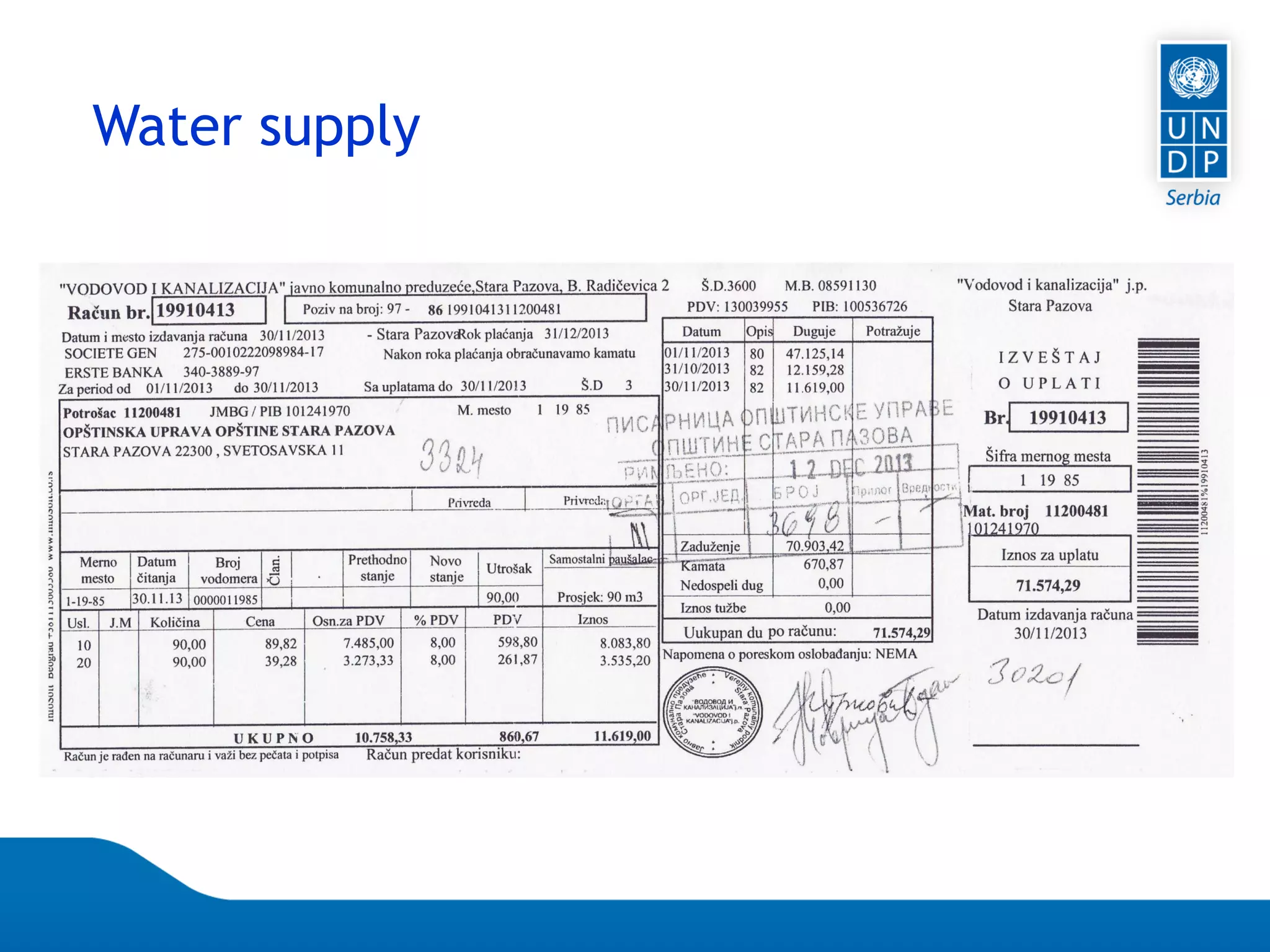
Water supply
 Water supply is a public utility activity;
 Serbia has about 150 water supply systems of different
sizes;
 Local governments are in charge of water prices and
manner of collecting payment for supplied water;
 Collection of payments is based on measured quantities
of supplied water;
 Many local governments also provide sewerage services
for which payment is collected based on measured
quantities of supplied water.
Page 74
Water supply
Page 75
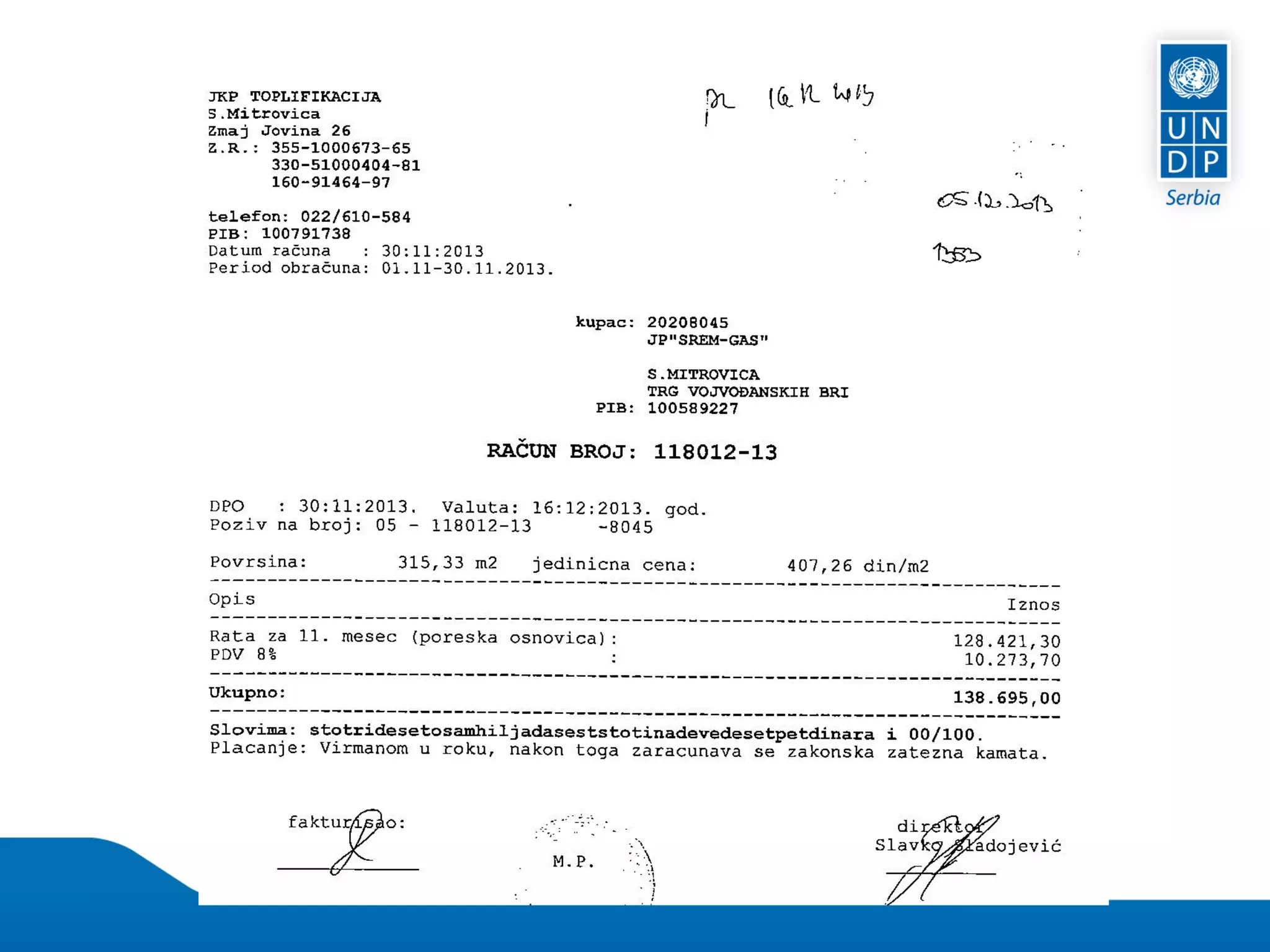
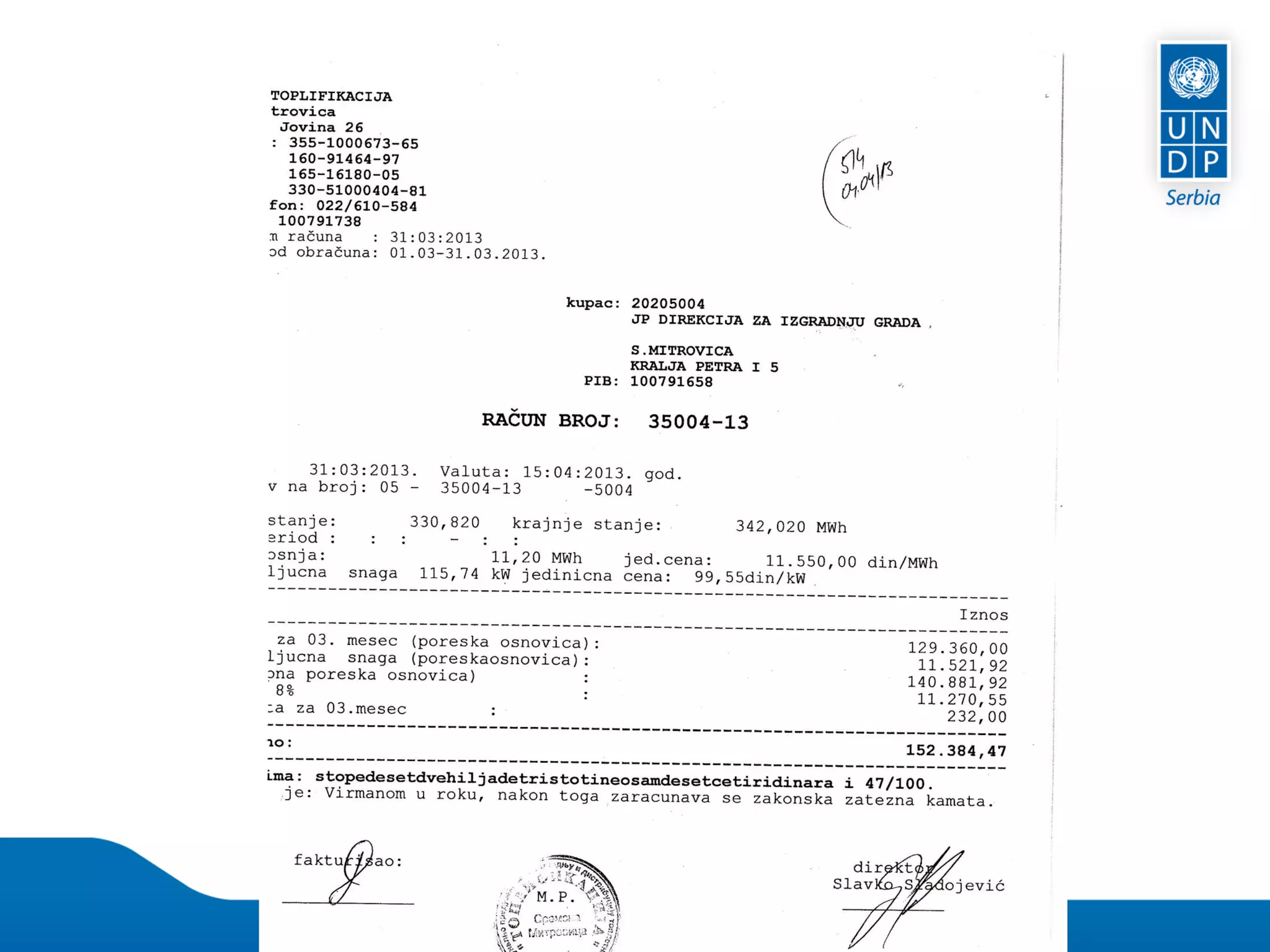
District heating
 District heating is public utility and energy activity;
 Local governments are in charge of prices and manner of collecting
payment for delivered heat energy. The Ministry of Mining and
Energy prescribes the maximum price for heat energy.
 Colelction is done:
 Flat rate, based on number of heated m2 or
 Based on consumption measured by calorymeters;
 According to the Law on Efficient Use of Energy, as of 1 January
2015, all district heating systems are obliged to move to collecting
payment for delivered heat energy based on measured consumption.
Page 76
Page 77
Page 78
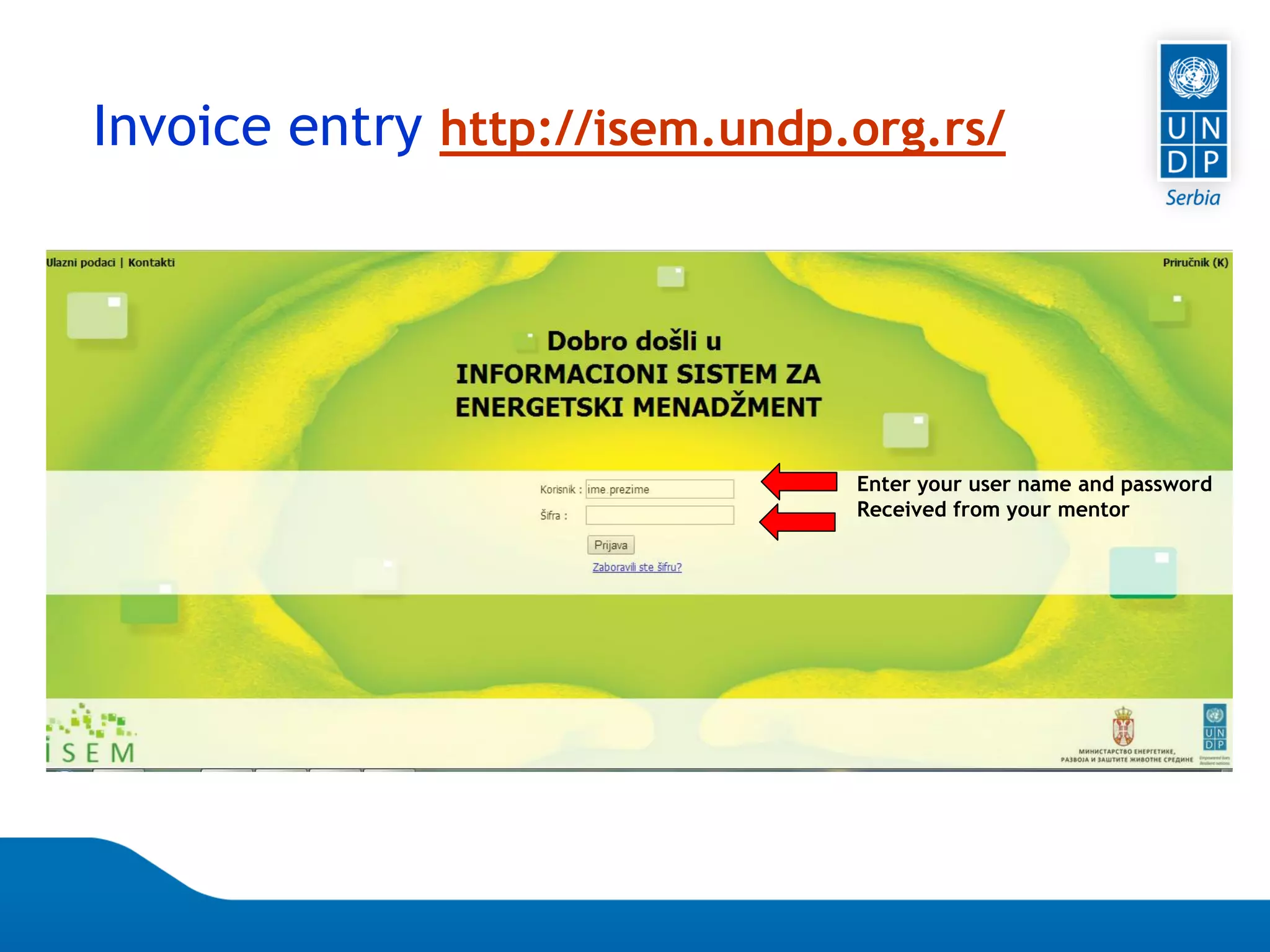
Invoice entry http://isem.undp.org.rs/
Enter your user name and password
Received from your mentor
Page 79
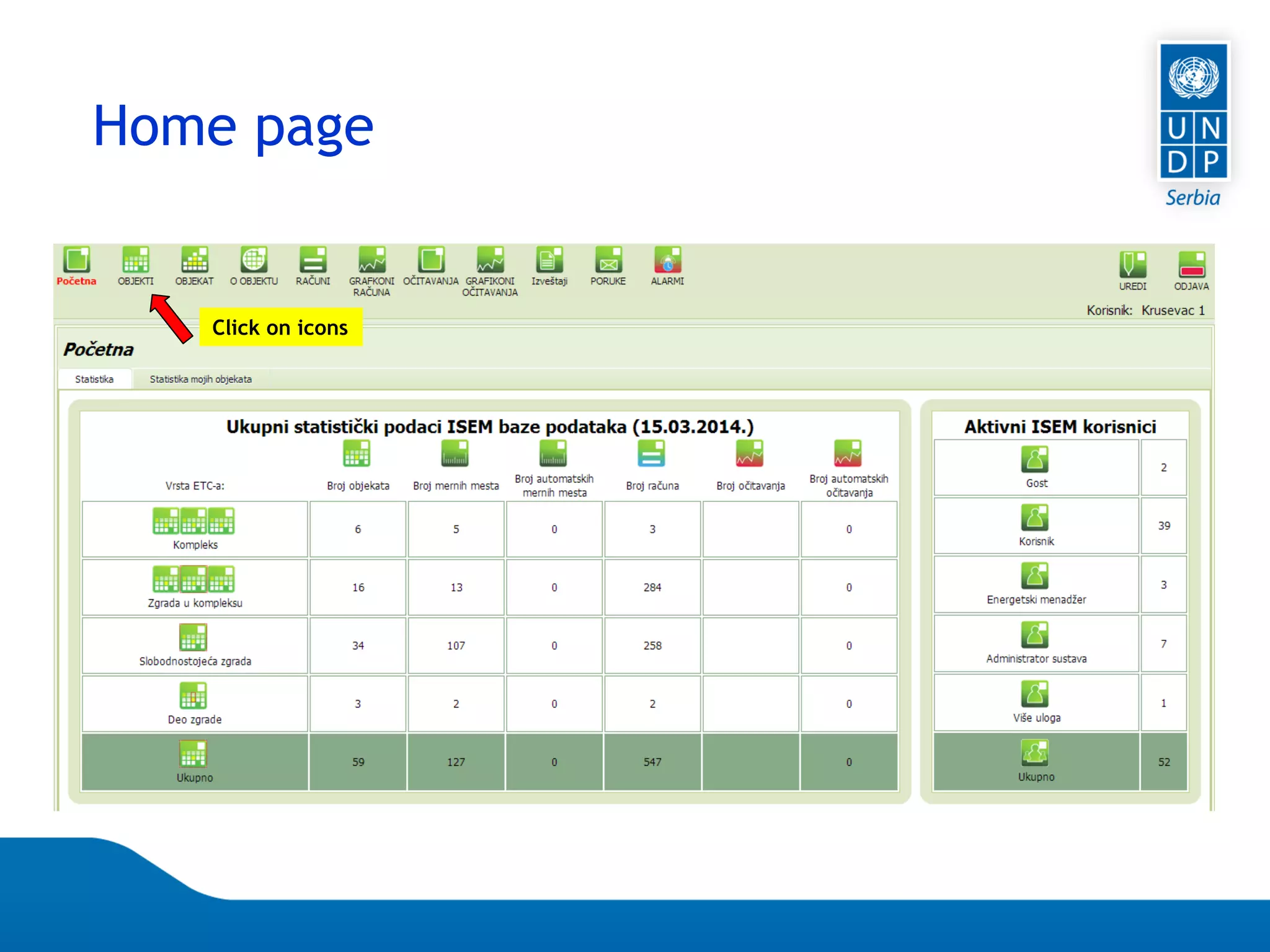
Home page
Click on icons
Page 80
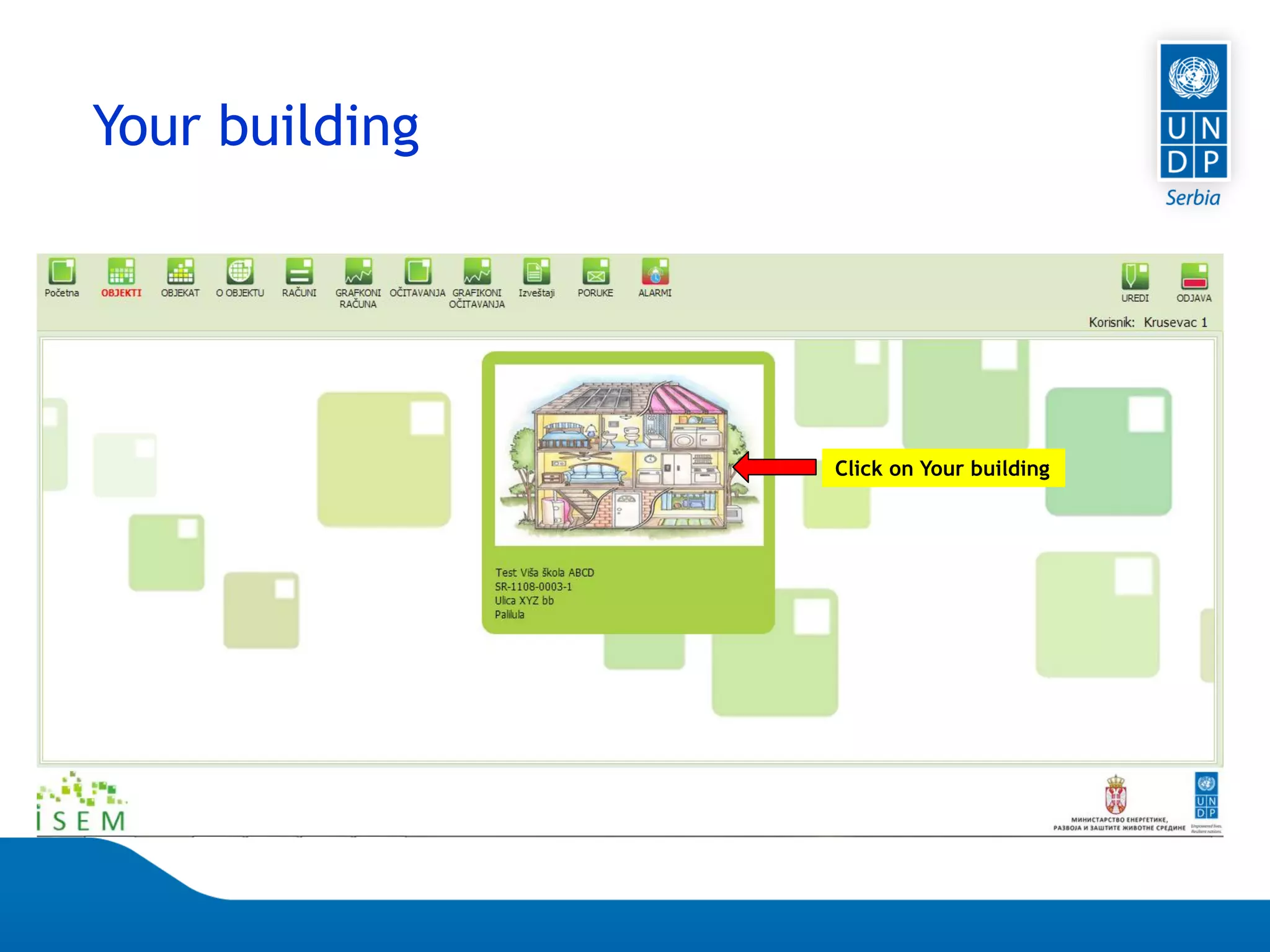
Your building
Click on Your building
Page 81
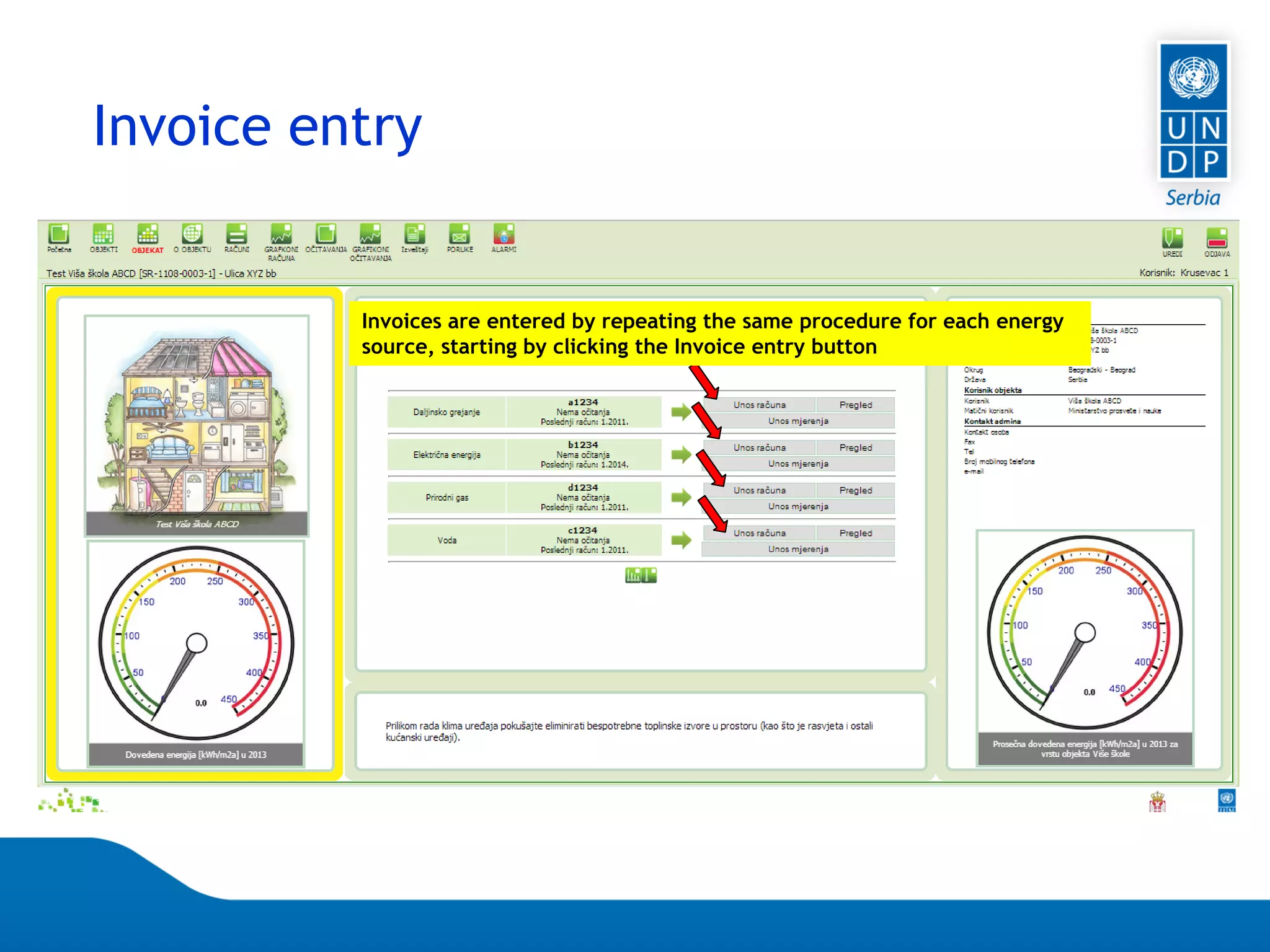
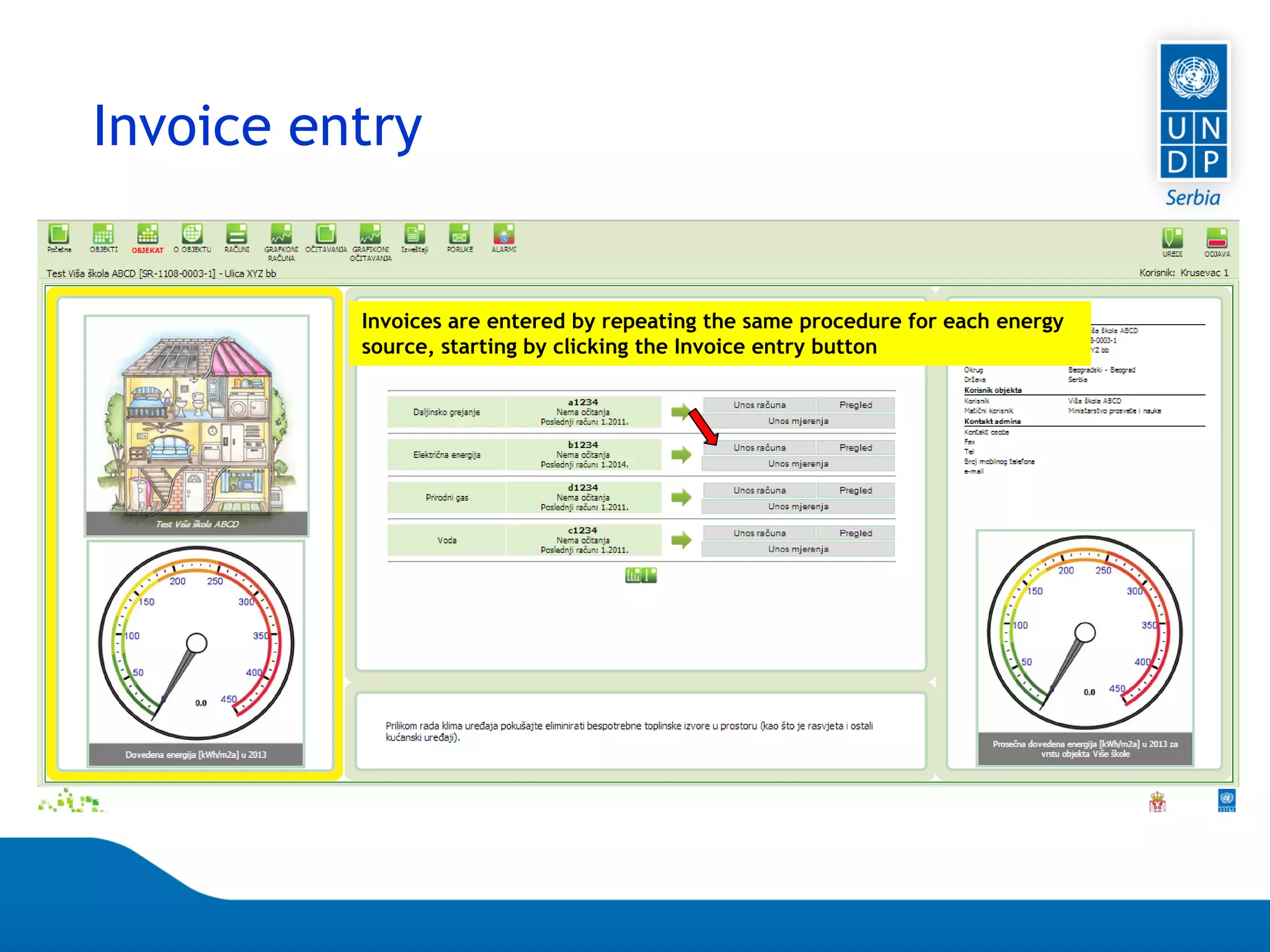
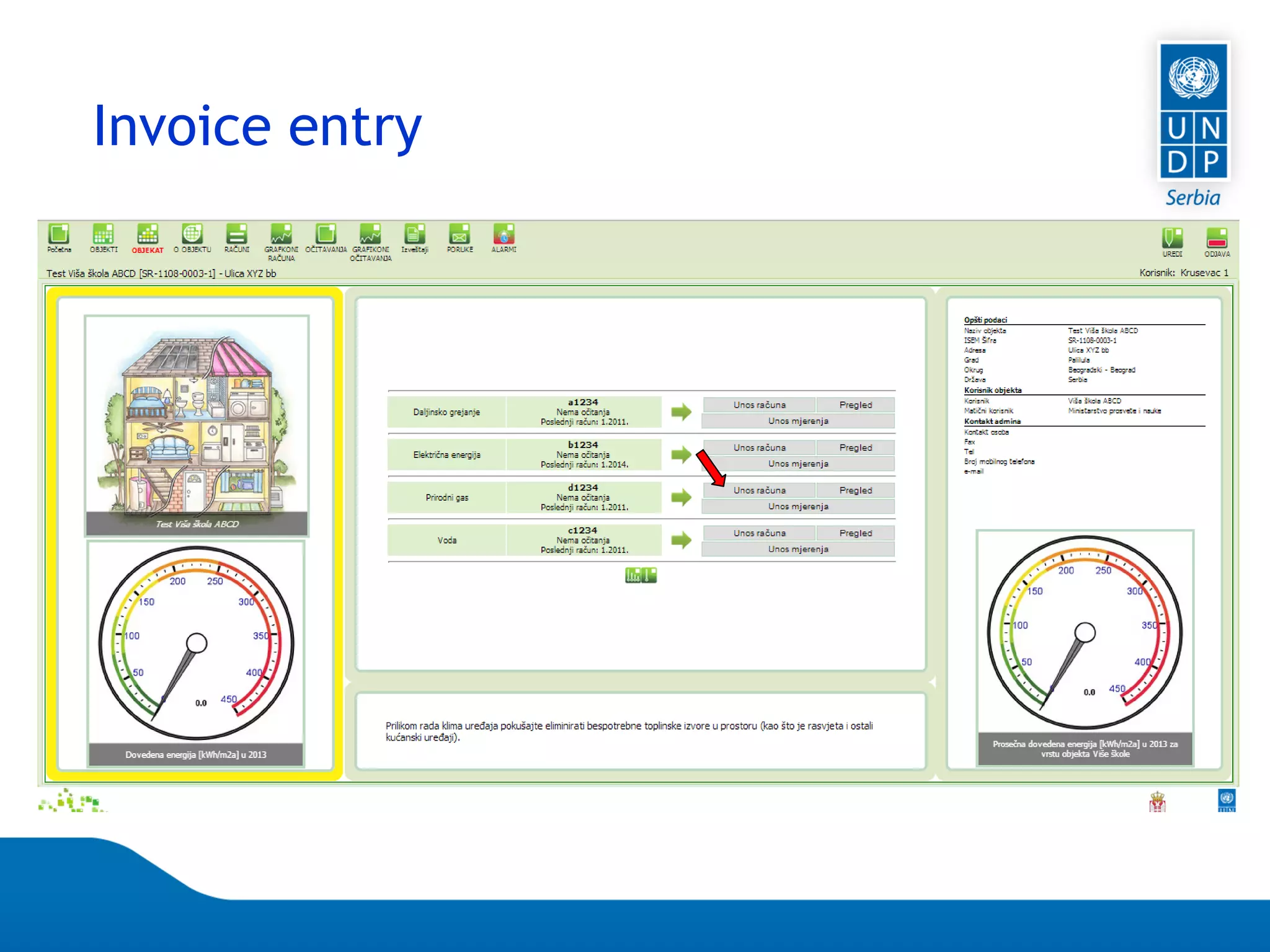
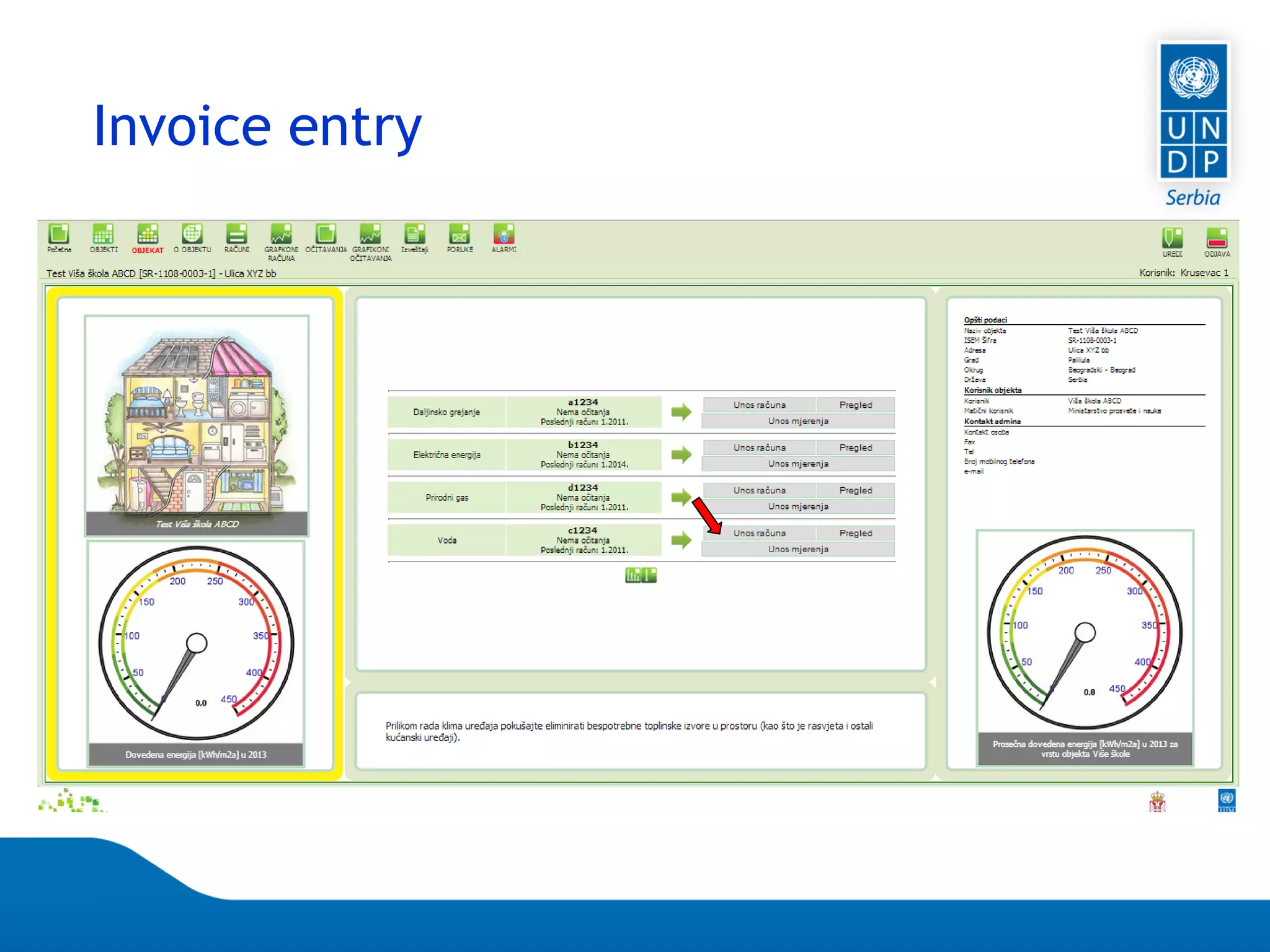
Invoice entry
Invoices are entered by repeating the same procedure for each energy
source, starting by clicking the Invoice entry button
Page 82
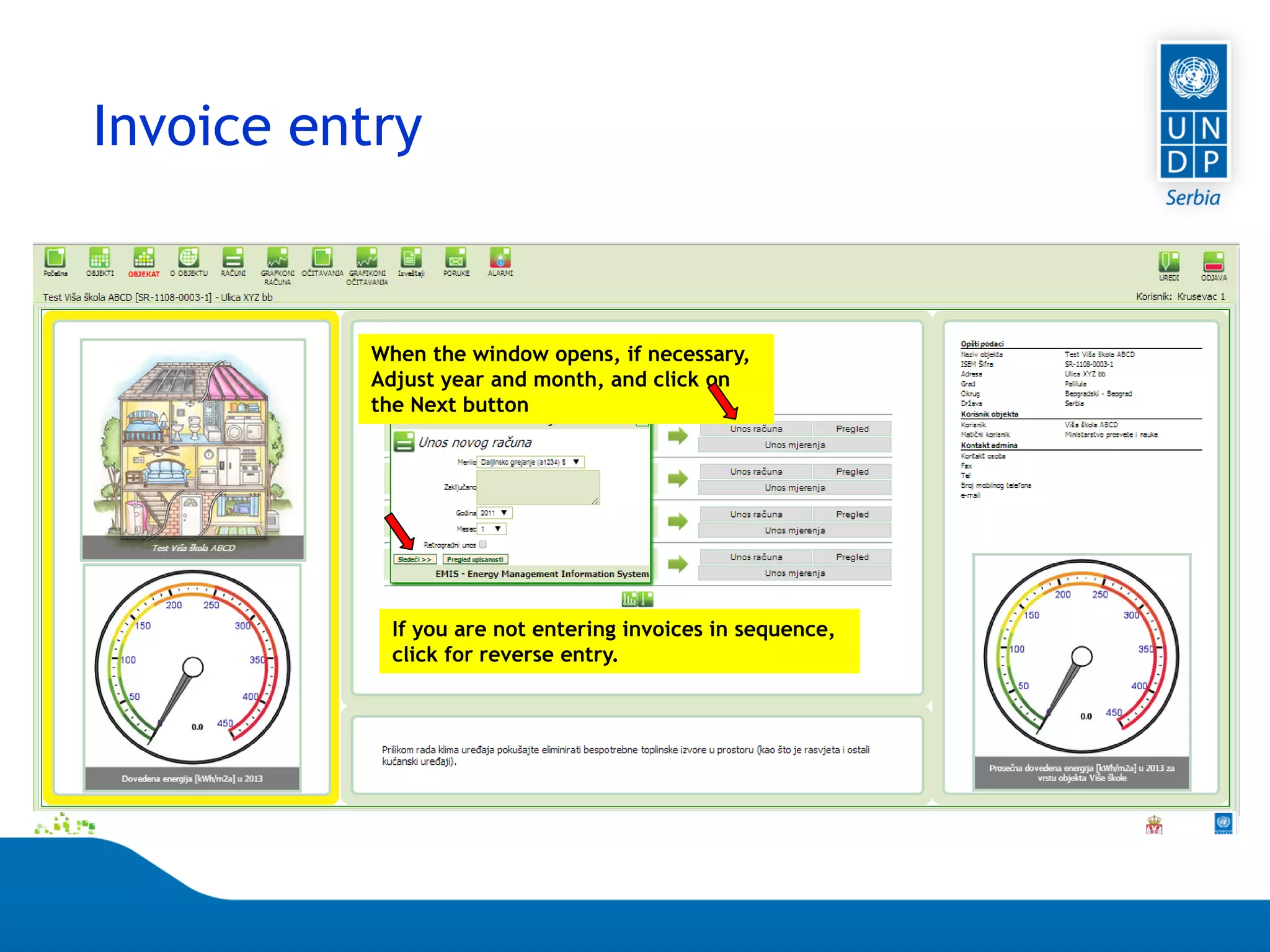
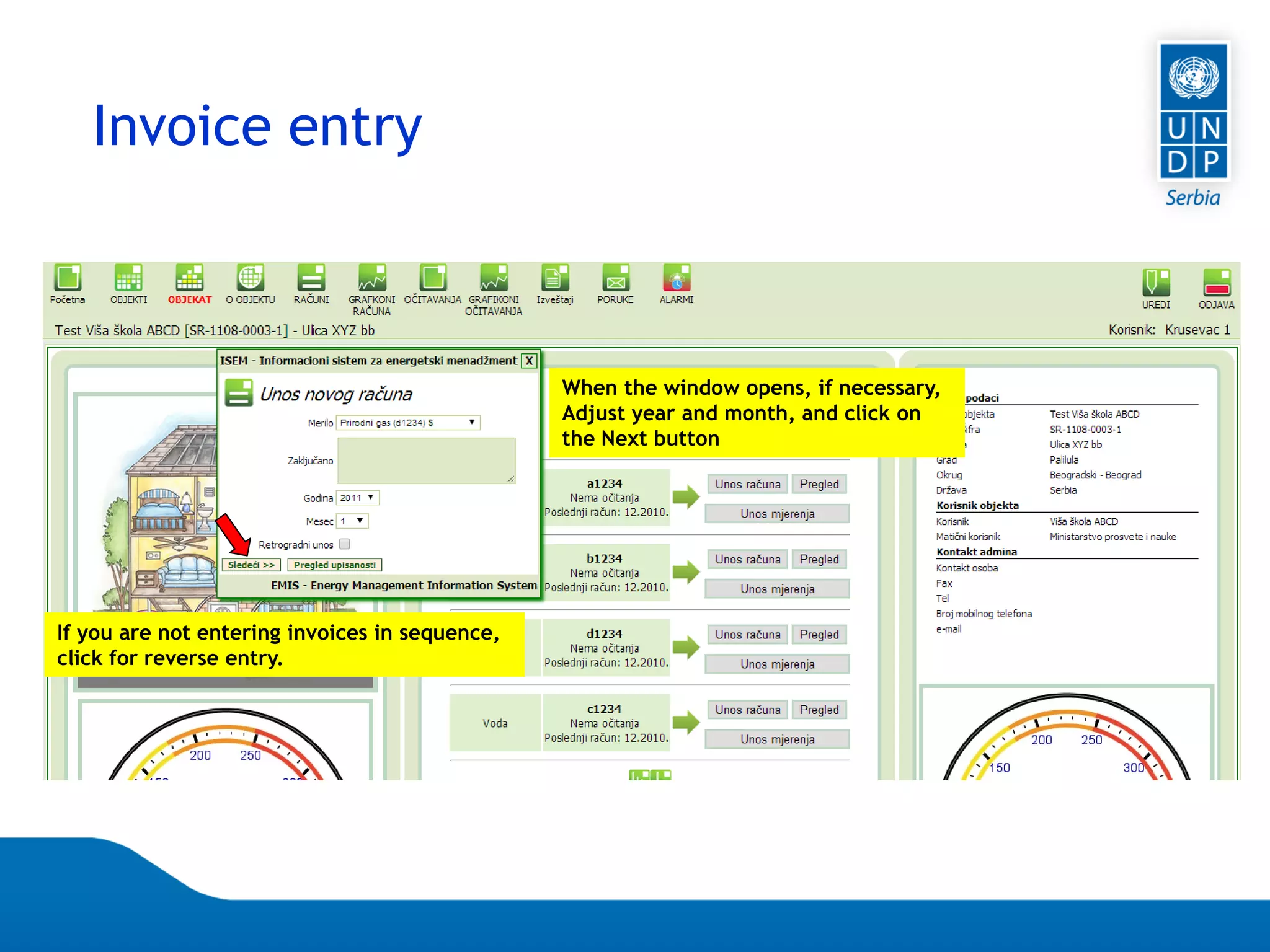
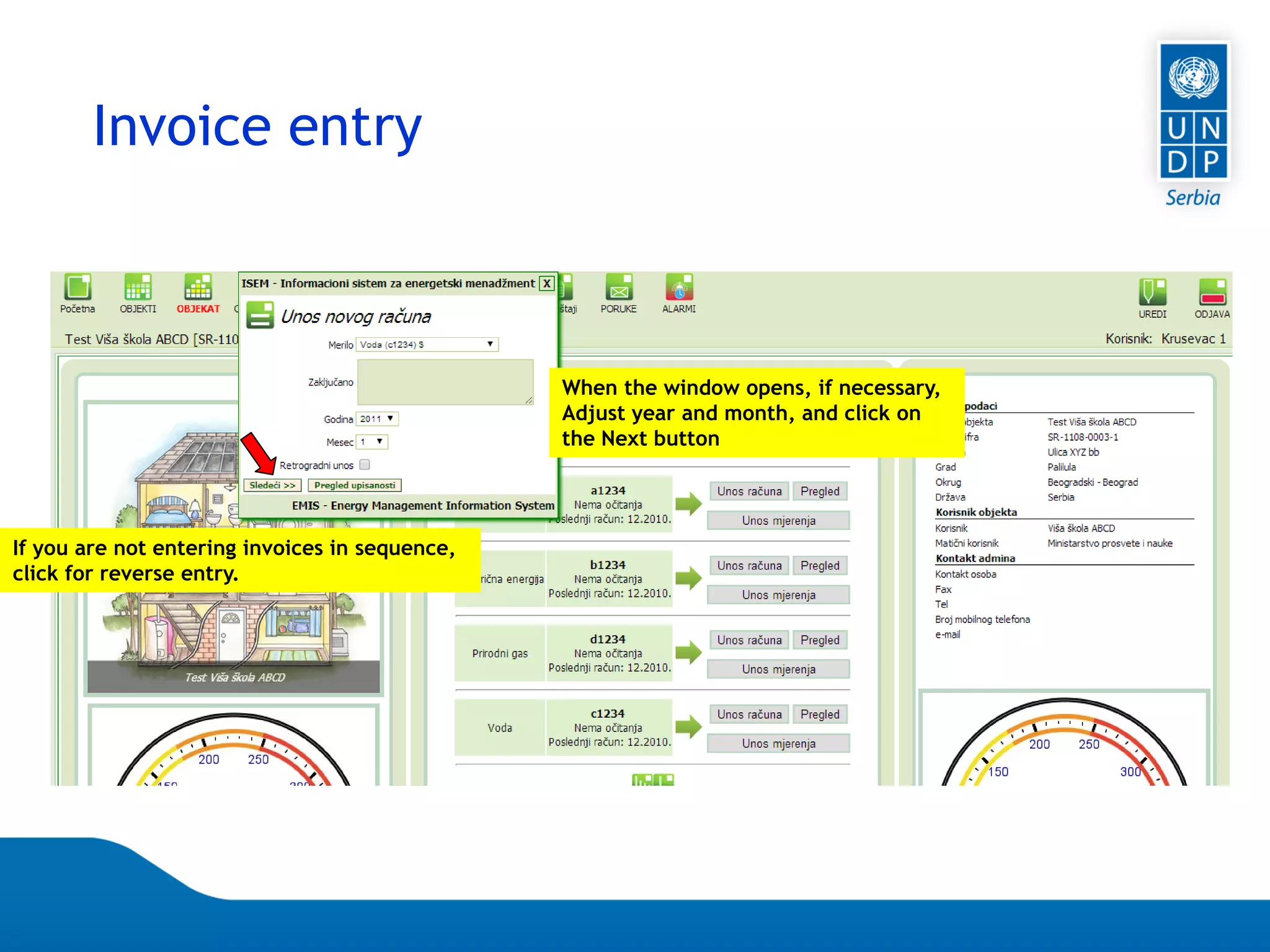
Invoice entry
When the window opens, if necessary,
Adjust year and month, and click on
the Next button
If you are not entering invoices in sequence,
click for reverse entry.
Page 83
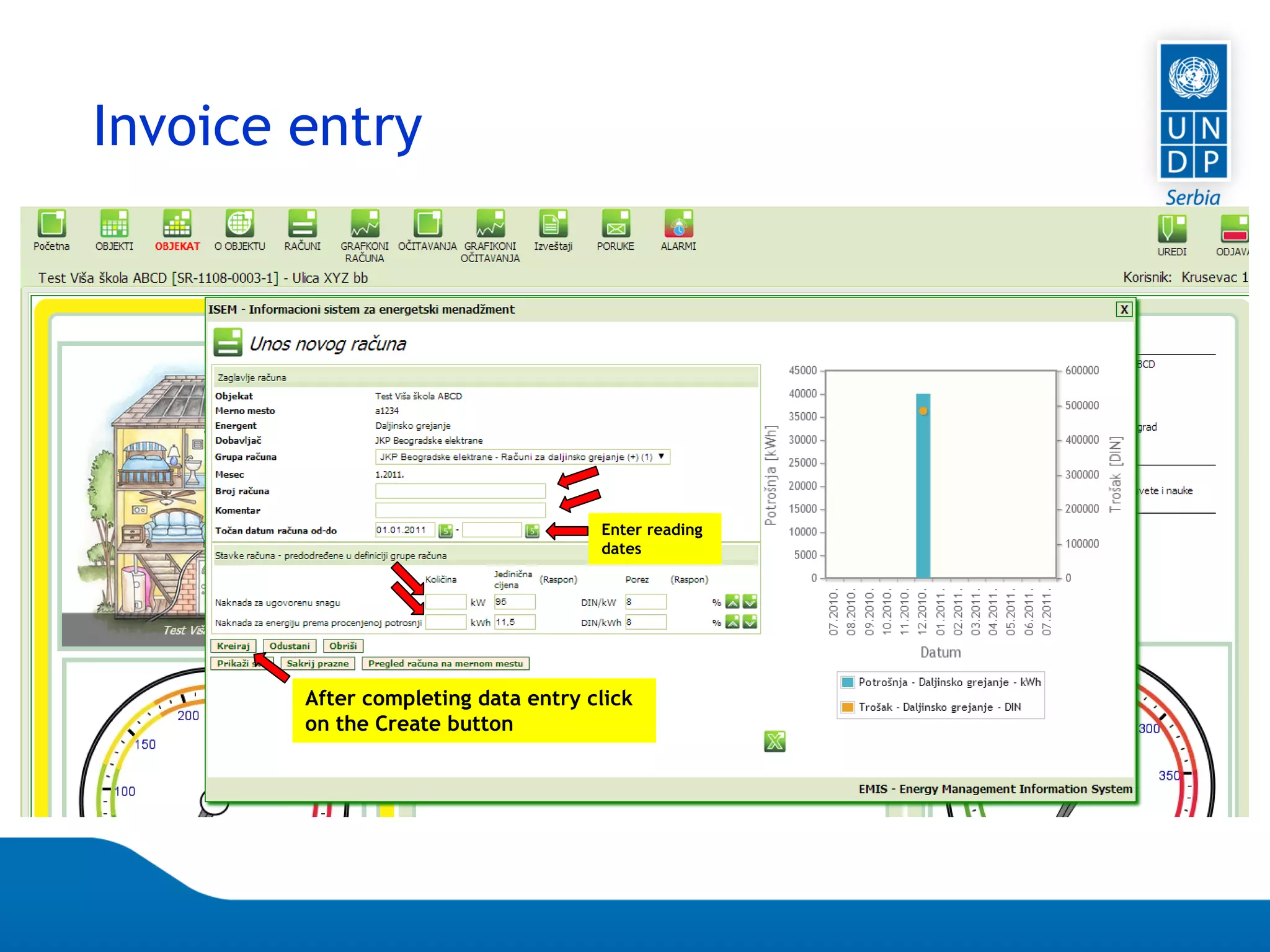
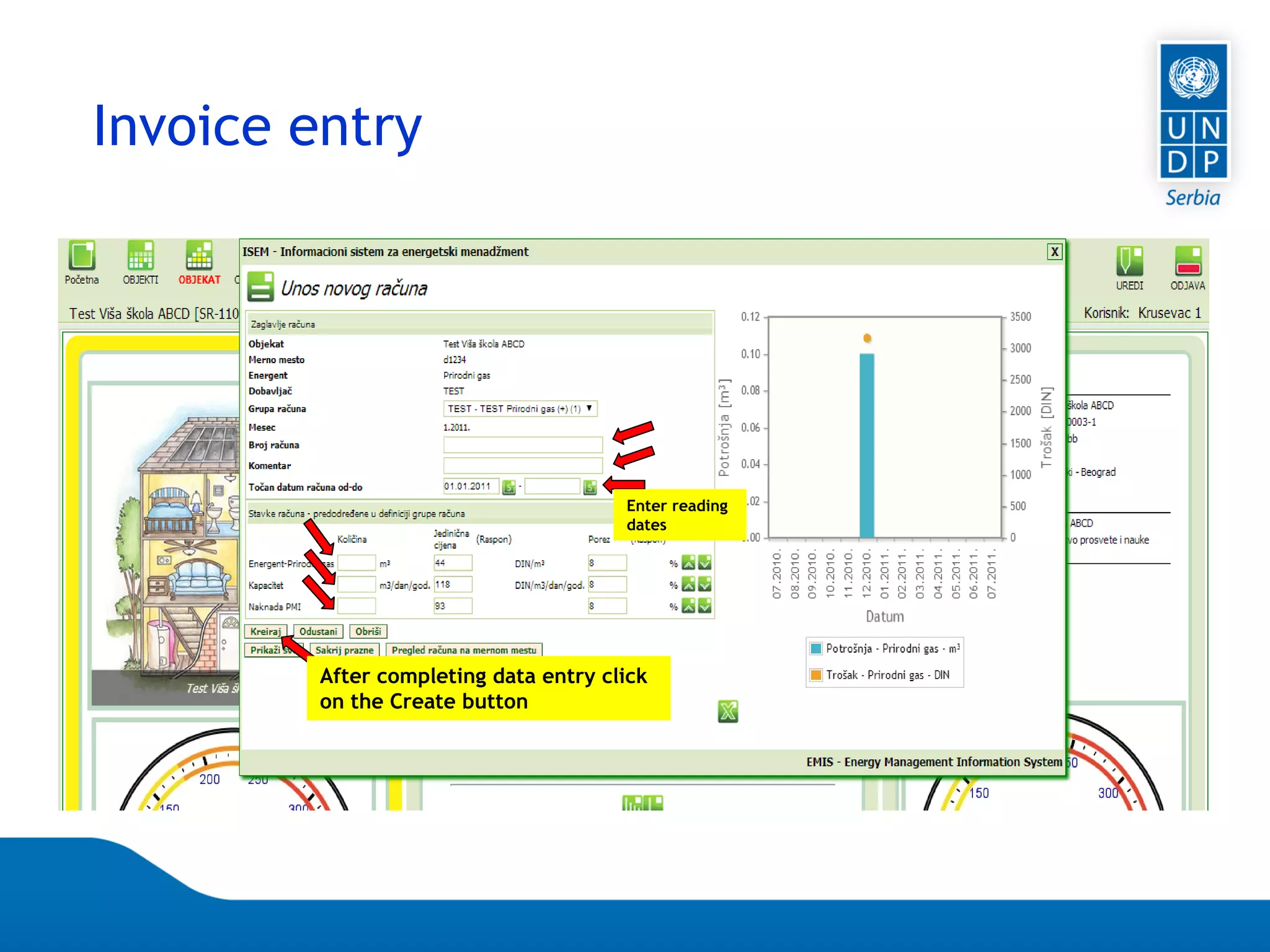
Invoice entry
Enter reading
dates
After completing data entry click
on the Create button
Page 84
Invoice entry
Invoices are entered by repeating the same procedure for each energy
source, starting by clicking the Invoice entry button
Page 85
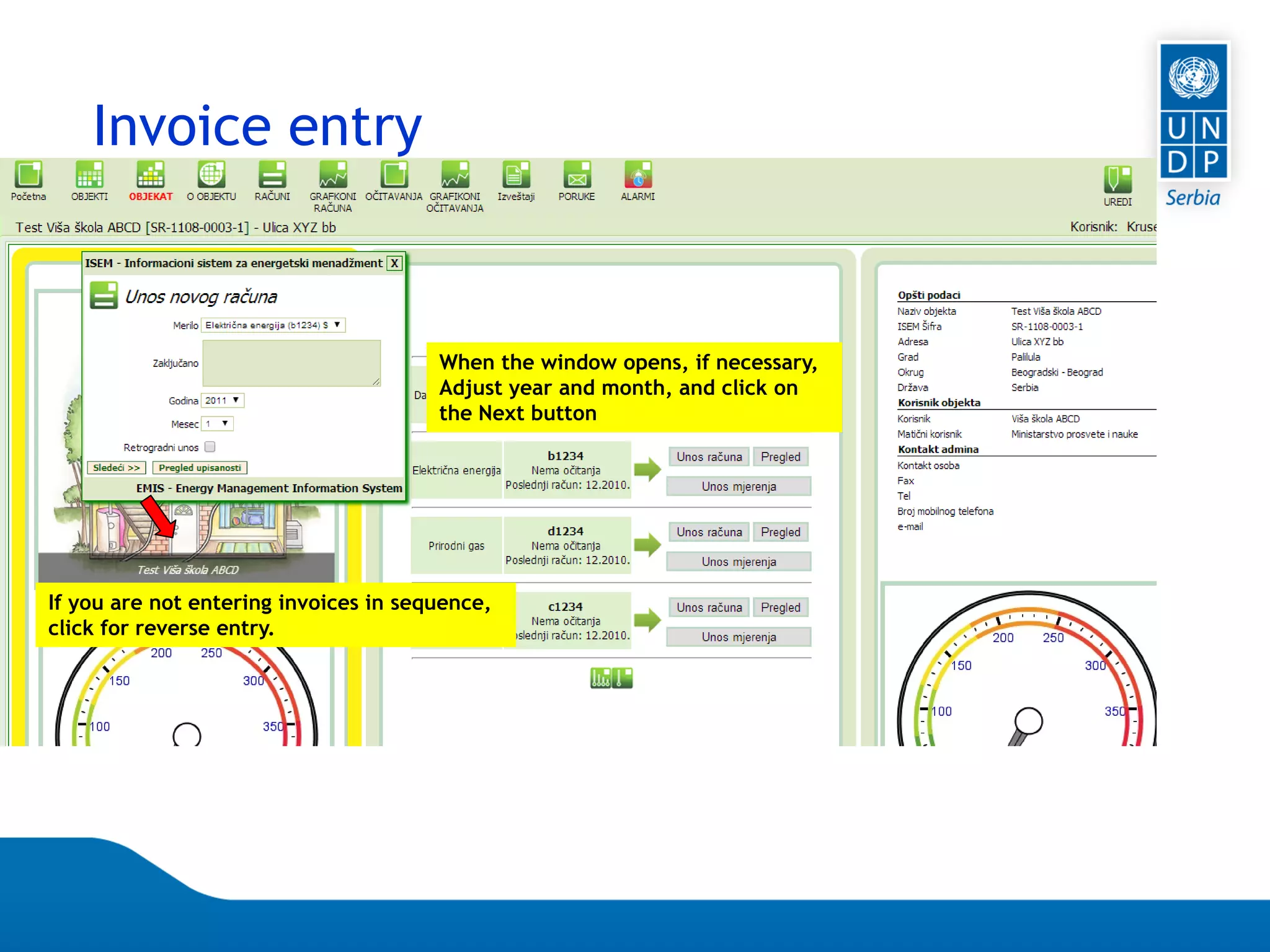
Invoice entry
When the window opens, if necessary,
Adjust year and month, and click on
the Next button
If you are not entering invoices in sequence,
click for reverse entry.
Page 86
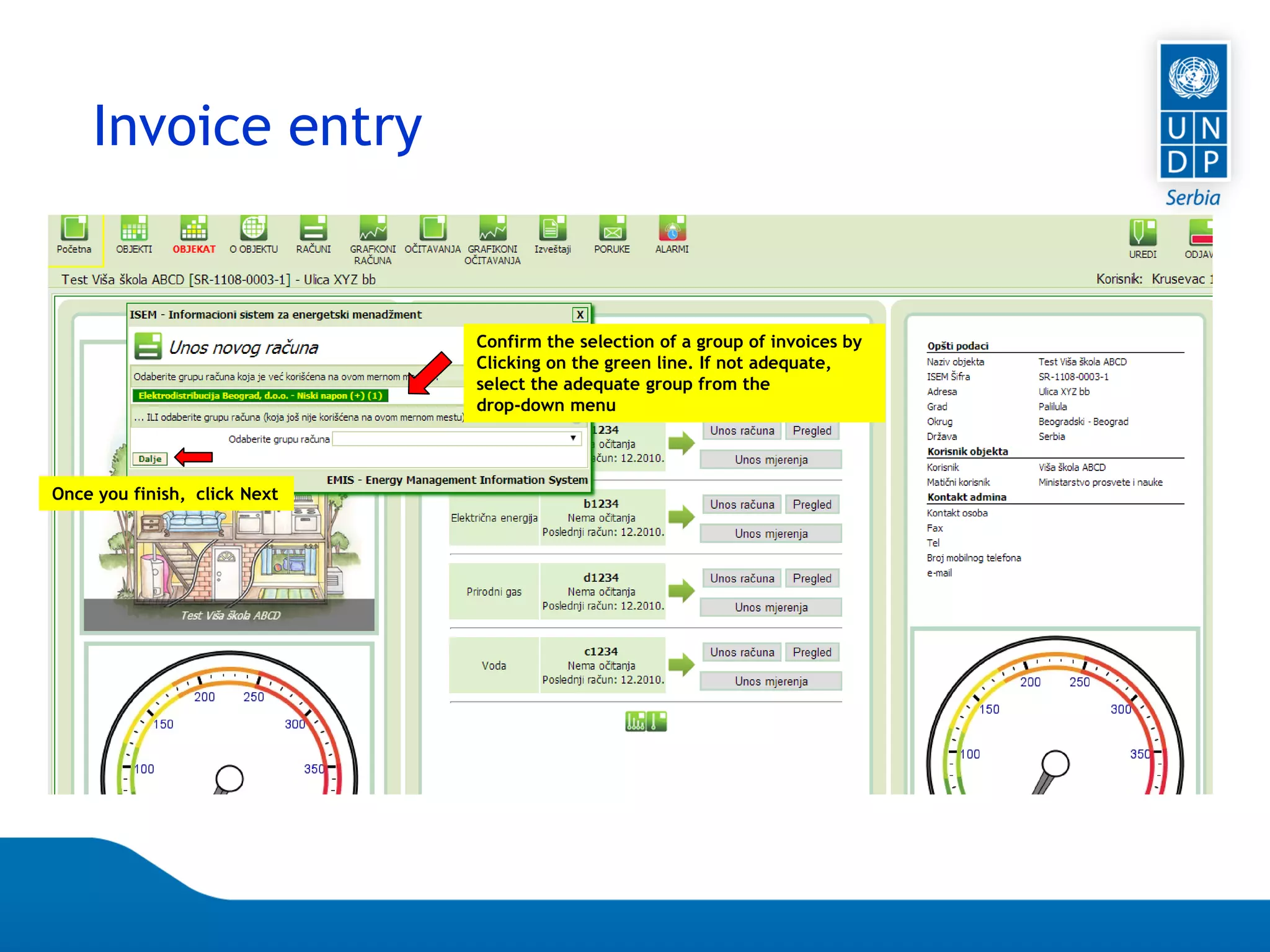
Invoice entry
Confirm the selection of a group of invoices by
Clicking on the green line. If not adequate,
select the adequate group from the
drop-down menu
Once you finish, click Next
Page 87
Invoice entry
Enter reading
dates
After completing data entry click
on the Create button
Page 88
Invoice entry
Page 89
Invoice entry
When the window opens, if necessary,
Adjust year and month, and click on
the Next button
If you are not entering invoices in sequence,
click for reverse entry.
Page 90
Invoice entry
Enter reading
dates
After completing data entry click
on the Create button
Page 91
Invoice entry
Page 92
Invoice entry
When the window opens, if necessary,
Adjust year and month, and click on
the Next button
If you are not entering invoices in sequence,
click for reverse entry.
Page 93
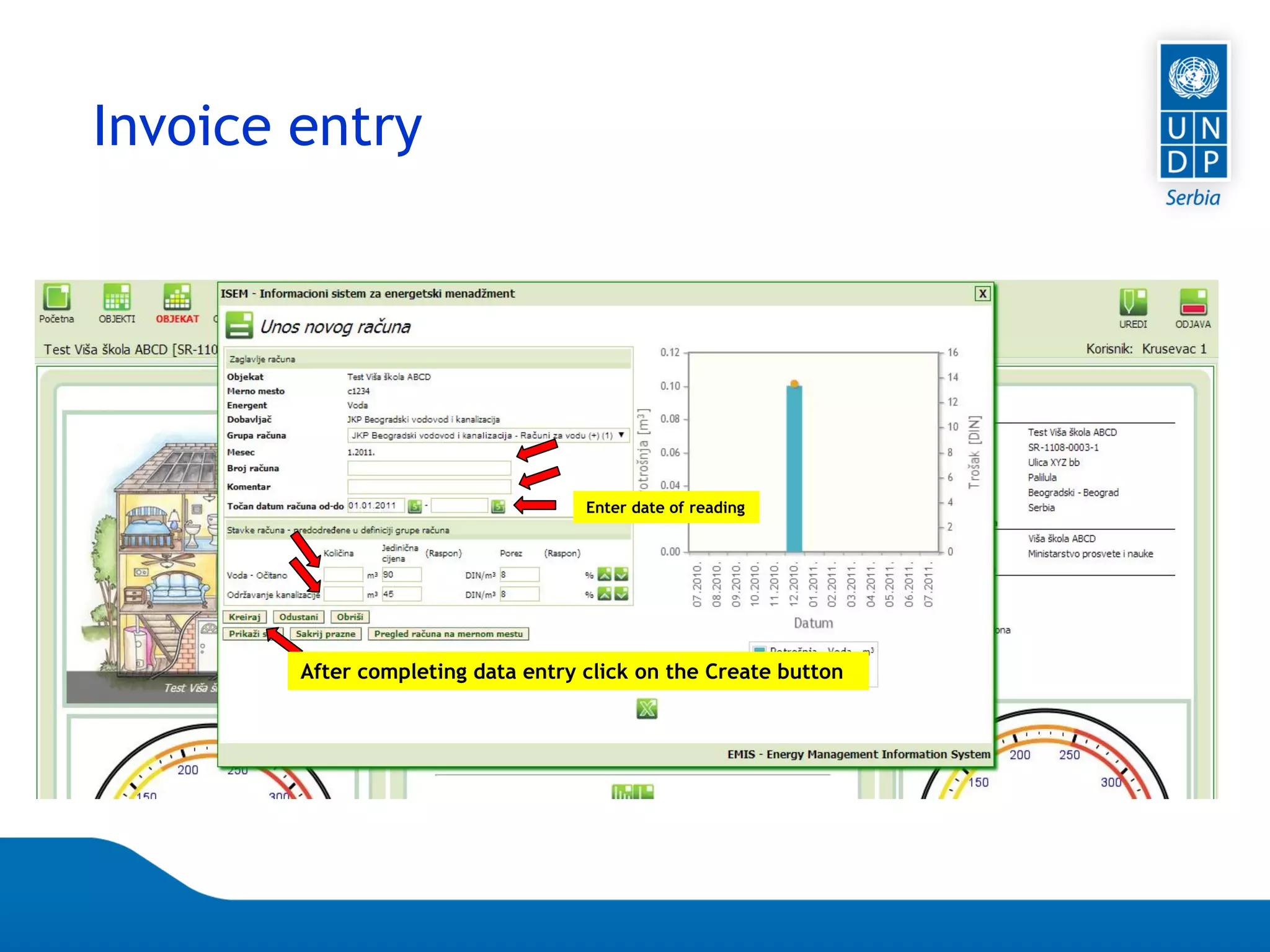
Invoice entry
Enter date of reading
After completing data entry click on the Create button
07.04.2015 Seite 94
Thank you for your attention!
Maja Matejić, MSc.
Portfolio Manager - Energy
United Nations Development Programme
e-mail: maja.matejic@undp.org

Energy management information system in public buildings

  • 1.
    07.04.2015 Seite 1 EMIS– ENERGY MANAGEMENT INFORMATION SYSTEM IN PUBLIC BUILDINGS April 2014
  • 2.
    Page 2 Energy efficiencyin RS – legislative framework Source: Law on Efficient Use of Energy, OG of RS 25/13  The Law on Efficient Use of Energy regulates: • The conditions and manner of efficient energy consumption in the sectors of energy generation, transmission, distribution and consumption; • Efficient energy consumption policies; • Energy management system; • Energy efficiency labeling of products which have impact on energy consumption; • Minimum requirements of energy efficiency in the generation, transmission and distribution of electricity and heat energy and supplying of natural gas; • Financing, incentives, and other measures in this field and other issues relevant for the rights and obligations of natural and legal persons with respect to efficient energy consumption.
  • 3.
    Page 3 Energy efficiencypolicy Source: Law on Efficient Use of Energy, OG of RS 25/13  The key documents determining the policy of efficient energy consumption include: • Energy Sector Development Strategy of the RS; • Programme for implementation of the Energy Sector Development Strategy of the RS; • National Action Plan for Energy Efficiency in the RS; • Programs and plans of energy efficiency adopted by local governments; • Programs and plans of energy efficiency adopted by other mandatory actors within the energy management system.
  • 4.
    Page 4 Source: Lawon Efficient Use of Energy, OG of RS 25/13  Energy management: • The subjects of the energy management system include: the Government, the Ministry, the designated organizations of the energy management system, energy managers and certified energy auditors; • The Government as a subject of the energy management system adopts regulations in the field of efficient energy consumption, at the proposal of the Ministry, and in accordance with the Law on Efficient Use of Energy. The Law on Efficient Use of Energy
  • 5.
    Page 5  Designatedorganizations of the energy management system: • Companies whose core activity is in the manufacturing sector, if they consume more energy than prescribed by the Government; • Companies whose core activity is in the sector of trading and services, if they consume more energy than prescribed by the Government; • Companies whose core activity is in the manufacturing sector, but are not mandatory subjects under the above two items, and posses facilities which jointly consume more energy than prescribed; • Bodies of public administration and other authorities of the Republic of Serbia, authorities of the autonomous province, authorities and bodies of local self-government with a population exceeding 20,000, and other public services using publicly owned buildings. Energy management Source: Law on Efficient Use of Energy, OG of RS 25/13
  • 6.
    Page 6  Designatedorganizations of the system are obliged to: • Achieve the planned targeted energy savings prescribed by the Government; • Appoint the necessary number of energy managers; • Adopt the energy efficiency program and plan and submit them to the Ministry, at its request; • Implement measures for efficient consumption of energy included in the program and the plan; • Notify the Ministry of the person appointed as energy manager and the person authorized on behalf of the subject, apart from the manager, to sign annual reports; • Submit to the Ministry its annual reports on achieving the objectives contained in the program and the plan; • Ensure implementation of energy audits at least once in five years, except when otherwise prescribed by the Law; • Undertake also other activities and measures in compliance with the Law. Energy management Source: Law on Efficient Use of Energy, OG of RS 25/13
  • 7.
    Page 7  Energymanager • natural person appointed by the designated organization, whose obligations are especially to: o Collect and analyze data regarding energy consumption by the subject; o Draft programs and plans prescribed by the Law; o Propose measures which contribute to efficient use of energy and take part in their implementation; o Ensure the preparation of the annual report in accordance with the Law; o Undertake other activities and measures prescribed by the Law. • The tasks of the energy manager can be performed by a person holding the license for energy managers. Energy management Source: Law on Efficient Use of Energy, OG of RS 25/13
  • 8.
    Page 8  By-lawsregulating energy management in more detail: • The Rule Book on the manner of implementation and content of trainign program for energy managers, expenditures for attending the training courses, and detailed conditions, curriculum, and taking of the examination for energy managers, the Official Gazette of RS 12/15 o The above rulebook prescribes the manner in which training is delivered, the content of theoretical and practical training for energy managers, the amount and manner of payment of costs related to energy manager training, and detailed conditions, the curriculum and taking of the examination for energy managers. • The Rule Book on conditions regarding human resources, equipment and premises of organizations delivering training for energy managers and authorized energy advisors, the Official Gazette of RS 12/15 o The above rulebook prescribes details with respect to human resources, equipment and premises of organizations delivering theoretical and practical training for energy managers and authorized energy auditors Energy management
  • 9.
    Page 9 About theProject Introducing the Energy Management Information System - EMIS (Serb. ISEM) in public buildings  National partner: The Ministry of Mining and Energy  UNDP donated the developed web-based software application for the monitoring, analysis and reporting on energy and water consumption in public buildings  The Ministry provided the hardware and the system software and, in cooperation with the UNDP, implemented the training for system administrators and the first group of end users.
  • 10.
    Page 10 About theProject  Activities which preceded the Project: • Providing the hardware, the system software and the hosting; • ISEM installation; • Training of system administrators;  Project activities: • Training the pilot group of end users. Training was delivered by the national system administrators; • Adjustments to the ISEM (in parallel with the training); • Technical assistance to end users in collecting data; • Anylysis of collected data and reporting; • Detailed adjustments to the ISEM for long-term use in Serbia.
  • 11.
    Page 11 Obligations ofend users  Obligations of end users of ISEM: • Attending one-day training course; • Establishing cooperation with the mentor who will allocate access to ISEM for the user; • Data collection: o Each participant is expected to collect data about one public building and data about consumption of energy, energy sources, and water for the year 2014. o Source of data: invoices for energy, energy sources, and water. • Introducing ISEM for onward monitoring of consumption of energy, energy sources, and water starting in January 2015.
  • 12.
    Page 12 UNDP Systemadministrators  Maja Matejić, MSc. Portfolio Manager - Energy United Nations Development Programme Tel. 011 2040 449 e-mail: maja.matejic@undp.org  Miloš Krivokuća, BSc. ICT Associate – Head of ICT Unit United Nations Development Programme Tel: 011 2040 488 e-mail: milos.krivokuca@undp.org Support to end users
  • 13.
    Page 13 ISEM What isthe purpose of ISEM? It is the basic tool for energy management in public buildings and municipalities Basic function  Collecting data on actual energy and water consumption in public buildings  Establishing a national data base on energy and water consumption in public buildings
  • 14.
    Page 14 How isdata collected? Manually  By entering data from invoices for energy (electricity, gas, district heating), energy sources (gas, coal, fuel-oil, crude, firewood, etc.) and water;  By entering data read from meters and counters; Automatically  By importing data from relevant meters and counters equipped for remote reading. ISEM
  • 15.
    Page 15 ISEM ISEM –Serbia, http://isem.undp.org.rs/ ISGE – Croatia, www.isge.hr www.energetska-efikasnost.undp.hr
  • 16.
    Page 16 ISEM –Online metering
  • 17.
    Page 17 ISEM –Online metering Faculty of Mechanical Engineering in Belgrade
  • 18.
    Page 18 ISEM The purposeof ISEM?  Recording public buildings and relevant data concerning buildings;  Analysis of energy and water consumption;  Calculation of energy indicators for public buildings and comparison with buildings of the same category in the country and abroad;  Recording undertaken energy efficiency measures in public buildings and monitoring their actual performance;  Identification of energy efficiency projects;  Development of energy efficiency projects;  Raising awareness of and promoting energy efficiency.
  • 19.
    Page 19 ISEM connectedto EE Panel https://eepanel.isge.hr/client/HR-10000-0296-1/Pclient.html
  • 20.
    Page 20 ISEM connectedto the web portal
  • 21.
    Page 21 ISEM connectedto EE Panel Faculty of Mechanical Engineering in Belgrade
  • 22.
  • 23.
    Page 23 ISEM Why isit important?  It enables us to know the actual consumption of energy and water by a public building and the price for it;  It enables identification of acute problems (excessive energy consumption or water losses) and taking of corrective actions;  It enables management of energy and water budgets for public buildings;  Provides the basis for project preparation in order to apply for funding from different sources;  Provides the basis for designing of public procurement for energy and energy sources;  Provides the basis for contracting performances, or ESCO projects.
  • 24.
    Page 24 Which buildingsis ISEM intended for? 1. Buildings falling within the competences of local self-governments (schools, kinder-gartnes, municipal administrative buildings, sports centers, primary health care centers, PUC’s buildings, etc.); 2. Buildings falling within the competences of national authorities (buildings of public administration, courts, hospitals, gerontology centers, faculties, students’ dormitories, military barracks, prisons, PUC’s buildings, etc.); 3. Buildings falling within the competences of indirect budget beneficiaries; 4. Buildings falling within the competences of other organizations and public companies; 5. ISEM can also be used for commercial buildings!!! ISEM
  • 25.
    Page 25  Theadjustments are underway for the use of the software in Serbia, covering: • Adjusting the terminology; • Changing the geo-administration; • Changing the categorization of buildings; • Changing the names in the hierarchy of users; • Entering data on users of public buildings in Serbia; • Entering data on suppliers of energy and water from Serbia; • Entering data on meteo-stations in Serbia, etc.  The ISEM still does not have sufficient data for all training courses which are necessary and therefore ISGE is used for demonstration on the software operation ISEM in Serbia = ISGE in Croatia
  • 26.
    Page 26 ISEM –User hierarchy ISEM hierarchy Serbia: 1. National system administrator 2. Energy manager 3. Energy administrator – local decision maker 4. User 5. Guest ISGE hierarchy Croatia: 1. National system administrator 2. Energy administrator 3. Energy manager – local decision maker 4. User 5. Guest =
  • 27.
    Page 27 ISEM –http://isem.undp.org.rs/
  • 28.
    Page 28 ISGE –www.isge.hr
  • 29.
    Page 29 ISGEBIH –www.isge.ba/ISGEBIH3
  • 30.
    Page 30 Organization ofdata collection in Serbia 2 system administrators (presently UNDP, later MME) En. manager En. manager En. manager En. manager User 1 User 2 User 3 User n User 1 User 2 User 3 User n User 1 User 2 User 3 User n User 1 User 2 User 3 User n
  • 31.
    Page 31  Managesusers • Defines users; • Supervises their work.  Manages buildings • Defines buildings and links them to relevant users; • Defines building users and sources of building financing; • Defines meters, counters, and water meters in buildings; • Defines other measuring systems in buildings.  Develops reports and graphs, performs analyses  Performs geo-administration  Performs energy-administration • Defines energy sources; • Defines suppliers; • Defines energy systems. The role of administrator 1
  • 32.
    Page 32  Performsdata entry on buildings • General data; • Structural data; • Data on systems consuming energy or water; • Energy data; • Documents.  Performs data entry for energy, energy sources, and water.  Performs entries from reading from meters, counters or water meters, or the relevant parameters such as user number, indoor temperature, etc.  Performs basic analyses and generates basic reports. The role of users
  • 33.
  • 34.
    Page 34 Building definition Basicuser User Sub-user Region District Municipality Meters and counters Energy sources Suppliers HM observatory Address Energy systems within buildings Building structural characteristics Person in charge of building ISEM user ISEM
  • 35.
    Page 35  Energycost centre (ETC) is a functional unit, or building or part thereof, for which it is possible to measure the relevant energy and water consumption and other parameters affecting consumption.  ETC is the subject of monitoring and discussion in ISEM Energy cost centers
  • 36.
    Page 36 Energy costcenters Stand-alone building Complex of buildings Section of building Building inside a complex
  • 37.
    Page 37 Energy costcenters Energy cost centers 2
  • 38.
    Page 38 Territorial organizationof the Republic of Serbia  4 regions  24 districts  169 municipalities Geo-administration
  • 39.
    Page 39 Serbia  SR-xyzw-pqrs-k SR – Serbia  xyzw – municipality:  x=1-4 Region  y=1-9 Serial number of district within region  zw = Serial number of municipality within region  pqrs – serial number of building within ISEM  k=0 – Complex  k>0 – Serial number of building within complex Example: SR-2707-1234-1 Stand-alone building in Stara Pazova entered in ISEM under serial number 1234 Geo-administration 3
  • 40.
    Page 40 Geo-administration Examples Example 1:SR-2707-1234-1 Stand-alone building in Stara Pazova, with measuring points for the whole building entered in ISEM under serial number 1234 for Stara Pazova Example 2: SR-1112-1100-1-A Part of stand-alone building in Belgrade, in city Municipality Vračar, with separate measuring points for that section of the building entered into ISEM under serial number 1100 for Belgrade 4
  • 41.
    Page 41 Geo-administration Examples Example 3: SR-3504-1200-0 Complexof buildings in Kruševac, entered in ISEM under serial number 1200 for Kruševac. A complex can be with or without common measuring points for the whole complex SR-3504-1200-1 Building number 1 within a complex SR-3504-1200-0 in Kruševac entered under number 1200. A building can and need not have its own measuring points. SR-3504-1200-2 Building number 2 within a complex of buildings SR-3504-1200-0 in Kruševac entered in ISEM under number 1200. A building can and need not have its own measuring points.
  • 42.
    Page 42 Buildings nomenclature Classificationof buildings in Serbia: A. Buildings of educational institutions B. Health care institutions C. Collective accommodation buildings D. Buildings of institutions of culture E. Sports buildings F. Administrative buildings G. Public transport buildings H. Hospitality buildings I. Buildings of public companies or PUC J. Other
  • 43.
    Page 43 Buildings nomenclature Codefor Type of group of building Type of group of building Code of Type of building Type of building Group of building 1 letter character Description Sub-group of buildings 2 characters (numerical) Description A Buildings of educational institutions 01 ---> Kinder-gartens / nurseries 02 ---> Elementary schools 03 ---> Secondary schools 04 ---> Colleges 05 ---> Faculties 06 ---> Special schools 99 ---> Other B Health care institutions 01 ---> Infirmaries 02 ---> Primary health care centers 03 ---> Clinics 04 ---> Hospitals 05 ---> Stationary infirmaries 06 ---> Clinical centers 07 ---> Pharmacies 99 ---> Other
  • 44.
    Page 44 Buildings nomenclature Codefor Type of group of building Type of group of building Code of Type of building Type of building Group of building 1 letter character Description Sub-group of buildings 2 characters (numerical) Description C Collective accommodation buildings 01 ---> Homes for fireigners 02 ---> Students and pupils dorms 03 ---> Homes for children 04 ---> Correctional homes ---> Penitentiaries ---> Barracks 99 ---> Other D Buildings of institutions of culture 01 ---> Cultural centers 02 ---> Cinemas 03 ---> Theatres 04 ---> Museums 05 ---> Libraries 99 ---> Other
  • 45.
    Page 45 Buildings nomenclature Codefor Type of group of building Type of group of building Code of Type of building Type of building Group of building 1 letter character Description Sub-group of buildings 2 characters (numerical) Description E Sports buildings 01 ---> Sports centers 02 ---> Outdoor swimming pools 03 ---> Indoor swimming pools 04 ---> Sports arenas 05 ---> Stadiums 06 ---> Skating rings 99 ---> Other F Administrative buildings 01 ---> Sub-municipal offices 02 ---> Municipal admin. Buildings 03 ---> City admin. Buildings 04 ---> Public admin. Buildings 05 ---> Courts 06 ---> Police 99 ---> Other
  • 46.
    Page 46 Buildings nomenclature Codefor Type of group of building Type of group of building Code of Type of building Type of building Group of building 1 letter character Description Sub-group of buildings 2 characters (numerical) Description G Public transport buildings 01 ---> Bus stations ---> Railway stations ---> Airports 99 ---> Other H Hospitality buildings 01 ---> Kitchens 02 ---> Restaurants 03 ---> Resorts 04 ---> Motels 05 ---> Hotels 06 ---> Hostels 99 ---> Other I PUC buildings 01 ---> Manufacturing parts of PUC 02 ---> Admin. Parts of PUC 99 ---> Other Z Other 01 ---> Other 99 ---> Other 5
  • 47.
    Page 47 Hierarchy ofbuilding users TYPE OF ORIGINAL USER ORIGINAL USER BUILDING USER BUILDING SUB-USER Who provided the budget for operational costs of the building In charge of the building Type of budget
  • 48.
    Page 48 Types oforiginal users of buildings Code of user Type of user O Municipality G City REP Republic POK Province JKP Public Utility Company JP Public Company INST Other institutions ORG Organizations KOM Commerical buildings PRIVAT Residential buildings OST Other Type of original user is defined by the budget from which the building’s operational costs are financed 6
  • 49.
    Page 49 Original buildinguser Original building user is defined by the budget line funding the operational expenditures of the building Type of user Name of original user Municipality Kruševac City of Belgrade City Secretariate for Education City Secretariate for Culture Republic Ministry nr. 1 Ministry nr. X Republic Republic Directorate nr. X Republic Republci Agency nr. X Province Provonciapl Secretariate nr.1 Province Provonciapl Secretariate nr. X Public utility company PUC Belgrade district heating Public utility company PUC XYZ Public company PC EPS Public company PC XYZ Other institutions Serbian Chanber of Commerce Organizations Serbian Auto-Moto Association Commercial buildings Insurance company ABC Housing buildings Family home owned by Marko Marković Other Something 7
  • 50.
    Page 50 Users andsub-users under original buildings user The building user is the actual user of the building, such as Primary School “Ivo Andrić”, Faculty of Technology, Primary health care centre “Vračar” etc. Sub-use is the user of a part of the building or user of one of the buildings belonging to the user. Example: regional units of original schools, local health clinics, sub-municipal administrative offices, local facilities of public companies, or facilities leased by the user.
  • 51.
    Page 51 1. Facultyof Mechanical Engineering Belgrade Type of original user: the Republic Original user: the Ministry of Education and Science User: the Faculty of Mechanical Engineering Belgrade Republic / Ministry of Education and Science / Faculty of Mechanical Engineering 2. Elementary School “Vuk Karadžić” in Stepojevac, unit in village Vrbovno Type of original user: City of Belgrade Original user: City Secretariat of Education User: Elementary School “Vuk Karadžić” Sub-User: Regional unit in village Vrbovno City of Belgrade / City Secretariat of Education / Primary School “Vuk Karadžić / unit Vrbovno Examples of hierarchy of users 8
  • 52.
    07.04.2015 Seite 52 Typesof data: Static – slow changing: Specific, non-technical and technical data defining the building Result:  Inventory of public consumption buildings Dynamic – fast changing: Data on energy or energy sources consumption on monthly, weekly and daily level and relevant data defining the intensity of operations in the building Result:  Energy balance of the specific public consumption building and  Energy efficiency indicators of the specific public consumption building Data collection, monitoring and analysis
  • 53.
    07.04.2015 Seite 53 Example Slowchanging data:  Region, district, municipality;  Address of the building;  Buildings within building;  Building owner;  Building user;  Source of funding;  Owner and user persons in charge;  Contact person;  ........... etc. Non-technical data: Data collection, monitoring and analysis
  • 54.
    07.04.2015 Seite 54 Surface area of building;  Number of floors;  Electricity supply (number of electricity meter, type of buyer, category of buyer, etc.);  Heating type (source of heating, energy source, etc.);  Total heated area, total heated volume;  Technical characteristics of the heating system;  Technical characteristics of the lighting system;  Operating processes in the building (food preparation, laundry washing, swimming pool, etc.);  ...... etc. Technical data: Example Slow changing data: Data collection, monitoring and analysis
  • 55.
    07.04.2015 Seite 55 Real operating temperature in the building;  Working hours (number of shifts, etc.);  Annual interruption of operations (vacations, holidays, etc.);  Number of users of the building (permanent and temporary):  Number of pupils and teachers;  Number of employees;  Number of hospital beds, etc.  Intensity of operating process:  Number of meals cooked;  Quantity of laundry washed;  Number of examinations with specialized medical devices;  .... etc. Data about operations in the building: Example Fast changing data: Data collection, monitoring and analysis
  • 56.
    07.04.2015 Seite 56 Invoices for electricity / gas / district heating / water (all tariff elements) in kWh/kVArh/m3/KJ;  Reading of meters and counters;  Data on energy supply:  Type of energy sources;  Quality of energy sources (heat value);  Supplier;  Quantity in t/m3;  Date of delivery;  Stocks;  Etc. Data on energy and water consumption: Example Fast changing data: Data collection, monitoring and analysis
  • 57.
    Page 57 Stand-alone building ISEM– Definition of buildings • Collect the bills for all energy sources and water for all measuring pints for the building for the period January – December 2014. • Scan a copy of the bills for all energy sources and water and send to mentor. • In case there are more measuring points per any energy source or water state the id. number of the meter and describe the consumption it measures (for which part of the stand-alone building). • Determine if any payment is collected on flat rate or pre-determined percentage basis. • In case of flat rate collection define the relevant surfaces.
  • 58.
    Page 58 ISEM –Definition of buildings Complex of buildings • Determine the number of stand-alone buildings in the complex. • Determine the total number of measuring points for all energy sources and water. • Determine the id. number of every meter and the consumption it measures (for which buildings, or parts thereof). • Determine if any payment is collected on flat rate or pre- determined percentage basis. • In case of flat rate collection define the relevant surfaces. • The rest should be the same as for stand-alone buildings.
  • 59.
    Page 59 ISEM –Definition of buildings Part of stand-alone building • Define the stand-alone building. • Determine the number of measuring points for all energy sources and water. • Determine the id. number of every meter and the consumption it measures (for which parts of the building). • Determine if any payment for any part is collected on flat rate or pre-determined percentage basis. • In case of flat rate collection define the relevant surfaces. • The rest should be the same as for stand-alone buildings.
  • 60.
    07.04.2015 Seite 60 Electricity As of 1 January 2013, only final consumers of electricity whose buildings are connected to the distribution system are entitled to public supply. Buyers connected to the transmission network are no longer entitled to be supplied at regulated prices.  As of 1 January 2014, only households and small buyers of electricity are entitled to public supply. Apart from buyers connected to the transmission network, also buyers connected to the distribution system (except for households and small buyers) are no longer entitled to be supplied at regulated prices.  As of 1 January 2015, apart form the right to public supply, households are entitled to freely choose the supplier on the market.
  • 61.
    07.04.2015 Seite 61 Electricity Small buyers of electricity are final buyers (legal persons and entrepreneurs) if they have less than 50 employees, total annual turnover up to Euro 10 million in RSD equivalent, and those whose all buildings are connected to the electricity distribution system of voltage up to 1kV.  Public supply is the sale of electricity to households and small buyers at regulated prices.  Buyers who are not entitled to public supply shall buy electricity from licensed suppliers in the free market.  Currently in Serbia there are 89 licensed electricity suppliers.
  • 62.
    07.04.2015 Seite 62 Invoicefor electricity Elements  Fee for access to electricity distribution system • Tariff elements: o Buyers at low or medium voltage (approved power, excessive power taken, active energy higher and lower daily tariff rate, reactive energy and excessive reactive energy taken over). o Consumer spending:  One-tariff metering (accounting demand and active energy);  Two-tariff metering (accounting demand, active energy higher and lower daily tariff rate).  Compensation for electricity consumption according to price determined in (public) procurement of electricity.
  • 63.
  • 64.
    07.04.2015 Seite 64 Electricityinvoice – public supply  Buyers at low voltage – tariff elements include 1. Accounting demand The monthly maximum active power is determined by metering and represents the maximum average 15-minute value of active power during the period of calculation. Tariff elements for maximum active power are accounting demand and excessive demand.. 2. Active energy The tariff element active energy is determined at the higher and lower daily tariff rate. The higher rate is applicable for energy taken over between 07-23 h (08-24 h in summer), and the lower between 23-07 h (00-08h in summer). 3. Reactive energy The tariff element reactive energy is determined by tariff elements reactive energy and excessive reactive energy. The tariff element reactive energy is applied if the power factor for the calculation period is greater than or equal to 0.95 and it applies to the quantity of measured reactive energy. Excessive reactive energy is the positive balance between the actually taken reactive energy and reactive energy equivalent to power factor of 0.95. The tariff element reactive energy is not determined on the basis of higher or lower daily level although it is often so stated in the invoices for electricity. 4. Costs of public supplier
  • 65.
    07.04.2015 Seite 65 Electricityinvoice – public supply  Consumer spending– single tariff metering, group 2 – public and common consumption or group 3 – other commercial consumption; the tariff elements include: 1. Accounting demand It is calculated for the calendar month according to the approved demand, or the peak load determined for the buyer’s connection to the system, as defined in the electric- energy permit and is expressed in kilowatt (kW). 2. Active energy The tariff element active energy is determined based on three tariff elements: 1.Tariff element for rational consumption up to 350 kWh, the „green zone“, 2.Tariff element for moderate consumption from 350 kWh to 1600 kWh, the „blue zone“, and 3.Tariff element for high consumption exceeding 1600 kWh, the „red zone“ For buyers from the category general consumption, group public and joint consumption, only tariff elements 1 and 2 are applicable 3. Costs of public supplier
  • 66.
    07.04.2015 Seite 66 Electricityinvoice – public supply  General consumption – two-tariff metering, group 2 – public and common consumption or group 3 – other commercial consumption; the tariff elements include 1. Accounting demand It is calculated for the calendar month according to the approved demand, or the peak load determined for the buyer’s connection to the system, as defined in the electric- energy permit and is expressed in kilowatt (kW). 2. Active energy The tariff element active energy is determined on the basis of the three tariff elements, both with lower and higher daily rates: 1.Tariff element for rational consumption up to 350 kWh, the „green zone“, 2.Tariff element for moderate consumption from 350 kWh to 1600 kWh, the „blue zone“, and 3.Tariff element for high consumption exceeding 1600 kWh, the „red zone“ For buyers from the category general consumption, group public and common consumption, only tariff elements 1 and 2 are applicable 3. Costs of public supplier
  • 67.
    Page 67  Asof February 2013 a fee for incentives for renewable energy sources is applicable to all categories of buyers; the amount of the fee until 13 January 2014 was RSD 0.044 /kWh, and as of 13 January 2014 it is RSD 0.081/kWh of consumed electricity Electricity
  • 68.
    Page 68 Prices forelectricity – tariff buyers
  • 69.
    07.04.2015 Seite 69 Gassupply The tariff system has 3 categories of buyers 1. Buyers with connection to the natural gas distribution system at a point of delivery with operating pressure lower than 6 bar (Category 1): 1.1 Households – natural persons 2.1 Other buyers – legal persons 2. Buyers with connection to the natural gas distribution system at a point of delivery with operating pressure greater than 6 bar but lower than 16 bar (Category 2): 2.1 District heating systems – including heat energy producers who use natural gas only for heat generation 2.2 Balanced consumption – including buyers who in the period from 1 October of preceding year to 1 April of the current year consume less than 70% of the total delivered amount of gas delivered in the period from 1 October of preceding year to 1 October of the current year. 2.3 Unbalanced consumption – buyers who, in the period from 1 October of preceding year to 1 April of the current year consume at least 70% of the total delivered amount of gas delivered in the period from 1 October of preceding year to 1 October of the current year.
  • 70.
    07.04.2015 Seite 70 Thetariff system has 3 categories of buyers 3. Buyers with connection to the natural gas transport system (Category 3) 3.1 District heating systems – including heat energy producers who use natural gas only for heat generation. 3.2 Balanced consumption – including buyers who in the period from 1 October of preceding year to 1 April of the current year consume less than 70% of the total delivered amount of gas delivered in the period from 1 October of preceding year to 1 October of the current year. 3.3 Unbalanced consumption – buyers who, in the period from 1 October of preceding year to 1 April of the current year consume at least 70% of the total delivered amount of gas delivered in the period from 1 October of preceding year to 1 October of the current year. Gas supply
  • 71.
    07.04.2015 Seite 71 Tariffelements: 1. Capacity The capacity of a tariff buyer is determined at each point of delivery as maximum daily consumption at that point during the preceding year and is expressed as m3/day/year (m3 of natural gas of heat power 33,33835 MJ/m3 at 288.15 K and pressure (1.01325 bar). 2. Energy source The tariff element energy source per buyer is defined as quantity of gas determined by measurement at the point of delivery in the calculation period. It is expressed in m3. 3. Delivery point Tariff element delivery point shall be established as number of delivery points on which the retailer sells natural gas. The Decree amending the Decree on conditions for delivery of natural gas („Official Gazette of RS“ Nr. 3/10 ) prescribes the calculation determining the delivered volume (quantity) of natural gas relative to standard balance. The Energy Agency has prescribed the methodology for calculating the volume of natural gas to standard conditions for measuring points without the integrated corrector. Gas supply
  • 72.
  • 73.
    Page 73 Water supply Water supply is a public utility activity;  Serbia has about 150 water supply systems of different sizes;  Local governments are in charge of water prices and manner of collecting payment for supplied water;  Collection of payments is based on measured quantities of supplied water;  Many local governments also provide sewerage services for which payment is collected based on measured quantities of supplied water.
  • 74.
  • 75.
    Page 75 District heating District heating is public utility and energy activity;  Local governments are in charge of prices and manner of collecting payment for delivered heat energy. The Ministry of Mining and Energy prescribes the maximum price for heat energy.  Colelction is done:  Flat rate, based on number of heated m2 or  Based on consumption measured by calorymeters;  According to the Law on Efficient Use of Energy, as of 1 January 2015, all district heating systems are obliged to move to collecting payment for delivered heat energy based on measured consumption.
  • 76.
  • 77.
  • 78.
    Page 78 Invoice entryhttp://isem.undp.org.rs/ Enter your user name and password Received from your mentor
  • 79.
  • 80.
  • 81.
    Page 81 Invoice entry Invoicesare entered by repeating the same procedure for each energy source, starting by clicking the Invoice entry button
  • 82.
    Page 82 Invoice entry Whenthe window opens, if necessary, Adjust year and month, and click on the Next button If you are not entering invoices in sequence, click for reverse entry.
  • 83.
    Page 83 Invoice entry Enterreading dates After completing data entry click on the Create button
  • 84.
    Page 84 Invoice entry Invoicesare entered by repeating the same procedure for each energy source, starting by clicking the Invoice entry button
  • 85.
    Page 85 Invoice entry Whenthe window opens, if necessary, Adjust year and month, and click on the Next button If you are not entering invoices in sequence, click for reverse entry.
  • 86.
    Page 86 Invoice entry Confirmthe selection of a group of invoices by Clicking on the green line. If not adequate, select the adequate group from the drop-down menu Once you finish, click Next
  • 87.
    Page 87 Invoice entry Enterreading dates After completing data entry click on the Create button
  • 88.
  • 89.
    Page 89 Invoice entry Whenthe window opens, if necessary, Adjust year and month, and click on the Next button If you are not entering invoices in sequence, click for reverse entry.
  • 90.
    Page 90 Invoice entry Enterreading dates After completing data entry click on the Create button
  • 91.
  • 92.
    Page 92 Invoice entry Whenthe window opens, if necessary, Adjust year and month, and click on the Next button If you are not entering invoices in sequence, click for reverse entry.
  • 93.
    Page 93 Invoice entry Enterdate of reading After completing data entry click on the Create button
  • 94.
    07.04.2015 Seite 94 Thankyou for your attention! Maja Matejić, MSc. Portfolio Manager - Energy United Nations Development Programme e-mail: maja.matejic@undp.org