Endoderm
Anatomy
Dr. Khayati Santram
Development, Derivatives,
and Clinical Significance
Dr. Khayati Santram
The endoderm is one of the three germ layers
formed during embryonic development. It is
the innermost layer that gives rise to the lining
of the digestive tract, respiratory tract, and
various other organs. In this blog, we will
explore the development of endoderm, its
derivatives, and its clinical significance.
Dr. Khayati Santram
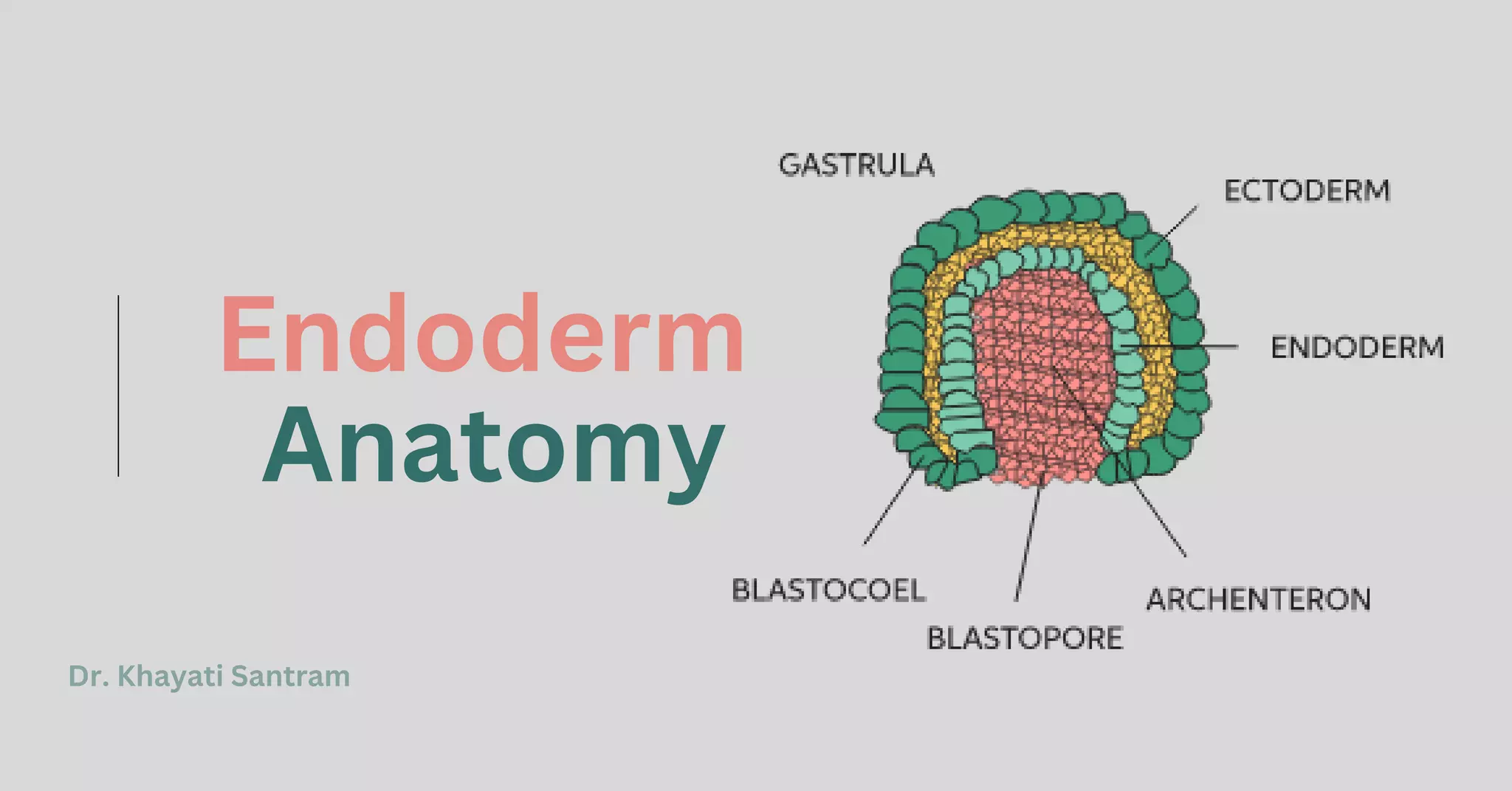
During gastrulation, the cells in the blastula rearrange to
form three germ layers – endoderm, mesoderm, and
ectoderm. The endoderm is formed from the cells that
migrate through the primitive streak and displace the
hypoblast cells. These cells then form a layer that lines
the embryonic yolk sac and the archenteron.
DEVELOPMENT OF ENDODERM
Dr. Khayati Santram
As the embryo develops, the endoderm folds inward to form
the foregut, midgut, and hindgut. The foregut gives rise to
the pharynx, esophagus, stomach, liver, pancreas, and the
upper respiratory tract. The midgut forms the small
intestine, cecum, appendix, ascending colon, and transverse
colon. The hindgut forms the descending colon, sigmoid
colon, rectum, and the anal canal.
Dr. Khayati Santram
The endoderm gives rise to a variety of
organs and tissues, including:
DERIVATIVES OF ENDODERM
Dr. Khayati Santram
Digestive System: The endoderm forms the epithelial lining
of the entire digestive tract, including the pharynx,
esophagus, stomach, small intestine, large intestine, and the
anal canal. It also gives rise to the salivary glands, liver,
gallbladder, and pancreas.
1.
Respiratory System: The endoderm forms the
epithelial lining of the respiratory tract, including the
trachea, bronchi, and lungs.
Endocrine System: The endoderm gives rise to the
thyroid gland, parathyroid gland, and the thymus
gland.
Dr. Khayati Santram
Urinary and Reproductive System: The endoderm
forms the epithelial lining of the urinary bladder and
the urethra. In females, it forms the epithelial lining
of the vagina and the cervix. In males, it contributes
to the epithelial lining of the prostate gland.
Dr. Khayati Santram
Endodermal Sinus Tumor: Endodermal sinus tumor, also
known as yolk sac tumor, is a rare type of tumor that
usually occurs in the ovaries or testes. It arises from the
remnants of the yolk sac, which is a structure that
forms during embryonic development and gives rise to
the endoderm.
CLINICAL SIGNIFICANCE
Dr. Khayati Santram
Anomalies of the Digestive System: Malformations of the
digestive system can occur due to abnormalities in the
development of the endoderm. For example, esophageal
atresia is a condition where the esophagus does not develop
properly, and there is a gap between the upper and lower
parts of the esophagus.
Dr. Khayati Santram
Endocrine Disorders: The endocrine glands that arise
from the endoderm can be affected by various
disorders. For example, hypothyroidism occurs when
the thyroid gland does not produce enough thyroid
hormone.
Dr. Khayati Santram

Endoderm Anatomy.pdf

  • 1.
  • 2.
    Development, Derivatives, and ClinicalSignificance Dr. Khayati Santram
  • 3.
    The endoderm isone of the three germ layers formed during embryonic development. It is the innermost layer that gives rise to the lining of the digestive tract, respiratory tract, and various other organs. In this blog, we will explore the development of endoderm, its derivatives, and its clinical significance. Dr. Khayati Santram
  • 4.
    During gastrulation, thecells in the blastula rearrange to form three germ layers – endoderm, mesoderm, and ectoderm. The endoderm is formed from the cells that migrate through the primitive streak and displace the hypoblast cells. These cells then form a layer that lines the embryonic yolk sac and the archenteron. DEVELOPMENT OF ENDODERM Dr. Khayati Santram
  • 5.
    As the embryodevelops, the endoderm folds inward to form the foregut, midgut, and hindgut. The foregut gives rise to the pharynx, esophagus, stomach, liver, pancreas, and the upper respiratory tract. The midgut forms the small intestine, cecum, appendix, ascending colon, and transverse colon. The hindgut forms the descending colon, sigmoid colon, rectum, and the anal canal. Dr. Khayati Santram
  • 6.
    The endoderm givesrise to a variety of organs and tissues, including: DERIVATIVES OF ENDODERM Dr. Khayati Santram Digestive System: The endoderm forms the epithelial lining of the entire digestive tract, including the pharynx, esophagus, stomach, small intestine, large intestine, and the anal canal. It also gives rise to the salivary glands, liver, gallbladder, and pancreas. 1.
  • 7.
    Respiratory System: Theendoderm forms the epithelial lining of the respiratory tract, including the trachea, bronchi, and lungs. Endocrine System: The endoderm gives rise to the thyroid gland, parathyroid gland, and the thymus gland. Dr. Khayati Santram
  • 8.
    Urinary and ReproductiveSystem: The endoderm forms the epithelial lining of the urinary bladder and the urethra. In females, it forms the epithelial lining of the vagina and the cervix. In males, it contributes to the epithelial lining of the prostate gland. Dr. Khayati Santram
  • 9.
    Endodermal Sinus Tumor:Endodermal sinus tumor, also known as yolk sac tumor, is a rare type of tumor that usually occurs in the ovaries or testes. It arises from the remnants of the yolk sac, which is a structure that forms during embryonic development and gives rise to the endoderm. CLINICAL SIGNIFICANCE Dr. Khayati Santram
  • 10.
    Anomalies of theDigestive System: Malformations of the digestive system can occur due to abnormalities in the development of the endoderm. For example, esophageal atresia is a condition where the esophagus does not develop properly, and there is a gap between the upper and lower parts of the esophagus. Dr. Khayati Santram
  • 11.
    Endocrine Disorders: Theendocrine glands that arise from the endoderm can be affected by various disorders. For example, hypothyroidism occurs when the thyroid gland does not produce enough thyroid hormone. Dr. Khayati Santram