~ 1 ~
TOYOTA & THE
AUTOMOBILE INDUSTRY
This report presents a brief analysis of the Toyota Motor Corporation in 2014.It analyses
Toyotas performance during the recession, characterizes the nature of the auto-industry in
which it competes and outlines the challenges and opportunities Toyota faces in the
coming years.
~ 2 ~
INTRODUCTION
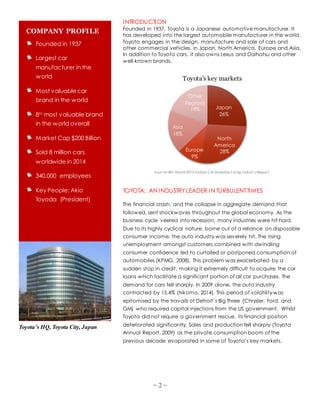
Founded in 1937, Toyota is a Japanese automotive manufacturer. It
has developed into the largest automobile manufacturer in the world.
Toyota engages in the design, manufacture and sale of cars and
other commercial vehicles, in Japan, North America, Europe and Asia.
In addition to Toyota cars, it also owns Lexus and Daihatsu and other
well-known brands.
Source IBIS World 2013 Global Car Manufact uring Indust ryReport
TOYOTA: AN INDUSTRYLEADER IN TURBULENTTIMES
The financial crash, and the collapse in aggregate demand that
followed, sent shockwaves throughout the global economy. As the
business cycle veered into recession, many industries were hit hard.
Due to its highly cyclical nature, borne out of a reliance on disposable
consumer income, the auto industry was severely hit. The rising
unemployment amongst customers combined with dwindling
consumer confidence led to curtailed or postponed consumption of
automobiles (KPMG, 2008). This problem was exacerbated by a
sudden stop in credit, making it extremely difficult to acquire the car
loans which facilitate a significant portion of all car purchases. The
demand for cars fell sharply. In 2009 alone, the auto industry
contracted by 15.4% (Nkomo, 2014). This period of volatility was
epitomised by the travails of Detroit’s Big Three (Chrysler, Ford, and
GM) who required capital injections from the US government. Whilst
Toyota did not require a government rescue, its financial position
deteriorated significantly. Sales and production fell sharply (Toyota
Annual Report, 2009) as the private consumption boom of the
previous decade evaporated in some of Toyota’s key markets.
Japan
26%
North
America
28%Europe
9%
Asia
18%
Other
Regions
19%
Toyota's key markets
COMPANY PROFILE
Founded in 1937
Largest car
manufacturer in the
world
Most valuablecar
brand in the world
8th most valuable brand
in the world overall
Market Cap $200 Billion
Sold 8 million cars
worldwide in 2014
340,000 employees
Key People: Akio
Toyoda (President)
Main Customer
Toyota’s HQ, Toyota City, Japan
~ 3 ~
Toyota’s Sales Performance during the Global Recession
Region 2007
(000’s of
units)
2008
(000’s of
units)
2009
(000’s of
units)
% Change 2008-2009
Japan 2273 2188 1945 -11.1
North America 2942 2958 2212 -25.2
Europe 1224 1284 1062 -17.3
Asia 789 956 905 -5.3
Central Asia 284 320 279 -12.8
Oceania 268 289 261 -9.7
Africa 304 314 289 -8
Middle East 433 597 606 1.5
Others 7 7 8 14.3
Total 8524 8913 7567 -15.1
Source: 2009 Toyot a Annual Report
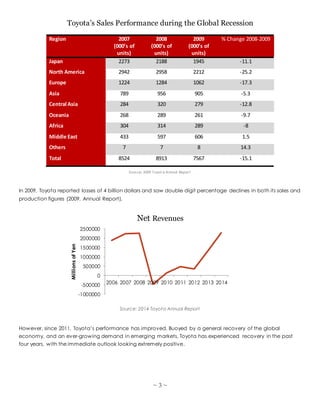
In 2009, Toyota reported losses of 4 billion dollars and saw double digit percentage declines in both its sales and
production figures (2009, Annual Report).
Source: 2014 Toyota Annual Report
However, since 2011, Toyota’s performance has improved. Buoyed by a general recovery of the global
economy, and an ever-growing demand in emerging markets, Toyota has experienced recovery in the past
four years, with the immediate outlook looking extremely positive.
-1000000
-500000
0
500000
1000000
1500000
2000000
2500000
2006 2007 2008 2009 2010 2011 2012 2013 2014
MillionsofYen
Net Revenues
~ 4 ~
Source: 2014 Toyota Annual Report
THE NATURE OF THE AUTOMOBILE INDUSTRY
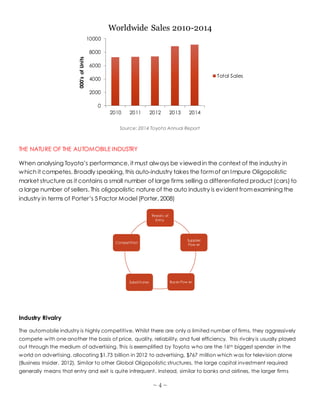
When analysing Toyota’s performance, it must always be viewed in the context of the industry in
which it competes. Broadly speaking, this auto-industry takes the formof an Impure Oligopolistic
market structure as it contains a small number of large firms selling a differentiated product (cars) to
a large number of sellers. This oligopolistic nature of the auto industry is evident from examining the
industry in terms of Porter’s 5 Factor Model (Porter, 2008)
Industry Rivalry
The automobile industry is highly competitive. Whilst there are only a limited number of firms, they aggressively
compete with one another the basis of price, quality, reliability, and fuel efficiency. This rivalry is usually played
out through the medium of advertising. This is exemplified by Toyota who are the 16th biggest spender in the
world on advertising, allocating $1.73 billion in 2012 to advertising, $767 million which was for television alone
(Business Insider, 2012). Similar to other Global Oligopolistic structures, the large capital investment required
generally means that entry and exit is quite infrequent. Instead, similar to banks and airlines, the larger firms
0
2000
4000
6000
8000
10000
2010 2011 2012 2013 2014
000'sofUnits
Worldwide Sales 2010-2014
Total Sales
Threats of
Entry
Supplier
Pow er
Buyer Pow erSubsititutes
Competition
~ 5 ~
have a tendency to acquire their competitors. These mergers and acquisitions allow the buying firm to avail of
newfound economies of scale and scope and enable them tailor different subsidiaries to different sectors of
the market.’ In Toyotas case, Lexus target the high end clients.
Threats of Entry
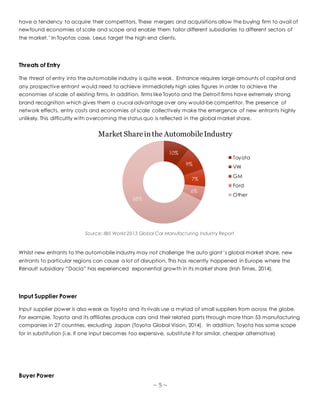
The threat of entry into the automobile industry is quite weak. Entrance requires large amounts of capital and
any prospective entrant would need to achieve immediately high sales figures in order to achieve the
economies of scale of existing firms. In addition, firms like Toyota and the Detroit firms have extremely strong
brand recognition which gives them a crucial advantage over any would-be competitor. The presence of
network effects, entry costs and economies of scale collectively make the emergence of new entrants highly
unlikely. This difficultly with overcoming the status quo is reflected in the global market share.
Source: IBIS World 2013 Global Car Manufacturing Industry Report
Whilst new entrants to the automobile industry may not challenge the auto giant’s global market share, new
entrants to particular regions can cause a lot of disruption. This has recently happened in Europe where the
Renault subsidiary “Dacia” has experienced exponential growth in its market share (Irish Times, 2014).
Input Supplier Power
Input supplier power is also weak as Toyota and its rivals use a myriad of small suppliers from across the globe.
For example, Toyota and its affiliates produce cars and their related parts through more than 53 manufacturing
companies in 27 countries, excluding Japan (Toyota Global Vision, 2014). In addition, Toyota has some scope
for in substitution (i.e. If one input becomes too expensive, substitute it for similar, cheaper alternative)
Buyer Power
10%
9%
7%
6%
68%
Market Shareinthe AutomobileIndustry
Toyota
VW
GM
Ford
Other
~ 6 ~
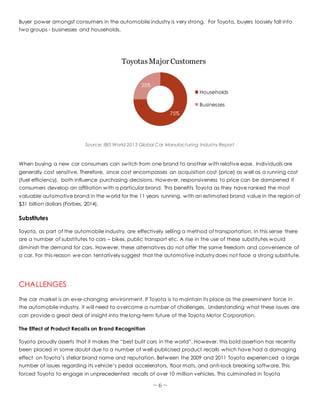
Buyer power amongst consumers in the automobile industry is very strong. For Toyota, buyers loosely fall into
two groups - businesses and households.
Source: IBIS World 2013 Global Car Manufacturing Industry Report
When buying a new car consumers can switch from one brand to another with relative ease. Individuals are
generally cost sensitive. Therefore, since cost encompasses an acquisition cost (price) as well as a running cost
(fuel efficiency), both influence purchasing decisions. However, responsiveness to price can be dampened if
consumers develop an affiliation with a particular brand. This benefits Toyota as they have ranked the most
valuable automotive brand in the world for the 11 years running, with an estimated brand value in the region of
$31 billion dollars (Forbes, 2014).
Substitutes
Toyota, as part of the automobile industry, are effectively selling a method of transportation. In this sense there
are a number of substitutes to cars – bikes, public transport etc. A rise in the use of these substitutes would
diminish the demand for cars. However, these alternatives do not offer the same freedom and convenience of
a car. For this reason we can tentatively suggest that the automotive industry does not face a strong substitute.
CHALLENGES
The car market is an ever-changing environment. If Toyota is to maintain its place as the preeminent force in
the automobile industry, it will need to overcome a number of challenges. Understanding what these issues are
can provide a great deal of insight into the long-term future of the Toyota Motor Corporation.
The Effect of Product Recalls on Brand Recognition
Toyota proudly asserts that it makes the “best built cars in the world”. However, this bold assertion has recently
been placed in some doubt due to a number of well-publicised product recalls which have had a damaging
effect on Toyota’s stellar brand name and reputation. Between the 2009 and 2011 Toyota experienced a large
number of issues regarding its vehicle’s pedal accelerators, floor mats, and anti-lock breaking software. This
forced Toyota to engage in unprecedented recalls of over 10 million vehicles. This culminated in Toyota
75%
25%
ToyotasMajor Customers
Households
Businesses
~ 7 ~
president Akio Toyoda testifying before a US congressional hearing after it was revealed that Toyota had
knowing concealed safety problems in its vehicles (Reuters, 2014) and eventually resulted in a 1.2$ dollar
settlement .These recalls eroded some of the positive reputation Toyota had built up over many years and
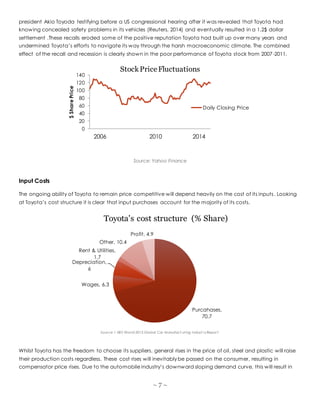
undermined Toyota’s efforts to navigate its way through the harsh macroeconomic climate. The combined
effect of the recall and recession is clearly shown in the poor performance of Toyota stock from 2007-2011.
Source: Yahoo Finance
Input Costs
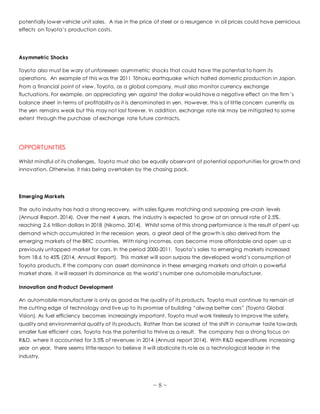
The ongoing ability of Toyota to remain price competitive will depend heavily on the cost of its inputs. Looking
at Toyota’s cost structure it is clear that input purchases account for the majority of its costs.
Source 1 IBIS World 2013 Global Car Manufact uring Indust ryReport
Whilst Toyota has the freedom to choose its suppliers, general rises in the price of oil, steel and plastic will raise
their production costs regardless. These cost rises will inevitably be passed on the consumer, resulting in
compensator price rises. Due to the automobile industry’s downward sloping demand curve, this will result in
0
20
40
60
80
100
120
140
$SharePrice StockPriceFluctuations
Daily Closing Price
2006 2010 2014
Purcahases,
70.7
Wages, 6.3
Depreciation,
6
Rent & Utilities,
1.7
Other, 10.4
Profit, 4.9
Toyota's cost structure (% Share)
~ 8 ~
potentially lower vehicle unit sales. A rise in the price of steel or a resurgence in oil prices could have pernicious
effects on Toyota’s production costs.
Asymmetric Shocks
Toyota also must be wary of unforeseen asymmetric shocks that could have the potential to harm its
operations. An example of this was the 2011 Tōhoku earthquake which halted domestic production in Japan.
From a financial point of view, Toyota, as a global company, must also monitor currency exchange
fluctuations. For example, an appreciating yen against the dollar would have a negative effect on the firm’s
balance sheet in terms of profitability as it is denominated in yen. However, this is of little concern currently as
the yen remains weak but this may not last forever. In addition, exchange rate risk may be mitigated to some
extent through the purchase of exchange rate future contracts.
OPPORTUNITIES
Whilst mindful of its challenges, Toyota must also be equally observant of potential opportunities for growth and
innovation. Otherwise, it risks being overtaken by the chasing pack.
Emerging Markets
The auto industry has had a strong recovery, with sales figures matching and surpassing pre-crash levels
(Annual Report, 2014). Over the next 4 years, the industry is expected to grow at an annual rate of 2.5%,
reaching 2.6 trillion dollars in 2018 (Nkomo, 2014). Whilst some of this strong performance is the result of pent-up
demand which accumulated in the recession years, a great deal of the growth is also derived from the
emerging markets of the BRIC countries. With rising incomes, cars become more affordable and open up a
previously untapped market for cars. In the period 2000-2011, Toyota’s sales to emerging markets increased
from 18.6 to 45% (2014, Annual Report). This market will soon surpass the developed world’s consumption of
Toyota products. If the company can assert dominance in these emerging markets and attain a powerful
market share, it will reassert its dominance as the world’s number one automobile manufacturer.
Innovation and Product Development
An automobile manufacturer is only as good as the quality of its products. Toyota must continue to remain at
the cutting edge of technology and live up to its promise of building “always better cars” (Toyota Global
Vision). As fuel efficiency becomes increasingly important, Toyota must work tirelessly to improve the safety,
quality and environmental quality of its products. Rather than be scared of the shift in consumer taste towards
smaller fuel efficient cars, Toyota has the potential to thrive as a result. The company has a strong focus on
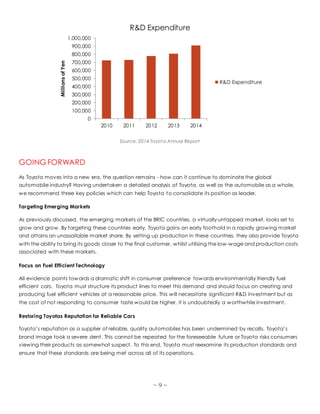
R&D, where it accounted for 3.5% of revenues in 2014 (Annual report 2014). With R&D expenditures increasing
year on year, there seems little reason to believe it will abdicate its role as a technological leader in the
industry.
~ 9 ~
Source: 2014 Toyota Annual Report
GOING FORWARD
As Toyota moves into a new era, the question remains - how can it continue to dominate the global
automobile industry? Having undertaken a detailed analysis of Toyota, as well as the automobile as a whole,
we recommend three key policies which can help Toyota to consolidate its position as leader.
Targeting Emerging Markets
As previously discussed, the emerging markets of the BRIC countries, a virtually untapped market, looks set to
grow and grow. By targeting these countries early, Toyota gains an early foothold in a rapidly growing market
and attains an unassailable market share. By setting up production in these countries, they also provide Toyota
with the ability to bring its goods closer to the final customer, whilst utilising the low-wage and production costs
associated with these markets.
Focus on Fuel Efficient Technology
All evidence points towards a dramatic shift in consumer preference towards environmentally friendly fuel
efficient cars. Toyota must structure its product lines to meet this demand and should focus on creating and
producing fuel efficient vehicles at a reasonable price. This will necessitate significant R&D investment but as
the cost of not responding to consumer taste would be higher, it is undoubtedly a worthwhile investment.
Restoring Toyotas Reputation for Reliable Cars
Toyota’s reputation as a supplier of reliable, quality automobiles has been undermined by recalls. Toyota’s
brand image took a severe dent. This cannot be repeated for the foreseeable future or Toyota risks consumers
viewing their products as somewhat suspect. To this end, Toyota must reexamine its production standards and
ensure that these standards are being met across all of its operations.
0
100,000
200,000
300,000
400,000
500,000
600,000
700,000
800,000
900,000
1,000,000
2010 2011 2012 2013 2014
MillionsofYen
R&D Expenditure
R&D Expenditure
~ 10 ~
Bibliography
1. Business Insider (2012), Companies that spent over 1 billion on Ads Retrieved 5th November, Available
at http://www.businessinsider.com/the-35-companies-that-spent-1-billion-on-ads-in-2011-2012-
11?op=1&IR=T
2. Forbes (2014), The World’s Most Powerful Brands Retrieved 3rd November, Available at
http://www.forbes.com/powerful-brands/list/
3. IBIS, (2013) , Global Car Manufacturing Industry Report
4. Irish Times (2014), Ex-communist car company doubles its sales in Ireland. Retrieved 9th November ,
Available at http://www.independent.ie/business/irish/excommunist-car-company-doubles-its-sales-in-
ireland-30692266.html
5. KPMG (2008) , Rough Road A rough road: The effects of today’s financial crisis on the global
automotive industry, Retrieved November 4th ,Available at
http://www.kpmg.com/EU/en/Documents/20081101_A_rough_road_effects_financial_crisis.pdf
6. Nkomo.T (2014) , “Analysis of the Toyota Motor Corporation” Retrieved 5th November, Available at
http://scholar.harvard.edu/files/tnkomo/files/analysis_of_toyota.pdf
7. Porter, Michael E.(2008) "The five competitive forces that shape strategy." Harvard business review
86.1: 25-40.
8. Reuters (2014) U.S. judge approves Toyota $1.2 billion settlement over concealing defects Retrieved 7th
November, Available at http://www.reuters.com/article/2014/03/20/us-toyota-settlement-
idUSBREA2I0VB20140320
9. Toyota Motor Corporation, (2009), Annual Report Retrieved November 5th,Available at
http://www.toyota-global.com/investors/ir_library/annual/index.html
10. Toyota Motor Corporation, (2010), Annual Report Retrieved November 5th,Available at
http://www.toyota-global.com/investors/ir_library/annual/index.html
11. Toyota Motor Corporation, (2014), 75 Years of Toyota, Retrieved November 4th ,Available at
http://www.toyotaglobal.com/company/history_of_toyota/75years/text/leaping_forward_as_a_global_co
rporation/chapter5/section4/item1.html
12. Toyota Motor Corporation, (2014), Annual Report Retrieved November 5th,Available at
http://www.toyota-global.com/investors/ir_library/annual/index.html
13. Yahoo Finance (2014), Toyota Motor Corporation Historical Prices, Retrieved November 4th Available at
http://finance.yahoo.com/q/hp?s=TM&a=07&b=18&c=2006&d=10&e=10&f=2014&g=m

Toyota

  • 1.
    ~ 1 ~ TOYOTA& THE AUTOMOBILE INDUSTRY This report presents a brief analysis of the Toyota Motor Corporation in 2014.It analyses Toyotas performance during the recession, characterizes the nature of the auto-industry in which it competes and outlines the challenges and opportunities Toyota faces in the coming years.
  • 2.
    ~ 2 ~ INTRODUCTION Foundedin 1937, Toyota is a Japanese automotive manufacturer. It has developed into the largest automobile manufacturer in the world. Toyota engages in the design, manufacture and sale of cars and other commercial vehicles, in Japan, North America, Europe and Asia. In addition to Toyota cars, it also owns Lexus and Daihatsu and other well-known brands. Source IBIS World 2013 Global Car Manufact uring Indust ryReport TOYOTA: AN INDUSTRYLEADER IN TURBULENTTIMES The financial crash, and the collapse in aggregate demand that followed, sent shockwaves throughout the global economy. As the business cycle veered into recession, many industries were hit hard. Due to its highly cyclical nature, borne out of a reliance on disposable consumer income, the auto industry was severely hit. The rising unemployment amongst customers combined with dwindling consumer confidence led to curtailed or postponed consumption of automobiles (KPMG, 2008). This problem was exacerbated by a sudden stop in credit, making it extremely difficult to acquire the car loans which facilitate a significant portion of all car purchases. The demand for cars fell sharply. In 2009 alone, the auto industry contracted by 15.4% (Nkomo, 2014). This period of volatility was epitomised by the travails of Detroit’s Big Three (Chrysler, Ford, and GM) who required capital injections from the US government. Whilst Toyota did not require a government rescue, its financial position deteriorated significantly. Sales and production fell sharply (Toyota Annual Report, 2009) as the private consumption boom of the previous decade evaporated in some of Toyota’s key markets. Japan 26% North America 28%Europe 9% Asia 18% Other Regions 19% Toyota's key markets COMPANY PROFILE Founded in 1937 Largest car manufacturer in the world Most valuablecar brand in the world 8th most valuable brand in the world overall Market Cap $200 Billion Sold 8 million cars worldwide in 2014 340,000 employees Key People: Akio Toyoda (President) Main Customer Toyota’s HQ, Toyota City, Japan
  • 3.
    ~ 3 ~ Toyota’sSales Performance during the Global Recession Region 2007 (000’s of units) 2008 (000’s of units) 2009 (000’s of units) % Change 2008-2009 Japan 2273 2188 1945 -11.1 North America 2942 2958 2212 -25.2 Europe 1224 1284 1062 -17.3 Asia 789 956 905 -5.3 Central Asia 284 320 279 -12.8 Oceania 268 289 261 -9.7 Africa 304 314 289 -8 Middle East 433 597 606 1.5 Others 7 7 8 14.3 Total 8524 8913 7567 -15.1 Source: 2009 Toyot a Annual Report In 2009, Toyota reported losses of 4 billion dollars and saw double digit percentage declines in both its sales and production figures (2009, Annual Report). Source: 2014 Toyota Annual Report However, since 2011, Toyota’s performance has improved. Buoyed by a general recovery of the global economy, and an ever-growing demand in emerging markets, Toyota has experienced recovery in the past four years, with the immediate outlook looking extremely positive. -1000000 -500000 0 500000 1000000 1500000 2000000 2500000 2006 2007 2008 2009 2010 2011 2012 2013 2014 MillionsofYen Net Revenues
  • 4.
    ~ 4 ~ Source:2014 Toyota Annual Report THE NATURE OF THE AUTOMOBILE INDUSTRY When analysing Toyota’s performance, it must always be viewed in the context of the industry in which it competes. Broadly speaking, this auto-industry takes the formof an Impure Oligopolistic market structure as it contains a small number of large firms selling a differentiated product (cars) to a large number of sellers. This oligopolistic nature of the auto industry is evident from examining the industry in terms of Porter’s 5 Factor Model (Porter, 2008) Industry Rivalry The automobile industry is highly competitive. Whilst there are only a limited number of firms, they aggressively compete with one another the basis of price, quality, reliability, and fuel efficiency. This rivalry is usually played out through the medium of advertising. This is exemplified by Toyota who are the 16th biggest spender in the world on advertising, allocating $1.73 billion in 2012 to advertising, $767 million which was for television alone (Business Insider, 2012). Similar to other Global Oligopolistic structures, the large capital investment required generally means that entry and exit is quite infrequent. Instead, similar to banks and airlines, the larger firms 0 2000 4000 6000 8000 10000 2010 2011 2012 2013 2014 000'sofUnits Worldwide Sales 2010-2014 Total Sales Threats of Entry Supplier Pow er Buyer Pow erSubsititutes Competition
  • 5.
    ~ 5 ~ havea tendency to acquire their competitors. These mergers and acquisitions allow the buying firm to avail of newfound economies of scale and scope and enable them tailor different subsidiaries to different sectors of the market.’ In Toyotas case, Lexus target the high end clients. Threats of Entry The threat of entry into the automobile industry is quite weak. Entrance requires large amounts of capital and any prospective entrant would need to achieve immediately high sales figures in order to achieve the economies of scale of existing firms. In addition, firms like Toyota and the Detroit firms have extremely strong brand recognition which gives them a crucial advantage over any would-be competitor. The presence of network effects, entry costs and economies of scale collectively make the emergence of new entrants highly unlikely. This difficultly with overcoming the status quo is reflected in the global market share. Source: IBIS World 2013 Global Car Manufacturing Industry Report Whilst new entrants to the automobile industry may not challenge the auto giant’s global market share, new entrants to particular regions can cause a lot of disruption. This has recently happened in Europe where the Renault subsidiary “Dacia” has experienced exponential growth in its market share (Irish Times, 2014). Input Supplier Power Input supplier power is also weak as Toyota and its rivals use a myriad of small suppliers from across the globe. For example, Toyota and its affiliates produce cars and their related parts through more than 53 manufacturing companies in 27 countries, excluding Japan (Toyota Global Vision, 2014). In addition, Toyota has some scope for in substitution (i.e. If one input becomes too expensive, substitute it for similar, cheaper alternative) Buyer Power 10% 9% 7% 6% 68% Market Shareinthe AutomobileIndustry Toyota VW GM Ford Other
  • 6.
    ~ 6 ~ Buyerpower amongst consumers in the automobile industry is very strong. For Toyota, buyers loosely fall into two groups - businesses and households. Source: IBIS World 2013 Global Car Manufacturing Industry Report When buying a new car consumers can switch from one brand to another with relative ease. Individuals are generally cost sensitive. Therefore, since cost encompasses an acquisition cost (price) as well as a running cost (fuel efficiency), both influence purchasing decisions. However, responsiveness to price can be dampened if consumers develop an affiliation with a particular brand. This benefits Toyota as they have ranked the most valuable automotive brand in the world for the 11 years running, with an estimated brand value in the region of $31 billion dollars (Forbes, 2014). Substitutes Toyota, as part of the automobile industry, are effectively selling a method of transportation. In this sense there are a number of substitutes to cars – bikes, public transport etc. A rise in the use of these substitutes would diminish the demand for cars. However, these alternatives do not offer the same freedom and convenience of a car. For this reason we can tentatively suggest that the automotive industry does not face a strong substitute. CHALLENGES The car market is an ever-changing environment. If Toyota is to maintain its place as the preeminent force in the automobile industry, it will need to overcome a number of challenges. Understanding what these issues are can provide a great deal of insight into the long-term future of the Toyota Motor Corporation. The Effect of Product Recalls on Brand Recognition Toyota proudly asserts that it makes the “best built cars in the world”. However, this bold assertion has recently been placed in some doubt due to a number of well-publicised product recalls which have had a damaging effect on Toyota’s stellar brand name and reputation. Between the 2009 and 2011 Toyota experienced a large number of issues regarding its vehicle’s pedal accelerators, floor mats, and anti-lock breaking software. This forced Toyota to engage in unprecedented recalls of over 10 million vehicles. This culminated in Toyota 75% 25% ToyotasMajor Customers Households Businesses
  • 7.
    ~ 7 ~ presidentAkio Toyoda testifying before a US congressional hearing after it was revealed that Toyota had knowing concealed safety problems in its vehicles (Reuters, 2014) and eventually resulted in a 1.2$ dollar settlement .These recalls eroded some of the positive reputation Toyota had built up over many years and undermined Toyota’s efforts to navigate its way through the harsh macroeconomic climate. The combined effect of the recall and recession is clearly shown in the poor performance of Toyota stock from 2007-2011. Source: Yahoo Finance Input Costs The ongoing ability of Toyota to remain price competitive will depend heavily on the cost of its inputs. Looking at Toyota’s cost structure it is clear that input purchases account for the majority of its costs. Source 1 IBIS World 2013 Global Car Manufact uring Indust ryReport Whilst Toyota has the freedom to choose its suppliers, general rises in the price of oil, steel and plastic will raise their production costs regardless. These cost rises will inevitably be passed on the consumer, resulting in compensator price rises. Due to the automobile industry’s downward sloping demand curve, this will result in 0 20 40 60 80 100 120 140 $SharePrice StockPriceFluctuations Daily Closing Price 2006 2010 2014 Purcahases, 70.7 Wages, 6.3 Depreciation, 6 Rent & Utilities, 1.7 Other, 10.4 Profit, 4.9 Toyota's cost structure (% Share)
  • 8.
    ~ 8 ~ potentiallylower vehicle unit sales. A rise in the price of steel or a resurgence in oil prices could have pernicious effects on Toyota’s production costs. Asymmetric Shocks Toyota also must be wary of unforeseen asymmetric shocks that could have the potential to harm its operations. An example of this was the 2011 Tōhoku earthquake which halted domestic production in Japan. From a financial point of view, Toyota, as a global company, must also monitor currency exchange fluctuations. For example, an appreciating yen against the dollar would have a negative effect on the firm’s balance sheet in terms of profitability as it is denominated in yen. However, this is of little concern currently as the yen remains weak but this may not last forever. In addition, exchange rate risk may be mitigated to some extent through the purchase of exchange rate future contracts. OPPORTUNITIES Whilst mindful of its challenges, Toyota must also be equally observant of potential opportunities for growth and innovation. Otherwise, it risks being overtaken by the chasing pack. Emerging Markets The auto industry has had a strong recovery, with sales figures matching and surpassing pre-crash levels (Annual Report, 2014). Over the next 4 years, the industry is expected to grow at an annual rate of 2.5%, reaching 2.6 trillion dollars in 2018 (Nkomo, 2014). Whilst some of this strong performance is the result of pent-up demand which accumulated in the recession years, a great deal of the growth is also derived from the emerging markets of the BRIC countries. With rising incomes, cars become more affordable and open up a previously untapped market for cars. In the period 2000-2011, Toyota’s sales to emerging markets increased from 18.6 to 45% (2014, Annual Report). This market will soon surpass the developed world’s consumption of Toyota products. If the company can assert dominance in these emerging markets and attain a powerful market share, it will reassert its dominance as the world’s number one automobile manufacturer. Innovation and Product Development An automobile manufacturer is only as good as the quality of its products. Toyota must continue to remain at the cutting edge of technology and live up to its promise of building “always better cars” (Toyota Global Vision). As fuel efficiency becomes increasingly important, Toyota must work tirelessly to improve the safety, quality and environmental quality of its products. Rather than be scared of the shift in consumer taste towards smaller fuel efficient cars, Toyota has the potential to thrive as a result. The company has a strong focus on R&D, where it accounted for 3.5% of revenues in 2014 (Annual report 2014). With R&D expenditures increasing year on year, there seems little reason to believe it will abdicate its role as a technological leader in the industry.
  • 9.
    ~ 9 ~ Source:2014 Toyota Annual Report GOING FORWARD As Toyota moves into a new era, the question remains - how can it continue to dominate the global automobile industry? Having undertaken a detailed analysis of Toyota, as well as the automobile as a whole, we recommend three key policies which can help Toyota to consolidate its position as leader. Targeting Emerging Markets As previously discussed, the emerging markets of the BRIC countries, a virtually untapped market, looks set to grow and grow. By targeting these countries early, Toyota gains an early foothold in a rapidly growing market and attains an unassailable market share. By setting up production in these countries, they also provide Toyota with the ability to bring its goods closer to the final customer, whilst utilising the low-wage and production costs associated with these markets. Focus on Fuel Efficient Technology All evidence points towards a dramatic shift in consumer preference towards environmentally friendly fuel efficient cars. Toyota must structure its product lines to meet this demand and should focus on creating and producing fuel efficient vehicles at a reasonable price. This will necessitate significant R&D investment but as the cost of not responding to consumer taste would be higher, it is undoubtedly a worthwhile investment. Restoring Toyotas Reputation for Reliable Cars Toyota’s reputation as a supplier of reliable, quality automobiles has been undermined by recalls. Toyota’s brand image took a severe dent. This cannot be repeated for the foreseeable future or Toyota risks consumers viewing their products as somewhat suspect. To this end, Toyota must reexamine its production standards and ensure that these standards are being met across all of its operations. 0 100,000 200,000 300,000 400,000 500,000 600,000 700,000 800,000 900,000 1,000,000 2010 2011 2012 2013 2014 MillionsofYen R&D Expenditure R&D Expenditure
  • 10.
    ~ 10 ~ Bibliography 1.Business Insider (2012), Companies that spent over 1 billion on Ads Retrieved 5th November, Available at http://www.businessinsider.com/the-35-companies-that-spent-1-billion-on-ads-in-2011-2012- 11?op=1&IR=T 2. Forbes (2014), The World’s Most Powerful Brands Retrieved 3rd November, Available at http://www.forbes.com/powerful-brands/list/ 3. IBIS, (2013) , Global Car Manufacturing Industry Report 4. Irish Times (2014), Ex-communist car company doubles its sales in Ireland. Retrieved 9th November , Available at http://www.independent.ie/business/irish/excommunist-car-company-doubles-its-sales-in- ireland-30692266.html 5. KPMG (2008) , Rough Road A rough road: The effects of today’s financial crisis on the global automotive industry, Retrieved November 4th ,Available at http://www.kpmg.com/EU/en/Documents/20081101_A_rough_road_effects_financial_crisis.pdf 6. Nkomo.T (2014) , “Analysis of the Toyota Motor Corporation” Retrieved 5th November, Available at http://scholar.harvard.edu/files/tnkomo/files/analysis_of_toyota.pdf 7. Porter, Michael E.(2008) "The five competitive forces that shape strategy." Harvard business review 86.1: 25-40. 8. Reuters (2014) U.S. judge approves Toyota $1.2 billion settlement over concealing defects Retrieved 7th November, Available at http://www.reuters.com/article/2014/03/20/us-toyota-settlement- idUSBREA2I0VB20140320 9. Toyota Motor Corporation, (2009), Annual Report Retrieved November 5th,Available at http://www.toyota-global.com/investors/ir_library/annual/index.html 10. Toyota Motor Corporation, (2010), Annual Report Retrieved November 5th,Available at http://www.toyota-global.com/investors/ir_library/annual/index.html 11. Toyota Motor Corporation, (2014), 75 Years of Toyota, Retrieved November 4th ,Available at http://www.toyotaglobal.com/company/history_of_toyota/75years/text/leaping_forward_as_a_global_co rporation/chapter5/section4/item1.html 12. Toyota Motor Corporation, (2014), Annual Report Retrieved November 5th,Available at http://www.toyota-global.com/investors/ir_library/annual/index.html 13. Yahoo Finance (2014), Toyota Motor Corporation Historical Prices, Retrieved November 4th Available at http://finance.yahoo.com/q/hp?s=TM&a=07&b=18&c=2006&d=10&e=10&f=2014&g=m