ENAMEL
Introduction
Physical properties
Chemical properties
Structure of enamel
Rods
Gnarled enamel
Dentino-enamel junction
Cemento-enamel
junction
•Aprismatic enamel
•Hunter schreger bands
•Striae of retizius
o Microscopic details of
surface enamel
Perikymata
Rod ends
Enamel crack
o Investing layers
associated with enamel
surface
 Age changes
 Difference b/w deciduous
& permanent tooth
 Development of enamel
Amelogenesis
Life cycle of ameloblast
 Etiology of developmental
anomalies of enamel (as per
soames)
 Amelogenesis imperfecta
Classification (as per witkop)
Clinical features
Radiographic features
 Enamel hypoplasia
Factors
In brief about each
factor
 Clinical aspect
 Enamel caries
 Non carious lesions of
enamel
 Effect of bleaching
(Greenwall)
 Discolouration
classification (hyas,
nathoo)
 Consideration for cavity
preparation (marzouk)
 Effects of drugs on enamel
Tetracycline
Minocycline
 Effect of micro abrasion
&macro abrasion
 Effect of burs
 Effect of fluoride on enamel
 Cavosurface considerations
Composite
Inlay
 Enamel etching
Ectopic enamel
Effects of lasers
Emdogain
Conclusion
Reference
Teeth is composed of 3 mineralized tissues i.e.
Enamel, dentin & cementum.
1.Acellular calcified tissue covering anatomic
crown & providing shape & contour to tooth.
2. Ectodermal in origin.
3. Hardest tissue of body.
4. Physiologically unrepairable tissue.
colour
Appears bluish white or greyish at the thick opaque
areas & yellow-white at the thin areas reflecting
underlying dentin.
 Translucency of enamel – increase with increasing
wavelengths
i. Dehydration decreases translucency but it was reversed on rehydration.
Hardness:-
 hardest structure of the body i.e.5 to 8khn.
Permeability:-
 selectively permeable.
Density:-
 decreases from the surface of enamel to the
dentino-enamel junction.
Thickness:-
 cusps of the molars measures 2.5 mm
 incisal edges of incisors 2.0 mm.
 Hexagonal structure
with width:70nm;
thickness:25nm.
 Ions present are
magnesium, lead,
fluorides.
 Core is more soluble
than periphery
Amelogenins
 Heterogenus group of low
molecular weight proteins
 Hydrophobic; rich in proline,
histidine, glutamine and leucine.
Non amelogenins
 Enamelin, ameloblastin, tuftelin.
 High molecular weight proteins.
 Rich in glycine, aspartic acid,
serine
Inorganic Organic
 BY WT:2%
 By vol:5-10%
 Water lies -in b/w crystals and rods
Trapped in defects of crystalline structure
Rods/ enamel prism
 Basic structural unit of enamel.
 Rods are thin running from DEJ to surface in a
tortures manner.
 Length of rods are more than width.
 Longer in cuspal region than cervical area
 Dia .of rods increases from DEJ to surface in a
ratio of 1:2.
 Rods dimensions: width:5µm
length:9µm
diameter:4µm
 Type 1: circular
 Type2: parallel rows.
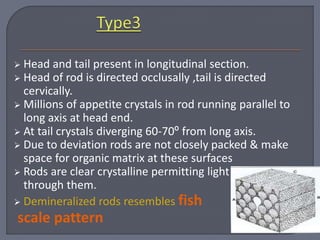
 Type3: key hole/paddle shaped pattern.
 All three type of pattern are seen in human teeth but
most common is type 3.
 Head and tail present in longitudinal section.
 Head of rod is directed occlusally ,tail is directed
cervically.
 Millions of appetite crystals in rod running parallel to
long axis at head end.
 At tail crystals diverging 60-70º from long axis.
 Due to deviation rods are not closely packed & make
space for organic matrix at these surfaces
 Rods are clear crystalline permitting light to pass
through them.
 Demineralized rods resembles fish
scale pattern
 Deciduous tooth: horizontal at cervical and
central part.
 Permanent tooth: horizontal in occlusal two
third of crown and apically directed at cervical
third.
 Permanent maxillarymolar:12 million rods.
 Permanent lower incisors:5 million rods.
 The enamel at the cusp of the tooth generally
exhibits a wavy pattern. This enamel is called gnarled
enamel
 Optical appearance of enamel cut in oblique plane
 Bundles of rods appear interwine more irregularly
 Makes enamel stronger
 Seen in the incisal or cuspal region.
 Optical phenomenon seen in reflected
light
 Alternate light and dark bands
 Seen in ground longitudinal section
 Originate from the DEJ.
 Dark bands – parazones
 Light bands – Diazones.
 Angle between them is 40 degrees
Longitudinal section: runs
obliquely from D.E.J to surface
Appears as brownish band in
ground section.
Moderate intensity is
considered as normal
Etiology
1. Periodic bending of E. rods.
2. Variation in organic structure.
3. Physiologic calcification rhythm.
Concentric lines like
growth rings of tree
Due to metabolic
disturbances during
matrix formations results
in broad and prominent
incremental lines
1. Aprismatic enamel
2. Perikymata
3. Enamel cracks
4. Rod ends
 About 30 µm thick.
 In 70% permanent teeth and all deciduous teeth.
 Found least often over the cusp tips.
 Found commonly in the cervical areas.
 No prisms outlines are visible
 All the apatite crystals are parallel to one another and
perpendicular to the striae of Retzius.
 More mineralized than the bulk of Enamel beneath it.
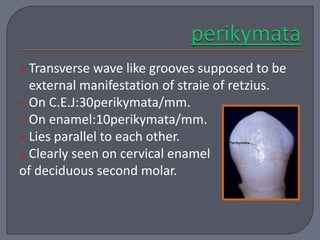
 Transverse wave like grooves supposed to be
external manifestation of straie of retzius.
 On C.E.J:30perikymata/mm.
 On enamel:10perikymata/mm.
 Lies parallel to each other.
 Clearly seen on cervical enamel
of deciduous second molar.
Rod ends
 Concave & vary in depth & shape
 Shallowest in cervical& deepest in occlusal
• Ultra structurally, surface of enamel – Uneven
• Pits of about 1 – 1.5 micrometers in diameter.
• Elevations of about 10-15micrometer - enamel caps
Enamel cracks
The narrow, fissure like structure that are seen
on almost all surface
Supposed to be an outer edge of lamellae
Extends for varying length perpendicular to
D.E.J.
Long lamellae appear thicker than shorter
ones
 Supposed to be resulted due to abrupt change in the
environment & nutrition of newborn infant
 prenatal enamel is better developed than post natal
enamel because fetus develops in a well protected
environment with adequate supply of essential
nutrients
 Due to undisturbed development the perikymata is
absent in occlusal part while present on post natal
cervical part
Scalloped junction – the convexities towards
Dentin.
At this junction, the pitted Dentin surface fit
rounded projections of the enamel.
Crystals of enamel and dentin mix with each
other.
Enamel lamella
Enamel spindle
Enamel tufts
TRANSVERSE SECTION
SHOWING THE D.E.J.
SCALLOPED
APPEARANCE OF D.E.J
DEJ, more pronounced in occlusal area,
where masticatory stresses are greater.
 Thin leaf like extending from enamel to
D.E.J.
 Hypo mineralized , best seen in transverse
sections.
 Persists even after decalcification.
 Develops in plane of
tension, rods crossing this
plane do not calcify.
3 types are present i.e.
Type A
Type B
Type C
Type A
Seen in enamel.
Rods are poorly calcified.
May reach into dentin.
Consists of degenerated cells.
TYPE C
May reach into dentin.
In erupted teeth filled with organic
matter.
Narrow (8 µm in dia.) extending 25µm in
enamel
Resulted due to entrapment of odontoblastic
process b/w ameloblast during early stage of
tooth development.
Commonly seen in region of cusp where most
crowding of odontoblast would have occurred.
Best seen in longitudinal section
Longitudinal section of enamel showing
enamel spindles
Arises from DEJ & seen 1/5th to 1/3rd thickness
of enamel
Resembles to tufts of grass in thick ground
section & under low magnification
Extends in long axis, so best seen in horizontal
section
Consist of hypocalcified E. rods and
interprismatic substance
3 patterns are present
Pattern 1- 60%: cementum overlaps enamel
Pattern 2- 30%: cementum meets enamel at
butt joint.
Pattern 3- 10%: cementum fails to meet
enamel and exposes dentin.
Three patterns of C.E.J.
1. Primary E. cuticle (Nasmyth’s membrane).
2. Afibrillar cementum.
3. Pellicle (a precipitate of salivary proteins).
Primary enamel cuticle:
 Covers the entire crown of newly erupted tooth.
 Thickness: 0.2 µm.
 Removed by mastication (remains intact in
protective areas).
 Function- protect the surface of the enamel from
the resorptive activity of the adjacent vascular
tissue prior to the eruption of the teeth.
Afibrillar cementum.
 Covered the cervical area of the enamel.
 Thickness: up to 10 µm.
 Continuous with the cementum.
 Secreted after Enamel Organ retracted from
the cervical region during tooth development.
Pellicle:
 Precipitate of salivary protein
 Covers the crown
 Re-form within hours after mechanical cleaning
.
 May be colonized by microorganisms to form a
bacterial plaque.
 Plaque may be calcified forming calculus.
 Physiological wear depending on diet, habits etc.
 Darker in colour due to decreased translucency,
formation of secondary dentin, surface stains &
thinning of enamels.
 Decreased permeability & water content results in
harder tooth surface.
 Increased fluoride & nitrogen incorporation in surface
of enamel results in decreased porosity & caries
incidence.
Lighter in colour , bluish
white
Darker in colour grayish or
yellow white
Thinner enamel i.e. 1mm thicker enamel i.e. 2-3 mm
Rods are perpendicular to
DEJ
Directed gingivally in
cervical direction
More supplemental
grooves
Lesser supplemental
grooves
Epithelial enamel organ
4 distinct layers depending on morphology,
function or location
-Outer enamel epithelium
-Stellate reticulum
-Stratum intermedium
-Inner enamel epithelium
Border line b/w I.E.E & dental papillae is D.E.J
of future
Outer enamel epithelium
 Single layer of cubodial cells separated from dental
sac by basement membrane
 Increased vascularity ensures a rich metabolism
 During enamel formation cells of O.E.E develops
cytoplasmic vesicles & large no of mitochondria
STELLATE RETICULUM
Star shaped cells are separated by inter
cellular substances
Connected to cells of enamel epithelium &
stratum intermedium by desmosomes
Provides elasticity so acts as a buffer against
forces that might distort the formation of DEJ
STRATUM INTERMEDIUM
Present between stellate reticulum & I.E.E
Believed to play a role in enamel production.
Action via fluid diffusion or by contributing
necessary elements or enzymes
INNER ENAMEL EPITHELIUM
Derived from basal layer of epithelium
Assume a columnar shape & differentiate into
ameloblast that produces enamel matrix
 Cell differentiation occur early in incisal edge
or cuspal region than cervical loop.
CERVICAL LOOP:
 At the free border of the enamel organ the
outer and inner enamel epithelial layers are
continuous and reflected into one another as
the cervical loop.
 When the crown has been formed, the cells of
this portion give rise to Hertwig’s epithelial
root sheath.
6 stages are present.
Morphogenic stage.
Organizing stage.
Formative stage.
Maturative stage.
Protective stage.
Desmolytic stage.
Before the full differentiation of amoeloblast
and production of enamel they interact with
adjacent mesenchymal tissue
shape determination of DEJ & crown
 Cells are short columnar, oval nuclei, with
dispersed mitochondria
 Basal lamina separates dental papillae and
I.E.E.
 Elongation of epithelial cells towards papillae.
 Close contact between papillae and epithelial cells.
odontoblast
 At terminal phase of this stage odontoblast gives
dentin
Formation of enamel matrix.
Ameloblast approx. retain the same size.
Development of blunt process on ameloblast
surface which penetrate the basal lamina and
predentin.
 Starts after full thickness matrix formation on
occlusal or incisal area.
 At cervical matrix formation is under progress.
 Ameloblast is reduced in size.
 Ameloblast display microvilli at the distal extremities
and cytoplasmic vacuoles containing enamel matrix
like material
Ameloblast can’t be differentiated from
S.I.&O.E.E as once enamel get fully matured.
Stratified epithelium covering enamel is
termed as REDUCED ENAMEL EPITHELIUM.
Which protects mature enamel.
Retraction of epithelium at cervical edge .
Deposition of afibrillar cementum on enamel
Reduced enamel epithelium covering enamel
 Reduced enamel epithelium induces atrophy
of connective tissue separating it with oral
epithelium thus fusion of the two epithelia can
occur
 Premature degeneration of the reduced
enamel epithelium may prevent the eruption
of the tooth
.
Majorly composed of 2 process
1. Organic matrix formation
Development of tomes process
Distal terminal bars
Ameloblast covering mature enamel
2.Mineralization & maturation of enamel matrix
Starts after dentin formation
Island of enamel matrix are deposited along
predentin
Amelogenin degradation into
smaller low M.wt fragments – specific
functions in regulating crystal growth.
In fully formed teeth, amelogenin is present
between crystals, absence of amelogenin
hypoplastic teeth
Ameloblastin and enamelin helps in
nucleation and crystal growth.
Amelotin, a new protein, secreted by mature
ameloblast helps in enamel formation.
 Projection of ameloblast into matrix is called as
tomes process containing abundant R.E.R. &
mitochondria
 As per electron microscope- 4 ameloblast results in
the synthesis of 1 enamel rod
Juctional complexes which encircle ameloblast
at distal and proximal ends have fine radiating
actin filaments extending into cytoplasm,
forming webs.
Serves to control substances that pass
between ameloblast and enamel.
 separate tomes process from rest of cells.
Shorter ameloblast covering the mature
enamel
Ameloblast reduce in height, enamel stops
secretion, process of amelogenin removal
starts.
Modulation: ameloblast alternate cyclically in
developing ruffled and smooth borders in the
apical cytoplasm during the maturative stage .
Ruffled ended ameloblast- numerous
lysosomes and endolytic activity, promotes
calcium entry into forming enamel.
Smooth ended ameloblast- leaks small
amounts of proteins and water into forming
enamel.
2 stages.
First stage: Partial mineralization of matrix &
interprismatic substance.
Influx of about 25-30% of total mineral
content, form crystalline apatite,
some studies say it is octacalcium phosphate,
however it is unstable and convert into
hydroxyapatite.
Second stage: starts from height of crown &
proceed cervically.
Rods mature from -depth to surface
-cusp to cervical lines
Maturation starts before matrix reaches full
thickness.
Advancing front is at first parallel to DEJ &
later to outer enamel surface.
Primary ribbon shaped crystals increase in
thickness more than width .
they increase from 1.5 - 25µm during
maturative phase.
The rate of formation of enamel is 4µm/day
Therefore to form 1mm layer of enamel it
would take 240 days
Local cause: (as per soames)
 Infection
 Trauma
 Radiotherapy
 Idiopathic
Generalized cause:
 Environmental/ systemic
 Prenatal - infection
-maternal disease.
-excess fluoride ions
Neonatal –hemolytic disease of new born
-hypo calcemia
Post natal-severe child hood disease
-Cancer chemotherapy
-Excess fluoride ions
-Ingestion of lead, tetracycline
Genetic
Teeth only affected- Amelogenesis imperfecta
Teeth is affected in association with
generalized defects –down syndrome
-ectodermal dysplasia
Extent of enamel defect depends on:
 Intensity of etiological factors.
 Duration of presence of factors.
 Time at which factors occurring during crown
development
Ectodermal disturbance
 development of enamel takes places in 3
stages:
Formative stage (deposition of organic matrix)
 calcification stage (matrix mineralization)
Maturation stage (crystals are enlarged &
matured)
 4types of Amelogenesis imperfecta.
 Hypo plastic (defective matrix formation)
 Hypo calcification (defective matrix
mineralization)
 Hypo maturation (immature enamel
crystallites)
Hypomaturation – hypoplastic with
taurodontism
Hypo plastic type: enamel not formed to full
thickness on newly erupted developing teeth.
Hypo calcified type: enamel is soft & can be
removed by prophylactic instrument.
Hypo maturation type: pierced by an explorer
tip under firm pressure & can be lost by
chipping.
Discolouration ranges from yellow to dark
brown.
Enamel may be totally absent, may
have chalky texture, cheesy
consistency or may be hard sometimes
 smooth or with numerous parallel
vertical grooves
Open contacts & abraded occlusal ,
incisal edges
radiographic features
Enamel may be absent, may be very
thin over tips of cusps & interproximal
surfaces
Defined as an incomplete or defective
formation of enamel matrix of teeth.
Types:
Hereditary
Environmental
Hereditary type
Deciduous & permanent teeth are affected
Environmental type
 Either dentition is affected , both enamel & dentin is
affected.
Factors producing injury to ameloblast:
 Deficiency of vit.A &vit.D.
 Exanthematous disease like measles , chicken pox etc.
 Birth injury, Rh hemolytic disease
 Local infection or trauma
 Chemical ingestion
 Congenital syphilis
 Hypocalcaemia
 Idiopathic cause.
Mild environmental hypoplasia results in small
grooves or pits on surface
In severe condition presence of deep pits
arranged horizontally across the tooth surface
It results only in the formative stage of enamel
formation
Commonly seen in- central/ lateral incisors
- canine
- first molar
Vit. D deficiency is the most common cause,
may be seen due to deficiency of vit. A & vit.C
 pitting type of hypoplasia is present.
 Commonly involve- max. & mand. central
incisor ,first molars
Anterior teeth- Hutchinson's teeth
Post. Teeth- mulberry/ moon’s/Fournier’s molars
 Upper central incisors are screw driver shaped due to
absence of central tubercle or calcification centre.
 1st molar: -irregular crown
-Enamel of occlusal 3rd of tooth appears to
be an agglomerate of globules rather than well
formed cusp.
Due to hypo calcemia:
Pitting variety.
Due to birth injuries:
Traumatic birth may cause cessation of enamel
formation
Due to local infection or trauma:
Single tooth involvement is common called as
TURNER’S TOOTH & condition is called as
TURNERS HYPOPLASIA
Commonly involved are max. incisors &
premolars
Mild brownish to severe pitting &irregularity of
teeth
Carries bacterial infection to ameloblast layer of
tooth.
Trauma to teeth inward movement of teeth
disturbance in permanent teeth
Due to fluoride
Mottled enamel is formed
Water level of fluoride as per W.H.O should
range b/w 0.7-1.2 ppm
 Excess may lead to fluorosis .
 Presence of enamel in unusual location mainly root
 Hemispherical in shape , may consist entirely of
enamel or may contain underlying dentin & pulp
tissue.
 Commonly seen in furcations or c.e.j of
maxillary molars followed by mandibular
molars.
 Clinically significant for endoperio lesions
Zones of enamel caries
Zone1: translucent zone.
Zone2: dark zone.
Zone3:body of lesion.
Zone4:surface zone
Zones of enamel caries
TRANSLUCENT ZONE
Deepest zone.
Represent advancing front of lesion
Pore volume:1%, i.e. 10 times greater than
normal enamel.
DARK ZONE
Because does not transmit polarized light.
Less of crystalline structure.
Total pore volume:2-4%
BODY OF LESION
o Largest portion
o Pore volume:5% -25% at periphery.
o Striae of retzius are marked & accentuated
SURFACE ZONE
o Relatively stable
o Radiopacity comparable to adjacent enamel
Large no. of S.Sangius are found in pit &
fissure of newly erupted teeth
Where as large no. streptococcus mutans are
present in carious pits & fissures.
Gross appearance: inverted V shaped with a
narrow entrance & wider at base.
Pit & fissure enamel caries
Plaque accumulation is seen towards gingiva
below the contact area.
Gross appearance: V shaped lesion with wider
area of origin & apex of V is directed towards
D.E.J.
 Attrition
 Abrasion
 Erosion
 Localized nonhereditary enamel hypoplasia
 Localized non hereditary enamel hypo calcification
 Discolouration
 Amelogenesis imperfecta
(AS PER MARZOUK)
Attrition
Surface tooth structure loss resulting from
direct frictional force b/w contacting teeth
Physiological: age dependent, continuous
Type: - proximal
- occlusal
Abrasion :
Surface loss of tooth structure resulting from
direct friction b/w teeth & external object or
from frictional force b/w contacting tooth
component in the presence of abrasive
medium
 smooth polished , v shaped
Etiological features:- Tooth brush abrasion
-denture of porcelain teeth opposing
naturals
Erosion
 Loss of tooth structure resulting from
chemicomechanical acts in the absence of specific
microorganism
 Glazed surface
 decreased caries incidence
 Supporting teeth are healthy
 etiological factors:-
-acids of diet
- acids of gingival crevice
-acid fumes
16-35% of carbamide peroxide results in loss of
aprismatic layer, exposure of enamel prism &
pitting. (BITTER 1995)
Surface hardness & wear resistance
10% carbamide peroxide may lead to reduction
in hardness which reflect the loss of mineral
from enamel and decreased wear resistance
(SEGHI & DENRY1992)
Decreased fracture toughness
Loss of organic content from treated enamel
Increased enamel resistance
Increased rate of post eruptive maturation
Remineralization of incipient lesion
When hydroxyapatite is exposed to F- ion
concentration upto 1ppm a layer of
flouroapetite is formed.
Most of the fluoride ion which enter the
enamel replaces the OH- ion.
 Increased rate of post eruptive maturatation
Hypomineralised area of recently erupted
tooth are mineralized as they get exposed to
fluoride ion of oral cavity.
 Acts by accelerating the growth of enamel crystals in
incipient lesion
 Rate of remineralization is enhanced in the presence
of calcium & phosphorus ions
Preeruptive incorporation
 Get incorporated in fluid filled sac around the tooth
 Highest concentration is seen in enamel crown near
surface
Post eruptive incorporation
 Resulting into formation of flouroapetite crystals
 As per classification of DZIERKAN(1991), HYAES et al(1986)&
NATHOO(1997)
 Extrinsic stains:
- plaque
- Mouthwashes e.g. chlorhexidine
-Beverages e.g. tea , coffee
-Foods e.g. berries, beet roots
-Dietary fibers precipitate
-Antibiotics
-iron supplements
 Intrinsic stains:
preeruptive disease- liver disease
hematological disease e.g. Rh factor disorder
Medications : tetracycline
Post eruptive disease- trauma
-Aging
-Smoking
-Dental restorations.
Tetracycline: (DCNA OCT2002& SHAFERS
4TH ED.)
 In 1961 & 1963 it was suggested that tetracycline
bounds to Ca++ ion of newly formed teeth or bone in
young children.
 Administration during pregnancy leads to deposition
in fetal teeth resulting in brownish grey
discolouration
 Teeth shows bright yellow discoloration under u.v.
light.
Precautions:
 No tetracycline before 8 yrs & oxytetracycline or
doxycycline in spite of tetracycline during pregnancy
Severe tetracycline staining
Minocycline:
Semi synthetic tetracycline
Absorbed into dentin via pulpal blood vessels
Enter into enamel defect through crevicular
fluid.
 stains are composed of drug degradation
product Minocycline- Hemosidrin complex
 Enamel rods should rest on sound dentin.
 Enamel rods forming cavosurface margin/ angle must
have their inner ends resting on sound dentin & outer
end must be covered by restorative material.
 Junction b/w different enamel walls should be
rounded.
 If walls has to be inclined then outermost part of wall
should follow the direction of rods & innermost is
supported by dentin.
 In area where there is abrupt change in the direction
of rods or where rods do not follow any specific
direction, that part should be included in cavity &
place the cavity margins in more predictable rod
pattern
(As per sturedvent)
 In 1984 MCCLOSKY recommended for removing brown
stains of fluorosis by 18% HCl.
 In 1986 CROLL AND CAVANAUGH used HCl & pumice
and termed as mircoabrasion
 Useful for removal of superficial 0.2-0.3 mm of enamel
 Rotary instrument application for stain removal allows
the simultaneous abrasion & erosion of enamel
surface.
 A generalized smoothening of enamel is documented
(BERG & DONLY ET AL 1992)
 It consists of amorphous layer of compacted mineral
called as ENAMEL GLAZE abrasion effect
(GREENWALL)
 Some opacity of enamel which do not respond to
micro abrasion & removal of them by macro abrasion
do not expose dentin.( MAGNE 1997)
 Removal of stains from fast moving hand piece with
fine grit diamond with air water spray.
 Final finishing & polishing is done with 30 bladed
tungsten carbide bur
 Results in rough enamel surface
(Greenwall)
Higher speed results in more rougher surface
Straight cut provides smoother finish than
cross cut design.
Tungsten carbide provide smoother finish than
stainless or diamond burs.
(KIDD & SMITH)
 Bevels are generally given on gingival, occlusal or
cavosurface depending on type of restoration.
 Bevels should follow the direction of enamel rods.
Bevels in inlay restorations
 Flame shaped , fine grit diamond is used to bevel
occlusal & gingival margins.
 This beveling provide seal & protect the margins
resulting in stronger enamel margins with an angle
of 140º-150º.
 provide marginal metal 30-40º
 Gingival bevel should be 30-40º & 0.5-1 mm wide.
Commonly used bevels for inlays:
A- Partial bevel
B- Short bevel
C- Long bevel
D- Full bevel
E- Counter bevel
F- Hollow ground/concave bevel
Bevel in amalgams:
 bevels in amalgam restoration are
contraindicated except at the gingival surface.
Bevel is given at 15-20º.
Functions of gingival bevels:
Removal of weak enamel.
 provide burnishable metal margin in inlays
Lap sliding fit is produced which improves the
fit of casting.
Bevels in composite:
Used in beveled conventional preparation .
 bevels are given at cavosurface , 45º to the
external tooth surface with flame shaped or
round bur
Bevel provides more surface area for end on
etching of rods.
Width of bevel: 0.25-0.5mm
Provide more resistance to microleakage.
Instruments used are:
Gingival marginal trimmer
Jeffery angle former
Flame shaped enamel finishing bur(no.7901 or
242)
Sonicys with torpedo tip.
precautions
bevels are not given on cementum & on lingual
surface which under centric contact or heavy
forces
 The process of roughening a solid surface by
exposing it to an acid and thoroughly rinsing the
residue to promote micro mechanical bonding of an
adhesive to surface
 By BUONOCORE in 1955.
 Silverstone suggested use of 30-40% of phosphoric
acid.
 Removal of 10µm of surface enamel & create a micro
porous layer of 5-50µm depth.
Etching pattern (SILVERSTONE 1975)
 Type 1: dissolution of prism cores- HONEY COMB
APPEARANCE
 Type 2: dissolution of periphery of enamel rods-
COBBLESTONE APPEARANCE
 Type 3: No distinct pattern or mixed
Type 1 Type 2 Type 3
Etching provide:
o rough surface for micromechanical bonding
o Increased surface area
o increased free surface energy
Method of etching:
o Apply 35% of ortho phosphoric acid for 15 sec.
(increased time duration for flourosed &
primary teeth)
o Rinse it off
o On drying gives frosty white appearance of
enamel
According to Silverstone : 120sec etch
necessary to establish proper enamel porosity
MUELLER (1977): by increasing the etch time
an increase in tag formation was seen
NORDENVELL et al : 15-60 sec gave surface
irregularities in primary teeth
Factors which affect biological effect of laser
on enamel
Wave length , energy, density & duration of
laser radiation
Absorption, reflection , transmission &
scattering properties of tissues
Energy needed for enamel ablation by ER:YAG
is 200mjoule,
Pulse/ sec-15 Hz
depth of penetration :5µ with 300µs pulse
width.
Enamel surface remain rough after ER:YAG
(Frentzen et al)
Treatment of sound enamel with argon laser
causes surface melting & fusion due to loss of
organic content water & carbonate content
resulting in marked resistance to
demineralization. (HICKS ET AL)
Use of fine mist does not greatly decreases
ablation rate & does not cause any
carbonization or melting of enamel (Hossain
Et al)
[Dcna oct 2000]
 Enamel matrix derived protein
 Promote regeneration of lost periodontal tissue
 EMD is accumulated at root surface & promote
regeneration of periodontal tissue & acellular
cementum of transplanted teeth
 Also seems to promote healing of root resorption
 It improves prognosis of teeth that are replanted
with traumatically damaged periodontal ligament
& in intentional replantation
 The cementum regeneration-promoting factor in
enamel proteins that is clinically used for
periodontal regeneration to induce cementum-
promotive and osteopromotive activities
Dental Traumatology(17-2001;36)
(18-2002;12)
 Developed by DR. ROBERT BLACK in 1940.
 Air abrasion hand pieces & nozzles are sterilizable
and can be used at angulation ranging from 0 to
120º.
 Uses aluminum oxide particles which are irregular &
sharp, needed hardness & lower cost
 When these particles hit enamel/ dentin ,kinetic
energy is absorbed by substate resulting in cutting or
abrasion of surface
 Particle size: 50µm for primary teeth
27µm for permanent teeth
 Air pressure ranges from 40-160 pounds/ inch2
Uses of air abrasion:
 Cavity preparation
 Preparation for sealant application
 Removal of temporary cement from inside of crown
 Removal of old restoration
 Removal of porcelains inlays & onlays
 Modifications of dentin & porcelains for bonding
 Stain removal
 Micro abrasion for enamel hypoplasia
 Aid in repair of acrylic, composite & porcelain
Advantage of air abrasion:
Non traumatic
Biocompatible
Efficient
No chipping & micro fracture
Micro smooth margins
Enhanced quality of care
Lesser discomfort during cavity preparation
Time saving
Reduced need for anesthesia
( lambrechts et al 1997)

Enamel.pptx

  • 1.
  • 2.
    Introduction Physical properties Chemical properties Structureof enamel Rods Gnarled enamel Dentino-enamel junction Cemento-enamel junction •Aprismatic enamel •Hunter schreger bands •Striae of retizius o Microscopic details of surface enamel Perikymata Rod ends Enamel crack o Investing layers associated with enamel surface
  • 3.
     Age changes Difference b/w deciduous & permanent tooth  Development of enamel Amelogenesis Life cycle of ameloblast  Etiology of developmental anomalies of enamel (as per soames)  Amelogenesis imperfecta Classification (as per witkop) Clinical features Radiographic features  Enamel hypoplasia Factors In brief about each factor  Clinical aspect  Enamel caries  Non carious lesions of enamel  Effect of bleaching (Greenwall)  Discolouration classification (hyas, nathoo)
  • 4.
     Consideration forcavity preparation (marzouk)  Effects of drugs on enamel Tetracycline Minocycline  Effect of micro abrasion &macro abrasion  Effect of burs  Effect of fluoride on enamel  Cavosurface considerations Composite Inlay  Enamel etching Ectopic enamel Effects of lasers Emdogain Conclusion Reference
  • 5.
    Teeth is composedof 3 mineralized tissues i.e. Enamel, dentin & cementum. 1.Acellular calcified tissue covering anatomic crown & providing shape & contour to tooth. 2. Ectodermal in origin. 3. Hardest tissue of body. 4. Physiologically unrepairable tissue.
  • 6.
    colour Appears bluish whiteor greyish at the thick opaque areas & yellow-white at the thin areas reflecting underlying dentin.  Translucency of enamel – increase with increasing wavelengths i. Dehydration decreases translucency but it was reversed on rehydration.
  • 7.
    Hardness:-  hardest structureof the body i.e.5 to 8khn. Permeability:-  selectively permeable. Density:-  decreases from the surface of enamel to the dentino-enamel junction. Thickness:-  cusps of the molars measures 2.5 mm  incisal edges of incisors 2.0 mm.
  • 9.
     Hexagonal structure withwidth:70nm; thickness:25nm.  Ions present are magnesium, lead, fluorides.  Core is more soluble than periphery Amelogenins  Heterogenus group of low molecular weight proteins  Hydrophobic; rich in proline, histidine, glutamine and leucine. Non amelogenins  Enamelin, ameloblastin, tuftelin.  High molecular weight proteins.  Rich in glycine, aspartic acid, serine Inorganic Organic
  • 10.
     BY WT:2% By vol:5-10%  Water lies -in b/w crystals and rods Trapped in defects of crystalline structure
  • 11.
    Rods/ enamel prism Basic structural unit of enamel.  Rods are thin running from DEJ to surface in a tortures manner.  Length of rods are more than width.  Longer in cuspal region than cervical area  Dia .of rods increases from DEJ to surface in a ratio of 1:2.  Rods dimensions: width:5µm length:9µm diameter:4µm
  • 13.
     Type 1:circular  Type2: parallel rows.  Type3: key hole/paddle shaped pattern.  All three type of pattern are seen in human teeth but most common is type 3.
  • 14.
     Head andtail present in longitudinal section.  Head of rod is directed occlusally ,tail is directed cervically.  Millions of appetite crystals in rod running parallel to long axis at head end.  At tail crystals diverging 60-70º from long axis.  Due to deviation rods are not closely packed & make space for organic matrix at these surfaces  Rods are clear crystalline permitting light to pass through them.  Demineralized rods resembles fish scale pattern
  • 15.
     Deciduous tooth:horizontal at cervical and central part.  Permanent tooth: horizontal in occlusal two third of crown and apically directed at cervical third.  Permanent maxillarymolar:12 million rods.  Permanent lower incisors:5 million rods.
  • 16.
     The enamelat the cusp of the tooth generally exhibits a wavy pattern. This enamel is called gnarled enamel  Optical appearance of enamel cut in oblique plane  Bundles of rods appear interwine more irregularly  Makes enamel stronger  Seen in the incisal or cuspal region.
  • 17.
     Optical phenomenonseen in reflected light  Alternate light and dark bands  Seen in ground longitudinal section  Originate from the DEJ.  Dark bands – parazones  Light bands – Diazones.  Angle between them is 40 degrees
  • 18.
    Longitudinal section: runs obliquelyfrom D.E.J to surface Appears as brownish band in ground section. Moderate intensity is considered as normal Etiology 1. Periodic bending of E. rods. 2. Variation in organic structure. 3. Physiologic calcification rhythm.
  • 19.
    Concentric lines like growthrings of tree Due to metabolic disturbances during matrix formations results in broad and prominent incremental lines
  • 20.
    1. Aprismatic enamel 2.Perikymata 3. Enamel cracks 4. Rod ends
  • 21.
     About 30µm thick.  In 70% permanent teeth and all deciduous teeth.  Found least often over the cusp tips.  Found commonly in the cervical areas.  No prisms outlines are visible  All the apatite crystals are parallel to one another and perpendicular to the striae of Retzius.  More mineralized than the bulk of Enamel beneath it.
  • 22.
     Transverse wavelike grooves supposed to be external manifestation of straie of retzius.  On C.E.J:30perikymata/mm.  On enamel:10perikymata/mm.  Lies parallel to each other.  Clearly seen on cervical enamel of deciduous second molar.
  • 24.
    Rod ends  Concave& vary in depth & shape  Shallowest in cervical& deepest in occlusal • Ultra structurally, surface of enamel – Uneven • Pits of about 1 – 1.5 micrometers in diameter. • Elevations of about 10-15micrometer - enamel caps
  • 25.
    Enamel cracks The narrow,fissure like structure that are seen on almost all surface Supposed to be an outer edge of lamellae Extends for varying length perpendicular to D.E.J. Long lamellae appear thicker than shorter ones
  • 26.
     Supposed tobe resulted due to abrupt change in the environment & nutrition of newborn infant  prenatal enamel is better developed than post natal enamel because fetus develops in a well protected environment with adequate supply of essential nutrients  Due to undisturbed development the perikymata is absent in occlusal part while present on post natal cervical part
  • 27.
    Scalloped junction –the convexities towards Dentin. At this junction, the pitted Dentin surface fit rounded projections of the enamel. Crystals of enamel and dentin mix with each other. Enamel lamella Enamel spindle Enamel tufts
  • 28.
    TRANSVERSE SECTION SHOWING THED.E.J. SCALLOPED APPEARANCE OF D.E.J DEJ, more pronounced in occlusal area, where masticatory stresses are greater.
  • 29.
     Thin leaflike extending from enamel to D.E.J.  Hypo mineralized , best seen in transverse sections.  Persists even after decalcification.  Develops in plane of tension, rods crossing this plane do not calcify.
  • 30.
    3 types arepresent i.e. Type A Type B Type C Type A Seen in enamel. Rods are poorly calcified.
  • 31.
    May reach intodentin. Consists of degenerated cells. TYPE C May reach into dentin. In erupted teeth filled with organic matter.
  • 32.
    Narrow (8 µmin dia.) extending 25µm in enamel Resulted due to entrapment of odontoblastic process b/w ameloblast during early stage of tooth development. Commonly seen in region of cusp where most crowding of odontoblast would have occurred. Best seen in longitudinal section
  • 33.
    Longitudinal section ofenamel showing enamel spindles
  • 34.
    Arises from DEJ& seen 1/5th to 1/3rd thickness of enamel Resembles to tufts of grass in thick ground section & under low magnification Extends in long axis, so best seen in horizontal section Consist of hypocalcified E. rods and interprismatic substance
  • 36.
    3 patterns arepresent Pattern 1- 60%: cementum overlaps enamel Pattern 2- 30%: cementum meets enamel at butt joint. Pattern 3- 10%: cementum fails to meet enamel and exposes dentin.
  • 37.
  • 38.
    1. Primary E.cuticle (Nasmyth’s membrane). 2. Afibrillar cementum. 3. Pellicle (a precipitate of salivary proteins).
  • 39.
    Primary enamel cuticle: Covers the entire crown of newly erupted tooth.  Thickness: 0.2 µm.  Removed by mastication (remains intact in protective areas).  Function- protect the surface of the enamel from the resorptive activity of the adjacent vascular tissue prior to the eruption of the teeth.
  • 40.
    Afibrillar cementum.  Coveredthe cervical area of the enamel.  Thickness: up to 10 µm.  Continuous with the cementum.  Secreted after Enamel Organ retracted from the cervical region during tooth development.
  • 41.
    Pellicle:  Precipitate ofsalivary protein  Covers the crown  Re-form within hours after mechanical cleaning .  May be colonized by microorganisms to form a bacterial plaque.  Plaque may be calcified forming calculus.
  • 42.
     Physiological weardepending on diet, habits etc.  Darker in colour due to decreased translucency, formation of secondary dentin, surface stains & thinning of enamels.  Decreased permeability & water content results in harder tooth surface.  Increased fluoride & nitrogen incorporation in surface of enamel results in decreased porosity & caries incidence.
  • 43.
    Lighter in colour, bluish white Darker in colour grayish or yellow white Thinner enamel i.e. 1mm thicker enamel i.e. 2-3 mm Rods are perpendicular to DEJ Directed gingivally in cervical direction More supplemental grooves Lesser supplemental grooves
  • 44.
    Epithelial enamel organ 4distinct layers depending on morphology, function or location -Outer enamel epithelium -Stellate reticulum -Stratum intermedium -Inner enamel epithelium
  • 45.
    Border line b/wI.E.E & dental papillae is D.E.J of future Outer enamel epithelium  Single layer of cubodial cells separated from dental sac by basement membrane  Increased vascularity ensures a rich metabolism  During enamel formation cells of O.E.E develops cytoplasmic vesicles & large no of mitochondria
  • 46.
    STELLATE RETICULUM Star shapedcells are separated by inter cellular substances Connected to cells of enamel epithelium & stratum intermedium by desmosomes Provides elasticity so acts as a buffer against forces that might distort the formation of DEJ
  • 47.
    STRATUM INTERMEDIUM Present betweenstellate reticulum & I.E.E Believed to play a role in enamel production. Action via fluid diffusion or by contributing necessary elements or enzymes
  • 48.
    INNER ENAMEL EPITHELIUM Derivedfrom basal layer of epithelium Assume a columnar shape & differentiate into ameloblast that produces enamel matrix  Cell differentiation occur early in incisal edge or cuspal region than cervical loop.
  • 49.
    CERVICAL LOOP:  Atthe free border of the enamel organ the outer and inner enamel epithelial layers are continuous and reflected into one another as the cervical loop.  When the crown has been formed, the cells of this portion give rise to Hertwig’s epithelial root sheath.
  • 50.
    6 stages arepresent. Morphogenic stage. Organizing stage. Formative stage. Maturative stage. Protective stage. Desmolytic stage.
  • 52.
    Before the fulldifferentiation of amoeloblast and production of enamel they interact with adjacent mesenchymal tissue shape determination of DEJ & crown  Cells are short columnar, oval nuclei, with dispersed mitochondria  Basal lamina separates dental papillae and I.E.E.
  • 53.
     Elongation ofepithelial cells towards papillae.  Close contact between papillae and epithelial cells. odontoblast  At terminal phase of this stage odontoblast gives dentin
  • 54.
    Formation of enamelmatrix. Ameloblast approx. retain the same size. Development of blunt process on ameloblast surface which penetrate the basal lamina and predentin.
  • 55.
     Starts afterfull thickness matrix formation on occlusal or incisal area.  At cervical matrix formation is under progress.  Ameloblast is reduced in size.  Ameloblast display microvilli at the distal extremities and cytoplasmic vacuoles containing enamel matrix like material
  • 56.
    Ameloblast can’t bedifferentiated from S.I.&O.E.E as once enamel get fully matured. Stratified epithelium covering enamel is termed as REDUCED ENAMEL EPITHELIUM. Which protects mature enamel. Retraction of epithelium at cervical edge . Deposition of afibrillar cementum on enamel
  • 57.
  • 58.
     Reduced enamelepithelium induces atrophy of connective tissue separating it with oral epithelium thus fusion of the two epithelia can occur  Premature degeneration of the reduced enamel epithelium may prevent the eruption of the tooth .
  • 59.
    Majorly composed of2 process 1. Organic matrix formation Development of tomes process Distal terminal bars Ameloblast covering mature enamel 2.Mineralization & maturation of enamel matrix
  • 60.
    Starts after dentinformation Island of enamel matrix are deposited along predentin Amelogenin degradation into smaller low M.wt fragments – specific functions in regulating crystal growth. In fully formed teeth, amelogenin is present between crystals, absence of amelogenin hypoplastic teeth
  • 61.
    Ameloblastin and enamelinhelps in nucleation and crystal growth. Amelotin, a new protein, secreted by mature ameloblast helps in enamel formation.
  • 62.
     Projection ofameloblast into matrix is called as tomes process containing abundant R.E.R. & mitochondria  As per electron microscope- 4 ameloblast results in the synthesis of 1 enamel rod
  • 63.
    Juctional complexes whichencircle ameloblast at distal and proximal ends have fine radiating actin filaments extending into cytoplasm, forming webs. Serves to control substances that pass between ameloblast and enamel.  separate tomes process from rest of cells.
  • 64.
    Shorter ameloblast coveringthe mature enamel Ameloblast reduce in height, enamel stops secretion, process of amelogenin removal starts. Modulation: ameloblast alternate cyclically in developing ruffled and smooth borders in the apical cytoplasm during the maturative stage .
  • 65.
    Ruffled ended ameloblast-numerous lysosomes and endolytic activity, promotes calcium entry into forming enamel. Smooth ended ameloblast- leaks small amounts of proteins and water into forming enamel.
  • 66.
    2 stages. First stage:Partial mineralization of matrix & interprismatic substance. Influx of about 25-30% of total mineral content, form crystalline apatite, some studies say it is octacalcium phosphate, however it is unstable and convert into hydroxyapatite.
  • 67.
    Second stage: startsfrom height of crown & proceed cervically. Rods mature from -depth to surface -cusp to cervical lines Maturation starts before matrix reaches full thickness. Advancing front is at first parallel to DEJ & later to outer enamel surface.
  • 68.
    Primary ribbon shapedcrystals increase in thickness more than width . they increase from 1.5 - 25µm during maturative phase. The rate of formation of enamel is 4µm/day Therefore to form 1mm layer of enamel it would take 240 days
  • 69.
    Local cause: (asper soames)  Infection  Trauma  Radiotherapy  Idiopathic Generalized cause:  Environmental/ systemic  Prenatal - infection -maternal disease. -excess fluoride ions
  • 70.
    Neonatal –hemolytic diseaseof new born -hypo calcemia Post natal-severe child hood disease -Cancer chemotherapy -Excess fluoride ions -Ingestion of lead, tetracycline Genetic Teeth only affected- Amelogenesis imperfecta Teeth is affected in association with generalized defects –down syndrome -ectodermal dysplasia
  • 71.
    Extent of enameldefect depends on:  Intensity of etiological factors.  Duration of presence of factors.  Time at which factors occurring during crown development
  • 72.
    Ectodermal disturbance  developmentof enamel takes places in 3 stages: Formative stage (deposition of organic matrix)  calcification stage (matrix mineralization) Maturation stage (crystals are enlarged & matured)
  • 73.
     4types ofAmelogenesis imperfecta.  Hypo plastic (defective matrix formation)  Hypo calcification (defective matrix mineralization)  Hypo maturation (immature enamel crystallites) Hypomaturation – hypoplastic with taurodontism
  • 75.
    Hypo plastic type:enamel not formed to full thickness on newly erupted developing teeth. Hypo calcified type: enamel is soft & can be removed by prophylactic instrument. Hypo maturation type: pierced by an explorer tip under firm pressure & can be lost by chipping. Discolouration ranges from yellow to dark brown.
  • 76.
    Enamel may betotally absent, may have chalky texture, cheesy consistency or may be hard sometimes  smooth or with numerous parallel vertical grooves Open contacts & abraded occlusal , incisal edges radiographic features Enamel may be absent, may be very thin over tips of cusps & interproximal surfaces
  • 77.
    Defined as anincomplete or defective formation of enamel matrix of teeth. Types: Hereditary Environmental Hereditary type Deciduous & permanent teeth are affected
  • 78.
    Environmental type  Eitherdentition is affected , both enamel & dentin is affected. Factors producing injury to ameloblast:  Deficiency of vit.A &vit.D.  Exanthematous disease like measles , chicken pox etc.  Birth injury, Rh hemolytic disease  Local infection or trauma  Chemical ingestion  Congenital syphilis  Hypocalcaemia  Idiopathic cause.
  • 79.
    Mild environmental hypoplasiaresults in small grooves or pits on surface In severe condition presence of deep pits arranged horizontally across the tooth surface It results only in the formative stage of enamel formation
  • 80.
    Commonly seen in-central/ lateral incisors - canine - first molar Vit. D deficiency is the most common cause, may be seen due to deficiency of vit. A & vit.C  pitting type of hypoplasia is present.
  • 81.
     Commonly involve-max. & mand. central incisor ,first molars Anterior teeth- Hutchinson's teeth Post. Teeth- mulberry/ moon’s/Fournier’s molars  Upper central incisors are screw driver shaped due to absence of central tubercle or calcification centre.  1st molar: -irregular crown -Enamel of occlusal 3rd of tooth appears to be an agglomerate of globules rather than well formed cusp.
  • 82.
    Due to hypocalcemia: Pitting variety. Due to birth injuries: Traumatic birth may cause cessation of enamel formation Due to local infection or trauma: Single tooth involvement is common called as TURNER’S TOOTH & condition is called as TURNERS HYPOPLASIA Commonly involved are max. incisors & premolars
  • 83.
    Mild brownish tosevere pitting &irregularity of teeth Carries bacterial infection to ameloblast layer of tooth. Trauma to teeth inward movement of teeth disturbance in permanent teeth
  • 84.
    Due to fluoride Mottledenamel is formed Water level of fluoride as per W.H.O should range b/w 0.7-1.2 ppm  Excess may lead to fluorosis .
  • 85.
     Presence ofenamel in unusual location mainly root  Hemispherical in shape , may consist entirely of enamel or may contain underlying dentin & pulp tissue.  Commonly seen in furcations or c.e.j of maxillary molars followed by mandibular molars.  Clinically significant for endoperio lesions
  • 86.
    Zones of enamelcaries Zone1: translucent zone. Zone2: dark zone. Zone3:body of lesion. Zone4:surface zone
  • 87.
  • 88.
    TRANSLUCENT ZONE Deepest zone. Representadvancing front of lesion Pore volume:1%, i.e. 10 times greater than normal enamel. DARK ZONE Because does not transmit polarized light. Less of crystalline structure. Total pore volume:2-4%
  • 89.
    BODY OF LESION oLargest portion o Pore volume:5% -25% at periphery. o Striae of retzius are marked & accentuated SURFACE ZONE o Relatively stable o Radiopacity comparable to adjacent enamel
  • 90.
    Large no. ofS.Sangius are found in pit & fissure of newly erupted teeth Where as large no. streptococcus mutans are present in carious pits & fissures. Gross appearance: inverted V shaped with a narrow entrance & wider at base.
  • 91.
    Pit & fissureenamel caries
  • 92.
    Plaque accumulation isseen towards gingiva below the contact area. Gross appearance: V shaped lesion with wider area of origin & apex of V is directed towards D.E.J.
  • 93.
     Attrition  Abrasion Erosion  Localized nonhereditary enamel hypoplasia  Localized non hereditary enamel hypo calcification  Discolouration  Amelogenesis imperfecta (AS PER MARZOUK)
  • 94.
    Attrition Surface tooth structureloss resulting from direct frictional force b/w contacting teeth Physiological: age dependent, continuous Type: - proximal - occlusal
  • 95.
    Abrasion : Surface lossof tooth structure resulting from direct friction b/w teeth & external object or from frictional force b/w contacting tooth component in the presence of abrasive medium  smooth polished , v shaped Etiological features:- Tooth brush abrasion -denture of porcelain teeth opposing naturals
  • 96.
    Erosion  Loss oftooth structure resulting from chemicomechanical acts in the absence of specific microorganism  Glazed surface  decreased caries incidence  Supporting teeth are healthy  etiological factors:- -acids of diet - acids of gingival crevice -acid fumes
  • 97.
    16-35% of carbamideperoxide results in loss of aprismatic layer, exposure of enamel prism & pitting. (BITTER 1995) Surface hardness & wear resistance 10% carbamide peroxide may lead to reduction in hardness which reflect the loss of mineral from enamel and decreased wear resistance (SEGHI & DENRY1992) Decreased fracture toughness Loss of organic content from treated enamel
  • 98.
    Increased enamel resistance Increasedrate of post eruptive maturation Remineralization of incipient lesion
  • 99.
    When hydroxyapatite isexposed to F- ion concentration upto 1ppm a layer of flouroapetite is formed. Most of the fluoride ion which enter the enamel replaces the OH- ion.  Increased rate of post eruptive maturatation Hypomineralised area of recently erupted tooth are mineralized as they get exposed to fluoride ion of oral cavity.
  • 100.
     Acts byaccelerating the growth of enamel crystals in incipient lesion  Rate of remineralization is enhanced in the presence of calcium & phosphorus ions Preeruptive incorporation  Get incorporated in fluid filled sac around the tooth  Highest concentration is seen in enamel crown near surface Post eruptive incorporation  Resulting into formation of flouroapetite crystals
  • 101.
     As perclassification of DZIERKAN(1991), HYAES et al(1986)& NATHOO(1997)  Extrinsic stains: - plaque - Mouthwashes e.g. chlorhexidine -Beverages e.g. tea , coffee -Foods e.g. berries, beet roots -Dietary fibers precipitate -Antibiotics -iron supplements  Intrinsic stains: preeruptive disease- liver disease hematological disease e.g. Rh factor disorder Medications : tetracycline Post eruptive disease- trauma -Aging -Smoking -Dental restorations.
  • 102.
    Tetracycline: (DCNA OCT2002&SHAFERS 4TH ED.)  In 1961 & 1963 it was suggested that tetracycline bounds to Ca++ ion of newly formed teeth or bone in young children.  Administration during pregnancy leads to deposition in fetal teeth resulting in brownish grey discolouration  Teeth shows bright yellow discoloration under u.v. light. Precautions:  No tetracycline before 8 yrs & oxytetracycline or doxycycline in spite of tetracycline during pregnancy
  • 103.
  • 104.
    Minocycline: Semi synthetic tetracycline Absorbedinto dentin via pulpal blood vessels Enter into enamel defect through crevicular fluid.  stains are composed of drug degradation product Minocycline- Hemosidrin complex
  • 105.
     Enamel rodsshould rest on sound dentin.  Enamel rods forming cavosurface margin/ angle must have their inner ends resting on sound dentin & outer end must be covered by restorative material.  Junction b/w different enamel walls should be rounded.  If walls has to be inclined then outermost part of wall should follow the direction of rods & innermost is supported by dentin.  In area where there is abrupt change in the direction of rods or where rods do not follow any specific direction, that part should be included in cavity & place the cavity margins in more predictable rod pattern (As per sturedvent)
  • 106.
     In 1984MCCLOSKY recommended for removing brown stains of fluorosis by 18% HCl.  In 1986 CROLL AND CAVANAUGH used HCl & pumice and termed as mircoabrasion  Useful for removal of superficial 0.2-0.3 mm of enamel  Rotary instrument application for stain removal allows the simultaneous abrasion & erosion of enamel surface.  A generalized smoothening of enamel is documented (BERG & DONLY ET AL 1992)  It consists of amorphous layer of compacted mineral called as ENAMEL GLAZE abrasion effect (GREENWALL)
  • 107.
     Some opacityof enamel which do not respond to micro abrasion & removal of them by macro abrasion do not expose dentin.( MAGNE 1997)  Removal of stains from fast moving hand piece with fine grit diamond with air water spray.  Final finishing & polishing is done with 30 bladed tungsten carbide bur  Results in rough enamel surface (Greenwall)
  • 108.
    Higher speed resultsin more rougher surface Straight cut provides smoother finish than cross cut design. Tungsten carbide provide smoother finish than stainless or diamond burs. (KIDD & SMITH)
  • 109.
     Bevels aregenerally given on gingival, occlusal or cavosurface depending on type of restoration.  Bevels should follow the direction of enamel rods. Bevels in inlay restorations  Flame shaped , fine grit diamond is used to bevel occlusal & gingival margins.  This beveling provide seal & protect the margins resulting in stronger enamel margins with an angle of 140º-150º.  provide marginal metal 30-40º  Gingival bevel should be 30-40º & 0.5-1 mm wide.
  • 110.
    Commonly used bevelsfor inlays: A- Partial bevel B- Short bevel C- Long bevel D- Full bevel E- Counter bevel F- Hollow ground/concave bevel
  • 112.
    Bevel in amalgams: bevels in amalgam restoration are contraindicated except at the gingival surface. Bevel is given at 15-20º. Functions of gingival bevels: Removal of weak enamel.  provide burnishable metal margin in inlays Lap sliding fit is produced which improves the fit of casting.
  • 113.
    Bevels in composite: Usedin beveled conventional preparation .  bevels are given at cavosurface , 45º to the external tooth surface with flame shaped or round bur Bevel provides more surface area for end on etching of rods. Width of bevel: 0.25-0.5mm Provide more resistance to microleakage. Instruments used are: Gingival marginal trimmer Jeffery angle former Flame shaped enamel finishing bur(no.7901 or 242) Sonicys with torpedo tip. precautions bevels are not given on cementum & on lingual surface which under centric contact or heavy forces
  • 114.
     The processof roughening a solid surface by exposing it to an acid and thoroughly rinsing the residue to promote micro mechanical bonding of an adhesive to surface  By BUONOCORE in 1955.  Silverstone suggested use of 30-40% of phosphoric acid.  Removal of 10µm of surface enamel & create a micro porous layer of 5-50µm depth. Etching pattern (SILVERSTONE 1975)  Type 1: dissolution of prism cores- HONEY COMB APPEARANCE  Type 2: dissolution of periphery of enamel rods- COBBLESTONE APPEARANCE  Type 3: No distinct pattern or mixed
  • 115.
    Type 1 Type2 Type 3
  • 116.
    Etching provide: o roughsurface for micromechanical bonding o Increased surface area o increased free surface energy Method of etching: o Apply 35% of ortho phosphoric acid for 15 sec. (increased time duration for flourosed & primary teeth) o Rinse it off o On drying gives frosty white appearance of enamel
  • 117.
    According to Silverstone: 120sec etch necessary to establish proper enamel porosity MUELLER (1977): by increasing the etch time an increase in tag formation was seen NORDENVELL et al : 15-60 sec gave surface irregularities in primary teeth
  • 118.
    Factors which affectbiological effect of laser on enamel Wave length , energy, density & duration of laser radiation Absorption, reflection , transmission & scattering properties of tissues Energy needed for enamel ablation by ER:YAG is 200mjoule, Pulse/ sec-15 Hz depth of penetration :5µ with 300µs pulse width.
  • 119.
    Enamel surface remainrough after ER:YAG (Frentzen et al) Treatment of sound enamel with argon laser causes surface melting & fusion due to loss of organic content water & carbonate content resulting in marked resistance to demineralization. (HICKS ET AL) Use of fine mist does not greatly decreases ablation rate & does not cause any carbonization or melting of enamel (Hossain Et al) [Dcna oct 2000]
  • 120.
     Enamel matrixderived protein  Promote regeneration of lost periodontal tissue  EMD is accumulated at root surface & promote regeneration of periodontal tissue & acellular cementum of transplanted teeth  Also seems to promote healing of root resorption  It improves prognosis of teeth that are replanted with traumatically damaged periodontal ligament & in intentional replantation  The cementum regeneration-promoting factor in enamel proteins that is clinically used for periodontal regeneration to induce cementum- promotive and osteopromotive activities Dental Traumatology(17-2001;36) (18-2002;12)
  • 121.
     Developed byDR. ROBERT BLACK in 1940.  Air abrasion hand pieces & nozzles are sterilizable and can be used at angulation ranging from 0 to 120º.  Uses aluminum oxide particles which are irregular & sharp, needed hardness & lower cost  When these particles hit enamel/ dentin ,kinetic energy is absorbed by substate resulting in cutting or abrasion of surface
  • 122.
     Particle size:50µm for primary teeth 27µm for permanent teeth  Air pressure ranges from 40-160 pounds/ inch2 Uses of air abrasion:  Cavity preparation  Preparation for sealant application  Removal of temporary cement from inside of crown  Removal of old restoration  Removal of porcelains inlays & onlays  Modifications of dentin & porcelains for bonding  Stain removal  Micro abrasion for enamel hypoplasia  Aid in repair of acrylic, composite & porcelain
  • 123.
    Advantage of airabrasion: Non traumatic Biocompatible Efficient No chipping & micro fracture Micro smooth margins Enhanced quality of care Lesser discomfort during cavity preparation Time saving Reduced need for anesthesia ( lambrechts et al 1997)