What do we know
about reducing
greenhouse
gas emissions?
A simplified guide to the IPCC’s
“Climate Change 2001: Mitigation”
Information Unit for Conventions
United Nations Environment
Programme
CH-1219 Geneva, Switzerland
Tel: +41 (22) 917 82 44 / 917 81 96
Fax: + 41 (22) 797 34 64
Web: www.unep.ch/conventions
This guide has been funded and produced by the United Nations Environment Programme
with additional support from the Government of the Netherlands. For more information,
please contact UNEP, Information Unit for Conventions, International Environment House,
15 chemin des Anémones, CH-1219 Châtelaine (Geneva), Switzerland; iuc@unep.ch; or
+41-22-917-8244/8196. See also www.ipcc.ch, www.unep.org, and www.wmo.ch.
All figures in this booklet are from “Climate Change 2001: Mitigation”,
Intergovernmental Panel on Climate Change, Cambridge University Press, 2001.
GE.0201807/E - September 2002 - 2000
1
What do we know about
reducing greenhouse gas
emissions?
A simplified guide to the IPCC’s “Climate Change
2001: Mitigation”
Foreword
The concepts and conclusions presented by
“Climate Change 2001: Mitigation”, part of
the ground-breaking Third Assessment
Report by the WMO/UNEP Intergovernmental
Panel on Climate Change, are central to
global action on climate change. While the
first two volumes of the Report detail what
is known about causes, impacts, and adap-
tation – thus highlighting the need for action
– the third volume on mitigation analyses
how to take action by limiting net greenhouse
gas emissions. Policymakers at the national
and local levels, business leaders, community
leaders,andconcernedindividualsand organ-
izations can use these tools to make a real
difference.
This simplified guide briefly introduces and
explains what Working Group Three – led by
its co-chairs, Prof. Ogunlade Davidson of
Sierra Leone and Dr. Bert Metz of The
Netherlands – found when it assessed the
peer-reviewed expert literature on mitigation.
The guide is not an official document and
has been neither approved nor accepted by
the IPCC. Instead, it represents an effort to
make the hundreds of pages of detailed
and technical text that constitute the volume
on “Mitigation” more accessible to a broader
audience. It is my sincere hope that you will
find this introduction useful in its own right
and that it will serve as a stepping stone to
further understanding and action.
Klaus Töpfer
Executive Director
United Nations Environment
Programme
Whatdoweknowaboutreducinggreenhousegasemissions?
2
The Intergovernmental Panel on Climate
Change was established in 1988 by the
World Meteorological Organization (WMO)
and the United Nations Environment
Programme (UNEP). The IPCC does not
conduct new research. Instead, its mandate
is to make policy-relevant assessments of
the existing world-wide literature on the
scientific, technical and socio-economic
aspects of climate change. Most of this
expert literature has appeared in peer-
reviewed publications.
The IPCC has produced a series of assess-
ment reports, special reports, technical
papers and methodologies that have
become standard works of reference for
climate change policymakers, experts, and
students. The Panel is organized into three
Working Groups: Working Group I focuses
on the science of the climate system;
Working Group II on impacts, vulnerability
and adaptation; and Working Group III on
mitigation, a term used to describe human
interventions to reduce greenhouse gas
emissions and to enhance “sinks” (forests,
oceans and other natural systems that can
absorb carbon dioxide from the atmosphere
and store it).
The IPCC’s First Assessment Report was
completed in 1990 and helped to inspire the
intergovernmental talks that led to the 1992
United Nations Framework Convention on
Climate Change. Its Second Assessment
Report was published in 1996 and played a
role in the Kyoto Protocol negotiations.
The 2001 Third Assessment Report concen-
trated on new findings since 1995 and paid
special attention to what is known about
climate change at the regional level.
About the IPCC
3
Introduction
Introduction
Human activities such as industry and
agriculture are emitting carbon dioxide,
methane and other greenhouse gases that
change the way the atmosphere absorbs
and re-emits energy. According to current
projections, higher atmospheric concen-
trations of these gases will cause the
average global temperature to rise by 1.4 to
5.8°C by the year 2100. This warming would
be much larger and much more rapid than
any temperature change experienced over
at least the last 10,000 years. It would have
significant impacts on human society and
the natural environment.
Climate change will affect our future ability to
satisfy human needs, in both positive and
negative ways. It will alter agricultural con-
ditions; local and regional trends in
droughts, floods, and storms; stresses on
buildings and other long-standing infra-
structure; health risks; and much more.
Many environmental changes that are con-
sistent with global warming can already be
detected today.
Some degree of climate change is now
inevitable due to past emissions. One essen-
tial strategy for responding to this will be
adaptation, which involves taking action to
help communities and ecosystems cope
with changing climate conditions.
The second strategy, known as mitigation, is
based on action to limit net emissions of
greenhouse gases – defined as emissions
minus removals by sinks (such as forests).
Limiting emissions will slow and eventually
reversetheriseinatmosphericconcentrations
of greenhouse gases. (Because greenhouse
gases remain in the atmosphere for decades
or longer, atmospheric levels respond only
gradually to lower emissions.) In this way,
mitigation can minimize climate change and
its expected negative impacts.
The 185 member governments of the UN
Climate Change Convention have agreed
that their objective is to stabilize atmos-
pheric concentrations of greenhouse gases
at safe levels. How can this goal best be
achieved? What are the most promising
policies and technologies? What are their
costs and benefits? What are the barriers to
adopting them? And how can action on
climate change be made mutually supportive
with sustainable development? This booklet
will explore the IPCC’s answers to these
questions.
4
Climate change is a global, complex, and
long-term problem (up to several centuries)
that is still not fully understood.
Climate change involves complex interac-
tions amongst climatic, environmental, eco-
nomic, political, institutional, social and
technological processes. While the IPCC
reports reflect a broad scientific consensus
on key points such as the reality of the
risks involved, they also identify many
uncertainties. Some of these relate to the
complexity of natural systems, others to
the fact that future human actions affecting
climate change are as yet unknown. For
example, the type, magnitude, timing and cost
of mitigation depend on what is feasible –
given differing national circumstances, socio-
economic conditions and technologies – and
on what emissions target has been agreed.
The end result is that governments must
take decisions on climate change under
circumstances characterised by uncertainty
and risk.
Climate change is intimately
linked to broader development
issues.
Climate change mitigation is not a stand-
alone problem: It will both affect and be
affected by socio-economic policies and by
choices involving development, sustain-
ability, and equity. Policies to limit net emis-
sions can best promote sustainable
development if they are consistent with
broader societal objectives. Some mitigation
actions can even promote benefits far
beyond immediate climate concerns – such
as reducing health problems, increasing
local employment, minimizing air pollution,
protecting and enhancing forests and
watersheds, minimizing certain subsidies
and taxes, and accelerating the develop-
ment and diffusion of energy-efficient
technologies. Similarly, development choices
that promote sustainability may result in
lower emissions.
Equity concerns arise within and
between countries and genera-
tions.
Equity issues are shaped by the unequal
distribution of resources – technological,
natural and financial – between countries
and regions and between present and future
generations. They reflect the ability of some
countries (and generations) to reduce emis-
sions more or less expensively than others
can. Inequities are likely to be created or
worsened by the impacts of climate change
and of climate changes policies. Concern
about equity led governments to incorporate
the principle of “common but differentiated
responsibilities” into the Climate Change
Convention and to assign developed
countries – the major emitters to date –
responsibility for taking the lead on reducing
emissions; developing countries have no
quantitative emissions commitments but
are expected to pursue development paths
leading to lower emissions.
What is the mitigation
challenge?
5
Climate-friendly energy sources
are the key to cutting emissions.
Since fossil fuels are the primary source of
greenhouse emissions, changing the way
energy is produced and consumed will
prove central to reducing emissions. Most
available energy strategies involve moving
away from fossil fuels and exploiting zero-
or low-carbon sources. The extent to which
the global energy mix evolves towards such
sources will determine whether atmos-
pheric concentrations of greenhouse gases
are stabilized or reduced – and at what level
and cost. Currently, most investment in
energy production still goes towards
discovering and developing more fossil fuel
resources.
Whatisthemitigationchallenge?
6
Technologies
and practices
Many low-emissions technologies
are available now – but they are
not being fully exploited.
Global emissions could be reduced below
current levels within a few decades using
technologies that are already available or
being tested. These existing technologies
might even suffice to stabilize atmospheric
concentrations of carbon dioxide (CO2) over
the next 100 years at levels well below
twice pre-industrial levels (that is, well
below 550 parts per million, compared to
today’s 365). This would require transferring
these technologies to countries and regions
that currently lack them. In addition, many
barriers to fully exploiting low-emissions
technologies will have to be overcome.
All economic sectors have seen a
faster-than-expected development
of climate-friendly technologies
over the past decade.
While it is essential that all sectors exploit
new these technologies, two sectors of
particular importance will be illustrated
below. The first is energy and industry,
which includes energy production
plus energy use in transport, industry and
buildings. Many technologies and practices
involving conservation, increased fuel
efficiency and alternative fuels are available
for reducing energy-related emissions.
The second key sector is agriculture and
forestry. Here the main potential is for
storing carbon in sinks and reducing
emissions of methane and nitrous oxide
through improved land management.
All sectors can pursue energy
conservation and efficiency
improvements.
Hundreds of technologies and practices
exist for converting fossil fuels into energy
more efficiently, thus reducing greenhouse
gas emissions from households, infrastruc-
ture, transport, and industry. For example,
combined-cycle gas turbines – in which
the heat from the burning fuel drives steam
turbines while the thermal expansion of the
exhaust gases drives gas turbines – may
boost the efficiency of power generation by
70%; in the longer term, new technologies
could double the efficiency of power plants.
Meanwhile, fuel cells and other advanced
automotive technologies can reduce emis-
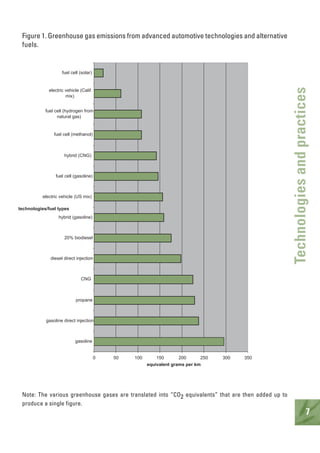
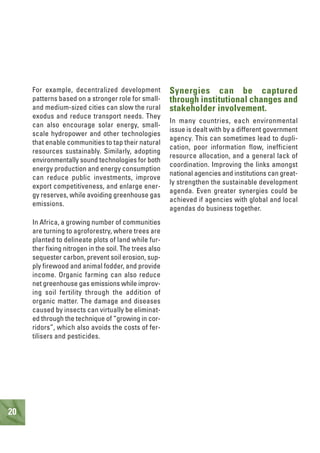
sions from transport (see Figure 1).
7
Figure 1. Greenhouse gas emissions from advanced automotive technologies and alternative
fuels.
0 50 100 150 200 250 300 350
gasoline
gasoline direct injection
propane
CNG
diesel direct injection
20% biodiesel
hybrid (gasoline)
electric vehicle (US mix)
fuel cell (gasoline)
hybrid (CNG)
fuel cell (methanol)
fuel cell (hydrogen from
natural gas)
electric vehicle (Calif.
mix)
fuel cell (solar)
technologies/fuel types
equivalent grams per km
Note: The various greenhouse gases are translated into “CO2 equivalents” that are then added up to
produce a single figure.
Technologiesandpractices
8
Industry’s main short-term option
is to enhance energy efficiency.
Industry accounts for over 40% of global
carbon dioxide emissions, and its energy
efficiency varies widely from country to
country. Short-term improvements may
come from combined heat and power co-
generation, other uses of waste-heat,
improved energy management, and innova-
tions in manufacturing processes. Improving
material efficiency through better product
design, recycling, and material substitution
can also reduce emissions. Energy effi-
ciency improvements will remain important
for industry over the longer term as well.
There are many options for
moving to cleaner energy
sources.
One of the sources promising fewer emis-
sions per unit of energy is natural gas,
which, though a fossil fuel, releases less
CO2 than coal or oil. Various forms of renew-
able energy can also cut emissions. These
include biomass sources, such as fuel-
wood, alcohol fermented from sugar, com-
bustible oils extracted from soy beans, and
methane gas emitted by waste dumps.
These sources will contribute to emissions
reductions if they are sustainably produced,
for example through regular replanting.
Where suitable land and water is available,
crops grown as biomass fuels can supple-
ment naturally existing biomass sources.
Other low- and zero-emissions renewables
include hydroelectricity, solar photovoltaics,
wind energy and hydrogen fuel cells. While
large-scale hydropower could make a
significant contribution to reducing emissions,
its use may be limited by concerns about its
impacts on human settlements and river
systems. The use of non-hydro renewables
continues to grow as their costs decline,
although their contribution to global energy
supplies is currently still below 2%.
Nuclear energy also emits virtually no
greenhouse gases. However, it faces pub-
lic concerns over safety, the transport and
disposal of radioactive wastes, and
weapons proliferation.
Meanwhile, new technologies have become
available that can capture carbon dioxide
emitted by fossil-fuel power plants before it
reaches the atmosphere. This could offer a
cost-competitive “clean fossil” energy alter-
native to renewables. The captured carbon
dioxide would be stored underground, in
empty oil or gas reservoirs, underground
water reservoirs, unused coal beds or in the
deep ocean. Some such applications are
already in operation. However, more
research is needed on reducing the costs
and assessing the possible risks and envi-
ronmental impacts.
Enhancing carbon sinks can par-
tially offset fossil fuel emissions.
As trees grow, they store carbon, thus keep-
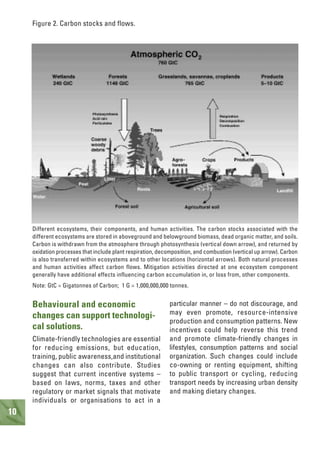
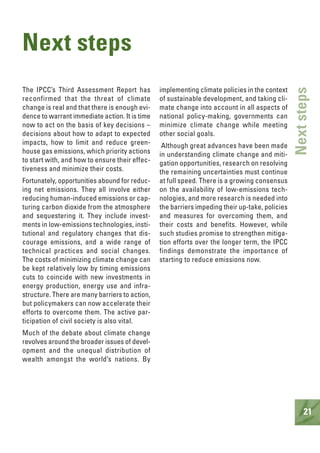
ing it out of the atmosphere (see Figure 2).
9
Technologiesandpractices
Sinks can therefore buy time for developing
low-emitting technologies. This can be
achieved by:
1. conserving existing carbon sinks,
for example by slowing or halting
deforestation;
2. expanding the size of carbon sinks, for
example by planting trees or enhancing
the ability of soil to retain carbon; and
3. substituting sustainably-produced
biological products for fossil fuels and
fossil-fuel-based products, for example
by using biomass fuels instead of coal or
oil for energy, or wood instead of steel
for construction.If properly managed,
forest and soil sinks may provide social,
economic and environmental benefits
beyond reducing atmospheric carbon
dioxide. Healthy forests that absorb CO2
can also conserve nature, prevent ero-
sion, and create rural employment. If
poorly managed, forests and soils can
cease storing CO2, lose biodiversity,
pollute groundwater and disrupt local
communities.
Even if the amount of carbon stored in trees,
vegetation and soils increases, there
remains a risk that CO2 will be released in
the future if the underlying ecosystem is
later disturbed by fire, land clearance or
other natural or human-induced changes.
Appropriate, long-term land management in
areas where carbon is stored is therefore
essential.
Conserving threatened forests may not
offset emissions if it simply displaces tree
cutting or clearing to other areas. To be
sustainable, a strategy for enhancing sinks
must address the broader socio-economic
causes of deforestation and other activities
that destroy carbon sinks.
Improved agricultural manage-
ment can boost carbon storage.
Carbon stored in agricultural soils can often
be preserved or enhanced through
no-tillage or low-tillage techniques, which
slow the rate at which organic soil matter
decomposes. Changing how a parcel of
land is used, for example from cropland to
grassland, to better suit its soil character-
istics, can also contribute. The introduction
of nitrogen-fixing legumes in grazing land
favours carbon storage. Reducing erosion
through terracing, windbreaks, and residue
management can further prevent losses of
carbon (as well as nitrogen). However, the
net effect of soil erosion on carbon storage
is still uncertain, because the carbon in
eroded soil may simply be deposited in soil
elsewhere and become at least partially
stabilized.
In rice fields, methane emissions can be
suppressed to some extent through tillage
practices, water management, and crop
rotation. In general, using nitrogen fertilizers
more efficiently can reduce emissions of
nitrous oxide, which is a powerful green-
house gas.
10
Figure 2. Carbon stocks and flows.
Different ecosystems, their components, and human activities. The carbon stocks associated with the
different ecosystems are stored in aboveground and belowground biomass, dead organic matter, and soils.
Carbon is withdrawn from the atmosphere through photosynthesis (vertical down arrow), and returned by
oxidation processes that include plant respiration, decomposition, and combustion (vertical up arrow). Carbon
is also transferred within ecosystems and to other locations (horizontal arrows). Both natural processes
and human activities affect carbon flows. Mitigation activities directed at one ecosystem component
generally have additional effects influencing carbon accumulation in, or loss from, other components.
Note: GtC = Gigatonnes of Carbon; 1 G = 1,000,000,000 tonnes.
Behavioural and economic
changes can support technologi-
cal solutions.
Climate-friendly technologies are essential
for reducing emissions, but education,
training, public awareness,and institutional
changes can also contribute. Studies
suggest that current incentive systems –
based on laws, norms, taxes and other
regulatory or market signals that motivate
individuals or organisations to act in a
particular manner – do not discourage, and
may even promote, resource-intensive
production and consumption patterns. New
incentives could help reverse this trend
and promote climate-friendly changes in
lifestyles, consumption patterns and social
organization. Such changes could include
co-owning or renting equipment, shifting
to public transport or cycling, reducing
transport needs by increasing urban density
and making dietary changes.
11
Costsandbenefits
Costs and benefits
Mitigation policies can have
both costs and benefits.
The costs of cutting emissions are likely to
be relatively certain, immediate, and borne
by an identifiable group. The benefits of
avoided climate change, however, will be
spread out over a longer period and may be
difficult to put a price tag on. Many of those
set to benefit are future generations and
industries that do not yet exist. In addition
to these direct costs and benefits, the full
equation must consider the indirect effects
of emissions reduction policies. These
“ancillary” effects are defined as the costs
and benefits of a policy over and beyond
avoided climate change. Many of these
effects, such as improved air quality and
reduced traffic congestion, involve imme-
diate benefits.
The costs of climate protection
depend on the assumptions
made.
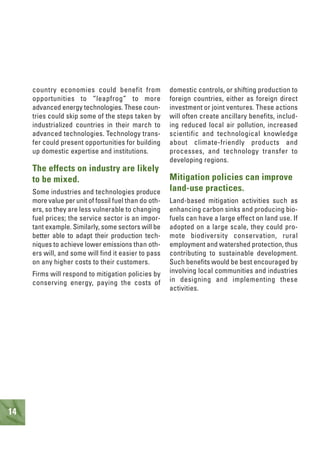
Mitigation costs are hotly debated by
economists and depend to a great degree on
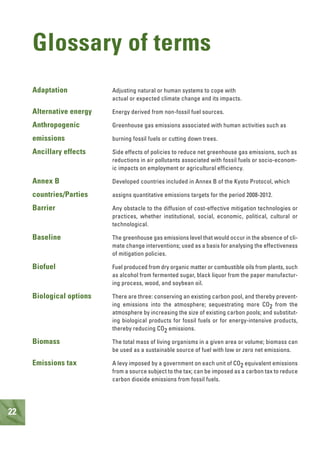
certain assumptions (see Figure 3):
• the definition of the baseline, that is, the
greenhouse gas emissions that would
occur in the absence of emissions
policies. The baseline helps determine
how expensive emissions cuts might
be. It is based on assumptions about
future population trends, economic
growth, and technological change.
• the discount rate, a measure that
economists use to compare future costs
and benefits to current costs and bene-
fits. A high discount rate reduces the
current importance of future costs and
benefits.
• the flexibility of government regulations.
The costs of cutting emissions are often
influenced by the regulations adopted by
national governments to address
climate change. The more flexibility
allowed by the regulations, the lower the
overall costs to the economy of achieving
a given reduction.
• the ancillary costs and benefits of emis-
sion reduction policies. Climate change
policies may have a number of indirect
side effects – both positive and negative
– on air pollution, transportation, agri-
culture, land-use practices, employ-
ment, and fuel security. Including these
impacts in the cost equation can lead to
higher or lower mitigation costs.
• the availability of “no regret options”,
which reduce greenhouse gas emis-
sions while generating direct or indirect
(ancillary) benefits large enough to off-
set their costs. In some calculation
methods, “no regret options” are left out.
Such zero-cost options may, of course,
not be sufficient by themselves to
achieve an emissions target and will
need to be supplemented by other meas-
ures. In addition, there may be social,
economic and other barriers to their
adoption.
12
Figure 3. A typical cost curve showing costs increasing with the level
of greenhouse gas reduction.
Marginal cost
of abatement
(US$/tC)
Abatement of
GHG emissions
B
0
A
Note: From A to B, marginal abatement costs are negative, representing no-regrets solutions.
From B onwards, marginal costs are positive.
Internationally traded emissions
allowances could lower costs.
Under an international system of tradable
emissions allowances – such as the system
established under the Kyoto Protocol – each
country may emit a certain quantity of
greenhouse gases each year. Countries that
can reduce their emissions cheaply may sell
their excess allowances to countries for
which domestic action is more expensive. In
this way, emissions will tend to be cut where
it is least expensive to do so, lowering the
overall cost. The more countries in the sys-
tem, the lower costs are likely to be. In gen-
eral, economists estimate that implementing
the Kyoto Protocol would reduce the pro-
jected gross domestic product of the OECD
(developed) countries by 0.2 – 2%. However,
an emissions trading system would lower
13
Costsandbenefits
this loss to an estimated 0.1 - 1% of future
GDP. Taking into account real-world trans-
action costs would increase estimated GDP
losses; taking into account sinks, reductions
in non-C02 greenhouse emissions, ancil-
lary benefits and other factors would further
reduce losses.
Developed country mitigation
policies could affect developing
country economies.
Because the global economy is so inter-
linked, actions by developed countries to
reduce greenhouse gas emissions have
implications for developing countries known
as “spill-over effects”. Such effects gener-
ally lead to increased emissions in devel-
oping countries, compensating for part of
the decline in developed countries. Current
estimates are that full-scale implementation
of the Kyoto Protocol may cause 5 - 20% of
the emissions cut in developed countries to
“leak” into developing countries.
For example, emissions cuts in developed
countries could lower oil demand and thus
international oil prices. Those countries not
trying to reduce their greenhouse emis-
sions could take advantage of the reduced
price and import more oil, boosting pro-
duction and thereby emitting more CO2 than
they would have otherwise. As a result,
oil-importing countries may benefit
economically while oil exporters see lower
revenues.
Another example involves decisions to
relocate carbon-intensive industries.
Studies suggest that companies may
respond to emissions controls in developed
countries by moving some facilities to
countries without such controls. Such
relocation would benefit developing
countries economically at the expense of
developed countries. Still another example
might be a decline in developing country
exports if emissions controls slow economic
growth in developed countries. Positive
examples of spill-over exist as well; one
would be the international spread of envi-
ronmentally sound technologies in response
to pressures to reduce emissions.
Action to reduce energy
emissions can have social and
economic implications.
Production and employment in the coal and
oil industries would decline. The natural gas
industry may or may not benefit over the next
20 years, depending on local availability, the
potential for gas to replace coal in power
generation, and other factors. The renew-
able energy sector should gain larger
markets, but much depends on technological
developments; in addition, the sector’s
prospects vary from region to region. Market
gains for renewables could encourage more
research and development as well as
investment, leading to lower costs and even
larger markets. Meanwhile, developing
14
country economies could benefit from
opportunities to “leapfrog” to more
advanced energy technologies. These coun-
tries could skip some of the steps taken by
industrialized countries in their march to
advanced technologies. Technology trans-
fer could present opportunities for building
up domestic expertise and institutions.
The effects on industry are likely
to be mixed.
Some industries and technologies produce
more value per unit of fossil fuel than do oth-
ers, so they are less vulnerable to changing
fuel prices; the service sector is an impor-
tant example. Similarly, some sectors will be
better able to adapt their production tech-
niques to achieve lower emissions than oth-
ers will, and some will find it easier to pass
on any higher costs to their customers.
Firms will respond to mitigation policies by
conserving energy, paying the costs of
domestic controls, or shifting production to
foreign countries, either as foreign direct
investment or joint ventures. These actions
will often create ancillary benefits, includ-
ing reduced local air pollution, increased
scientific and technological knowledge
about climate-friendly products and
processes, and technology transfer to
developing regions.
Mitigation policies can improve
land-use practices.
Land-based mitigation activities such as
enhancing carbon sinks and producing bio-
fuels can have a large effect on land use. If
adopted on a large scale, they could pro-
mote biodiversity conservation, rural
employment and watershed protection, thus
contributing to sustainable development.
Such benefits would be best encouraged by
involving local communities and industries
in designing and implementing these
activities.
15
Barriers to action
There are many barriers to the
diffusion of climate-friendly
technologies.
Despite the availability of effective tech-
nologies at relatively low costs, efforts to
control emissions are not very far advanced.
Why is this so? The IPCC concludes that a
wide range of barriers – technical, eco-
nomic, political, cultural, social, behaviour-
al and institutional – is obstructing oppor-
tunities for reducing emissions.
Institutional barriers exist to
some degree in all countries.
Many countries have limited human and
institutional capacity for implementing and
monitoring mitigation measures. This con-
strains and slows down the process of
adopting more efficient technologies to
replace those currently in use. The lack of
effective regulatory agencies is a further
constraint. Many countries have excellent
constitutional and legal provisions for envi-
ronmental protection but they are not
enforced. A further problem is limited or
lacking information; businesses and con-
sumers cannot make good decisions about
which technologies to use unless they pos-
sess the appropriate information.
Cultural barriers include current
lifestyles, behaviours, and con-
sumption patterns.
Social conditions can affect consumption
through, for example, the association of
certain objects with status and class. The
choice for more sustainable consumption
patterns depends not only on the match
between those patterns and the perceived
needs of individuals, but also on the extent
to which other consumption options are
known and available.
Economic barriers send
unhelpful signals to producers
and consumers.
Unstable macroeconomic conditions
increase general investment risks and can
discourage the early adoption of environ-
mentally sound technologies, which often
have high up-front costs. Certain taxes, fos-
sil fuel subsidies, trade barriers and other
policy interventions also slow the diffusion
of these technologies. Trade barriers may
favour inefficient technologies or prevent
access to efficient foreign technologies.
Technological barriers can exist
in the early stages of
a technology’s introduction.
New technologies may require infrastruc-
ture that is not initially available. For exam-
ple, the attractiveness of vehicles using
compressed natural gas depends on the
availability of convenient refuelling sites. At
the same time, the development of a fuel dis-
tribution infrastructure depends on there
being enough demand.
Barrierstoaction
16
Climate-friendly policies
and measures
Many different policies and
measures can help to overcome
barriers.
Policies and measures can be crafted to
influence a broad range of economic activ-
ities or just one specific sector. Any list of
possible options would likely include:
• taxes on emissions, carbon, or energy;
• subsidies for climate-friendly activities;
• deposit-refund systems for appliances,
batteries and other commodities;
• voluntary agreements, notably between
governments and the private sector;
• emissions trading regimes;
• regulations (such as energy-efficiency
standards for buildings);
• minimum performance standards for
technologies;
• bans on high-emitting products; and
• direct government investment in energy-
efficient technologies.
Policies and measures should
be selected only after rigorous
evaluation.
Key criteria to consider include:
• Environmental effectiveness. How well
will the policy achieve its goal of reducing
emissions? How reliably will it achieve that
goal? Will its effectiveness erode over time?
Will it create continual incentives to improve
products or processes in ways that reduce
emissions? Will the policy have wider
environmental effects, such as improved
local air quality?
• Cost-effectiveness. Will the policy
achieve its environmental goal at the lowest
cost, taking into account transaction, infor-
mation, and enforcement costs? What addi-
tional benefits will the policy or measure
have?
• Equity considerations. How will the
costs of achieving the environmental goal be
distributed across groups within society,
now and in the future? How will the policy
affect inflation, competitiveness, employ-
ment and trade?
• Administrative and political feasibility.
Will the policy or measure actually be imple-
mented? Is it politically acceptable? What
are the administrative requirements? Could
the policy be enforced? How will it interact
with other government objectives (such as
meeting fiscal targets)? Will it contribute to
changing attitudes and increasing aware-
ness of climate change?
Because the importance of these criteria
will differ according to time and place, most
governments will limit net emissions through
a portfolio of policy instruments, rather than
a single policy. In this way, policymakers can
combine the strengths of various policy
instruments while compensating for their
weaknesses, thus improving overall effec-
tiveness and efficiency.
17
Climate-friendlypoliciesandmeasures
Countries may benefit from
coordinating their policies and
measures.
Coordinating action among countries and
sectors could help address concerns about
competitiveness and potential conflicts with
international trade rules. It could also
reduce costs. Some options are:
• the Kyoto Protocol mechanisms, name-
ly joint implementation (JI), the clean
development mechanism (CDM) and
international emissions trading;
• an international tax on emissions, car-
bon, or energy;
• internationally coordinated product
standards; and
• international voluntary agreements.
Non-climate policies can also
affect greenhouse gas emis-
sions.
Examples include trade liberalization, price
and subsidy reforms and the opening of ener-
gy markets. Such macroeconomic policies
can create favourable conditions for pro-
moting climate-friendly investments.
18
Towards sustainable
development
Environment and development
issues are strongly interlinked.
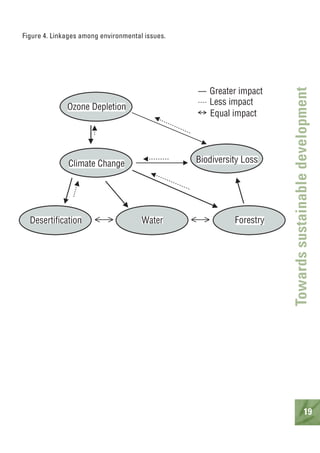
Climate change, biodiversity, desertifica-
tion, freshwater supplies, forests and pover-
ty are linked through a complex set of
physical, chemical, and biological processes
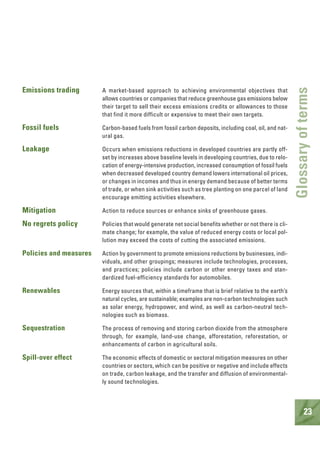
(see Figure 4). Climate change, for example,
alters the global hydrological cycle, affects
the functioning of ecological systems, and
accelerates land degradation and deserti-
fication. These negative impacts can rein-
force each other and seriously threaten
land productivity, food, freshwater supplies,
and biological diversity. Policies addressing
climate change can thus ameliorate other
problems. They can also involve trade-offs,
however. For example, depending on how it is
managed, large-scale tree planting aimed at
sequestering carbon could negatively affect
local biodiversity and local development
opportunities.
Treaties on environment and
sustainable development share
common goals and means.
The international community is addressing
environment and sustainable development
through a range of binding and non-binding
agreements. These agreements – the deser-
tification, biodiversity, climate change and
ozone treaties, for example – tend to inter-
act at many levels. They also share many
common features, requiring their members
to:
• build governmental and civil institutions
to implement internationally agreed
actions;
• formulate strategies and action plans as
a framework for country-level imple-
mentation;
• collectdataandreportontheirobligations;
and
• strengthen the capacity of both human
resources and institutions.
Coordinating the implementation of these
agreements at the local, national and inter-
national levels can reinforce their effec-
tiveness and avoid duplication of effort.
National policies can ensure that
climate change and sustainable
development goals are mutually
reinforcing.
Policies for limiting emissions can be more
effective when they take development
issues into account. Conversely, non-
climate policies can produce climate benefits.
Recognizing the potential for synergies
between climate and development can
lower the political and institutional
barriers for climate-specific measures.
Many synergies can be found in actions
related to industry, transportation, agricul-
ture, forestry, and human settlements.
19
Greater impact
Less impact
Equal impact
Towardssustainabledevelopment
Figure 4. Linkages among environmental issues.
20
For example, decentralized development
patterns based on a stronger role for small-
and medium-sized cities can slow the rural
exodus and reduce transport needs. They
can also encourage solar energy, small-
scale hydropower and other technologies
that enable communities to tap their natural
resources sustainably. Similarly, adopting
environmentally sound technologies for both
energy production and energy consumption
can reduce public investments, improve
export competitiveness, and enlarge ener-
gy reserves, while avoiding greenhouse gas
emissions.
In Africa, a growing number of communities
are turning to agroforestry, where trees are
planted to delineate plots of land while fur-
ther fixing nitrogen in the soil. The trees also
sequester carbon, prevent soil erosion, sup-
ply firewood and animal fodder, and provide
income. Organic farming can also reduce
net greenhouse gas emissions while improv-
ing soil fertility through the addition of
organic matter. The damage and diseases
caused by insects can virtually be eliminat-
ed through the technique of “growing in cor-
ridors”, which also avoids the costs of fer-
tilisers and pesticides.
Synergies can be captured
through institutional changes and
stakeholder involvement.
In many countries, each environmental
issue is dealt with by a different government
agency. This can sometimes lead to dupli-
cation, poor information flow, inefficient
resource allocation, and a general lack of
coordination. Improving the links amongst
national agencies and institutions can great-
ly strengthen the sustainable development
agenda. Even greater synergies could be
achieved if agencies with global and local
agendas do business together.
21
Nextsteps
Next steps
The IPCC’s Third Assessment Report has
reconfirmed that the threat of climate
change is real and that there is enough evi-
dence to warrant immediate action. It is time
now to act on the basis of key decisions –
decisions about how to adapt to expected
impacts, how to limit and reduce green-
house gas emissions, which priority actions
to start with, and how to ensure their effec-
tiveness and minimize their costs.
Fortunately, opportunities abound for reduc-
ing net emissions. They all involve either
reducing human-induced emissions or cap-
turing carbon dioxide from the atmosphere
and sequestering it. They include invest-
ments in low-emissions technologies, insti-
tutional and regulatory changes that dis-
courage emissions, and a wide range of
technical practices and social changes.
The costs of minimizing climate change can
be kept relatively low by timing emissions
cuts to coincide with new investments in
energy production, energy use and infra-
structure. There are many barriers to action,
but policymakers can now accelerate their
efforts to overcome them. The active par-
ticipation of civil society is also vital.
Much of the debate about climate change
revolves around the broader issues of devel-
opment and the unequal distribution of
wealth amongst the world’s nations. By
implementing climate policies in the context
of sustainable development, and taking cli-
mate change into account in all aspects of
national policy-making, governments can
minimize climate change while meeting
other social goals.
Although great advances have been made
in understanding climate change and miti-
gation opportunities, research on resolving
the remaining uncertainties must continue
at full speed. There is a growing consensus
on the availability of low-emissions tech-
nologies, and more research is needed into
the barriers impeding their up-take, policies
and measures for overcoming them, and
their costs and benefits. However, while
such studies promise to strengthen mitiga-
tion efforts over the longer term, the IPCC
findings demonstrate the importance of
starting to reduce emissions now.
22
Glossary of terms
Adaptation Adjusting natural or human systems to cope with
actual or expected climate change and its impacts.
Alternative energy Energy derived from non-fossil fuel sources.
Anthropogenic Greenhouse gas emissions associated with human activities such as
emissions burning fossil fuels or cutting down trees.
Ancillary effects Side effects of policies to reduce net greenhouse gas emissions, such as
reductions in air pollutants associated with fossil fuels or socio-econom-
ic impacts on employment or agricultural efficiency.
Annex B Developed countries included in Annex B of the Kyoto Protocol, which
countries/Parties assigns quantitative emissions targets for the period 2008-2012.
Barrier Any obstacle to the diffusion of cost-effective mitigation technologies or
practices, whether institutional, social, economic, political, cultural or
technological.
Baseline The greenhouse gas emissions level that would occur in the absence of cli-
mate change interventions; used as a basis for analysing the effectiveness
of mitigation policies.
Biofuel Fuel produced from dry organic matter or combustible oils from plants, such
as alcohol from fermented sugar, black liquor from the paper manufactur-
ing process, wood, and soybean oil.
Biological options There are three: conserving an existing carbon pool, and thereby prevent-
ing emissions into the atmosphere; sequestrating more CO2 from the
atmosphere by increasing the size of existing carbon pools; and substitut-
ing biological products for fossil fuels or for energy-intensive products,
thereby reducing CO2 emissions.
Biomass The total mass of living organisms in a given area or volume; biomass can
be used as a sustainable source of fuel with low or zero net emissions.
Emissions tax A levy imposed by a government on each unit of CO2 equivalent emissions
from a source subject to the tax; can be imposed as a carbon tax to reduce
carbon dioxide emissions from fossil fuels.
23
Glossaryofterms
Emissions trading A market-based approach to achieving environmental objectives that
allows countries or companies that reduce greenhouse gas emissions below
their target to sell their excess emissions credits or allowances to those
that find it more difficult or expensive to meet their own targets.
Fossil fuels Carbon-based fuels from fossil carbon deposits, including coal, oil, and nat-
ural gas.
Leakage Occurs when emissions reductions in developed countries are partly off-
set by increases above baseline levels in developing countries, due to relo-
cation of energy-intensive production, increased consumption of fossil fuels
when decreased developed country demand lowers international oil prices,
or changes in incomes and thus in energy demand because of better terms
of trade, or when sink activities such as tree planting on one parcel of land
encourage emitting activities elsewhere.
Mitigation Action to reduce sources or enhance sinks of greenhouse gases.
No regrets policy Policies that would generate net social benefits whether or not there is cli-
mate change; for example, the value of reduced energy costs or local pol-
lution may exceed the costs of cutting the associated emissions.
Policies and measures Action by government to promote emissions reductions by businesses, indi-
viduals, and other groupings; measures include technologies, processes,
and practices; policies include carbon or other energy taxes and stan-
dardized fuel-efficiency standards for automobiles.
Renewables Energy sources that, within a timeframe that is brief relative to the earth’s
natural cycles, are sustainable; examples are non-carbon technologies such
as solar energy, hydropower, and wind, as well as carbon-neutral tech-
nologies such as biomass.
Sequestration The process of removing and storing carbon dioxide from the atmosphere
through, for example, land-use change, afforestation, reforestation, or
enhancements of carbon in agricultural soils.
Spill-over effect The economic effects of domestic or sectoral mitigation measures on other
countries or sectors, which can be positive or negative and include effects
on trade, carbon leakage, and the transfer and diffusion of environmental-
ly sound technologies.
24
Stakeholders People or entities with interests that would be affected by a particular action
or policy.
Sequestration The process of removing and storing carbon dioxide from the atmosphere
through, for example, land-use change, afforestation, reforestation, or
enhancements of carbon in agricultural soils.
Spill-over effect The economic effects of domestic or sectoral mitigation measures on other
countries or sectors, which can be positive or negative and include effects
on trade, carbon leakage, and the transfer and diffusion of environmental-
ly sound technologies.
Stakeholders People or entities with interests that would be affected by a particular action
or policy.
Subsidy A direct payment from the government to an entity, or a tax reduction to that
entity, for implementing a practice the government wishes to encourage;
greenhouse gas emissions can be discouraged by reducing fossil-fuel sub-
sidies or granting subsidies for insulating buildings or planting trees.
Technology transfer An exchange of knowledge, money, or goods that promotes the spread of
technologies for adapting to or mitigating climate change; the term gener-
ally refers to the diffusion of technologies and technological co-operation
across and within countries.
Voluntary agreement An agreement between government and business, or a unilateral private-
sector commitment that is acknowledged by the government, aimed at
achieving environmental objectives or improving environmental perform-
ance.
Voluntary measures Measures to reduce greenhouse gas emissions that are adopted by firms
or other actors in the absence of government mandates; they can involve
making climate-friendly products or processes more readily available or
encouraging consumers to incorporate environmental values in their mar-
ket choices.
What do we know
about reducing
greenhouse
gas emissions?
A simplified guide to the IPCC’s
“Climate Change 2001: Mitigation”
Information Unit for Conventions
United Nations Environment
Programme
CH-1219 Geneva, Switzerland
Tel: +41 (22) 917 82 44 / 917 81 96
Fax: + 41 (22) 797 34 64
Web: www.unep.ch/conventions

ipcc_wg3_booklet

  • 1.
    What do weknow about reducing greenhouse gas emissions? A simplified guide to the IPCC’s “Climate Change 2001: Mitigation” Information Unit for Conventions United Nations Environment Programme CH-1219 Geneva, Switzerland Tel: +41 (22) 917 82 44 / 917 81 96 Fax: + 41 (22) 797 34 64 Web: www.unep.ch/conventions
  • 2.
    This guide hasbeen funded and produced by the United Nations Environment Programme with additional support from the Government of the Netherlands. For more information, please contact UNEP, Information Unit for Conventions, International Environment House, 15 chemin des Anémones, CH-1219 Châtelaine (Geneva), Switzerland; iuc@unep.ch; or +41-22-917-8244/8196. See also www.ipcc.ch, www.unep.org, and www.wmo.ch. All figures in this booklet are from “Climate Change 2001: Mitigation”, Intergovernmental Panel on Climate Change, Cambridge University Press, 2001. GE.0201807/E - September 2002 - 2000
  • 3.
    1 What do weknow about reducing greenhouse gas emissions? A simplified guide to the IPCC’s “Climate Change 2001: Mitigation” Foreword The concepts and conclusions presented by “Climate Change 2001: Mitigation”, part of the ground-breaking Third Assessment Report by the WMO/UNEP Intergovernmental Panel on Climate Change, are central to global action on climate change. While the first two volumes of the Report detail what is known about causes, impacts, and adap- tation – thus highlighting the need for action – the third volume on mitigation analyses how to take action by limiting net greenhouse gas emissions. Policymakers at the national and local levels, business leaders, community leaders,andconcernedindividualsand organ- izations can use these tools to make a real difference. This simplified guide briefly introduces and explains what Working Group Three – led by its co-chairs, Prof. Ogunlade Davidson of Sierra Leone and Dr. Bert Metz of The Netherlands – found when it assessed the peer-reviewed expert literature on mitigation. The guide is not an official document and has been neither approved nor accepted by the IPCC. Instead, it represents an effort to make the hundreds of pages of detailed and technical text that constitute the volume on “Mitigation” more accessible to a broader audience. It is my sincere hope that you will find this introduction useful in its own right and that it will serve as a stepping stone to further understanding and action. Klaus Töpfer Executive Director United Nations Environment Programme Whatdoweknowaboutreducinggreenhousegasemissions?
  • 4.
    2 The Intergovernmental Panelon Climate Change was established in 1988 by the World Meteorological Organization (WMO) and the United Nations Environment Programme (UNEP). The IPCC does not conduct new research. Instead, its mandate is to make policy-relevant assessments of the existing world-wide literature on the scientific, technical and socio-economic aspects of climate change. Most of this expert literature has appeared in peer- reviewed publications. The IPCC has produced a series of assess- ment reports, special reports, technical papers and methodologies that have become standard works of reference for climate change policymakers, experts, and students. The Panel is organized into three Working Groups: Working Group I focuses on the science of the climate system; Working Group II on impacts, vulnerability and adaptation; and Working Group III on mitigation, a term used to describe human interventions to reduce greenhouse gas emissions and to enhance “sinks” (forests, oceans and other natural systems that can absorb carbon dioxide from the atmosphere and store it). The IPCC’s First Assessment Report was completed in 1990 and helped to inspire the intergovernmental talks that led to the 1992 United Nations Framework Convention on Climate Change. Its Second Assessment Report was published in 1996 and played a role in the Kyoto Protocol negotiations. The 2001 Third Assessment Report concen- trated on new findings since 1995 and paid special attention to what is known about climate change at the regional level. About the IPCC
  • 5.
    3 Introduction Introduction Human activities suchas industry and agriculture are emitting carbon dioxide, methane and other greenhouse gases that change the way the atmosphere absorbs and re-emits energy. According to current projections, higher atmospheric concen- trations of these gases will cause the average global temperature to rise by 1.4 to 5.8°C by the year 2100. This warming would be much larger and much more rapid than any temperature change experienced over at least the last 10,000 years. It would have significant impacts on human society and the natural environment. Climate change will affect our future ability to satisfy human needs, in both positive and negative ways. It will alter agricultural con- ditions; local and regional trends in droughts, floods, and storms; stresses on buildings and other long-standing infra- structure; health risks; and much more. Many environmental changes that are con- sistent with global warming can already be detected today. Some degree of climate change is now inevitable due to past emissions. One essen- tial strategy for responding to this will be adaptation, which involves taking action to help communities and ecosystems cope with changing climate conditions. The second strategy, known as mitigation, is based on action to limit net emissions of greenhouse gases – defined as emissions minus removals by sinks (such as forests). Limiting emissions will slow and eventually reversetheriseinatmosphericconcentrations of greenhouse gases. (Because greenhouse gases remain in the atmosphere for decades or longer, atmospheric levels respond only gradually to lower emissions.) In this way, mitigation can minimize climate change and its expected negative impacts. The 185 member governments of the UN Climate Change Convention have agreed that their objective is to stabilize atmos- pheric concentrations of greenhouse gases at safe levels. How can this goal best be achieved? What are the most promising policies and technologies? What are their costs and benefits? What are the barriers to adopting them? And how can action on climate change be made mutually supportive with sustainable development? This booklet will explore the IPCC’s answers to these questions.
  • 6.
    4 Climate change isa global, complex, and long-term problem (up to several centuries) that is still not fully understood. Climate change involves complex interac- tions amongst climatic, environmental, eco- nomic, political, institutional, social and technological processes. While the IPCC reports reflect a broad scientific consensus on key points such as the reality of the risks involved, they also identify many uncertainties. Some of these relate to the complexity of natural systems, others to the fact that future human actions affecting climate change are as yet unknown. For example, the type, magnitude, timing and cost of mitigation depend on what is feasible – given differing national circumstances, socio- economic conditions and technologies – and on what emissions target has been agreed. The end result is that governments must take decisions on climate change under circumstances characterised by uncertainty and risk. Climate change is intimately linked to broader development issues. Climate change mitigation is not a stand- alone problem: It will both affect and be affected by socio-economic policies and by choices involving development, sustain- ability, and equity. Policies to limit net emis- sions can best promote sustainable development if they are consistent with broader societal objectives. Some mitigation actions can even promote benefits far beyond immediate climate concerns – such as reducing health problems, increasing local employment, minimizing air pollution, protecting and enhancing forests and watersheds, minimizing certain subsidies and taxes, and accelerating the develop- ment and diffusion of energy-efficient technologies. Similarly, development choices that promote sustainability may result in lower emissions. Equity concerns arise within and between countries and genera- tions. Equity issues are shaped by the unequal distribution of resources – technological, natural and financial – between countries and regions and between present and future generations. They reflect the ability of some countries (and generations) to reduce emis- sions more or less expensively than others can. Inequities are likely to be created or worsened by the impacts of climate change and of climate changes policies. Concern about equity led governments to incorporate the principle of “common but differentiated responsibilities” into the Climate Change Convention and to assign developed countries – the major emitters to date – responsibility for taking the lead on reducing emissions; developing countries have no quantitative emissions commitments but are expected to pursue development paths leading to lower emissions. What is the mitigation challenge?
  • 7.
    5 Climate-friendly energy sources arethe key to cutting emissions. Since fossil fuels are the primary source of greenhouse emissions, changing the way energy is produced and consumed will prove central to reducing emissions. Most available energy strategies involve moving away from fossil fuels and exploiting zero- or low-carbon sources. The extent to which the global energy mix evolves towards such sources will determine whether atmos- pheric concentrations of greenhouse gases are stabilized or reduced – and at what level and cost. Currently, most investment in energy production still goes towards discovering and developing more fossil fuel resources. Whatisthemitigationchallenge?
  • 8.
    6 Technologies and practices Many low-emissionstechnologies are available now – but they are not being fully exploited. Global emissions could be reduced below current levels within a few decades using technologies that are already available or being tested. These existing technologies might even suffice to stabilize atmospheric concentrations of carbon dioxide (CO2) over the next 100 years at levels well below twice pre-industrial levels (that is, well below 550 parts per million, compared to today’s 365). This would require transferring these technologies to countries and regions that currently lack them. In addition, many barriers to fully exploiting low-emissions technologies will have to be overcome. All economic sectors have seen a faster-than-expected development of climate-friendly technologies over the past decade. While it is essential that all sectors exploit new these technologies, two sectors of particular importance will be illustrated below. The first is energy and industry, which includes energy production plus energy use in transport, industry and buildings. Many technologies and practices involving conservation, increased fuel efficiency and alternative fuels are available for reducing energy-related emissions. The second key sector is agriculture and forestry. Here the main potential is for storing carbon in sinks and reducing emissions of methane and nitrous oxide through improved land management. All sectors can pursue energy conservation and efficiency improvements. Hundreds of technologies and practices exist for converting fossil fuels into energy more efficiently, thus reducing greenhouse gas emissions from households, infrastruc- ture, transport, and industry. For example, combined-cycle gas turbines – in which the heat from the burning fuel drives steam turbines while the thermal expansion of the exhaust gases drives gas turbines – may boost the efficiency of power generation by 70%; in the longer term, new technologies could double the efficiency of power plants. Meanwhile, fuel cells and other advanced automotive technologies can reduce emis- sions from transport (see Figure 1).
  • 9.
    7 Figure 1. Greenhousegas emissions from advanced automotive technologies and alternative fuels. 0 50 100 150 200 250 300 350 gasoline gasoline direct injection propane CNG diesel direct injection 20% biodiesel hybrid (gasoline) electric vehicle (US mix) fuel cell (gasoline) hybrid (CNG) fuel cell (methanol) fuel cell (hydrogen from natural gas) electric vehicle (Calif. mix) fuel cell (solar) technologies/fuel types equivalent grams per km Note: The various greenhouse gases are translated into “CO2 equivalents” that are then added up to produce a single figure. Technologiesandpractices
  • 10.
    8 Industry’s main short-termoption is to enhance energy efficiency. Industry accounts for over 40% of global carbon dioxide emissions, and its energy efficiency varies widely from country to country. Short-term improvements may come from combined heat and power co- generation, other uses of waste-heat, improved energy management, and innova- tions in manufacturing processes. Improving material efficiency through better product design, recycling, and material substitution can also reduce emissions. Energy effi- ciency improvements will remain important for industry over the longer term as well. There are many options for moving to cleaner energy sources. One of the sources promising fewer emis- sions per unit of energy is natural gas, which, though a fossil fuel, releases less CO2 than coal or oil. Various forms of renew- able energy can also cut emissions. These include biomass sources, such as fuel- wood, alcohol fermented from sugar, com- bustible oils extracted from soy beans, and methane gas emitted by waste dumps. These sources will contribute to emissions reductions if they are sustainably produced, for example through regular replanting. Where suitable land and water is available, crops grown as biomass fuels can supple- ment naturally existing biomass sources. Other low- and zero-emissions renewables include hydroelectricity, solar photovoltaics, wind energy and hydrogen fuel cells. While large-scale hydropower could make a significant contribution to reducing emissions, its use may be limited by concerns about its impacts on human settlements and river systems. The use of non-hydro renewables continues to grow as their costs decline, although their contribution to global energy supplies is currently still below 2%. Nuclear energy also emits virtually no greenhouse gases. However, it faces pub- lic concerns over safety, the transport and disposal of radioactive wastes, and weapons proliferation. Meanwhile, new technologies have become available that can capture carbon dioxide emitted by fossil-fuel power plants before it reaches the atmosphere. This could offer a cost-competitive “clean fossil” energy alter- native to renewables. The captured carbon dioxide would be stored underground, in empty oil or gas reservoirs, underground water reservoirs, unused coal beds or in the deep ocean. Some such applications are already in operation. However, more research is needed on reducing the costs and assessing the possible risks and envi- ronmental impacts. Enhancing carbon sinks can par- tially offset fossil fuel emissions. As trees grow, they store carbon, thus keep- ing it out of the atmosphere (see Figure 2).
  • 11.
    9 Technologiesandpractices Sinks can thereforebuy time for developing low-emitting technologies. This can be achieved by: 1. conserving existing carbon sinks, for example by slowing or halting deforestation; 2. expanding the size of carbon sinks, for example by planting trees or enhancing the ability of soil to retain carbon; and 3. substituting sustainably-produced biological products for fossil fuels and fossil-fuel-based products, for example by using biomass fuels instead of coal or oil for energy, or wood instead of steel for construction.If properly managed, forest and soil sinks may provide social, economic and environmental benefits beyond reducing atmospheric carbon dioxide. Healthy forests that absorb CO2 can also conserve nature, prevent ero- sion, and create rural employment. If poorly managed, forests and soils can cease storing CO2, lose biodiversity, pollute groundwater and disrupt local communities. Even if the amount of carbon stored in trees, vegetation and soils increases, there remains a risk that CO2 will be released in the future if the underlying ecosystem is later disturbed by fire, land clearance or other natural or human-induced changes. Appropriate, long-term land management in areas where carbon is stored is therefore essential. Conserving threatened forests may not offset emissions if it simply displaces tree cutting or clearing to other areas. To be sustainable, a strategy for enhancing sinks must address the broader socio-economic causes of deforestation and other activities that destroy carbon sinks. Improved agricultural manage- ment can boost carbon storage. Carbon stored in agricultural soils can often be preserved or enhanced through no-tillage or low-tillage techniques, which slow the rate at which organic soil matter decomposes. Changing how a parcel of land is used, for example from cropland to grassland, to better suit its soil character- istics, can also contribute. The introduction of nitrogen-fixing legumes in grazing land favours carbon storage. Reducing erosion through terracing, windbreaks, and residue management can further prevent losses of carbon (as well as nitrogen). However, the net effect of soil erosion on carbon storage is still uncertain, because the carbon in eroded soil may simply be deposited in soil elsewhere and become at least partially stabilized. In rice fields, methane emissions can be suppressed to some extent through tillage practices, water management, and crop rotation. In general, using nitrogen fertilizers more efficiently can reduce emissions of nitrous oxide, which is a powerful green- house gas.
  • 12.
    10 Figure 2. Carbonstocks and flows. Different ecosystems, their components, and human activities. The carbon stocks associated with the different ecosystems are stored in aboveground and belowground biomass, dead organic matter, and soils. Carbon is withdrawn from the atmosphere through photosynthesis (vertical down arrow), and returned by oxidation processes that include plant respiration, decomposition, and combustion (vertical up arrow). Carbon is also transferred within ecosystems and to other locations (horizontal arrows). Both natural processes and human activities affect carbon flows. Mitigation activities directed at one ecosystem component generally have additional effects influencing carbon accumulation in, or loss from, other components. Note: GtC = Gigatonnes of Carbon; 1 G = 1,000,000,000 tonnes. Behavioural and economic changes can support technologi- cal solutions. Climate-friendly technologies are essential for reducing emissions, but education, training, public awareness,and institutional changes can also contribute. Studies suggest that current incentive systems – based on laws, norms, taxes and other regulatory or market signals that motivate individuals or organisations to act in a particular manner – do not discourage, and may even promote, resource-intensive production and consumption patterns. New incentives could help reverse this trend and promote climate-friendly changes in lifestyles, consumption patterns and social organization. Such changes could include co-owning or renting equipment, shifting to public transport or cycling, reducing transport needs by increasing urban density and making dietary changes.
  • 13.
    11 Costsandbenefits Costs and benefits Mitigationpolicies can have both costs and benefits. The costs of cutting emissions are likely to be relatively certain, immediate, and borne by an identifiable group. The benefits of avoided climate change, however, will be spread out over a longer period and may be difficult to put a price tag on. Many of those set to benefit are future generations and industries that do not yet exist. In addition to these direct costs and benefits, the full equation must consider the indirect effects of emissions reduction policies. These “ancillary” effects are defined as the costs and benefits of a policy over and beyond avoided climate change. Many of these effects, such as improved air quality and reduced traffic congestion, involve imme- diate benefits. The costs of climate protection depend on the assumptions made. Mitigation costs are hotly debated by economists and depend to a great degree on certain assumptions (see Figure 3): • the definition of the baseline, that is, the greenhouse gas emissions that would occur in the absence of emissions policies. The baseline helps determine how expensive emissions cuts might be. It is based on assumptions about future population trends, economic growth, and technological change. • the discount rate, a measure that economists use to compare future costs and benefits to current costs and bene- fits. A high discount rate reduces the current importance of future costs and benefits. • the flexibility of government regulations. The costs of cutting emissions are often influenced by the regulations adopted by national governments to address climate change. The more flexibility allowed by the regulations, the lower the overall costs to the economy of achieving a given reduction. • the ancillary costs and benefits of emis- sion reduction policies. Climate change policies may have a number of indirect side effects – both positive and negative – on air pollution, transportation, agri- culture, land-use practices, employ- ment, and fuel security. Including these impacts in the cost equation can lead to higher or lower mitigation costs. • the availability of “no regret options”, which reduce greenhouse gas emis- sions while generating direct or indirect (ancillary) benefits large enough to off- set their costs. In some calculation methods, “no regret options” are left out. Such zero-cost options may, of course, not be sufficient by themselves to achieve an emissions target and will need to be supplemented by other meas- ures. In addition, there may be social, economic and other barriers to their adoption.
  • 14.
    12 Figure 3. Atypical cost curve showing costs increasing with the level of greenhouse gas reduction. Marginal cost of abatement (US$/tC) Abatement of GHG emissions B 0 A Note: From A to B, marginal abatement costs are negative, representing no-regrets solutions. From B onwards, marginal costs are positive. Internationally traded emissions allowances could lower costs. Under an international system of tradable emissions allowances – such as the system established under the Kyoto Protocol – each country may emit a certain quantity of greenhouse gases each year. Countries that can reduce their emissions cheaply may sell their excess allowances to countries for which domestic action is more expensive. In this way, emissions will tend to be cut where it is least expensive to do so, lowering the overall cost. The more countries in the sys- tem, the lower costs are likely to be. In gen- eral, economists estimate that implementing the Kyoto Protocol would reduce the pro- jected gross domestic product of the OECD (developed) countries by 0.2 – 2%. However, an emissions trading system would lower
  • 15.
    13 Costsandbenefits this loss toan estimated 0.1 - 1% of future GDP. Taking into account real-world trans- action costs would increase estimated GDP losses; taking into account sinks, reductions in non-C02 greenhouse emissions, ancil- lary benefits and other factors would further reduce losses. Developed country mitigation policies could affect developing country economies. Because the global economy is so inter- linked, actions by developed countries to reduce greenhouse gas emissions have implications for developing countries known as “spill-over effects”. Such effects gener- ally lead to increased emissions in devel- oping countries, compensating for part of the decline in developed countries. Current estimates are that full-scale implementation of the Kyoto Protocol may cause 5 - 20% of the emissions cut in developed countries to “leak” into developing countries. For example, emissions cuts in developed countries could lower oil demand and thus international oil prices. Those countries not trying to reduce their greenhouse emis- sions could take advantage of the reduced price and import more oil, boosting pro- duction and thereby emitting more CO2 than they would have otherwise. As a result, oil-importing countries may benefit economically while oil exporters see lower revenues. Another example involves decisions to relocate carbon-intensive industries. Studies suggest that companies may respond to emissions controls in developed countries by moving some facilities to countries without such controls. Such relocation would benefit developing countries economically at the expense of developed countries. Still another example might be a decline in developing country exports if emissions controls slow economic growth in developed countries. Positive examples of spill-over exist as well; one would be the international spread of envi- ronmentally sound technologies in response to pressures to reduce emissions. Action to reduce energy emissions can have social and economic implications. Production and employment in the coal and oil industries would decline. The natural gas industry may or may not benefit over the next 20 years, depending on local availability, the potential for gas to replace coal in power generation, and other factors. The renew- able energy sector should gain larger markets, but much depends on technological developments; in addition, the sector’s prospects vary from region to region. Market gains for renewables could encourage more research and development as well as investment, leading to lower costs and even larger markets. Meanwhile, developing
  • 16.
    14 country economies couldbenefit from opportunities to “leapfrog” to more advanced energy technologies. These coun- tries could skip some of the steps taken by industrialized countries in their march to advanced technologies. Technology trans- fer could present opportunities for building up domestic expertise and institutions. The effects on industry are likely to be mixed. Some industries and technologies produce more value per unit of fossil fuel than do oth- ers, so they are less vulnerable to changing fuel prices; the service sector is an impor- tant example. Similarly, some sectors will be better able to adapt their production tech- niques to achieve lower emissions than oth- ers will, and some will find it easier to pass on any higher costs to their customers. Firms will respond to mitigation policies by conserving energy, paying the costs of domestic controls, or shifting production to foreign countries, either as foreign direct investment or joint ventures. These actions will often create ancillary benefits, includ- ing reduced local air pollution, increased scientific and technological knowledge about climate-friendly products and processes, and technology transfer to developing regions. Mitigation policies can improve land-use practices. Land-based mitigation activities such as enhancing carbon sinks and producing bio- fuels can have a large effect on land use. If adopted on a large scale, they could pro- mote biodiversity conservation, rural employment and watershed protection, thus contributing to sustainable development. Such benefits would be best encouraged by involving local communities and industries in designing and implementing these activities.
  • 17.
    15 Barriers to action Thereare many barriers to the diffusion of climate-friendly technologies. Despite the availability of effective tech- nologies at relatively low costs, efforts to control emissions are not very far advanced. Why is this so? The IPCC concludes that a wide range of barriers – technical, eco- nomic, political, cultural, social, behaviour- al and institutional – is obstructing oppor- tunities for reducing emissions. Institutional barriers exist to some degree in all countries. Many countries have limited human and institutional capacity for implementing and monitoring mitigation measures. This con- strains and slows down the process of adopting more efficient technologies to replace those currently in use. The lack of effective regulatory agencies is a further constraint. Many countries have excellent constitutional and legal provisions for envi- ronmental protection but they are not enforced. A further problem is limited or lacking information; businesses and con- sumers cannot make good decisions about which technologies to use unless they pos- sess the appropriate information. Cultural barriers include current lifestyles, behaviours, and con- sumption patterns. Social conditions can affect consumption through, for example, the association of certain objects with status and class. The choice for more sustainable consumption patterns depends not only on the match between those patterns and the perceived needs of individuals, but also on the extent to which other consumption options are known and available. Economic barriers send unhelpful signals to producers and consumers. Unstable macroeconomic conditions increase general investment risks and can discourage the early adoption of environ- mentally sound technologies, which often have high up-front costs. Certain taxes, fos- sil fuel subsidies, trade barriers and other policy interventions also slow the diffusion of these technologies. Trade barriers may favour inefficient technologies or prevent access to efficient foreign technologies. Technological barriers can exist in the early stages of a technology’s introduction. New technologies may require infrastruc- ture that is not initially available. For exam- ple, the attractiveness of vehicles using compressed natural gas depends on the availability of convenient refuelling sites. At the same time, the development of a fuel dis- tribution infrastructure depends on there being enough demand. Barrierstoaction
  • 18.
    16 Climate-friendly policies and measures Manydifferent policies and measures can help to overcome barriers. Policies and measures can be crafted to influence a broad range of economic activ- ities or just one specific sector. Any list of possible options would likely include: • taxes on emissions, carbon, or energy; • subsidies for climate-friendly activities; • deposit-refund systems for appliances, batteries and other commodities; • voluntary agreements, notably between governments and the private sector; • emissions trading regimes; • regulations (such as energy-efficiency standards for buildings); • minimum performance standards for technologies; • bans on high-emitting products; and • direct government investment in energy- efficient technologies. Policies and measures should be selected only after rigorous evaluation. Key criteria to consider include: • Environmental effectiveness. How well will the policy achieve its goal of reducing emissions? How reliably will it achieve that goal? Will its effectiveness erode over time? Will it create continual incentives to improve products or processes in ways that reduce emissions? Will the policy have wider environmental effects, such as improved local air quality? • Cost-effectiveness. Will the policy achieve its environmental goal at the lowest cost, taking into account transaction, infor- mation, and enforcement costs? What addi- tional benefits will the policy or measure have? • Equity considerations. How will the costs of achieving the environmental goal be distributed across groups within society, now and in the future? How will the policy affect inflation, competitiveness, employ- ment and trade? • Administrative and political feasibility. Will the policy or measure actually be imple- mented? Is it politically acceptable? What are the administrative requirements? Could the policy be enforced? How will it interact with other government objectives (such as meeting fiscal targets)? Will it contribute to changing attitudes and increasing aware- ness of climate change? Because the importance of these criteria will differ according to time and place, most governments will limit net emissions through a portfolio of policy instruments, rather than a single policy. In this way, policymakers can combine the strengths of various policy instruments while compensating for their weaknesses, thus improving overall effec- tiveness and efficiency.
  • 19.
    17 Climate-friendlypoliciesandmeasures Countries may benefitfrom coordinating their policies and measures. Coordinating action among countries and sectors could help address concerns about competitiveness and potential conflicts with international trade rules. It could also reduce costs. Some options are: • the Kyoto Protocol mechanisms, name- ly joint implementation (JI), the clean development mechanism (CDM) and international emissions trading; • an international tax on emissions, car- bon, or energy; • internationally coordinated product standards; and • international voluntary agreements. Non-climate policies can also affect greenhouse gas emis- sions. Examples include trade liberalization, price and subsidy reforms and the opening of ener- gy markets. Such macroeconomic policies can create favourable conditions for pro- moting climate-friendly investments.
  • 20.
    18 Towards sustainable development Environment anddevelopment issues are strongly interlinked. Climate change, biodiversity, desertifica- tion, freshwater supplies, forests and pover- ty are linked through a complex set of physical, chemical, and biological processes (see Figure 4). Climate change, for example, alters the global hydrological cycle, affects the functioning of ecological systems, and accelerates land degradation and deserti- fication. These negative impacts can rein- force each other and seriously threaten land productivity, food, freshwater supplies, and biological diversity. Policies addressing climate change can thus ameliorate other problems. They can also involve trade-offs, however. For example, depending on how it is managed, large-scale tree planting aimed at sequestering carbon could negatively affect local biodiversity and local development opportunities. Treaties on environment and sustainable development share common goals and means. The international community is addressing environment and sustainable development through a range of binding and non-binding agreements. These agreements – the deser- tification, biodiversity, climate change and ozone treaties, for example – tend to inter- act at many levels. They also share many common features, requiring their members to: • build governmental and civil institutions to implement internationally agreed actions; • formulate strategies and action plans as a framework for country-level imple- mentation; • collectdataandreportontheirobligations; and • strengthen the capacity of both human resources and institutions. Coordinating the implementation of these agreements at the local, national and inter- national levels can reinforce their effec- tiveness and avoid duplication of effort. National policies can ensure that climate change and sustainable development goals are mutually reinforcing. Policies for limiting emissions can be more effective when they take development issues into account. Conversely, non- climate policies can produce climate benefits. Recognizing the potential for synergies between climate and development can lower the political and institutional barriers for climate-specific measures. Many synergies can be found in actions related to industry, transportation, agricul- ture, forestry, and human settlements.
  • 21.
    19 Greater impact Less impact Equalimpact Towardssustainabledevelopment Figure 4. Linkages among environmental issues.
  • 22.
    20 For example, decentralizeddevelopment patterns based on a stronger role for small- and medium-sized cities can slow the rural exodus and reduce transport needs. They can also encourage solar energy, small- scale hydropower and other technologies that enable communities to tap their natural resources sustainably. Similarly, adopting environmentally sound technologies for both energy production and energy consumption can reduce public investments, improve export competitiveness, and enlarge ener- gy reserves, while avoiding greenhouse gas emissions. In Africa, a growing number of communities are turning to agroforestry, where trees are planted to delineate plots of land while fur- ther fixing nitrogen in the soil. The trees also sequester carbon, prevent soil erosion, sup- ply firewood and animal fodder, and provide income. Organic farming can also reduce net greenhouse gas emissions while improv- ing soil fertility through the addition of organic matter. The damage and diseases caused by insects can virtually be eliminat- ed through the technique of “growing in cor- ridors”, which also avoids the costs of fer- tilisers and pesticides. Synergies can be captured through institutional changes and stakeholder involvement. In many countries, each environmental issue is dealt with by a different government agency. This can sometimes lead to dupli- cation, poor information flow, inefficient resource allocation, and a general lack of coordination. Improving the links amongst national agencies and institutions can great- ly strengthen the sustainable development agenda. Even greater synergies could be achieved if agencies with global and local agendas do business together.
  • 23.
    21 Nextsteps Next steps The IPCC’sThird Assessment Report has reconfirmed that the threat of climate change is real and that there is enough evi- dence to warrant immediate action. It is time now to act on the basis of key decisions – decisions about how to adapt to expected impacts, how to limit and reduce green- house gas emissions, which priority actions to start with, and how to ensure their effec- tiveness and minimize their costs. Fortunately, opportunities abound for reduc- ing net emissions. They all involve either reducing human-induced emissions or cap- turing carbon dioxide from the atmosphere and sequestering it. They include invest- ments in low-emissions technologies, insti- tutional and regulatory changes that dis- courage emissions, and a wide range of technical practices and social changes. The costs of minimizing climate change can be kept relatively low by timing emissions cuts to coincide with new investments in energy production, energy use and infra- structure. There are many barriers to action, but policymakers can now accelerate their efforts to overcome them. The active par- ticipation of civil society is also vital. Much of the debate about climate change revolves around the broader issues of devel- opment and the unequal distribution of wealth amongst the world’s nations. By implementing climate policies in the context of sustainable development, and taking cli- mate change into account in all aspects of national policy-making, governments can minimize climate change while meeting other social goals. Although great advances have been made in understanding climate change and miti- gation opportunities, research on resolving the remaining uncertainties must continue at full speed. There is a growing consensus on the availability of low-emissions tech- nologies, and more research is needed into the barriers impeding their up-take, policies and measures for overcoming them, and their costs and benefits. However, while such studies promise to strengthen mitiga- tion efforts over the longer term, the IPCC findings demonstrate the importance of starting to reduce emissions now.
  • 24.
    22 Glossary of terms AdaptationAdjusting natural or human systems to cope with actual or expected climate change and its impacts. Alternative energy Energy derived from non-fossil fuel sources. Anthropogenic Greenhouse gas emissions associated with human activities such as emissions burning fossil fuels or cutting down trees. Ancillary effects Side effects of policies to reduce net greenhouse gas emissions, such as reductions in air pollutants associated with fossil fuels or socio-econom- ic impacts on employment or agricultural efficiency. Annex B Developed countries included in Annex B of the Kyoto Protocol, which countries/Parties assigns quantitative emissions targets for the period 2008-2012. Barrier Any obstacle to the diffusion of cost-effective mitigation technologies or practices, whether institutional, social, economic, political, cultural or technological. Baseline The greenhouse gas emissions level that would occur in the absence of cli- mate change interventions; used as a basis for analysing the effectiveness of mitigation policies. Biofuel Fuel produced from dry organic matter or combustible oils from plants, such as alcohol from fermented sugar, black liquor from the paper manufactur- ing process, wood, and soybean oil. Biological options There are three: conserving an existing carbon pool, and thereby prevent- ing emissions into the atmosphere; sequestrating more CO2 from the atmosphere by increasing the size of existing carbon pools; and substitut- ing biological products for fossil fuels or for energy-intensive products, thereby reducing CO2 emissions. Biomass The total mass of living organisms in a given area or volume; biomass can be used as a sustainable source of fuel with low or zero net emissions. Emissions tax A levy imposed by a government on each unit of CO2 equivalent emissions from a source subject to the tax; can be imposed as a carbon tax to reduce carbon dioxide emissions from fossil fuels.
  • 25.
    23 Glossaryofterms Emissions trading Amarket-based approach to achieving environmental objectives that allows countries or companies that reduce greenhouse gas emissions below their target to sell their excess emissions credits or allowances to those that find it more difficult or expensive to meet their own targets. Fossil fuels Carbon-based fuels from fossil carbon deposits, including coal, oil, and nat- ural gas. Leakage Occurs when emissions reductions in developed countries are partly off- set by increases above baseline levels in developing countries, due to relo- cation of energy-intensive production, increased consumption of fossil fuels when decreased developed country demand lowers international oil prices, or changes in incomes and thus in energy demand because of better terms of trade, or when sink activities such as tree planting on one parcel of land encourage emitting activities elsewhere. Mitigation Action to reduce sources or enhance sinks of greenhouse gases. No regrets policy Policies that would generate net social benefits whether or not there is cli- mate change; for example, the value of reduced energy costs or local pol- lution may exceed the costs of cutting the associated emissions. Policies and measures Action by government to promote emissions reductions by businesses, indi- viduals, and other groupings; measures include technologies, processes, and practices; policies include carbon or other energy taxes and stan- dardized fuel-efficiency standards for automobiles. Renewables Energy sources that, within a timeframe that is brief relative to the earth’s natural cycles, are sustainable; examples are non-carbon technologies such as solar energy, hydropower, and wind, as well as carbon-neutral tech- nologies such as biomass. Sequestration The process of removing and storing carbon dioxide from the atmosphere through, for example, land-use change, afforestation, reforestation, or enhancements of carbon in agricultural soils. Spill-over effect The economic effects of domestic or sectoral mitigation measures on other countries or sectors, which can be positive or negative and include effects on trade, carbon leakage, and the transfer and diffusion of environmental- ly sound technologies.
  • 26.
    24 Stakeholders People orentities with interests that would be affected by a particular action or policy. Sequestration The process of removing and storing carbon dioxide from the atmosphere through, for example, land-use change, afforestation, reforestation, or enhancements of carbon in agricultural soils. Spill-over effect The economic effects of domestic or sectoral mitigation measures on other countries or sectors, which can be positive or negative and include effects on trade, carbon leakage, and the transfer and diffusion of environmental- ly sound technologies. Stakeholders People or entities with interests that would be affected by a particular action or policy. Subsidy A direct payment from the government to an entity, or a tax reduction to that entity, for implementing a practice the government wishes to encourage; greenhouse gas emissions can be discouraged by reducing fossil-fuel sub- sidies or granting subsidies for insulating buildings or planting trees. Technology transfer An exchange of knowledge, money, or goods that promotes the spread of technologies for adapting to or mitigating climate change; the term gener- ally refers to the diffusion of technologies and technological co-operation across and within countries. Voluntary agreement An agreement between government and business, or a unilateral private- sector commitment that is acknowledged by the government, aimed at achieving environmental objectives or improving environmental perform- ance. Voluntary measures Measures to reduce greenhouse gas emissions that are adopted by firms or other actors in the absence of government mandates; they can involve making climate-friendly products or processes more readily available or encouraging consumers to incorporate environmental values in their mar- ket choices.
  • 27.
    What do weknow about reducing greenhouse gas emissions? A simplified guide to the IPCC’s “Climate Change 2001: Mitigation” Information Unit for Conventions United Nations Environment Programme CH-1219 Geneva, Switzerland Tel: +41 (22) 917 82 44 / 917 81 96 Fax: + 41 (22) 797 34 64 Web: www.unep.ch/conventions