Download as PDF, PPTX
![use System;
public class DatePrinter {
public static void Main(string[] args)
{
Print(new DateTime());
}
public static void Print(DateTime d)
{
Console.WriteLine(d);
}
}](https://image.slidesharecdn.com/awayday-typesystems-pcalcado-090812033604-phpapp02/85/ThoughtWorks-Away-Day-2009-one-or-two-things-you-may-not-know-about-typesystems-8-320.jpg)
![☑
use System;
public class DatePrinter {
public static void Main(string[] args)
{
Print(new DateTime());
}
public static void Print(DateTime d)
{
Console.WriteLine(d);
}
}](https://image.slidesharecdn.com/awayday-typesystems-pcalcado-090812033604-phpapp02/85/ThoughtWorks-Away-Day-2009-one-or-two-things-you-may-not-know-about-typesystems-9-320.jpg)
![use System;
public class DatePrinter {
public static void Main(string[] args)
{
Print(null);
}
public static void Print(DateTime d)
{
Console.WriteLine(d);
}
}](https://image.slidesharecdn.com/awayday-typesystems-pcalcado-090812033604-phpapp02/85/ThoughtWorks-Away-Day-2009-one-or-two-things-you-may-not-know-about-typesystems-10-320.jpg)
![☒
use System;
public class DatePrinter {
public static void Main(string[] args)
{
Print(null);
}
public static void Print(DateTime d)
{
Console.WriteLine(d);
}
pcalcado@pcalcado:awayday2009$
gmcs
DatePrinter.cs
} DatePrinter.cs(7,5):
error
CS1502:
The
best
overloaded
method
match
for
`DatePrinter.Print(System.DateTime)'
has
some
invalid
arguments
DatePrinter.cs(10,22):
(Location
of
the
symbol
related
to
previous
error)
DatePrinter.cs(7,5):
error
CS1503:
Argument
`#1'
cannot
convert
`null'
expression
to
type
`System.DateTime'
Compilation
failed:
2
error(s),
0
warnings](https://image.slidesharecdn.com/awayday-typesystems-pcalcado-090812033604-phpapp02/85/ThoughtWorks-Away-Day-2009-one-or-two-things-you-may-not-know-about-typesystems-11-320.jpg)
![use System;
public class DatePrinter {
public static void Main(string[] args)
{
Print(null);
}
public static void Print(DateTime? d)
{
Console.WriteLine(d);
}
}](https://image.slidesharecdn.com/awayday-typesystems-pcalcado-090812033604-phpapp02/85/ThoughtWorks-Away-Day-2009-one-or-two-things-you-may-not-know-about-typesystems-12-320.jpg)
![☑
use System;
public class DatePrinter {
public static void Main(string[] args)
{
Print(null);
}
public static void Print(DateTime? d)
{
Console.WriteLine(d);
}
}](https://image.slidesharecdn.com/awayday-typesystems-pcalcado-090812033604-phpapp02/85/ThoughtWorks-Away-Day-2009-one-or-two-things-you-may-not-know-about-typesystems-13-320.jpg)
![“I call it my billion-dollar mistake. It was the
invention of the null reference in 1965. At that
time, I was designing the first comprehensive type
system [...] My goal was to ensure that all use of
references should be absolutely safe, with checking
performed automatically by the compiler. But I
couldn’t resist the temptation to put in a null
reference [...] This has led to innumerable errors
[...] which have probably caused a billion dollars of
pain and damage in the last forty years. In recent
years, a number of program analysers [...] in
Microsoft have been used to check references, and
give warnings if there is a risk they may be non-
null. More recent programming languages like Spec#
have introduced declarations for non-null references.
This is the solution, which I rejected in 1965.”
- C.A.R. Hoare](https://image.slidesharecdn.com/awayday-typesystems-pcalcado-090812033604-phpapp02/85/ThoughtWorks-Away-Day-2009-one-or-two-things-you-may-not-know-about-typesystems-14-320.jpg)
![public class NoError{
public static void main(String[] args){
Triangle t = new Triangle();
t.addVertex(0,0);
t.addVertex(10,10);
t.addVertex(20,20);
t.addVertex(30,30);
System.out.println("Your triangle has "+
t.getVertices().size() + " vertices");
}
}
class Triangle{
private List<int[]> vertices = new ArrayList<int[]>();
public void addVertex(int x, int y){
vertices.add(new int[]{x, y});
}
public List<int[]> getVertices(){
return vertices;
}
}](https://image.slidesharecdn.com/awayday-typesystems-pcalcado-090812033604-phpapp02/85/ThoughtWorks-Away-Day-2009-one-or-two-things-you-may-not-know-about-typesystems-26-320.jpg)
![Clojure
(defn add [a b]
(+ a b))
Dynamic](https://image.slidesharecdn.com/awayday-typesystems-pcalcado-090812033604-phpapp02/85/ThoughtWorks-Away-Day-2009-one-or-two-things-you-may-not-know-about-typesystems-33-320.jpg)
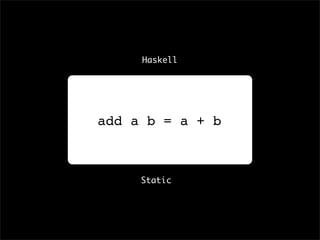
![add a b = a + b
Prelude>
:load
add.hs
[1
of
1]
Compiling
Main
(
add.hs,
interpreted
)
Ok,
modules
loaded:
Main.
*Main>
:type
add
add
::
(Num
a)
=>
a
‐>
a
‐>
a
*Main>
:type
(add
1
2)
(add
1
2)
::
(Num
t)
=>
t
*Main>](https://image.slidesharecdn.com/awayday-typesystems-pcalcado-090812033604-phpapp02/85/ThoughtWorks-Away-Day-2009-one-or-two-things-you-may-not-know-about-typesystems-36-320.jpg)
![“we think that people use eval as a poor
man’s substitute for higher-order
functions. Instead of passing around
a function and call it, they pass around
a string and eval it. [...]
A final use of eval that we want to
mention is for partial evaluation,multi-
stage programming, or meta programming.
We argue that in that case strings are
not really the most optimal structure to
represent programs and it is much better
to use programs to represent programs,
i.e. C++-style templates, quasiquote/
unquote as in Lisp, or code literals as
in the various multi-stage programming
languages.”
- The End of the Cold War Between Programming
Languages, Erik Meijer and Peter Drayton](https://image.slidesharecdn.com/awayday-typesystems-pcalcado-090812033604-phpapp02/85/ThoughtWorks-Away-Day-2009-one-or-two-things-you-may-not-know-about-typesystems-40-320.jpg)
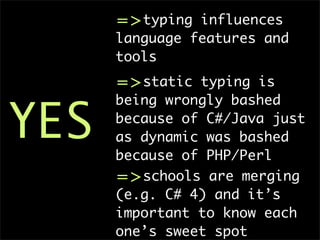
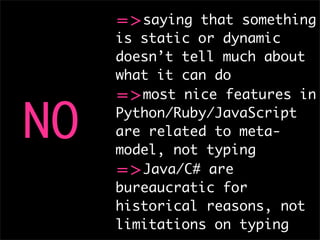

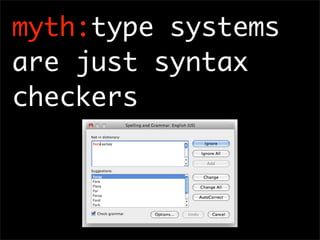
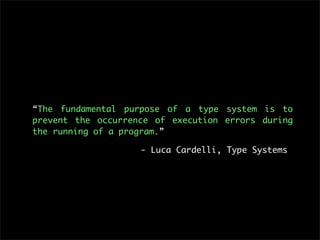
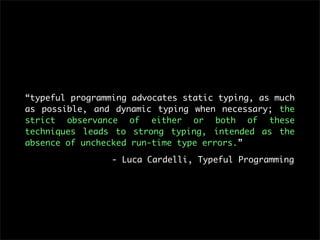
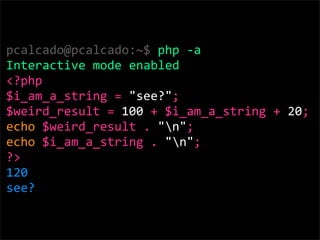
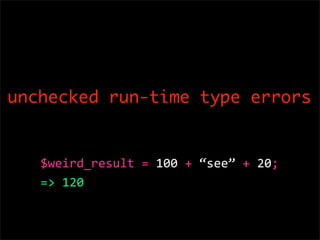
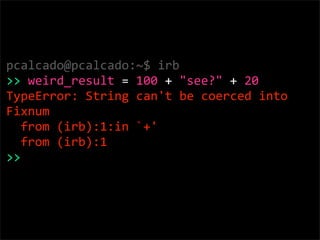
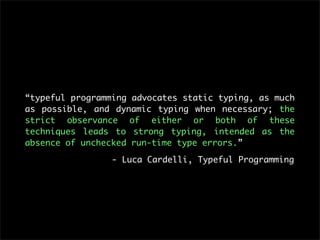
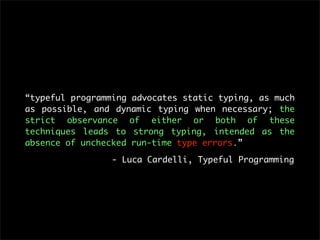
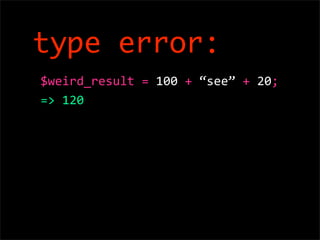
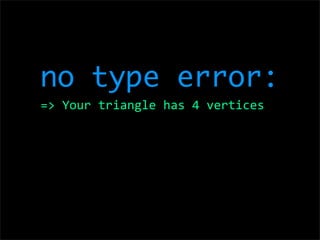
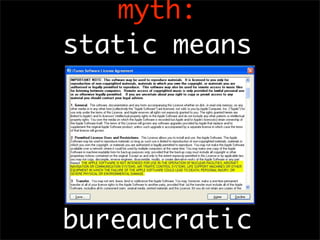
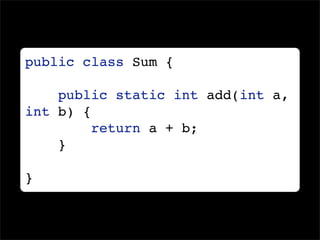
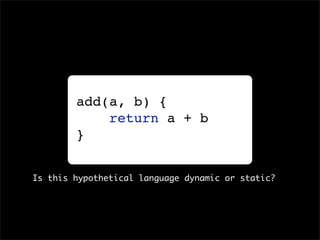
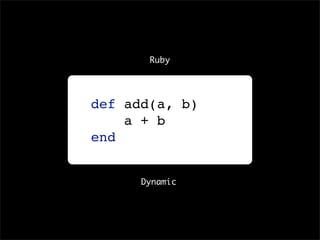
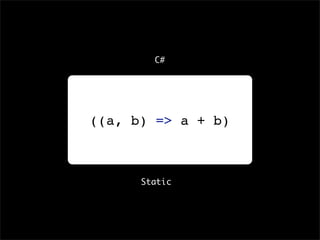
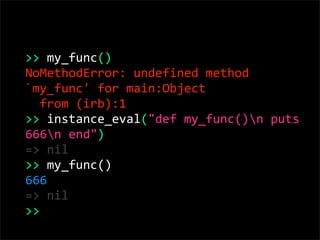
Type systems are not just syntax checkers, but are intended to prevent execution errors by catching type errors. Static typing catches errors at compile-time rather than run-time, as demonstrated by examples in Ruby and C#. While static typing can seem bureaucratic in some languages, it enables type inference and other "smart" features in languages like Haskell. Both static and dynamic typing are flexible depending on the language, as dynamic languages allow for eval and meta-programming while static languages have reflection and templates. Overall, typing influences language design and tools but flexible features depend more on the language's meta-model, while static languages can feel bureaucratic due to historical reasons rather than limitations of the typing model.


