MACHINE LEARNING MODELON ATTRITION ANALYSIS ON
IBM CLOUD USING SNAP RANDOM FOREST CLASSIFIER
ALGORITHM
CAPSTONE PROJECT
Presented By
P.Deeksha Sree
Vignan’s Institute of Management and Technology
CSE
2.
OUTLINE
Problem Statement
Proposed System/Solution
System Development Approach
Algorithm & Deployment
Result (Output Image)
Conclusion
Future Scope
References
3.
PROBLEM STATEMENT
The datasetcontains information about 1,000 employees,
including their demographics, job roles, and work-related
metrics, with an indication of whether they have left the
company (attrition). The goal is to understand the factors
influencing employee attrition and provide actionable insights to
reduce turnover.
4.
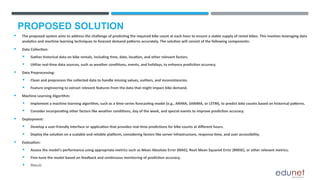
PROPOSED SOLUTION
Theproposed system aims to address the challenge of predicting the required bike count at each hour to ensure a stable supply of rental bikes. This involves leveraging data
analytics and machine learning techniques to forecast demand patterns accurately. The solution will consist of the following components:
Data Collection:
Gather historical data on bike rentals, including time, date, location, and other relevant factors.
Utilize real-time data sources, such as weather conditions, events, and holidays, to enhance prediction accuracy.
Data Preprocessing:
Clean and preprocess the collected data to handle missing values, outliers, and inconsistencies.
Feature engineering to extract relevant features from the data that might impact bike demand.
Machine Learning Algorithm:
Implement a machine learning algorithm, such as a time-series forecasting model (e.g., ARIMA, SARIMA, or LSTM), to predict bike counts based on historical patterns.
Consider incorporating other factors like weather conditions, day of the week, and special events to improve prediction accuracy.
Deployment:
Develop a user-friendly interface or application that provides real-time predictions for bike counts at different hours.
Deploy the solution on a scalable and reliable platform, considering factors like server infrastructure, response time, and user accessibility.
Evaluation:
Assess the model's performance using appropriate metrics such as Mean Absolute Error (MAE), Root Mean Squared Error (RMSE), or other relevant metrics.
Fine-tune the model based on feedback and continuous monitoring of prediction accuracy.
Result:
5.
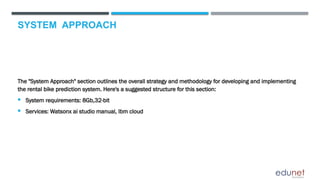
SYSTEM APPROACH
The "SystemApproach" section outlines the overall strategy and methodology for developing and implementing
the rental bike prediction system. Here's a suggested structure for this section:
System requirements: 8Gb,32-bit
Services: Watsonx ai studio manual, Ibm cloud
6.
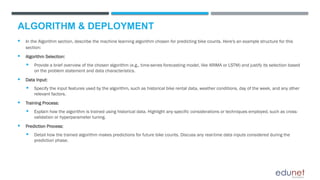
ALGORITHM & DEPLOYMENT
In the Algorithm section, describe the machine learning algorithm chosen for predicting bike counts. Here's an example structure for this
section:
Algorithm Selection:
Provide a brief overview of the chosen algorithm (e.g., time-series forecasting model, like ARIMA or LSTM) and justify its selection based
on the problem statement and data characteristics.
Data Input:
Specify the input features used by the algorithm, such as historical bike rental data, weather conditions, day of the week, and any other
relevant factors.
Training Process:
Explain how the algorithm is trained using historical data. Highlight any specific considerations or techniques employed, such as cross-
validation or hyperparameter tuning.
Prediction Process:
Detail how the trained algorithm makes predictions for future bike counts. Discuss any real-time data inputs considered during the
prediction phase.
CONCLUSION
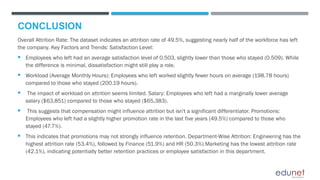
Overall Attrition Rate:The dataset indicates an attrition rate of 49.5%, suggesting nearly half of the workforce has left
the company. Key Factors and Trends: Satisfaction Level:
Employees who left had an average satisfaction level of 0.503, slightly lower than those who stayed (0.509). While
the difference is minimal, dissatisfaction might still play a role.
Workload (Average Monthly Hours): Employees who left worked slightly fewer hours on average (198.78 hours)
compared to those who stayed (200.19 hours).
The impact of workload on attrition seems limited. Salary: Employees who left had a marginally lower average
salary ($63,851) compared to those who stayed ($65,383).
This suggests that compensation might influence attrition but isn't a significant differentiator. Promotions:
Employees who left had a slightly higher promotion rate in the last five years (49.5%) compared to those who
stayed (47.7%).
This indicates that promotions may not strongly influence retention. Department-Wise Attrition: Engineering has the
highest attrition rate (53.4%), followed by Finance (51.9%) and HR (50.3%).Marketing has the lowest attrition rate
(42.1%), indicating potentially better retention practices or employee satisfaction in this department.
11.
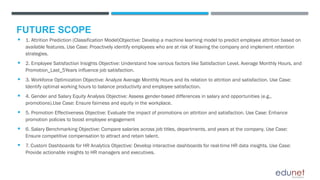
1. AttritionPrediction (Classification Model)Objective: Develop a machine learning model to predict employee attrition based on
available features. Use Case: Proactively identify employees who are at risk of leaving the company and implement retention
strategies.
2. Employee Satisfaction Insights Objective: Understand how various factors like Satisfaction Level, Average Monthly Hours, and
Promotion_Last_5Years influence job satisfaction.
3. Workforce Optimization Objective: Analyze Average Monthly Hours and its relation to attrition and satisfaction. Use Case:
Identify optimal working hours to balance productivity and employee satisfaction.
4. Gender and Salary Equity Analysis Objective: Assess gender-based differences in salary and opportunities (e.g.,
promotions).Use Case: Ensure fairness and equity in the workplace.
5. Promotion Effectiveness Objective: Evaluate the impact of promotions on attrition and satisfaction. Use Case: Enhance
promotion policies to boost employee engagement
6. Salary Benchmarking Objective: Compare salaries across job titles, departments, and years at the company. Use Case:
Ensure competitive compensation to attract and retain talent.
7. Custom Dashboards for HR Analytics Objective: Develop interactive dashboards for real-time HR data insights. Use Case:
Provide actionable insights to HR managers and executives.
FUTURE SCOPE


![IBM-HR-Analytics-Employee-Attrition-and-Performance[1].pptx](https://cdn.slidesharecdn.com/ss_thumbnails/ibm-hr-analytics-employee-attrition-and-performance1-251018181740-7e1d1f2b-thumbnail.jpg?width=640&height=640&fit=bounds)


![DA-_MID-II-Quiz_Bank[1] - Cop.............................y.docx](https://cdn.slidesharecdn.com/ss_thumbnails/da-mid-ii-quizbank1-copy-250613140452-dc99fb83-thumbnail.jpg?width=640&height=640&fit=bounds)

![JUnit_Guide_Expanded_Presentation[1].docx](https://cdn.slidesharecdn.com/ss_thumbnails/junitguideexpandedpresentation1-250613140244-8aa65372-thumbnail.jpg?width=640&height=640&fit=bounds)
![JUnit_Guide_Expanded_Presentation[1].docx](https://cdn.slidesharecdn.com/ss_thumbnails/junitguideexpandedpresentation1-250613140208-37dbf690-thumbnail.jpg?width=640&height=640&fit=bounds)
![JUnit_Guide_Expanded_Presentation[1].docx............................](https://cdn.slidesharecdn.com/ss_thumbnails/junitguideexpandedpresentation1-250613140128-a608bde9-thumbnail.jpg?width=640&height=640&fit=bounds)


