© Intuit Inc. All rights reserved. 
Employee Engagement at Intuit 
By Craig Ramsay 
With Martha Finney
© Intuit Inc. All rights reserved.  2 
Employee Engagement at Intuit 
By Craig S. Ramsay 
With Martha I. Finney 
Index 
Introduction  3 
The Case for Employee Engagement  7 
The Engagement Journey at Intuit  13 
The Foundation for Intuit’s Employee Engagement Culture and Practices  18 
Making Employee Engagement Meaningful and Real  30 
Steps for Establishing an Employee Engagement Culture in Your Company  41 
About Intuit and the Authors  49 
Appendix  50
© 2008 Intuit Inc. All rights reserved. No part of this material may be duplicated or
republished without prior written permission from Intuit Inc.
© Intuit Inc. All rights reserved.  3 
Introduction
In 2000, at a time when the technology sector was experiencing
significant transformation, Intuit was also undergoing vital changes.
A new CEO Steve Bennett, who joined Intuit from G.E. in January
2000, brought with him an enthusiasm for helping to grow the
company by building on the legendary innovation and customer-
driven expertise that founder Scott Cook has instituted at Intuit.
Steve focused his initial efforts on the business with Six Sigma
process excellence practices, and on Intuit’s organizational
capability through leadership development and talent management
practices.
Because Steve shared the Intuit philosophy about “It’s the people…”
which clearly states the prominent role employees play in the
success of the company, it’s not surprising that his initial
stakeholder focus was not solely on customers and shareholders…
but also on our employees! In fact, Steve’s first hire was the senior
head of Human Resources, Sherry Whiteley, to collaborate with him
every step of the way in creating a high performance organization
and a great place to work.
One of his first mandates to leadership was to identify those culture
characteristics, values, behaviors and leadership qualities that
make Intuit great -- not just for our customers but also for our
employees -- and he wanted them to be measurable. The task was
to understand the attributes that make the company a place where
our employees would be excited to come every day, do their very
best work, choose to stay despite tempting offers to go elsewhere,
and treat one another with dignity and respect.
Of course, the idea of developing a motivating and rewarding
workplace environment wasn’t exactly new. The Fortune 100 Best
Companies to Work For list, for instance, had already been well-
established and recognized for many years by that time. But Steve’s
mandate would take Intuit deeper into this field of inquiry, and
through a rigorous journey of self-discovery, establish us as one of
the model practitioners for what would soon be called employee
engagement. This conversation has since gone far beyond any
discussion of employee training, incentives, benefits, and programs,
and has required Intuit to dig deeply into the employee relationship
to examine more complex questions about real passion, inspiration,
dedication, and commitment. We have had to understand how our
people actually think, feel and act when they are “engaged.”
© Intuit Inc. All rights reserved.  4
Others have begun to notice what we’re doing to engage our
employees. We’ve been approached by consultants, academics, and
our colleagues in corporate leadership with requests for information
on our particular approach to building an extraordinary workplace
that attracts top talent and keeps people who want to do their best
work. And so, we have decided to create this document that
describes our essential point of view, approaches and the results
we’ve experienced so far.
This is not an exact science. Employee engagement should be an
ever-evolving, developing and improving approach to making a
workplace the best it can be for a company’s valued talent, who will,
in turn, invest their own passion, innovation and dedication to
making the company best in class. With that said, we’re offering a
description of our own approach, which you might be able to borrow
from to build an engagement framework for your company that can
be measured and gets results.
Before we get into the details of Intuit’s employee engagement
practices, let’s set some expectations about employee engagement.
You probably already know that helping employees to be highly
engaged has been proven to benefit essential business interests
such as productivity, customer satisfaction, innovation, quality,
attraction and retention of the best talent available. (We’ll get into
more specific evidence in the next section.) But we’d also like to
invite you to consider what employee engagement is not:
Employee engagement is not a nice thing to do. Skeptics (or at
least people experienced enough to have watched leadership trends
come and go) may be tempted to dismiss employee engagement as
another one of those “soft and fuzzy,” “feel-good” approaches to
people management. To the contrary, focusing on employee
engagement is a commitment to creating a winning workplace
environment -- a commitment that requires staying consistent to the
philosophy, even -- and especially -- in tough economic or industry
times. A commitment to fully engaged workforce will, at times, force
management to make some very tough, painful decisions.
Throughout the company, employees will hold their leaders
accountable for decisions that are made on their behalf, and such
accountability must be monitored. And to some extent this
accountability needs to be made public. And leadership will be
expected to commit itself again and again to the core, driving
principles of its engagement philosophy. If you’re going to do this,
you better be ready for the ride.
Employee engagement is not the sole purview of Human Resources.
Your company should not have anyone whose title is “VP of 
“We approach every 
discussion and interaction 
through a filter of 
authenticity and integrity 
without compromise. As a 
leader, I am always asking 
myself, ‘Are people growing 
and developing? Is 
everyone being heard? Am 
I drawing out the best in 
every individual? At the end 
of the day, have I shown up 
as the best I can possibly 
be?’” 
(Vice President of 
Procurement & Real Estate 
Services)
© Intuit Inc. All rights reserved.  5
Employee Engagement”. Even though employee engagement is
people-oriented, its only chance for true success is absolute
commitment from the top. In fact, the success of an engagement
focus is contingent on the extent to which it is aligned with the
values of the company and is driven by all the top leaders.
Regardless of the various “people” practices, processes and
programs that can be implemented, engaging employees starts with
examining the core values held by the company to understand what
they really mean when they talk about the importance and value of
people to the company. Even more importantly, the mindset and
behavior of leaders must reflect their belief in the importance of
employees. Ask yourself: Do your leaders truly believe that
company success is significantly dependent on consistently meeting
the needs of your people over time. Do their actions and decisions
demonstrate a genuine concern for employee well-being? Can they
sincerely articulate their own point of view about the value
employees bring to the company? “Yes” is the only answer that will
give employee engagement a chance for success in your
organization.
Employee engagement is not about free food or balloons or five-year
tenure plaques. Of course, various benefits, incentives, and other
amenities may be part of your company’s unique motivation and
appreciation culture, but true employee engagement cannot be
“bought.” Most employees’ sense of real engagement is affected by
their total experience of the company, their job, their coworkers and
the work environment over a sustained period, not by the perks that
they receive.
Employee engagement is not a one-size-fits-all proposition. There
may be an employee who enjoys balloons and new coffee mugs. In
that same department you will have another employee who would
prefer to take a few hours off in the afternoon to watch a child’s
soccer game. Some employees cherish their work because they see
how the company serves its customers in a deep and profound way
– or they truly enjoy the people they work with. Others value their
jobs because their steady paychecks enable them to send the first
generation of their family to college. While there are common
expectations of the workplace that apply to most employees, every
individual has their own unique set of needs…and even those needs
can change for the individual over time. So, a wise employee
engagement practice remembers that every individual has a
different set of values and imperatives in life, and as life changes,
so too do those needs. Valuing and honoring these individual
differences is the only way to help each employee be the best they
can be throughout their career journey with the company.
© Intuit Inc. All rights reserved.  6 
Employee engagement doesn’t require perfection to get started. You
can initiate a focus on employee engagement no matter what kind
of business you’re in or where your company is along its journey.
You don’t have to have a particularly enticing consumer product.
You don’t have to have top-of-the-line furnishings or interior design
in your workplace. You just have to be willing to look unblinkingly at
your company’s current condition and see how you actually value
employees – how well the current experience of your employees
aligns with whatever employee value proposition your leaders have
decided to stand by. And you have to be committed to taking not
only the first step but also stay the course for as long as your
company stands for those values.
Abraham Maslow once said, "What is necessary to change a person
is to change his awareness of himself." While he was originally
talking about individual self-actualization, the same can be said for
the adventure of initiating employee engagement in your company
and the growth and change that comes with making such a
commitment. As you will see in the Intuit story, employee
engagement starts with an exercise in thorough self-discovery. It is
this process that will launch you down the path toward best
practices in employee engagement, and you will return to it
repeatedly in the years to come. Again, you don’t have to be perfect.
But you must be willing to look. And see. And then take action.
So, knowing all of this, the question before us is: Is this an endeavor
you really want to undertake? You don’t have to. Employee
engagement isn’t for every company. But there are a few facts we
will all face in the next few years: A workforce shortage is in your
near future, if it’s not squarely in your lap already. People (especially
top employees) are going to have more choices in the work they do
and the companies they do it for. Consequently, we are going to see
a desperate attempt to attract and keep top talent among
companies across all industries and geographic regions. There are
organizations that will not recognize the importance of regarding
employees as key stakeholders in the success of the enterprise. And
there are firms that will not choose to inspire their people to perform
at their highest levels. And there are workplaces that will not decide
to address the one-at-a-time needs of each employee to feel like a
unique, contributing member of the organization.
The best employees will find companies that will.
© Intuit Inc. All rights reserved.  7 
The Case for Employee Engagement
Recently, workplace trends watchers have seized upon the notion
that employee engagement is the “new loyalty.” The idea is that the
“old loyalty” died with the passing of the old cradle-to-grave
employment contract, and that in the past, people were “loyal” to
companies because, in return, they had employment for life. With
the vast layoffs, downsizings and corporate reengineering of the
80’s and early 90’s, employees got the message: “You own your
own career. The company will not watch out for you.” Today’s
employees are looking out for Number One. This new, self-
determining frame of reference (which is really just smart career
consumerism) has created a transactional relationship between
workers and their companies. In this new reciprocal version of
loyalty, people will only invest their time and energy with a company
that is committed to satisfying their expectations.
Companies foster this new loyalty when they provide new and
challenging growth opportunities, promote the flexibility for
employees to work hard and have a life, help employees build
community with coworkers and make employees feel proud about
what the company does for customers and the community. In
summary, people will be loyal to a company that is loyal to them.
Engagement can flourish in a company where loyalty flows in both
directions, where both employers and employees are free and
equipped to make independent employment decisions, and where
both employers and employees willingly agree to engage each
other in a shared mission of thriving economically and serving their
ultimate vision, mission and purpose – according to a mutually
agreed-upon set of values and expectations.
Where the old loyalty put the burden of performance and
“measuring up” squarely on the shoulders of the employees, the
mutuality implied in employee engagement shifts some of the load
to the employer. And for leaders not already signed on to the
principles of employee engagement, it’s natural for them to wonder
if the results are worth the extra effort and trouble – especially if
the trade-off (balancing employee and employer needs) is
perceived as a loss of managerial power. 
Engagement Research
Over recent years, many academic, consulting and workplace
research firms have studied employee engagement and tracked
the results. And they generally agree that companies willing to
© Intuit Inc. All rights reserved.  8
undertake the sustained system-wide overhaul of their
employer/employee relationships have shown measurable return
on their investment and positive changes in their culture and
external competitiveness.
Academic researchers, consulting firms and employers have not yet
reached consensus on an accepted definition or construct that
measures employee engagement. Many concepts are offered as
elements of engagement: Satisfaction, job involvement, intrinsic
motivation, attachment, loyalty, affective commitment, intention to
stay, organizational citizenship behavior and discretionary effort.
A few consulting firms have created models and assessments
based on the established research and have used them to
measure engagement across thousands of employees. In its 2004
Employee Engagement Survey report, the Corporate Leadership
Council, for example, describes engagement as “the extent to
which employees commit to something or someone in their
organization and how hard they work and how long they stay as a
result of that commitment.”
Towers Perrin uses the expression “discretionary effort,” describing
it as the “extra time, brain power, and energy…employees’
willingness and ability to contribute to company success.” In its
2003 Talent Report, Towers Perrin expresses confidence in the
power of engagement: “…Engagement remains the ultimate prize
for employers…at a time when virtually every organization is
struggling with cutbacks and financial pressure -- trying to improve
performance with fewer people and dollars – having a critical mass
of employees who freely give that effort is of tremendous value.”
The report goes on to capture the absolutely essential multi-
dimensional aspect of employee engagement: “Think of it as
human power driving the financial and operational engine. The
greater the power, the better the engine performs on multiple
levels.”
Hewitt Associates does it in three words: Say, stay, strive. In other
words: Engaged employees are more likely to say good things about
their employers to friends, families, and potential customers; they
are more likely to stay with their current companies; and they are
more likely to throw in all the necessary additional effort to help
their companies achieve their shared goals.
How do these characteristics show up in the ways engaged
employees talk about their workplace experience? Generally
speaking, the research supports the following attitudes almost
universally shared by employees who work for companies 
“I absolutely love change. 
I love to be different. I love 
to be Number 1. And my 
teams know it. They have 
become so creative!” 
(Director of Service 
Delivery)
© Intuit Inc. All rights reserved.  9
committed to the principles of employee engagement,
consequently considering themselves active participants in
achieving their company’s prosperity and their own:
§ I am personally motivated to help my company succeed.
§ I can see the connection between my work and the company’s
overall success.
§ The company uses clear and regular communications to keep me
current on everything I need to know to be successful in my job.
§ My company is committed to equity and fairness.
§ My company’s values align with my personal values.
§ I believe in the future of my company.
§ There is clarity throughout the organization about roles and
responsibilities.
§ I willingly do work above and beyond the call of duty.
§ I respect, trust and admire the people I work with.
§ There is both formal and informal recognition of work well done.
§ I know that my company can quickly adapt to shifts in the economy
or our market.
§ My company cares about customer service and I have what I need
to serve my customers to their satisfaction.
§ I trust and understand the words and actions of senior management
and my direct supervisors.
§ If I’m offered a similar job at a different company, I would choose to
stay where I am.
On the face of it, how can anyone say no to the prospects and
promises of employees who feel this way about their jobs? But as
this report shows, implementing an employee engagement culture
requires total commitment from the very top of the organization, all
the way down to the individual contributors themselves. As multi-
faceted as the benefits may be, the efforts must also be taken in a
multi-dimensional way requiring determination, significant expense,
unblinking self-awareness, courage and patience. So it helps to be
very clear as to the many ways employee engagement provides a
compelling return on investment. 
Benefits of Employee Engagement 
Performance. Almost every research organization studying the
performance impacts of employee engagement has been able to
prove that the business units with engaged employees generally
have higher levels of productivity, profit and customer satisfaction
than the ones who don’t – even where those business units belong
to the same company. The Corporate Leadership Council, for
instance, found that engaged employees perform 20% better than
their non-engaged counterparts.
Likewise, ISR found that companies that scored high in employee
engagement – even during the tough economic period between
© Intuit Inc. All rights reserved.  10
1999 and 2001 – saw a 3.74% increase in operating margins and
a 2.06% increase in net profit margins. However, companies in the
low engagement groups underperformed, realizing negative results
in both operating and net profit margins. In a later study, ISR found
in 2004 that high-scoring companies surpassed their industry
average performance in net income growth by 6%. Companies with
low engagement scores underperformed in their industry by 9%.
Employee engagement benefits also show up in the stock market. A
study by Hewitt Associates of its own Best Employers list
(companies with 60% to 100% engaged employees) showed an
average of total shareholder return of 20.2%. Conversely,
companies with fewer than 40% engaged employees saw a
negative return (-9.6%). Companies that fell in between these two
groups in terms of percentage of engaged employees experienced
only a total shareholder return of 5.6%.
Talent Attraction and Retention. There was a time in the early
2000’s when the war for talent subsided somewhat as the
economy faltered. That time is over and the war for talent resumes.
The consulting firm Accenture reports that 41% of its surveyed
firms anticipate that their war for talent will be “significant to
severe” in upcoming years. Likewise, back in 2003, the Society for
Human Resource Job Recovery survey found that 64% of
employees were planning to look for new jobs, citing better
compensation, dissatisfaction with current career development,
poor management, boredom and conflict with their organization’s
values and mission as reasons for their decision to seek alternative
jobs.
If you are the only company in your industry known to have a high
engagement culture, you are most likely to attract and keep the
highest quality talent – thereby creating a virtuous cycle of industry
stars attracting one another and combining their passion and
talents to promote their company’s continued success. Conversely,
if your company is the only employer among your competitors that
isn’t implementing an employee engagement culture, you may end
up with lower-quality talent – those people who are still available
for employment because the higher-quality engagers have passed
them by.
Companies committed to employee engagement are also most
likely to keep the valuable talent they have brought onboard.
According to the Corporate Leadership Council, engaged employees
are not only higher performers, they are also 87% less likely to
leave their companies. (The Corporate Leadership Council
estimates that replacing front-line employees costs about 40% of
© Intuit Inc. All rights reserved.  11
their salary, and other studies show employee replacement costs
amounting to as much as 200% of their salaries).
Leadership Development. Great leadership and high employee
engagement go hand in hand. Across the board, companies with
high engagement scores find that the best get better. Because
there is such a high emphasis on self-awareness and personal
accountability for all levels of leadership at these companies, a
manager’s ability to engage employees keeps getting better. The
net effect for employees is both a positive job experience of and
better relationships with their bosses.
The 2006 Gallup Employee Engagement Index found that “happy
and engaged employees are much more likely to have a positive
relationship with their boss, are better equipped to handle new
challenges and changes, feel they are more valued by their
employers, handle stress more effectively, and are much more
satisfied with their lives….77% of engaged employees say their
supervisor focuses on strengths and positive characteristics….”
Physical Health and Personal Well-being. In the days of the old
loyalty, an employee’s physical condition and frame of mind may
have been considered extraneous to company concerns. However,
rising health care costs and the need to reduce expensive,
regrettable attrition have made employee well-being an essential
consideration for organizations that want to operate at peak
performance.
The 2006 Gallup Employee Engagement Index reported that 45%
of engaged workers reported a “great deal of overall happiness
from their work life,” and 53% said that they experienced “general
life fulfillment.” Conversely, this survey showed that 54% of
disengaged workers reported that job-related stress caused them
to behave poorly with family and friends.
A year earlier, the Gallup index reported that 62% of engaged
employees felt that their worklife positively affected their physical
health. And 54% of actively disengaged (the other extreme of the
engagement spectrum, where employees are so disaffected with
their jobs that they may sabotage their company’s efforts or
contaminate the culture for engaged employees) said their jobs
had a negative affect on their physical health. That same year 78%
of engaged workers reported that their work lives benefited them
psychologically, while 51% of actively disengaged employees felt
their work lives were having a negative impact on their mental well-
being.
© Intuit Inc. All rights reserved.  12 
The High Cost of Disengagement
Just as employee engagement has an active set of benefits for
employers who want to leverage their employees’ talents,
intelligence, energy and knowledge to create a mutually beneficial
future, employee disengagement can actively destroy a company’s
prospects for prosperity. Disengaged employees may speak
disparagingly about their company to their friends, family and
potential customers and employees. They will be unlikely to go the
extra mile in the service of customer satisfaction. They’ll indulge in
expensive, unnecessary absenteeism. And, perhaps worst of all,
they’ll spoil things for the moderately or extremely engaged
employees, who could, as a result, lose their own grip on their
loyalty to the company.
Not only would employers not want to have actively disengaged
employees on their rolls, companies also cannot afford to have
them in their employ. According to Gallup statistics, about 22.5
million workers in the United States are actively disengaged,
amounting to a loss of $350 billion in lost productivity.
With the presence of actively disengaged employees, many of those
wonderful advantages that engaged employees bring to the
workplace go to waste. In addition to the lost productivity
mentioned above, disengaged employees threaten a company’s
reputation in its community and industry; they present a risk of
sabotage of either the company’s products or the internal culture,
causing valued employees to leave in search of a healthier, more
productive workplace environment. The presence and effects of
actively disengaged employees threaten to destroy every
company’s most solid competitive advantage – the dedication and
commitment of its most valuable employees. 
Conclusion
If employee engagement is indeed a “new loyalty”, this two-way
transference of energy and commitment to realizing a prosperous
future is a self-evident argument to make. Every year new surveys
and new statistics prove out the fundamental principle that high-
quality employees deeply desire to benefit their companies and go
the extra mile to support their companies’ objectives and to provide
superior customer service. The case for employee engagement is
an obvious one to make: It’s not only the right thing to do, it’s also
simply good business.
© Intuit Inc. All rights reserved.  13 
The Engagement Journey at Intuit
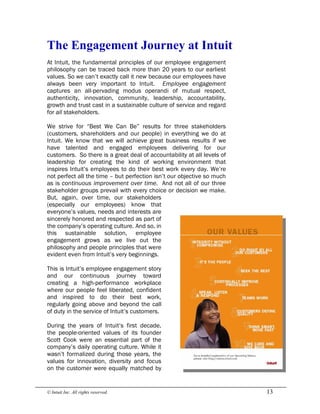
At Intuit, the fundamental principles of our employee engagement
philosophy can be traced back more than 20 years to our earliest
values. So we can’t exactly call it new because our employees have
always been very important to Intuit. Employee engagement
captures an all-pervading modus operandi of mutual respect,
authenticity, innovation, community, leadership, accountability,
growth and trust cast in a sustainable culture of service and regard
for all stakeholders.
We strive for “Best We Can Be” results for three stakeholders
(customers, shareholders and our people) in everything we do at
Intuit. We know that we will achieve great business results if we
have talented and engaged employees delivering for our
customers. So there is a great deal of accountability at all levels of
leadership for creating the kind of working environment that
inspires Intuit’s employees to do their best work every day. We’re
not perfect all the time – but perfection isn’t our objective so much
as is continuous improvement over time. And not all of our three
stakeholder groups prevail with every choice or decision we make.
But, again, over time, our stakeholders
(especially our employees) know that
everyone’s values, needs and interests are
sincerely honored and respected as part of
the company’s operating culture. And so, in
this sustainable solution, employee
engagement grows as we live out the
philosophy and people principles that were
evident even from Intuit’s very beginnings.
This is Intuit’s employee engagement story
and our continuous journey toward
creating a high-performance workplace
where our people feel liberated, confident
and inspired to do their best work,
regularly going above and beyond the call
of duty in the service of Intuit’s customers.
During the years of Intuit’s first decade,
the people-oriented values of its founder
Scott Cook were an essential part of the
company’s daily operating culture. While it
wasn’t formalized during those years, the
values for innovation, diversity and focus
on the customer were equally matched by
© Intuit Inc. All rights reserved.  14
the pervading value of respecting and valuing individual human
dignity and the contributions Intuit’s people brought to the
enterprise.
By Intuit’s 10th year in 1993, Cook wisely recognized the
importance of codifying Intuit’s values and formally establishing a
permanent philosophical map. Instead of unilaterally undertaking
this exercise himself, he put his people value into action by shutting
down for a one-day offsite, where the entire community of
employees could create and agree upon that set of operating
values.
Intuit continued to thrive over the next seven
years after the writing of those operating
values. But as the company grew and
matured some of its “familial” cultural norms,
like consensus driven decision making, were
holding Intuit back. In 2000, when Steve
Bennett was brought on board, he seriously
considered and then embraced all the
employee-written operating values (asking
permission to change only one word,
transforming the original Think Fast, Move
Fast to Think Smart, Move Fast).
Bennett shared the company’s belief that its
people were its primary source of competitive
advantage, especially in the software
industry. Knowing this, he got down to
business looking for a way to translate these
operating values into a set of rigorous,
measurable and accountable expectations of
the company and its leaders. Intuit already
had mechanisms for measuring satisfaction
from the customers’ standpoint, so now he
wanted to develop the same comprehensive
understanding of how the employees were
experiencing Intuit against its stated values.
Along with the newly hired senior vice president of HR, Sherry
Whiteley, Intuit’s leaders began asking themselves two driving
questions: “Our operating values state that employees are
important, but what are we really committing to the employees?”
and “What can we point to that says ‘this is what working at Intuit
should feel like according to employees’?”
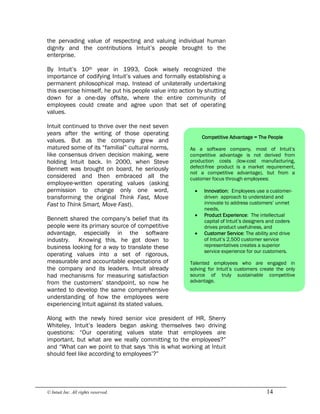
Competitive Advantage = The People
As a software company, most of Intuit’s
competitive advantage is not derived from
production costs (low-cost manufacturing,
defect-free product is a market requirement,
not a competitive advantage), but from a
customer focus through employees:
· Innovation: Employees use a customer-
driven approach to understand and
innovate to address customers’ unmet
needs,
· Product Experience: The intellectual
capital of Intuit’s designers and coders
drives product usefulness, and
· Customer Service: The ability and drive
of Intuit’s 2,500 customer service
representatives creates a superior
service experience for our customers.
Talented employees who are engaged in
solving for Intuit’s customers create the only
source of truly sustainable competitive
advantage.
© Intuit Inc. All rights reserved.  15
Our senior leaders traveled to all sites in the
company asking employee groups: “What would
it take for us to ensure that this is a great place
to work and a high-performing organization?
What would that look like to you?” Because of
the high-touch, pro-people culture already
established inside Intuit, people could trust that
the leaders were sincere in seeking out the
answers. And so they started talking. Out of
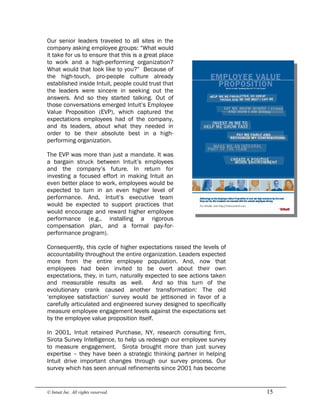
those conversations emerged Intuit’s Employee
Value Proposition (EVP), which captured the
expectations employees had of the company,
and its leaders, about what they needed in
order to be their absolute best in a high-
performing organization.
The EVP was more than just a mandate. It was
a bargain struck between Intuit’s employees
and the company’s future. In return for
investing a focused effort in making Intuit an
even better place to work, employees would be
expected to turn in an even higher level of
performance. And, Intuit’s executive team
would be expected to support practices that
would encourage and reward higher employee
performance (e.g., installing a rigorous
compensation plan, and a formal pay-for-
performance program).
Consequently, this cycle of higher expectations raised the levels of
accountability throughout the entire organization. Leaders expected
more from the entire employee population. And, now that
employees had been invited to be overt about their own
expectations, they, in turn, naturally expected to see actions taken
and measurable results as well. And so this turn of the
evolutionary crank caused another transformation: The old
‘employee satisfaction’ survey would be jettisoned in favor of a
carefully articulated and engineered survey designed to specifically
measure employee engagement levels against the expectations set
by the employee value proposition itself.
In 2001, Intuit retained Purchase, NY, research consulting firm,
Sirota Survey Intelligence, to help us redesign our employee survey
to measure engagement. Sirota brought more than just survey
expertise – they have been a strategic thinking partner in helping
Intuit drive important changes through our survey process. Our
survey which has seen annual refinements since 2001 has become
© Intuit Inc. All rights reserved.  16
a popularly anticipated event – we get close to 95% participation
every year - and an essential tool for driving improvements
throughout the year.
The survey process itself has been a significant catalyst for driving
an understanding of engagement and a set of engagement
practices into our culture over the past few years. It has given our
employees a means to honestly express their needs with the
confidence that action will be taken. And it has facilitated the
development of natural leader behaviors that help them focus on
and respond to employee needs. 
Today
While a lot of attention is still paid to the annual survey results, it is
the day-to-day experiences employees have that make engagement
come alive in the context of our culture today. Much of the
responsibility for manifesting our values as behaviors and choices
lands squarely on the heads of all the people who lead, manage
and supervise Intuit employees. While we don’t expect absolute
perfection at all supervisory levels throughout the year, we look for
continuing progress. And, frankly, some managers – actually, some
stars in other aspects of their work – have lost their jobs because
year to year they showed no signs of adopting the engagement
mindset by integrating the values behind our EVP into their own
leadership styles. But the principles of employee engagement must
prevail over time. Otherwise it loses its resonance and meaning to
employees - it becomes just another program, another flavor of the
month.
At this writing, our employee engagement culture has been in place
for over five years, and with every passing day it evolves,
transforms, improves to more accurately reflect and serve what is
most important to all our employees. In the past two years, we
have expanded our engagement focus to include all points along
the ‘employment lifecycle.’ This longitudinal look at the ‘total
people experience’ allows us to understand what is most important
from the time people first become aware of Intuit as an employer,
through their experiences as a candidate and a new hire, to the
various phases of their tenure as an Intuit employee, to the
experiences they have in their last days and after they leave.
By understanding the end-to-end employee experience, we have
the insights, skills, tools and resources we need to continuously
improve the way we deliver an engaging experience to Intuit’s
people throughout their journey with the organization. We want
© Intuit Inc. All rights reserved.  17
every employee to feel inspired to be their very best while delivering
for customers and fueling company growth, and all the while, be
having such a great experience with Intuit that they can’t imagine
having a better experience anywhere else. To this end (as you will
see later in this report), our programs, processes and practices
cover as many aspects of our employees’ lives as we can
anticipate, and then even more as employees bring their needs,
desires and ambitions to our attention.
Yes, we continue to measure the way these efforts are experienced
in an annual employee survey. But it is the day-to-day interaction in
the hallways; it’s the casual conversations in employees’ cubicles;
it’s the celebrations of new marriages and new babies; it’s our
presence in our communities through company-sponsored
volunteerism and giving; it’s the transparency of our plans,
approaches, even our executives’ own personal plans for
improvement; it’s the way we help our employees solve for their
customers’ needs while we help their supervisors solve for their
employees’ needs; it’s the way we learn from our mistakes and use
those lessons to build new knowledge, technique and processes;
it’s the way we help our people put their own families first; it’s the
way we build our own road to the future by helping our employees
build a visible future for themselves – it’s all those things that
make our employee engagement come alive.
A Steve Bennett mantra that is still with us is “talented and
engaged employees delivering for customers.” His mandate to the
entire company: Get great at what you do. Do the best job you can.
Tell us how we can do it better. Listen to and solve for your
customers. And everything else will follow.
And the ongoing story is that we continue to do the right things to
institutionalize that mandate and make it accessible to everyone.
© Intuit Inc. All rights reserved.  18 
The Foundation for Intuit’s Employee 
Engagement Culture and Practices
Establishing employee engagement as a natural part of our
company culture required that Intuit commit itself to a mindset
and management practices for continually gathering feedback and
taking visible actions to meet employee needs. In this section, we
describe the fundamental frameworks and processes that have
helped us define employee engagement and measure
engagement levels at Intuit.
The ideal engagement measurement system should show:
§ How the company is performing against its Employee Value Proposition,
§ How engaged employees actually are at various key points in their
journey with the company,
§ What sorts of environmental factors are driving engagement levels, and
§ What impact engagement levels might have on important employee
outcomes.
Our process clearly assesses each employee’s experience of the
company and his or her work, and shows how this experience is
affecting her or his level of motivation. When examined across all
our employees, we can determine the relationship between
engagement and other important indicators such as turnover,
performance and customer satisfaction. 
Definition of “Employee Engagement”
To establish a framework for measuring engagement at Intuit, we
had to start by developing our own clear definition of employee
engagement. When we first started using this phrase in the early
2000’s it may have well been completely interchangeable with
employee “satisfaction,” “commitment,” or “motivation” in our
conversations. So, over the first couple of years, we began to
research the engagement concept to discover for ourselves what
makes it different and what it means to Intuit. We talked to our
leaders and employees to gather their knowledge and points of
view; benchmarked with other research groups; spoke with
consulting firms; and we read an extensive amount of academic
literature – and if anything, we learned that we were not the only
ones trying to understand the subject of employee engagement.
As of this writing, we are not aware of any construct for defining
and measuring employee engagement that is universally accepted
by management theorists, practitioners or academicians.
© Intuit Inc. All rights reserved.  19 
The “Outside­In” View
According to our review of available research, the concept of
engagement has been described by most organizational
psychology experts as having both psychological and behavioral
aspects. Many take a multi-dimensional view and define
engagement as a work-related mindset that is influenced by
individual traits, cognitive and emotional states, and/or
characterized by highly motivated behaviors. Some find that it is
a more persistent motivational state - not affected by any
particular event – but determined by characteristics of the
workplace environment experienced over time. Others have
suggested that it is the opposite of job burnout.
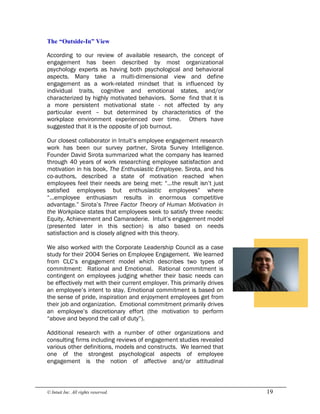
Our closest collaborator in Intuit’s employee engagement research
work has been our survey partner, Sirota Survey Intelligence.
Founder David Sirota summarized what the company has learned
through 40 years of work researching employee satisfaction and
motivation in his book, The Enthusiastic Employee. Sirota, and his
co-authors, described a state of motivation reached when
employees feel their needs are being met: “…the result isn’t just
satisfied employees but enthusiastic employees” where
“…employee enthusiasm results in enormous competitive
advantage.” Sirota’s Three Factor Theory of Human Motivation in
the Workplace states that employees seek to satisfy three needs:
Equity, Achievement and Camaraderie. Intuit’s engagement model
(presented later in this section) is also based on needs
satisfaction and is closely aligned with this theory.
We also worked with the Corporate Leadership Council as a case
study for their 2004 Series on Employee Engagement. We learned
from CLC’s engagement model which describes two types of
commitment: Rational and Emotional. Rational commitment is
contingent on employees judging whether their basic needs can
be effectively met with their current employer. This primarily drives
an employee’s intent to stay. Emotional commitment is based on
the sense of pride, inspiration and enjoyment employees get from
their job and organization. Emotional commitment primarily drives
an employee’s discretionary effort (the motivation to perform
“above and beyond the call of duty”).
Additional research with a number of other organizations and
consulting firms including reviews of engagement studies revealed
various other definitions, models and constructs. We learned that
one of the strongest psychological aspects of employee
engagement is the notion of affective and/or attitudinal
© Intuit Inc. All rights reserved.  20
investment in one’s work. These feelings of commitment, value
and involvement have several key components:
§ The sense of value and worth the individual feels as part of the
organization,
§ The feelings of pride for, and satisfaction with the organization,
§ The sense of personal investment in, dedication to, and attachment to
the job or organization,
§ The feelings of connection and community within the organization, and
§ The inspiration and motivation to grow and contribute to make things
better.
Although we did not find a common construct for engagement, the
external research did help shape our thinking. To develop our own
definition and model, we rationalized these external viewpoints
with our own culture by interviewing 100’s of employees,
managers and executive leaders. Our employee survey team
hosted focus groups to understand from employees what most
energizes and motivates them. We heard employees tell us that
an “engaged employee” at Intuit is passionate about delivering
high performance because this is the place where they feel they
get to do their best work. They also said they care a great deal
about our customers, and the success of the company, as well as
their own fulfillment and achievement. In addition, a cross-
functional team of Intuit’s senior managers (part of Intuit’s Action
Learning Program) talked to each one of our executive staff to
elicit their definition of employee engagement and best practices
for building engagement in their organizations. This team also
interviewed 100’s of employees to determine, from the employee
perspective, what management behaviors had the biggest impact
on their engagement. (See the appendix for a complete list of
these behaviors.)
Based on this research we developed a definition of employee
engagement that works for Intuit. We believe that employee
engagement is the emotional and intellectual state -- or mindset --
our employees have about Intuit and their work experience. But it
is not just a feeling or an attitude; it is a motivated state of being,
compelling our employees into action. We define employee
engagement as “how an Intuit employee thinks and feels about,
and acts towards his or her job, the work experience and Intuit.”
The fact that we could not find a widely-accepted construct that
measures engagement has not stopped Intuit from developing our
own. Through the very process of developing a definition and
measurement practice that works within the context of our culture,
we have established a meaning of engagement that works for us.
This is probably more powerful than had we adopted a “standard.”
© Intuit Inc. All rights reserved.  21 
Building a Model
Because our model is founded in needs satisfaction, our research
efforts also included identifying the motivational factors that might
influence an employee’s level of engagement. We started with a
review of the various theories on basic human motivation itself --
‘Need (Content) Theories of Motivation’ -- such as Maslow’s
Hierarchy, Aldelfer’s Existence, Relatedness, Growth (ERG) Theory,
McClelland’s Motivational Needs Theory, Herzberg’s Hygiene and
Motivation Theory and a number of others. A couple of basic
concepts about human motivation were common across the
studies:
§ Most people have basic innate needs which start with material and
physiological well-being, then satisfying interpersonal relationships
and personal achievement, and finally self-fulfillment,
§ Most people are free to act upon their higher order needs as long
as lower, more basic needs are substantially met.
More recent works discuss a transcendent state which seeks to
find meaning and identify with something greater than
achievement and power: In the highest state of human motivation,
people have an almost spiritual yearning to connect to something
beyond their own ego to make a real difference in the world.
We translated these concepts to the workplace setting and
constructed a four-level model we believe best characterizes
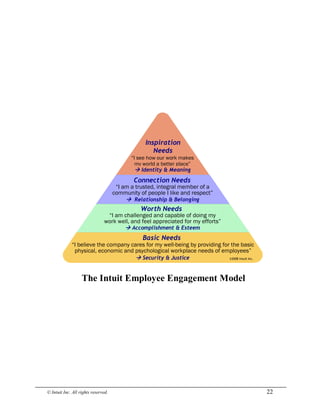
engagement at Intuit: The Intuit Employee Engagement Model. 
The Intuit Employee Engagement Model
The Intuit model captures the attitudinal and motivational state
that results from common experiences of our work environment
that fulfill an employee’s needs in four areas. Loosely based on
preceding models of motivation, engagement becomes stronger
as more of an employee’s needs are met in these four needs
areas - each building on the others in terms of power to motivate
employees to the highest levels of engagement.
© Intuit Inc. All rights reserved.  22 
The Intuit Employee Engagement Model 
à Identity & Meaning
“I see how our work makes
my world a better place”
à Relationship & Belonging
“I am challenged and capable of doing my
work well, and feel appreciated for my efforts”
“I believe the company cares for my well-being by providing for the basic
physical, economic and psychological workplace needs of employees”
à Security & Justice ©2008 Intuit Inc.
Inspiration
Needs
Worth Needs
Connection Needs
Basic Needs
“I am a trusted, integral member of a
community of people I like and respect”
à Accomplishment & Esteem
© Intuit Inc. All rights reserved.  23
The following are brief descriptions of the four needs areas of
Intuit’s Employee Engagement Model:
Meeting “Basic Needs” ensures a sense of security and justice: It
is achieved with employees feeling that the company cares about
their well-being – that basic (and primarily self-serving) physical,
economic and psychological needs are met by Intuit. These needs
include: Feeling safe, being paid equitably, feeling secured with
benefits, feeling included, and being treated with dignity and
respect. Employees determine a sense of equity and justice by
comparing their own situation and experiences at Intuit with
internal and external market place referents. Perceived inequity
occurs when employees feel that the rewards they receive for their
contributions compare unfavorably to the rewards other
employees appear to be receiving for their work. This extends to
feelings of treatment and respect. Employees form perceptions of
what constitutes a fair trade between their energy and efforts and
work outcomes, and whether Intuit has a practice of bringing
justice to inequities. Because these are vital human needs,
meeting or exceeding them will not necessarily inspire higher
performance, but can significantly increase one’s commitment to
stay at the company.
Meeting “Worth Needs” provides for a sense of accomplishment
and esteem. People want to feel empowered and capable of
making a difference, and that their skills and contributions are
valued by the organization. Challenging and satisfying work is key
to a sense of worth and personal fulfillment. A clear understanding
of how one’s job supports the organization’s goals affects a
person’s sense of purpose, and feelings of value as derived from
his or her work experience. Being truly appreciated for one’s
contributions and achievements helps employees feel valued for
their accomplishments. Feeling supported in learning new skills
and developing one’s career are also factors that greatly increase
a commitment to stay and a willingness to invest discretionary
effort.
Meeting “Connection Needs” promotes relationship and belonging
through a person’s association with and attachment to his or her
leadership, direct manager and coworkers. This sense of affiliation
comes when employees feel real camaraderie with members of
their team, and cared for and supported by their bosses as well as
the company’s senior leaders. Meeting these social needs shapes
the employee’s sense of allegiance to their immediate manager,
and affiliation with a broader community of people at work. When
employees genuinely like their coworkers and feel like an integral
part of the team they experience a deeper connection and 
“I come here every day and 
give 110% because I enjoy my 
work. I appreciate and value 
the people I work with. We 
really feel that we’re family. 
Job offers from other 
companies come along all the 
time. But they’re not that 
important to me. What’s 
important to me is who I work 
with and the experiences that 
we have every day.” 
(Applications Administrator)
© Intuit Inc. All rights reserved.  24
commitment to the organization, which can significantly increase
their willingness to stay and to go ‘above and beyond’ for the
team.
Meeting “Inspiration Needs” establishes identity and meaning,
which is experienced as the sense of affirmation a person gets
from being part of a winning company with a compelling vision and
purpose. When employees can identify with and commit to the
company’s mission, and align with the values of the company, they
are willing to go to extraordinary lengths to help it succeed. A
strong identity with the company is greatly shaped by how the
company treats its customers, the environment and serves the
community.
Helping employees clearly see how the company makes the world
a better place for its customers and stakeholders can turn
employees into strong advocates for the company, significantly
increase their commitment to stay, and instill a real passion for
producing outstanding results.
The next step in our model development was to identify the key
organizational processes and practices that most shape the Intuit
employee experience in each of the four engagement model needs
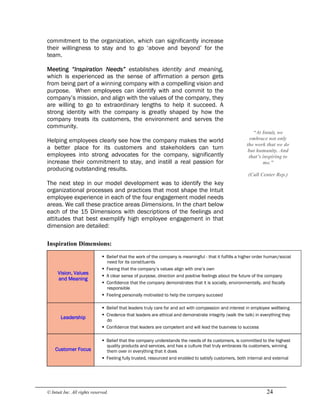
areas. We call these practice areas Dimensions. In the chart below
each of the 15 Dimensions with descriptions of the feelings and
attitudes that best exemplify high employee engagement in that
dimension are detailed: 
Inspiration Dimensions: 
Vision, Values
and Meaning
§ Belief that the work of the company is meaningful - that it fulfills a higher order human/social
need for its constituents
§ Feeing that the company’s values align with one’s own
§ A clear sense of purpose, direction and positive feelings about the future of the company
§ Confidence that the company demonstrates that it is socially, environmentally, and fiscally
responsible
§ Feeling personally motivated to help the company succeed
Leadership
§ Belief that leaders truly care for and act with compassion and interest in employee wellbeing
§ Credence that leaders are ethical and demonstrate integrity (walk the talk) in everything they
do
§ Confidence that leaders are competent and will lead the business to success
Customer Focus
§ Belief that the company understands the needs of its customers, is committed to the highest
quality products and services, and has a culture that truly embraces its customers, winning
them over in everything that it does
§ Feeling fully trusted, resourced and enabled to satisfy customers, both internal and external 
“At Intuit, we 
embrace not only 
the work that we do 
but humanity. And 
that’s inspiring to 
me.” 
(Call Center Rep.)
© Intuit Inc. All rights reserved.  25 
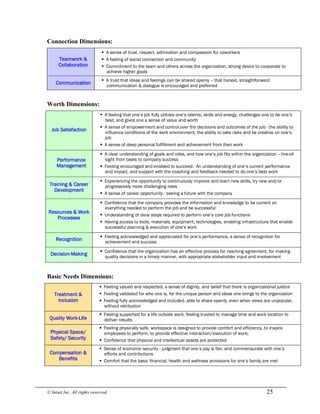
Connection Dimensions: 
Teamwork &
Collaboration
§ A sense of trust, respect, admiration and compassion for coworkers
§ A feeling of social connection and community
§ Commitment to the team and others across the organization, strong desire to cooperate to
achieve higher goals
Communication
§ A trust that ideas and feelings can be shared openly – that honest, straightforward
communication & dialogue is encouraged and preferred 
Worth Dimensions: 
Basic Needs Dimensions: 
Treatment &
Inclusion
§ Feeling valued and respected, a sense of dignity, and belief that there is organizational justice
§ Feeling validated for who one is, for the unique person and ideas one brings to the organization
§ Feeling fully acknowledged and included, able to share openly, even when views are unpopular,
without retribution
Quality Work-Life
§ Feeling supported for a life outside work, feeling trusted to manage time and work location to
deliver results
Physical Space/
Safety/ Security
§ Feeling physically safe, workspace is designed to provide comfort and efficiency, to inspire
employees to perform, to provide effective interaction/execution of work;
§ Confidence that physical and intellectual assets are protected
Compensation &
Benefits
§ Sense of economic security - judgment that one’s pay is fair, and commensurate with one’s
efforts and contributions
§ Comfort that the basic financial, health and wellness provisions for one’s family are met
Job Satisfaction
§ A feeling that one’s job fully utilizes one’s talents, skills and energy, challenges one to be one’s
best, and gives one a sense of value and worth
§ A sense of empowerment and control over the decisions and outcomes of the job - the ability to
influence conditions of the work environment, the ability to take risks and be creative on one’s
job
§ A sense of deep personal fulfillment and achievement from their work
Performance
Management
§ A clear understanding of goals and roles, and how one’s job fits within the organization -- line-of-
sight from tasks to company success
§ Feeling encouraged and enabled to succeed: An understanding of one’s current performance
and impact, and support with the coaching and feedback needed to do one’s best work
Training & Career
Development
§ Experiencing the opportunity to continuously improve and learn new skills, try new and/or
progressively more challenging roles
§ A sense of career opportunity - seeing a future with the company
Resources & Work
Processes
§ Confidence that the company provides the information and knowledge to be current on
everything needed to perform the job and be successful
§ Understanding of clear steps required to perform one’s core job functions
§ Having access to tools, materials, equipment, technologies, enabling infrastructure that enable
successful planning & execution of one’s work
Recognition
§ Feeling acknowledged and appreciated for one’s performance, a sense of recognition for
achievement and success
Decision-Making
§ Confidence that the organization has an effective process for reaching agreement, for making
quality decisions in a timely manner, with appropriate stakeholder input and involvement
© Intuit Inc. All rights reserved.  26 
Engagement Outcomes
Once we had defined employee engagement for Intuit and
developed a model to understand what might impact engagement
levels we stopped to ask: Now, how do we know if an employee
actually has this motivated state of being? How does one spot an
“engaged” employee? And if they are indeed engaged, what sort of
behaviors can we observe and results can we expect?
As outlined in the prior section, research has certainly shown that
highly engaged employees demonstrate some predictable
behavioral outcomes, including: Higher customer satisfaction
ratings, better performance, higher sales, lower regrettable attrition
and superior productivity. It became imperative for us to derive a
valid engagement measurement system so that we could
proactively take action that would affect these important outcomes. 
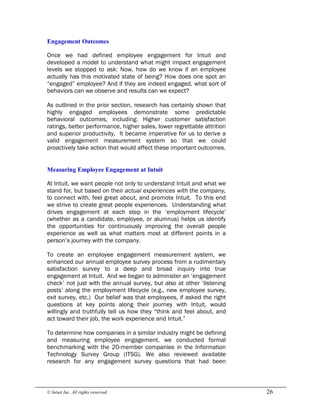
Measuring Employee Engagement at Intuit
At Intuit, we want people not only to understand Intuit and what we
stand for, but based on their actual experiences with the company,
to connect with, feel great about, and promote Intuit. To this end
we strive to create great people experiences. Understanding what
drives engagement at each step in the ‘employment lifecycle’
(whether as a candidate, employee, or alumnus) helps us identify
the opportunities for continuously improving the overall people
experience as well as what matters most at different points in a
person’s journey with the company.
To create an employee engagement measurement system, we
enhanced our annual employee survey process from a rudimentary
satisfaction survey to a deep and broad inquiry into true
engagement at Intuit. And we began to administer an ‘engagement
check’ not just with the annual survey, but also at other ‘listening
posts’ along the employment lifecycle (e.g., new employee survey,
exit survey, etc.) Our belief was that employees, if asked the right
questions at key points along their journey with Intuit, would
willingly and truthfully tell us how they “think and feel about, and
act toward their job, the work experience and Intuit.”
To determine how companies in a similar industry might be defining
and measuring employee engagement, we conducted formal
benchmarking with the 20-member companies in the Information
Technology Survey Group (ITSG). We also reviewed available
research for any engagement survey questions that had been
© Intuit Inc. All rights reserved.  27
proven as valid indicators of engagement or predictors of the
employee outcomes we desired.
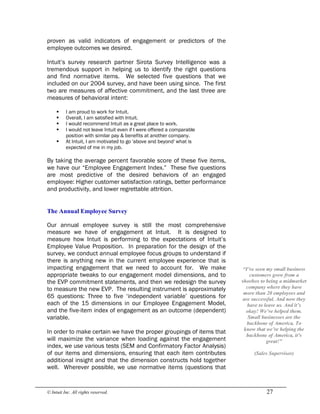
Intuit’s survey research partner Sirota Survey Intelligence was a
tremendous support in helping us to identify the right questions
and find normative items. We selected five questions that we
included on our 2004 survey, and have been using since. The first
two are measures of affective commitment, and the last three are
measures of behavioral intent:
§ I am proud to work for Intuit.
§ Overall, I am satisfied with Intuit.
§ I would recommend Intuit as a great place to work.
§ I would not leave Intuit even if I were offered a comparable
position with similar pay & benefits at another company.
§ At Intuit, I am motivated to go 'above and beyond' what is
expected of me in my job.
By taking the average percent favorable score of these five items,
we have our “Employee Engagement Index.” These five questions
are most predictive of the desired behaviors of an engaged
employee: Higher customer satisfaction ratings, better performance
and productivity, and lower regrettable attrition. 
The Annual Employee Survey
Our annual employee survey is still the most comprehensive
measure we have of engagement at Intuit. It is designed to
measure how Intuit is performing to the expectations of Intuit’s
Employee Value Proposition. In preparation for the design of the
survey, we conduct annual employee focus groups to understand if
there is anything new in the current employee experience that is
impacting engagement that we need to account for. We make
appropriate tweaks to our engagement model dimensions, and to
the EVP commitment statements, and then we redesign the survey
to measure the new EVP. The resulting instrument is approximately
65 questions: Three to five ‘independent variable’ questions for
each of the 15 dimensions in our Employee Engagement Model,
and the five-item index of engagement as an outcome (dependent)
variable.
In order to make certain we have the proper groupings of items that
will maximize the variance when loading against the engagement
index, we use various tests (SEM and Confirmatory Factor Analysis)
of our items and dimensions, ensuring that each item contributes
additional insight and that the dimension constructs hold together
well. Wherever possible, we use normative items (questions that 
“I’ve seen my small business 
customers grow from a 
shoebox to being a midmarket 
company where they have 
more than 20 employees and 
are successful. And now they 
have to leave us. And it’s 
okay! We’ve helped them. 
Small businesses are the 
backbone of America. To 
know that we’re helping the 
backbone of America, it’s 
great!” 
(Sales Supervisor)
© Intuit Inc. All rights reserved.  28
can be compared to others in our industry), and we try not to make
so many changes to the items that we loose the ability to show year
over year comparisons. In fact, applying this survey design process
rigor, we have not had to change more than a few items each year.
Our survey is administered for three weeks by Sirota Survey
intelligence through a web interface. Every unit in the company
(with five or more responses on the survey) receives survey results.
This includes the employee engagement index score, scores for all
survey items plus dimension scores. Our manager reports include
comparisons to higher and lower levels of management. Our
managers hold feedback sessions with their teams and use their
survey results to establish shared vision on what’s working well and
what needs improvement. Hosting these sessions is not optional in
our culture, nor is taking visible action optional. (For more specific
information on how we do this, see the following chapter, “Making
Employee Engagement Meaningful and Real”).
For executives, we provide score comparisons year over year and a
detailed engagement breakdown for their organizations showing
demographic analyses, dimension scores, and the top 8 – 12 “Key
Driver” items (those survey questions that have the strongest
correlation with the unit’s employee engagement index). We also
publish the employee engagement index scores for every manager
in their unit so it is explicitly clear to executives where there are
engaged and disengaged teams in their organizations. This allows
for clear decisions and actions to be taken to provide support and
make improvements.
As an example, Sales and Customer Service employees (making up
40% of Intuit’s workforce and handling most of the contact with our
customers) had some of the lowest engagement scores in the
company on the 2004 survey. Analysis of the dimensions clearly
showed where there were roadblocks and de-motivators. So, with a
sustained focus over the past two years on the dimensions that
mattered most for high engagement of this group, we have seen
their engagement shoot up 16%. It is now higher than the
company average, which is already near best in class (top 10% in
our industry). 
Empirical Results
By comparing survey responses to actual employee behaviors, we
have shown that the extent to which Intuit employees feel engaged
has a significant impact on their retention and performance. Using
multivariate regression and correlation analyses we found that our
© Intuit Inc. All rights reserved.  29
most engaged employees truly value, enjoy and believe in what
they do. They exhibit the following predictable behaviors:
§ They expend extra effort with customers and coworkers. Our most
engaged employees are indeed 130% more likely to be higher
performing,
§ They are two and a half times more likely to feel encouraged to be
innovative,
§ They are six times more likely to feel valued (their inputs used to
improve products/services),
§ They identify with and stay with the company. Our most engaged
employees are five times more likely to say they will stay at Intuit,
even if offered a comparable position elsewhere!
And over time, we have seen predictable outcomes for our
customers: Customer satisfaction ratings have a strong correlation
with engagement among our Call Center (Customer Service)
employees. In a 2005 study, we found that frontline units with the
highest engagement index scores had significantly higher call
resolution scores as rated by their customers.
With our most recent 2006 survey, our overall Intuit engagement
index score again moved up (seven points to 83%), placing us in
the top 10% in our industry for employee engagement. We believe
that highly engaged employees deliver truly better customer
experiences, and over time this translates to better business
results.
Because Intuit has posted better than expected earnings and
enjoyed a 40% increase in stock price (more than double the S & P
500) during the past two years, we wondered, as many companies
do, whether this “winning company” climate affected employee
attitudes and engagement levels. We commissioned Sirota Survey
Intelligence to examine the relationship between Intuit’s
engagement scores and the stock price activity, stock option
ownership, and employee stock participation by individual
employees over the past four survey cycles. They found that only
1/10th of one percent of the variation in Intuit’s engagement scores
could be attributed to movement in stock price, or any other
financial metrics; and that leadership practices and organizational
factors (see Dimensions above) accounted for almost all of the
variance in engagement scores. This gives us great confidence in
our engagement model and supporting measurement process; and
that these tools have helped us foster an engagement culture that
we actually do have the ability to influence.
© Intuit Inc. All rights reserved.  30 
Making  Employee  Engagement 
Meaningful and Real
Building a company culture that places an authentic and natural
focus on engaging employees is an evolutionary process in four
phases: Creating Awareness, Building Understanding, Gaining
Commitment and Taking Action. A company can accelerate this
evolution by purposefully encouraging the right management
mindset and intentionally re-architecting organizational practices
so that nearly anything that affects the employee experience is
explicitly directed at fostering employee engagement.
In this section, you will learn how Intuit has leveraged its leadership
and organizational practices to establish a culture for engagement. 
Creating Awareness of Employee Engagement
The Awareness Phase starts with an unflinching self-examination by
the company’s management to determine just how important
engaging its employees is to the company. A sustained focus on
engagement is usually possible if two attitudes are present among
the company’s top leaders:
1. Right Thing To Do: They sincerely believe it is the right thing to do
for employees. They know that in the company’s espoused value
system, treating employees right by addressing their engagement
needs is something they should support in good times and bad.
2. Good For Business: They believe it will be good for business.
Engaging employees will produce tangible benefits for all other
stakeholders: Customers, shareholders, and the community. So a
sustained focus on employee needs will help the company be
successful and grow.
At Intuit, the journey started in 2001 with this same “gut-check”
and business rationalization. Our strong beliefs about the role that
employees play in the success of the company were already made
clear by our Operating Values. Our Employee Value Proposition
established unquestionably the specific expectations of the
company and management for creating an optimal engagement
environment (see both in the “Engagement Journey at Intuit”).
The external research on employee engagement was full of
conclusive studies showing the links among high engagement and
reduced turnover, increased performance and improved customer
satisfaction. At the time we did not have any evidence that this
was true for Intuit, other than it made intuitive sense.
© Intuit Inc. All rights reserved.  31
The value of employees is clear to Intuit’s executives. One of the
mantras you will hear often at Intuit clearly places the importance
of employees right up there with Intuit’s customers and
shareholders by making this simple statement:
“What we need is talented and engaged employees
delivering for customers…business results will follow.”
So through a process of self-discovery, we knew that establishing
an employee engagement culture was the right thing to do for
Intuit, as well as a key component to our success as a company. 
Understanding How Engaged Employees Really Are
Sensing how the company is doing to engage employees must start
with listening to employees. They know what their needs are and if
those needs are being met sufficiently. In 2002, Intuit identified
and began actively promoting the formal and informal practices
that focused on listening to and understanding what’s important to
our employees. We called these “Voice of Employee” (VOE)
processes.
Since then, we have expended our focus. We have designed and
implemented several confidential opinion surveys and other
‘listening posts’ to gather inputs and measure salient points at
every stage of the Intuit employee experience. Some examples are:
§ The Annual Employee Survey to gain a census view of the entire
company,
§ Pulse Surveys to check in on selected units,
§ Exit Surveys to listen to those who are leaving the company,
§ Training feedback to understand how well training is working, and
§ The New Employee Survey to see how assimilation experiences are
engaging employees.
More recently, we introduced feedback opportunities through
Employee Suggestion Programs. All these “self-reporting” VOE
processes have helped us to understand what is engaging and
disengaging to employees along all points in the “employee
lifecycle.”
Because we do not report survey results for fewer than five
responses, the opinion surveys work well for determining how
engagement is going at the team level, but not for individuals.
Each employee is motivated by different things and has different
needs at any point in their tenure at Intuit. It is a manager’s job to
© Intuit Inc. All rights reserved.  32
be aware of this and to actively stay in tune real-time with each his
or her employees.
We have come to realize that the best source of VOE is face-o-face:
§ Informal hallway chats where leaders stop and talk to
employees at every level,
§ One-on-one meetings between the employee and manager,
§ Focus groups where employees are free and safe to talk about
their concerns and
§ Skip-level meetings between employees and their boss’ boss.
In addition, managers are encouraged to look for signs of
engagement and disengagement as they work together with their
employees. These personal observations and interactions allow
managers to check in on how things are going and find out directly
what is most engaging or disengaging to each employee.
We can also get a sense for engagement levels by paying attention
to information collected about our employees’ behaviors: Retention
rates, absentee rates, participation in company programs (training
classes, etc.), number and type of employee relations escalations,
percentage of employee referrals, customer satisfaction ratings,
internal job transfers and promotion rates, and recognition program
utilization. These aggregate views are the least useful sources for
gauging engagement, because they are often lagging indicators.
Even though employee outcome data can be useful for trying to
identify the causes of engagement and disengagement, any actions
taken based on this type of VOE is reactive at best.
Intuit’s managers use a wide range of methods for gathering and
understanding VOE. Some still depend on Intuit’s formal “listening
posts” (e.g., survey data). But many have internalized Intuit’s
expectations of staying current with what’s going on with their
employees, and they do it naturally as part of their ongoing routine.
They believe listening to and responding to employees is what good
Intuit leaders do. And they know that more frequent informal check-
ins will give them the insight early enough to actually make a
difference. 
Committing to Focus on Employee Engagement
Engagement happens one employee at a time. And the greatest
advantage a company has for building an engagement culture is
their leaders. Intuit managers are expected to show their
commitment by taking time to understand and respond to
engagement not only at the team level but also for each member of 
“Everyone who comes to 
work has their own life when 
they go home. They have 
their own reasons why they 
come to work. 
Understanding their beliefs 
helps you understand how to 
motivate someone and how 
to encourage them to be the 
best that they can be.” 
“Every conversation, 
every interaction I have 
with each and every one 
of my employees has to 
benefit them to a high 
level so they feel good 
about the time they 
spend with each other.”
© Intuit Inc. All rights reserved.  33
the team. Being committed to helping each employee feel highly
engaged requires managers to maintain a personal relationship
with each of their employees.
Another important tool for building an engagement culture is its
work environment. This does not mean creating a bunch of new
“engagement processes, programs and checklists” that may seem
attractive but have no real significance in the context of the culture
we are trying to achieve. Instead, we look at the existing
organizational processes and management practices and ask how
they can be reframed to focus on engaging employees. Intuit has
spent the last few years re-architecting these processes and
programs to focus on engagement at all four levels of our
engagement model: Basic Needs, Worth Needs, Connection Needs
and Inspiration Needs.
This is not an exhaustive list, but the programs and processes at
Intuit that most influence our employees’ engagement at each level
in the Intuit Employee Engagement Model are detailed below.
Addressing Basic Needs. To help employees feel a sense of safety
and respect, Intuit provides a safe and secure workplace. This
includes workspaces that are efficiently laid out, aesthetically
pleasing and comfortable, furniture that is ergonomically designed,
convenient services to make it easier to get work done, procedures
to handle medical and other emergencies, and a security staff to
protect employees and company assets. We also have various
amenities that promote health and wellness, such as onsite
exercise classes and recreational activities. Some of our office
locations provide additional amenities onsite to help employees
access services conveniently, such as a cafeteria, gym and workout
facilities, a mobile dentist, and other services.
Intuit’s competitive base pay and benefits are designed to help
employees feel that they are fairly compensated for their work as
well as provided with the financial security to take good care of
their families. Every employee owns stock so they can share in the
success of the company. We also trust and support employees to
manage their time between their work and home life by providing
flexibility in where and how they work. Approximately 60% of Intuit
employees can telecommute, and 91% of employees reported on
our last survey that they feel their manager supports their efforts to
balance their work and personal life. In fact, the customer reps in
one of our online product groups work exclusively from home. And
they have some of the highest engagement scores and customer
satisfaction ratings in the company!
© Intuit Inc. All rights reserved.  34
Intuit’s value of ‘Dignity and Respect’ epitomizes how we treat each
other. By promoting a culture where individuals get to feel heard
and validated for who they are, we help each employee to share
her or his unique ideas and contributions. Our culture promotes
diversity and honors these values, helping employees feel included
and freeing them to bring their whole selves to their work and to
share their best ideas when problem solving. According to our last
employee survey here’s what employees had to say about how they
are treated at Intuit (these scores are in the top 10% in our
industry): 92% felt they were treated with dignity and respect, 88%
agreed that their manager fosters an environment where diversity
is valued, and 87% said their manager responds to their ideas and
suggestions.
Taken together these values, norms and basic provisions help free
our employees from economic, physical and psychological concerns
and roadblocks that may inhibit them from applying their full
passion, energy and creativity to their work.
Addressing Worth Needs. We start by matching people with great
work that they can enjoy. We do this by finding a good job fit
between what the business needs and the employee’s desires,
aspirations, skills and abilities. We then supply quality job
resources – the information, tools, technology, work processes and
other infrastructures - that enable employees to do their jobs well.
Intuit’s performance management processes are strongly
centralized requiring each manager to set clear goals, give ongoing
feedback and coaching, and have mid-year and annual
performance discussions to ensure that every employee is
performing at her or his best.
Our employee education and leadership development offerings
enable skills building through classroom and online courses, tuition
reimbursement, job rotation programs, and executive Action
Learning Programs. Through our Learn-Teach-Learn process, we
share our knowledge and help others grow by teaching each other
what we are learning. All these processes help employees develop
capability, feel challenged and grow. We also have fast track
development programs for high potential employees. On our last
survey 77% of employees reported to have meaningful
development conversations with their managers.
We support career development by identifying a growth and
mobility path inside Intuit that helps each employee get on-the-job
training for future positions, find stimulating new assignments, and
take on challenging “stretch” roles. These programs and processes 
“You have to recognize the 
value that someone is 
bringing to the job. When 
they perform well, 
recognize the good job 
they do. When they under 
perform, coach them in a 
safe environment. It’s 
always about getting 
better.” 
(Group Manager, 
Customer Care)
© Intuit Inc. All rights reserved.  35
help Intuit employees develop their skills, and enable the company
and employee to build a future together.
Intuit’s rewards programs, which pay according to performance
through bonuses, stock and other recognition (non-cash awards)
help the employee feel appreciated and valued for their
accomplishments. According to the survey, 80% of employees are
satisfied with Intuit's total rewards package (salary, incentives,
benefits, stock ownership, etc.) and 76% feel their
accomplishments are recognized (top 10% in our industry).
We empower employees to take ownership of their jobs and
encourage them to enjoy their work. Our customer-driven
innovation culture encourages employees to be creative when
solving for current customers and our technology-driven innovation
culture encourages employees to find new customers and new
ways of doing things. These processes help our employees feel a
sense of job satisfaction and value. According to our annual survey,
95% believe they are making a significant contribution to the
success of their workgroup, and 88% say they like the kind of work
they do.
Addressing Connection Needs. Helping employees build
relationships starts on Day One. Our assimilation process includes
a buddy assignment for each employee so they have someone they
can go to in addition to their boss to accelerate their onboarding
experience. The General Managers of some of our groups take their
new employees out to lunch the first week to help them quickly feel
welcomed and like a part of the team. Many employees describe
their Intuit coworkers as “like family.” In fact, an average of 89% of
our employees reported on our most recent employee survey that
“We care about each other as individuals.”
Intuit’s strong Operating Value “Teams Work” sets the stage for
employees working well together to reach for common goals within
and across organizations. On the same survey, 92% of employees
report that their work team cooperates with other work teams to
achieve objectives, and 85% report that their work team works well
together. These scores put Intuit in the top 3% of our industry when
it comes to our employees’ opinions about collaboration.
The company sponsors Employee Networks to help employees
connect with others with similar interests. These affinity groups
(such as the Intuit Women’s Network, the Indian Network, the
Latino Network, and the Lesbian, Gay, Bisexual, Transgender
Network) not only honor the diversity at Intuit, and help employees 
“I’ve learned a lot from 
each of you and I’m a 
better person and 
professional for having 
known each of you ­ I 
thank you for that. I 
feel that I am not just 
leaving a company, but 
my family.” 
(Letter to coworkers 
from a departing 
employee) 
“Everyone works as a 
team. If we have an issue 
that we can’t resolve we 
can look to each other to 
find the answer.” 
(Technical Services Rep.)
© Intuit Inc. All rights reserved.  36
feel a deeper sense of inclusion, but also establish a sense of
community though new connections that benefit the business.
We also know how to have fun! Our celebrations are legendary!
We celebrate almost anything – a successful product launch, a
coworker who just had a baby, or even for a project that failed (so
participants can learn from it). We like to take time to acknowledge
the milestones that mark our hard work as well as important events
in employee’s lives. In this way we share our values and learn to
relate with each other on a more personal level.
All these programs help Intuit employees build a social bond and a
sense of community with their coworkers, satisfying the need for
connection at work.
Addressing Inspirational Needs. Our CEO Brad Smith shares
Intuit’s mission and vision through state-of-the company addresses
to all employees, quarterly online CEO chats, and personal “town
hall” meetings during site visits. The Executive Leaders of each unit
share the goals and strategy of Intuit and their organization at
monthly or quarterly “All-hands” meetings. These meetings all help
employees understand Intuit’s purpose and direction, and the
impact the company is having in the world.
Each individual manager continues to share, or “cascade,”
company news and unit-level information so that employees can
draw a “line of sight” between their jobs and the goals of their unit
and the company. Our last employee survey revealed that 88% of
employees report that they understand Intuit’s overall goals and
direction, 90% say their direct manager shares business unit
strategy with them, and 88% say they see a clear link between their
work and Intuit's goals.
Employee communications are designed to not only provide
relevant information; but in doing so, help Intuit employees become
more engaged in the company. Intranet articles are published daily
covering a wide range of business topics, interviews with
customers, new product launches, employees sharing success
stories, and executives talking about the business. Where possible,
these articles frame messages through the eyes of our employees
themselves, so employees recognize their own voice. They almost
always feature Intuit as a winning company by clearly showing how
the company is delivering for the three stakeholders and making
the world a better place. 95% of Intuit employees reported on our
survey that ‘Intuit’s products and services solve important
problems for our customers.’ 
Intuit’s Mission: 
Revolutionize 
People’s Lives by 
Solving Important 
Problems. 
“When you have 
alignment between your 
team’s goals and their 
customers, whether they 
are other teams or our 
paying customers, 
working toward a 
common theme you can 
really get great 
performance.” 
(Call Center Manager)
© Intuit Inc. All rights reserved.  37
Our We Care and Give Back program is a great example of how
Intuit takes social responsibility and supports employee
involvement in the community. It provides 32 hours per year paid
time off for employees to donate their time, and donation matching
where the company will match charitable donations made by the
employee.
Our communications practices help employees establish real
meaning for their work and give them the opportunity to develop a
strong sense of identity with the purpose and direction of the
company. When employees perceive true alignment between their
values and vision and that of the company, the resulting
inspirational engagement is compelling. 
Taking Visible Actions
The final phase in establishing a successful employee engagement
culture is fostering an open environment where employees clearly
see that their needs are being actively addressed. Once the
company’s managers have internalized the importance of
engagement, and have taken steps to listen to and understand the
VOE (voice of their employees), the real test of commitment will be
in how they show visible actions in response to employee needs.
The single biggest roadblock to building an engagement culture is
failing to “walk the talk.”
If employees are asked for their opinions, feelings, thoughts, ideas
and feedback, and must then stand by while management does
nothing with the information they will lose trust in the process.
Taking action doesn’t mean that every employee will get all that
they need all the time, but each one should feel heard,
acknowledged and dignified with some sort of response. To help
foster this trust, Intuit’s managers at all levels are expected to:
§ Role model Intuit’s Operating Values,
§ Be transparent in communications, share thoughts and feelings about
what is real,
§ Be humble and demonstrate the ability to listen and learn,
§ Involve and include employees,
§ Show genuine interest and care for each employee as an individual,
§ Be accountable, take action on behalf of employees, show a good
“say/do” ratio.
The mindset and actions of leaders supported by strong
organizational practices are what currently drive the culture for
engagement at Intuit. Getting Intuit’s managers to the point where
they are now - self-motivated to improve employee engagement –
© Intuit Inc. All rights reserved.  38
has been an evolutionary process in our culture over the past few
years.
When we first introduced a new employee survey in 2001, we had
few managers who paid as much attention to employee needs as
they did to customer concerns or getting business results. When
we gave each manager their survey results, our CEO issued a
mandate that each one had to host feedback sessions with their
team to develop a shared understanding about what’s working and
what’s not, and create written survey action plans which were
posted publicly on our intranet for all employees to see. Today, we
still deliver survey results to all managers; however, we no longer
require formal action plans to be written or posted. Two things have
changed to eliminate the need to mandate action planning:
1. Most Managers have adopted the “engagement mindset:” They believe
it is the job of Intuit leaders to engage each employee, and are inclined
to take actions because it is now a requisite responsibility of being a
good leader at the company.
2. Managers are held accountable for improving engagement on their
teams. Part of the performance assessment for each manager is how
well they attend to their employee’s engagement needs as reported by
employee’s, and taking visible action is the only real way to make
sustainable improvement.
Our managers are held accountable because their team’s survey
results are so visible to our company leaders. We report employee
survey results to our CEO and all division heads showing
engagement scores down to the individual manager level
throughout the entire Intuit organization. This enables our leaders
to clearly identify best practice units where engagement is
flourishing and pockets where support or corrective action is
needed.
The change in mindset can be seen in the chart below by looking at
the four levels of ‘Engagement Mindset’ of leaders at Intuit. Again,
when we started the survey process most managers were simply
following the prescribed steps for gathering survey feedback, and
complying with the action planning mandate. As more and more
managers began to understand and internalize the value of
engaging their employees, they began to monitor engagement
levels independent of any survey, and make a concerted effort to
address issues real-time. Today, we have a few managers who are
still in the “Unconscious” stage; however these managers will not
be allowed to stay in that mindset. Most of Intuit’s managers have
integrated an engagement focus into how they run their
organization using ongoing dialogue and feedback with employees
to understand their engagement, and taking visible actions to
address and improve engagement.
© Intuit Inc. All rights reserved.  39 
Four Levels of Manager Engagement Mindset at Intuit 
Institutionalizing the Engagement Culture
Once the company begins to realize the competitive advantages of
an engaged workforce, and sees signs of tangible progress, it must
look for ways to further embed the new engagement mindset and
behaviors so they become part of the culture of the company.
In 2005, Intuit launched an employee-focused initiative called
“Prospect-to-Retire.” The purpose of this cross-functional group of
executives and work teams is to optimize the engagement
experience at all points in an individual’s journey with Intuit. This
process begins when a person becomes aware of Intuit as a
possible company to work for, through the recruiting, interviewing,
onboarding and assimilation period, through every experience as
Level “Unconscious ” “Aware” “Conscientious” “Masterful”
Manager’s
Engagement
Mindset
“I’ve heard of it,
but engagement
is not something I
think about
regularly or that I
am actively
solving for.”
“I understand the
importance of
engaging my
employees – but
not sure exactly
what to do”
“I take time to
actively check-in
with my employees
to understand
what’s engaging
them.”
“As a function of how I
naturally interact with my
employees every day, I
hear what each one needs,
and have developed a
deep understanding of
what is motivating and
demotivating for each
individual person.”
How they view
gathering
feedback and
understanding
the Voice Of
Employee
“I think about how
engaged my
employees are
only when I get
my annual
employee survey
results.”
“I value the
annual survey as
a key input to
determining what
is important for
engaging my
team.”
“I value the many
opportunities I
have for both
formal and informal
feedback in
determining what is
engaging to the
team.”
“Since I am already
naturally in tune with what
is engaging for each of my
employees…I find the
annual survey results just
serve to validate what I
already knew.”
How they view
taking actions
to improve
“I follow the
required process
for doing a
feedback session
and action
planning.”
“I am not always
sure where else
to look and
exactly how to
make a
difference in my
team’s
engagement.”
”I set aside
considerable time
and attention to
develop action
plans and make a
visible difference to
my team.”
“In the normal course of
running my business, I am
taking actions all the time
to keep engagement levels
high for each employee.”
© Intuit Inc. All rights reserved.  40
an employee, and finally through retirement or leaving the
company. According to our last annual survey, employees at Intuit
less than three months report a 93% average engagement level
and this drops to 86% average for employees reaching their first
anniversary. Something happens to them during their first year that
changes their perceptions and expectations, and the Prospect-to-
Retire team is committed to finding out how we can sustain initial
engagement levels.
We have also redesigned our most important annual business
planning and review processes so that engagement levels display
prominently in the dialogue and decision making. For example, our
annual High Performance Organization Review is where our
functional groups and business units assess changes needed to
their organizational capability to better execute on strategy. This
process heavily leverages the Annual Employee Survey results as
one of the key inputs for not only assessing issues that may be
potentially holding back an organization’s performance, but also for
evaluating each leader within an organization for how well they are
doing to role model engaging behaviors and teach others their best
practices.
The rewards system should also place the right emphasis on
leaders demonstrating the right mindset and behaviors to engage
employees. At Intuit leaders are truly evaluated as much on how
they got the job done as on what they delivered.
We have found that success with our engagement practices starts
with the resolute belief that employees matter, and that diligently
attending to their needs is not only the right thing to do from our
values perspective, but simply good business. The resulting
“engagement mindset” helps our managers take the time to
understand each employee’s needs and take visible action as a
natural part of their ongoing leadership duties.
Reinforcing the engagement culture at Intuit has also been
advanced by the careful (re)design of business and management
practices so that solving for the needs of employees and improving
their experience is an explicit part of every planning process.
Nothing is more compelling than the results themselves. We have
seen Intuit’s sustained focus on engagement pay off with solid
improvements in customer ratings, market share and business
results over the last four years.
© Intuit Inc. All rights reserved.  41 
Steps for Establishing an Employee 
Engagement Culture in Your Company
One of the driving reasons why we created this report on Intuit’s
employee engagement culture is that executives from other
companies have increasingly reached out to us seeking advice on
how they can increase the chance for engagement success in their
own organizations. So, for that specific purpose, we decided to
dedicate the last portion of this report as a self-help guide to
improving the engagement culture in other enterprises.
However, it’s important to reiterate that improving your own
company’s engagement culture is not a simple proposition.
Establishing a practice of employee engagement requires a
tremendous amount of leadership, patience and tenacity. Even if
you already have some or all of the necessary basic elements in
place, they must work together in order to be successful. As you
move through the various steps, transitions and decision-making
points, remember they are all interrelated. And, like a complex
pattern of yarns and colors on an oriental carpet, these elements
will quickly fall apart unless they’re interwoven on a solid backing of
executive support and complete commitment to the principles and
outcomes of employee engagement, come what may: Discouraging
survey returns; industry or market downturns; internal crises;
changes in leadership, etc.
Culture change is never easy. However, the time and effort to
create an employee engagement culture will probably be well worth
it for you – especially in comparison to the high cost of
disengagement. This is your go/no-go starting point. And so, in this
final chapter, we will take you through the key decision points to
help you move your company toward a true practice of employee
engagement.
Your first goal is to establish and promote a leadership mindset
that integrates all the necessary behaviors, beliefs and attitudes
that foster engagement every day – not by relying on expensive
surveys or unnecessarily elaborate communications and incentive
schemes. Managers with the engagement mindset simply take
every opportunity, every day, to show their employees that they
care about each one as an individual. They ask each employee
how they are doing, what they might need to do their work better,
and check to make sure each one feels like a they are a valued
member of a team that is helping the company achieve its
objectives. 
“The atmosphere 
keeps me engaged all 
the time. Everyone 
seems to want to do 
really well for the 
company. The happy 
atmosphere keeps 
everyone working very 
hard.” 
(Call Center Rep.)
© Intuit Inc. All rights reserved.  42 
Step 1:  Confirm That All the Prerequisites Are In Place
An employee engagement culture seems like it would be an ideal
environment for any company. However, it’s not for everyone. It
requires a culture that’s naturally people-centric, or one that
genuinely aspires to be people-centric. It also requires stamina,
courage and an authentic desire to put in the necessary effort. And
it requires a willingness to undergo an ongoing exercise in self-
discovery, which may be unpleasant at times. Your own belief
system, as well as that of your senior leaders, should already
uphold the principle that your employees are equal to your
customers and shareholders in terms of deserving to command
leadership attention and actions on their behalf. It’s tempting and
easy to say, “Well, of course!” But if, in fact, these qualities aren’t in
place and you attempt to launch an employee engagement
initiative, and then fail, you will be worse off than you would have
been if you chose to wait until these elements were taken care of.
Can you agree with the following descriptions of your current
culture, business and leadership?
§ Senior leaders are deeply committed to the principles of
employee engagement.
§ Senior leaders are themselves engaged – they model
engaging behaviors and values to the rest of the organization.
§ The current company culture already values its people, and
Human Resources issues are given the necessary time and
attention (e.g., in executive staff meetings) to be effectively
resolved.
§ Senior leadership knows the importance of involving the
entire company in the culture changes that are required.
§ Employees trust their leadership enough to collaborate in the
process of creating a culture shift.
§ Employee engagement practices that are established will be
honored, even in the face of a possible negative downturn in
my company, industry, or market.
§ There are no emergencies, mergers and acquisitions,
significant downsizings, or other profound organization-wide
changes on the immediate horizon.
If your current culture and leadership beliefs match these
prerequisites, you can now confidently begin to take action on
building an employee engagement culture and practices. 
“Engagement starts 
with you. If you’re 
engaged and can’t wait 
to come to work in the 
morning, some of that 
is contagious.” 
(Call Center Rep.)
© Intuit Inc. All rights reserved.  43 
Step 2: Initiate Planning and Build the Infrastructure From the 
Employee’s Point of View
Once you have decided that your organization is prepared to take
on this cultural shift, it’s now time to undertake a significant
amount of foundation work. During this phase you will be
demonstrating to employees the company’s commitment to their
engagement by inviting and involving them in defining what
engagement means to them. This process should be employee-
centric, not management-centric. It should be based on feedback
from employees about what they know is engaging to them, not on
what leaders feel may be important. Two important “building
blocks” in the engagement practice should be established at this
point:
§ An Employee Value Proposition (EVP) that states the needs and
expectations that your employees have of their workplace
experience, and
§ A set of Voice of Employee (VOE) practices (e.g., an Employee
Survey) that measure how engaged your employees are as a
result of their experiences (their needs and expectations being
met) at key points in their tenure
Establish a Voice of Employee (VOE) steering committee made up
of executives who have presented themselves as early adopters of
the principles of employee engagement. By setting up a
governance body to help you move this initiative throughout your
entire company, you are not only dispersing the responsibilities by
way of a powerful leadership team, you are also testing the mettle
of their will and energy behind this concept before you go public
and involve the entire employee population.
Develop an employee value proposition (EVP). Involve a broad
cross-section of your employees in a process to find out from them
specifically what they would need in order to experience the
company as a great place work and a high performing organization.
Conduct employee focus groups (again, preferably using outside
facilitators to help promote candid commentary) with a fair
representation from across your office locations, all levels of the
organization, all business units, and demographic groups and
whatever special interest groups might be present in your
organization..
Announce your EVP. Using the data that you have collected as a
result of these focus groups, develop a customized engagement
definition that fits your culture and articulate your company’s EVP
in clear terms. Give your employees another chance to comment on
the definition and EVP that you have developed. Once you have the
© Intuit Inc. All rights reserved.  44
EVP revised to the point where everyone is reasonably satisfied
with it, publish and promote it using every opportunity and means
available. Recruit your communications team to help you establish
your EVP and create a brand for your evolving culture.
Institute an employee survey process. You may need outside help
to avoid costly and embarrassing missteps. Survey consultants,
especially, are invaluable in helping you identify what you want to
measure, where and how. Survey questionnaires should have
precisely worded questions to accurately measure how well the
expectations of your EVP are being met. They can help you design a
survey that will gauge your employees’ level of engagement and
help understand what aspects of their experience are critical to
your engagement culture. Employees expect to have their survey
responses treated confidentially, so if you ask the outside survey
consultants to administer the actual surveys, you are more likely to
receive honest responses – and a lot more of them of it – than if
you were to administer the survey in house yourself.
Put together a communication plan. Again, outside consultants can
help you ask and answer the critical questions before going public
with your engagement intentions. You will need a communication
and change management plan: What is the core message that
your CEO will use to announce this new initiative? What
expectations will you place on your leaders and how will you hold
them accountable for supporting this new push toward employee
engagement and taking action? What are the resources you
currently have in house to support the change? 
Step 3:  Implement Your Strategy to Establish 
Employee Engagement in Your Culture
Once all the initial research is accomplished to discover what your
employees value most out of their experience working in the
company, the time has come to measure the quality of their actual
experiences, and to take specific actions to address those results.
Launch your survey process. Again, you will probably benefit from
an outside survey consulting company, which will help you identify
the essential questions and create the mechanism for gathering
this data. The survey should, ideally, be done once a year, but
expect to see changes and improvements with each survey
iteration. The experience of every year helps refine the process for
the next one. And some questions that might be relevant this year
may be replaced by a different set the next.
© Intuit Inc. All rights reserved.  45 
Promote the survey. Let your employees know that this survey is
based on the information and insights generated through their
input during the EVP data-gathering process and focus groups.
Make sure they understand that the results will be completely
confidential and that they can answer the questions candidly at no
risk to their jobs.
Administer the survey. Your ideal is to attract a critical mass of
survey respondents, so that the results will most accurately and
completely reflect what employees are experiencing on a day-to-day
basis. Actively encourage survey participation without intimidating
or pressuring employees. They will take the time to complete the
survey if they believe the company will take action on the results;
so, if you do not get a high response rate, this itself can be an
indicator of your current engagement level.
Report the results organization-wide. Managers should be given
their survey results with data comparisons to the prior year scores
and to levels of management above and below as appropriate.
Make sure your employees know that their leaders will receive a
survey report and that they are expected to share the results with
employees to better understand the meaning of their responses
and take action on them. Visible and dependable action will
reinforce not only the value of the survey experience but the validity
of the entire employee engagement initiative itself. Hold managers
personally responsible for taking action on the survey results.
Launch post-survey accountability steps. Train your managers to
facilitate survey feedback sessions with their employees. They
should celebrate good results and develop specific action plans in
areas needing improvement, involving employees in this process as
much as possible. Visible and dependable action will reinforce not
only the value of the survey experience but also the validity of the
entire employee engagement initiative itself. Hold managers
personally responsible for taking action on the survey results and
give them the support they need.
At Intuit, for instance, we value continuous improvement over time,
versus trying to hit certain target engagement scores on the survey.
Likewise, there are negative repercussions for managers who show
no improvement year after year, or have the lowest engagement
scores in their organizations. On an executive level, the senior
most leaders must also be involved in reading and understanding
the survey results. And they must decide on and communicate
whatever commitments to action will be taken company-wide. They
must demonstrate through their actions that they are personally
© Intuit Inc. All rights reserved.  46
committed to the principles of engagement, and drive this bias for
action down through their respective organizations.
Communicate status of results and actions to the whole team. An
essential aspect of the employee engagement process is
communication, transparency and responsiveness at every step.
Each manager should regularly report the status of the actions they
are taking so that progress is visible to employees who are
affected. Employees need to see that what they are saying is being
heard and understood, that actions in response make sense, and
that visible progress is being made. 
What Happens Next?
A well-designed survey process is a catalyst for change. It gives the
company a regular check in to see how employees are engaged at
a point in time. It generates conversations about engagement
across the organization, and helps managers make decisions for
action on behalf of their employees. These are all essential steps
to building the engagement mindset in your company.
However, your survey is a solid means to building an engagement
culture, not an end. With all the hard work and emphasis placed
on the survey, it’s easy to lose sight of the fact that the goal is to
solve for the needs of your people. Surveys are merely a snapshot
in time, and, in some cases, by the time the data is analyzed, they
may already be obsolete. Because managers may get their initial
(and perhaps only) engagement data from surveys, they can
become overly reliant on them, and they forget the real client of the
employee engagement process: Individual employees themselves.
Managers who have developed the engagement mindset will be the
ones most likely to succeed in the employee engagement arena.
This mindset puts the survey into perspective and allows them to
quickly leverage their results to generate good dialogue with their
team. It is in these conversations that the real understanding and
insight occurs, not from a survey report. As managers continue to
develop this mindset, they embark on the practice of having
ongoing conversations with each of their employees to further
understand and address their individual engagement needs.
True, on the corporate level, leaders should respond to the desires
of key segments of the population and to the collective whole. They
should identify important organizational issues and opportunities,
and take action. These corporate responses may include things
like employee social and developmental networks; telecommuting
© Intuit Inc. All rights reserved.  47
options; pay-for-performance programs; even some amenities like
on-site dry cleaning, etc. All those improvements in delivering a
better employee experience should not be minimized. But where
the real engagement happens is in the hallway, in one-to-ones,
wherever managers and employees talk to each other like the
individual human beings they are, share information on project
progress, company mission, personal news, training opportunities,
new ideas, etc. As we have mentioned before, engagement is a
one-size-fits-one proposition, and we have found that since 60% to
80% of a person’s experience of a company can be directly shaped
by the manager, one of the key employee engagement levers is
completely within the manager’s control.
Every company is unique. Therefore the solutions, program
improvements, amenities you decide to install in your company
cannot be prescribed here. But we have given you some examples
of what we have done, and you can find additional ideas every year
in Fortune’s 100 Best Companies to Work For special issue, as well
as a crop of new books that come out annually. The one rule of
thumb that is universal and can’t be repeated too often:
Engagement is the result of an accumulation of experiences mostly
influenced by the interactions between employees and their direct
supervisors. 
How Do You Know It’s Working?
You can assess how well the company is doing to establish the
engagement mindset and practices by asking these questions:
§ Are our leaders executing to the expectations of the company’s EVP?
§ Are our employees experiencing the expectations of the company’s EVP
through their day-to-day interactions with management?
§ Are our employees recommending the company to their friends and
family as a great place to work?
§ Are we attracting a higher caliber of job candidates?
§ Are employees willing to stick it out, even when we’re going through an
uncertain period in the business?
§ Are we getting more of the right behaviors from our entire employee
group? Or fewer?
§ Are we seeing higher productivity?
§ Is there more innovation coming out of every division and function in our
company?
§ Are we tracking higher customer satisfaction scores?
§ Has unwanted turnover reduced?
§ Are they willing to go above and beyond the call of duty?
§ Are more and more employees participating in the survey every year?
§ Is there a pervasive atmosphere throughout your company of joy,
excitement, mission, hope, drive, camaraderie and teamwork?
§ Do you love coming to work everyday because you know that you’ll
experience all or most of the above?
© Intuit Inc. All rights reserved.  48 
Conclusion
Employee engagement should never be just another flavor-of-the-
month initiative. Once you launch an engagement initiative, be
prepared to stand by it – or, even better, improve upon it – for the
lifetime of your company. It’s not overstating things to say that this
is a sacred contract between leadership and the company’s
employees.
Will it be worth the effort? The answer is unmistakably yes,
provided everyone is fully committed to the principles you have
mutually established. At this writing, companies that are seeking to
intentionally architect a culture that promotes employee
engagement are still in the minority. Consequently, these firms will
be perfectly positioned to attract the best of the best in talent,
abilities, creativity, dedication and innovation.
Shouldn’t you belong to that elite group?
© Intuit Inc. All rights reserved.  49 
About Intuit Inc.
Intuit Inc. is a leading provider of business and financial management solutions for small- and mid-sized
businesses, consumers and accounting professionals. Its flagship products and services, including
QuickBooks®, Quicken® and TurboTax® software, simplify small business management and payroll
processing, personal finance, and tax preparation and filing. ProSeries® and Lacerte® are Intuit's leading
tax preparation software suites for professional accountants. Founded in 1983, Intuit had annual revenue
of more than $2 billion in its fiscal year 2005. The company has nearly 7,000 employees with major
offices in 13 states across the U.S., and offices in Canada and the United Kingdom. More information can
be found at www.Intuit.com.
Corporate Headquarters
2700 Coast Ave.
Mountain View, CA 94043
(650) 944-6000 
About Craig S. Ramsay
Craig is the leader of the Workforce Research team at Intuit based in Mountain View, CA.
His current responsibilities involve researching workforce and Human Resources best
practices, designing decision support solutions that model and measure organizational
capability, talent and employee engagement. In his four years at Intuit Craig has
architected and implemented three cornerstone workforce assessments: The Annual
Employee Survey process, the 360 Leadership Assessment, and the High Performance
Organization and Talent Review process. These measures of employee engagement and
leadership bench strength have enabled Intuit to gain strategic insight and foresight for
human capital decision making and company-wide commitment to continuously improving capability and
performance.
Craig received his Master’s in Organizational Development from the University of San Francisco and his
Bachelor of Science degree in Industrial and Systems Engineering from San Jose State University. He is
the current Vice Chairman of the Information Technology Survey Group (ITSG), a consortium of workforce
research practitioners. 
About Martha I Finney
Martha Finney is a management consultant, executive interviewer, speaker and
columnist specializing in employee engagement and leadership
communications. The editor of a three-volume book series on employee
engagement (forthcoming, 2007), her other books include HR From the Heart:
Inspiring Stories and Strategies For Building the People Side of Great Business,
with Libby Sartain, Senior Vice President of HR, Yahoo! She is the producer of
the online journal, Working From the HeartLand, and her original research into
joy in the American workplace has been featured on NPR's Morning Edition and CNN. She can be reached
at martha@marthafinney.com.
© Intuit Inc. All rights reserved.  50 
Appendix 
Intuit’s Action Learning Program (ALP) ­ Engagement in Action
In late 2004, as part of their executive development program, 36 Intuit Directors and Vice Presidents were
divided into cross-functional teams and handed projects that would help them gain a broader
understanding of Intuit and practice leadership skills on real work.
One of the teams was given the assignment to discover what management behaviors had the biggest
impact on Intuit employee engagement – and how these behaviors were directly experienced from the
employees’ perspectives. After an exhaustive survey of employees throughout the company – a project
that took them well into 2005 – this ALP team boiled down the results into a short list of management
behaviors that speak most powerfully to Intuit employees. Here they are, along with a brief explanation of
each:
§ Clear Direction – Help your employees clearly understand how their roles directly serve your
company’s overall objectives and priorities?
§ Winning Mindset – Inspire peak performance by creating a high-spirited, optimistic culture
with the “can-do” attitude.
§ Community & Social Architecture – Creating a sense of inclusions and belonging is essential
to building a strong team. Bring out the best in each employee by valuing differences, and
emphasizing open dialogue, respect and teamwork.
§ Leadership and Organizational Transparency – Openly share your thinking… remove barriers
to essential information, so that everyone is “in the know” about what is going on and “the
why’s” behind decisions and actions.
§ Relentless Customer Focus – Promote a shared value of customer service – and all the forms
that takes – provides the clarity and focus necessary for employees to feel confident in their
priorities and empowered to provide creative solutions and service to the satisfaction of both
internal and external customers.
§ Say/Do Leadership Modeling – Employee trust starts with you. If you want your employees to
honor their own commitments, they must observe you fulfilling yours.
§ Empower Employee Judgment – High value employees want the latitude to use their
intelligence and skills to make their own choices on how to best do their jobs. Trust your
employees enough to give them what they need and the freedom to achieve their objectives
according to their own judgment.
§ Recognize My Value – Make authentic acknowledgments, gratitude, appreciation and praise
parts of your daily interactions with your employees.
§ Create a Safe Environment to Take Risks and Learn – Growth and change depend on fresh
ideas, innovation, exploration, discovery and learning. Make space for and reward creative
thinking, pioneering experimentation, and trying new ways of doing things. Don’t punish the
ones that fail in the spirit of risk taking.
§ “Making Things Happen” Enables Engagement – Employees need to see you take action.
Employees who watch their leaders take action are inspired and encouraged to take action
themselves.
§ Development Environment – High-value employees know that their personal futures depend
on learning and building their skills sets. Encourage continuous development through
coaching, assigning challenging goals, stretch assignments, or providing opportunities to try
new jobs within the company.
§ Communications …Everyone Knows – Teach and communicate. As your employees learn,
encourage them to “Learn/Teach/Learn” by sharing their new knowledge with their
coworkers.
© Intuit Inc. All rights reserved.  51 
References and Additional Resources 
The following organizations were mentioned in this report:
Accenture
161 North Clark Street
Chicago, IL 60601
(312) 693-0161
www.accenture.com
Corporate Leadership Council
2000 Pennsylvania Avenue, NW
Suite 6000
Washington, DC 20006
(202) 777-5000
www.corporateleadershipcouncil.com
Hewitt Associates LLC
100 Half Day Road
Lincolnshire, IL 60069
(847) 295-5000
www.hewitt.com
International Survey Research
303 East Ohio Street
Chicago, IL 60611
(800) 300-0750
www.isrinsight.com
Sirota Survey Intelligence
The Centre at Purchase
One Manhattanville Road
Purchase, NY 10577-2128
914-696-4700
www.sirota.com
The Gallup Organization
901 F Street, NW
Washington, DC 20004
(202) 715-3030
www.gallup.com
Towers Perrin
335 Madison Avenue
New York, NY 10017-4605
(212) 309-3400
www.towersperrin.com
© Intuit Inc. All rights reserved.  52 
The following books and article references will provide additional understanding on the 
subject of employee engagement:
Built on Trust: Gaining Competitive Advantage in Any Organization, by Arky R. Ciancutti and Thomas L.
Steding. McGraw-Hill Companies, September, 2000.
Contented Cows Give Better Milk, by Bill Catlette and Richard Hadden. Williford Communications,
November, 2000.
Enthusiastic Employee, The: How Companies Benefit By Giving Workers What They Want, by David Sirota,
Louis A. Mischkind, and Michael S. Meltzer. Wharton School Publishing, January, 2005.
First, Break All the Rules: What the World’s Greatest Managers Do Differently, by Marcus Buckingham and
Curt Coffman. Simon & Schuster, May 1999.
Good to Great: Why Some Companies Make the Leap…and Others Don’t, by Jim Collins. HarperCollins,
May, 2001.
Hidden Value: How Great Companies Achieve Extraordinary Results With Ordinary People, by Charles
O’Reilly. Harvard Business School Press, August 2000.
Human Equation, The: Building Profits By Putting People First, by Jeffrey Pfeffer. Harvard Business School
Press, January, 1998.
Organizational commitment (Mowday, Porter & Steers; 1982; Meyer & Allen, 1991)
Organizational citizenship behavior (or OCB) (Organ & Ryan, 1995)
Vigor, persistence, absorption (Schaufeli, Salanova, Gonzalez-Roma, & Bakker, 2002)

Employee Engagement Practices at Intuit

  • 1.
  • 2.
    © Intuit Inc. All rights reserved.  2  Employee Engagement at Intuit  By Craig S. Ramsay  With Martha I. Finney  Index  Introduction  3  The Case for Employee Engagement 7  The Engagement Journey at Intuit  13  The Foundation for Intuit’s Employee Engagement Culture and Practices  18  Making Employee Engagement Meaningful and Real  30  Steps for Establishing an Employee Engagement Culture in Your Company  41  About Intuit and the Authors  49  Appendix  50 © 2008 Intuit Inc. All rights reserved. No part of this material may be duplicated or republished without prior written permission from Intuit Inc.
  • 3.
    © Intuit Inc. All rights reserved.  3  Introduction In 2000,at a time when the technology sector was experiencing significant transformation, Intuit was also undergoing vital changes. A new CEO Steve Bennett, who joined Intuit from G.E. in January 2000, brought with him an enthusiasm for helping to grow the company by building on the legendary innovation and customer- driven expertise that founder Scott Cook has instituted at Intuit. Steve focused his initial efforts on the business with Six Sigma process excellence practices, and on Intuit’s organizational capability through leadership development and talent management practices. Because Steve shared the Intuit philosophy about “It’s the people…” which clearly states the prominent role employees play in the success of the company, it’s not surprising that his initial stakeholder focus was not solely on customers and shareholders… but also on our employees! In fact, Steve’s first hire was the senior head of Human Resources, Sherry Whiteley, to collaborate with him every step of the way in creating a high performance organization and a great place to work. One of his first mandates to leadership was to identify those culture characteristics, values, behaviors and leadership qualities that make Intuit great -- not just for our customers but also for our employees -- and he wanted them to be measurable. The task was to understand the attributes that make the company a place where our employees would be excited to come every day, do their very best work, choose to stay despite tempting offers to go elsewhere, and treat one another with dignity and respect. Of course, the idea of developing a motivating and rewarding workplace environment wasn’t exactly new. The Fortune 100 Best Companies to Work For list, for instance, had already been well- established and recognized for many years by that time. But Steve’s mandate would take Intuit deeper into this field of inquiry, and through a rigorous journey of self-discovery, establish us as one of the model practitioners for what would soon be called employee engagement. This conversation has since gone far beyond any discussion of employee training, incentives, benefits, and programs, and has required Intuit to dig deeply into the employee relationship to examine more complex questions about real passion, inspiration, dedication, and commitment. We have had to understand how our people actually think, feel and act when they are “engaged.”
  • 4.
    © Intuit Inc. All rights reserved.  4 Others havebegun to notice what we’re doing to engage our employees. We’ve been approached by consultants, academics, and our colleagues in corporate leadership with requests for information on our particular approach to building an extraordinary workplace that attracts top talent and keeps people who want to do their best work. And so, we have decided to create this document that describes our essential point of view, approaches and the results we’ve experienced so far. This is not an exact science. Employee engagement should be an ever-evolving, developing and improving approach to making a workplace the best it can be for a company’s valued talent, who will, in turn, invest their own passion, innovation and dedication to making the company best in class. With that said, we’re offering a description of our own approach, which you might be able to borrow from to build an engagement framework for your company that can be measured and gets results. Before we get into the details of Intuit’s employee engagement practices, let’s set some expectations about employee engagement. You probably already know that helping employees to be highly engaged has been proven to benefit essential business interests such as productivity, customer satisfaction, innovation, quality, attraction and retention of the best talent available. (We’ll get into more specific evidence in the next section.) But we’d also like to invite you to consider what employee engagement is not: Employee engagement is not a nice thing to do. Skeptics (or at least people experienced enough to have watched leadership trends come and go) may be tempted to dismiss employee engagement as another one of those “soft and fuzzy,” “feel-good” approaches to people management. To the contrary, focusing on employee engagement is a commitment to creating a winning workplace environment -- a commitment that requires staying consistent to the philosophy, even -- and especially -- in tough economic or industry times. A commitment to fully engaged workforce will, at times, force management to make some very tough, painful decisions. Throughout the company, employees will hold their leaders accountable for decisions that are made on their behalf, and such accountability must be monitored. And to some extent this accountability needs to be made public. And leadership will be expected to commit itself again and again to the core, driving principles of its engagement philosophy. If you’re going to do this, you better be ready for the ride. Employee engagement is not the sole purview of Human Resources. Your company should not have anyone whose title is “VP of  “We approach every  discussion and interaction  through a filter of  authenticity and integrity  without compromise. As a  leader, I am always asking  myself, ‘Are people growing  and developing? Is  everyone being heard? Am  I drawing out the best in  every individual? At the end  of the day, have I shown up  as the best I can possibly  be?’”  (Vice President of  Procurement & Real Estate  Services)
  • 5.
    © Intuit Inc. All rights reserved.  5 Employee Engagement”.Even though employee engagement is people-oriented, its only chance for true success is absolute commitment from the top. In fact, the success of an engagement focus is contingent on the extent to which it is aligned with the values of the company and is driven by all the top leaders. Regardless of the various “people” practices, processes and programs that can be implemented, engaging employees starts with examining the core values held by the company to understand what they really mean when they talk about the importance and value of people to the company. Even more importantly, the mindset and behavior of leaders must reflect their belief in the importance of employees. Ask yourself: Do your leaders truly believe that company success is significantly dependent on consistently meeting the needs of your people over time. Do their actions and decisions demonstrate a genuine concern for employee well-being? Can they sincerely articulate their own point of view about the value employees bring to the company? “Yes” is the only answer that will give employee engagement a chance for success in your organization. Employee engagement is not about free food or balloons or five-year tenure plaques. Of course, various benefits, incentives, and other amenities may be part of your company’s unique motivation and appreciation culture, but true employee engagement cannot be “bought.” Most employees’ sense of real engagement is affected by their total experience of the company, their job, their coworkers and the work environment over a sustained period, not by the perks that they receive. Employee engagement is not a one-size-fits-all proposition. There may be an employee who enjoys balloons and new coffee mugs. In that same department you will have another employee who would prefer to take a few hours off in the afternoon to watch a child’s soccer game. Some employees cherish their work because they see how the company serves its customers in a deep and profound way – or they truly enjoy the people they work with. Others value their jobs because their steady paychecks enable them to send the first generation of their family to college. While there are common expectations of the workplace that apply to most employees, every individual has their own unique set of needs…and even those needs can change for the individual over time. So, a wise employee engagement practice remembers that every individual has a different set of values and imperatives in life, and as life changes, so too do those needs. Valuing and honoring these individual differences is the only way to help each employee be the best they can be throughout their career journey with the company.
  • 6.
    © Intuit Inc. All rights reserved.  6  Employee engagementdoesn’t require perfection to get started. You can initiate a focus on employee engagement no matter what kind of business you’re in or where your company is along its journey. You don’t have to have a particularly enticing consumer product. You don’t have to have top-of-the-line furnishings or interior design in your workplace. You just have to be willing to look unblinkingly at your company’s current condition and see how you actually value employees – how well the current experience of your employees aligns with whatever employee value proposition your leaders have decided to stand by. And you have to be committed to taking not only the first step but also stay the course for as long as your company stands for those values. Abraham Maslow once said, "What is necessary to change a person is to change his awareness of himself." While he was originally talking about individual self-actualization, the same can be said for the adventure of initiating employee engagement in your company and the growth and change that comes with making such a commitment. As you will see in the Intuit story, employee engagement starts with an exercise in thorough self-discovery. It is this process that will launch you down the path toward best practices in employee engagement, and you will return to it repeatedly in the years to come. Again, you don’t have to be perfect. But you must be willing to look. And see. And then take action. So, knowing all of this, the question before us is: Is this an endeavor you really want to undertake? You don’t have to. Employee engagement isn’t for every company. But there are a few facts we will all face in the next few years: A workforce shortage is in your near future, if it’s not squarely in your lap already. People (especially top employees) are going to have more choices in the work they do and the companies they do it for. Consequently, we are going to see a desperate attempt to attract and keep top talent among companies across all industries and geographic regions. There are organizations that will not recognize the importance of regarding employees as key stakeholders in the success of the enterprise. And there are firms that will not choose to inspire their people to perform at their highest levels. And there are workplaces that will not decide to address the one-at-a-time needs of each employee to feel like a unique, contributing member of the organization. The best employees will find companies that will.
  • 7.
    © Intuit Inc. All rights reserved.  7  The Case for Employee Engagement Recently, workplacetrends watchers have seized upon the notion that employee engagement is the “new loyalty.” The idea is that the “old loyalty” died with the passing of the old cradle-to-grave employment contract, and that in the past, people were “loyal” to companies because, in return, they had employment for life. With the vast layoffs, downsizings and corporate reengineering of the 80’s and early 90’s, employees got the message: “You own your own career. The company will not watch out for you.” Today’s employees are looking out for Number One. This new, self- determining frame of reference (which is really just smart career consumerism) has created a transactional relationship between workers and their companies. In this new reciprocal version of loyalty, people will only invest their time and energy with a company that is committed to satisfying their expectations. Companies foster this new loyalty when they provide new and challenging growth opportunities, promote the flexibility for employees to work hard and have a life, help employees build community with coworkers and make employees feel proud about what the company does for customers and the community. In summary, people will be loyal to a company that is loyal to them. Engagement can flourish in a company where loyalty flows in both directions, where both employers and employees are free and equipped to make independent employment decisions, and where both employers and employees willingly agree to engage each other in a shared mission of thriving economically and serving their ultimate vision, mission and purpose – according to a mutually agreed-upon set of values and expectations. Where the old loyalty put the burden of performance and “measuring up” squarely on the shoulders of the employees, the mutuality implied in employee engagement shifts some of the load to the employer. And for leaders not already signed on to the principles of employee engagement, it’s natural for them to wonder if the results are worth the extra effort and trouble – especially if the trade-off (balancing employee and employer needs) is perceived as a loss of managerial power.  Engagement Research Over recent years, many academic, consulting and workplace research firms have studied employee engagement and tracked the results. And they generally agree that companies willing to
  • 8.
    © Intuit Inc. All rights reserved.  8 undertake thesustained system-wide overhaul of their employer/employee relationships have shown measurable return on their investment and positive changes in their culture and external competitiveness. Academic researchers, consulting firms and employers have not yet reached consensus on an accepted definition or construct that measures employee engagement. Many concepts are offered as elements of engagement: Satisfaction, job involvement, intrinsic motivation, attachment, loyalty, affective commitment, intention to stay, organizational citizenship behavior and discretionary effort. A few consulting firms have created models and assessments based on the established research and have used them to measure engagement across thousands of employees. In its 2004 Employee Engagement Survey report, the Corporate Leadership Council, for example, describes engagement as “the extent to which employees commit to something or someone in their organization and how hard they work and how long they stay as a result of that commitment.” Towers Perrin uses the expression “discretionary effort,” describing it as the “extra time, brain power, and energy…employees’ willingness and ability to contribute to company success.” In its 2003 Talent Report, Towers Perrin expresses confidence in the power of engagement: “…Engagement remains the ultimate prize for employers…at a time when virtually every organization is struggling with cutbacks and financial pressure -- trying to improve performance with fewer people and dollars – having a critical mass of employees who freely give that effort is of tremendous value.” The report goes on to capture the absolutely essential multi- dimensional aspect of employee engagement: “Think of it as human power driving the financial and operational engine. The greater the power, the better the engine performs on multiple levels.” Hewitt Associates does it in three words: Say, stay, strive. In other words: Engaged employees are more likely to say good things about their employers to friends, families, and potential customers; they are more likely to stay with their current companies; and they are more likely to throw in all the necessary additional effort to help their companies achieve their shared goals. How do these characteristics show up in the ways engaged employees talk about their workplace experience? Generally speaking, the research supports the following attitudes almost universally shared by employees who work for companies  “I absolutely love change.  I love to be different. I love  to be Number 1. And my  teams know it. They have  become so creative!”  (Director of Service  Delivery)
  • 9.
    © Intuit Inc. All rights reserved.  9 committed tothe principles of employee engagement, consequently considering themselves active participants in achieving their company’s prosperity and their own: § I am personally motivated to help my company succeed. § I can see the connection between my work and the company’s overall success. § The company uses clear and regular communications to keep me current on everything I need to know to be successful in my job. § My company is committed to equity and fairness. § My company’s values align with my personal values. § I believe in the future of my company. § There is clarity throughout the organization about roles and responsibilities. § I willingly do work above and beyond the call of duty. § I respect, trust and admire the people I work with. § There is both formal and informal recognition of work well done. § I know that my company can quickly adapt to shifts in the economy or our market. § My company cares about customer service and I have what I need to serve my customers to their satisfaction. § I trust and understand the words and actions of senior management and my direct supervisors. § If I’m offered a similar job at a different company, I would choose to stay where I am. On the face of it, how can anyone say no to the prospects and promises of employees who feel this way about their jobs? But as this report shows, implementing an employee engagement culture requires total commitment from the very top of the organization, all the way down to the individual contributors themselves. As multi- faceted as the benefits may be, the efforts must also be taken in a multi-dimensional way requiring determination, significant expense, unblinking self-awareness, courage and patience. So it helps to be very clear as to the many ways employee engagement provides a compelling return on investment.  Benefits of Employee Engagement  Performance. Almost every research organization studying the performance impacts of employee engagement has been able to prove that the business units with engaged employees generally have higher levels of productivity, profit and customer satisfaction than the ones who don’t – even where those business units belong to the same company. The Corporate Leadership Council, for instance, found that engaged employees perform 20% better than their non-engaged counterparts. Likewise, ISR found that companies that scored high in employee engagement – even during the tough economic period between
  • 10.
    © Intuit Inc. All rights reserved.  10 1999 and2001 – saw a 3.74% increase in operating margins and a 2.06% increase in net profit margins. However, companies in the low engagement groups underperformed, realizing negative results in both operating and net profit margins. In a later study, ISR found in 2004 that high-scoring companies surpassed their industry average performance in net income growth by 6%. Companies with low engagement scores underperformed in their industry by 9%. Employee engagement benefits also show up in the stock market. A study by Hewitt Associates of its own Best Employers list (companies with 60% to 100% engaged employees) showed an average of total shareholder return of 20.2%. Conversely, companies with fewer than 40% engaged employees saw a negative return (-9.6%). Companies that fell in between these two groups in terms of percentage of engaged employees experienced only a total shareholder return of 5.6%. Talent Attraction and Retention. There was a time in the early 2000’s when the war for talent subsided somewhat as the economy faltered. That time is over and the war for talent resumes. The consulting firm Accenture reports that 41% of its surveyed firms anticipate that their war for talent will be “significant to severe” in upcoming years. Likewise, back in 2003, the Society for Human Resource Job Recovery survey found that 64% of employees were planning to look for new jobs, citing better compensation, dissatisfaction with current career development, poor management, boredom and conflict with their organization’s values and mission as reasons for their decision to seek alternative jobs. If you are the only company in your industry known to have a high engagement culture, you are most likely to attract and keep the highest quality talent – thereby creating a virtuous cycle of industry stars attracting one another and combining their passion and talents to promote their company’s continued success. Conversely, if your company is the only employer among your competitors that isn’t implementing an employee engagement culture, you may end up with lower-quality talent – those people who are still available for employment because the higher-quality engagers have passed them by. Companies committed to employee engagement are also most likely to keep the valuable talent they have brought onboard. According to the Corporate Leadership Council, engaged employees are not only higher performers, they are also 87% less likely to leave their companies. (The Corporate Leadership Council estimates that replacing front-line employees costs about 40% of
  • 11.
    © Intuit Inc. All rights reserved.  11 their salary,and other studies show employee replacement costs amounting to as much as 200% of their salaries). Leadership Development. Great leadership and high employee engagement go hand in hand. Across the board, companies with high engagement scores find that the best get better. Because there is such a high emphasis on self-awareness and personal accountability for all levels of leadership at these companies, a manager’s ability to engage employees keeps getting better. The net effect for employees is both a positive job experience of and better relationships with their bosses. The 2006 Gallup Employee Engagement Index found that “happy and engaged employees are much more likely to have a positive relationship with their boss, are better equipped to handle new challenges and changes, feel they are more valued by their employers, handle stress more effectively, and are much more satisfied with their lives….77% of engaged employees say their supervisor focuses on strengths and positive characteristics….” Physical Health and Personal Well-being. In the days of the old loyalty, an employee’s physical condition and frame of mind may have been considered extraneous to company concerns. However, rising health care costs and the need to reduce expensive, regrettable attrition have made employee well-being an essential consideration for organizations that want to operate at peak performance. The 2006 Gallup Employee Engagement Index reported that 45% of engaged workers reported a “great deal of overall happiness from their work life,” and 53% said that they experienced “general life fulfillment.” Conversely, this survey showed that 54% of disengaged workers reported that job-related stress caused them to behave poorly with family and friends. A year earlier, the Gallup index reported that 62% of engaged employees felt that their worklife positively affected their physical health. And 54% of actively disengaged (the other extreme of the engagement spectrum, where employees are so disaffected with their jobs that they may sabotage their company’s efforts or contaminate the culture for engaged employees) said their jobs had a negative affect on their physical health. That same year 78% of engaged workers reported that their work lives benefited them psychologically, while 51% of actively disengaged employees felt their work lives were having a negative impact on their mental well- being.
  • 12.
    © Intuit Inc. All rights reserved.  12  The High Cost of Disengagement Just asemployee engagement has an active set of benefits for employers who want to leverage their employees’ talents, intelligence, energy and knowledge to create a mutually beneficial future, employee disengagement can actively destroy a company’s prospects for prosperity. Disengaged employees may speak disparagingly about their company to their friends, family and potential customers and employees. They will be unlikely to go the extra mile in the service of customer satisfaction. They’ll indulge in expensive, unnecessary absenteeism. And, perhaps worst of all, they’ll spoil things for the moderately or extremely engaged employees, who could, as a result, lose their own grip on their loyalty to the company. Not only would employers not want to have actively disengaged employees on their rolls, companies also cannot afford to have them in their employ. According to Gallup statistics, about 22.5 million workers in the United States are actively disengaged, amounting to a loss of $350 billion in lost productivity. With the presence of actively disengaged employees, many of those wonderful advantages that engaged employees bring to the workplace go to waste. In addition to the lost productivity mentioned above, disengaged employees threaten a company’s reputation in its community and industry; they present a risk of sabotage of either the company’s products or the internal culture, causing valued employees to leave in search of a healthier, more productive workplace environment. The presence and effects of actively disengaged employees threaten to destroy every company’s most solid competitive advantage – the dedication and commitment of its most valuable employees.  Conclusion If employee engagement is indeed a “new loyalty”, this two-way transference of energy and commitment to realizing a prosperous future is a self-evident argument to make. Every year new surveys and new statistics prove out the fundamental principle that high- quality employees deeply desire to benefit their companies and go the extra mile to support their companies’ objectives and to provide superior customer service. The case for employee engagement is an obvious one to make: It’s not only the right thing to do, it’s also simply good business.
  • 13.
    © Intuit Inc. All rights reserved.  13  The Engagement Journey at Intuit At Intuit,the fundamental principles of our employee engagement philosophy can be traced back more than 20 years to our earliest values. So we can’t exactly call it new because our employees have always been very important to Intuit. Employee engagement captures an all-pervading modus operandi of mutual respect, authenticity, innovation, community, leadership, accountability, growth and trust cast in a sustainable culture of service and regard for all stakeholders. We strive for “Best We Can Be” results for three stakeholders (customers, shareholders and our people) in everything we do at Intuit. We know that we will achieve great business results if we have talented and engaged employees delivering for our customers. So there is a great deal of accountability at all levels of leadership for creating the kind of working environment that inspires Intuit’s employees to do their best work every day. We’re not perfect all the time – but perfection isn’t our objective so much as is continuous improvement over time. And not all of our three stakeholder groups prevail with every choice or decision we make. But, again, over time, our stakeholders (especially our employees) know that everyone’s values, needs and interests are sincerely honored and respected as part of the company’s operating culture. And so, in this sustainable solution, employee engagement grows as we live out the philosophy and people principles that were evident even from Intuit’s very beginnings. This is Intuit’s employee engagement story and our continuous journey toward creating a high-performance workplace where our people feel liberated, confident and inspired to do their best work, regularly going above and beyond the call of duty in the service of Intuit’s customers. During the years of Intuit’s first decade, the people-oriented values of its founder Scott Cook were an essential part of the company’s daily operating culture. While it wasn’t formalized during those years, the values for innovation, diversity and focus on the customer were equally matched by
  • 14.
    © Intuit Inc. All rights reserved.  14 the pervadingvalue of respecting and valuing individual human dignity and the contributions Intuit’s people brought to the enterprise. By Intuit’s 10th year in 1993, Cook wisely recognized the importance of codifying Intuit’s values and formally establishing a permanent philosophical map. Instead of unilaterally undertaking this exercise himself, he put his people value into action by shutting down for a one-day offsite, where the entire community of employees could create and agree upon that set of operating values. Intuit continued to thrive over the next seven years after the writing of those operating values. But as the company grew and matured some of its “familial” cultural norms, like consensus driven decision making, were holding Intuit back. In 2000, when Steve Bennett was brought on board, he seriously considered and then embraced all the employee-written operating values (asking permission to change only one word, transforming the original Think Fast, Move Fast to Think Smart, Move Fast). Bennett shared the company’s belief that its people were its primary source of competitive advantage, especially in the software industry. Knowing this, he got down to business looking for a way to translate these operating values into a set of rigorous, measurable and accountable expectations of the company and its leaders. Intuit already had mechanisms for measuring satisfaction from the customers’ standpoint, so now he wanted to develop the same comprehensive understanding of how the employees were experiencing Intuit against its stated values. Along with the newly hired senior vice president of HR, Sherry Whiteley, Intuit’s leaders began asking themselves two driving questions: “Our operating values state that employees are important, but what are we really committing to the employees?” and “What can we point to that says ‘this is what working at Intuit should feel like according to employees’?” Competitive Advantage = The People As a software company, most of Intuit’s competitive advantage is not derived from production costs (low-cost manufacturing, defect-free product is a market requirement, not a competitive advantage), but from a customer focus through employees: · Innovation: Employees use a customer- driven approach to understand and innovate to address customers’ unmet needs, · Product Experience: The intellectual capital of Intuit’s designers and coders drives product usefulness, and · Customer Service: The ability and drive of Intuit’s 2,500 customer service representatives creates a superior service experience for our customers. Talented employees who are engaged in solving for Intuit’s customers create the only source of truly sustainable competitive advantage.
  • 15.
    © Intuit Inc. All rights reserved.  15 Our seniorleaders traveled to all sites in the company asking employee groups: “What would it take for us to ensure that this is a great place to work and a high-performing organization? What would that look like to you?” Because of the high-touch, pro-people culture already established inside Intuit, people could trust that the leaders were sincere in seeking out the answers. And so they started talking. Out of those conversations emerged Intuit’s Employee Value Proposition (EVP), which captured the expectations employees had of the company, and its leaders, about what they needed in order to be their absolute best in a high- performing organization. The EVP was more than just a mandate. It was a bargain struck between Intuit’s employees and the company’s future. In return for investing a focused effort in making Intuit an even better place to work, employees would be expected to turn in an even higher level of performance. And, Intuit’s executive team would be expected to support practices that would encourage and reward higher employee performance (e.g., installing a rigorous compensation plan, and a formal pay-for- performance program). Consequently, this cycle of higher expectations raised the levels of accountability throughout the entire organization. Leaders expected more from the entire employee population. And, now that employees had been invited to be overt about their own expectations, they, in turn, naturally expected to see actions taken and measurable results as well. And so this turn of the evolutionary crank caused another transformation: The old ‘employee satisfaction’ survey would be jettisoned in favor of a carefully articulated and engineered survey designed to specifically measure employee engagement levels against the expectations set by the employee value proposition itself. In 2001, Intuit retained Purchase, NY, research consulting firm, Sirota Survey Intelligence, to help us redesign our employee survey to measure engagement. Sirota brought more than just survey expertise – they have been a strategic thinking partner in helping Intuit drive important changes through our survey process. Our survey which has seen annual refinements since 2001 has become
  • 16.
    © Intuit Inc. All rights reserved.  16 a popularlyanticipated event – we get close to 95% participation every year - and an essential tool for driving improvements throughout the year. The survey process itself has been a significant catalyst for driving an understanding of engagement and a set of engagement practices into our culture over the past few years. It has given our employees a means to honestly express their needs with the confidence that action will be taken. And it has facilitated the development of natural leader behaviors that help them focus on and respond to employee needs.  Today While a lot of attention is still paid to the annual survey results, it is the day-to-day experiences employees have that make engagement come alive in the context of our culture today. Much of the responsibility for manifesting our values as behaviors and choices lands squarely on the heads of all the people who lead, manage and supervise Intuit employees. While we don’t expect absolute perfection at all supervisory levels throughout the year, we look for continuing progress. And, frankly, some managers – actually, some stars in other aspects of their work – have lost their jobs because year to year they showed no signs of adopting the engagement mindset by integrating the values behind our EVP into their own leadership styles. But the principles of employee engagement must prevail over time. Otherwise it loses its resonance and meaning to employees - it becomes just another program, another flavor of the month. At this writing, our employee engagement culture has been in place for over five years, and with every passing day it evolves, transforms, improves to more accurately reflect and serve what is most important to all our employees. In the past two years, we have expanded our engagement focus to include all points along the ‘employment lifecycle.’ This longitudinal look at the ‘total people experience’ allows us to understand what is most important from the time people first become aware of Intuit as an employer, through their experiences as a candidate and a new hire, to the various phases of their tenure as an Intuit employee, to the experiences they have in their last days and after they leave. By understanding the end-to-end employee experience, we have the insights, skills, tools and resources we need to continuously improve the way we deliver an engaging experience to Intuit’s people throughout their journey with the organization. We want
  • 17.
    © Intuit Inc. All rights reserved.  17 every employeeto feel inspired to be their very best while delivering for customers and fueling company growth, and all the while, be having such a great experience with Intuit that they can’t imagine having a better experience anywhere else. To this end (as you will see later in this report), our programs, processes and practices cover as many aspects of our employees’ lives as we can anticipate, and then even more as employees bring their needs, desires and ambitions to our attention. Yes, we continue to measure the way these efforts are experienced in an annual employee survey. But it is the day-to-day interaction in the hallways; it’s the casual conversations in employees’ cubicles; it’s the celebrations of new marriages and new babies; it’s our presence in our communities through company-sponsored volunteerism and giving; it’s the transparency of our plans, approaches, even our executives’ own personal plans for improvement; it’s the way we help our employees solve for their customers’ needs while we help their supervisors solve for their employees’ needs; it’s the way we learn from our mistakes and use those lessons to build new knowledge, technique and processes; it’s the way we help our people put their own families first; it’s the way we build our own road to the future by helping our employees build a visible future for themselves – it’s all those things that make our employee engagement come alive. A Steve Bennett mantra that is still with us is “talented and engaged employees delivering for customers.” His mandate to the entire company: Get great at what you do. Do the best job you can. Tell us how we can do it better. Listen to and solve for your customers. And everything else will follow. And the ongoing story is that we continue to do the right things to institutionalize that mandate and make it accessible to everyone.
  • 18.
    © Intuit Inc. All rights reserved.  18  The Foundation for Intuit’s Employee  Engagement Culture and Practices Establishing employeeengagement as a natural part of our company culture required that Intuit commit itself to a mindset and management practices for continually gathering feedback and taking visible actions to meet employee needs. In this section, we describe the fundamental frameworks and processes that have helped us define employee engagement and measure engagement levels at Intuit. The ideal engagement measurement system should show: § How the company is performing against its Employee Value Proposition, § How engaged employees actually are at various key points in their journey with the company, § What sorts of environmental factors are driving engagement levels, and § What impact engagement levels might have on important employee outcomes. Our process clearly assesses each employee’s experience of the company and his or her work, and shows how this experience is affecting her or his level of motivation. When examined across all our employees, we can determine the relationship between engagement and other important indicators such as turnover, performance and customer satisfaction.  Definition of “Employee Engagement” To establish a framework for measuring engagement at Intuit, we had to start by developing our own clear definition of employee engagement. When we first started using this phrase in the early 2000’s it may have well been completely interchangeable with employee “satisfaction,” “commitment,” or “motivation” in our conversations. So, over the first couple of years, we began to research the engagement concept to discover for ourselves what makes it different and what it means to Intuit. We talked to our leaders and employees to gather their knowledge and points of view; benchmarked with other research groups; spoke with consulting firms; and we read an extensive amount of academic literature – and if anything, we learned that we were not the only ones trying to understand the subject of employee engagement. As of this writing, we are not aware of any construct for defining and measuring employee engagement that is universally accepted by management theorists, practitioners or academicians.
  • 19.
    © Intuit Inc. All rights reserved.  19  The “Outside­In” View According toour review of available research, the concept of engagement has been described by most organizational psychology experts as having both psychological and behavioral aspects. Many take a multi-dimensional view and define engagement as a work-related mindset that is influenced by individual traits, cognitive and emotional states, and/or characterized by highly motivated behaviors. Some find that it is a more persistent motivational state - not affected by any particular event – but determined by characteristics of the workplace environment experienced over time. Others have suggested that it is the opposite of job burnout. Our closest collaborator in Intuit’s employee engagement research work has been our survey partner, Sirota Survey Intelligence. Founder David Sirota summarized what the company has learned through 40 years of work researching employee satisfaction and motivation in his book, The Enthusiastic Employee. Sirota, and his co-authors, described a state of motivation reached when employees feel their needs are being met: “…the result isn’t just satisfied employees but enthusiastic employees” where “…employee enthusiasm results in enormous competitive advantage.” Sirota’s Three Factor Theory of Human Motivation in the Workplace states that employees seek to satisfy three needs: Equity, Achievement and Camaraderie. Intuit’s engagement model (presented later in this section) is also based on needs satisfaction and is closely aligned with this theory. We also worked with the Corporate Leadership Council as a case study for their 2004 Series on Employee Engagement. We learned from CLC’s engagement model which describes two types of commitment: Rational and Emotional. Rational commitment is contingent on employees judging whether their basic needs can be effectively met with their current employer. This primarily drives an employee’s intent to stay. Emotional commitment is based on the sense of pride, inspiration and enjoyment employees get from their job and organization. Emotional commitment primarily drives an employee’s discretionary effort (the motivation to perform “above and beyond the call of duty”). Additional research with a number of other organizations and consulting firms including reviews of engagement studies revealed various other definitions, models and constructs. We learned that one of the strongest psychological aspects of employee engagement is the notion of affective and/or attitudinal
  • 20.
    © Intuit Inc. All rights reserved.  20 investment inone’s work. These feelings of commitment, value and involvement have several key components: § The sense of value and worth the individual feels as part of the organization, § The feelings of pride for, and satisfaction with the organization, § The sense of personal investment in, dedication to, and attachment to the job or organization, § The feelings of connection and community within the organization, and § The inspiration and motivation to grow and contribute to make things better. Although we did not find a common construct for engagement, the external research did help shape our thinking. To develop our own definition and model, we rationalized these external viewpoints with our own culture by interviewing 100’s of employees, managers and executive leaders. Our employee survey team hosted focus groups to understand from employees what most energizes and motivates them. We heard employees tell us that an “engaged employee” at Intuit is passionate about delivering high performance because this is the place where they feel they get to do their best work. They also said they care a great deal about our customers, and the success of the company, as well as their own fulfillment and achievement. In addition, a cross- functional team of Intuit’s senior managers (part of Intuit’s Action Learning Program) talked to each one of our executive staff to elicit their definition of employee engagement and best practices for building engagement in their organizations. This team also interviewed 100’s of employees to determine, from the employee perspective, what management behaviors had the biggest impact on their engagement. (See the appendix for a complete list of these behaviors.) Based on this research we developed a definition of employee engagement that works for Intuit. We believe that employee engagement is the emotional and intellectual state -- or mindset -- our employees have about Intuit and their work experience. But it is not just a feeling or an attitude; it is a motivated state of being, compelling our employees into action. We define employee engagement as “how an Intuit employee thinks and feels about, and acts towards his or her job, the work experience and Intuit.” The fact that we could not find a widely-accepted construct that measures engagement has not stopped Intuit from developing our own. Through the very process of developing a definition and measurement practice that works within the context of our culture, we have established a meaning of engagement that works for us. This is probably more powerful than had we adopted a “standard.”
  • 21.
    © Intuit Inc. All rights reserved.  21  Building a Model Because ourmodel is founded in needs satisfaction, our research efforts also included identifying the motivational factors that might influence an employee’s level of engagement. We started with a review of the various theories on basic human motivation itself -- ‘Need (Content) Theories of Motivation’ -- such as Maslow’s Hierarchy, Aldelfer’s Existence, Relatedness, Growth (ERG) Theory, McClelland’s Motivational Needs Theory, Herzberg’s Hygiene and Motivation Theory and a number of others. A couple of basic concepts about human motivation were common across the studies: § Most people have basic innate needs which start with material and physiological well-being, then satisfying interpersonal relationships and personal achievement, and finally self-fulfillment, § Most people are free to act upon their higher order needs as long as lower, more basic needs are substantially met. More recent works discuss a transcendent state which seeks to find meaning and identify with something greater than achievement and power: In the highest state of human motivation, people have an almost spiritual yearning to connect to something beyond their own ego to make a real difference in the world. We translated these concepts to the workplace setting and constructed a four-level model we believe best characterizes engagement at Intuit: The Intuit Employee Engagement Model.  The Intuit Employee Engagement Model The Intuit model captures the attitudinal and motivational state that results from common experiences of our work environment that fulfill an employee’s needs in four areas. Loosely based on preceding models of motivation, engagement becomes stronger as more of an employee’s needs are met in these four needs areas - each building on the others in terms of power to motivate employees to the highest levels of engagement.
  • 22.
    © Intuit Inc. All rights reserved.  22  The Intuit Employee Engagement Model  à Identity& Meaning “I see how our work makes my world a better place” à Relationship & Belonging “I am challenged and capable of doing my work well, and feel appreciated for my efforts” “I believe the company cares for my well-being by providing for the basic physical, economic and psychological workplace needs of employees” à Security & Justice ©2008 Intuit Inc. Inspiration Needs Worth Needs Connection Needs Basic Needs “I am a trusted, integral member of a community of people I like and respect” à Accomplishment & Esteem
  • 23.
    © Intuit Inc. All rights reserved.  23 The followingare brief descriptions of the four needs areas of Intuit’s Employee Engagement Model: Meeting “Basic Needs” ensures a sense of security and justice: It is achieved with employees feeling that the company cares about their well-being – that basic (and primarily self-serving) physical, economic and psychological needs are met by Intuit. These needs include: Feeling safe, being paid equitably, feeling secured with benefits, feeling included, and being treated with dignity and respect. Employees determine a sense of equity and justice by comparing their own situation and experiences at Intuit with internal and external market place referents. Perceived inequity occurs when employees feel that the rewards they receive for their contributions compare unfavorably to the rewards other employees appear to be receiving for their work. This extends to feelings of treatment and respect. Employees form perceptions of what constitutes a fair trade between their energy and efforts and work outcomes, and whether Intuit has a practice of bringing justice to inequities. Because these are vital human needs, meeting or exceeding them will not necessarily inspire higher performance, but can significantly increase one’s commitment to stay at the company. Meeting “Worth Needs” provides for a sense of accomplishment and esteem. People want to feel empowered and capable of making a difference, and that their skills and contributions are valued by the organization. Challenging and satisfying work is key to a sense of worth and personal fulfillment. A clear understanding of how one’s job supports the organization’s goals affects a person’s sense of purpose, and feelings of value as derived from his or her work experience. Being truly appreciated for one’s contributions and achievements helps employees feel valued for their accomplishments. Feeling supported in learning new skills and developing one’s career are also factors that greatly increase a commitment to stay and a willingness to invest discretionary effort. Meeting “Connection Needs” promotes relationship and belonging through a person’s association with and attachment to his or her leadership, direct manager and coworkers. This sense of affiliation comes when employees feel real camaraderie with members of their team, and cared for and supported by their bosses as well as the company’s senior leaders. Meeting these social needs shapes the employee’s sense of allegiance to their immediate manager, and affiliation with a broader community of people at work. When employees genuinely like their coworkers and feel like an integral part of the team they experience a deeper connection and  “I come here every day and  give 110% because I enjoy my  work. I appreciate and value  the people I work with. We  really feel that we’re family.  Job offers from other  companies come along all the  time. But they’re not that  important to me. What’s  important to me is who I work  with and the experiences that  we have every day.”  (Applications Administrator)
  • 24.
    © Intuit Inc. All rights reserved.  24 commitment tothe organization, which can significantly increase their willingness to stay and to go ‘above and beyond’ for the team. Meeting “Inspiration Needs” establishes identity and meaning, which is experienced as the sense of affirmation a person gets from being part of a winning company with a compelling vision and purpose. When employees can identify with and commit to the company’s mission, and align with the values of the company, they are willing to go to extraordinary lengths to help it succeed. A strong identity with the company is greatly shaped by how the company treats its customers, the environment and serves the community. Helping employees clearly see how the company makes the world a better place for its customers and stakeholders can turn employees into strong advocates for the company, significantly increase their commitment to stay, and instill a real passion for producing outstanding results. The next step in our model development was to identify the key organizational processes and practices that most shape the Intuit employee experience in each of the four engagement model needs areas. We call these practice areas Dimensions. In the chart below each of the 15 Dimensions with descriptions of the feelings and attitudes that best exemplify high employee engagement in that dimension are detailed:  Inspiration Dimensions:  Vision, Values and Meaning § Belief that the work of the company is meaningful - that it fulfills a higher order human/social need for its constituents § Feeing that the company’s values align with one’s own § A clear sense of purpose, direction and positive feelings about the future of the company § Confidence that the company demonstrates that it is socially, environmentally, and fiscally responsible § Feeling personally motivated to help the company succeed Leadership § Belief that leaders truly care for and act with compassion and interest in employee wellbeing § Credence that leaders are ethical and demonstrate integrity (walk the talk) in everything they do § Confidence that leaders are competent and will lead the business to success Customer Focus § Belief that the company understands the needs of its customers, is committed to the highest quality products and services, and has a culture that truly embraces its customers, winning them over in everything that it does § Feeling fully trusted, resourced and enabled to satisfy customers, both internal and external  “At Intuit, we  embrace not only  the work that we do  but humanity. And  that’s inspiring to  me.”  (Call Center Rep.)
  • 25.
    © Intuit Inc. All rights reserved.  25  Connection Dimensions:  Teamwork & Collaboration §A sense of trust, respect, admiration and compassion for coworkers § A feeling of social connection and community § Commitment to the team and others across the organization, strong desire to cooperate to achieve higher goals Communication § A trust that ideas and feelings can be shared openly – that honest, straightforward communication & dialogue is encouraged and preferred  Worth Dimensions:  Basic Needs Dimensions:  Treatment & Inclusion § Feeling valued and respected, a sense of dignity, and belief that there is organizational justice § Feeling validated for who one is, for the unique person and ideas one brings to the organization § Feeling fully acknowledged and included, able to share openly, even when views are unpopular, without retribution Quality Work-Life § Feeling supported for a life outside work, feeling trusted to manage time and work location to deliver results Physical Space/ Safety/ Security § Feeling physically safe, workspace is designed to provide comfort and efficiency, to inspire employees to perform, to provide effective interaction/execution of work; § Confidence that physical and intellectual assets are protected Compensation & Benefits § Sense of economic security - judgment that one’s pay is fair, and commensurate with one’s efforts and contributions § Comfort that the basic financial, health and wellness provisions for one’s family are met Job Satisfaction § A feeling that one’s job fully utilizes one’s talents, skills and energy, challenges one to be one’s best, and gives one a sense of value and worth § A sense of empowerment and control over the decisions and outcomes of the job - the ability to influence conditions of the work environment, the ability to take risks and be creative on one’s job § A sense of deep personal fulfillment and achievement from their work Performance Management § A clear understanding of goals and roles, and how one’s job fits within the organization -- line-of- sight from tasks to company success § Feeling encouraged and enabled to succeed: An understanding of one’s current performance and impact, and support with the coaching and feedback needed to do one’s best work Training & Career Development § Experiencing the opportunity to continuously improve and learn new skills, try new and/or progressively more challenging roles § A sense of career opportunity - seeing a future with the company Resources & Work Processes § Confidence that the company provides the information and knowledge to be current on everything needed to perform the job and be successful § Understanding of clear steps required to perform one’s core job functions § Having access to tools, materials, equipment, technologies, enabling infrastructure that enable successful planning & execution of one’s work Recognition § Feeling acknowledged and appreciated for one’s performance, a sense of recognition for achievement and success Decision-Making § Confidence that the organization has an effective process for reaching agreement, for making quality decisions in a timely manner, with appropriate stakeholder input and involvement
  • 26.
    © Intuit Inc. All rights reserved.  26  Engagement Outcomes Once wehad defined employee engagement for Intuit and developed a model to understand what might impact engagement levels we stopped to ask: Now, how do we know if an employee actually has this motivated state of being? How does one spot an “engaged” employee? And if they are indeed engaged, what sort of behaviors can we observe and results can we expect? As outlined in the prior section, research has certainly shown that highly engaged employees demonstrate some predictable behavioral outcomes, including: Higher customer satisfaction ratings, better performance, higher sales, lower regrettable attrition and superior productivity. It became imperative for us to derive a valid engagement measurement system so that we could proactively take action that would affect these important outcomes.  Measuring Employee Engagement at Intuit At Intuit, we want people not only to understand Intuit and what we stand for, but based on their actual experiences with the company, to connect with, feel great about, and promote Intuit. To this end we strive to create great people experiences. Understanding what drives engagement at each step in the ‘employment lifecycle’ (whether as a candidate, employee, or alumnus) helps us identify the opportunities for continuously improving the overall people experience as well as what matters most at different points in a person’s journey with the company. To create an employee engagement measurement system, we enhanced our annual employee survey process from a rudimentary satisfaction survey to a deep and broad inquiry into true engagement at Intuit. And we began to administer an ‘engagement check’ not just with the annual survey, but also at other ‘listening posts’ along the employment lifecycle (e.g., new employee survey, exit survey, etc.) Our belief was that employees, if asked the right questions at key points along their journey with Intuit, would willingly and truthfully tell us how they “think and feel about, and act toward their job, the work experience and Intuit.” To determine how companies in a similar industry might be defining and measuring employee engagement, we conducted formal benchmarking with the 20-member companies in the Information Technology Survey Group (ITSG). We also reviewed available research for any engagement survey questions that had been
  • 27.
    © Intuit Inc. All rights reserved.  27 proven asvalid indicators of engagement or predictors of the employee outcomes we desired. Intuit’s survey research partner Sirota Survey Intelligence was a tremendous support in helping us to identify the right questions and find normative items. We selected five questions that we included on our 2004 survey, and have been using since. The first two are measures of affective commitment, and the last three are measures of behavioral intent: § I am proud to work for Intuit. § Overall, I am satisfied with Intuit. § I would recommend Intuit as a great place to work. § I would not leave Intuit even if I were offered a comparable position with similar pay & benefits at another company. § At Intuit, I am motivated to go 'above and beyond' what is expected of me in my job. By taking the average percent favorable score of these five items, we have our “Employee Engagement Index.” These five questions are most predictive of the desired behaviors of an engaged employee: Higher customer satisfaction ratings, better performance and productivity, and lower regrettable attrition.  The Annual Employee Survey Our annual employee survey is still the most comprehensive measure we have of engagement at Intuit. It is designed to measure how Intuit is performing to the expectations of Intuit’s Employee Value Proposition. In preparation for the design of the survey, we conduct annual employee focus groups to understand if there is anything new in the current employee experience that is impacting engagement that we need to account for. We make appropriate tweaks to our engagement model dimensions, and to the EVP commitment statements, and then we redesign the survey to measure the new EVP. The resulting instrument is approximately 65 questions: Three to five ‘independent variable’ questions for each of the 15 dimensions in our Employee Engagement Model, and the five-item index of engagement as an outcome (dependent) variable. In order to make certain we have the proper groupings of items that will maximize the variance when loading against the engagement index, we use various tests (SEM and Confirmatory Factor Analysis) of our items and dimensions, ensuring that each item contributes additional insight and that the dimension constructs hold together well. Wherever possible, we use normative items (questions that  “I’ve seen my small business  customers grow from a  shoebox to being a midmarket  company where they have  more than 20 employees and  are successful. And now they  have to leave us. And it’s  okay! We’ve helped them.  Small businesses are the  backbone of America. To  know that we’re helping the  backbone of America, it’s  great!”  (Sales Supervisor)
  • 28.
    © Intuit Inc. All rights reserved.  28 can becompared to others in our industry), and we try not to make so many changes to the items that we loose the ability to show year over year comparisons. In fact, applying this survey design process rigor, we have not had to change more than a few items each year. Our survey is administered for three weeks by Sirota Survey intelligence through a web interface. Every unit in the company (with five or more responses on the survey) receives survey results. This includes the employee engagement index score, scores for all survey items plus dimension scores. Our manager reports include comparisons to higher and lower levels of management. Our managers hold feedback sessions with their teams and use their survey results to establish shared vision on what’s working well and what needs improvement. Hosting these sessions is not optional in our culture, nor is taking visible action optional. (For more specific information on how we do this, see the following chapter, “Making Employee Engagement Meaningful and Real”). For executives, we provide score comparisons year over year and a detailed engagement breakdown for their organizations showing demographic analyses, dimension scores, and the top 8 – 12 “Key Driver” items (those survey questions that have the strongest correlation with the unit’s employee engagement index). We also publish the employee engagement index scores for every manager in their unit so it is explicitly clear to executives where there are engaged and disengaged teams in their organizations. This allows for clear decisions and actions to be taken to provide support and make improvements. As an example, Sales and Customer Service employees (making up 40% of Intuit’s workforce and handling most of the contact with our customers) had some of the lowest engagement scores in the company on the 2004 survey. Analysis of the dimensions clearly showed where there were roadblocks and de-motivators. So, with a sustained focus over the past two years on the dimensions that mattered most for high engagement of this group, we have seen their engagement shoot up 16%. It is now higher than the company average, which is already near best in class (top 10% in our industry).  Empirical Results By comparing survey responses to actual employee behaviors, we have shown that the extent to which Intuit employees feel engaged has a significant impact on their retention and performance. Using multivariate regression and correlation analyses we found that our
  • 29.
    © Intuit Inc. All rights reserved.  29 most engagedemployees truly value, enjoy and believe in what they do. They exhibit the following predictable behaviors: § They expend extra effort with customers and coworkers. Our most engaged employees are indeed 130% more likely to be higher performing, § They are two and a half times more likely to feel encouraged to be innovative, § They are six times more likely to feel valued (their inputs used to improve products/services), § They identify with and stay with the company. Our most engaged employees are five times more likely to say they will stay at Intuit, even if offered a comparable position elsewhere! And over time, we have seen predictable outcomes for our customers: Customer satisfaction ratings have a strong correlation with engagement among our Call Center (Customer Service) employees. In a 2005 study, we found that frontline units with the highest engagement index scores had significantly higher call resolution scores as rated by their customers. With our most recent 2006 survey, our overall Intuit engagement index score again moved up (seven points to 83%), placing us in the top 10% in our industry for employee engagement. We believe that highly engaged employees deliver truly better customer experiences, and over time this translates to better business results. Because Intuit has posted better than expected earnings and enjoyed a 40% increase in stock price (more than double the S & P 500) during the past two years, we wondered, as many companies do, whether this “winning company” climate affected employee attitudes and engagement levels. We commissioned Sirota Survey Intelligence to examine the relationship between Intuit’s engagement scores and the stock price activity, stock option ownership, and employee stock participation by individual employees over the past four survey cycles. They found that only 1/10th of one percent of the variation in Intuit’s engagement scores could be attributed to movement in stock price, or any other financial metrics; and that leadership practices and organizational factors (see Dimensions above) accounted for almost all of the variance in engagement scores. This gives us great confidence in our engagement model and supporting measurement process; and that these tools have helped us foster an engagement culture that we actually do have the ability to influence.
  • 30.
    © Intuit Inc. All rights reserved.  30  Making  Employee Engagement  Meaningful and Real Building a company culture that places an authentic and natural focus on engaging employees is an evolutionary process in four phases: Creating Awareness, Building Understanding, Gaining Commitment and Taking Action. A company can accelerate this evolution by purposefully encouraging the right management mindset and intentionally re-architecting organizational practices so that nearly anything that affects the employee experience is explicitly directed at fostering employee engagement. In this section, you will learn how Intuit has leveraged its leadership and organizational practices to establish a culture for engagement.  Creating Awareness of Employee Engagement The Awareness Phase starts with an unflinching self-examination by the company’s management to determine just how important engaging its employees is to the company. A sustained focus on engagement is usually possible if two attitudes are present among the company’s top leaders: 1. Right Thing To Do: They sincerely believe it is the right thing to do for employees. They know that in the company’s espoused value system, treating employees right by addressing their engagement needs is something they should support in good times and bad. 2. Good For Business: They believe it will be good for business. Engaging employees will produce tangible benefits for all other stakeholders: Customers, shareholders, and the community. So a sustained focus on employee needs will help the company be successful and grow. At Intuit, the journey started in 2001 with this same “gut-check” and business rationalization. Our strong beliefs about the role that employees play in the success of the company were already made clear by our Operating Values. Our Employee Value Proposition established unquestionably the specific expectations of the company and management for creating an optimal engagement environment (see both in the “Engagement Journey at Intuit”). The external research on employee engagement was full of conclusive studies showing the links among high engagement and reduced turnover, increased performance and improved customer satisfaction. At the time we did not have any evidence that this was true for Intuit, other than it made intuitive sense.
  • 31.
    © Intuit Inc. All rights reserved.  31 The valueof employees is clear to Intuit’s executives. One of the mantras you will hear often at Intuit clearly places the importance of employees right up there with Intuit’s customers and shareholders by making this simple statement: “What we need is talented and engaged employees delivering for customers…business results will follow.” So through a process of self-discovery, we knew that establishing an employee engagement culture was the right thing to do for Intuit, as well as a key component to our success as a company.  Understanding How Engaged Employees Really Are Sensing how the company is doing to engage employees must start with listening to employees. They know what their needs are and if those needs are being met sufficiently. In 2002, Intuit identified and began actively promoting the formal and informal practices that focused on listening to and understanding what’s important to our employees. We called these “Voice of Employee” (VOE) processes. Since then, we have expended our focus. We have designed and implemented several confidential opinion surveys and other ‘listening posts’ to gather inputs and measure salient points at every stage of the Intuit employee experience. Some examples are: § The Annual Employee Survey to gain a census view of the entire company, § Pulse Surveys to check in on selected units, § Exit Surveys to listen to those who are leaving the company, § Training feedback to understand how well training is working, and § The New Employee Survey to see how assimilation experiences are engaging employees. More recently, we introduced feedback opportunities through Employee Suggestion Programs. All these “self-reporting” VOE processes have helped us to understand what is engaging and disengaging to employees along all points in the “employee lifecycle.” Because we do not report survey results for fewer than five responses, the opinion surveys work well for determining how engagement is going at the team level, but not for individuals. Each employee is motivated by different things and has different needs at any point in their tenure at Intuit. It is a manager’s job to
  • 32.
    © Intuit Inc. All rights reserved.  32 be awareof this and to actively stay in tune real-time with each his or her employees. We have come to realize that the best source of VOE is face-o-face: § Informal hallway chats where leaders stop and talk to employees at every level, § One-on-one meetings between the employee and manager, § Focus groups where employees are free and safe to talk about their concerns and § Skip-level meetings between employees and their boss’ boss. In addition, managers are encouraged to look for signs of engagement and disengagement as they work together with their employees. These personal observations and interactions allow managers to check in on how things are going and find out directly what is most engaging or disengaging to each employee. We can also get a sense for engagement levels by paying attention to information collected about our employees’ behaviors: Retention rates, absentee rates, participation in company programs (training classes, etc.), number and type of employee relations escalations, percentage of employee referrals, customer satisfaction ratings, internal job transfers and promotion rates, and recognition program utilization. These aggregate views are the least useful sources for gauging engagement, because they are often lagging indicators. Even though employee outcome data can be useful for trying to identify the causes of engagement and disengagement, any actions taken based on this type of VOE is reactive at best. Intuit’s managers use a wide range of methods for gathering and understanding VOE. Some still depend on Intuit’s formal “listening posts” (e.g., survey data). But many have internalized Intuit’s expectations of staying current with what’s going on with their employees, and they do it naturally as part of their ongoing routine. They believe listening to and responding to employees is what good Intuit leaders do. And they know that more frequent informal check- ins will give them the insight early enough to actually make a difference.  Committing to Focus on Employee Engagement Engagement happens one employee at a time. And the greatest advantage a company has for building an engagement culture is their leaders. Intuit managers are expected to show their commitment by taking time to understand and respond to engagement not only at the team level but also for each member of  “Everyone who comes to  work has their own life when  they go home. They have  their own reasons why they  come to work.  Understanding their beliefs  helps you understand how to  motivate someone and how  to encourage them to be the  best that they can be.”  “Every conversation,  every interaction I have  with each and every one  of my employees has to  benefit them to a high  level so they feel good  about the time they  spend with each other.”
  • 33.
    © Intuit Inc. All rights reserved.  33 the team.Being committed to helping each employee feel highly engaged requires managers to maintain a personal relationship with each of their employees. Another important tool for building an engagement culture is its work environment. This does not mean creating a bunch of new “engagement processes, programs and checklists” that may seem attractive but have no real significance in the context of the culture we are trying to achieve. Instead, we look at the existing organizational processes and management practices and ask how they can be reframed to focus on engaging employees. Intuit has spent the last few years re-architecting these processes and programs to focus on engagement at all four levels of our engagement model: Basic Needs, Worth Needs, Connection Needs and Inspiration Needs. This is not an exhaustive list, but the programs and processes at Intuit that most influence our employees’ engagement at each level in the Intuit Employee Engagement Model are detailed below. Addressing Basic Needs. To help employees feel a sense of safety and respect, Intuit provides a safe and secure workplace. This includes workspaces that are efficiently laid out, aesthetically pleasing and comfortable, furniture that is ergonomically designed, convenient services to make it easier to get work done, procedures to handle medical and other emergencies, and a security staff to protect employees and company assets. We also have various amenities that promote health and wellness, such as onsite exercise classes and recreational activities. Some of our office locations provide additional amenities onsite to help employees access services conveniently, such as a cafeteria, gym and workout facilities, a mobile dentist, and other services. Intuit’s competitive base pay and benefits are designed to help employees feel that they are fairly compensated for their work as well as provided with the financial security to take good care of their families. Every employee owns stock so they can share in the success of the company. We also trust and support employees to manage their time between their work and home life by providing flexibility in where and how they work. Approximately 60% of Intuit employees can telecommute, and 91% of employees reported on our last survey that they feel their manager supports their efforts to balance their work and personal life. In fact, the customer reps in one of our online product groups work exclusively from home. And they have some of the highest engagement scores and customer satisfaction ratings in the company!
  • 34.
    © Intuit Inc. All rights reserved.  34 Intuit’s valueof ‘Dignity and Respect’ epitomizes how we treat each other. By promoting a culture where individuals get to feel heard and validated for who they are, we help each employee to share her or his unique ideas and contributions. Our culture promotes diversity and honors these values, helping employees feel included and freeing them to bring their whole selves to their work and to share their best ideas when problem solving. According to our last employee survey here’s what employees had to say about how they are treated at Intuit (these scores are in the top 10% in our industry): 92% felt they were treated with dignity and respect, 88% agreed that their manager fosters an environment where diversity is valued, and 87% said their manager responds to their ideas and suggestions. Taken together these values, norms and basic provisions help free our employees from economic, physical and psychological concerns and roadblocks that may inhibit them from applying their full passion, energy and creativity to their work. Addressing Worth Needs. We start by matching people with great work that they can enjoy. We do this by finding a good job fit between what the business needs and the employee’s desires, aspirations, skills and abilities. We then supply quality job resources – the information, tools, technology, work processes and other infrastructures - that enable employees to do their jobs well. Intuit’s performance management processes are strongly centralized requiring each manager to set clear goals, give ongoing feedback and coaching, and have mid-year and annual performance discussions to ensure that every employee is performing at her or his best. Our employee education and leadership development offerings enable skills building through classroom and online courses, tuition reimbursement, job rotation programs, and executive Action Learning Programs. Through our Learn-Teach-Learn process, we share our knowledge and help others grow by teaching each other what we are learning. All these processes help employees develop capability, feel challenged and grow. We also have fast track development programs for high potential employees. On our last survey 77% of employees reported to have meaningful development conversations with their managers. We support career development by identifying a growth and mobility path inside Intuit that helps each employee get on-the-job training for future positions, find stimulating new assignments, and take on challenging “stretch” roles. These programs and processes  “You have to recognize the  value that someone is  bringing to the job. When  they perform well,  recognize the good job  they do. When they under  perform, coach them in a  safe environment. It’s  always about getting  better.”  (Group Manager,  Customer Care)
  • 35.
    © Intuit Inc. All rights reserved.  35 help Intuitemployees develop their skills, and enable the company and employee to build a future together. Intuit’s rewards programs, which pay according to performance through bonuses, stock and other recognition (non-cash awards) help the employee feel appreciated and valued for their accomplishments. According to the survey, 80% of employees are satisfied with Intuit's total rewards package (salary, incentives, benefits, stock ownership, etc.) and 76% feel their accomplishments are recognized (top 10% in our industry). We empower employees to take ownership of their jobs and encourage them to enjoy their work. Our customer-driven innovation culture encourages employees to be creative when solving for current customers and our technology-driven innovation culture encourages employees to find new customers and new ways of doing things. These processes help our employees feel a sense of job satisfaction and value. According to our annual survey, 95% believe they are making a significant contribution to the success of their workgroup, and 88% say they like the kind of work they do. Addressing Connection Needs. Helping employees build relationships starts on Day One. Our assimilation process includes a buddy assignment for each employee so they have someone they can go to in addition to their boss to accelerate their onboarding experience. The General Managers of some of our groups take their new employees out to lunch the first week to help them quickly feel welcomed and like a part of the team. Many employees describe their Intuit coworkers as “like family.” In fact, an average of 89% of our employees reported on our most recent employee survey that “We care about each other as individuals.” Intuit’s strong Operating Value “Teams Work” sets the stage for employees working well together to reach for common goals within and across organizations. On the same survey, 92% of employees report that their work team cooperates with other work teams to achieve objectives, and 85% report that their work team works well together. These scores put Intuit in the top 3% of our industry when it comes to our employees’ opinions about collaboration. The company sponsors Employee Networks to help employees connect with others with similar interests. These affinity groups (such as the Intuit Women’s Network, the Indian Network, the Latino Network, and the Lesbian, Gay, Bisexual, Transgender Network) not only honor the diversity at Intuit, and help employees  “I’ve learned a lot from  each of you and I’m a  better person and  professional for having  known each of you ­ I  thank you for that. I  feel that I am not just  leaving a company, but  my family.”  (Letter to coworkers  from a departing  employee)  “Everyone works as a  team. If we have an issue  that we can’t resolve we  can look to each other to  find the answer.”  (Technical Services Rep.)
  • 36.
    © Intuit Inc. All rights reserved.  36 feel adeeper sense of inclusion, but also establish a sense of community though new connections that benefit the business. We also know how to have fun! Our celebrations are legendary! We celebrate almost anything – a successful product launch, a coworker who just had a baby, or even for a project that failed (so participants can learn from it). We like to take time to acknowledge the milestones that mark our hard work as well as important events in employee’s lives. In this way we share our values and learn to relate with each other on a more personal level. All these programs help Intuit employees build a social bond and a sense of community with their coworkers, satisfying the need for connection at work. Addressing Inspirational Needs. Our CEO Brad Smith shares Intuit’s mission and vision through state-of-the company addresses to all employees, quarterly online CEO chats, and personal “town hall” meetings during site visits. The Executive Leaders of each unit share the goals and strategy of Intuit and their organization at monthly or quarterly “All-hands” meetings. These meetings all help employees understand Intuit’s purpose and direction, and the impact the company is having in the world. Each individual manager continues to share, or “cascade,” company news and unit-level information so that employees can draw a “line of sight” between their jobs and the goals of their unit and the company. Our last employee survey revealed that 88% of employees report that they understand Intuit’s overall goals and direction, 90% say their direct manager shares business unit strategy with them, and 88% say they see a clear link between their work and Intuit's goals. Employee communications are designed to not only provide relevant information; but in doing so, help Intuit employees become more engaged in the company. Intranet articles are published daily covering a wide range of business topics, interviews with customers, new product launches, employees sharing success stories, and executives talking about the business. Where possible, these articles frame messages through the eyes of our employees themselves, so employees recognize their own voice. They almost always feature Intuit as a winning company by clearly showing how the company is delivering for the three stakeholders and making the world a better place. 95% of Intuit employees reported on our survey that ‘Intuit’s products and services solve important problems for our customers.’  Intuit’s Mission:  Revolutionize  People’s Lives by  Solving Important  Problems.  “When you have  alignment between your  team’s goals and their  customers, whether they  are other teams or our  paying customers,  working toward a  common theme you can  really get great  performance.”  (Call Center Manager)
  • 37.
    © Intuit Inc. All rights reserved.  37 Our WeCare and Give Back program is a great example of how Intuit takes social responsibility and supports employee involvement in the community. It provides 32 hours per year paid time off for employees to donate their time, and donation matching where the company will match charitable donations made by the employee. Our communications practices help employees establish real meaning for their work and give them the opportunity to develop a strong sense of identity with the purpose and direction of the company. When employees perceive true alignment between their values and vision and that of the company, the resulting inspirational engagement is compelling.  Taking Visible Actions The final phase in establishing a successful employee engagement culture is fostering an open environment where employees clearly see that their needs are being actively addressed. Once the company’s managers have internalized the importance of engagement, and have taken steps to listen to and understand the VOE (voice of their employees), the real test of commitment will be in how they show visible actions in response to employee needs. The single biggest roadblock to building an engagement culture is failing to “walk the talk.” If employees are asked for their opinions, feelings, thoughts, ideas and feedback, and must then stand by while management does nothing with the information they will lose trust in the process. Taking action doesn’t mean that every employee will get all that they need all the time, but each one should feel heard, acknowledged and dignified with some sort of response. To help foster this trust, Intuit’s managers at all levels are expected to: § Role model Intuit’s Operating Values, § Be transparent in communications, share thoughts and feelings about what is real, § Be humble and demonstrate the ability to listen and learn, § Involve and include employees, § Show genuine interest and care for each employee as an individual, § Be accountable, take action on behalf of employees, show a good “say/do” ratio. The mindset and actions of leaders supported by strong organizational practices are what currently drive the culture for engagement at Intuit. Getting Intuit’s managers to the point where they are now - self-motivated to improve employee engagement –
  • 38.
    © Intuit Inc. All rights reserved.  38 has beenan evolutionary process in our culture over the past few years. When we first introduced a new employee survey in 2001, we had few managers who paid as much attention to employee needs as they did to customer concerns or getting business results. When we gave each manager their survey results, our CEO issued a mandate that each one had to host feedback sessions with their team to develop a shared understanding about what’s working and what’s not, and create written survey action plans which were posted publicly on our intranet for all employees to see. Today, we still deliver survey results to all managers; however, we no longer require formal action plans to be written or posted. Two things have changed to eliminate the need to mandate action planning: 1. Most Managers have adopted the “engagement mindset:” They believe it is the job of Intuit leaders to engage each employee, and are inclined to take actions because it is now a requisite responsibility of being a good leader at the company. 2. Managers are held accountable for improving engagement on their teams. Part of the performance assessment for each manager is how well they attend to their employee’s engagement needs as reported by employee’s, and taking visible action is the only real way to make sustainable improvement. Our managers are held accountable because their team’s survey results are so visible to our company leaders. We report employee survey results to our CEO and all division heads showing engagement scores down to the individual manager level throughout the entire Intuit organization. This enables our leaders to clearly identify best practice units where engagement is flourishing and pockets where support or corrective action is needed. The change in mindset can be seen in the chart below by looking at the four levels of ‘Engagement Mindset’ of leaders at Intuit. Again, when we started the survey process most managers were simply following the prescribed steps for gathering survey feedback, and complying with the action planning mandate. As more and more managers began to understand and internalize the value of engaging their employees, they began to monitor engagement levels independent of any survey, and make a concerted effort to address issues real-time. Today, we have a few managers who are still in the “Unconscious” stage; however these managers will not be allowed to stay in that mindset. Most of Intuit’s managers have integrated an engagement focus into how they run their organization using ongoing dialogue and feedback with employees to understand their engagement, and taking visible actions to address and improve engagement.
  • 39.
    © Intuit Inc. All rights reserved.  39  Four Levelsof Manager Engagement Mindset at Intuit  Institutionalizing the Engagement Culture Once the company begins to realize the competitive advantages of an engaged workforce, and sees signs of tangible progress, it must look for ways to further embed the new engagement mindset and behaviors so they become part of the culture of the company. In 2005, Intuit launched an employee-focused initiative called “Prospect-to-Retire.” The purpose of this cross-functional group of executives and work teams is to optimize the engagement experience at all points in an individual’s journey with Intuit. This process begins when a person becomes aware of Intuit as a possible company to work for, through the recruiting, interviewing, onboarding and assimilation period, through every experience as Level “Unconscious ” “Aware” “Conscientious” “Masterful” Manager’s Engagement Mindset “I’ve heard of it, but engagement is not something I think about regularly or that I am actively solving for.” “I understand the importance of engaging my employees – but not sure exactly what to do” “I take time to actively check-in with my employees to understand what’s engaging them.” “As a function of how I naturally interact with my employees every day, I hear what each one needs, and have developed a deep understanding of what is motivating and demotivating for each individual person.” How they view gathering feedback and understanding the Voice Of Employee “I think about how engaged my employees are only when I get my annual employee survey results.” “I value the annual survey as a key input to determining what is important for engaging my team.” “I value the many opportunities I have for both formal and informal feedback in determining what is engaging to the team.” “Since I am already naturally in tune with what is engaging for each of my employees…I find the annual survey results just serve to validate what I already knew.” How they view taking actions to improve “I follow the required process for doing a feedback session and action planning.” “I am not always sure where else to look and exactly how to make a difference in my team’s engagement.” ”I set aside considerable time and attention to develop action plans and make a visible difference to my team.” “In the normal course of running my business, I am taking actions all the time to keep engagement levels high for each employee.”
  • 40.
    © Intuit Inc. All rights reserved.  40 an employee,and finally through retirement or leaving the company. According to our last annual survey, employees at Intuit less than three months report a 93% average engagement level and this drops to 86% average for employees reaching their first anniversary. Something happens to them during their first year that changes their perceptions and expectations, and the Prospect-to- Retire team is committed to finding out how we can sustain initial engagement levels. We have also redesigned our most important annual business planning and review processes so that engagement levels display prominently in the dialogue and decision making. For example, our annual High Performance Organization Review is where our functional groups and business units assess changes needed to their organizational capability to better execute on strategy. This process heavily leverages the Annual Employee Survey results as one of the key inputs for not only assessing issues that may be potentially holding back an organization’s performance, but also for evaluating each leader within an organization for how well they are doing to role model engaging behaviors and teach others their best practices. The rewards system should also place the right emphasis on leaders demonstrating the right mindset and behaviors to engage employees. At Intuit leaders are truly evaluated as much on how they got the job done as on what they delivered. We have found that success with our engagement practices starts with the resolute belief that employees matter, and that diligently attending to their needs is not only the right thing to do from our values perspective, but simply good business. The resulting “engagement mindset” helps our managers take the time to understand each employee’s needs and take visible action as a natural part of their ongoing leadership duties. Reinforcing the engagement culture at Intuit has also been advanced by the careful (re)design of business and management practices so that solving for the needs of employees and improving their experience is an explicit part of every planning process. Nothing is more compelling than the results themselves. We have seen Intuit’s sustained focus on engagement pay off with solid improvements in customer ratings, market share and business results over the last four years.
  • 41.
    © Intuit Inc. All rights reserved.  41  Steps for Establishing an Employee  Engagement Culture in Your Company One ofthe driving reasons why we created this report on Intuit’s employee engagement culture is that executives from other companies have increasingly reached out to us seeking advice on how they can increase the chance for engagement success in their own organizations. So, for that specific purpose, we decided to dedicate the last portion of this report as a self-help guide to improving the engagement culture in other enterprises. However, it’s important to reiterate that improving your own company’s engagement culture is not a simple proposition. Establishing a practice of employee engagement requires a tremendous amount of leadership, patience and tenacity. Even if you already have some or all of the necessary basic elements in place, they must work together in order to be successful. As you move through the various steps, transitions and decision-making points, remember they are all interrelated. And, like a complex pattern of yarns and colors on an oriental carpet, these elements will quickly fall apart unless they’re interwoven on a solid backing of executive support and complete commitment to the principles and outcomes of employee engagement, come what may: Discouraging survey returns; industry or market downturns; internal crises; changes in leadership, etc. Culture change is never easy. However, the time and effort to create an employee engagement culture will probably be well worth it for you – especially in comparison to the high cost of disengagement. This is your go/no-go starting point. And so, in this final chapter, we will take you through the key decision points to help you move your company toward a true practice of employee engagement. Your first goal is to establish and promote a leadership mindset that integrates all the necessary behaviors, beliefs and attitudes that foster engagement every day – not by relying on expensive surveys or unnecessarily elaborate communications and incentive schemes. Managers with the engagement mindset simply take every opportunity, every day, to show their employees that they care about each one as an individual. They ask each employee how they are doing, what they might need to do their work better, and check to make sure each one feels like a they are a valued member of a team that is helping the company achieve its objectives.  “The atmosphere  keeps me engaged all  the time. Everyone  seems to want to do  really well for the  company. The happy  atmosphere keeps  everyone working very  hard.”  (Call Center Rep.)
  • 42.
    © Intuit Inc. All rights reserved.  42  Step 1:  Confirm That All the Prerequisites Are In Place Anemployee engagement culture seems like it would be an ideal environment for any company. However, it’s not for everyone. It requires a culture that’s naturally people-centric, or one that genuinely aspires to be people-centric. It also requires stamina, courage and an authentic desire to put in the necessary effort. And it requires a willingness to undergo an ongoing exercise in self- discovery, which may be unpleasant at times. Your own belief system, as well as that of your senior leaders, should already uphold the principle that your employees are equal to your customers and shareholders in terms of deserving to command leadership attention and actions on their behalf. It’s tempting and easy to say, “Well, of course!” But if, in fact, these qualities aren’t in place and you attempt to launch an employee engagement initiative, and then fail, you will be worse off than you would have been if you chose to wait until these elements were taken care of. Can you agree with the following descriptions of your current culture, business and leadership? § Senior leaders are deeply committed to the principles of employee engagement. § Senior leaders are themselves engaged – they model engaging behaviors and values to the rest of the organization. § The current company culture already values its people, and Human Resources issues are given the necessary time and attention (e.g., in executive staff meetings) to be effectively resolved. § Senior leadership knows the importance of involving the entire company in the culture changes that are required. § Employees trust their leadership enough to collaborate in the process of creating a culture shift. § Employee engagement practices that are established will be honored, even in the face of a possible negative downturn in my company, industry, or market. § There are no emergencies, mergers and acquisitions, significant downsizings, or other profound organization-wide changes on the immediate horizon. If your current culture and leadership beliefs match these prerequisites, you can now confidently begin to take action on building an employee engagement culture and practices.  “Engagement starts  with you. If you’re  engaged and can’t wait  to come to work in the  morning, some of that  is contagious.”  (Call Center Rep.)
  • 43.
    © Intuit Inc. All rights reserved.  43  Step 2: Initiate Planning and Build the Infrastructure From the  Employee’s Point of View Onceyou have decided that your organization is prepared to take on this cultural shift, it’s now time to undertake a significant amount of foundation work. During this phase you will be demonstrating to employees the company’s commitment to their engagement by inviting and involving them in defining what engagement means to them. This process should be employee- centric, not management-centric. It should be based on feedback from employees about what they know is engaging to them, not on what leaders feel may be important. Two important “building blocks” in the engagement practice should be established at this point: § An Employee Value Proposition (EVP) that states the needs and expectations that your employees have of their workplace experience, and § A set of Voice of Employee (VOE) practices (e.g., an Employee Survey) that measure how engaged your employees are as a result of their experiences (their needs and expectations being met) at key points in their tenure Establish a Voice of Employee (VOE) steering committee made up of executives who have presented themselves as early adopters of the principles of employee engagement. By setting up a governance body to help you move this initiative throughout your entire company, you are not only dispersing the responsibilities by way of a powerful leadership team, you are also testing the mettle of their will and energy behind this concept before you go public and involve the entire employee population. Develop an employee value proposition (EVP). Involve a broad cross-section of your employees in a process to find out from them specifically what they would need in order to experience the company as a great place work and a high performing organization. Conduct employee focus groups (again, preferably using outside facilitators to help promote candid commentary) with a fair representation from across your office locations, all levels of the organization, all business units, and demographic groups and whatever special interest groups might be present in your organization.. Announce your EVP. Using the data that you have collected as a result of these focus groups, develop a customized engagement definition that fits your culture and articulate your company’s EVP in clear terms. Give your employees another chance to comment on the definition and EVP that you have developed. Once you have the
  • 44.
    © Intuit Inc. All rights reserved.  44 EVP revisedto the point where everyone is reasonably satisfied with it, publish and promote it using every opportunity and means available. Recruit your communications team to help you establish your EVP and create a brand for your evolving culture. Institute an employee survey process. You may need outside help to avoid costly and embarrassing missteps. Survey consultants, especially, are invaluable in helping you identify what you want to measure, where and how. Survey questionnaires should have precisely worded questions to accurately measure how well the expectations of your EVP are being met. They can help you design a survey that will gauge your employees’ level of engagement and help understand what aspects of their experience are critical to your engagement culture. Employees expect to have their survey responses treated confidentially, so if you ask the outside survey consultants to administer the actual surveys, you are more likely to receive honest responses – and a lot more of them of it – than if you were to administer the survey in house yourself. Put together a communication plan. Again, outside consultants can help you ask and answer the critical questions before going public with your engagement intentions. You will need a communication and change management plan: What is the core message that your CEO will use to announce this new initiative? What expectations will you place on your leaders and how will you hold them accountable for supporting this new push toward employee engagement and taking action? What are the resources you currently have in house to support the change?  Step 3:  Implement Your Strategy to Establish  Employee Engagement in Your Culture Once all the initial research is accomplished to discover what your employees value most out of their experience working in the company, the time has come to measure the quality of their actual experiences, and to take specific actions to address those results. Launch your survey process. Again, you will probably benefit from an outside survey consulting company, which will help you identify the essential questions and create the mechanism for gathering this data. The survey should, ideally, be done once a year, but expect to see changes and improvements with each survey iteration. The experience of every year helps refine the process for the next one. And some questions that might be relevant this year may be replaced by a different set the next.
  • 45.
    © Intuit Inc. All rights reserved.  45  Promote thesurvey. Let your employees know that this survey is based on the information and insights generated through their input during the EVP data-gathering process and focus groups. Make sure they understand that the results will be completely confidential and that they can answer the questions candidly at no risk to their jobs. Administer the survey. Your ideal is to attract a critical mass of survey respondents, so that the results will most accurately and completely reflect what employees are experiencing on a day-to-day basis. Actively encourage survey participation without intimidating or pressuring employees. They will take the time to complete the survey if they believe the company will take action on the results; so, if you do not get a high response rate, this itself can be an indicator of your current engagement level. Report the results organization-wide. Managers should be given their survey results with data comparisons to the prior year scores and to levels of management above and below as appropriate. Make sure your employees know that their leaders will receive a survey report and that they are expected to share the results with employees to better understand the meaning of their responses and take action on them. Visible and dependable action will reinforce not only the value of the survey experience but the validity of the entire employee engagement initiative itself. Hold managers personally responsible for taking action on the survey results. Launch post-survey accountability steps. Train your managers to facilitate survey feedback sessions with their employees. They should celebrate good results and develop specific action plans in areas needing improvement, involving employees in this process as much as possible. Visible and dependable action will reinforce not only the value of the survey experience but also the validity of the entire employee engagement initiative itself. Hold managers personally responsible for taking action on the survey results and give them the support they need. At Intuit, for instance, we value continuous improvement over time, versus trying to hit certain target engagement scores on the survey. Likewise, there are negative repercussions for managers who show no improvement year after year, or have the lowest engagement scores in their organizations. On an executive level, the senior most leaders must also be involved in reading and understanding the survey results. And they must decide on and communicate whatever commitments to action will be taken company-wide. They must demonstrate through their actions that they are personally
  • 46.
    © Intuit Inc. All rights reserved.  46 committed tothe principles of engagement, and drive this bias for action down through their respective organizations. Communicate status of results and actions to the whole team. An essential aspect of the employee engagement process is communication, transparency and responsiveness at every step. Each manager should regularly report the status of the actions they are taking so that progress is visible to employees who are affected. Employees need to see that what they are saying is being heard and understood, that actions in response make sense, and that visible progress is being made.  What Happens Next? A well-designed survey process is a catalyst for change. It gives the company a regular check in to see how employees are engaged at a point in time. It generates conversations about engagement across the organization, and helps managers make decisions for action on behalf of their employees. These are all essential steps to building the engagement mindset in your company. However, your survey is a solid means to building an engagement culture, not an end. With all the hard work and emphasis placed on the survey, it’s easy to lose sight of the fact that the goal is to solve for the needs of your people. Surveys are merely a snapshot in time, and, in some cases, by the time the data is analyzed, they may already be obsolete. Because managers may get their initial (and perhaps only) engagement data from surveys, they can become overly reliant on them, and they forget the real client of the employee engagement process: Individual employees themselves. Managers who have developed the engagement mindset will be the ones most likely to succeed in the employee engagement arena. This mindset puts the survey into perspective and allows them to quickly leverage their results to generate good dialogue with their team. It is in these conversations that the real understanding and insight occurs, not from a survey report. As managers continue to develop this mindset, they embark on the practice of having ongoing conversations with each of their employees to further understand and address their individual engagement needs. True, on the corporate level, leaders should respond to the desires of key segments of the population and to the collective whole. They should identify important organizational issues and opportunities, and take action. These corporate responses may include things like employee social and developmental networks; telecommuting
  • 47.
    © Intuit Inc. All rights reserved.  47 options; pay-for-performanceprograms; even some amenities like on-site dry cleaning, etc. All those improvements in delivering a better employee experience should not be minimized. But where the real engagement happens is in the hallway, in one-to-ones, wherever managers and employees talk to each other like the individual human beings they are, share information on project progress, company mission, personal news, training opportunities, new ideas, etc. As we have mentioned before, engagement is a one-size-fits-one proposition, and we have found that since 60% to 80% of a person’s experience of a company can be directly shaped by the manager, one of the key employee engagement levers is completely within the manager’s control. Every company is unique. Therefore the solutions, program improvements, amenities you decide to install in your company cannot be prescribed here. But we have given you some examples of what we have done, and you can find additional ideas every year in Fortune’s 100 Best Companies to Work For special issue, as well as a crop of new books that come out annually. The one rule of thumb that is universal and can’t be repeated too often: Engagement is the result of an accumulation of experiences mostly influenced by the interactions between employees and their direct supervisors.  How Do You Know It’s Working? You can assess how well the company is doing to establish the engagement mindset and practices by asking these questions: § Are our leaders executing to the expectations of the company’s EVP? § Are our employees experiencing the expectations of the company’s EVP through their day-to-day interactions with management? § Are our employees recommending the company to their friends and family as a great place to work? § Are we attracting a higher caliber of job candidates? § Are employees willing to stick it out, even when we’re going through an uncertain period in the business? § Are we getting more of the right behaviors from our entire employee group? Or fewer? § Are we seeing higher productivity? § Is there more innovation coming out of every division and function in our company? § Are we tracking higher customer satisfaction scores? § Has unwanted turnover reduced? § Are they willing to go above and beyond the call of duty? § Are more and more employees participating in the survey every year? § Is there a pervasive atmosphere throughout your company of joy, excitement, mission, hope, drive, camaraderie and teamwork? § Do you love coming to work everyday because you know that you’ll experience all or most of the above?
  • 48.
    © Intuit Inc. All rights reserved.  48  Conclusion Employee engagementshould never be just another flavor-of-the- month initiative. Once you launch an engagement initiative, be prepared to stand by it – or, even better, improve upon it – for the lifetime of your company. It’s not overstating things to say that this is a sacred contract between leadership and the company’s employees. Will it be worth the effort? The answer is unmistakably yes, provided everyone is fully committed to the principles you have mutually established. At this writing, companies that are seeking to intentionally architect a culture that promotes employee engagement are still in the minority. Consequently, these firms will be perfectly positioned to attract the best of the best in talent, abilities, creativity, dedication and innovation. Shouldn’t you belong to that elite group?
  • 49.
    © Intuit Inc. All rights reserved.  49  About Intuit Inc. Intuit Inc.is a leading provider of business and financial management solutions for small- and mid-sized businesses, consumers and accounting professionals. Its flagship products and services, including QuickBooks®, Quicken® and TurboTax® software, simplify small business management and payroll processing, personal finance, and tax preparation and filing. ProSeries® and Lacerte® are Intuit's leading tax preparation software suites for professional accountants. Founded in 1983, Intuit had annual revenue of more than $2 billion in its fiscal year 2005. The company has nearly 7,000 employees with major offices in 13 states across the U.S., and offices in Canada and the United Kingdom. More information can be found at www.Intuit.com. Corporate Headquarters 2700 Coast Ave. Mountain View, CA 94043 (650) 944-6000  About Craig S. Ramsay Craig is the leader of the Workforce Research team at Intuit based in Mountain View, CA. His current responsibilities involve researching workforce and Human Resources best practices, designing decision support solutions that model and measure organizational capability, talent and employee engagement. In his four years at Intuit Craig has architected and implemented three cornerstone workforce assessments: The Annual Employee Survey process, the 360 Leadership Assessment, and the High Performance Organization and Talent Review process. These measures of employee engagement and leadership bench strength have enabled Intuit to gain strategic insight and foresight for human capital decision making and company-wide commitment to continuously improving capability and performance. Craig received his Master’s in Organizational Development from the University of San Francisco and his Bachelor of Science degree in Industrial and Systems Engineering from San Jose State University. He is the current Vice Chairman of the Information Technology Survey Group (ITSG), a consortium of workforce research practitioners.  About Martha I Finney Martha Finney is a management consultant, executive interviewer, speaker and columnist specializing in employee engagement and leadership communications. The editor of a three-volume book series on employee engagement (forthcoming, 2007), her other books include HR From the Heart: Inspiring Stories and Strategies For Building the People Side of Great Business, with Libby Sartain, Senior Vice President of HR, Yahoo! She is the producer of the online journal, Working From the HeartLand, and her original research into joy in the American workplace has been featured on NPR's Morning Edition and CNN. She can be reached at martha@marthafinney.com.
  • 50.
    © Intuit Inc. All rights reserved.  50  Appendix  Intuit’s Action Learning Program (ALP) ­ Engagement in Action In late2004, as part of their executive development program, 36 Intuit Directors and Vice Presidents were divided into cross-functional teams and handed projects that would help them gain a broader understanding of Intuit and practice leadership skills on real work. One of the teams was given the assignment to discover what management behaviors had the biggest impact on Intuit employee engagement – and how these behaviors were directly experienced from the employees’ perspectives. After an exhaustive survey of employees throughout the company – a project that took them well into 2005 – this ALP team boiled down the results into a short list of management behaviors that speak most powerfully to Intuit employees. Here they are, along with a brief explanation of each: § Clear Direction – Help your employees clearly understand how their roles directly serve your company’s overall objectives and priorities? § Winning Mindset – Inspire peak performance by creating a high-spirited, optimistic culture with the “can-do” attitude. § Community & Social Architecture – Creating a sense of inclusions and belonging is essential to building a strong team. Bring out the best in each employee by valuing differences, and emphasizing open dialogue, respect and teamwork. § Leadership and Organizational Transparency – Openly share your thinking… remove barriers to essential information, so that everyone is “in the know” about what is going on and “the why’s” behind decisions and actions. § Relentless Customer Focus – Promote a shared value of customer service – and all the forms that takes – provides the clarity and focus necessary for employees to feel confident in their priorities and empowered to provide creative solutions and service to the satisfaction of both internal and external customers. § Say/Do Leadership Modeling – Employee trust starts with you. If you want your employees to honor their own commitments, they must observe you fulfilling yours. § Empower Employee Judgment – High value employees want the latitude to use their intelligence and skills to make their own choices on how to best do their jobs. Trust your employees enough to give them what they need and the freedom to achieve their objectives according to their own judgment. § Recognize My Value – Make authentic acknowledgments, gratitude, appreciation and praise parts of your daily interactions with your employees. § Create a Safe Environment to Take Risks and Learn – Growth and change depend on fresh ideas, innovation, exploration, discovery and learning. Make space for and reward creative thinking, pioneering experimentation, and trying new ways of doing things. Don’t punish the ones that fail in the spirit of risk taking. § “Making Things Happen” Enables Engagement – Employees need to see you take action. Employees who watch their leaders take action are inspired and encouraged to take action themselves. § Development Environment – High-value employees know that their personal futures depend on learning and building their skills sets. Encourage continuous development through coaching, assigning challenging goals, stretch assignments, or providing opportunities to try new jobs within the company. § Communications …Everyone Knows – Teach and communicate. As your employees learn, encourage them to “Learn/Teach/Learn” by sharing their new knowledge with their coworkers.
  • 51.
    © Intuit Inc. All rights reserved.  51  References and Additional Resources  The following organizations were mentioned in this report: Accenture 161 NorthClark Street Chicago, IL 60601 (312) 693-0161 www.accenture.com Corporate Leadership Council 2000 Pennsylvania Avenue, NW Suite 6000 Washington, DC 20006 (202) 777-5000 www.corporateleadershipcouncil.com Hewitt Associates LLC 100 Half Day Road Lincolnshire, IL 60069 (847) 295-5000 www.hewitt.com International Survey Research 303 East Ohio Street Chicago, IL 60611 (800) 300-0750 www.isrinsight.com Sirota Survey Intelligence The Centre at Purchase One Manhattanville Road Purchase, NY 10577-2128 914-696-4700 www.sirota.com The Gallup Organization 901 F Street, NW Washington, DC 20004 (202) 715-3030 www.gallup.com Towers Perrin 335 Madison Avenue New York, NY 10017-4605 (212) 309-3400 www.towersperrin.com
  • 52.
    © Intuit Inc. All rights reserved.  52  The following books and article references will provide additional understanding on the  subject of employee engagement: Built onTrust: Gaining Competitive Advantage in Any Organization, by Arky R. Ciancutti and Thomas L. Steding. McGraw-Hill Companies, September, 2000. Contented Cows Give Better Milk, by Bill Catlette and Richard Hadden. Williford Communications, November, 2000. Enthusiastic Employee, The: How Companies Benefit By Giving Workers What They Want, by David Sirota, Louis A. Mischkind, and Michael S. Meltzer. Wharton School Publishing, January, 2005. First, Break All the Rules: What the World’s Greatest Managers Do Differently, by Marcus Buckingham and Curt Coffman. Simon & Schuster, May 1999. Good to Great: Why Some Companies Make the Leap…and Others Don’t, by Jim Collins. HarperCollins, May, 2001. Hidden Value: How Great Companies Achieve Extraordinary Results With Ordinary People, by Charles O’Reilly. Harvard Business School Press, August 2000. Human Equation, The: Building Profits By Putting People First, by Jeffrey Pfeffer. Harvard Business School Press, January, 1998. Organizational commitment (Mowday, Porter & Steers; 1982; Meyer & Allen, 1991) Organizational citizenship behavior (or OCB) (Organ & Ryan, 1995) Vigor, persistence, absorption (Schaufeli, Salanova, Gonzalez-Roma, & Bakker, 2002)