1© Davis & Company
Tackle your fear
of employee communication
measurement
Smart guide
2© Davis & Company
Measurement doesn’t have to be frightening
YOU KNOW WHAT THEY SAY ABOUT
MAKING ASSUMPTIONS…
There are 2 dangerous assumptions you can
make about communication:
What you prefer about communication
will appeal to all employees.
Just because you’ve sent a message,
employees have received it, understood
it, accepted it and acted on it.
The only way to understand your employee
audience is to assess their needs and
preferences.
Surveyphobia. Measurementitis. Yes, these are made-up
terms, but do they sound familiar? Have you put off measuring
the effectiveness of your employee communication program
because doing so is time-consuming, expensive or—most
frightening of all—mathematical?
Twenty-five years ago, most communicators did not measure
the effectiveness of their efforts. Collecting this data was not
seen as part of the core responsibilities of a communicator’s
job.
But today, metrics have become a must, as senior leaders
demand accountability and communicators seek to explore
if they’re getting through to employees. Simply put: you don’t
want to be the only person in the (board) room without data.
When it comes to determining the effectiveness of your
efforts, there’s no substitute. Measurement helps you move
from a communicator with an opinion to a valued expert. With
metrics in hand, you can be the counselor who explains what
employees need and how communication will contribute to the
business.
1
2
3© Davis & Company
Having measurement data is key to understanding your audience and having the facts to
improve how the organization communicates. Yet many communication professionals let
fears about measurement stand in their way.
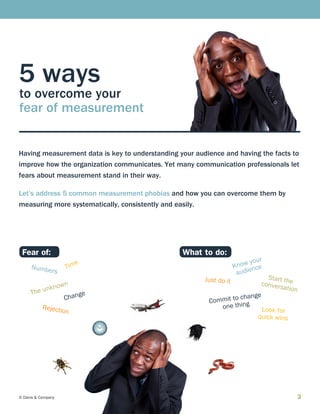
Let’s address 5 common measurement phobias and how you can overcome them by
measuring more systematically, consistently and easily.
fear of measurement
Numbers
Time
Rejection
Just do it
Look for
quick wins
ChangeThe unknown
Start theconversation
Know your
audience
Fear of: What to do:
Commit to change
one thing
to overcome your
5 ways
4© Davis & Company
1
6
9
7
3
4
5
1
2
8
HOW TO BEGIN
Paint a clear picture of the people in your
organization by partnering with Human
Resources to obtain data on 3 essential
areas:
• Geography: Location, location, location.
When it comes to how employees
experience organizations (headquarters
vs. field offices), geography is an important
factor.
• Tenure/length of service: Longevity has
implications for how much employees
understand about the company—and what
they remember about past events.
• Age ranges: Sociologists and marketers
use terms like “baby boomers” and “Gen
X-ers” to describe groups of people bound
together by broad shared experiences.
Solution: Know your audience
Measurement doesn’t have to be difficult—or even include a lot
of math! For example, one of the best ways to begin to know
your employee audience is to learn their demographics. After
all, the more you understand who you’re communicating with,
the better you can capture their attention.
Although not a foolproof predictor of behavior, demographics
are so valuable that every communicator should have
employee information at their fingertips to answer
questions like these:
•	How many locations are there?
•	What is the average tenure?
•	What are our employee age ranges?
•	What percentage of employees work
in manufacturing, sales and office positions?
Demographics provide insights into almost every aspect of
what employees prefer: how information is delivered (for
example, print vs. digital) and what topics are communicated.
Arithmophobia
Fear of
numbers
1
Fear of missles: Ballistophobia
Common phobias
5© Davis  Company
5 TIPS FOR EFFECTIVE VIRTUAL
(WEB-BASED) FOCUS GROUPS
• Choose the right topic. Emotionally
charged issues are best reserved for
in-person groups.
• Invite more people. Studies show
that people are more likely to miss a
conference call than a face-to-face
meeting. Over-invite so you end up with
10 to 12 participants.
• Make it interactive. Use visuals, real-time
polls and live chats.
• Create a level playing field. Don’t mix
in-person and web-based participants
during the same focus group.
• Be a strong facilitator. Since you can’t
observe non-verbal cues, be sure to call
on participants by name and don’t jump in
right away if you have a few seconds
of silence.
Solution: Start the conversation
Why seek employee feedback? The answer is simple: The
more you know, the more you can create solutions that meet
employees’ needs.
Focus groups are a great option for exploring a variety of
topics, from benefits to performance management, from
corporate strategy to how leaders inspire.
One of the best reasons to use focus groups is to understand
the why behind behaviors, perceptions and decisions. If you’re
asking, “Why is this true?” or “What does this mean?” then
focus groups are the right research method.
With employees scattered around the world, you may dismiss
focus groups because they take too long to organize or are
too expensive. While it’s true that face-to-face focus groups
are the gold standard, it’s also possible to gather valuable
insights by conducting virtual focus groups via a web-meeting
platform.
Fear of frogs: Batrachophobia
Common phobias
Fear of
the unknown
2
6© Davis  Company
Solution: Just do it
“What if the survey shows that employees don’t like the
communication work I’m producing?,” “What will my boss say
if focus groups bash the communication program?”
Ignorance isn’t bliss. Don’t let fear of rejection hold you back
from measuring your employee communication. Finance
measures profitability, Sales measures the number of units
sold and you need to measure how well your communication
program is meeting its objectives.
The hard truth comes out one way or another. You’ll earn
more respect by measuring and making changes than by
putting your head in the sand. For example, if you survey
employees to assess if your CEO’s strategy is understood,
you can proactively take steps to address issues rather than
blindly continuing down the wrong path.
And, remember, feedback not only identifies areas for
improvement, it also highlights what’s working well.
Just do it. Conduct one measurement activity this quarter.
It’s not as scary as you think.
DIAL A FRIEND
Luckily, you aren’t on your own.
Measurement help is just a phone
call or click away.
If your organization has a
marketing department, chances
are you have MBA-trained survey
gurus within your company.
Or, you can sign up for a web
workshop, attend a training class
or devour a self-help book.
Fear of string: Linonophobia
Common phobias
Fear of
rejection
3
7© Davis  Company
Solution: Look for quick wins
You can’t afford not to measure. With a buzzing BlackBerry
and more meeting requests than you can tackle, it’s common
for communicators to face an overwhelming to-do list. Too
often measurement falls off that list.
Yet, you could be missing important data that shows you
where to spend your time and helps you reduce—or even
eliminate—communication that employees don’t value.
Why spend hours on communication that isn’t being read?
Use measurement to focus on those communication vehicles
or topics that matter most. Here are some options to get you
started quickly:
•	Launch an online survey after your CEO’s next town
hall meeting
•	Collect metrics on email opens and intranet site visits
•	Analyze existing data from past engagement and
attitude surveys
•	Conduct quick focus groups limited to 1 or 2 topics,
like your e-newsletter or company blog
•	Commit to posting a monthly one-question poll on
your portal
JUST 5 QUESTIONS
Whether you are measuring a town hall
meeting or newsletter, you can quickly obtain
valuable feedback with just a few questions.
Consider launching an online survey with
4 close-ended questions (using a “strongly
disagree, disagree, agree and strongly
agree” scale) such as:
Reading the newsletter is a good use of
my time.
The newsletter helps me understand the
company’s new strategy.
Newsletter content is relevant to me.
Articles are easy to understand.
And, 1 open-ended question:
If you could change or improve one thing
about the newsletter, what would it be?
1
2
3
4
5
Chronophobia
Fear of spiders: Arachnophobia
Common phobias
Fear of (not
enough) time
4
8© Davis  Company
Solution: Commit to change 1 thing
You may like the way your communication vehicles look. Or,
you don’t have the budget to make major revisions. Very few
people like to change.
Yet, one small step is all it takes to make improvements that
can boost the effectiveness of your communication, as well
as how you, as a communication expert, are perceived by
management.
A good way to get started is to focus on one communication
vehicle or topic to measure and improve. You don’t need to
toss everything, just commit to using data to make a few
changes that matter most, such as:
•	Creating an info graphic that explains the company
business initiative that employees don’t understand
•	Modeling future articles on those with the highest hit rates
or that receive the most “likes”
•	Adding more time for QA during the next CEO town hall
based on survey feedback
The possibilities are endless once you tackle your
measurement phobia!
SHARE RESULTS WITH EMPLOYEES
Now that you’ve invested the time to
research, analyze key findings and make
changes, don’t forget to close the loop by
reporting back to employees.
Show your employees that their feedback
mattered by posting a short wrap-up
article on the intranet or in your company
newsletter.
Sharing survey results and what actions
were taken in response goes a long way
toward making employees feel understood
and appreciated.
Fear of clowns: Coulrophobia
Common phobias
CainotophobiaFear of
change
5
9© Davis  Company
To schedule a consultation, just call us
at 1-877-399-5100 or email David Pitre
at david.pitre@davisandco.com.
11 Harristown Road
Glen Rock, NJ 07452
201.445.5100
About Davis  Company
Davis  Company is an award-winning firm that helps companies reach, engage
and motivate their employees.
Founded in 1984, Davis  Company develops innovative solutions and programs that
improve the success of employee communication for leading companies such as Nestlé,
PepsiCo and Pfizer. The company also offers web-based workshops, industry reports, how-
to books and newsletters for communication professionals on important topics pertaining
to employee communication. The firm is based in Glen Rock, N.J.
For more information, visit www.davisandco.com.
Smart guide

Tackle your Employee Communication Measurement Fears

  • 1.
    1© Davis &Company Tackle your fear of employee communication measurement Smart guide
  • 2.
    2© Davis &Company Measurement doesn’t have to be frightening YOU KNOW WHAT THEY SAY ABOUT MAKING ASSUMPTIONS… There are 2 dangerous assumptions you can make about communication: What you prefer about communication will appeal to all employees. Just because you’ve sent a message, employees have received it, understood it, accepted it and acted on it. The only way to understand your employee audience is to assess their needs and preferences. Surveyphobia. Measurementitis. Yes, these are made-up terms, but do they sound familiar? Have you put off measuring the effectiveness of your employee communication program because doing so is time-consuming, expensive or—most frightening of all—mathematical? Twenty-five years ago, most communicators did not measure the effectiveness of their efforts. Collecting this data was not seen as part of the core responsibilities of a communicator’s job. But today, metrics have become a must, as senior leaders demand accountability and communicators seek to explore if they’re getting through to employees. Simply put: you don’t want to be the only person in the (board) room without data. When it comes to determining the effectiveness of your efforts, there’s no substitute. Measurement helps you move from a communicator with an opinion to a valued expert. With metrics in hand, you can be the counselor who explains what employees need and how communication will contribute to the business. 1 2
  • 3.
    3© Davis &Company Having measurement data is key to understanding your audience and having the facts to improve how the organization communicates. Yet many communication professionals let fears about measurement stand in their way. Let’s address 5 common measurement phobias and how you can overcome them by measuring more systematically, consistently and easily. fear of measurement Numbers Time Rejection Just do it Look for quick wins ChangeThe unknown Start theconversation Know your audience Fear of: What to do: Commit to change one thing to overcome your 5 ways
  • 4.
    4© Davis &Company 1 6 9 7 3 4 5 1 2 8 HOW TO BEGIN Paint a clear picture of the people in your organization by partnering with Human Resources to obtain data on 3 essential areas: • Geography: Location, location, location. When it comes to how employees experience organizations (headquarters vs. field offices), geography is an important factor. • Tenure/length of service: Longevity has implications for how much employees understand about the company—and what they remember about past events. • Age ranges: Sociologists and marketers use terms like “baby boomers” and “Gen X-ers” to describe groups of people bound together by broad shared experiences. Solution: Know your audience Measurement doesn’t have to be difficult—or even include a lot of math! For example, one of the best ways to begin to know your employee audience is to learn their demographics. After all, the more you understand who you’re communicating with, the better you can capture their attention. Although not a foolproof predictor of behavior, demographics are so valuable that every communicator should have employee information at their fingertips to answer questions like these: • How many locations are there? • What is the average tenure? • What are our employee age ranges? • What percentage of employees work in manufacturing, sales and office positions? Demographics provide insights into almost every aspect of what employees prefer: how information is delivered (for example, print vs. digital) and what topics are communicated. Arithmophobia Fear of numbers 1 Fear of missles: Ballistophobia Common phobias
  • 5.
    5© Davis Company 5 TIPS FOR EFFECTIVE VIRTUAL (WEB-BASED) FOCUS GROUPS • Choose the right topic. Emotionally charged issues are best reserved for in-person groups. • Invite more people. Studies show that people are more likely to miss a conference call than a face-to-face meeting. Over-invite so you end up with 10 to 12 participants. • Make it interactive. Use visuals, real-time polls and live chats. • Create a level playing field. Don’t mix in-person and web-based participants during the same focus group. • Be a strong facilitator. Since you can’t observe non-verbal cues, be sure to call on participants by name and don’t jump in right away if you have a few seconds of silence. Solution: Start the conversation Why seek employee feedback? The answer is simple: The more you know, the more you can create solutions that meet employees’ needs. Focus groups are a great option for exploring a variety of topics, from benefits to performance management, from corporate strategy to how leaders inspire. One of the best reasons to use focus groups is to understand the why behind behaviors, perceptions and decisions. If you’re asking, “Why is this true?” or “What does this mean?” then focus groups are the right research method. With employees scattered around the world, you may dismiss focus groups because they take too long to organize or are too expensive. While it’s true that face-to-face focus groups are the gold standard, it’s also possible to gather valuable insights by conducting virtual focus groups via a web-meeting platform. Fear of frogs: Batrachophobia Common phobias Fear of the unknown 2
  • 6.
    6© Davis Company Solution: Just do it “What if the survey shows that employees don’t like the communication work I’m producing?,” “What will my boss say if focus groups bash the communication program?” Ignorance isn’t bliss. Don’t let fear of rejection hold you back from measuring your employee communication. Finance measures profitability, Sales measures the number of units sold and you need to measure how well your communication program is meeting its objectives. The hard truth comes out one way or another. You’ll earn more respect by measuring and making changes than by putting your head in the sand. For example, if you survey employees to assess if your CEO’s strategy is understood, you can proactively take steps to address issues rather than blindly continuing down the wrong path. And, remember, feedback not only identifies areas for improvement, it also highlights what’s working well. Just do it. Conduct one measurement activity this quarter. It’s not as scary as you think. DIAL A FRIEND Luckily, you aren’t on your own. Measurement help is just a phone call or click away. If your organization has a marketing department, chances are you have MBA-trained survey gurus within your company. Or, you can sign up for a web workshop, attend a training class or devour a self-help book. Fear of string: Linonophobia Common phobias Fear of rejection 3
  • 7.
    7© Davis Company Solution: Look for quick wins You can’t afford not to measure. With a buzzing BlackBerry and more meeting requests than you can tackle, it’s common for communicators to face an overwhelming to-do list. Too often measurement falls off that list. Yet, you could be missing important data that shows you where to spend your time and helps you reduce—or even eliminate—communication that employees don’t value. Why spend hours on communication that isn’t being read? Use measurement to focus on those communication vehicles or topics that matter most. Here are some options to get you started quickly: • Launch an online survey after your CEO’s next town hall meeting • Collect metrics on email opens and intranet site visits • Analyze existing data from past engagement and attitude surveys • Conduct quick focus groups limited to 1 or 2 topics, like your e-newsletter or company blog • Commit to posting a monthly one-question poll on your portal JUST 5 QUESTIONS Whether you are measuring a town hall meeting or newsletter, you can quickly obtain valuable feedback with just a few questions. Consider launching an online survey with 4 close-ended questions (using a “strongly disagree, disagree, agree and strongly agree” scale) such as: Reading the newsletter is a good use of my time. The newsletter helps me understand the company’s new strategy. Newsletter content is relevant to me. Articles are easy to understand. And, 1 open-ended question: If you could change or improve one thing about the newsletter, what would it be? 1 2 3 4 5 Chronophobia Fear of spiders: Arachnophobia Common phobias Fear of (not enough) time 4
  • 8.
    8© Davis Company Solution: Commit to change 1 thing You may like the way your communication vehicles look. Or, you don’t have the budget to make major revisions. Very few people like to change. Yet, one small step is all it takes to make improvements that can boost the effectiveness of your communication, as well as how you, as a communication expert, are perceived by management. A good way to get started is to focus on one communication vehicle or topic to measure and improve. You don’t need to toss everything, just commit to using data to make a few changes that matter most, such as: • Creating an info graphic that explains the company business initiative that employees don’t understand • Modeling future articles on those with the highest hit rates or that receive the most “likes” • Adding more time for QA during the next CEO town hall based on survey feedback The possibilities are endless once you tackle your measurement phobia! SHARE RESULTS WITH EMPLOYEES Now that you’ve invested the time to research, analyze key findings and make changes, don’t forget to close the loop by reporting back to employees. Show your employees that their feedback mattered by posting a short wrap-up article on the intranet or in your company newsletter. Sharing survey results and what actions were taken in response goes a long way toward making employees feel understood and appreciated. Fear of clowns: Coulrophobia Common phobias CainotophobiaFear of change 5
  • 9.
    9© Davis Company To schedule a consultation, just call us at 1-877-399-5100 or email David Pitre at david.pitre@davisandco.com. 11 Harristown Road Glen Rock, NJ 07452 201.445.5100 About Davis Company Davis Company is an award-winning firm that helps companies reach, engage and motivate their employees. Founded in 1984, Davis Company develops innovative solutions and programs that improve the success of employee communication for leading companies such as Nestlé, PepsiCo and Pfizer. The company also offers web-based workshops, industry reports, how- to books and newsletters for communication professionals on important topics pertaining to employee communication. The firm is based in Glen Rock, N.J. For more information, visit www.davisandco.com. Smart guide