Did 1.5°C suddenly get easier?
Glen Peters (CICERO)
Carbon Debate, 22/01/2018
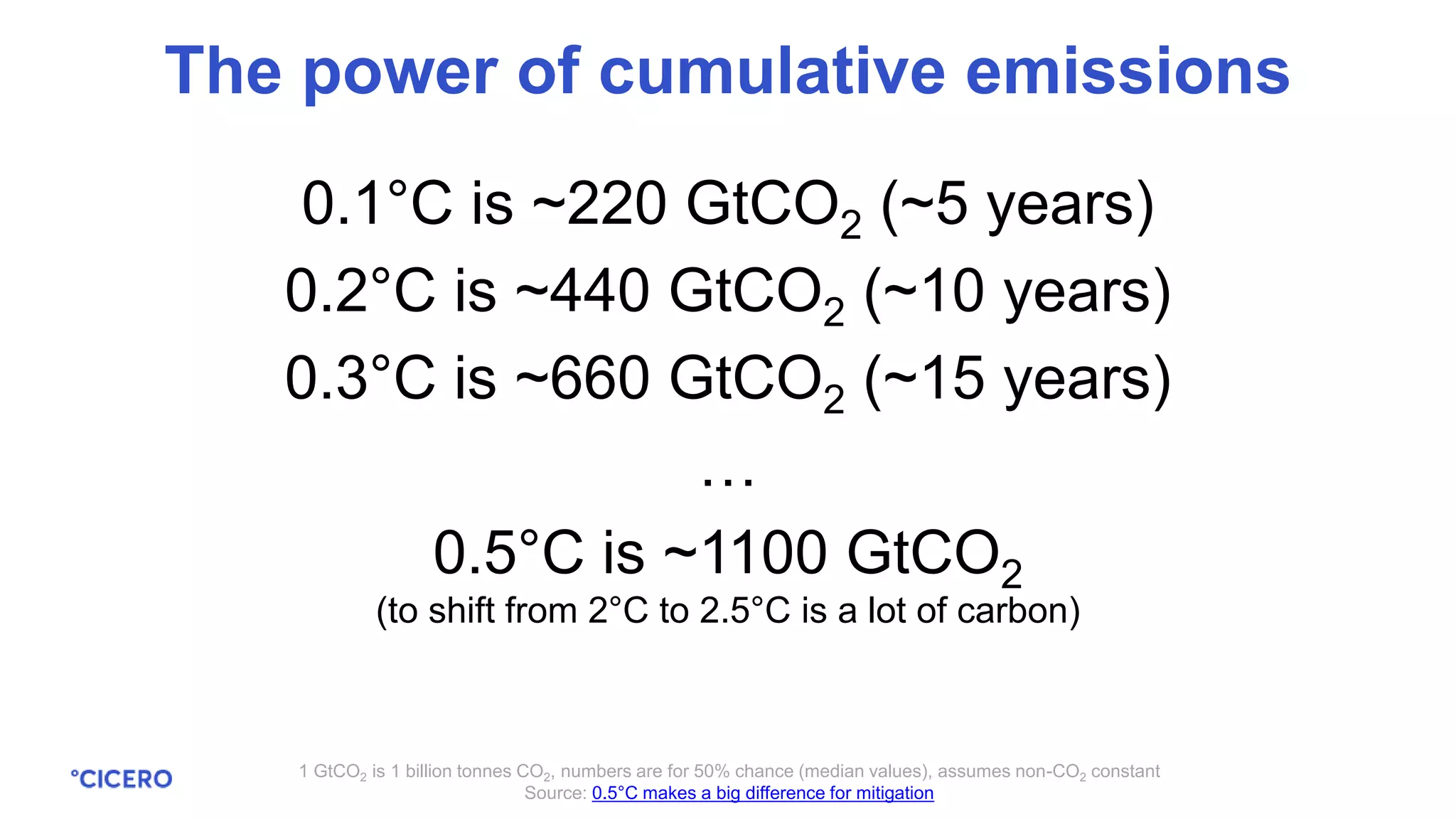
0.1°C is ~220 GtCO2 (~5 years)
0.2°C is ~440 GtCO2 (~10 years)
0.3°C is ~660 GtCO2 (~15 years)
…
0.5°C is ~1100 GtCO2
(to shift from 2°C to 2.5°C is a lot of carbon)
The power of cumulative emissions
1 GtCO2 is 1 billion tonnes CO2, numbers are for 50% chance (median values), assumes non-CO2 constant
Source: 0.5°C makes a big difference for mitigation
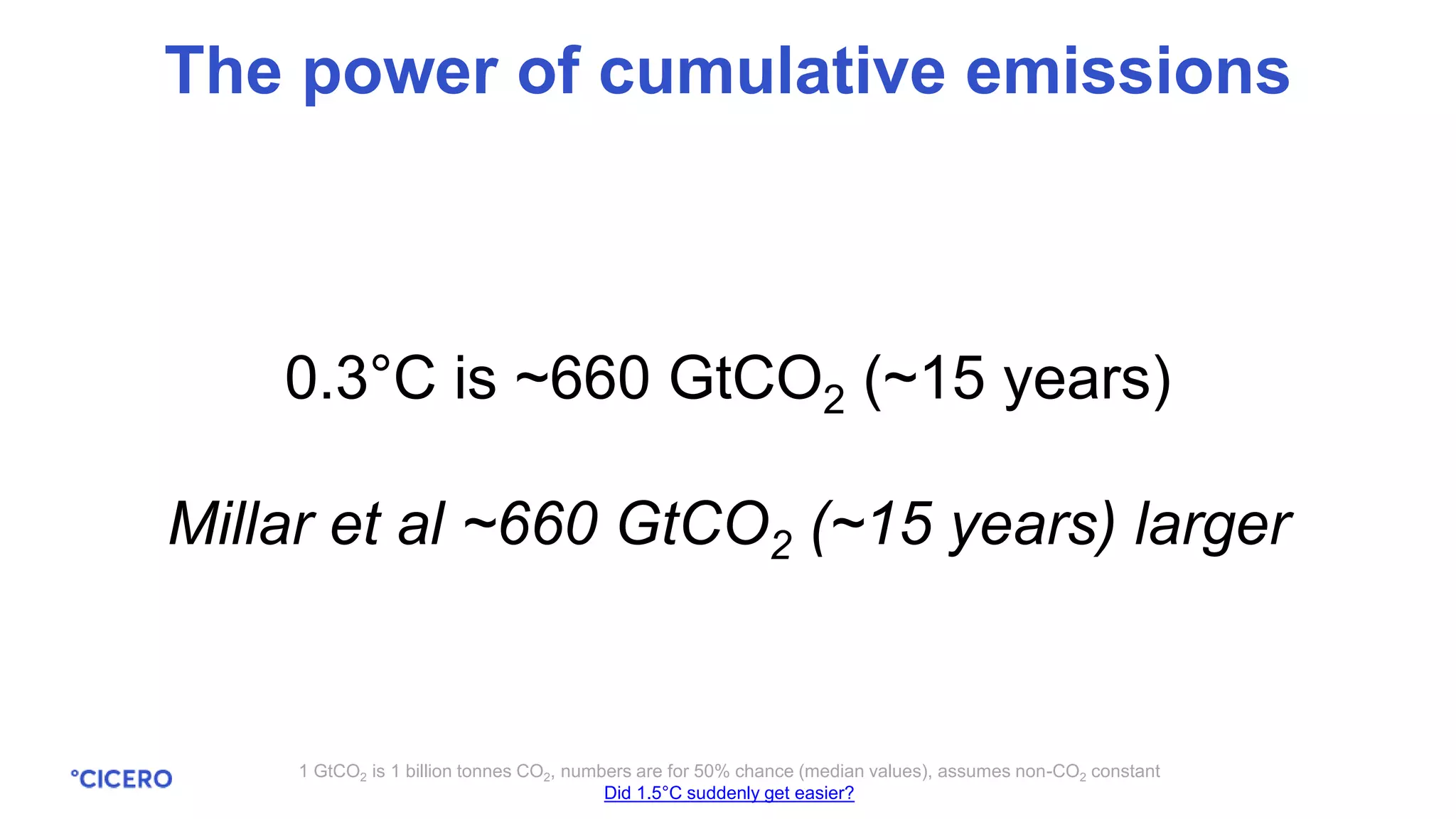
0.1°C is ~220 GtCO2 (~5 years)
0.2°C is ~440 GtCO2 (~10 years)
0.3°C is ~660 GtCO2 (~15 years)
Millar et al ~660 GtCO2 (~15 years) larger
The power of cumulative emissions
1 GtCO2 is 1 billion tonnes CO2, numbers are for 50% chance (median values), assumes non-CO2 constant
Did 1.5°C suddenly get easier?
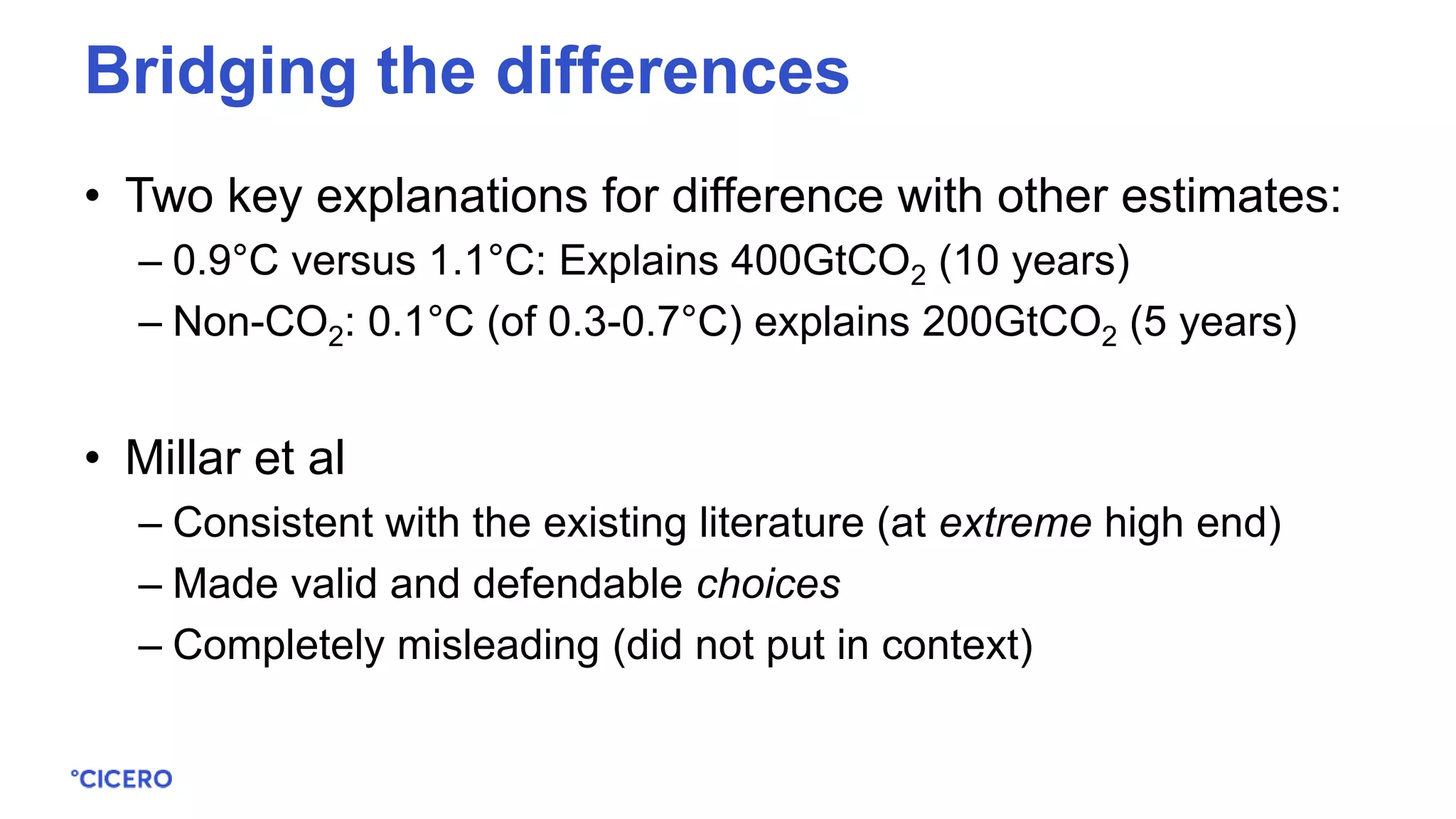
• Two key explanations for difference with other estimates:
– 0.9°C versus 1.1°C: Explains 400GtCO2 (10 years)
– Non-CO2: 0.1°C (of 0.3-0.7°C) explains 200GtCO2 (5 years)
• Millar et al
– Consistent with the existing literature (at extreme high end)
– Made valid and defendable choices
– Completely misleading (did not put in context)
Bridging the differences
Bringing out the nuances
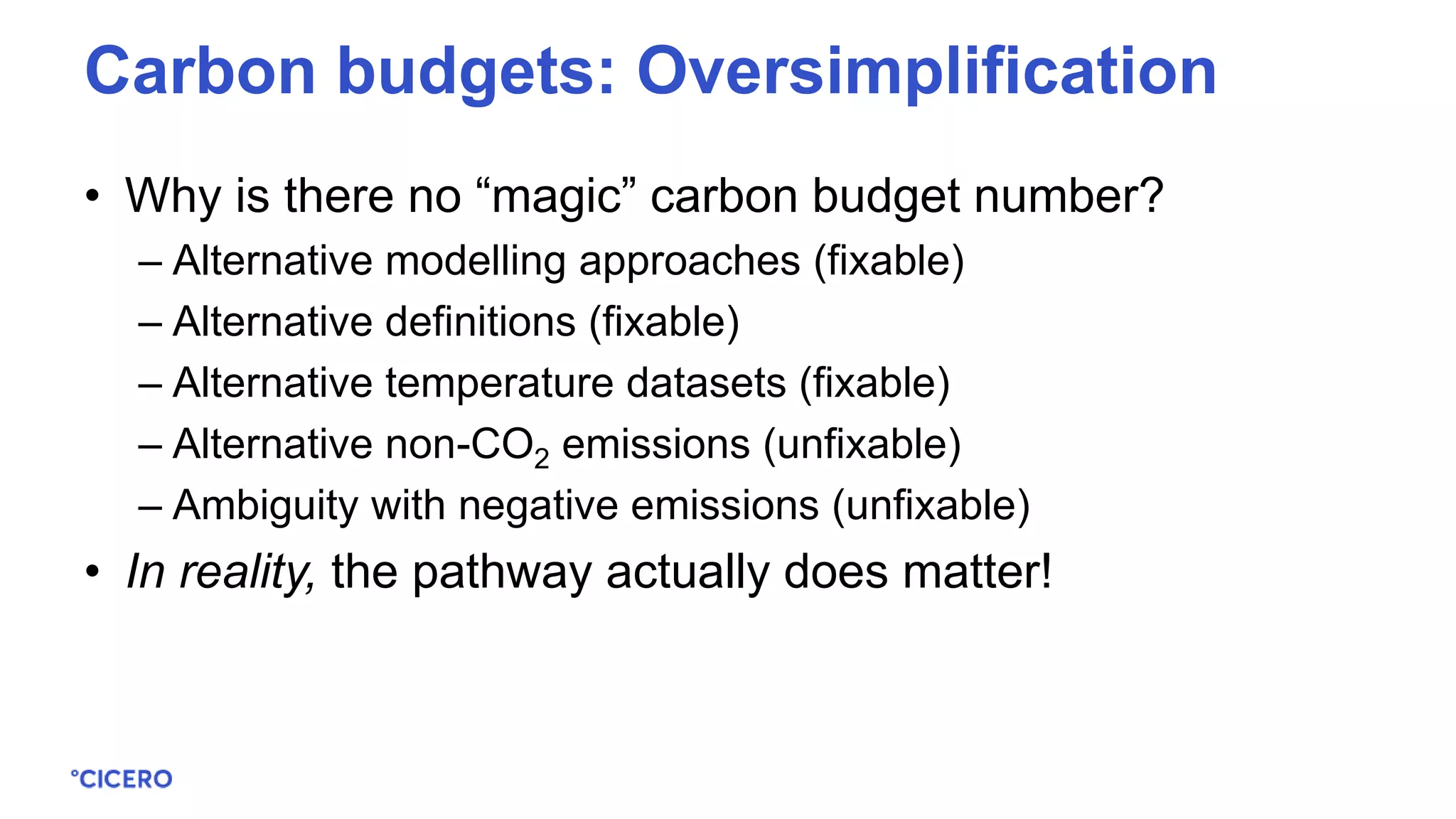
• Why is there no “magic” carbon budget number?
– Alternative modelling approaches (fixable)
– Alternative definitions (fixable)
– Alternative temperature datasets (fixable)
– Alternative non-CO2 emissions (unfixable)
– Ambiguity with negative emissions (unfixable)
• In reality, the pathway actually does matter!
Carbon budgets: Oversimplification
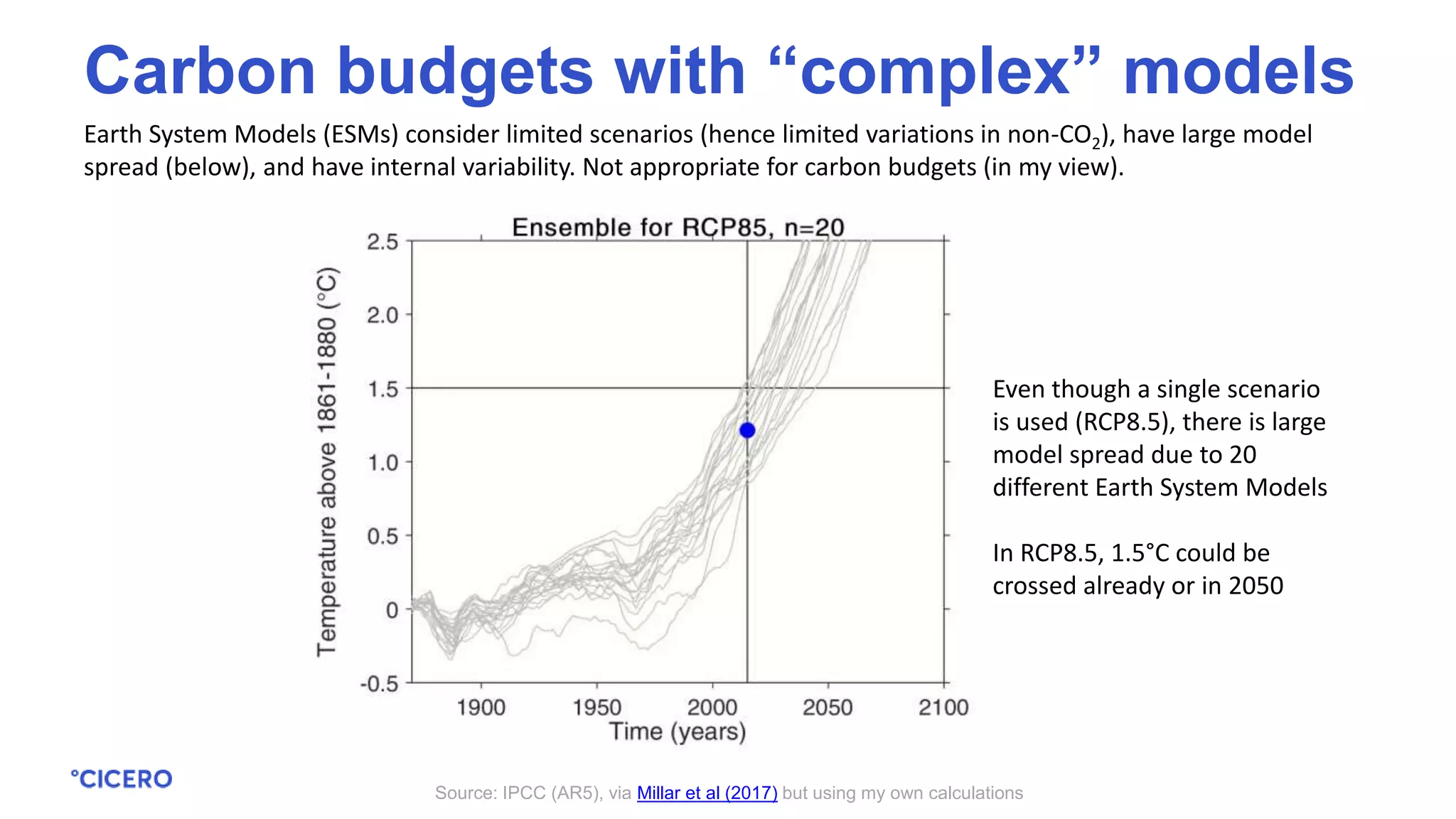
Earth System Models (ESMs) consider limited scenarios (hence limited variations in non-CO2), have large model
spread (below), and have internal variability. Not appropriate for carbon budgets (in my view).
Source: IPCC (AR5), via Millar et al (2017) but using my own calculations
Carbon budgets with “complex” models
Even though a single scenario
is used (RCP8.5), there is large
model spread due to 20
different Earth System Models
In RCP8.5, 1.5°C could be
crossed already or in 2050
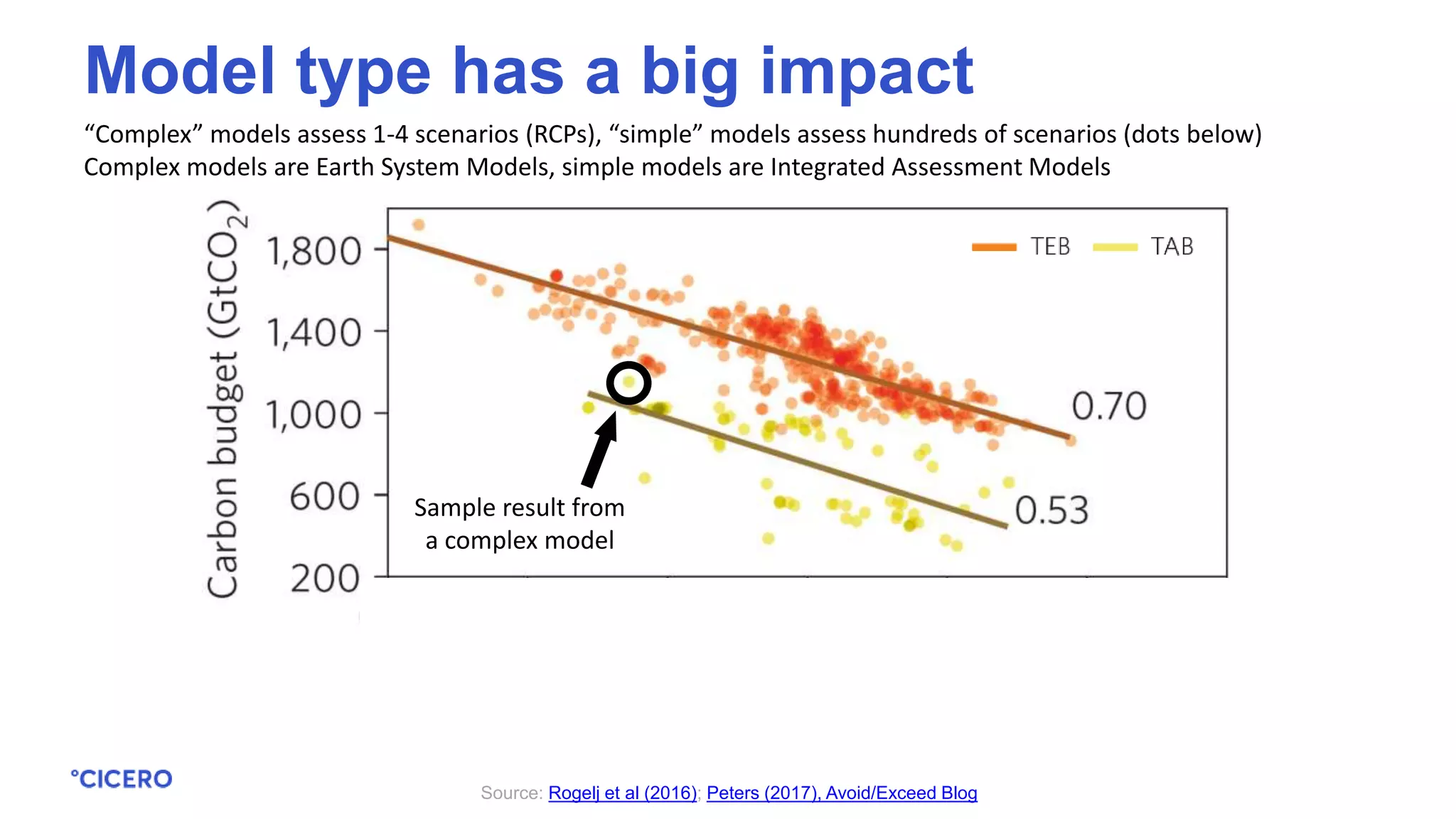
“Complex” models assess 1-4 scenarios (RCPs), “simple” models assess hundreds of scenarios (dots below)
Complex models are Earth System Models, simple models are Integrated Assessment Models
Source: Rogelj et al (2016); Peters (2017), Avoid/Exceed Blog
Model type has a big impact
Sample result from
a complex model
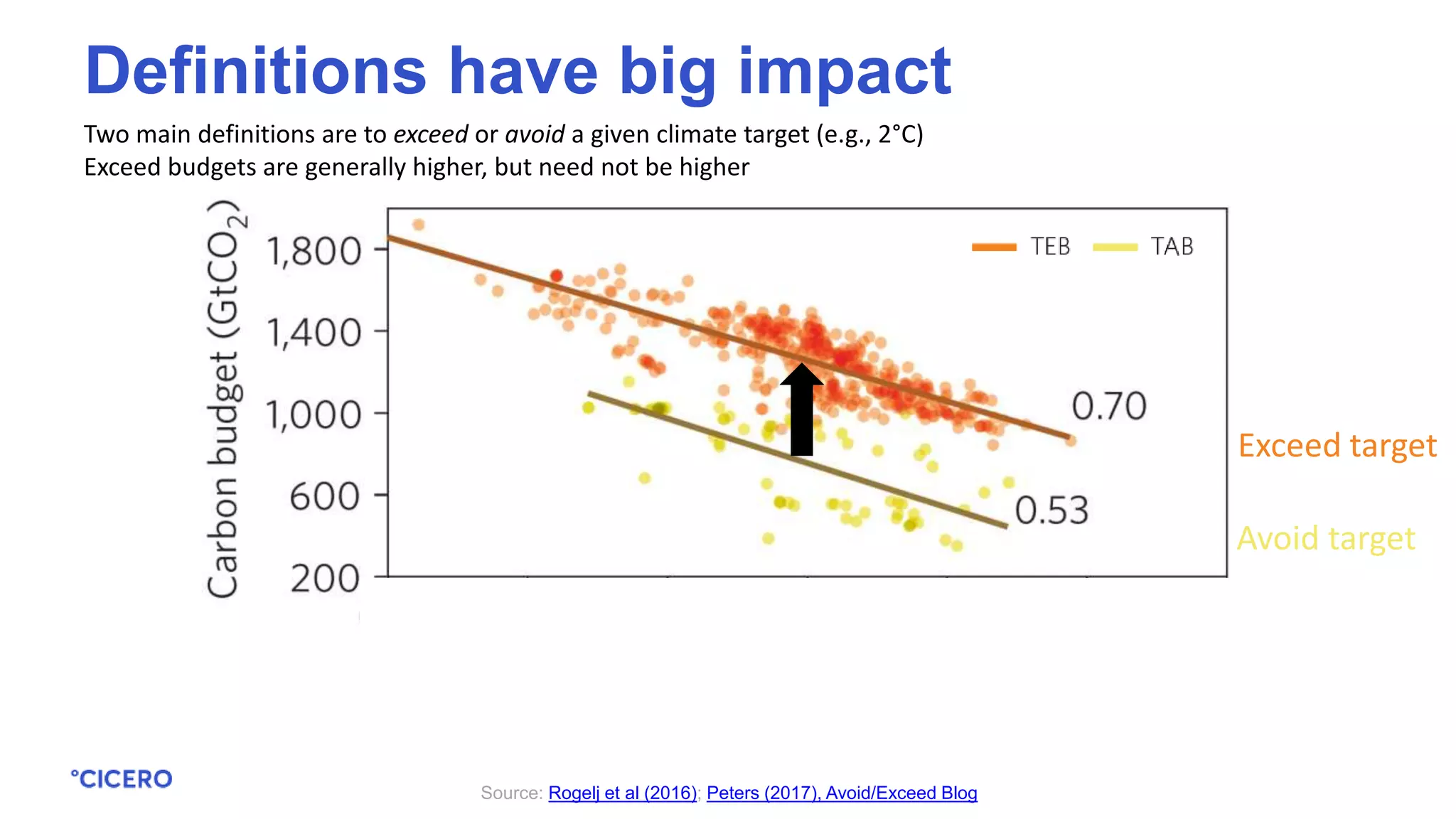
Two main definitions are to exceed or avoid a given climate target (e.g., 2°C)
Exceed budgets are generally higher, but need not be higher
Source: Rogelj et al (2016); Peters (2017), Avoid/Exceed Blog
Definitions have big impact
Exceed target
Avoid target
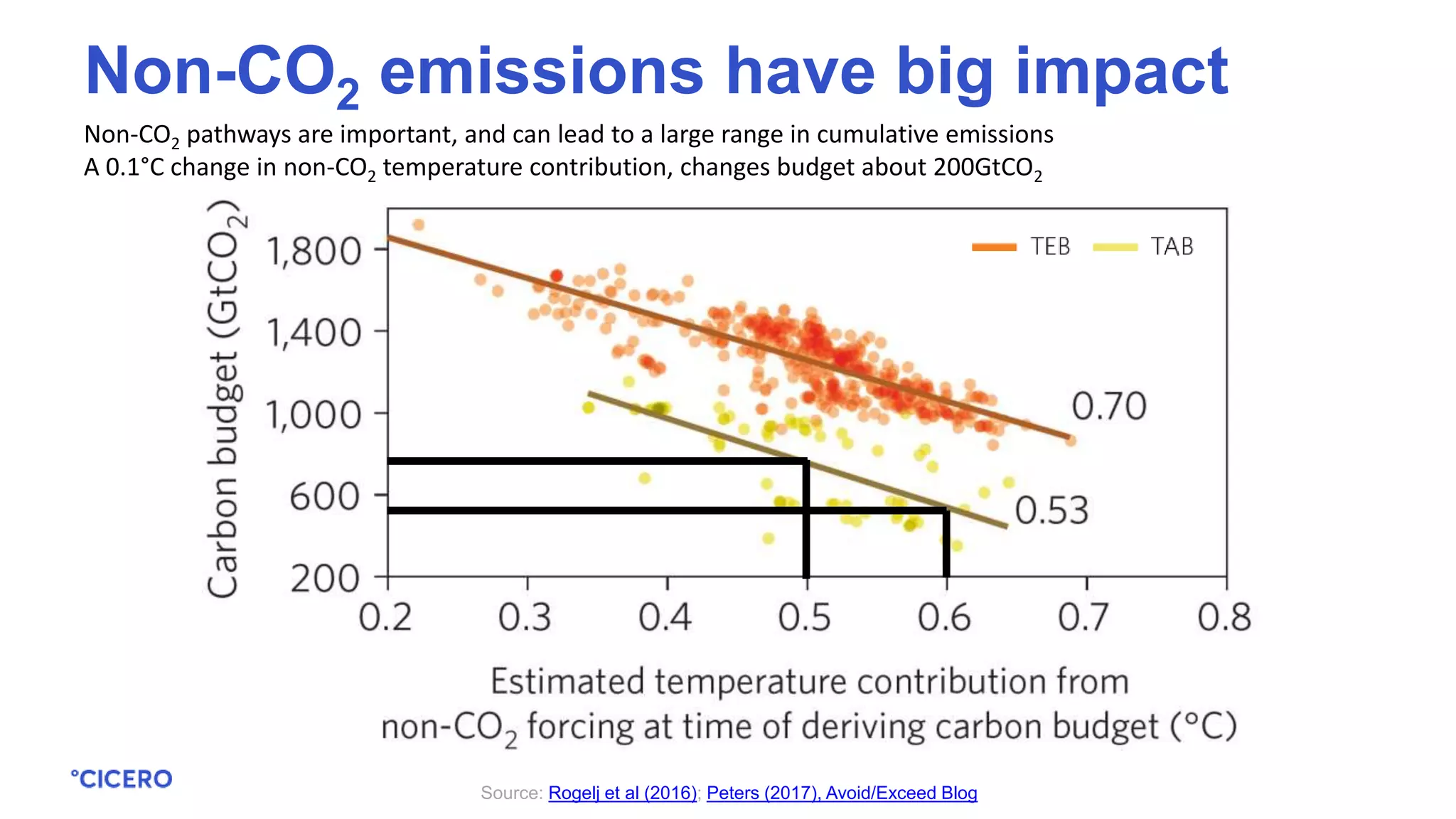
Non-CO2 pathways are important, and can lead to a large range in cumulative emissions
A 0.1°C change in non-CO2 temperature contribution, changes budget about 200GtCO2
Source: Rogelj et al (2016); Peters (2017), Avoid/Exceed Blog
Non-CO2 emissions have big impact
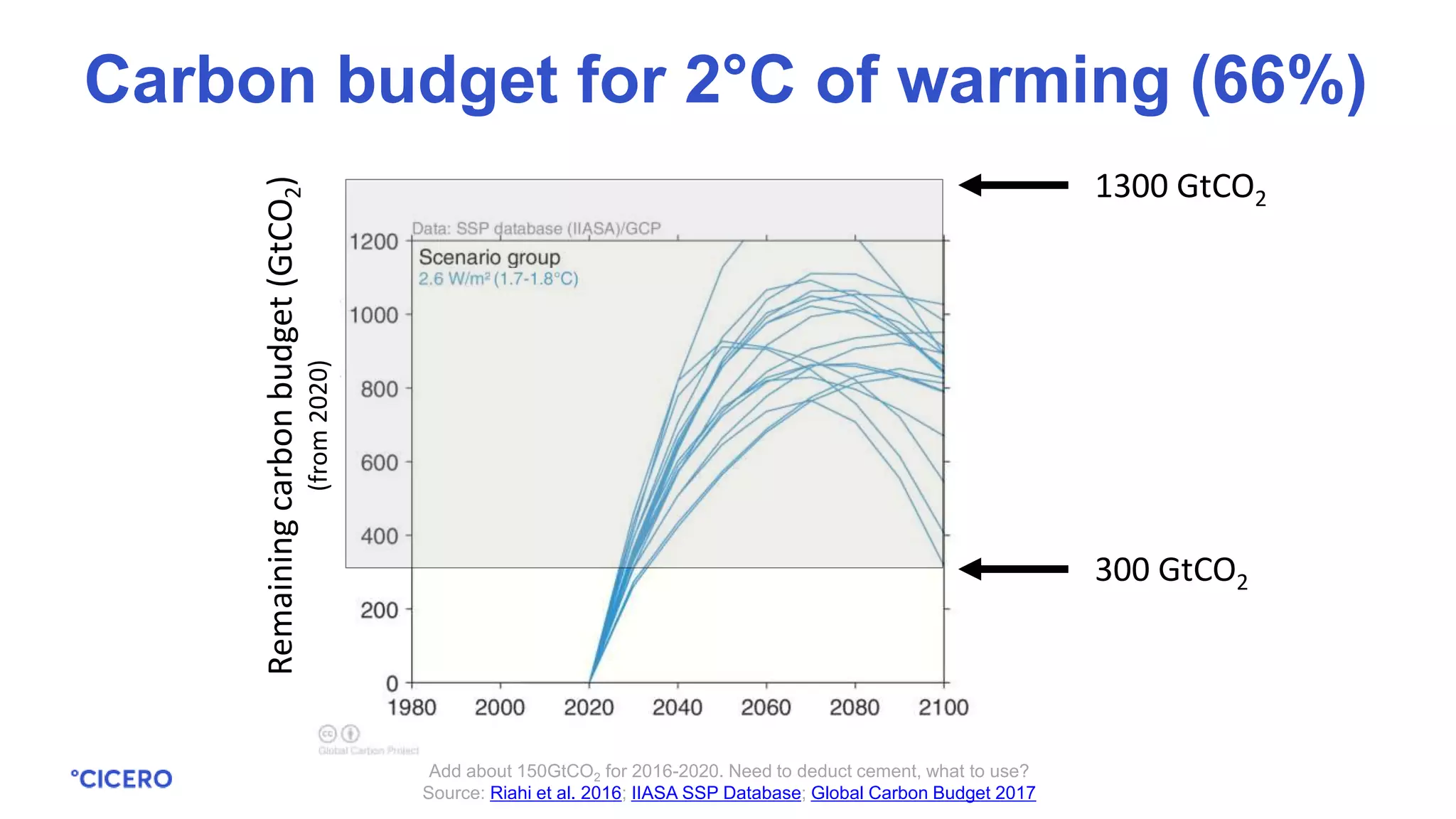
Add about 150GtCO2 for 2016-2020. Need to deduct cement, what to use?
Source: Riahi et al. 2016; IIASA SSP Database; Global Carbon Budget 2017
Carbon budget for 2°C of warming (66%)
Remainingcarbonbudget(GtCO2)
(from2020)
300 GtCO2
1300 GtCO2
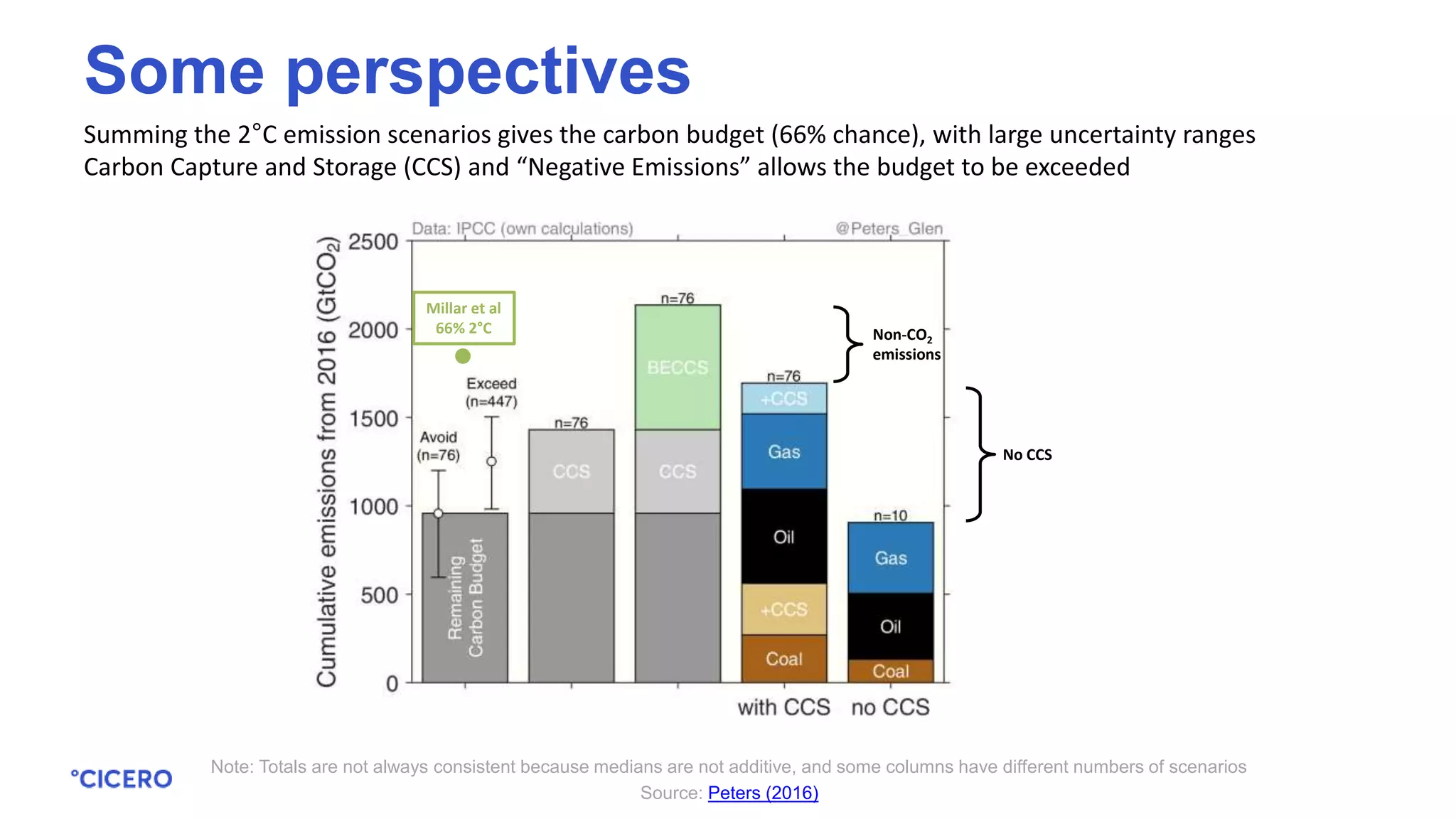
Summing the 2°C emission scenarios gives the carbon budget (66% chance), with large uncertainty ranges
Carbon Capture and Storage (CCS) and “Negative Emissions” allows the budget to be exceeded
Note: Totals are not always consistent because medians are not additive, and some columns have different numbers of scenarios
Source: Peters (2016)
Some perspectives
Non-CO2
emissions
No CCS
Millar et al
66% 2°C
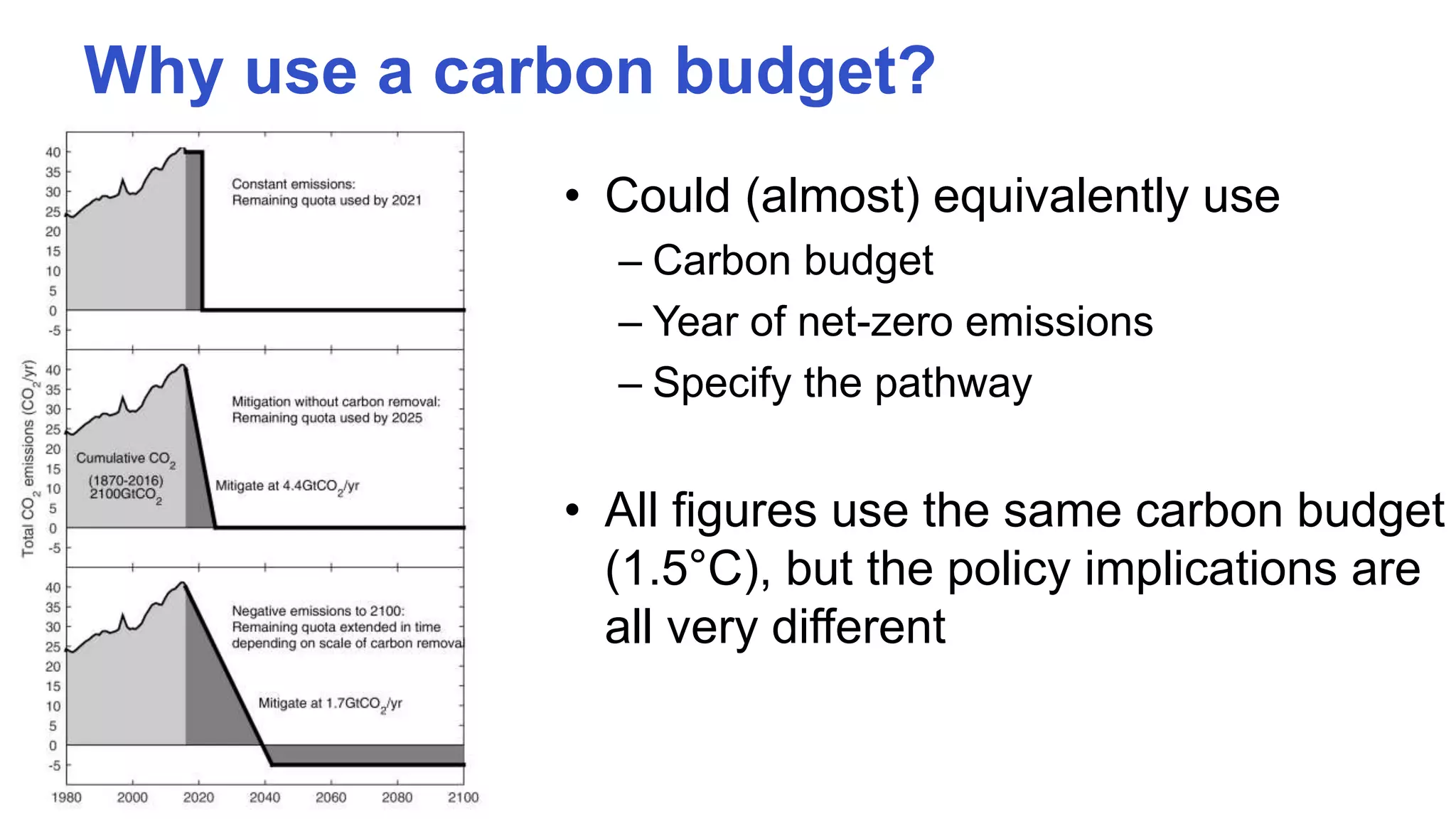
• Could (almost) equivalently use
– Carbon budget
– Year of net-zero emissions
– Specify the pathway
• All figures use the same carbon budget
(1.5°C), but the policy implications are
all very different
Why use a carbon budget?
Peters_Glen
cicero.oslo.no
cicerosenterforklimaforskning
glen.peters@cicero.oslo.no
Glen Peters

Did 1.5°C suddenly get easier?

  • 1.
    Did 1.5°C suddenlyget easier? Glen Peters (CICERO) Carbon Debate, 22/01/2018
  • 2.
    0.1°C is ~220GtCO2 (~5 years) 0.2°C is ~440 GtCO2 (~10 years) 0.3°C is ~660 GtCO2 (~15 years) … 0.5°C is ~1100 GtCO2 (to shift from 2°C to 2.5°C is a lot of carbon) The power of cumulative emissions 1 GtCO2 is 1 billion tonnes CO2, numbers are for 50% chance (median values), assumes non-CO2 constant Source: 0.5°C makes a big difference for mitigation
  • 3.
    0.1°C is ~220GtCO2 (~5 years) 0.2°C is ~440 GtCO2 (~10 years) 0.3°C is ~660 GtCO2 (~15 years) Millar et al ~660 GtCO2 (~15 years) larger The power of cumulative emissions 1 GtCO2 is 1 billion tonnes CO2, numbers are for 50% chance (median values), assumes non-CO2 constant Did 1.5°C suddenly get easier?
  • 4.
    • Two keyexplanations for difference with other estimates: – 0.9°C versus 1.1°C: Explains 400GtCO2 (10 years) – Non-CO2: 0.1°C (of 0.3-0.7°C) explains 200GtCO2 (5 years) • Millar et al – Consistent with the existing literature (at extreme high end) – Made valid and defendable choices – Completely misleading (did not put in context) Bridging the differences
  • 5.
  • 6.
    • Why isthere no “magic” carbon budget number? – Alternative modelling approaches (fixable) – Alternative definitions (fixable) – Alternative temperature datasets (fixable) – Alternative non-CO2 emissions (unfixable) – Ambiguity with negative emissions (unfixable) • In reality, the pathway actually does matter! Carbon budgets: Oversimplification
  • 7.
    Earth System Models(ESMs) consider limited scenarios (hence limited variations in non-CO2), have large model spread (below), and have internal variability. Not appropriate for carbon budgets (in my view). Source: IPCC (AR5), via Millar et al (2017) but using my own calculations Carbon budgets with “complex” models Even though a single scenario is used (RCP8.5), there is large model spread due to 20 different Earth System Models In RCP8.5, 1.5°C could be crossed already or in 2050
  • 8.
    “Complex” models assess1-4 scenarios (RCPs), “simple” models assess hundreds of scenarios (dots below) Complex models are Earth System Models, simple models are Integrated Assessment Models Source: Rogelj et al (2016); Peters (2017), Avoid/Exceed Blog Model type has a big impact Sample result from a complex model
  • 9.
    Two main definitionsare to exceed or avoid a given climate target (e.g., 2°C) Exceed budgets are generally higher, but need not be higher Source: Rogelj et al (2016); Peters (2017), Avoid/Exceed Blog Definitions have big impact Exceed target Avoid target
  • 10.
    Non-CO2 pathways areimportant, and can lead to a large range in cumulative emissions A 0.1°C change in non-CO2 temperature contribution, changes budget about 200GtCO2 Source: Rogelj et al (2016); Peters (2017), Avoid/Exceed Blog Non-CO2 emissions have big impact
  • 11.
    Add about 150GtCO2for 2016-2020. Need to deduct cement, what to use? Source: Riahi et al. 2016; IIASA SSP Database; Global Carbon Budget 2017 Carbon budget for 2°C of warming (66%) Remainingcarbonbudget(GtCO2) (from2020) 300 GtCO2 1300 GtCO2
  • 12.
    Summing the 2°Cemission scenarios gives the carbon budget (66% chance), with large uncertainty ranges Carbon Capture and Storage (CCS) and “Negative Emissions” allows the budget to be exceeded Note: Totals are not always consistent because medians are not additive, and some columns have different numbers of scenarios Source: Peters (2016) Some perspectives Non-CO2 emissions No CCS Millar et al 66% 2°C
  • 13.
    • Could (almost)equivalently use – Carbon budget – Year of net-zero emissions – Specify the pathway • All figures use the same carbon budget (1.5°C), but the policy implications are all very different Why use a carbon budget?
  • 14.