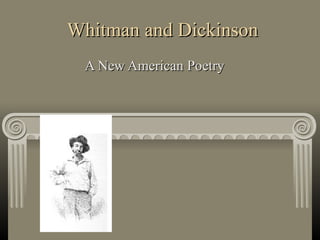
Whitman and DickinsonWhitman and Dickinson
A New American PoetryA New American Poetry
Whitman’s Early LifeWhitman’s Early Life
He was born May 31, 1819 in New York.
His formal schooling ended at age 11.
He worked as office boy and printer’s
assistant.
He became a journalist by the age of 20.
Whitman’s TravelsWhitman’s Travels
Around 1850, Whitman began traveling
around the U.S.
Travels gave Whitman a perspective on the
vastness of the United States.
Travels exposed Whitman to various cultures
within the nation.
Whitman’sWhitman’s
Beginning of Writing CareerBeginning of Writing Career
Editor of newspapers
The Freeman
Brooklyn Eagle
New York Aurora
Kept notebooks of travels
Kept notebooks of poems
Leaves of GrassLeaves of Grass
Self-published in 1855
Set some of the type himself
Publicized by sending excerpts to known authors
Published 9 editions, 1855-1892
12 poems in 1855 edition
350 poems in 1892 edition
Themes include
Sacredness of self
Death as part of cycle of life
Equality of all beings
Whitman’s Poetic ElementsWhitman’s Poetic Elements
Free verse
Cadence
Run of words that rise and fall to make emphasis of thought
Need to read poems aloud to hear cadence
Other poetic elements
Assonance
Alliteration
Onomatopoeia
Parallel structure
Imagery
““Song of Myself”Song of Myself”
Made up of 52 parts which parallel a year
Whitman billed himself as speaker for
American people
Introduced free verse
Employs chant and ordinary speech
Whitman’s Civil War ExperienceWhitman’s Civil War Experience
Served as a “wound dresser”
Was greatly affected by the carnage of the
war
Drum Taps based on war experiences
Responding to theResponding to the
Assassination of LincolnAssassination of Lincoln
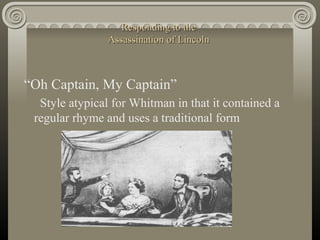
“Oh Captain, My Captain”
Style atypical for Whitman in that it contained a
regular rhyme and uses a traditional form
““When Lilacs Last in the Dooryard Bloom’d”When Lilacs Last in the Dooryard Bloom’d”
One of Whitman’s finest poems
Explores grief of narrator and of nation at
Lincoln’s death
Uses lilacs to symbolize life and rebirth
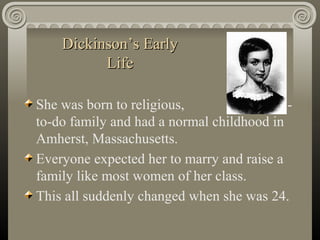
Dickinson’s EarlyDickinson’s Early
LifeLife
She was born to religious, well-
to-do family and had a normal childhood in
Amherst, Massachusetts.
Everyone expected her to marry and raise a
family like most women of her class.
This all suddenly changed when she was 24.
Poet and ReclusePoet and Recluse
“Dickinson used precise language and
unique poetic forms to simultaneously reveal
and conceal her private thoughts and
feelings” (Elements of Literature 345).
What happened to turn a young girl into an
unrecognized poet who never left her house?
What would cause a young
woman of 24 suddenly to isolate
herself within her yard and
house and ignore the world
outside?
Speculations About Why:Speculations About Why:
Left Amherst to go to Washington D.C. with her
father, a congressman, because she had fallen in
love with a married lawyer, who soon died of TB.
There , she fell in love with another married man,
Charles Wadsworth, a minister. He moved to San
Francisco in 1862. About this time she wrote, “I
sing as the boy does by the burying ground, because
I am afraid.”
Return to AmherstReturn to Amherst
Within a few years, she had retreated from
all social life in Amherst. Always wearing
white, like the bride she would never be, she
remained in her parents’ house and restricted
herself to household work and writing
poetry, which she would sometimes send to
people as gifts for valentines or birthdays,
along with a pie or some cookies.
Dickinson’s PoemsDickinson’s Poems
• Only a few of her poems were
published in her lifetime. She sent four
of them to a critic, Mr. Higginson,
asking for his help. When he sent
suggestions for changing her poems,
she replied in a letter, “Thank you for
the surgery; it was not so painful as I
supposed. I bring you others, as you
ask” (Higginson).
After her death, friends and relatives found
bundles of her poems, which they edited and
“corrected” and had published in installments.
In 1955, Thomas H. Johnson finally published
a collection of her poems that had not been
“corrected.” These are the versions we read
today.
What Sort of Poet Was She?
Dickinson is known for using poetry as
private observation.
Her poems are carefully crafted in
rhyme and meter.
DickinsonDickinson
In one of her best-known poems, Emily
Dickinson wrote: “This is my letter to the
World / That never wrote to Me—“ (1-2).
 The words nicely capture Dickinson’s two
opposite positions in the world of American
literature.
 During her life, she existed largely on the
margins.
 Unlike Whitman and Thoreau, she did not
count Ralph Waldo Emerson among her
friends or admirers. She did not travel
widely, as Herman Melville did.
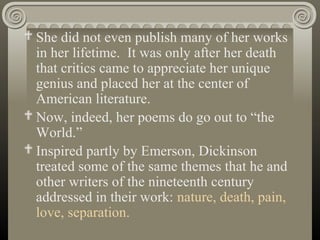
 She did not even publish many of her works
in her lifetime. It was only after her death
that critics came to appreciate her unique
genius and placed her at the center of
American literature.
 Now, indeed, her poems do go out to “the
World.”
 Inspired partly by Emerson, Dickinson
treated some of the same themes that he and
other writers of the nineteenth century
addressed in their work: nature, death, pain,
love, separation.
Indeed, one feels that Dickinson may have
had much in common with Whitman, Henry
Wadsworth Longfellow, and even Edgar
Allan Poe.
The reasons behind Dickinson’s relatively
poor reception in her own life, however, may
lie in her complex, unusual style, which is
characterized by the use of dashes, slant
rhyme, and ambiguous, elusive language.
Expressing American IdeasExpressing American Ideas
During the period in American History
known as Conflict and Celebration, there
were several poets who began to write
differently than people had written before.
Their writing style was more modern; they
broke with traditional styles. Among these
poets were Walt Whitman and Emily
Dickinson.
Expressing American IdeasExpressing American Ideas
They used these new writing styles to express
uniquely American ideas. Although both Whitman
and Dickinson are considered modern writers, their
writings can be compared and contrasted in many
ways.
There are by far more differences in the writing
styles of Whitman and Dickinson than there are
similarities.
WhitmanWhitman vs. Dickinson. Dickinson
structure of poems
One difference is the way
they structured their poems.
Basically, the structures of
Whitman’s poems are the
lack of any structure.
Whitman’s poems tend to
run on and on; there was no
set length for his poems,
stanzas, or even lines.
Dickinson, on the other
hand, wrote poems
with a definite
structure. She wrote
ballad stanzas, which
were four line stanzas
alternating in iambic
tetrameter and tri-
meter.
Whitman vs. DickinsonWhitman vs. Dickinson
use of rhyme
As with structure,
Whitman’s poetry has no
rhyme. In this way Whitman
also breaks from tradition.
Whitman’s poems make use
of free verse. This is poetry
that is written without
concern for regular rhyme
schemes and meter.
Dickinson’s poems,
unlike Whitman’s,
make use of slant
rhyme. This is the use
of near or approximate
rhymes, and is a
relatively modern idea.
SimilaritiesSimilarities::
use of modern ideas and concepts in poetry
One of the poetic
“tools” which Whitman
uses is cataloguing, or
enumeration.
Catalogs are long lists
of related things,
people, or events.
One of Dickinson’s modern
“tools” is her use of
startling imagery.
Typical of her writing are
the use of dashes that break
the lines, and serve to keep
them open.
Most of her poems are
short, but they take you on
an infinite trip; they look
simple enough, but what
you see is not what you get.
An interesting point of comparison onAn interesting point of comparison on
Whitman and DickinsonWhitman and Dickinson:
They are alike in the fact that they are not necessarily
transcendentalists, but often express transcendentalist
views in their poems
Even though both lived during the time of realism they
interpret nature through their poetry and use poetry as
a vehicle to participate in nature’s beauty and
transcendentalism.
They both find inspiration from nature and find an
expression or reflection of the soul in nature.
28
COME, I will make the continent indissoluble;
I will make the most splendid race the sun ever yet shone upon;
I will make divine magnetic lands,
With the love of comrades,
With the life-long love of comrades.
I will plant companionship thick as trees along all the rivers of
America, and along the shores of the great lakes, and all over
the prairies;
I will make inseparable cities, with their arms about each other's
necks;
By the love of comrades,
By the manly love of comrades.
For you these, from me, O Democracy, to serve you, ma femme! 10
For you! for you, I am trilling these songs,
In the love of comrades,
In the high-towering love of comrades.
Whitman
29
Dickinson
'Hope' is the thing with feathers—
That perches in the soul—
And sings the tune without the words—
And never stops—at all—
And sweetest—in the Gale—is heard—
And sore must be the storm—
That could abash the little Bird
That kept so many warm—
I've heard it in the chillest land—
And on the strangest Sea—
Yet, never, in Extremity,
It asked a crumb—of Me.

Whitman dickinson

  • 1.
    Whitman and DickinsonWhitmanand Dickinson A New American PoetryA New American Poetry
  • 2.
    Whitman’s Early LifeWhitman’sEarly Life He was born May 31, 1819 in New York. His formal schooling ended at age 11. He worked as office boy and printer’s assistant. He became a journalist by the age of 20.
  • 3.
    Whitman’s TravelsWhitman’s Travels Around1850, Whitman began traveling around the U.S. Travels gave Whitman a perspective on the vastness of the United States. Travels exposed Whitman to various cultures within the nation.
  • 4.
    Whitman’sWhitman’s Beginning of WritingCareerBeginning of Writing Career Editor of newspapers The Freeman Brooklyn Eagle New York Aurora Kept notebooks of travels Kept notebooks of poems
  • 5.
    Leaves of GrassLeavesof Grass Self-published in 1855 Set some of the type himself Publicized by sending excerpts to known authors Published 9 editions, 1855-1892 12 poems in 1855 edition 350 poems in 1892 edition Themes include Sacredness of self Death as part of cycle of life Equality of all beings
  • 6.
    Whitman’s Poetic ElementsWhitman’sPoetic Elements Free verse Cadence Run of words that rise and fall to make emphasis of thought Need to read poems aloud to hear cadence Other poetic elements Assonance Alliteration Onomatopoeia Parallel structure Imagery
  • 7.
    ““Song of Myself”Songof Myself” Made up of 52 parts which parallel a year Whitman billed himself as speaker for American people Introduced free verse Employs chant and ordinary speech
  • 8.
    Whitman’s Civil WarExperienceWhitman’s Civil War Experience Served as a “wound dresser” Was greatly affected by the carnage of the war Drum Taps based on war experiences
  • 9.
    Responding to theRespondingto the Assassination of LincolnAssassination of Lincoln “Oh Captain, My Captain” Style atypical for Whitman in that it contained a regular rhyme and uses a traditional form
  • 10.
    ““When Lilacs Lastin the Dooryard Bloom’d”When Lilacs Last in the Dooryard Bloom’d” One of Whitman’s finest poems Explores grief of narrator and of nation at Lincoln’s death Uses lilacs to symbolize life and rebirth
  • 11.
    Dickinson’s EarlyDickinson’s Early LifeLife Shewas born to religious, well- to-do family and had a normal childhood in Amherst, Massachusetts. Everyone expected her to marry and raise a family like most women of her class. This all suddenly changed when she was 24.
  • 12.
    Poet and ReclusePoetand Recluse “Dickinson used precise language and unique poetic forms to simultaneously reveal and conceal her private thoughts and feelings” (Elements of Literature 345). What happened to turn a young girl into an unrecognized poet who never left her house?
  • 13.
    What would causea young woman of 24 suddenly to isolate herself within her yard and house and ignore the world outside?
  • 14.
    Speculations About Why:SpeculationsAbout Why: Left Amherst to go to Washington D.C. with her father, a congressman, because she had fallen in love with a married lawyer, who soon died of TB. There , she fell in love with another married man, Charles Wadsworth, a minister. He moved to San Francisco in 1862. About this time she wrote, “I sing as the boy does by the burying ground, because I am afraid.”
  • 15.
    Return to AmherstReturnto Amherst Within a few years, she had retreated from all social life in Amherst. Always wearing white, like the bride she would never be, she remained in her parents’ house and restricted herself to household work and writing poetry, which she would sometimes send to people as gifts for valentines or birthdays, along with a pie or some cookies.
  • 16.
    Dickinson’s PoemsDickinson’s Poems •Only a few of her poems were published in her lifetime. She sent four of them to a critic, Mr. Higginson, asking for his help. When he sent suggestions for changing her poems, she replied in a letter, “Thank you for the surgery; it was not so painful as I supposed. I bring you others, as you ask” (Higginson).
  • 17.
    After her death,friends and relatives found bundles of her poems, which they edited and “corrected” and had published in installments. In 1955, Thomas H. Johnson finally published a collection of her poems that had not been “corrected.” These are the versions we read today.
  • 18.
    What Sort ofPoet Was She? Dickinson is known for using poetry as private observation. Her poems are carefully crafted in rhyme and meter.
  • 19.
    DickinsonDickinson In one ofher best-known poems, Emily Dickinson wrote: “This is my letter to the World / That never wrote to Me—“ (1-2).  The words nicely capture Dickinson’s two opposite positions in the world of American literature.  During her life, she existed largely on the margins.  Unlike Whitman and Thoreau, she did not count Ralph Waldo Emerson among her friends or admirers. She did not travel widely, as Herman Melville did.
  • 20.
     She didnot even publish many of her works in her lifetime. It was only after her death that critics came to appreciate her unique genius and placed her at the center of American literature.  Now, indeed, her poems do go out to “the World.”  Inspired partly by Emerson, Dickinson treated some of the same themes that he and other writers of the nineteenth century addressed in their work: nature, death, pain, love, separation.
  • 21.
    Indeed, one feelsthat Dickinson may have had much in common with Whitman, Henry Wadsworth Longfellow, and even Edgar Allan Poe. The reasons behind Dickinson’s relatively poor reception in her own life, however, may lie in her complex, unusual style, which is characterized by the use of dashes, slant rhyme, and ambiguous, elusive language.
  • 22.
    Expressing American IdeasExpressingAmerican Ideas During the period in American History known as Conflict and Celebration, there were several poets who began to write differently than people had written before. Their writing style was more modern; they broke with traditional styles. Among these poets were Walt Whitman and Emily Dickinson.
  • 23.
    Expressing American IdeasExpressingAmerican Ideas They used these new writing styles to express uniquely American ideas. Although both Whitman and Dickinson are considered modern writers, their writings can be compared and contrasted in many ways. There are by far more differences in the writing styles of Whitman and Dickinson than there are similarities.
  • 24.
    WhitmanWhitman vs. Dickinson.Dickinson structure of poems One difference is the way they structured their poems. Basically, the structures of Whitman’s poems are the lack of any structure. Whitman’s poems tend to run on and on; there was no set length for his poems, stanzas, or even lines. Dickinson, on the other hand, wrote poems with a definite structure. She wrote ballad stanzas, which were four line stanzas alternating in iambic tetrameter and tri- meter.
  • 25.
    Whitman vs. DickinsonWhitmanvs. Dickinson use of rhyme As with structure, Whitman’s poetry has no rhyme. In this way Whitman also breaks from tradition. Whitman’s poems make use of free verse. This is poetry that is written without concern for regular rhyme schemes and meter. Dickinson’s poems, unlike Whitman’s, make use of slant rhyme. This is the use of near or approximate rhymes, and is a relatively modern idea.
  • 26.
    SimilaritiesSimilarities:: use of modernideas and concepts in poetry One of the poetic “tools” which Whitman uses is cataloguing, or enumeration. Catalogs are long lists of related things, people, or events. One of Dickinson’s modern “tools” is her use of startling imagery. Typical of her writing are the use of dashes that break the lines, and serve to keep them open. Most of her poems are short, but they take you on an infinite trip; they look simple enough, but what you see is not what you get.
  • 27.
    An interesting pointof comparison onAn interesting point of comparison on Whitman and DickinsonWhitman and Dickinson: They are alike in the fact that they are not necessarily transcendentalists, but often express transcendentalist views in their poems Even though both lived during the time of realism they interpret nature through their poetry and use poetry as a vehicle to participate in nature’s beauty and transcendentalism. They both find inspiration from nature and find an expression or reflection of the soul in nature.
  • 28.
    28 COME, I willmake the continent indissoluble; I will make the most splendid race the sun ever yet shone upon; I will make divine magnetic lands, With the love of comrades, With the life-long love of comrades. I will plant companionship thick as trees along all the rivers of America, and along the shores of the great lakes, and all over the prairies; I will make inseparable cities, with their arms about each other's necks; By the love of comrades, By the manly love of comrades. For you these, from me, O Democracy, to serve you, ma femme! 10 For you! for you, I am trilling these songs, In the love of comrades, In the high-towering love of comrades. Whitman
  • 29.
    29 Dickinson 'Hope' is thething with feathers— That perches in the soul— And sings the tune without the words— And never stops—at all— And sweetest—in the Gale—is heard— And sore must be the storm— That could abash the little Bird That kept so many warm— I've heard it in the chillest land— And on the strangest Sea— Yet, never, in Extremity, It asked a crumb—of Me.