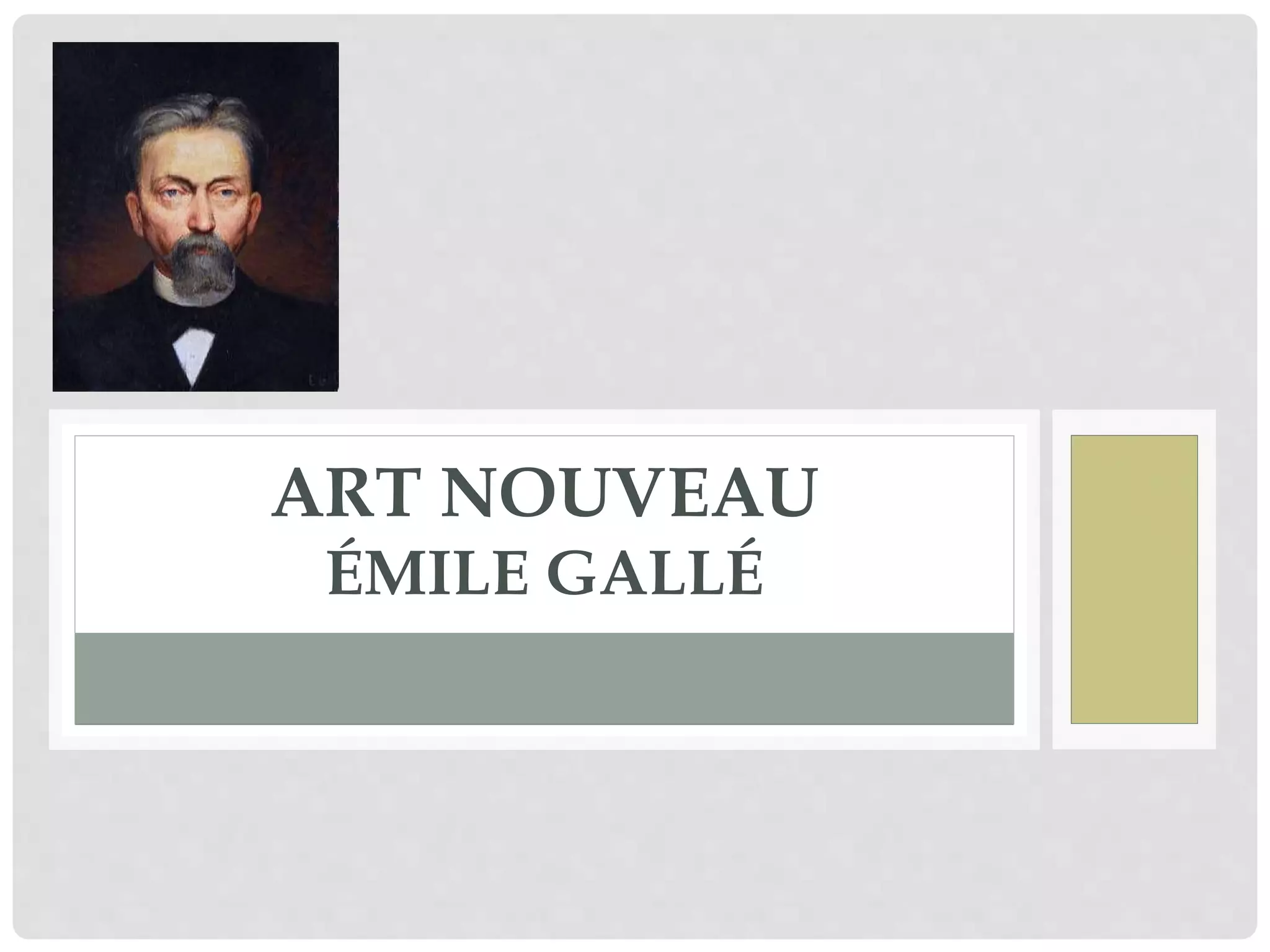
ART NOUVEAU
ÉMILE GALLÉ
OUTLINE
• 1-Introduction to Art Nouveau.
• 2- Characteristics of Art Nouveau.
• 3-Biography of Emile Gallé.
• 4- Emile Gallé’s style of work.
• 5- Conclusion.
1-INTRODUCTION TO ART NOUVEAU.
• Art Nouveau was an innovative international style of modern
art that became fashionable from about 1890 to the First
World War.
• The movement issued in a wide variety of styles, and,
consequently, it is known by various names, such as the
Glasgow Style, or, in the German-speaking world, Jugendstil.
• Arising as a reaction to 19th-century designs dominated by
historicism in general and neoclassicism in particular.
CHARACTERISTICS OF ART NOUVEAU.
Characteristics:
• Aim to modernize design.
• Use of new technologies and materials.
• Inspired by the lines and shapes of nature.
• Harmony : total work of art.
• Different interpretation but same concept.
3-BIOGRAPHY OF EMILE GALLÉ.
Biography :
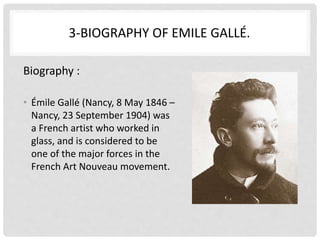
• Émile Gallé (Nancy, 8 May 1846 –
Nancy, 23 September 1904) was
a French artist who worked in
glass, and is considered to be
one of the major forces in the
French Art Nouveau movement.
4- EMILE GALLÉ’S STYLE OF WORK
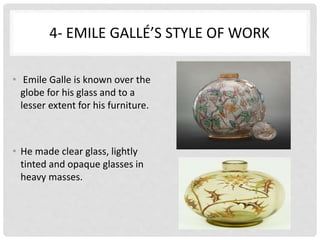
• Emile Galle is known over the
globe for his glass and to a
lesser extent for his furniture.
• He made clear glass, lightly
tinted and opaque glasses in
heavy masses.
4- EMILE GALLÉ’S STYLE OF WORK
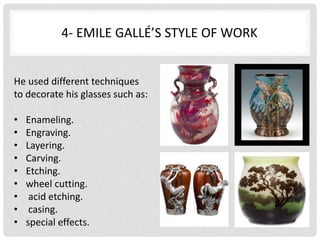
He used different techniques
to decorate his glasses such as:
• Enameling.
• Engraving.
• Layering.
• Carving.
• Etching.
• wheel cutting.
• acid etching.
• casing.
• special effects.
4- EMILE GALLÉ’S STYLE OF WORK
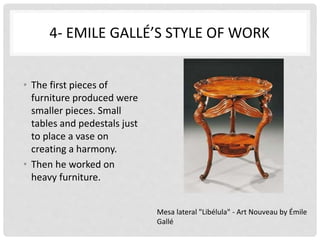
• The first pieces of
furniture produced were
smaller pieces. Small
tables and pedestals just
to place a vase on
creating a harmony.
• Then he worked on
heavy furniture.
Mesa lateral "Libélula" - Art Nouveau by Émile
Gallé
4- EMILE GALLÉ’S STYLE OF WORK
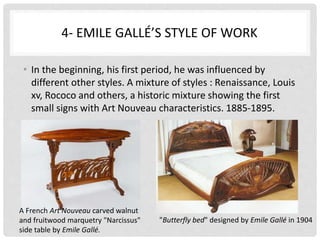
• In the beginning, his first period, he was influenced by
different other styles. A mixture of styles : Renaissance, Louis
xv, Rococo and others, a historic mixture showing the first
small signs with Art Nouveau characteristics. 1885-1895.
A French Art Nouveau carved walnut
and fruitwood marquetry "Narcissus"
side table by Emile Gallé.
"Butterfly bed" designed by Emile Gallé in 1904
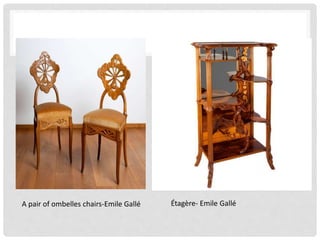
A pair of ombelles chairs-Emile Gallé Étagère- Emile Gallé
4- EMILE GALLÉ’S STYLE OF WORK
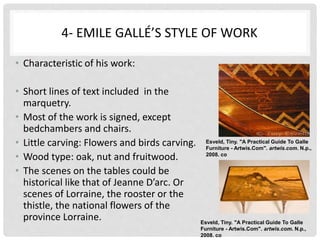
• Characteristic of his work:
• Short lines of text included in the
marquetry.
• Most of the work is signed, except
bedchambers and chairs.
• Little carving: Flowers and birds carving.
• Wood type: oak, nut and fruitwood.
• The scenes on the tables could be
historical like that of Jeanne D’arc. Or
scenes of Lorraine, the rooster or the
thistle, the national flowers of the
province Lorraine. Esveld, Tiny. "A Practical Guide To Galle
Furniture - Artwis.Com". artwis.com. N.p.,
2008. co
Esveld, Tiny. "A Practical Guide To Galle
Furniture - Artwis.Com". artwis.com. N.p.,
2008. co
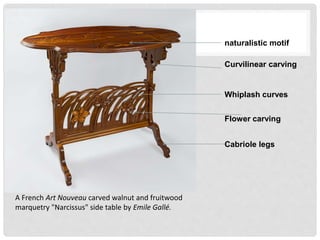
Flower carving
Whiplash curves
naturalistic motif
Cabriole legs
Curvilinear carving
A French Art Nouveau carved walnut and fruitwood
marquetry "Narcissus" side table by Emile Gallé.
CONCLUSION
• French designer Emile Gallé is considered to be one of the
driving forces behind the Art Nouveau movement.
• Taking his inspiration from nature and plants along with a
heavy Japanese design influence.
• His artwork lives on in almost every museum around the
world, including the Metropolitan Museum of Art, the
Smithsonian, and the Musée du Louvre in Paris.
SOURCES
• "Emile Galle Glass: L'ecole De Nancy & Art Nouveau - Antique
Marks". 2016. Antique-
• Esveld, Tiny. 2008. "A Practical Guide To Galle Furniture. -
Artwis.Com". Artwis.Com.

EMILE GALEE

  • 1.
  • 2.
    OUTLINE • 1-Introduction toArt Nouveau. • 2- Characteristics of Art Nouveau. • 3-Biography of Emile Gallé. • 4- Emile Gallé’s style of work. • 5- Conclusion.
  • 3.
    1-INTRODUCTION TO ARTNOUVEAU. • Art Nouveau was an innovative international style of modern art that became fashionable from about 1890 to the First World War. • The movement issued in a wide variety of styles, and, consequently, it is known by various names, such as the Glasgow Style, or, in the German-speaking world, Jugendstil. • Arising as a reaction to 19th-century designs dominated by historicism in general and neoclassicism in particular.
  • 4.
    CHARACTERISTICS OF ARTNOUVEAU. Characteristics: • Aim to modernize design. • Use of new technologies and materials. • Inspired by the lines and shapes of nature. • Harmony : total work of art. • Different interpretation but same concept.
  • 5.
    3-BIOGRAPHY OF EMILEGALLÉ. Biography : • Émile Gallé (Nancy, 8 May 1846 – Nancy, 23 September 1904) was a French artist who worked in glass, and is considered to be one of the major forces in the French Art Nouveau movement.
  • 6.
    4- EMILE GALLÉ’SSTYLE OF WORK • Emile Galle is known over the globe for his glass and to a lesser extent for his furniture. • He made clear glass, lightly tinted and opaque glasses in heavy masses.
  • 7.
    4- EMILE GALLÉ’SSTYLE OF WORK He used different techniques to decorate his glasses such as: • Enameling. • Engraving. • Layering. • Carving. • Etching. • wheel cutting. • acid etching. • casing. • special effects.
  • 8.
    4- EMILE GALLÉ’SSTYLE OF WORK • The first pieces of furniture produced were smaller pieces. Small tables and pedestals just to place a vase on creating a harmony. • Then he worked on heavy furniture. Mesa lateral "Libélula" - Art Nouveau by Émile Gallé
  • 9.
    4- EMILE GALLÉ’SSTYLE OF WORK • In the beginning, his first period, he was influenced by different other styles. A mixture of styles : Renaissance, Louis xv, Rococo and others, a historic mixture showing the first small signs with Art Nouveau characteristics. 1885-1895. A French Art Nouveau carved walnut and fruitwood marquetry "Narcissus" side table by Emile Gallé. "Butterfly bed" designed by Emile Gallé in 1904
  • 10.
    A pair ofombelles chairs-Emile Gallé Étagère- Emile Gallé
  • 11.
    4- EMILE GALLÉ’SSTYLE OF WORK • Characteristic of his work: • Short lines of text included in the marquetry. • Most of the work is signed, except bedchambers and chairs. • Little carving: Flowers and birds carving. • Wood type: oak, nut and fruitwood. • The scenes on the tables could be historical like that of Jeanne D’arc. Or scenes of Lorraine, the rooster or the thistle, the national flowers of the province Lorraine. Esveld, Tiny. "A Practical Guide To Galle Furniture - Artwis.Com". artwis.com. N.p., 2008. co Esveld, Tiny. "A Practical Guide To Galle Furniture - Artwis.Com". artwis.com. N.p., 2008. co
  • 12.
    Flower carving Whiplash curves naturalisticmotif Cabriole legs Curvilinear carving A French Art Nouveau carved walnut and fruitwood marquetry "Narcissus" side table by Emile Gallé.
  • 13.
    CONCLUSION • French designerEmile Gallé is considered to be one of the driving forces behind the Art Nouveau movement. • Taking his inspiration from nature and plants along with a heavy Japanese design influence. • His artwork lives on in almost every museum around the world, including the Metropolitan Museum of Art, the Smithsonian, and the Musée du Louvre in Paris.
  • 14.
    SOURCES • "Emile GalleGlass: L'ecole De Nancy & Art Nouveau - Antique Marks". 2016. Antique- • Esveld, Tiny. 2008. "A Practical Guide To Galle Furniture. - Artwis.Com". Artwis.Com.