Emerging Viral Diseases
Japanese Encephalitis, SARS & Chikungunya
• Emerging infectious diseases can be defined as those that have
appeared for the first time in a population or which have existed
previously but are rapidly increasing in incidence or geographical
range
Japanese Encephalitis
• This virus occurs from East Asia to South Asia, from Korea and
Japan in the north to India and Malaysia in the south
• The disease has been recognized in Japan since 1871 and was
named Japanese ‘B’ Encephalitis to distinguish it from
‘Encephalitis A’
• First isolated in Japan during an epidemic in 1935
• Epidemics show seasonal incidence (summer-autumn) in the
temperate regions
Morphology
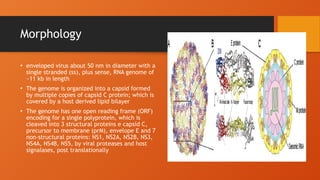
• enveloped virus about 50 nm in diameter with a
single stranded (ss), plus sense, RNA genome of
~11 kb in length
• The genome is organized into a capsid formed
by multiple copies of capsid C protein; which is
covered by a host derived lipid bilayer
• The genome has one open reading frame (ORF)
encoding for a single polyprotein, which is
cleaved into 3 structural proteins e capsid C,
precursor to membrane (prM), envelope E and 7
non-structural proteins: NS1, NS2A, NS2B, NS3,
NS4A, NS4B, NS5, by viral proteases and host
signalases, post translationally
Clinical Features
• Culex tritaeniorhynchus, a rural mosquito that breeds in rice
fields, is the principal vector
• The disease has an abrupt onset with fever, headache and vomiting
• After 1-6 days, signs of encephalitis set in with nuchal rigidity,
convulsions, altered sensorium and coma
• The fever is high and continuous
• There is presence of neutrophil leucocytosis in peripheral blood
and pleocytosis with normal or raised sugar levels and slightly
raised protein levels in the CSF
Clinical Features
• The mortality rate in some epidemics has been upto 50%
• Upto 50% survivors may have neurological or psychiatric sequelae
• Infection in pregnant women during first and second trimester has
led to fetal death
• In India, JE was first recognized in 1955 when the virus was
isolated from mosquitoes of the Culex vishnui complex from
Vellore during an outbreak of encephalitis in Tamil Nadu
• The virus was continued to be active in TN and Andhra, causing
illness mainly in children, indicating epidemic nature of the virus
Clinical Features
• Most of the cases occur between October and November
• Since 1976, the highest rates of human disease have been reported
from the states of Andhra Pradesh, Assam, Bihar, Haryana, Goa,
Karnataka, Kerala, TN, UP and West Bengal
Epidemiology
• Herons act as reservoir hosts and pigs as amplifier hosts
• Human infection is a dead end event and occurs when the infected
mosquitoes reach high density
• Natural infection has been demonstrated in Ardeid birds (herons
and egrets);bird-to-bird transmission also takes place through
Culex tritaeniorhynchus
• The mosquito Culex tritaeniorhynchus has a predilection for cattle
and bites them in preference to humans or pigs, but cattle do not
develop viremia, hence do not spread the virus
• The high cattle-pig ration in India has been suggested to be a
factor limiting human infection
Control measures
• Preventive measures include mosquito control and locating piggeries
away from human dwellings
• Vaccine is available
• Vaccine:
A formalin-inactivated mouse brain vaccine using the Nakayama
strain, two doses at two weeks interval followed by a booster dose 6-
12 months later
A live attenuated vaccine has been developed in China from JE strain
SA 14-14-2, passed through weanling mice, two doses, one year apart
Severe Acute Respiratory Syndrome (SARS)
• A group of spherical or pleomorphic enveloped RNA viruses,
carrying petal or club shaped peplomers on their surface –
Coronaviruses
• There are two groups – acid-labile viruses (associated with
common-cold like illnesses) & acid-stable viruses (associated with
human and animal gastroenteritis)
Morphology
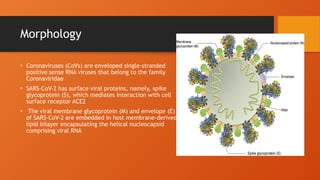
• Coronaviruses (CoVs) are enveloped single-stranded
positive sense RNA viruses that belong to the family
Coronaviridae
• SARS-CoV-2 has surface viral proteins, namely, spike
glycoprotein (S), which mediates interaction with cell
surface receptor ACE2
• The viral membrane glycoprotein (M) and envelope (E)
of SARS-CoV-2 are embedded in host membrane-derived
lipid bilayer encapsulating the helical nucleocapsid
comprising viral RNA
Epidemiology
• In November 2002, Guangdong province in South China
experienced an outbreak of an unusual respiratory infection, with
many deaths
• The world outside knew about it only in February 2003, when a
physician from Guangdong visited Hong Kong, fell ill and died
there, after infecting 12 persons who had stayed in the same hotel
• They initiated outbreaks in countries where they went
• By July, when the pandemic was controlled, it had affected over
30 countries with many thousands of cases and over 800 deaths
Epidemiology
• The coronavirus responsible for SARS appears to be a new virus
distinct from other coronaviruses which had been classified into
three types : Mammalian viruses in types 1 and 2 and Avian viruses
in type 3
• The new SARS virus is coronavirus type 4
• SARS spread by inhalation of the virus present in droplets or
aerosols of respiratory secretions of patients
• Fecal aerosols also may be infectious
• Incubation period is under 10 days
Clinical Features
• The disease starts as a fever with cough or other respiratory
symptoms
• Diarrhoea is sometimes seen
• The chest radiograph shows pneumonic changes
• Death is due to respiratory failure
• Middle East Respiratory Syndrome (MERS), first detected in Saudi
Arabia on 2012 – MERS-CoV
Laboratory Diagnosis
• The virus was identified by electron microscopy and confirmed by
growth in Vero cell culture, animal inoculation, cloning,
sequencing and histology
• RT PCR
• ELISA
Control
• No vaccine is currently available
• Strict isolation and quarantine
Chikungunya
• Virus first isolated from human patients in Tanzania in 1952
• The vector is Aedes aegypti
• No animal reservoir has been identified
• The name ‘Chikungunya’ was derived from native word for the
disease in which the patient lies doubled up due to severe joint
pain
• Epidemics have occurred in many African countries
• Virus first appeared in India in 1963, along with Dengue, caused
very extensive outbreaks in Kolkata, Chennai and other areas
Morphology
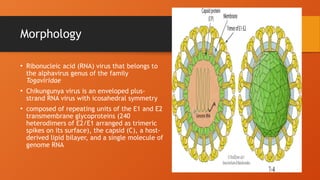
• Ribonucleic acid (RNA) virus that belongs to
the alphavirus genus of the family
Togaviridae
• Chikungunya virus is an enveloped plus-
strand RNA virus with icosahedral symmetry
• composed of repeating units of the E1 and E2
transmembrane glycoproteins (240
heterodimers of E2/E1 arranged as trimeric
spikes on its surface), the capsid (C), a host-
derived lipid bilayer, and a single molecule of
genome RNA
Chikungunya
• There are three major Chikungunya virus genotypes:
West African
East/Central/South African (ECSA)
Asian Genotypes
• The disease presents with a sudden onset of fever, crippling joint pain,
lymphadenopathy and conjunctivitis
• A maculopapular rash is common
• The fever is typically biphasic with a period of remission after 1-6 days
Chikungunya
• Detection of IgM or IgG in a paired serum sample by ELISA is the
mainstay of diagnosis
• RT-PCR can be used to detect viral RNA
• No vaccine is available

Emerging Viral Diseases-JEV,SARS, C.pptx

  • 1.
    Emerging Viral Diseases JapaneseEncephalitis, SARS & Chikungunya
  • 2.
    • Emerging infectiousdiseases can be defined as those that have appeared for the first time in a population or which have existed previously but are rapidly increasing in incidence or geographical range
  • 3.
    Japanese Encephalitis • Thisvirus occurs from East Asia to South Asia, from Korea and Japan in the north to India and Malaysia in the south • The disease has been recognized in Japan since 1871 and was named Japanese ‘B’ Encephalitis to distinguish it from ‘Encephalitis A’ • First isolated in Japan during an epidemic in 1935 • Epidemics show seasonal incidence (summer-autumn) in the temperate regions
  • 4.
    Morphology • enveloped virusabout 50 nm in diameter with a single stranded (ss), plus sense, RNA genome of ~11 kb in length • The genome is organized into a capsid formed by multiple copies of capsid C protein; which is covered by a host derived lipid bilayer • The genome has one open reading frame (ORF) encoding for a single polyprotein, which is cleaved into 3 structural proteins e capsid C, precursor to membrane (prM), envelope E and 7 non-structural proteins: NS1, NS2A, NS2B, NS3, NS4A, NS4B, NS5, by viral proteases and host signalases, post translationally
  • 5.
    Clinical Features • Culextritaeniorhynchus, a rural mosquito that breeds in rice fields, is the principal vector • The disease has an abrupt onset with fever, headache and vomiting • After 1-6 days, signs of encephalitis set in with nuchal rigidity, convulsions, altered sensorium and coma • The fever is high and continuous • There is presence of neutrophil leucocytosis in peripheral blood and pleocytosis with normal or raised sugar levels and slightly raised protein levels in the CSF
  • 6.
    Clinical Features • Themortality rate in some epidemics has been upto 50% • Upto 50% survivors may have neurological or psychiatric sequelae • Infection in pregnant women during first and second trimester has led to fetal death • In India, JE was first recognized in 1955 when the virus was isolated from mosquitoes of the Culex vishnui complex from Vellore during an outbreak of encephalitis in Tamil Nadu • The virus was continued to be active in TN and Andhra, causing illness mainly in children, indicating epidemic nature of the virus
  • 7.
    Clinical Features • Mostof the cases occur between October and November • Since 1976, the highest rates of human disease have been reported from the states of Andhra Pradesh, Assam, Bihar, Haryana, Goa, Karnataka, Kerala, TN, UP and West Bengal
  • 8.
    Epidemiology • Herons actas reservoir hosts and pigs as amplifier hosts • Human infection is a dead end event and occurs when the infected mosquitoes reach high density • Natural infection has been demonstrated in Ardeid birds (herons and egrets);bird-to-bird transmission also takes place through Culex tritaeniorhynchus • The mosquito Culex tritaeniorhynchus has a predilection for cattle and bites them in preference to humans or pigs, but cattle do not develop viremia, hence do not spread the virus • The high cattle-pig ration in India has been suggested to be a factor limiting human infection
  • 9.
    Control measures • Preventivemeasures include mosquito control and locating piggeries away from human dwellings • Vaccine is available • Vaccine: A formalin-inactivated mouse brain vaccine using the Nakayama strain, two doses at two weeks interval followed by a booster dose 6- 12 months later A live attenuated vaccine has been developed in China from JE strain SA 14-14-2, passed through weanling mice, two doses, one year apart
  • 10.
    Severe Acute RespiratorySyndrome (SARS) • A group of spherical or pleomorphic enveloped RNA viruses, carrying petal or club shaped peplomers on their surface – Coronaviruses • There are two groups – acid-labile viruses (associated with common-cold like illnesses) & acid-stable viruses (associated with human and animal gastroenteritis)
  • 11.
    Morphology • Coronaviruses (CoVs)are enveloped single-stranded positive sense RNA viruses that belong to the family Coronaviridae • SARS-CoV-2 has surface viral proteins, namely, spike glycoprotein (S), which mediates interaction with cell surface receptor ACE2 • The viral membrane glycoprotein (M) and envelope (E) of SARS-CoV-2 are embedded in host membrane-derived lipid bilayer encapsulating the helical nucleocapsid comprising viral RNA
  • 12.
    Epidemiology • In November2002, Guangdong province in South China experienced an outbreak of an unusual respiratory infection, with many deaths • The world outside knew about it only in February 2003, when a physician from Guangdong visited Hong Kong, fell ill and died there, after infecting 12 persons who had stayed in the same hotel • They initiated outbreaks in countries where they went • By July, when the pandemic was controlled, it had affected over 30 countries with many thousands of cases and over 800 deaths
  • 13.
    Epidemiology • The coronavirusresponsible for SARS appears to be a new virus distinct from other coronaviruses which had been classified into three types : Mammalian viruses in types 1 and 2 and Avian viruses in type 3 • The new SARS virus is coronavirus type 4 • SARS spread by inhalation of the virus present in droplets or aerosols of respiratory secretions of patients • Fecal aerosols also may be infectious • Incubation period is under 10 days
  • 14.
    Clinical Features • Thedisease starts as a fever with cough or other respiratory symptoms • Diarrhoea is sometimes seen • The chest radiograph shows pneumonic changes • Death is due to respiratory failure • Middle East Respiratory Syndrome (MERS), first detected in Saudi Arabia on 2012 – MERS-CoV
  • 15.
    Laboratory Diagnosis • Thevirus was identified by electron microscopy and confirmed by growth in Vero cell culture, animal inoculation, cloning, sequencing and histology • RT PCR • ELISA
  • 16.
    Control • No vaccineis currently available • Strict isolation and quarantine
  • 17.
    Chikungunya • Virus firstisolated from human patients in Tanzania in 1952 • The vector is Aedes aegypti • No animal reservoir has been identified • The name ‘Chikungunya’ was derived from native word for the disease in which the patient lies doubled up due to severe joint pain • Epidemics have occurred in many African countries • Virus first appeared in India in 1963, along with Dengue, caused very extensive outbreaks in Kolkata, Chennai and other areas
  • 18.
    Morphology • Ribonucleic acid(RNA) virus that belongs to the alphavirus genus of the family Togaviridae • Chikungunya virus is an enveloped plus- strand RNA virus with icosahedral symmetry • composed of repeating units of the E1 and E2 transmembrane glycoproteins (240 heterodimers of E2/E1 arranged as trimeric spikes on its surface), the capsid (C), a host- derived lipid bilayer, and a single molecule of genome RNA
  • 19.
    Chikungunya • There arethree major Chikungunya virus genotypes: West African East/Central/South African (ECSA) Asian Genotypes • The disease presents with a sudden onset of fever, crippling joint pain, lymphadenopathy and conjunctivitis • A maculopapular rash is common • The fever is typically biphasic with a period of remission after 1-6 days
  • 20.
    Chikungunya • Detection ofIgM or IgG in a paired serum sample by ELISA is the mainstay of diagnosis • RT-PCR can be used to detect viral RNA • No vaccine is available