10/01/11 Emerging Computing Environments  V.Rajaraman EMERGING COMPUTING ENVIRONMENTS What are the emerging computing environments? Why are they  required? Current technology trends which make these environments attractive Features of these new environments
10/01/11 Emerging Computing Environments  V.Rajaraman WHAT ARE THE EMERGING ENVIRONMENTS? Grid Computing Cloud  Computing Computing Utility Common characteristics All of these use the Internet All use geographically distributed computers
10/01/11 Emerging Computing Environments  V.Rajaraman WHY ARE THEY REQUIRED ? Computing Infrastructure is expensive to buy, install and continuously maintain (Infrastructure includes both hardware and software) Rapid obsolescence requires organizations to install new machines almost every three to five years. It is continuing investment Computing is a means to an end. Installing and maintaining computers is not a core activity of most organizations Sophisticated application software is very expensive with complex licensing rules It is very desirable if organizations have assured access to whatever they need from a provider and pay only for what they use
10/01/11 Emerging Computing Environments V.Rajaraman TECHNOLOGY TRENDS Computing speed doubling every 18 months Storage sizes doubling every 12 months Communication bandwidth doubling every 9 months all at constant cost Thus communications becoming very inexpensive and fast enabling a remote computer to be accessed as though it is local Methods of secure data storage and communications improving rapidly when using the Internet Wide band wireless communication at low cost allowing mobile access from anywhere, anytime – Emergence of 3G Services Remote applications software sharing possible Voice and video over internet will allow inexpensive access to consultants at the provider’s premises.
10/01/11 Emerging Computing Environments  V.Rajaraman GRID COMPUTING DEFINITION An infrastructure that enables the integrated,  collaborative  use of high-end computers, databases and scientific instruments owned and managed by  multiple autonomous organizations  providing adequate ‘Quality of Service’
10/01/11 Emerging Computing Environments V.Rajaraman GRID COMPUTING Interconnecting computing facilities of cooperating institutions to form a virtual organization Optimizing use of resources scattered in several similar organizations Allowing access to experimental data stored in various locations – e-Science Allowing use of expensive scientific instruments by remote control – Cooperative owning Desktop machines remain as at present No concept of customer-provider relationship and charging policies
10/01/11 Emerging Computing Environments  V.Rajaraman GRID COMPUTING Globus a Consortium of cooperating institutions evolved standards and tools to create global - Computer GRIDS Tools in open domain Tools being continuously improved
10/01/11 Emerging Computing Envifornments V.Rajaraman ENTERPRISE GRID Forming a virtual computing facility using computing resources within a single enterprise Optimizing use of computing resources scattered in several locations/ groups of one enterprise Sharing data bases within an enterprise based on need to access rules Unified threat management Cooperating vendors evolving standards to allow a variety of computers to work together. Borrows some software and standards from grid computing No concept of independent providers managing services and several customers using it on a pay-for-use basis.
10/01/11 Emerging Computing Environments  V.Rajaraman CLOUD COMPUTING DEFINITION Cloud computing is a system which delivers several hosted services over the Internet.  These are Infrastructure –as – a Service (IaaS), Software as a Service (SaaS) and Platform-as-a Service (PaaS)
10/01/11 Emerging Computing Environments  V.Rajaraman Cloud Computing Infrastructure maintained by service providers Access using browser Services offered – IaaS, SaaS and PaaS Amazon IaaS, QoS, SLA Salesforce.com SaaS Google, SaaS, PaaS Many organization considering entering cloud business – WIPRO – RELIANCE  - RAMCO - MICROSOFT
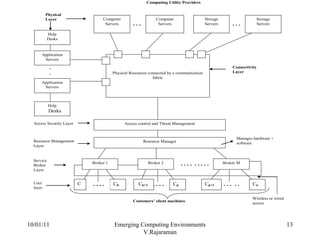
10/01/11 Emerging Computing Environments V.Rajaraman WHAT IS A COMPUTING UTILITY Resource consists of computer servers, storage servers, application servers established and maintained by several cooperating Service providers. Hosts several expensive applications; programs such as Nastran, CFD, VLSI Design Networked together and made accessible to customers by providers. Customers deal with single “unified provider” through brokers Provider assures security of customers’ data and programs Provider assures disaster recovery and (if needed) business process continuity.  Service Level Agreements. Provider gives consulting on use of specialized software-on demand Available to customer when and where he needs it. User pays for actual services used.
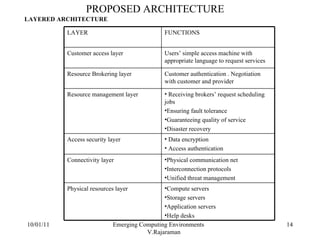
10/01/11 Emerging Computing Environments V.Rajaraman PARTS OF A COMPUTING UTILITY Client access machines – Good graphical user interface, audio, video and graphics. No hard disk – “Thin Client” -  Specially designed access language Broker machines – accepts user requests accesses resource manager – quotes time and cost trade offs Resource manager – Has information on available resources- schedules jobs optimally Access control and threat management – provides security of users’ programs and data Physical resources infrastructure with compute servers, help desks, application servers and storage servers
10/01/11 Emerging Computing Environments V.Rajaraman
10/01/11 Emerging Computing Environments  V.Rajaraman PROPOSED ARCHITECTURE LAYERED ARCHITECTURE LAYER FUNCTIONS Customer access layer Users’ simple access machine with appropriate language to request services Resource Brokering layer Customer authentication . Negotiation with customer and provider Resource management layer Receiving brokers’ request scheduling jobs Ensuring fault tolerance Guaranteeing quality of service Disaster recovery Access security layer Data encryption Access authentication Connectivity layer Physical communication net Interconnection protocols Unified threat management Physical resources layer Compute servers Storage servers Application servers Help desks
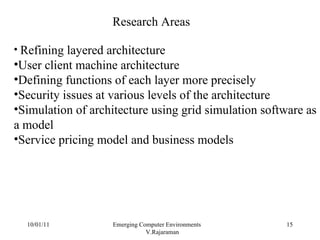
10/01/11 Emerging Computer Environments  V.Rajaraman Research Areas Refining layered architecture User client machine architecture Defining functions of each layer more precisely Security issues at various levels of the architecture Simulation of architecture using grid simulation software as a model Service pricing model and business models
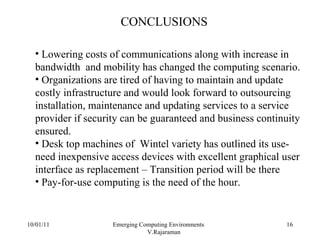
10/01/11 Emerging Computing Environments  V.Rajaraman CONCLUSIONS Lowering costs of communications along with increase in bandwidth  and mobility has changed the computing scenario. Organizations are tired of having to maintain and update costly infrastructure and would look forward to outsourcing installation, maintenance and updating services to a service provider if security can be guaranteed and business continuity ensured. Desk top machines of  Wintel variety has outlined its use-need inexpensive access devices with excellent graphical user interface as replacement – Transition period will be there Pay-for-use computing is the need of the hour.

Emerging computer environments- By Dr. V. Rajaraman

  • 1.
    10/01/11 Emerging ComputingEnvironments V.Rajaraman EMERGING COMPUTING ENVIRONMENTS What are the emerging computing environments? Why are they required? Current technology trends which make these environments attractive Features of these new environments
  • 2.
    10/01/11 Emerging ComputingEnvironments V.Rajaraman WHAT ARE THE EMERGING ENVIRONMENTS? Grid Computing Cloud Computing Computing Utility Common characteristics All of these use the Internet All use geographically distributed computers
  • 3.
    10/01/11 Emerging ComputingEnvironments V.Rajaraman WHY ARE THEY REQUIRED ? Computing Infrastructure is expensive to buy, install and continuously maintain (Infrastructure includes both hardware and software) Rapid obsolescence requires organizations to install new machines almost every three to five years. It is continuing investment Computing is a means to an end. Installing and maintaining computers is not a core activity of most organizations Sophisticated application software is very expensive with complex licensing rules It is very desirable if organizations have assured access to whatever they need from a provider and pay only for what they use
  • 4.
    10/01/11 Emerging ComputingEnvironments V.Rajaraman TECHNOLOGY TRENDS Computing speed doubling every 18 months Storage sizes doubling every 12 months Communication bandwidth doubling every 9 months all at constant cost Thus communications becoming very inexpensive and fast enabling a remote computer to be accessed as though it is local Methods of secure data storage and communications improving rapidly when using the Internet Wide band wireless communication at low cost allowing mobile access from anywhere, anytime – Emergence of 3G Services Remote applications software sharing possible Voice and video over internet will allow inexpensive access to consultants at the provider’s premises.
  • 5.
    10/01/11 Emerging ComputingEnvironments V.Rajaraman GRID COMPUTING DEFINITION An infrastructure that enables the integrated, collaborative use of high-end computers, databases and scientific instruments owned and managed by multiple autonomous organizations providing adequate ‘Quality of Service’
  • 6.
    10/01/11 Emerging ComputingEnvironments V.Rajaraman GRID COMPUTING Interconnecting computing facilities of cooperating institutions to form a virtual organization Optimizing use of resources scattered in several similar organizations Allowing access to experimental data stored in various locations – e-Science Allowing use of expensive scientific instruments by remote control – Cooperative owning Desktop machines remain as at present No concept of customer-provider relationship and charging policies
  • 7.
    10/01/11 Emerging ComputingEnvironments V.Rajaraman GRID COMPUTING Globus a Consortium of cooperating institutions evolved standards and tools to create global - Computer GRIDS Tools in open domain Tools being continuously improved
  • 8.
    10/01/11 Emerging ComputingEnvifornments V.Rajaraman ENTERPRISE GRID Forming a virtual computing facility using computing resources within a single enterprise Optimizing use of computing resources scattered in several locations/ groups of one enterprise Sharing data bases within an enterprise based on need to access rules Unified threat management Cooperating vendors evolving standards to allow a variety of computers to work together. Borrows some software and standards from grid computing No concept of independent providers managing services and several customers using it on a pay-for-use basis.
  • 9.
    10/01/11 Emerging ComputingEnvironments V.Rajaraman CLOUD COMPUTING DEFINITION Cloud computing is a system which delivers several hosted services over the Internet. These are Infrastructure –as – a Service (IaaS), Software as a Service (SaaS) and Platform-as-a Service (PaaS)
  • 10.
    10/01/11 Emerging ComputingEnvironments V.Rajaraman Cloud Computing Infrastructure maintained by service providers Access using browser Services offered – IaaS, SaaS and PaaS Amazon IaaS, QoS, SLA Salesforce.com SaaS Google, SaaS, PaaS Many organization considering entering cloud business – WIPRO – RELIANCE - RAMCO - MICROSOFT
  • 11.
    10/01/11 Emerging ComputingEnvironments V.Rajaraman WHAT IS A COMPUTING UTILITY Resource consists of computer servers, storage servers, application servers established and maintained by several cooperating Service providers. Hosts several expensive applications; programs such as Nastran, CFD, VLSI Design Networked together and made accessible to customers by providers. Customers deal with single “unified provider” through brokers Provider assures security of customers’ data and programs Provider assures disaster recovery and (if needed) business process continuity. Service Level Agreements. Provider gives consulting on use of specialized software-on demand Available to customer when and where he needs it. User pays for actual services used.
  • 12.
    10/01/11 Emerging ComputingEnvironments V.Rajaraman PARTS OF A COMPUTING UTILITY Client access machines – Good graphical user interface, audio, video and graphics. No hard disk – “Thin Client” - Specially designed access language Broker machines – accepts user requests accesses resource manager – quotes time and cost trade offs Resource manager – Has information on available resources- schedules jobs optimally Access control and threat management – provides security of users’ programs and data Physical resources infrastructure with compute servers, help desks, application servers and storage servers
  • 13.
    10/01/11 Emerging ComputingEnvironments V.Rajaraman
  • 14.
    10/01/11 Emerging ComputingEnvironments V.Rajaraman PROPOSED ARCHITECTURE LAYERED ARCHITECTURE LAYER FUNCTIONS Customer access layer Users’ simple access machine with appropriate language to request services Resource Brokering layer Customer authentication . Negotiation with customer and provider Resource management layer Receiving brokers’ request scheduling jobs Ensuring fault tolerance Guaranteeing quality of service Disaster recovery Access security layer Data encryption Access authentication Connectivity layer Physical communication net Interconnection protocols Unified threat management Physical resources layer Compute servers Storage servers Application servers Help desks
  • 15.
    10/01/11 Emerging ComputerEnvironments V.Rajaraman Research Areas Refining layered architecture User client machine architecture Defining functions of each layer more precisely Security issues at various levels of the architecture Simulation of architecture using grid simulation software as a model Service pricing model and business models
  • 16.
    10/01/11 Emerging ComputingEnvironments V.Rajaraman CONCLUSIONS Lowering costs of communications along with increase in bandwidth and mobility has changed the computing scenario. Organizations are tired of having to maintain and update costly infrastructure and would look forward to outsourcing installation, maintenance and updating services to a service provider if security can be guaranteed and business continuity ensured. Desk top machines of Wintel variety has outlined its use-need inexpensive access devices with excellent graphical user interface as replacement – Transition period will be there Pay-for-use computing is the need of the hour.