Background
• Number of oocytes retrieved following controlled
ovarian stimulation (COS) is an important prognostic
variable in IVF (Sunkara et al., 2011)
• There is a strong association between the number of
oocytes retrieved and live birth (LB) following IVF
• The number of oocytes is a robust surrogate
outcome for clinical success
Background
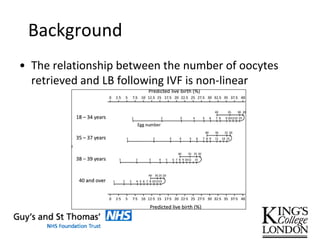
• The relationship between the number of oocytes
retrieved and LB following IVF is non-linear
Background
• This valuable information is helpful in
planning IVF treatment regimens
• COS regimens should aim to optimise the
number of oocytes and maximise IVF success
• Essential to personalise COS regimens as
there is diversity among couples and women
seeking ART
Background
• Female age and tests of ovarian reserve have a
predictive value for ovarian response to COS
• AFC and AMH are sensitive predictors of poor
response and hyper-response to COS (Broer et al.,
2009; Broer et al., 2011)
• Use of these tests can therefore provide a very
specific characterisation of individual women
Discussion
• The primary aim of IVF treatment is to achieve a
healthy live birth
• Two particular challenges to COS are women with
poor ovarian response and women likely to hyper-
respond
• Whilst poor responders have lower success rates
compared to normal responders (Ulug et al., 2003),
hyper-responders have an increased risk of OHSS
Discussion
• Moreover, it has been shown that the chance of LB is
reduced with very high number of oocytes following
a fresh IVF cycle (Sunkara et al., 2011)
• The GnRH agonist long regimen is the most widely
used in COS (Maklon et al., 2006)
Discussion
• The GnRH antagonist regimen is likely to be
beneficial for women with PCOS compared to the
GnRH agonist regimen (Pundir at al., 2012)
– associated with a lower incidence of moderate and severe
OHSS
– comparable live birth rates
Discussion
• Several interventions have been proposed to
improve the IVF outcome of poor responders
– various pituitary suppression regimens
– variations in gonadotrophin type and dose
– adjuvant therapies such as androgen, luteinising hormone
(LH) and growth hormone supplementation
• Inconclusive evidence that any particular
intervention is beneficial for poor responders
(Panadian et al., 2010)
Discussion
• Minimal or mild ovarian stimulation regimens are
considered to be cost effective with similar success
rates compared to the standard agonist regimen
(Heijnen et al., 2008)
• However, local guidelines and funding policies are
likely to influence decisions by clinicians and women
Conclusion
It is important to individualise COS regimens in order
to achieve desired outcome of a healthy live birth
with minimum costs and side effects

L10 key slides sunkara

  • 1.
    Background • Number ofoocytes retrieved following controlled ovarian stimulation (COS) is an important prognostic variable in IVF (Sunkara et al., 2011) • There is a strong association between the number of oocytes retrieved and live birth (LB) following IVF • The number of oocytes is a robust surrogate outcome for clinical success
  • 2.
    Background • The relationshipbetween the number of oocytes retrieved and LB following IVF is non-linear
  • 3.
    Background • This valuableinformation is helpful in planning IVF treatment regimens • COS regimens should aim to optimise the number of oocytes and maximise IVF success • Essential to personalise COS regimens as there is diversity among couples and women seeking ART
  • 4.
    Background • Female ageand tests of ovarian reserve have a predictive value for ovarian response to COS • AFC and AMH are sensitive predictors of poor response and hyper-response to COS (Broer et al., 2009; Broer et al., 2011) • Use of these tests can therefore provide a very specific characterisation of individual women
  • 5.
    Discussion • The primaryaim of IVF treatment is to achieve a healthy live birth • Two particular challenges to COS are women with poor ovarian response and women likely to hyper- respond • Whilst poor responders have lower success rates compared to normal responders (Ulug et al., 2003), hyper-responders have an increased risk of OHSS
  • 6.
    Discussion • Moreover, ithas been shown that the chance of LB is reduced with very high number of oocytes following a fresh IVF cycle (Sunkara et al., 2011) • The GnRH agonist long regimen is the most widely used in COS (Maklon et al., 2006)
  • 7.
    Discussion • The GnRHantagonist regimen is likely to be beneficial for women with PCOS compared to the GnRH agonist regimen (Pundir at al., 2012) – associated with a lower incidence of moderate and severe OHSS – comparable live birth rates
  • 8.
    Discussion • Several interventionshave been proposed to improve the IVF outcome of poor responders – various pituitary suppression regimens – variations in gonadotrophin type and dose – adjuvant therapies such as androgen, luteinising hormone (LH) and growth hormone supplementation • Inconclusive evidence that any particular intervention is beneficial for poor responders (Panadian et al., 2010)
  • 9.
    Discussion • Minimal ormild ovarian stimulation regimens are considered to be cost effective with similar success rates compared to the standard agonist regimen (Heijnen et al., 2008) • However, local guidelines and funding policies are likely to influence decisions by clinicians and women
  • 10.
    Conclusion It is importantto individualise COS regimens in order to achieve desired outcome of a healthy live birth with minimum costs and side effects