Embodied Energy in Buildings
Prof. B. V. Venkatarama Reddy
Department of Civil Engineering
Indian Institute of Science
Bangalore – 560 012
Need for
examining energy in buildings?
Indian construction Industry
• Employment generation
• Volume of materials produced
• Annual expenditure
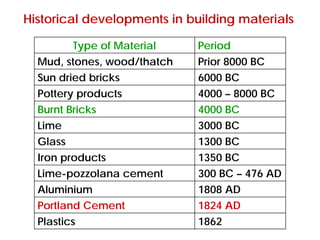
Type of Material Period
Mud, stones, wood/thatch Prior 8000 BC
Sun dried bricks 6000 BC
Pottery products 4000 – 8000 BC
Burnt Bricks 4000 BC
Lime 3000 BC
Glass 1300 BC
Iron products 1350 BC
Lime-pozzolana cement 300 BC – 476 AD
Aluminium 1808 AD
Portland Cement 1824 AD
Plastics 1862
Historical developments in building materials
Common building materials
Burnt clay Bricks
Stones, Concrete
blocks
Cement, Steel,
Concrete
Aluminum, Zinc, SS
Glass
Tiles (ceramic/burnt)
Plastics/PVC
Paints, Timber
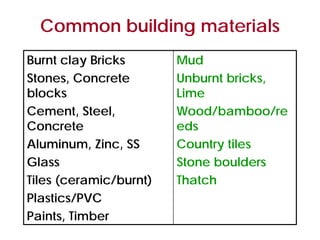
Common building materials
Burnt clay Bricks
Stones, Concrete
blocks
Cement, Steel,
Concrete
Aluminum, Zinc, SS
Glass
Tiles (ceramic/burnt)
Plastics/PVC
Paints, Timber
Mud
Unburnt bricks,
Lime
Wood/bamboo/re
eds
Country tiles
Stone boulders
Thatch
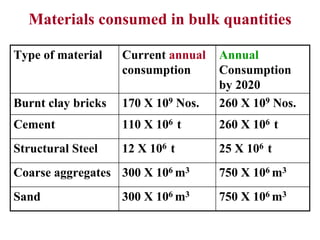
Materials consumed in bulk quantities
Type of material Current annual
consumption
Annual
Consumption
by 2020
Burnt clay bricks 170 X 109 Nos. 260 X 109 Nos.
Cement 110 X 106 t 260 X 106 t
Structural Steel 12 X 106 t 25 X 106 t
Coarse aggregates 300 X 106 m3 750 X 106 m3
Sand 300 X 106 m3 750 X 106 m3
0
20
40
60
80
100
120
140
160
180
200
1975 1980 1985 1990 1995 2000 2005
Year
In
Millions
Housing Shortage
Housing stock
No. of households
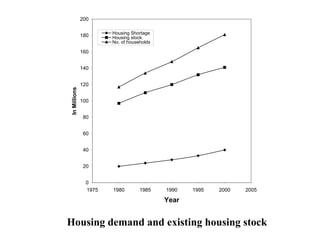
Housing demand and existing housing stock
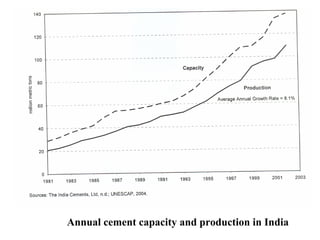
Annual cement capacity and production in India
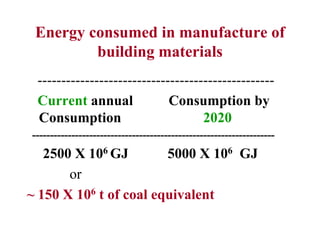
Energy consumed in manufacture of
building materials
--------------------------------------------------
Current annual Consumption by
Consumption 2020
--------------------------------------------------------------------
2500 X 106 GJ 5000 X 106 GJ
or
~ 150 X 106 t of coal equivalent
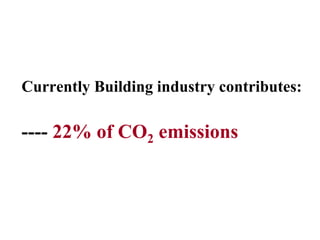
Currently Building industry contributes:
---- 22% of CO2 emissions
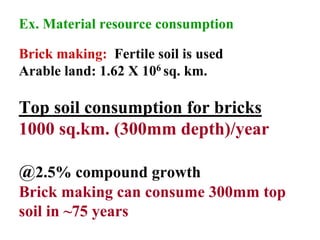
Ex. Material resource consumption
Brick making: Fertile soil is used
Arable land: 1.62 X 10⁶ sq. km.
Top soil consumption for bricks
1000 sq.km. (300mm depth)/year
@2.5% compound growth
Brick making can consume 300mm top
soil in ~75 years
Environment/resources conservation / protection
---- GHG emission reduction
---- Energy conservation
---- conservation of resources
How to achieve this?
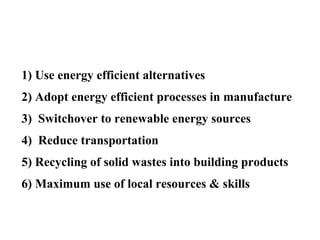
1) Use energy efficient alternatives
2) Adopt energy efficient processes in manufacture
3) Switchover to renewable energy sources
4) Reduce transportation
5) Recycling of solid wastes into building products
6) Maximum use of local resources & skills
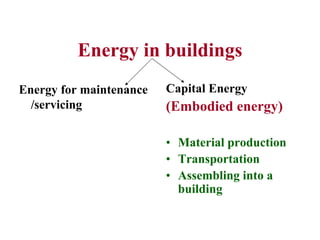
Energy in buildings
Energy for maintenance
/servicing
Capital Energy
(Embodied energy)
• Material production
• Transportation
• Assembling into a
building
Low energy building materials
& technologies
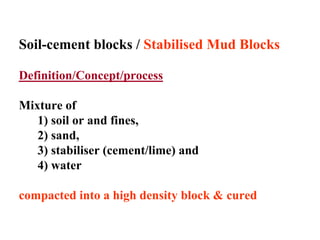
Soil-cement blocks / Stabilised Mud Blocks
Definition/Concept/process
Mixture of
1) soil or and fines,
2) sand,
3) stabiliser (cement/lime) and
4) water
compacted into a high density block & cured
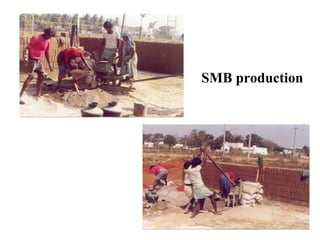
SMB production
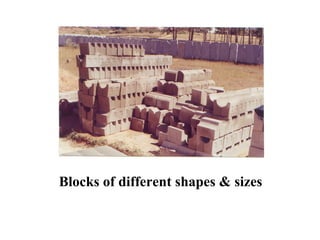
Blocks of different shapes & sizes
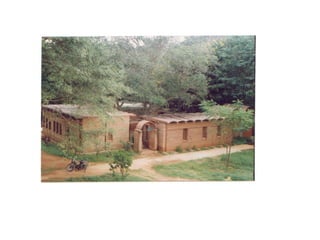
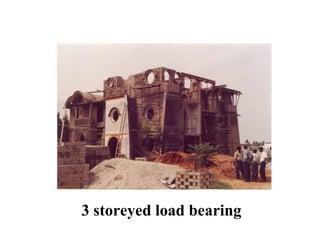
3 storeyed load bearing
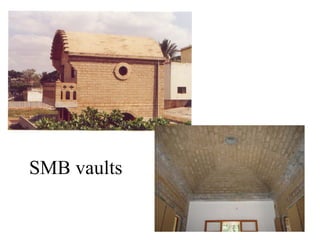
SMB vaults
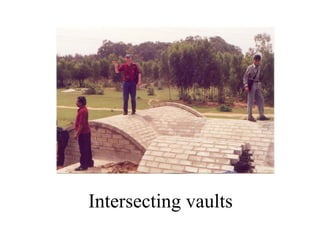
Intersecting vaults
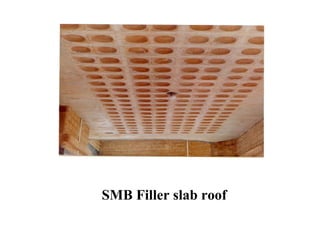
SMB Filler slab roof
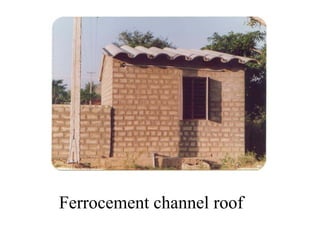
Ferrocement channel roof
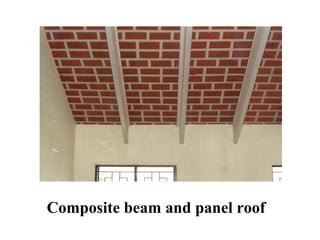
Composite beam and panel roof
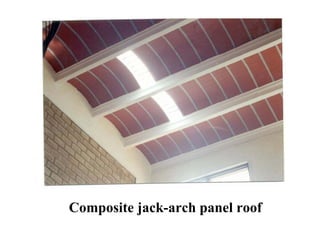
Composite jack-arch panel roof
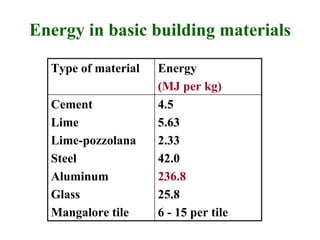
Energy in basic building materials
Type of material Energy
(MJ per kg)
Cement
Lime
Lime-pozzolana
Steel
Aluminum
Glass
Mangalore tile
4.5
5.63
2.33
42.0
236.8
25.8
6 - 15 per tile
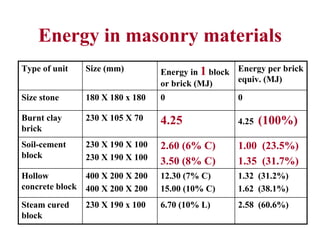
Energy in masonry materials
Type of unit Size (mm) Energy in 1 block
or brick (MJ)
Energy per brick
equiv. (MJ)
Size stone 180 X 180 x 180 0 0
Burnt clay
brick
230 X 105 X 70 4.25 4.25 (100%)
Soil-cement
block
230 X 190 X 100
230 X 190 X 100
2.60 (6% C)
3.50 (8% C)
1.00 (23.5%)
1.35 (31.7%)
Hollow
concrete block
400 X 200 X 200
400 X 200 X 200
12.30 (7% C)
15.00 (10% C)
1.32 (31.2%)
1.62 (38.1%)
Steam cured
block
230 X 190 x 100 6.70 (10% L) 2.58 (60.6%)
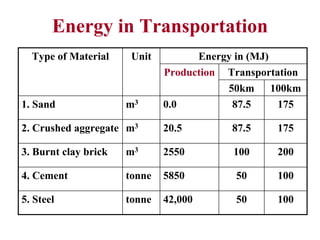
Energy in Transportation
Energy in (MJ)
Transportation
Production
50km 100km
175
175
200
100
100
87.5
87.5
100
50
1. Sand m3 0.0
2. Crushed aggregate m3 20.5
3. Burnt clay brick m3 2550
4. Cement tonne 5850
5. Steel tonne 42,000 50
Type of Material Unit
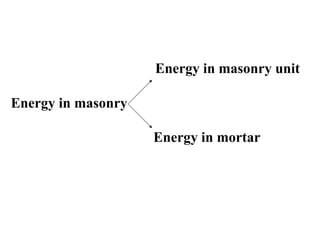
Energy in masonry unit
Energy in masonry
Energy in mortar
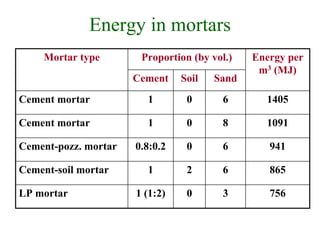
Energy in mortars
Proportion (by vol.)
Mortar type
Cement Soil Sand
0 6
8
6
6
3
0
0
2
0
Energy per
m3 (MJ)
Cement mortar 1 1405
Cement mortar 1 1091
Cement-pozz. mortar 0.8:0.2 941
Cement-soil mortar 1 865
LP mortar 1 (1:2) 756
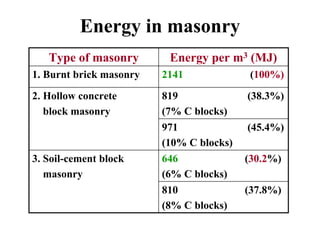
Energy in masonry
Type of masonry Energy per m3 (MJ)
1. Burnt brick masonry 2141 (100%)
819 (38.3%)
(7% C blocks)
2. Hollow concrete
block masonry
971 (45.4%)
(10% C blocks)
646 (30.2%)
(6% C blocks)
3. Soil-cement block
masonry
810 (37.8%)
(8% C blocks)
Burnt bricks: Clay is destroyed
Soil-cement block:
Clay intact, aggregation of silt
& sand particles
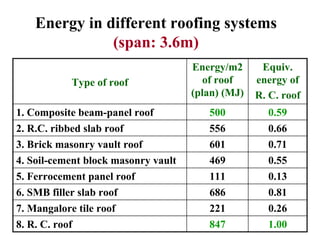
Energy in different roofing systems
(span: 3.6m)
Type of roof
Energy/m2
of roof
(plan) (MJ)
Equiv.
energy of
R. C. roof
1. Composite beam-panel roof 500 0.59
2. R.C. ribbed slab roof 556 0.66
3. Brick masonry vault roof 601 0.71
4. Soil-cement block masonry vault 469 0.55
5. Ferrocement panel roof 111 0.13
6. SMB filler slab roof 686 0.81
7. Mangalore tile roof 221 0.26
8. R. C. roof 847 1.00
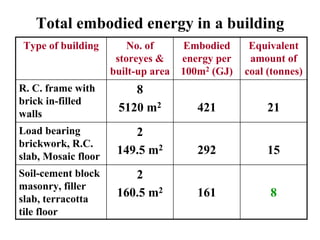
Total embodied energy in a building
Type of building No. of
storeyes &
built-up area
Embodied
energy per
100m2 (GJ)
Equivalent
amount of
coal (tonnes)
R. C. frame with
brick in-filled
walls
8
5120 m2 421 21
Load bearing
brickwork, R.C.
slab, Mosaic floor
2
149.5 m2 292 15
Soil-cement block
masonry, filler
slab, terracotta
tile floor
2
160.5 m2 161 8
Recycling of solid wastes
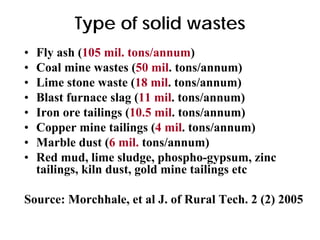
Type of solid wastes
• Fly ash (105 mil. tons/annum)
• Coal mine wastes (50 mil. tons/annum)
• Lime stone waste (18 mil. tons/annum)
• Blast furnace slag (11 mil. tons/annum)
• Iron ore tailings (10.5 mil. tons/annum)
• Copper mine tailings (4 mil. tons/annum)
• Marble dust (6 mil. tons/annum)
• Red mud, lime sludge, phospho-gypsum, zinc
tailings, kiln dust, gold mine tailings etc
Source: Morchhale, et al J. of Rural Tech. 2 (2) 2005
Examples
of
solid waste products
Gold mine tailings
from
Kolar Gold Fields
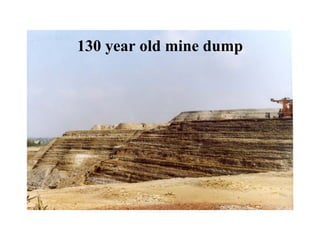
130 year old mine dump
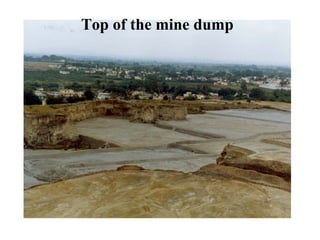
Top of the mine dump
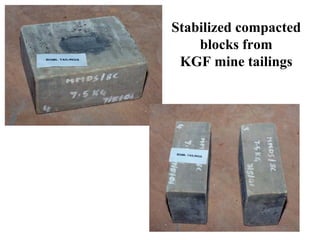
Stabilized compacted
blocks from
KGF mine tailings
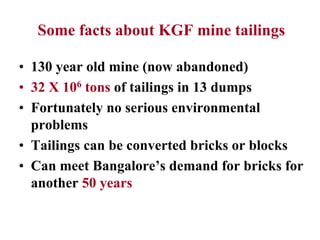
Some facts about KGF mine tailings
• 130 year old mine (now abandoned)
• 32 X 106 tons of tailings in 13 dumps
• Fortunately no serious environmental
problems
• Tailings can be converted bricks or blocks
• Can meet Bangalore’s demand for bricks for
another 50 years

Embodied energy.pdf

  • 1.
    Embodied Energy inBuildings Prof. B. V. Venkatarama Reddy Department of Civil Engineering Indian Institute of Science Bangalore – 560 012
  • 2.
  • 3.
    Indian construction Industry •Employment generation • Volume of materials produced • Annual expenditure
  • 4.
    Type of MaterialPeriod Mud, stones, wood/thatch Prior 8000 BC Sun dried bricks 6000 BC Pottery products 4000 – 8000 BC Burnt Bricks 4000 BC Lime 3000 BC Glass 1300 BC Iron products 1350 BC Lime-pozzolana cement 300 BC – 476 AD Aluminium 1808 AD Portland Cement 1824 AD Plastics 1862 Historical developments in building materials
  • 5.
    Common building materials Burntclay Bricks Stones, Concrete blocks Cement, Steel, Concrete Aluminum, Zinc, SS Glass Tiles (ceramic/burnt) Plastics/PVC Paints, Timber
  • 6.
    Common building materials Burntclay Bricks Stones, Concrete blocks Cement, Steel, Concrete Aluminum, Zinc, SS Glass Tiles (ceramic/burnt) Plastics/PVC Paints, Timber Mud Unburnt bricks, Lime Wood/bamboo/re eds Country tiles Stone boulders Thatch
  • 7.
    Materials consumed inbulk quantities Type of material Current annual consumption Annual Consumption by 2020 Burnt clay bricks 170 X 109 Nos. 260 X 109 Nos. Cement 110 X 106 t 260 X 106 t Structural Steel 12 X 106 t 25 X 106 t Coarse aggregates 300 X 106 m3 750 X 106 m3 Sand 300 X 106 m3 750 X 106 m3
  • 8.
    0 20 40 60 80 100 120 140 160 180 200 1975 1980 19851990 1995 2000 2005 Year In Millions Housing Shortage Housing stock No. of households Housing demand and existing housing stock
  • 9.
    Annual cement capacityand production in India
  • 10.
    Energy consumed inmanufacture of building materials -------------------------------------------------- Current annual Consumption by Consumption 2020 -------------------------------------------------------------------- 2500 X 106 GJ 5000 X 106 GJ or ~ 150 X 106 t of coal equivalent
  • 11.
    Currently Building industrycontributes: ---- 22% of CO2 emissions
  • 12.
    Ex. Material resourceconsumption Brick making: Fertile soil is used Arable land: 1.62 X 10⁶ sq. km. Top soil consumption for bricks 1000 sq.km. (300mm depth)/year @2.5% compound growth Brick making can consume 300mm top soil in ~75 years
  • 13.
    Environment/resources conservation /protection ---- GHG emission reduction ---- Energy conservation ---- conservation of resources How to achieve this?
  • 14.
    1) Use energyefficient alternatives 2) Adopt energy efficient processes in manufacture 3) Switchover to renewable energy sources 4) Reduce transportation 5) Recycling of solid wastes into building products 6) Maximum use of local resources & skills
  • 15.
    Energy in buildings Energyfor maintenance /servicing Capital Energy (Embodied energy) • Material production • Transportation • Assembling into a building
  • 16.
    Low energy buildingmaterials & technologies
  • 17.
    Soil-cement blocks /Stabilised Mud Blocks Definition/Concept/process Mixture of 1) soil or and fines, 2) sand, 3) stabiliser (cement/lime) and 4) water compacted into a high density block & cured
  • 18.
  • 19.
    Blocks of differentshapes & sizes
  • 21.
  • 25.
  • 26.
  • 27.
  • 28.
  • 29.
  • 30.
  • 31.
    Energy in basicbuilding materials Type of material Energy (MJ per kg) Cement Lime Lime-pozzolana Steel Aluminum Glass Mangalore tile 4.5 5.63 2.33 42.0 236.8 25.8 6 - 15 per tile
  • 32.
    Energy in masonrymaterials Type of unit Size (mm) Energy in 1 block or brick (MJ) Energy per brick equiv. (MJ) Size stone 180 X 180 x 180 0 0 Burnt clay brick 230 X 105 X 70 4.25 4.25 (100%) Soil-cement block 230 X 190 X 100 230 X 190 X 100 2.60 (6% C) 3.50 (8% C) 1.00 (23.5%) 1.35 (31.7%) Hollow concrete block 400 X 200 X 200 400 X 200 X 200 12.30 (7% C) 15.00 (10% C) 1.32 (31.2%) 1.62 (38.1%) Steam cured block 230 X 190 x 100 6.70 (10% L) 2.58 (60.6%)
  • 33.
    Energy in Transportation Energyin (MJ) Transportation Production 50km 100km 175 175 200 100 100 87.5 87.5 100 50 1. Sand m3 0.0 2. Crushed aggregate m3 20.5 3. Burnt clay brick m3 2550 4. Cement tonne 5850 5. Steel tonne 42,000 50 Type of Material Unit
  • 34.
    Energy in masonryunit Energy in masonry Energy in mortar
  • 35.
    Energy in mortars Proportion(by vol.) Mortar type Cement Soil Sand 0 6 8 6 6 3 0 0 2 0 Energy per m3 (MJ) Cement mortar 1 1405 Cement mortar 1 1091 Cement-pozz. mortar 0.8:0.2 941 Cement-soil mortar 1 865 LP mortar 1 (1:2) 756
  • 36.
    Energy in masonry Typeof masonry Energy per m3 (MJ) 1. Burnt brick masonry 2141 (100%) 819 (38.3%) (7% C blocks) 2. Hollow concrete block masonry 971 (45.4%) (10% C blocks) 646 (30.2%) (6% C blocks) 3. Soil-cement block masonry 810 (37.8%) (8% C blocks)
  • 37.
    Burnt bricks: Clayis destroyed Soil-cement block: Clay intact, aggregation of silt & sand particles
  • 38.
    Energy in differentroofing systems (span: 3.6m) Type of roof Energy/m2 of roof (plan) (MJ) Equiv. energy of R. C. roof 1. Composite beam-panel roof 500 0.59 2. R.C. ribbed slab roof 556 0.66 3. Brick masonry vault roof 601 0.71 4. Soil-cement block masonry vault 469 0.55 5. Ferrocement panel roof 111 0.13 6. SMB filler slab roof 686 0.81 7. Mangalore tile roof 221 0.26 8. R. C. roof 847 1.00
  • 39.
    Total embodied energyin a building Type of building No. of storeyes & built-up area Embodied energy per 100m2 (GJ) Equivalent amount of coal (tonnes) R. C. frame with brick in-filled walls 8 5120 m2 421 21 Load bearing brickwork, R.C. slab, Mosaic floor 2 149.5 m2 292 15 Soil-cement block masonry, filler slab, terracotta tile floor 2 160.5 m2 161 8
  • 40.
  • 41.
    Type of solidwastes • Fly ash (105 mil. tons/annum) • Coal mine wastes (50 mil. tons/annum) • Lime stone waste (18 mil. tons/annum) • Blast furnace slag (11 mil. tons/annum) • Iron ore tailings (10.5 mil. tons/annum) • Copper mine tailings (4 mil. tons/annum) • Marble dust (6 mil. tons/annum) • Red mud, lime sludge, phospho-gypsum, zinc tailings, kiln dust, gold mine tailings etc Source: Morchhale, et al J. of Rural Tech. 2 (2) 2005
  • 42.
  • 43.
  • 44.
    130 year oldmine dump
  • 45.
    Top of themine dump
  • 46.
  • 47.
    Some facts aboutKGF mine tailings • 130 year old mine (now abandoned) • 32 X 106 tons of tailings in 13 dumps • Fortunately no serious environmental problems • Tailings can be converted bricks or blocks • Can meet Bangalore’s demand for bricks for another 50 years