Email
Electronic Communications
Objectives
• Understand parts of an email
• Differentiate between good and bad emails
• Explain email etiquette
• Evaluate email security risks
• Write emails
Rev 10/2010 Report Writing —Email 2
Definition
Email is the electronic
transmission of
messages through a
computer network.
Rev 10/2010 Report Writing —Email 4
Rev 10/2010Report Writing —Email 5
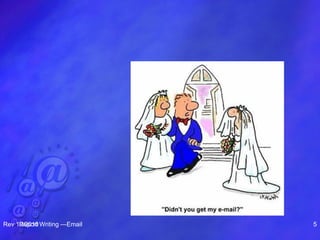
blog.esudhir.com/.../2009/09/email-cartoon.JPG
Basics of Good Communication
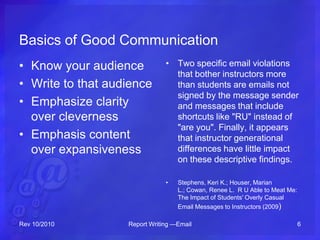
• Know your audience
• Write to that audience
• Emphasize clarity
over cleverness
• Emphasis content
over expansiveness
• Two specific email violations
that bother instructors more
than students are emails not
signed by the message sender
and messages that include
shortcuts like "RU" instead of
"are you". Finally, it appears
that instructor generational
differences have little impact
on these descriptive findings.
• Stephens, Keri K.; Houser, Marian
L.; Cowan, Renee L. R U Able to Meat Me:
The Impact of Students' Overly Casual
Email Messages to Instructors (2009)
Rev 10/2010 Report Writing —Email 6
Design
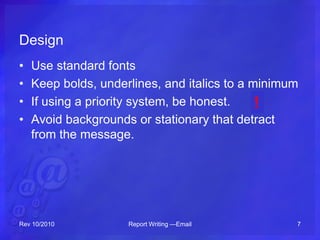
• Use standard fonts
• Keep bolds, underlines, and italics to a minimum
• If using a priority system, be honest.
• Avoid backgrounds or stationary that detract
from the message.
Rev 10/2010 Report Writing —Email 7
!
Parts of an email
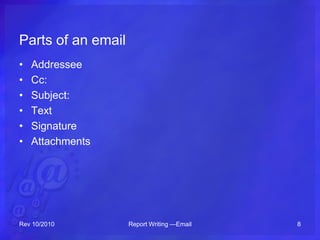
• Addressee
• Cc:
• Subject:
• Text
• Signature
• Attachments
Rev 10/2010 Report Writing —Email 8
Rev 10/2010Report Writing —Email 9
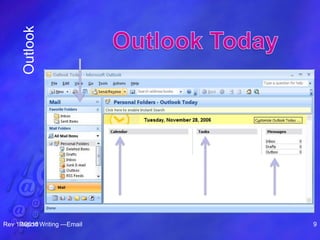
Outlook
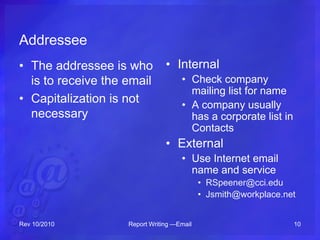
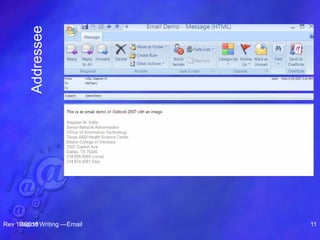
Addressee
• The addressee is who
is to receive the email
• Capitalization is not
necessary
• Internal
• Check company
mailing list for name
• A company usually
has a corporate list in
Contacts
• External
• Use Internet email
name and service
• RSpeener@cci.edu
• Jsmith@workplace.net
Rev 10/2010 Report Writing —Email 10
Addressee
Rev 10/2010Report Writing —Email 11
Complimentary Copy
• Additional people being sent copies.
• If the recipients are all of equal importance, put them on
the To: line
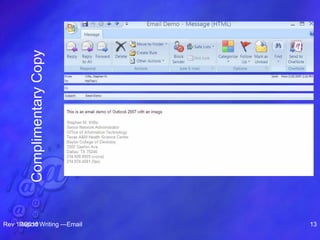
• Use cc for courtesy copies
• Use bcc (blind copy) for sending copies without the
Addressee knowing. Use sparingly.
Rev 10/2010 Report Writing —Email 12
ComplimentaryCopy
Rev 10/2010Report Writing —Email 13
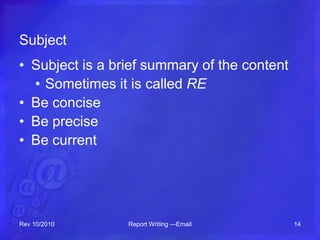
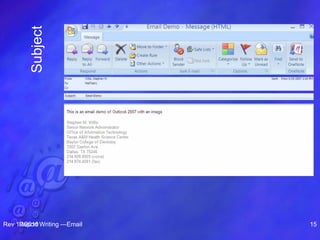
Subject
• Subject is a brief summary of the content
• Sometimes it is called RE
• Be concise
• Be precise
• Be current
Rev 10/2010 Report Writing —Email 14
Subject
Rev 10/2010Report Writing —Email 15
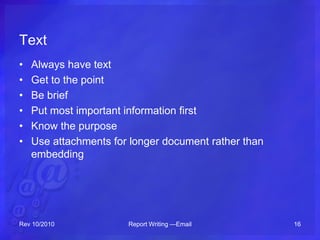
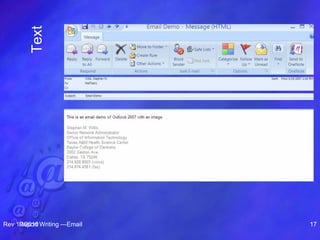
Text
• Always have text
• Get to the point
• Be brief
• Put most important information first
• Know the purpose
• Use attachments for longer document rather than
embedding
Rev 10/2010 Report Writing —Email 16
Text
Rev 10/2010Report Writing —Email 17
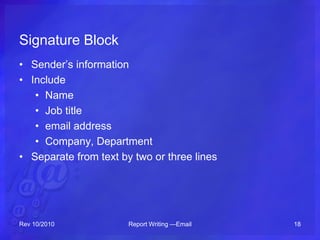
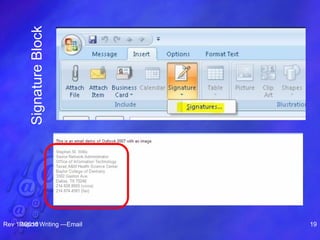
Signature Block
• Sender’s information
• Include
• Name
• Job title
• email address
• Company, Department
• Separate from text by two or three lines
Rev 10/2010 Report Writing —Email 18
SignatureBlock
Rev 10/2010Report Writing —Email 19
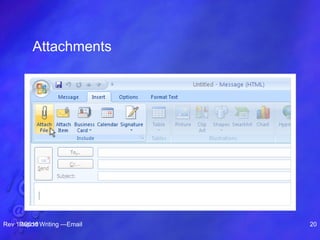
Attachments
Rev 10/2010Report Writing —Email 20
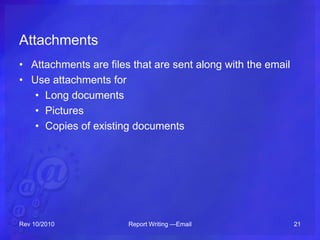
Attachments
• Attachments are files that are sent along with the email
• Use attachments for
• Long documents
• Pictures
• Copies of existing documents
Rev 10/2010 Report Writing —Email 21
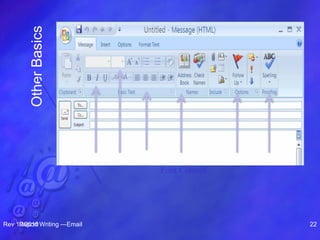
OtherBasics
Rev 10/2010Report Writing —Email 22
Address Book
Font Control
Style
• Usually less formal
• It is somewhere between a conversation
and a memo
• Personal
• Business suitable
• Avoid excessive abbreviations
• Don’t be cute — use emoticons sparingly
Rev 10/2010Report Writing —Email 23
Never email something in bad taste!
Before Sending
• Check spelling
• Check grammar
• Check for clarity
• Check Addressee's name
• Don’t send emails when angry
• Remember telephones still exist – Is email the best way
to respond?
Rev 10/2010 Report Writing —Email 24
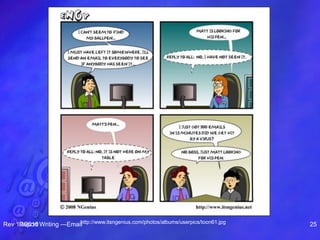
Rev 10/2010Report Writing —Email 25http://www.itsngenius.com/photos/albums/userpics/toon61.jpg
Managing
• Respond to emails promptly
• If given an assignment by email that will take several
days, acknowledge the assignment and the time
frame.
• Remove emails from active list frequently
• Archive frequently
Rev 10/2010 Report Writing —Email 26
REMEMBER
Rev 10/2010 Report Writing —Email 27
Emails are Forever
• Emails are never completely deleted
• They exist on files
• They exist in archives
• They exist in backups
• They exist on hard drives as ghosts
Rev 10/2010 Report Writing —Email 28
Security
Rev 10/2010 Report Writing —Email 29
Email and Security
• Emails and email attachments are a primary entry
method for computer viruses
• Viruses can spread extremely fast
• Computer crime is the growth sector of organized crime
Rev 10/2010 Report Writing —Email 30
Email Security
• Be skeptical
• Open an email from an unknown sender with caution
• Never open email attachments from an unknown sender
• Never give out passwords, social security numbers, bank
account numbers, etc.
Rev 10/2010 Report Writing —Email 31
Email Security Terms
• Virus – A type of software that run without your
knowledge, replicates itself and spreads to other
computers
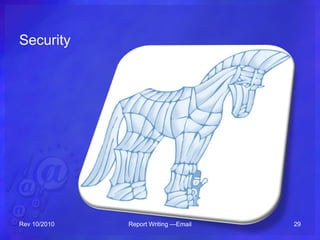
• Trojan Horse– A type of virus that is intended to
do harm to the computer. It is usually hidden
inside something attractive, such as a cartoon
• Worm – a type of virus that spreads by Email
Rev 10/2010 Report Writing —Email 32
Email Security Terms
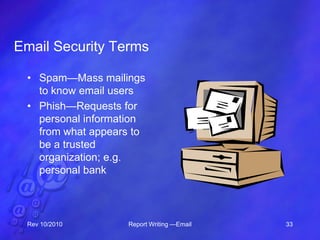
• Spam—Mass mailings
to know email users
• Phish—Requests for
personal information
from what appears to
be a trusted
organization; e.g.
personal bank
Rev 10/2010 Report Writing —Email 33
Internet Security Terms
• Zombie—Unauthorized use of a computer by
others for their personal reasons
• Bot—A web site that automatically transfers the
user to another undesired website
Rev 10/2010 Report Writing —Email 34
Internet Security Terms
• Adware—A program that automatically puts ads
(pop-ups) on the computer
• Spyware—A program that tracks one’s Internet
use. It may also track one’s keystrokes
(passwords etc.) and send it to a designated
recipient
Rev 10/2010 Report Writing —Email 35
Security Measures
• Have a good anti-virus
program
• Use a firewall
• Have good spyware and
adware filters
 Update regularly
• Have a good spam filter
• Update programs
frequently and quickly
• Do not open emails with
multiple forwards
• Be cautious in
downloading free or
shareware programs
• Be cautious in opening
emails from unknown
senders
• Be wary of attachments
Rev 10/2010 Report Writing —Email 36
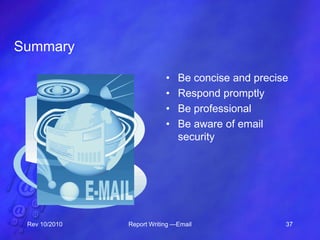
Summary
• Be concise and precise
• Respond promptly
• Be professional
• Be aware of email
security
Rev 10/2010 Report Writing —Email 37
Examples
• Examples of Bad Email Messages
http://www.michaelhorowitz.com/bademails.html
Rev 10/2010 Report Writing —Email 38
Resources
• Netiquette by Virginia Shea (2004)
http://www.albion.com/netiquette/book/index.html
• Outlook 2007 Tutorial http://tamhsc.edu/information-
technology/tutorials/outlook2007-
tutorial/Outlook%202007%20Tutorial.pdf
• Information Security Guidelines
http://www.gov.mu/portal/goc/ncb/file/pdf.pdf
• Getting up to Speed with Microsoft Outlook 2007
http://office.microsoft.com/training/training.aspx?AssetID=R
C101153581033
Rev 10/2010Report Writing —Email 39

EMail.pdf

  • 1.
  • 2.
    Objectives • Understand partsof an email • Differentiate between good and bad emails • Explain email etiquette • Evaluate email security risks • Write emails Rev 10/2010 Report Writing —Email 2
  • 3.
    Definition Email is theelectronic transmission of messages through a computer network. Rev 10/2010 Report Writing —Email 4
  • 4.
    Rev 10/2010Report Writing—Email 5 blog.esudhir.com/.../2009/09/email-cartoon.JPG
  • 5.
    Basics of GoodCommunication • Know your audience • Write to that audience • Emphasize clarity over cleverness • Emphasis content over expansiveness • Two specific email violations that bother instructors more than students are emails not signed by the message sender and messages that include shortcuts like "RU" instead of "are you". Finally, it appears that instructor generational differences have little impact on these descriptive findings. • Stephens, Keri K.; Houser, Marian L.; Cowan, Renee L. R U Able to Meat Me: The Impact of Students' Overly Casual Email Messages to Instructors (2009) Rev 10/2010 Report Writing —Email 6
  • 6.
    Design • Use standardfonts • Keep bolds, underlines, and italics to a minimum • If using a priority system, be honest. • Avoid backgrounds or stationary that detract from the message. Rev 10/2010 Report Writing —Email 7 !
  • 7.
    Parts of anemail • Addressee • Cc: • Subject: • Text • Signature • Attachments Rev 10/2010 Report Writing —Email 8
  • 8.
    Rev 10/2010Report Writing—Email 9 Outlook
  • 9.
    Addressee • The addresseeis who is to receive the email • Capitalization is not necessary • Internal • Check company mailing list for name • A company usually has a corporate list in Contacts • External • Use Internet email name and service • RSpeener@cci.edu • Jsmith@workplace.net Rev 10/2010 Report Writing —Email 10
  • 10.
  • 11.
    Complimentary Copy • Additionalpeople being sent copies. • If the recipients are all of equal importance, put them on the To: line • Use cc for courtesy copies • Use bcc (blind copy) for sending copies without the Addressee knowing. Use sparingly. Rev 10/2010 Report Writing —Email 12
  • 12.
  • 13.
    Subject • Subject isa brief summary of the content • Sometimes it is called RE • Be concise • Be precise • Be current Rev 10/2010 Report Writing —Email 14
  • 14.
  • 15.
    Text • Always havetext • Get to the point • Be brief • Put most important information first • Know the purpose • Use attachments for longer document rather than embedding Rev 10/2010 Report Writing —Email 16
  • 16.
  • 17.
    Signature Block • Sender’sinformation • Include • Name • Job title • email address • Company, Department • Separate from text by two or three lines Rev 10/2010 Report Writing —Email 18
  • 18.
  • 19.
  • 20.
    Attachments • Attachments arefiles that are sent along with the email • Use attachments for • Long documents • Pictures • Copies of existing documents Rev 10/2010 Report Writing —Email 21
  • 21.
    OtherBasics Rev 10/2010Report Writing—Email 22 Address Book Font Control
  • 22.
    Style • Usually lessformal • It is somewhere between a conversation and a memo • Personal • Business suitable • Avoid excessive abbreviations • Don’t be cute — use emoticons sparingly Rev 10/2010Report Writing —Email 23 Never email something in bad taste!
  • 23.
    Before Sending • Checkspelling • Check grammar • Check for clarity • Check Addressee's name • Don’t send emails when angry • Remember telephones still exist – Is email the best way to respond? Rev 10/2010 Report Writing —Email 24
  • 24.
    Rev 10/2010Report Writing—Email 25http://www.itsngenius.com/photos/albums/userpics/toon61.jpg
  • 25.
    Managing • Respond toemails promptly • If given an assignment by email that will take several days, acknowledge the assignment and the time frame. • Remove emails from active list frequently • Archive frequently Rev 10/2010 Report Writing —Email 26
  • 26.
    REMEMBER Rev 10/2010 ReportWriting —Email 27
  • 27.
    Emails are Forever •Emails are never completely deleted • They exist on files • They exist in archives • They exist in backups • They exist on hard drives as ghosts Rev 10/2010 Report Writing —Email 28
  • 28.
    Security Rev 10/2010 ReportWriting —Email 29
  • 29.
    Email and Security •Emails and email attachments are a primary entry method for computer viruses • Viruses can spread extremely fast • Computer crime is the growth sector of organized crime Rev 10/2010 Report Writing —Email 30
  • 30.
    Email Security • Beskeptical • Open an email from an unknown sender with caution • Never open email attachments from an unknown sender • Never give out passwords, social security numbers, bank account numbers, etc. Rev 10/2010 Report Writing —Email 31
  • 31.
    Email Security Terms •Virus – A type of software that run without your knowledge, replicates itself and spreads to other computers • Trojan Horse– A type of virus that is intended to do harm to the computer. It is usually hidden inside something attractive, such as a cartoon • Worm – a type of virus that spreads by Email Rev 10/2010 Report Writing —Email 32
  • 32.
    Email Security Terms •Spam—Mass mailings to know email users • Phish—Requests for personal information from what appears to be a trusted organization; e.g. personal bank Rev 10/2010 Report Writing —Email 33
  • 33.
    Internet Security Terms •Zombie—Unauthorized use of a computer by others for their personal reasons • Bot—A web site that automatically transfers the user to another undesired website Rev 10/2010 Report Writing —Email 34
  • 34.
    Internet Security Terms •Adware—A program that automatically puts ads (pop-ups) on the computer • Spyware—A program that tracks one’s Internet use. It may also track one’s keystrokes (passwords etc.) and send it to a designated recipient Rev 10/2010 Report Writing —Email 35
  • 35.
    Security Measures • Havea good anti-virus program • Use a firewall • Have good spyware and adware filters  Update regularly • Have a good spam filter • Update programs frequently and quickly • Do not open emails with multiple forwards • Be cautious in downloading free or shareware programs • Be cautious in opening emails from unknown senders • Be wary of attachments Rev 10/2010 Report Writing —Email 36
  • 36.
    Summary • Be conciseand precise • Respond promptly • Be professional • Be aware of email security Rev 10/2010 Report Writing —Email 37
  • 37.
    Examples • Examples ofBad Email Messages http://www.michaelhorowitz.com/bademails.html Rev 10/2010 Report Writing —Email 38
  • 38.
    Resources • Netiquette byVirginia Shea (2004) http://www.albion.com/netiquette/book/index.html • Outlook 2007 Tutorial http://tamhsc.edu/information- technology/tutorials/outlook2007- tutorial/Outlook%202007%20Tutorial.pdf • Information Security Guidelines http://www.gov.mu/portal/goc/ncb/file/pdf.pdf • Getting up to Speed with Microsoft Outlook 2007 http://office.microsoft.com/training/training.aspx?AssetID=R C101153581033 Rev 10/2010Report Writing —Email 39