“Without a good history,it’s an inevitable fact that the patient’s
problem will remain undiagnosed despite examination findings
and the results of the investigations that follow!”
Defination;It’s the process of acquiring information from the
patient with the aim of formulating a diagnosis and providing
medical care to the patient.(Dr.Anwar H.Siddiqui)
 To understand the importance of the medical history.
 To understand the relevant processes /steps involved
in taking a medical history.
 To be able to take a systematic,comprehensive history
from a patient.
 To recognize the importance of structure in a
systematic approach to history-taking.
 Comprehensive Health History.
 Periodic Health History.
 Problem-oriented History.
 Develop a rapport,be friendly.
 Be intrested.
 Use eye contact.
 Let the patient tell their story.
 Listen.
 Use appropriate language and terms.
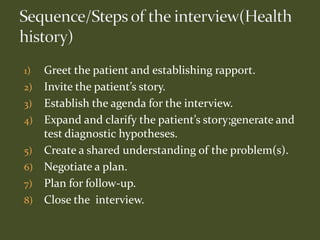
1) Greet the patient and establishing rapport.
2) Invite the patient’s story.
3) Establish the agenda for the interview.
4) Expand and clarify the patient’s story;generate and
test diagnostic hypotheses.
5) Create a shared understanding of the problem(s).
6) Negotiate a plan.
7) Plan for follow-up.
8) Close the interview.
 Active listening;Involves fully attending to what the patient is
communicating.
 Adaptive questioning;Involves directed questioning from general to
specific i.e,asking a series of questions one at a time.
 Non-verbal communication;Involves paying close attention to
aspects e.g,Eye contact,facial expressions,posture,head position, and
movements like nodding or shaking.
 Echoing;Involves simple repetition of the patient’s words.This helps
encourage the patient to express both factual details and feelings.
 Ephathic responses;Involves putting oneself in the patient’s shoes or
perspective,imagining/feeling what and how they feel.
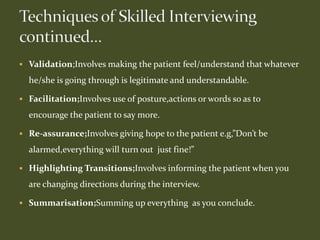
 Validation;Involves making the patient feel/understand that whatever
he/she is going through is legitimate and understandable.
 Facilitation;Involves use of posture,actions or words so as to
encourage the patient to say more.
 Re-assurance;Involves giving hope to the patient e.g,”Don’t be
alarmed,everything will turn out just fine!”
 Highlighting Transitions;Involves informing the patient when you
are changing directions during the interview.
 Summarisation;Summing up everything as you conclude.
 The patient himself/herself.
 Friend(s).
 Family.
 Letter of refferal.
 Medical records.
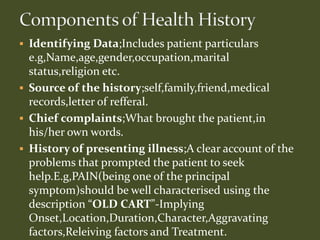
 Identifying Data;Includes patient particulars
e.g,Name,age,gender,occupation,marital
status,religion etc.
 Source of the history;self,family,friend,medical
records,letter of refferal.
 Chief complaints;What brought the patient,in
his/her own words.
 History of presenting illness;A clear account of the
problems that prompted the patient to seek
help.E.g,PAIN(being one of the principal
symptom)should be well characterised using the
description “OLD CART”-Implying
Onset,Location,Duration,Character,Aggravating
factors,Releiving factors and Treatment.
 Past Medical history;Includes several areas namely,
-History of childhood illnesses e.g measles,Rheumatic Heart Disease,Rubella etc.
-Medical history e.g,History of Diabetes Mellitus,Hypertension,Tuberculosis etc.
-Surgical History e.g Bleeding tendencies,blood transfusion,actual surgery etc.
-Obstetric/Gynaecologic History e.g Menstrual history,birth control and sexual function.
-Psychiatric history;Whether there’s history of mental illnesses on self or the family.
-Health maintainance;History of immunization,screening tests,pap smears and mammograms.
 Family History;Includes history on family structure,functions and relationships.Also if there are any
familial medical illnesses,psychiatric disease and drug abuse.
 Personal and Social history;Includes Childhood history,Schooling,Religious affiliation,Activities of
daily living,Occupation,Insurance,Hobbies,Lifestyle habits,Exercise and diet,Alternative healthcare
practices .
 Review of Body systems;General assessment,Cardiovascular system,Gastro-intestinal/Alimentary
system,Respiratory system,Urinary system,Nervous system,Genital system,Musculoskeletal system.
History-taking of a Patient(Updated)

History-taking of a Patient(Updated)

  • 1.
    “Without a goodhistory,it’s an inevitable fact that the patient’s problem will remain undiagnosed despite examination findings and the results of the investigations that follow!” Defination;It’s the process of acquiring information from the patient with the aim of formulating a diagnosis and providing medical care to the patient.(Dr.Anwar H.Siddiqui)
  • 2.
     To understandthe importance of the medical history.  To understand the relevant processes /steps involved in taking a medical history.  To be able to take a systematic,comprehensive history from a patient.  To recognize the importance of structure in a systematic approach to history-taking.
  • 3.
     Comprehensive HealthHistory.  Periodic Health History.  Problem-oriented History.
  • 4.
     Develop arapport,be friendly.  Be intrested.  Use eye contact.  Let the patient tell their story.  Listen.  Use appropriate language and terms.
  • 5.
    1) Greet thepatient and establishing rapport. 2) Invite the patient’s story. 3) Establish the agenda for the interview. 4) Expand and clarify the patient’s story;generate and test diagnostic hypotheses. 5) Create a shared understanding of the problem(s). 6) Negotiate a plan. 7) Plan for follow-up. 8) Close the interview.
  • 6.
     Active listening;Involvesfully attending to what the patient is communicating.  Adaptive questioning;Involves directed questioning from general to specific i.e,asking a series of questions one at a time.  Non-verbal communication;Involves paying close attention to aspects e.g,Eye contact,facial expressions,posture,head position, and movements like nodding or shaking.  Echoing;Involves simple repetition of the patient’s words.This helps encourage the patient to express both factual details and feelings.  Ephathic responses;Involves putting oneself in the patient’s shoes or perspective,imagining/feeling what and how they feel.
  • 7.
     Validation;Involves makingthe patient feel/understand that whatever he/she is going through is legitimate and understandable.  Facilitation;Involves use of posture,actions or words so as to encourage the patient to say more.  Re-assurance;Involves giving hope to the patient e.g,”Don’t be alarmed,everything will turn out just fine!”  Highlighting Transitions;Involves informing the patient when you are changing directions during the interview.  Summarisation;Summing up everything as you conclude.
  • 8.
     The patienthimself/herself.  Friend(s).  Family.  Letter of refferal.  Medical records.
  • 9.
     Identifying Data;Includespatient particulars e.g,Name,age,gender,occupation,marital status,religion etc.  Source of the history;self,family,friend,medical records,letter of refferal.  Chief complaints;What brought the patient,in his/her own words.  History of presenting illness;A clear account of the problems that prompted the patient to seek help.E.g,PAIN(being one of the principal symptom)should be well characterised using the description “OLD CART”-Implying Onset,Location,Duration,Character,Aggravating factors,Releiving factors and Treatment.
  • 10.
     Past Medicalhistory;Includes several areas namely, -History of childhood illnesses e.g measles,Rheumatic Heart Disease,Rubella etc. -Medical history e.g,History of Diabetes Mellitus,Hypertension,Tuberculosis etc. -Surgical History e.g Bleeding tendencies,blood transfusion,actual surgery etc. -Obstetric/Gynaecologic History e.g Menstrual history,birth control and sexual function. -Psychiatric history;Whether there’s history of mental illnesses on self or the family. -Health maintainance;History of immunization,screening tests,pap smears and mammograms.  Family History;Includes history on family structure,functions and relationships.Also if there are any familial medical illnesses,psychiatric disease and drug abuse.  Personal and Social history;Includes Childhood history,Schooling,Religious affiliation,Activities of daily living,Occupation,Insurance,Hobbies,Lifestyle habits,Exercise and diet,Alternative healthcare practices .  Review of Body systems;General assessment,Cardiovascular system,Gastro-intestinal/Alimentary system,Respiratory system,Urinary system,Nervous system,Genital system,Musculoskeletal system.