English Language Teaching across Curriculum
LESSON PLAN
Geography for tenth grader of senior high school
Name:
DIYANA SULISTYANI
NIM:
2201414064
Rombel: 507-508
English Education Study Program
English Department
Faculty of Languages and Arts
Semarang State University
2017
LESSON PLAN
Subject : GEOGRAPHY
Grade/Semester : X/1
Topic : Earth’s Rotation and Revolution
Meeting : 3rd
Time Allocation : 30 minutes
I. Core Competence
3. Memahami, menerapkan, menganalisis dan mengevaluasi pengetahuan pfaktual,
keonseptual, procedural, dan metakognitif berdasarkan rasa ingin tahunya tentang
ilmu pengetahuan, teknologi, seni, budaya, dan humaniora dengan wawasan
kemanusiaan, kebangsaan, kenegaraan, dan peradaban terkait penyebab fenomena
dan kejadian, serta menerapkan pengetahuan procedural pada bidang kajian spesifik
sesuai dengan bakat dan minatnya untuk memecahkan masalah.
II. Basic Competence
3.4 Menganalisis dinamika planet Bumi sebagai ruang kehidupan
4.4 Menyajikan karakteristik planet Bumi sebagai ruang kehidupan dengan
menggunakan peta, bagan, gambar, tabel, grafik, foto, dan/atau video.
III. Indicators
1. Content Indicators
a. Explaining the definition of Earth’s rotation and revolution.
b. Explaining the effects of Earth’s rotation and revolution.
2. Language Indicators
a. Pronouncing the terms related to Earth’s rotation and revolution.
b. Using the terms related to Earth’s rotation and revolution.
IV. Learning Objectives
1. Content Objectives
At the end of the lesson:
a. 90% of all students are able to explain definition of Earth’s rotation and
revolution.
b. 85% of all students are able to explain the effects of Earth’s rotation and
revolution on Earth.
2. Language Objectives
a. 90% of all students are able to pronounce the terms related to Earth’s rotation
and revolution.
b. 85% of all students are able to use the terms related to Earth’s rotation and
revolution.
V. Learning Materials
Content Materials:
a. Explanation about definition of Earth’s rotation and revolution.
b. Effects of Earth’s rotation and revolution.
Language Materials:
a. List of terminologies related to the topic.
b. Example of sentences using terminologies related to Earth’s rotation and
revolution.
 Content Materials
There are two movements of Earth, they are: rotation and revolution.
Earth’s Rotation
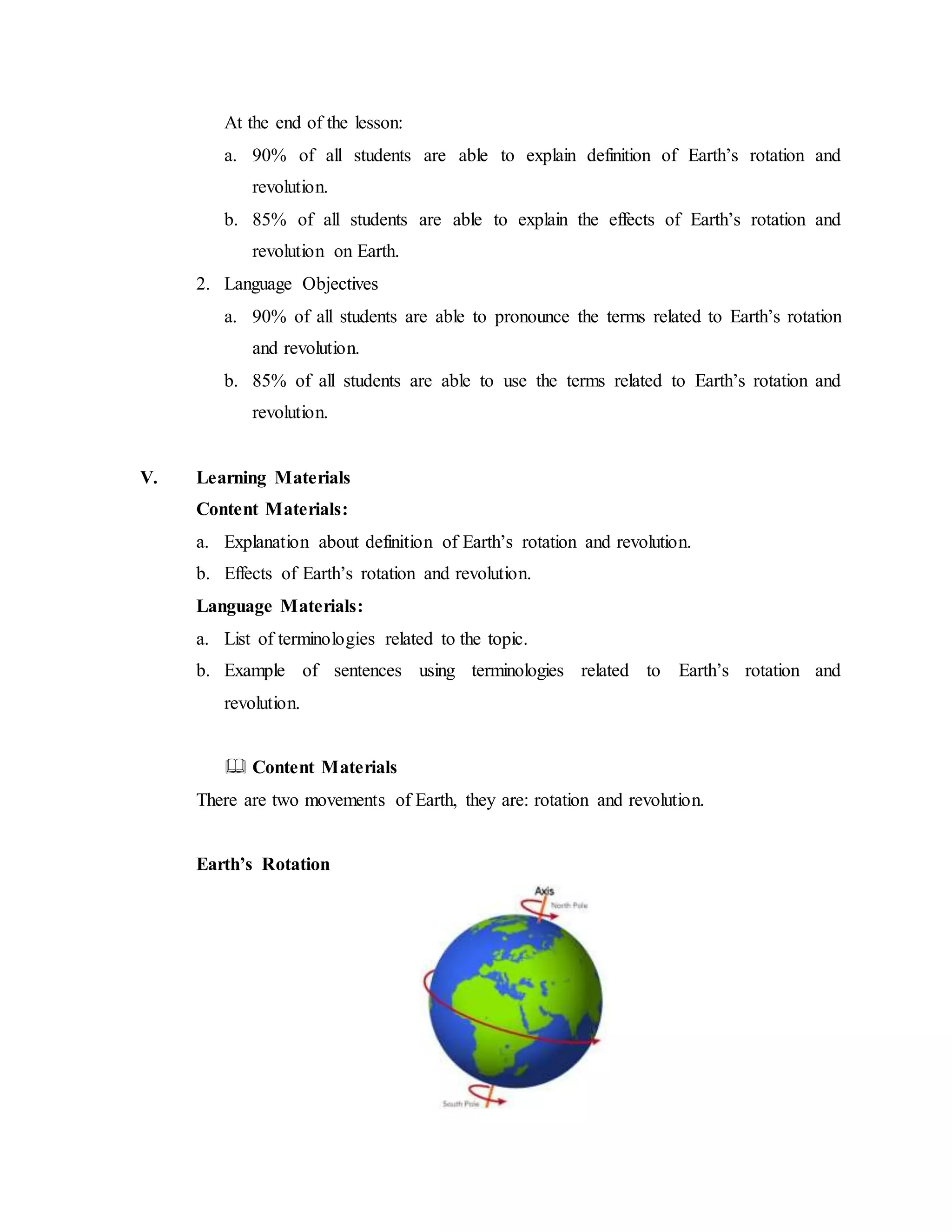
Earth’s rotation is the movement of Earth on its axis. Axis is an imaginary line
through the planet from North Pole to the South Pole. The Earth is tilted on its own axis at the
23.5° from a line perpendicular to the planet of its orbit of the sun. The earth rotates
counterclockwise from west to east. It takes 24 hours to complete one turn (rotation). This
rotation then will cause day and night; and sun’s rise and set on the Earth.
Earth’s Revolution
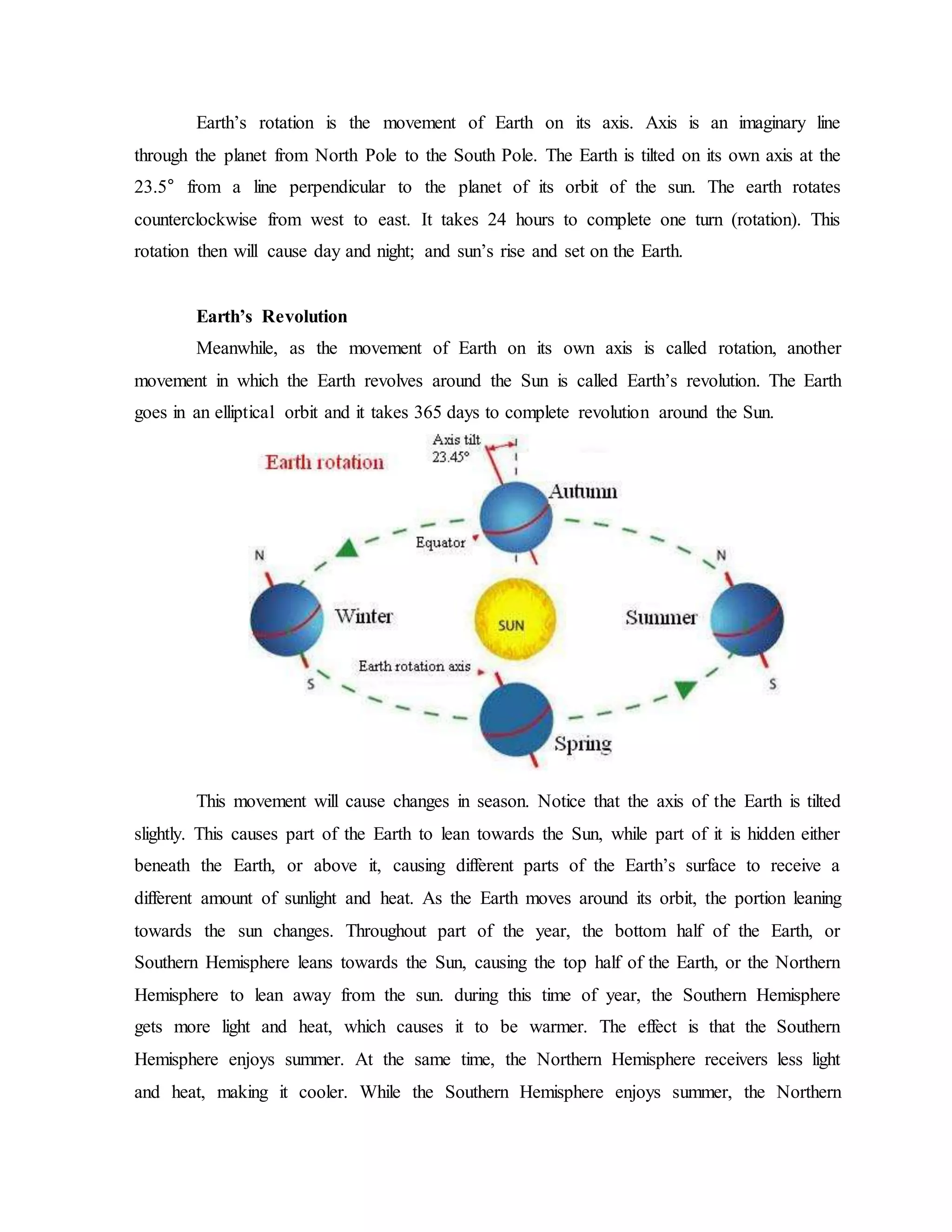
Meanwhile, as the movement of Earth on its own axis is called rotation, another
movement in which the Earth revolves around the Sun is called Earth’s revolution. The Earth
goes in an elliptical orbit and it takes 365 days to complete revolution around the Sun.
This movement will cause changes in season. Notice that the axis of the Earth is tilted
slightly. This causes part of the Earth to lean towards the Sun, while part of it is hidden either
beneath the Earth, or above it, causing different parts of the Earth’s surface to receive a
different amount of sunlight and heat. As the Earth moves around its orbit, the portion leaning
towards the sun changes. Throughout part of the year, the bottom half of the Earth, or
Southern Hemisphere leans towards the Sun, causing the top half of the Earth, or the Northern
Hemisphere to lean away from the sun. during this time of year, the Southern Hemisphere
gets more light and heat, which causes it to be warmer. The effect is that the Southern
Hemisphere enjoys summer. At the same time, the Northern Hemisphere receivers less light
and heat, making it cooler. While the Southern Hemisphere enjoys summer, the Northern
Hemisphere is in the midst of winter. As the Earth continues along its orbit around the sun,
the angle that the Earth’s axis tilts changes. Eventually the Northern Hemisphere faces the
sun, and the Southern Hemisphere leans away. During this time of the year, it is the Northern
Hemisphere’s turn to enjoy summer.
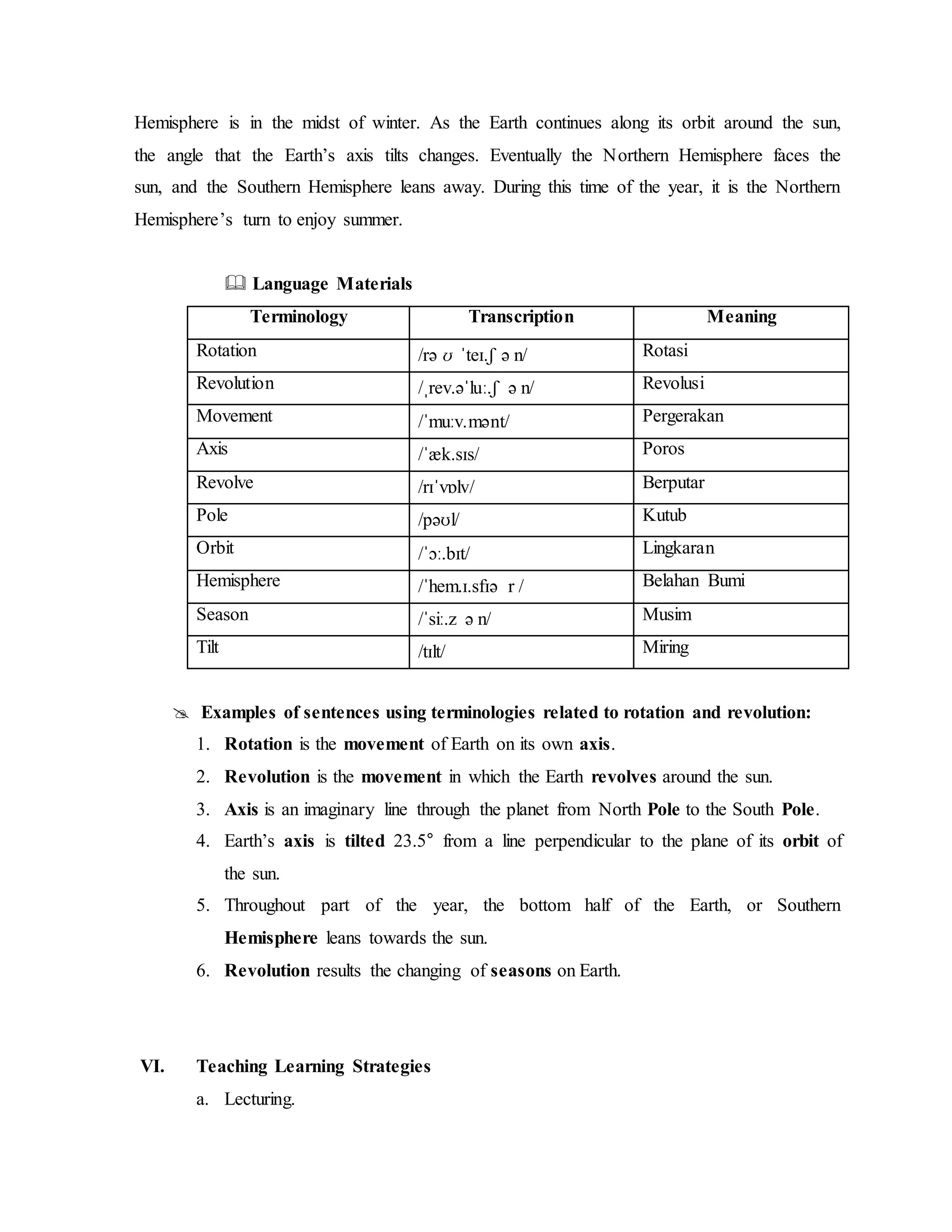
 Language Materials
Terminology Transcription Meaning
Rotation /rə ʊ  ˈteɪ.ʃ ə n/ Rotasi
Revolution /ˌrev.əˈluː.ʃ ə n/ Revolusi
Movement /ˈmuːv.mənt/ Pergerakan
Axis /ˈæk.sɪs/ Poros
Revolve /rɪˈvɒlv/ Berputar
Pole /pəʊl/ Kutub
Orbit /ˈɔː.bɪt/ Lingkaran
Hemisphere /ˈhem.ɪ.sfɪə r / Belahan Bumi
Season /ˈsiː.z ə n/ Musim
Tilt /tɪlt/ Miring
 Examples of sentences using terminologies related to rotation and revolution:
1. Rotation is the movement of Earth on its own axis.
2. Revolution is the movement in which the Earth revolves around the sun.
3. Axis is an imaginary line through the planet from North Pole to the South Pole.
4. Earth’s axis is tilted 23.5° from a line perpendicular to the plane of its orbit of
the sun.
5. Throughout part of the year, the bottom half of the Earth, or Southern
Hemisphere leans towards the sun.
6. Revolution results the changing of seasons on Earth.
VI. Teaching Learning Strategies
a. Lecturing.
b. Pair discussion.
c. Presentation.
d. Think-Pair-Share.
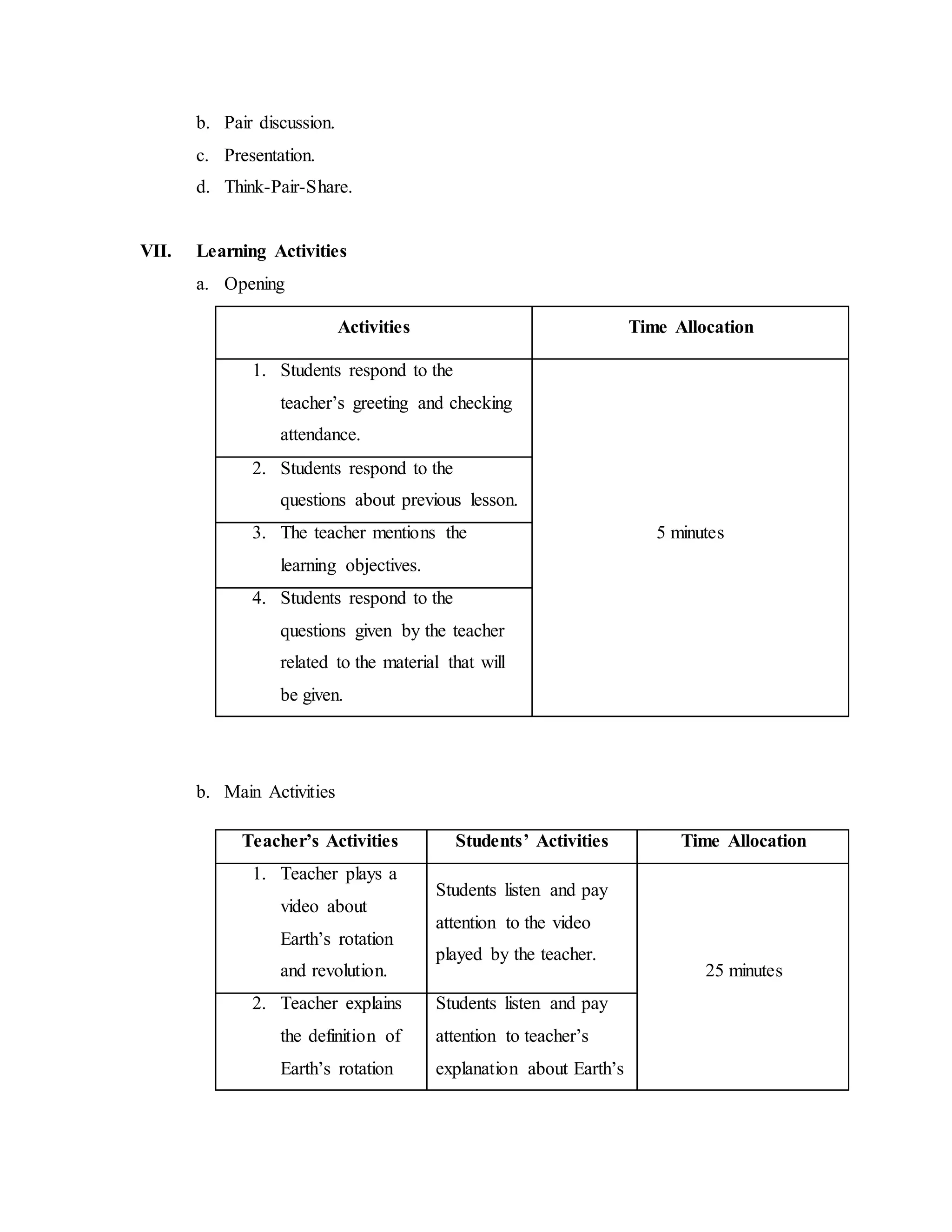
VII. Learning Activities
a. Opening
Activities Time Allocation
1. Students respond to the
teacher’s greeting and checking
attendance.
5 minutes
2. Students respond to the
questions about previous lesson.
3. The teacher mentions the
learning objectives.
4. Students respond to the
questions given by the teacher
related to the material that will
be given.
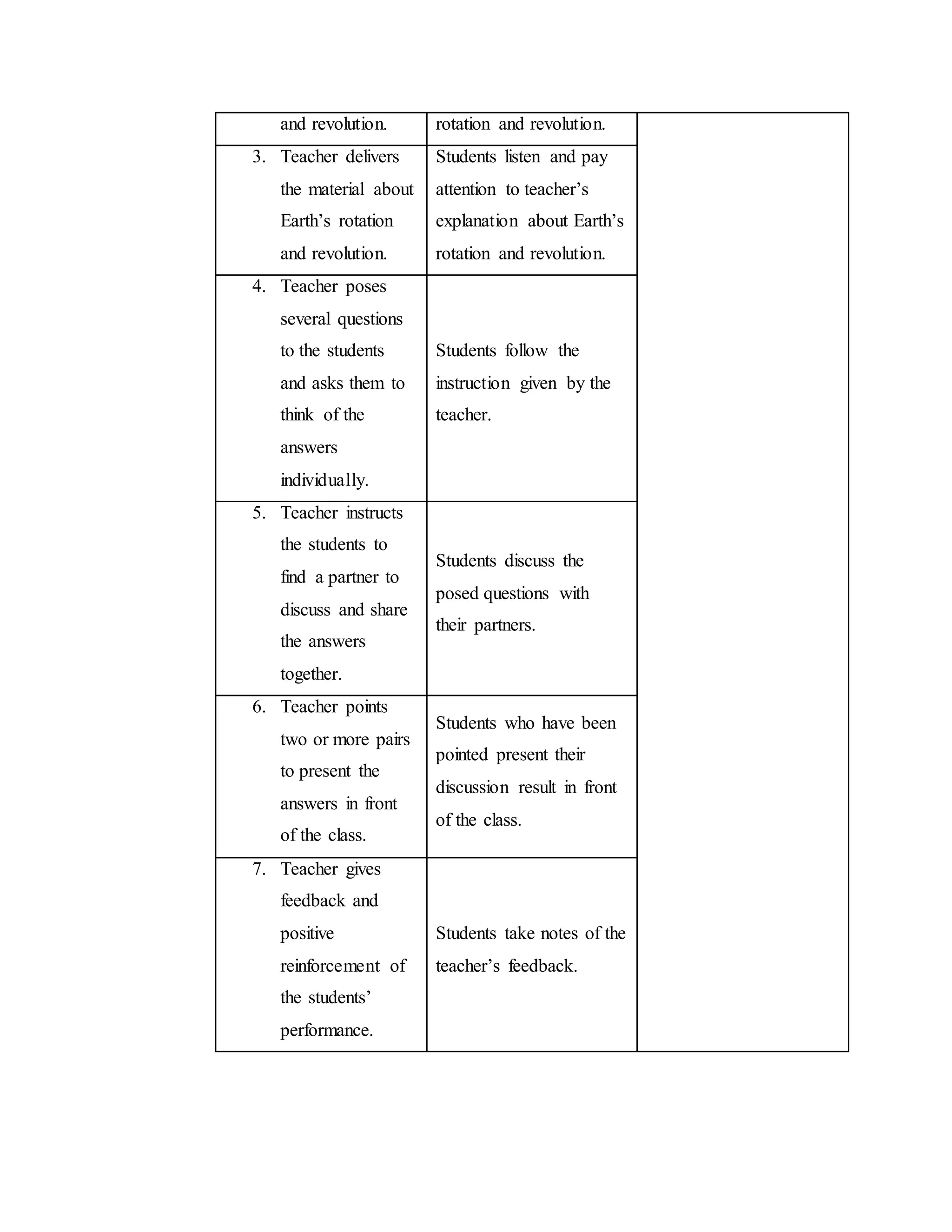
b. Main Activities
Teacher’s Activities Students’ Activities Time Allocation
1. Teacher plays a
video about
Earth’s rotation
and revolution.
Students listen and pay
attention to the video
played by the teacher.
25 minutes
2. Teacher explains
the definition of
Earth’s rotation
Students listen and pay
attention to teacher’s
explanation about Earth’s
and revolution. rotation and revolution.
3. Teacher delivers
the material about
Earth’s rotation
and revolution.
Students listen and pay
attention to teacher’s
explanation about Earth’s
rotation and revolution.
4. Teacher poses
several questions
to the students
and asks them to
think of the
answers
individually.
Students follow the
instruction given by the
teacher.
5. Teacher instructs
the students to
find a partner to
discuss and share
the answers
together.
Students discuss the
posed questions with
their partners.
6. Teacher points
two or more pairs
to present the
answers in front
of the class.
Students who have been
pointed present their
discussion result in front
of the class.
7. Teacher gives
feedback and
positive
reinforcement of
the students’
performance.
Students take notes of the
teacher’s feedback.
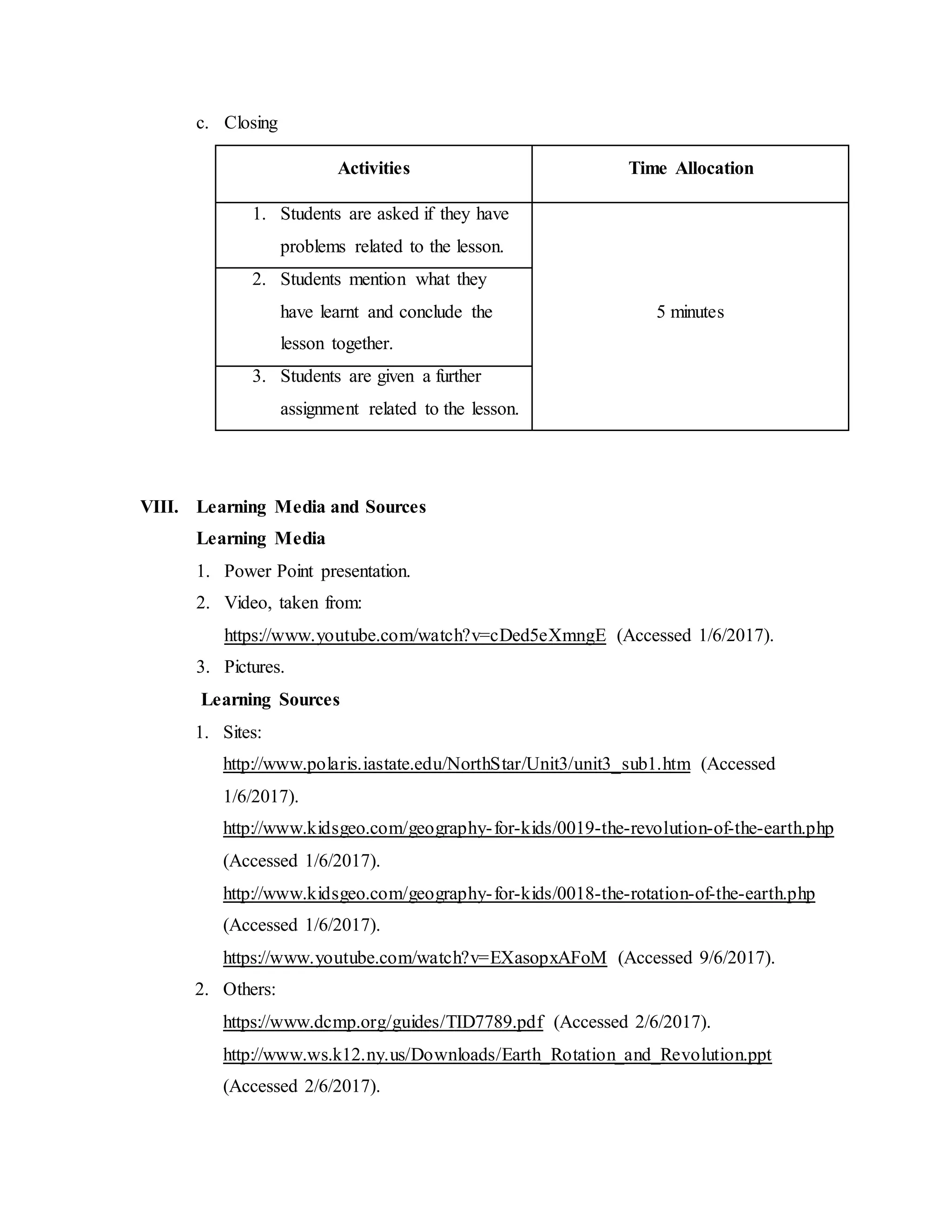
c. Closing
Activities Time Allocation
1. Students are asked if they have
problems related to the lesson.
5 minutes
2. Students mention what they
have learnt and conclude the
lesson together.
3. Students are given a further
assignment related to the lesson.
VIII. Learning Media and Sources
Learning Media
1. Power Point presentation.
2. Video, taken from:
https://www.youtube.com/watch?v=cDed5eXmngE (Accessed 1/6/2017).
3. Pictures.
Learning Sources
1. Sites:
http://www.polaris.iastate.edu/NorthStar/Unit3/unit3_sub1.htm (Accessed
1/6/2017).
http://www.kidsgeo.com/geography-for-kids/0019-the-revolution-of-the-earth.php
(Accessed 1/6/2017).
http://www.kidsgeo.com/geography-for-kids/0018-the-rotation-of-the-earth.php
(Accessed 1/6/2017).
https://www.youtube.com/watch?v=EXasopxAFoM (Accessed 9/6/2017).
2. Others:
https://www.dcmp.org/guides/TID7789.pdf (Accessed 2/6/2017).
http://www.ws.k12.ny.us/Downloads/Earth_Rotation_and_Revolution.ppt
(Accessed 2/6/2017).
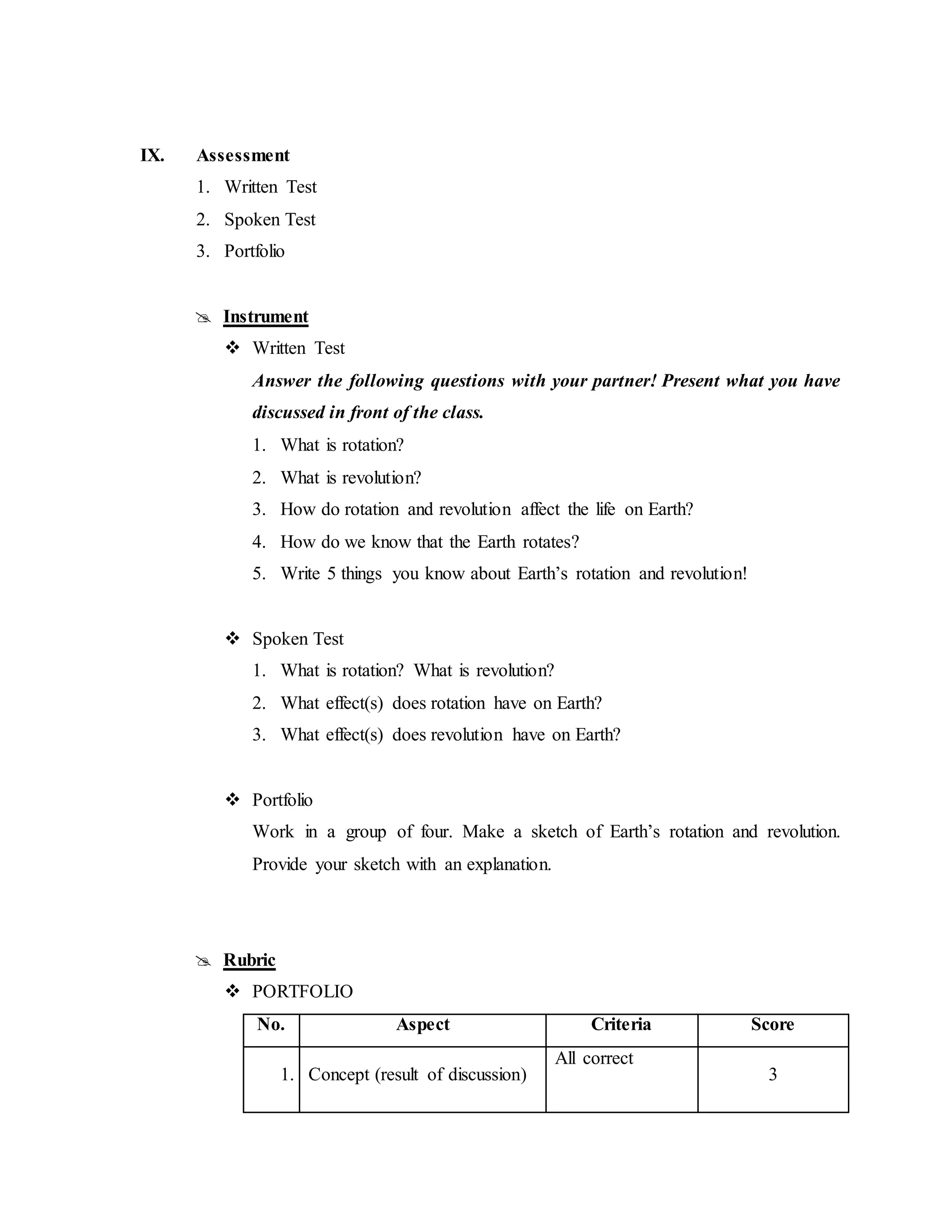
IX. Assessment
1. Written Test
2. Spoken Test
3. Portfolio
 Instrument
 Written Test
Answer the following questions with your partner! Present what you have
discussed in front of the class.
1. What is rotation?
2. What is revolution?
3. How do rotation and revolution affect the life on Earth?
4. How do we know that the Earth rotates?
5. Write 5 things you know about Earth’s rotation and revolution!
 Spoken Test
1. What is rotation? What is revolution?
2. What effect(s) does rotation have on Earth?
3. What effect(s) does revolution have on Earth?
 Portfolio
Work in a group of four. Make a sketch of Earth’s rotation and revolution.
Provide your sketch with an explanation.
 Rubric
 PORTFOLIO
No. Aspect Criteria Score
1. Concept (result of discussion)
All correct
3
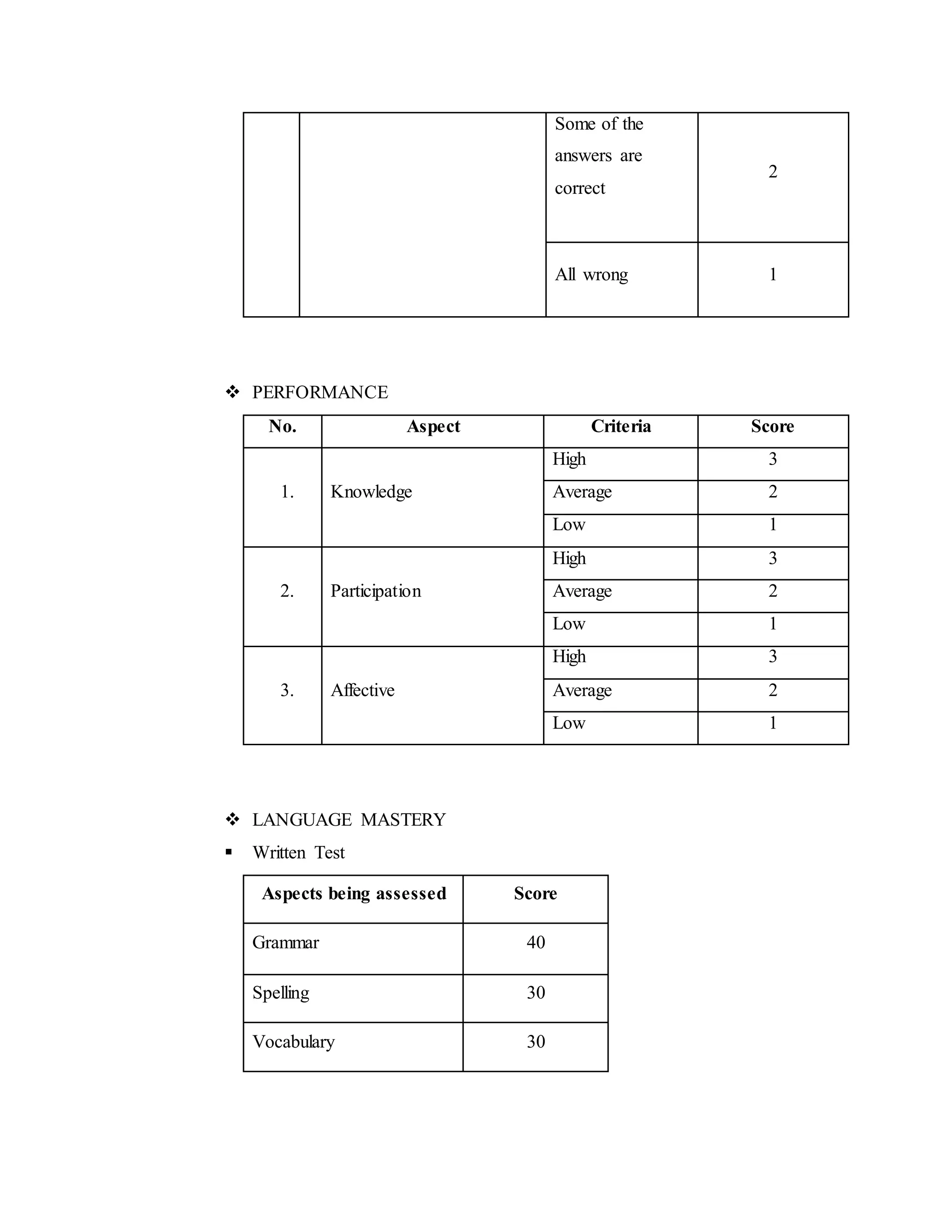
Some of the
answers are
correct
2
All wrong 1
 PERFORMANCE
No. Aspect Criteria Score
1. Knowledge
High 3
Average 2
Low 1
2. Participation
High 3
Average 2
Low 1
3. Affective
High 3
Average 2
Low 1
 LANGUAGE MASTERY
 Written Test
Aspects being assessed Score
Grammar 40
Spelling 30
Vocabulary 30
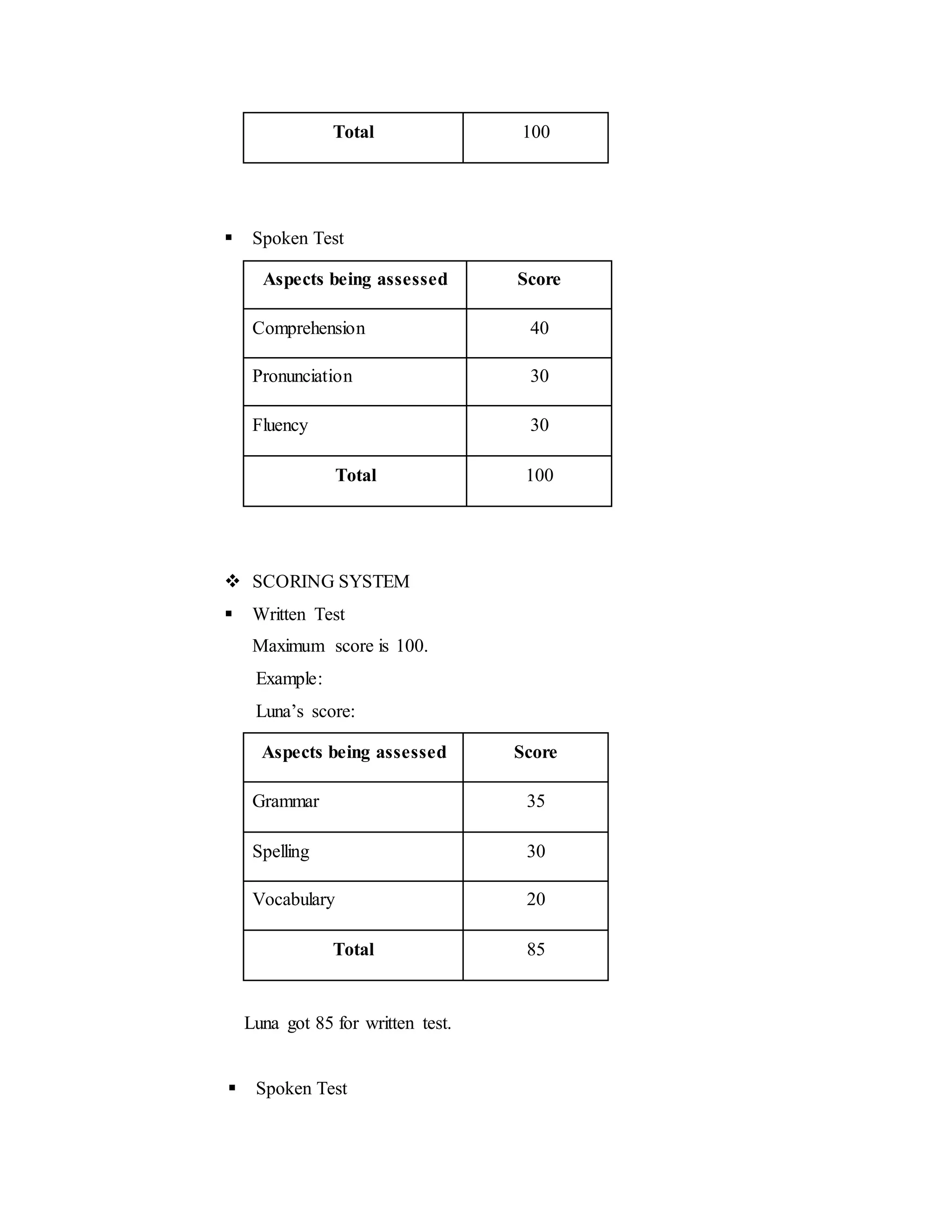
Total 100
 Spoken Test
Aspects being assessed Score
Comprehension 40
Pronunciation 30
Fluency 30
Total 100
 SCORING SYSTEM
 Written Test
Maximum score is 100.
Example:
Luna’s score:
Aspects being assessed Score
Grammar 35
Spelling 30
Vocabulary 20
Total 85
Luna got 85 for written test.
 Spoken Test
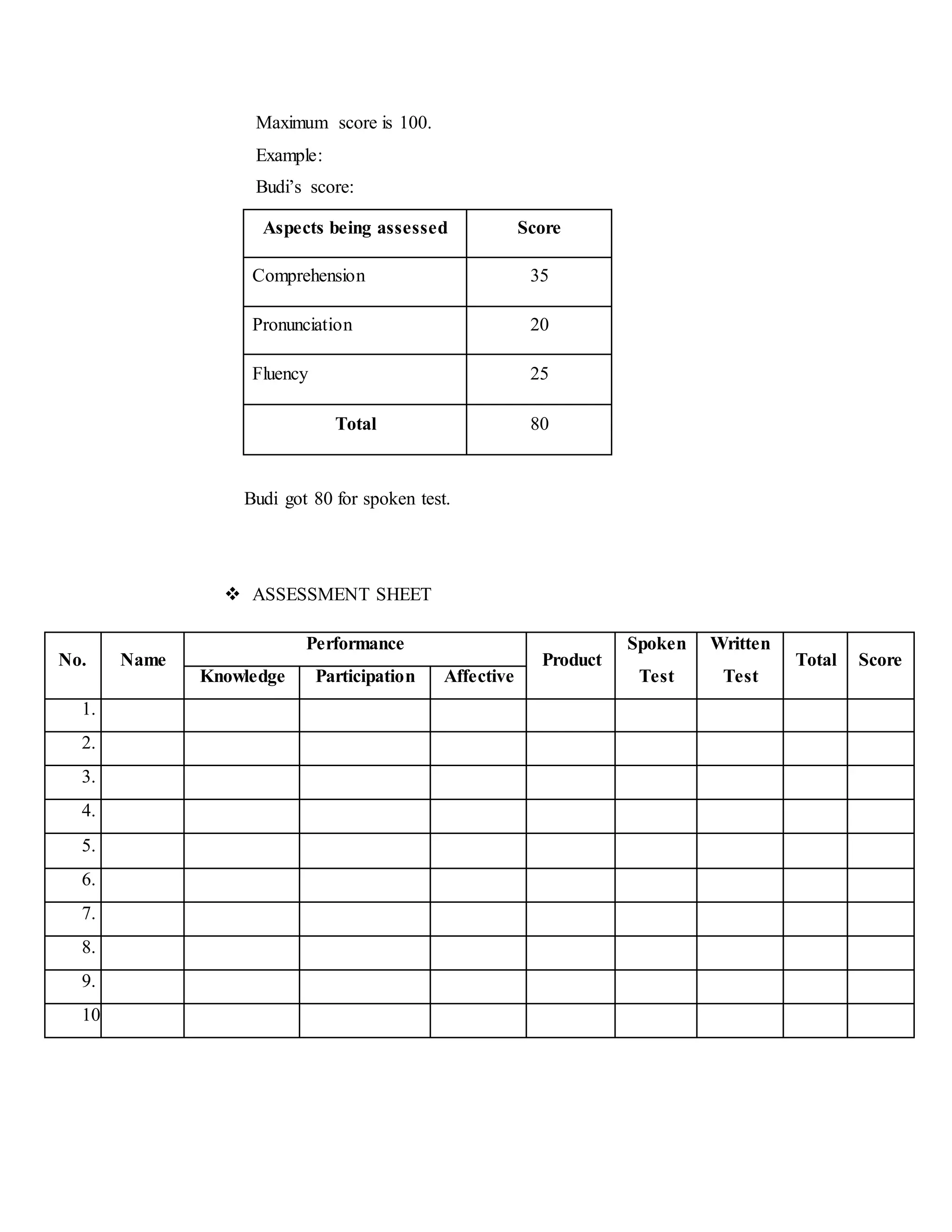
Maximum score is 100.
Example:
Budi’s score:
Aspects being assessed Score
Comprehension 35
Pronunciation 20
Fluency 25
Total 80
Budi got 80 for spoken test.
 ASSESSMENT SHEET
No. Name
Performance
Product
Spoken
Test
Written
Test
Total Score
Knowledge Participation Affective
1.
2.
3.
4.
5.
6.
7.
8.
9.
10.
Note:
 Score = (total: maximal score) x 10
 For students who do not meet KKM, they will do Remedial
............, ......................20 ...
Headmaster Teacher Trainee
.................................. ..................................
NIP : NIM:

ELT Across Curriculum (ELTAC) Lesson Plan

  • 1.
    English Language Teachingacross Curriculum LESSON PLAN Geography for tenth grader of senior high school Name: DIYANA SULISTYANI NIM: 2201414064 Rombel: 507-508 English Education Study Program English Department Faculty of Languages and Arts Semarang State University 2017
  • 2.
    LESSON PLAN Subject :GEOGRAPHY Grade/Semester : X/1 Topic : Earth’s Rotation and Revolution Meeting : 3rd Time Allocation : 30 minutes I. Core Competence 3. Memahami, menerapkan, menganalisis dan mengevaluasi pengetahuan pfaktual, keonseptual, procedural, dan metakognitif berdasarkan rasa ingin tahunya tentang ilmu pengetahuan, teknologi, seni, budaya, dan humaniora dengan wawasan kemanusiaan, kebangsaan, kenegaraan, dan peradaban terkait penyebab fenomena dan kejadian, serta menerapkan pengetahuan procedural pada bidang kajian spesifik sesuai dengan bakat dan minatnya untuk memecahkan masalah. II. Basic Competence 3.4 Menganalisis dinamika planet Bumi sebagai ruang kehidupan 4.4 Menyajikan karakteristik planet Bumi sebagai ruang kehidupan dengan menggunakan peta, bagan, gambar, tabel, grafik, foto, dan/atau video. III. Indicators 1. Content Indicators a. Explaining the definition of Earth’s rotation and revolution. b. Explaining the effects of Earth’s rotation and revolution. 2. Language Indicators a. Pronouncing the terms related to Earth’s rotation and revolution. b. Using the terms related to Earth’s rotation and revolution. IV. Learning Objectives 1. Content Objectives
  • 3.
    At the endof the lesson: a. 90% of all students are able to explain definition of Earth’s rotation and revolution. b. 85% of all students are able to explain the effects of Earth’s rotation and revolution on Earth. 2. Language Objectives a. 90% of all students are able to pronounce the terms related to Earth’s rotation and revolution. b. 85% of all students are able to use the terms related to Earth’s rotation and revolution. V. Learning Materials Content Materials: a. Explanation about definition of Earth’s rotation and revolution. b. Effects of Earth’s rotation and revolution. Language Materials: a. List of terminologies related to the topic. b. Example of sentences using terminologies related to Earth’s rotation and revolution.  Content Materials There are two movements of Earth, they are: rotation and revolution. Earth’s Rotation
  • 4.
    Earth’s rotation isthe movement of Earth on its axis. Axis is an imaginary line through the planet from North Pole to the South Pole. The Earth is tilted on its own axis at the 23.5° from a line perpendicular to the planet of its orbit of the sun. The earth rotates counterclockwise from west to east. It takes 24 hours to complete one turn (rotation). This rotation then will cause day and night; and sun’s rise and set on the Earth. Earth’s Revolution Meanwhile, as the movement of Earth on its own axis is called rotation, another movement in which the Earth revolves around the Sun is called Earth’s revolution. The Earth goes in an elliptical orbit and it takes 365 days to complete revolution around the Sun. This movement will cause changes in season. Notice that the axis of the Earth is tilted slightly. This causes part of the Earth to lean towards the Sun, while part of it is hidden either beneath the Earth, or above it, causing different parts of the Earth’s surface to receive a different amount of sunlight and heat. As the Earth moves around its orbit, the portion leaning towards the sun changes. Throughout part of the year, the bottom half of the Earth, or Southern Hemisphere leans towards the Sun, causing the top half of the Earth, or the Northern Hemisphere to lean away from the sun. during this time of year, the Southern Hemisphere gets more light and heat, which causes it to be warmer. The effect is that the Southern Hemisphere enjoys summer. At the same time, the Northern Hemisphere receivers less light and heat, making it cooler. While the Southern Hemisphere enjoys summer, the Northern
  • 5.
    Hemisphere is inthe midst of winter. As the Earth continues along its orbit around the sun, the angle that the Earth’s axis tilts changes. Eventually the Northern Hemisphere faces the sun, and the Southern Hemisphere leans away. During this time of the year, it is the Northern Hemisphere’s turn to enjoy summer.  Language Materials Terminology Transcription Meaning Rotation /rə ʊ  ˈteɪ.ʃ ə n/ Rotasi Revolution /ˌrev.əˈluː.ʃ ə n/ Revolusi Movement /ˈmuːv.mənt/ Pergerakan Axis /ˈæk.sɪs/ Poros Revolve /rɪˈvɒlv/ Berputar Pole /pəʊl/ Kutub Orbit /ˈɔː.bɪt/ Lingkaran Hemisphere /ˈhem.ɪ.sfɪə r / Belahan Bumi Season /ˈsiː.z ə n/ Musim Tilt /tɪlt/ Miring  Examples of sentences using terminologies related to rotation and revolution: 1. Rotation is the movement of Earth on its own axis. 2. Revolution is the movement in which the Earth revolves around the sun. 3. Axis is an imaginary line through the planet from North Pole to the South Pole. 4. Earth’s axis is tilted 23.5° from a line perpendicular to the plane of its orbit of the sun. 5. Throughout part of the year, the bottom half of the Earth, or Southern Hemisphere leans towards the sun. 6. Revolution results the changing of seasons on Earth. VI. Teaching Learning Strategies a. Lecturing.
  • 6.
    b. Pair discussion. c.Presentation. d. Think-Pair-Share. VII. Learning Activities a. Opening Activities Time Allocation 1. Students respond to the teacher’s greeting and checking attendance. 5 minutes 2. Students respond to the questions about previous lesson. 3. The teacher mentions the learning objectives. 4. Students respond to the questions given by the teacher related to the material that will be given. b. Main Activities Teacher’s Activities Students’ Activities Time Allocation 1. Teacher plays a video about Earth’s rotation and revolution. Students listen and pay attention to the video played by the teacher. 25 minutes 2. Teacher explains the definition of Earth’s rotation Students listen and pay attention to teacher’s explanation about Earth’s
  • 7.
    and revolution. rotationand revolution. 3. Teacher delivers the material about Earth’s rotation and revolution. Students listen and pay attention to teacher’s explanation about Earth’s rotation and revolution. 4. Teacher poses several questions to the students and asks them to think of the answers individually. Students follow the instruction given by the teacher. 5. Teacher instructs the students to find a partner to discuss and share the answers together. Students discuss the posed questions with their partners. 6. Teacher points two or more pairs to present the answers in front of the class. Students who have been pointed present their discussion result in front of the class. 7. Teacher gives feedback and positive reinforcement of the students’ performance. Students take notes of the teacher’s feedback.
  • 8.
    c. Closing Activities TimeAllocation 1. Students are asked if they have problems related to the lesson. 5 minutes 2. Students mention what they have learnt and conclude the lesson together. 3. Students are given a further assignment related to the lesson. VIII. Learning Media and Sources Learning Media 1. Power Point presentation. 2. Video, taken from: https://www.youtube.com/watch?v=cDed5eXmngE (Accessed 1/6/2017). 3. Pictures. Learning Sources 1. Sites: http://www.polaris.iastate.edu/NorthStar/Unit3/unit3_sub1.htm (Accessed 1/6/2017). http://www.kidsgeo.com/geography-for-kids/0019-the-revolution-of-the-earth.php (Accessed 1/6/2017). http://www.kidsgeo.com/geography-for-kids/0018-the-rotation-of-the-earth.php (Accessed 1/6/2017). https://www.youtube.com/watch?v=EXasopxAFoM (Accessed 9/6/2017). 2. Others: https://www.dcmp.org/guides/TID7789.pdf (Accessed 2/6/2017). http://www.ws.k12.ny.us/Downloads/Earth_Rotation_and_Revolution.ppt (Accessed 2/6/2017).
  • 9.
    IX. Assessment 1. WrittenTest 2. Spoken Test 3. Portfolio  Instrument  Written Test Answer the following questions with your partner! Present what you have discussed in front of the class. 1. What is rotation? 2. What is revolution? 3. How do rotation and revolution affect the life on Earth? 4. How do we know that the Earth rotates? 5. Write 5 things you know about Earth’s rotation and revolution!  Spoken Test 1. What is rotation? What is revolution? 2. What effect(s) does rotation have on Earth? 3. What effect(s) does revolution have on Earth?  Portfolio Work in a group of four. Make a sketch of Earth’s rotation and revolution. Provide your sketch with an explanation.  Rubric  PORTFOLIO No. Aspect Criteria Score 1. Concept (result of discussion) All correct 3
  • 10.
    Some of the answersare correct 2 All wrong 1  PERFORMANCE No. Aspect Criteria Score 1. Knowledge High 3 Average 2 Low 1 2. Participation High 3 Average 2 Low 1 3. Affective High 3 Average 2 Low 1  LANGUAGE MASTERY  Written Test Aspects being assessed Score Grammar 40 Spelling 30 Vocabulary 30
  • 11.
    Total 100  SpokenTest Aspects being assessed Score Comprehension 40 Pronunciation 30 Fluency 30 Total 100  SCORING SYSTEM  Written Test Maximum score is 100. Example: Luna’s score: Aspects being assessed Score Grammar 35 Spelling 30 Vocabulary 20 Total 85 Luna got 85 for written test.  Spoken Test
  • 12.
    Maximum score is100. Example: Budi’s score: Aspects being assessed Score Comprehension 35 Pronunciation 20 Fluency 25 Total 80 Budi got 80 for spoken test.  ASSESSMENT SHEET No. Name Performance Product Spoken Test Written Test Total Score Knowledge Participation Affective 1. 2. 3. 4. 5. 6. 7. 8. 9. 10.
  • 13.
    Note:  Score =(total: maximal score) x 10  For students who do not meet KKM, they will do Remedial ............, ......................20 ... Headmaster Teacher Trainee .................................. .................................. NIP : NIM: