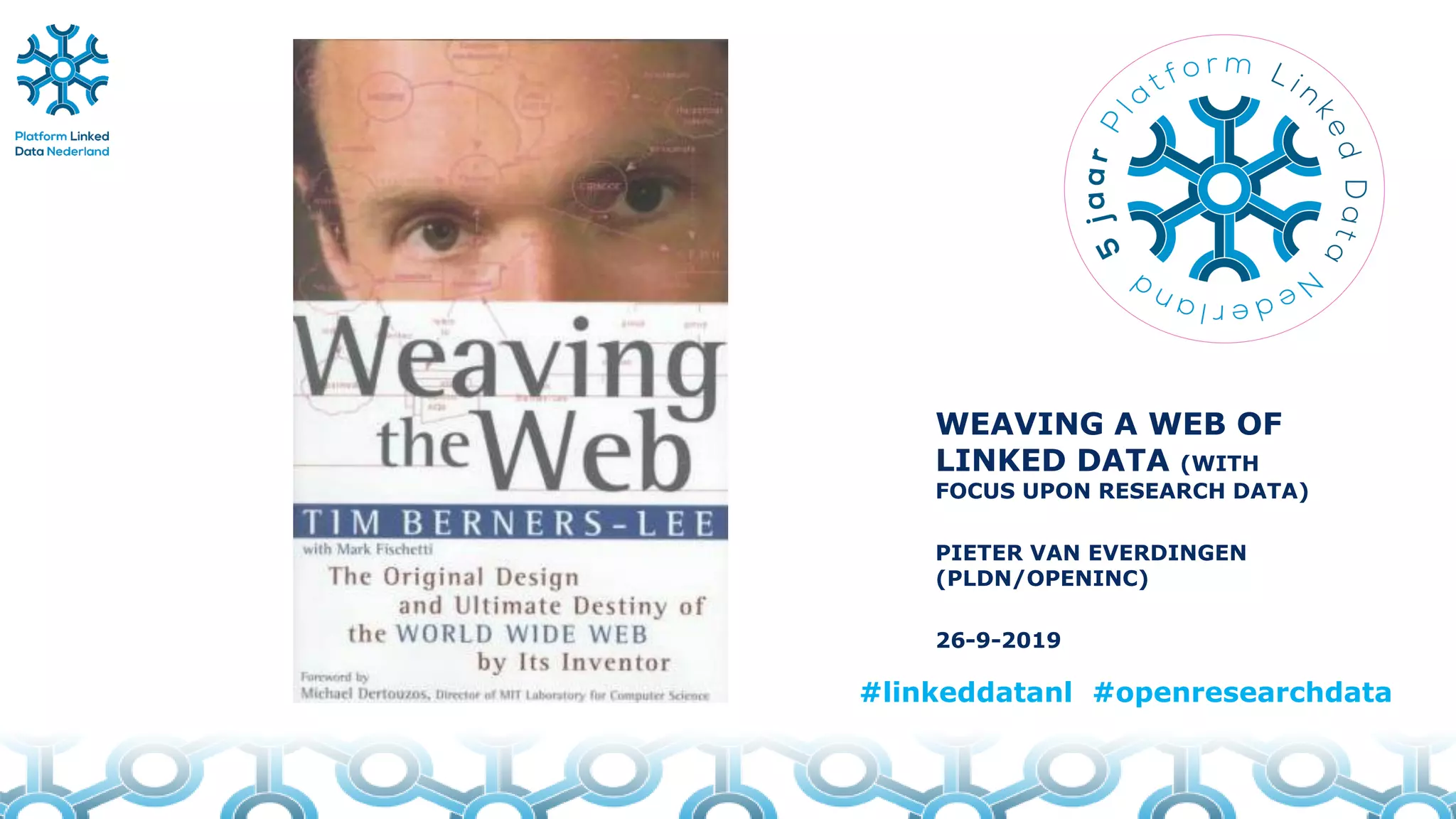
WEAVING A WEB OF
LINKED DATA (WITH
FOCUS UPON RESEARCH DATA)
PIETER VAN EVERDINGEN
(PLDN/OPENINC)
26-9-2019
#linkeddatanl #openresearchdata
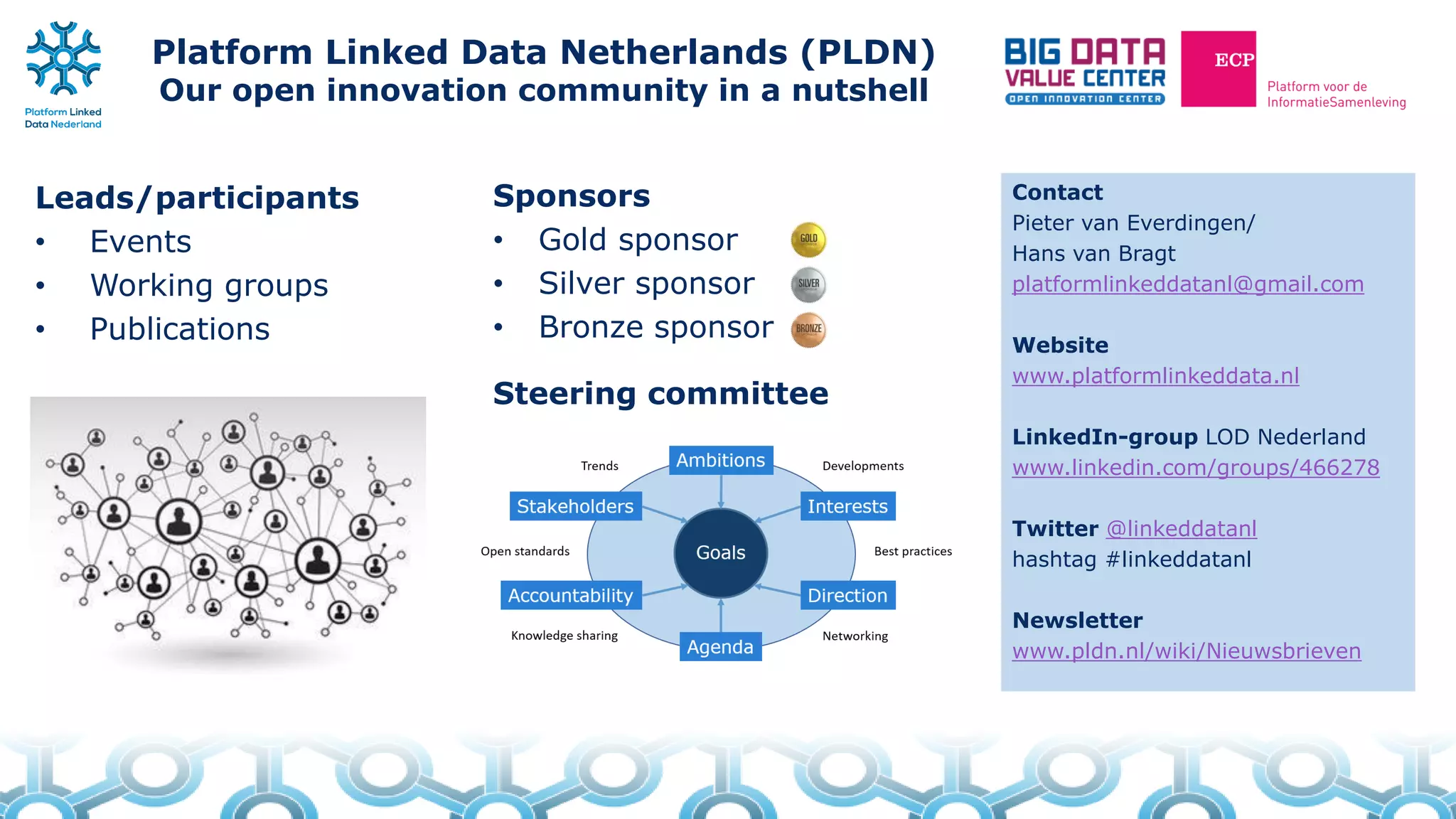
Platform Linked Data Netherlands (PLDN)
Our open innovation community in a nutshell
Leads/participants
• Events
• Working groups
• Publications
Sponsors
• Gold sponsor
• Silver sponsor
• Bronze sponsor
Steering committee
Contact
Pieter van Everdingen/
Hans van Bragt
platformlinkeddatanl@gmail.com
Website
www.platformlinkeddata.nl
LinkedIn-group LOD Nederland
www.linkedin.com/groups/466278
Twitter @linkeddatanl
hashtag #linkeddatanl
Newsletter
www.pldn.nl/wiki/Nieuwsbrieven
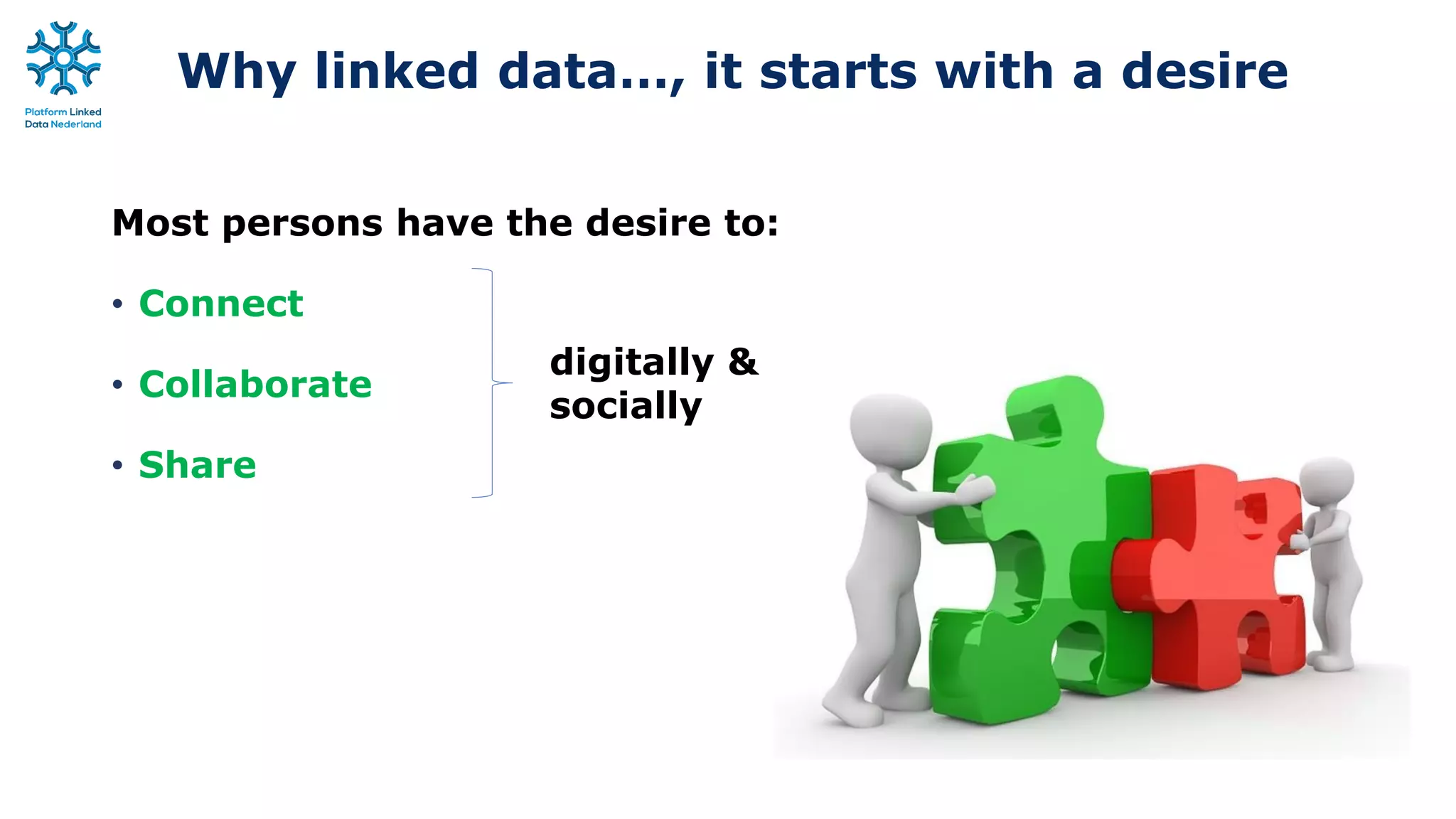
Why linked data…, it starts with a desire
Most persons have the desire to:
• Connect
• Collaborate
• Share
digitally &
socially
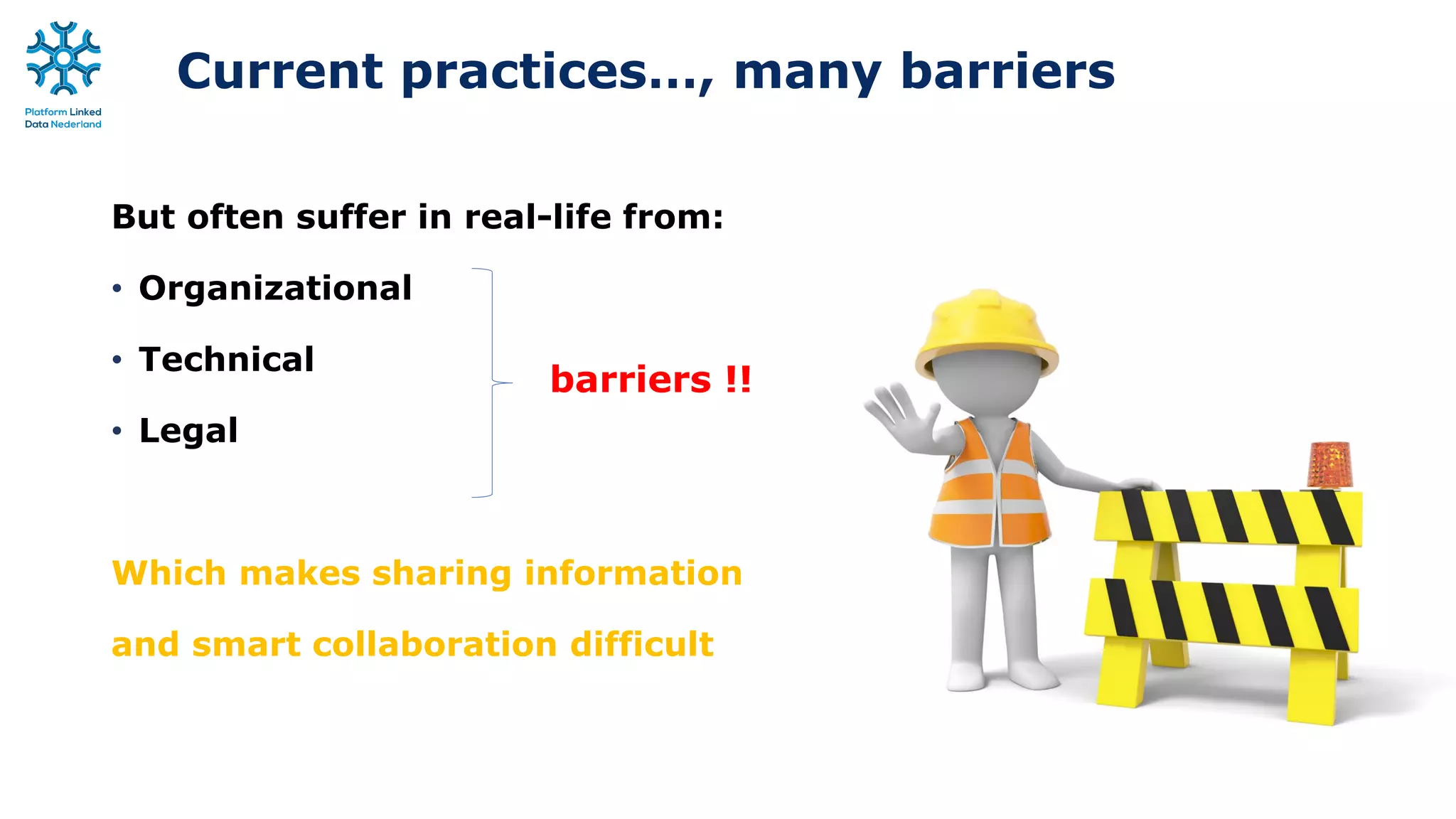
Current practices…, many barriers
But often suffer in real-life from:
• Organizational
• Technical
• Legal
Which makes sharing information
and smart collaboration difficult
barriers !!
Solution A…, traditional scenario’s
Drawbacks:
• Wide variety of data formats
• Many transfer protocols
• Rigid
• Expensive
• Many uncontrolled data copies
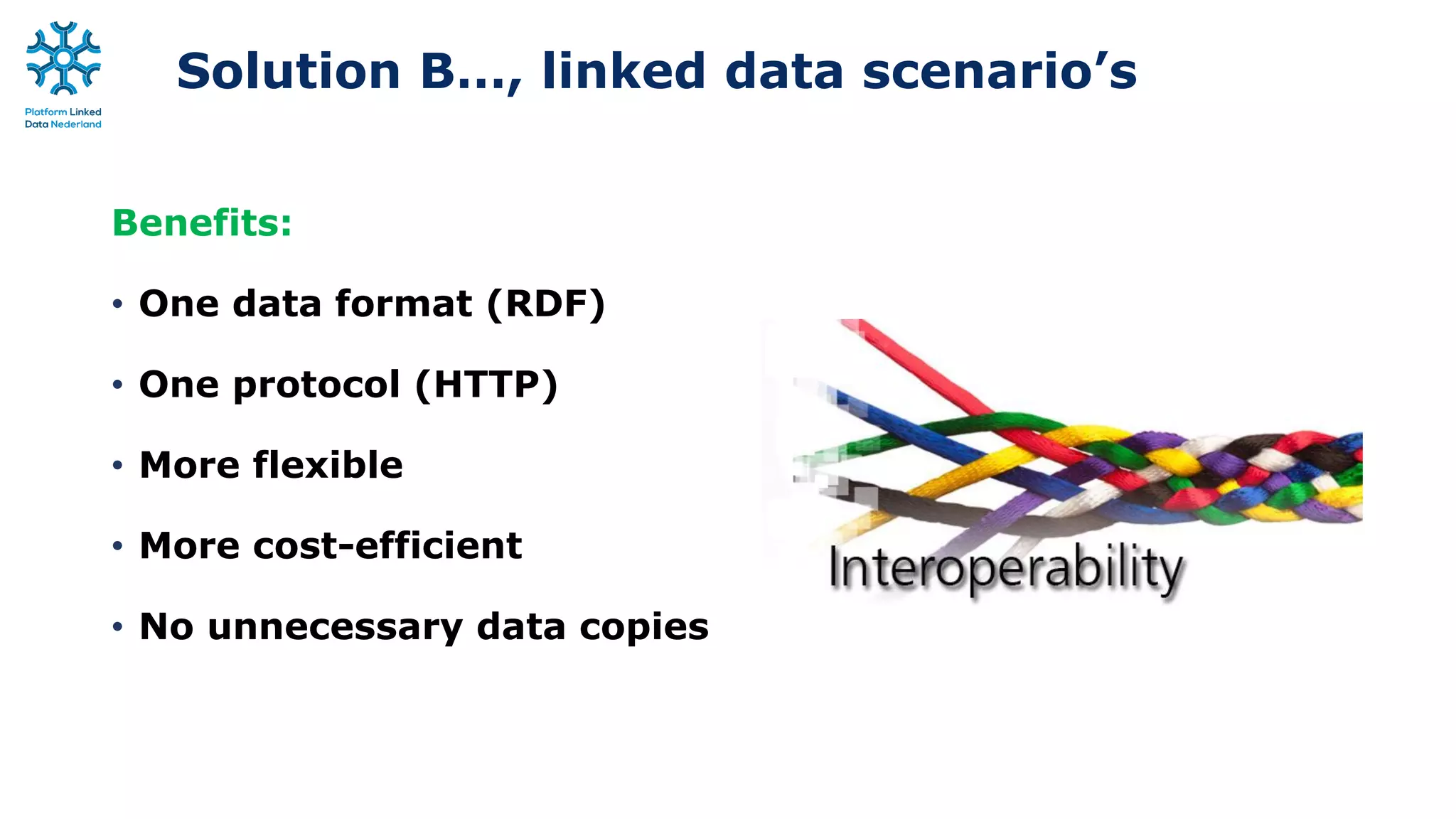
Solution B…, linked data scenario’s
Benefits:
• One data format (RDF)
• One protocol (HTTP)
• More flexible
• More cost-efficient
• No unnecessary data copies
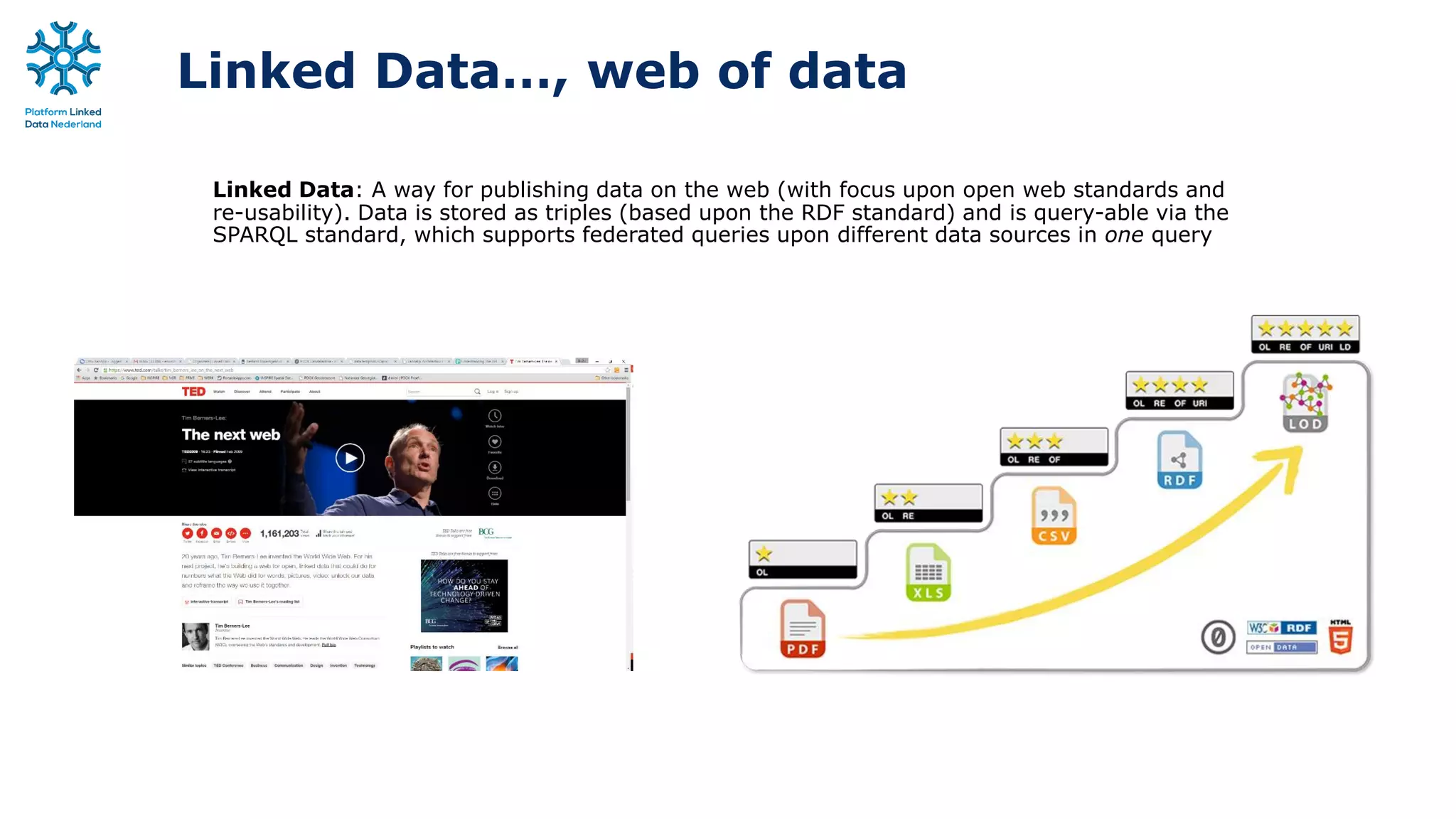
Linked Data: A way for publishing data on the web (with focus upon open web standards and
re-usability). Data is stored as triples (based upon the RDF standard) and is query-able via the
SPARQL standard, which supports federated queries upon different data sources in one query
Linked Data…, web of data
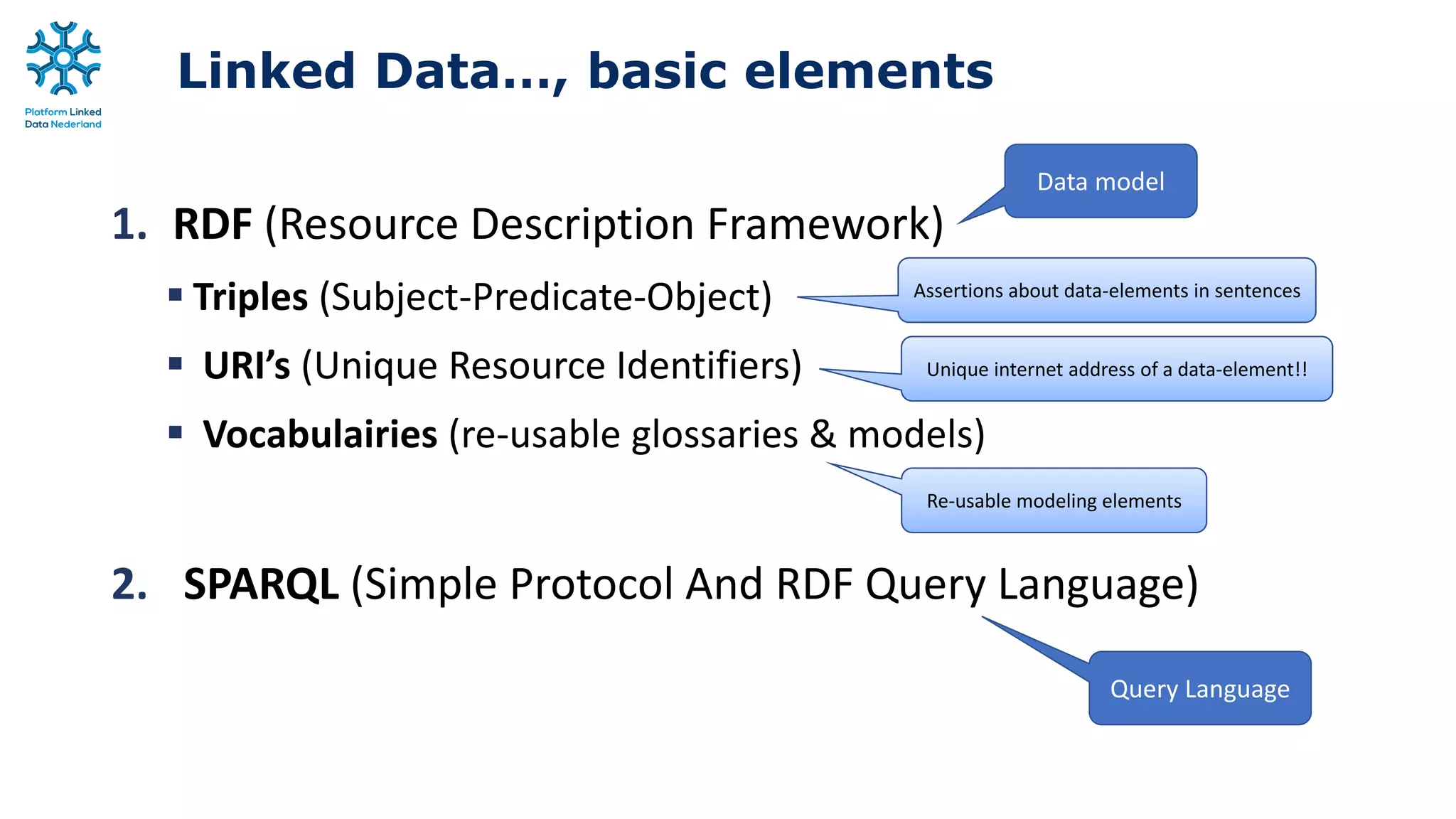
Linked Data…, basic elements
1. RDF (Resource Description Framework)
▪ Triples (Subject-Predicate-Object)
▪ URI’s (Unique Resource Identifiers)
▪ Vocabulairies (re-usable glossaries & models)
2. SPARQL (Simple Protocol And RDF Query Language)
Data model
Query Language
Unique internet address of a data-element!!
Assertions about data-elements in sentences
Re-usable modeling elements
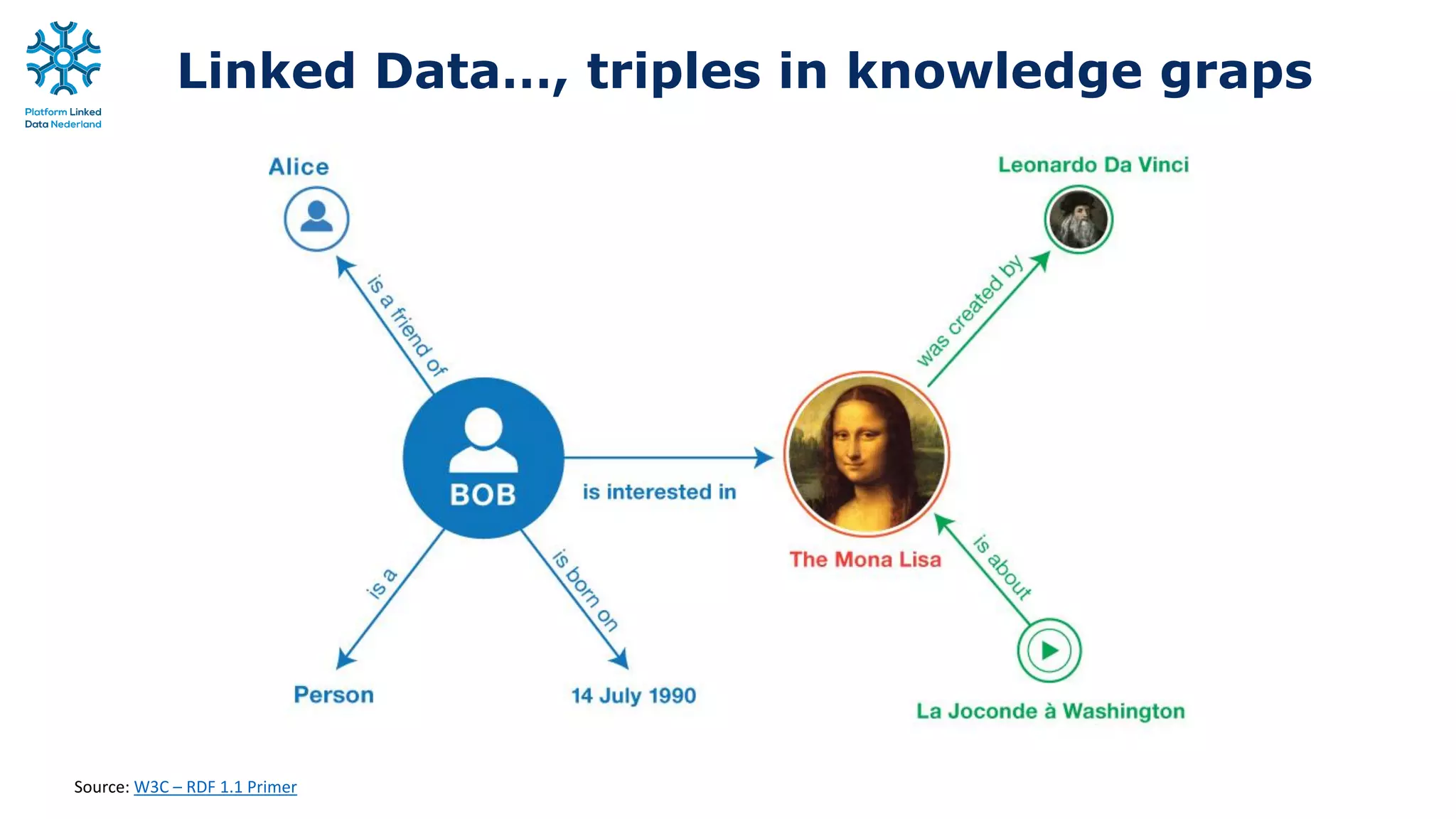
Source: W3C – RDF 1.1 Primer
Linked Data…, triples in knowledge graps
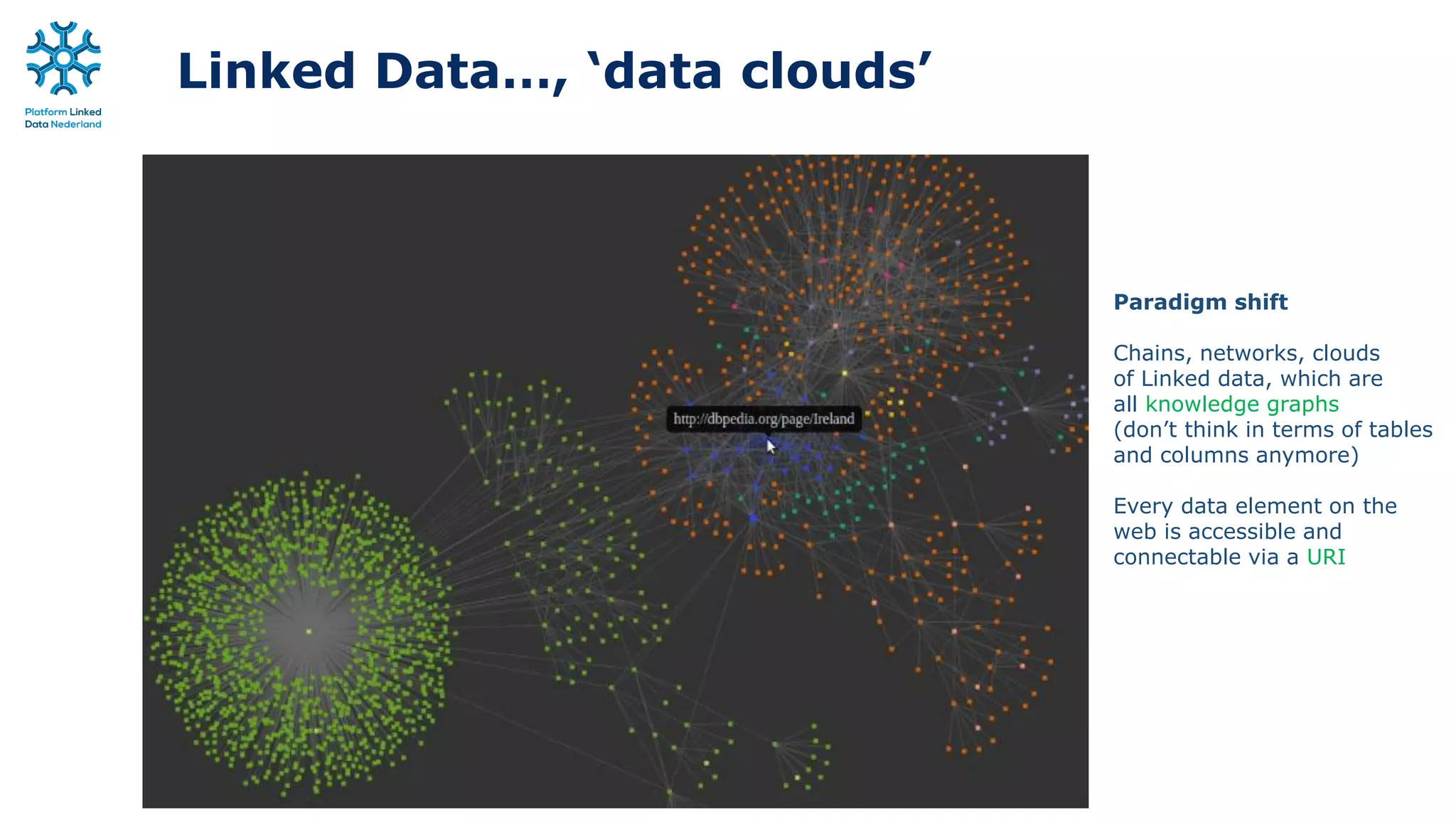
Linked Data…, ‘data clouds’
Paradigm shift
Chains, networks, clouds
of Linked data, which are
all knowledge graphs
(don’t think in terms of tables
and columns anymore)
Every data element on the
web is accessible and
connectable via a URI
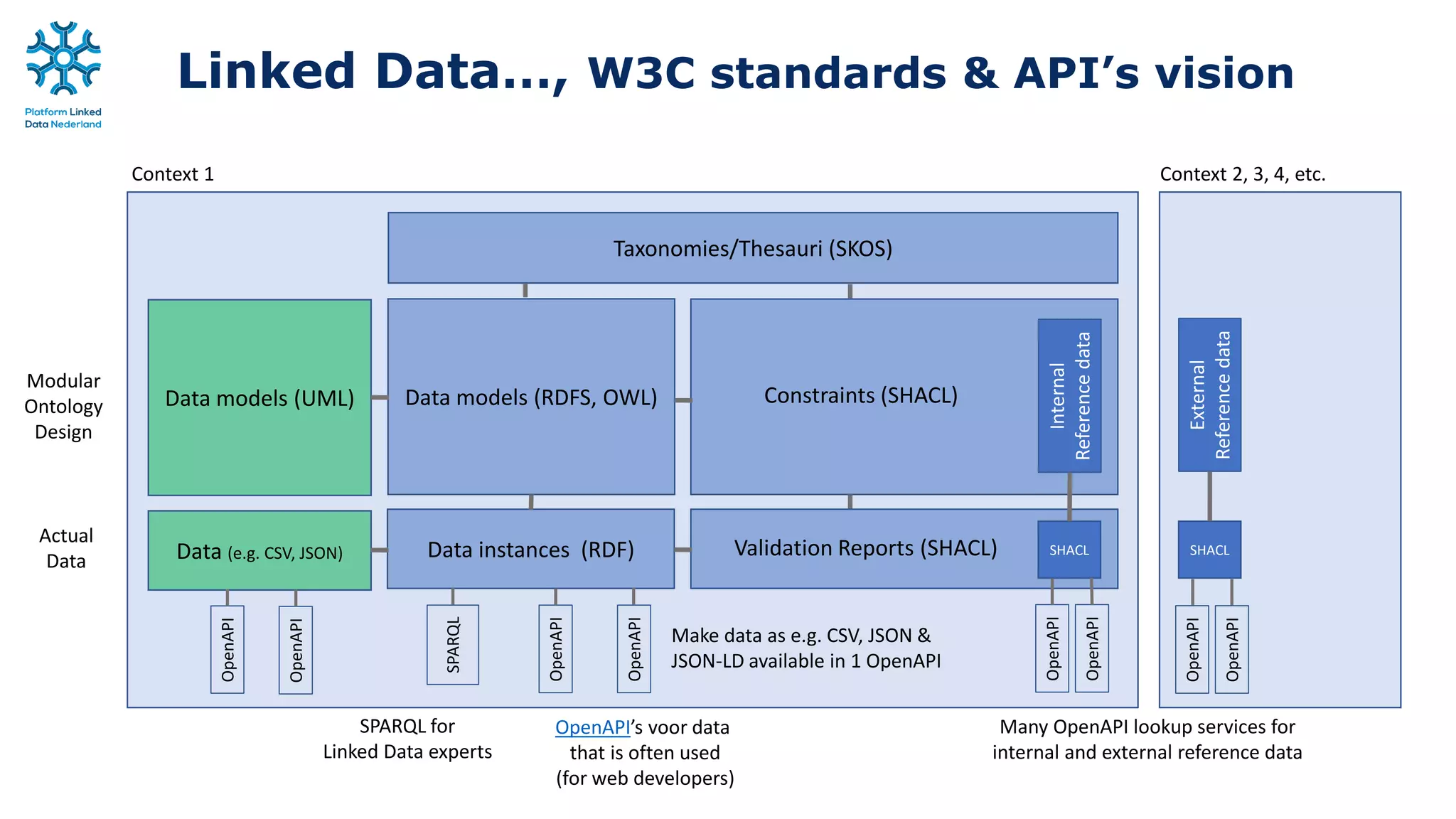
Linked Data…, W3C standards & API’s vision
Modular
Ontology
Design
Context 1 Context 2, 3, 4, etc.
Many OpenAPI lookup services for
internal and external reference data
External
Referencedata
Taxonomies/Thesauri (SKOS)
Data models (RDFS, OWL)
Internal
Referencedata
Data instances (RDF)
OpenAPI
OpenAPI
OpenAPI
OpenAPI
SHACL SHACL
Make data as e.g. CSV, JSON &
JSON-LD available in 1 OpenAPI
Constraints (SHACL)
Validation Reports (SHACL)
Data models (UML)
Data (e.g. CSV, JSON)
Actual
Data
OpenAPI’s voor data
that is often used
(for web developers)
OpenAPI
OpenAPI
SPARQL
OpenAPI
OpenAPI
SPARQL for
Linked Data experts
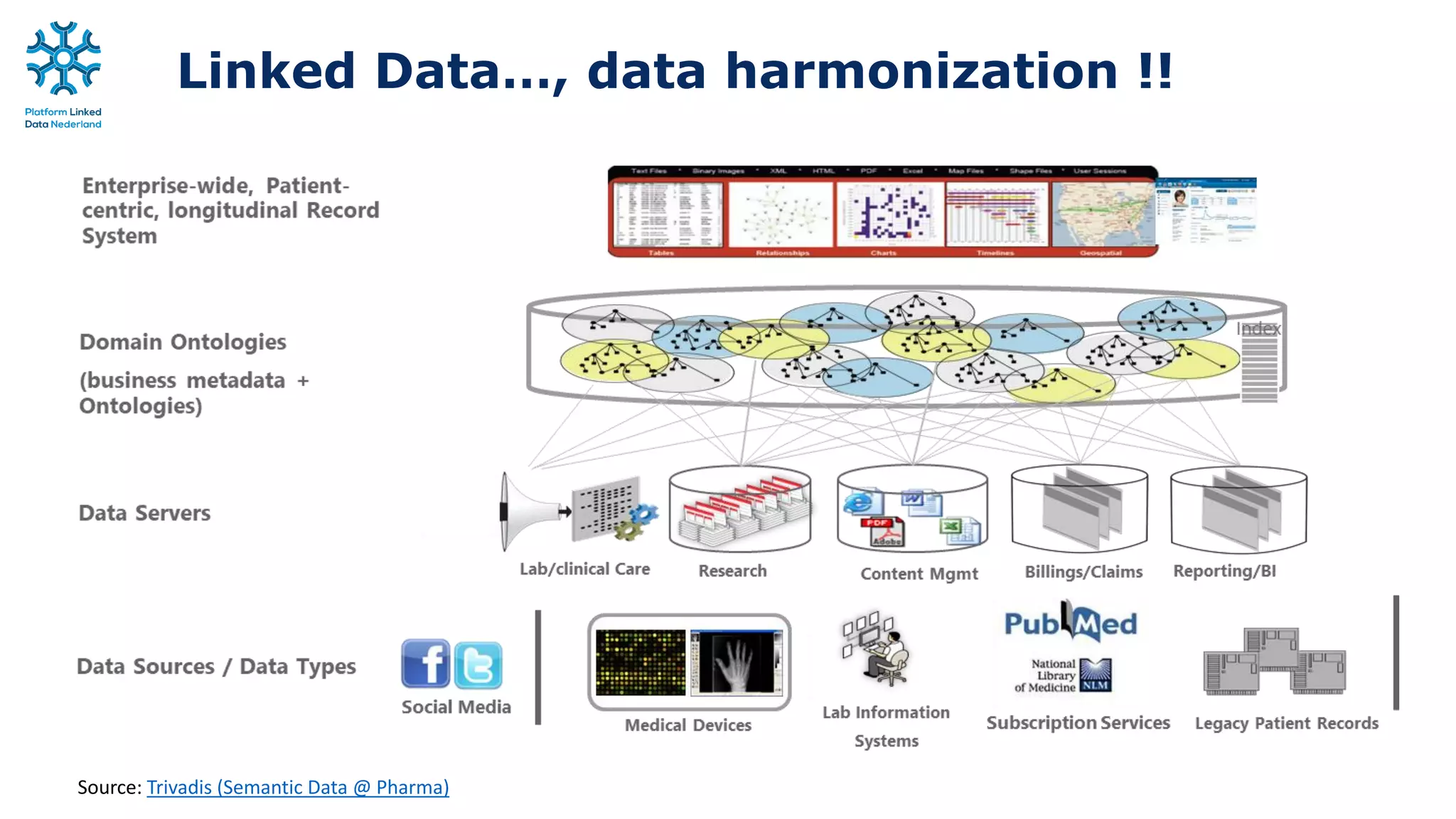
Linked Data…, data harmonization !!
Source: Trivadis (Semantic Data @ Pharma)
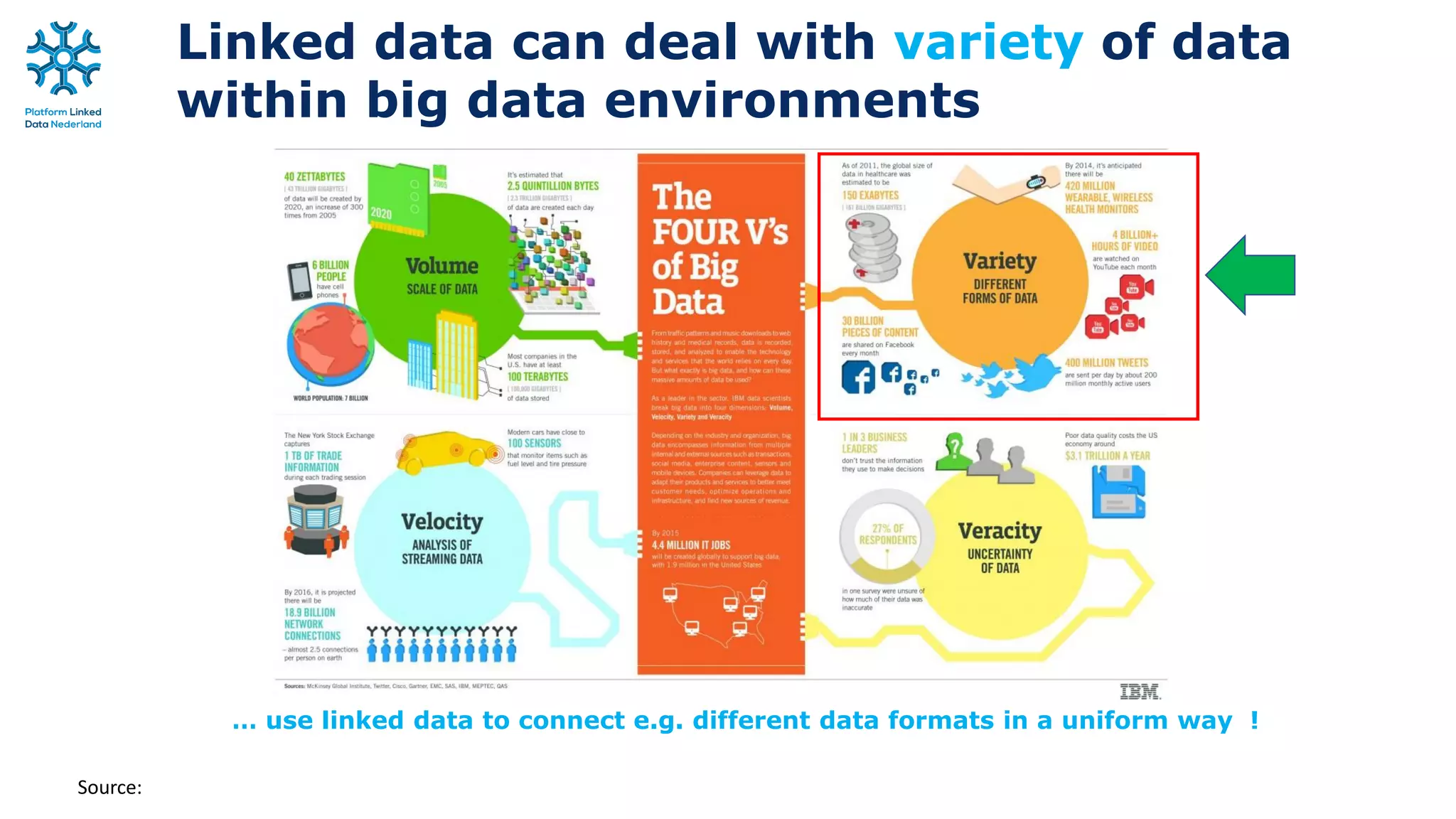
Linked data can deal with variety of data
within big data environments
… use linked data to connect e.g. different data formats in a uniform way !
Source:
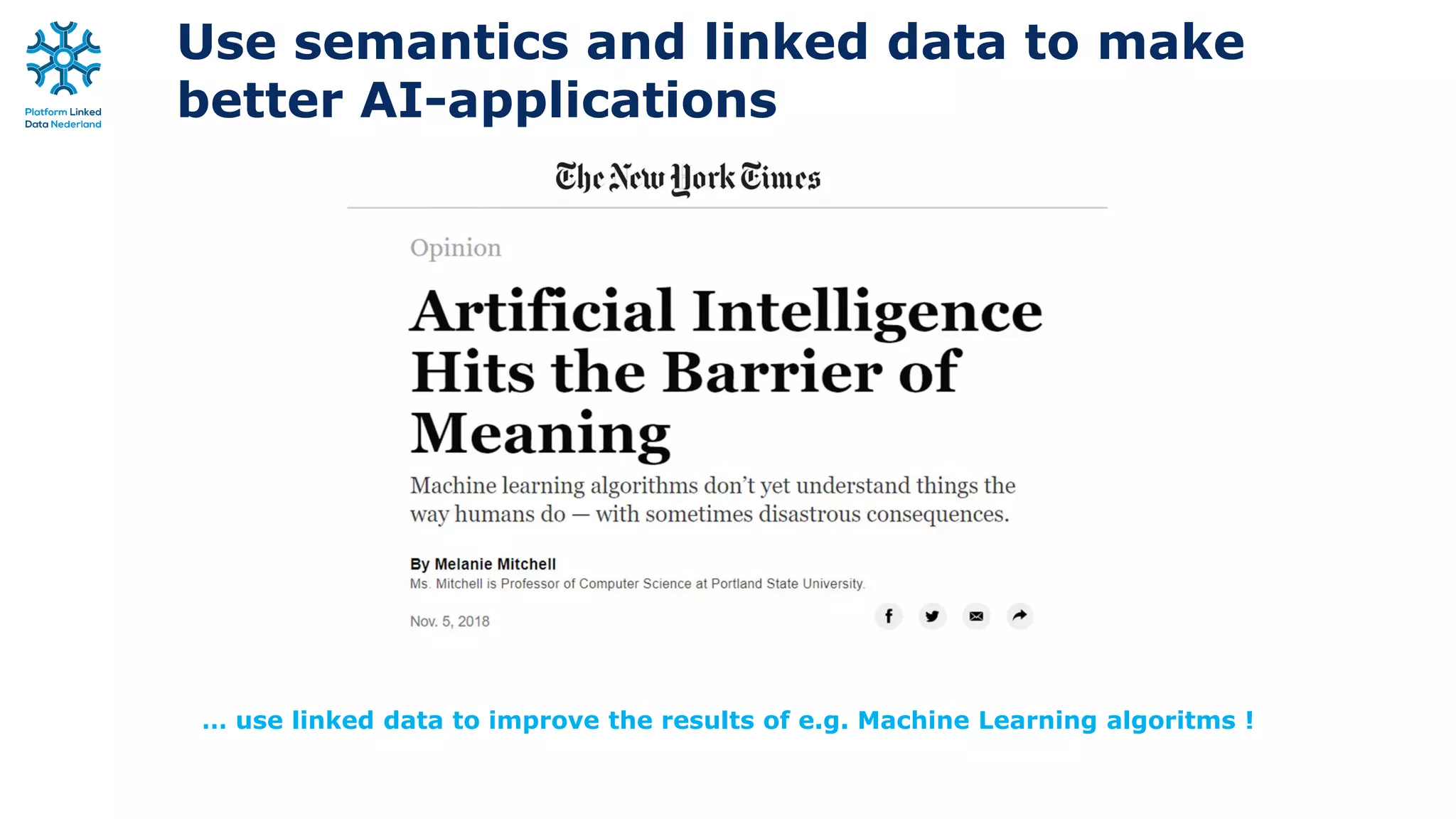
Use semantics and linked data to make
better AI-applications
… use linked data to improve the results of e.g. Machine Learning algoritms !
FAIR has similar ambitions as linked data
Principles to make data and services:
• Findable
• Accessible
• Interoperable
• Re-usable https://www.go-fair.org/fair-principles/
… use linked data to prevent us from working with unnecessary data copies !
But FAIR does not prescribe linked data
Mons [1] warns that “FAIR is not equal to RDF, Linked Data, or the
Semantic Web [...] and FAIR Principles explicitly do not prescribe the
use of RDF or any other Semantic Web framework or technology”, the
reality is that some of the most relevant advances in the field of health
are occurring in or are related to these technologies. Indeed, the
biopharmaceutical industry perceives as a technical barrier to the
implementation of FAIR principles the lack of agreement for the
representation of data in a common way and the agreement on
standards, for example, ontologies [11].
Source: FAIR4Health - D2.3. Guidelines for implementing FAIR open data policy in health research (PDF)
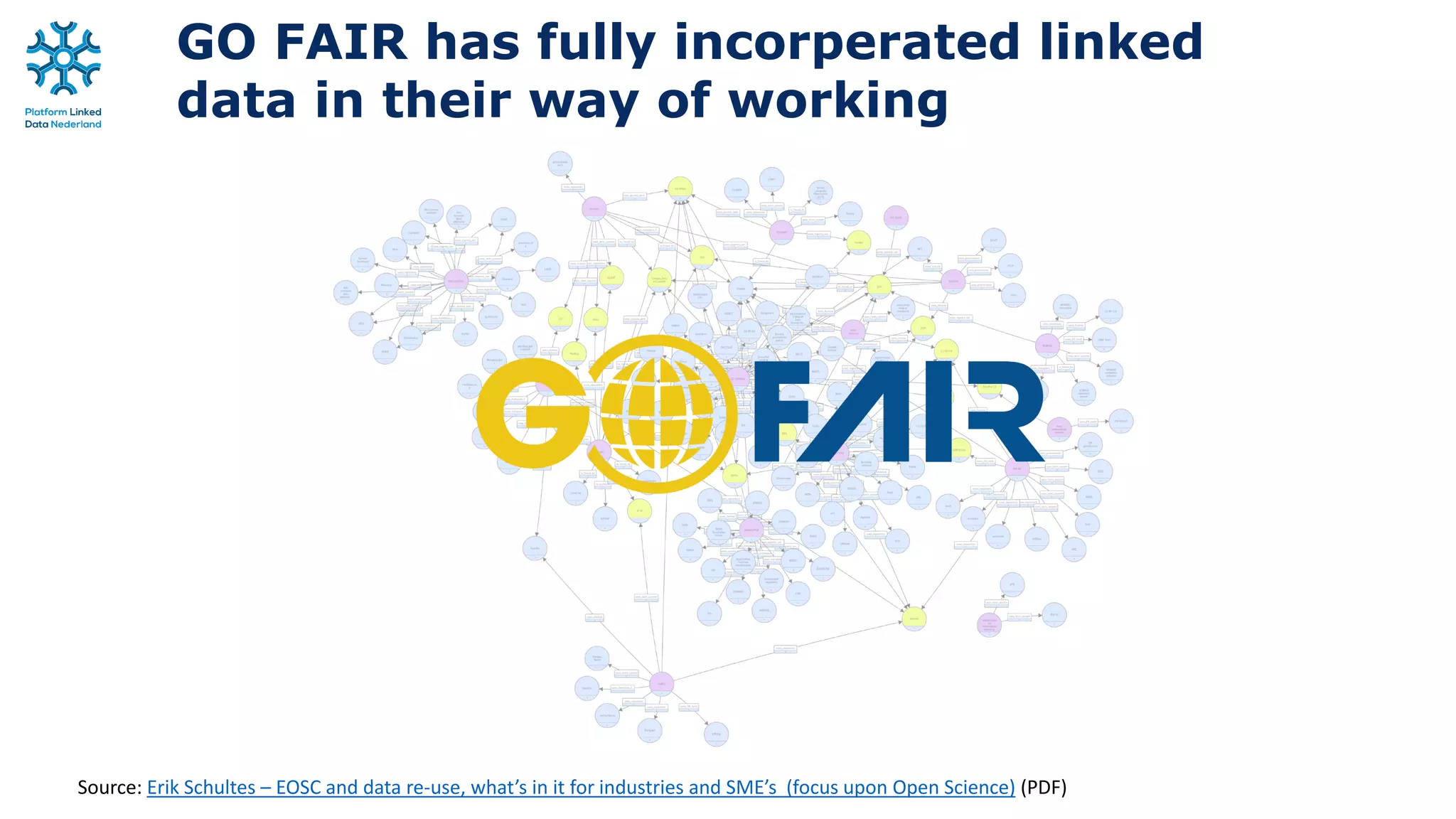
GO FAIR has fully incorperated linked
data in their way of working
Source: Erik Schultes – EOSC and data re-use, what’s in it for industries and SME’s (focus upon Open Science) (PDF)
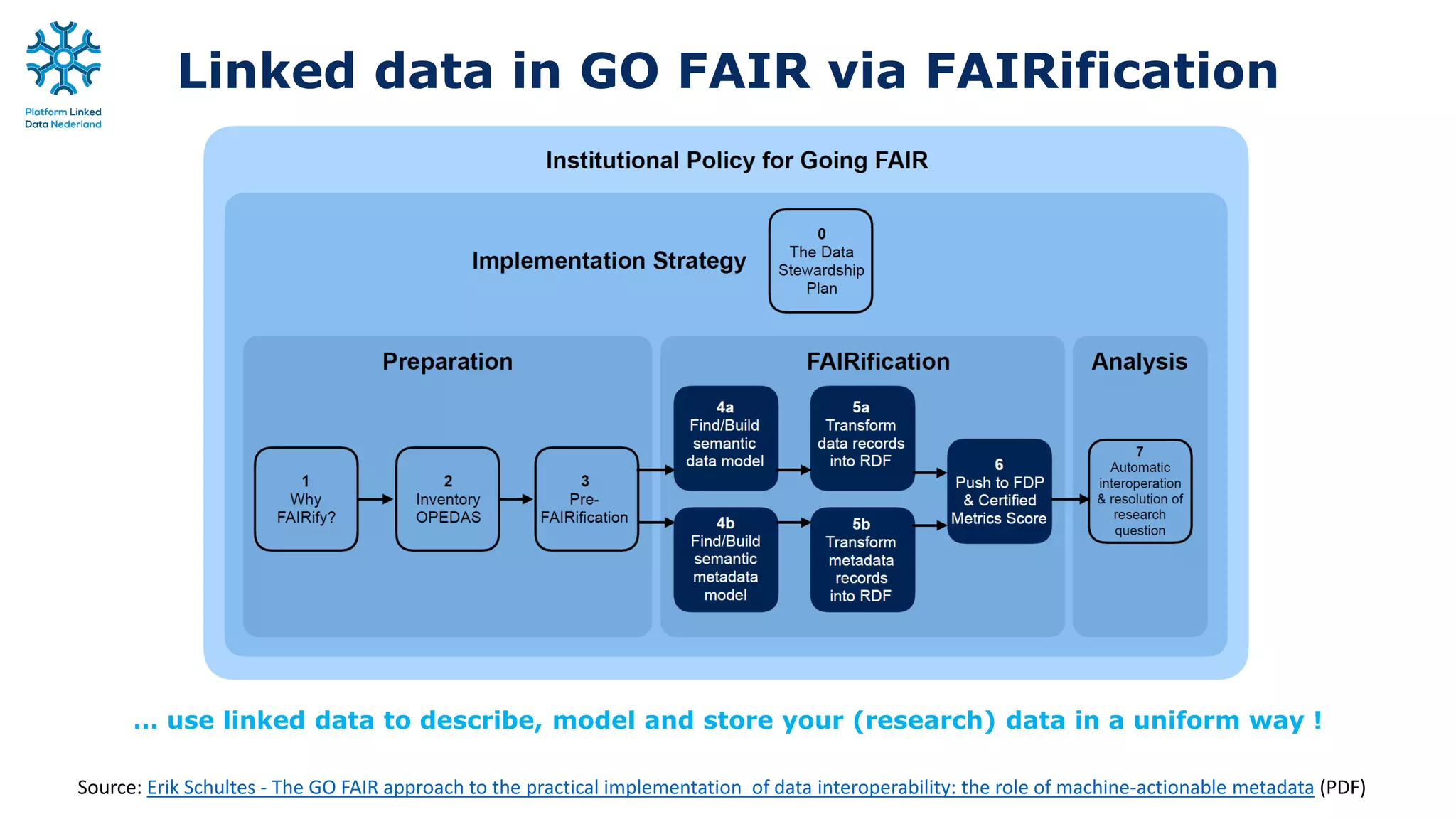
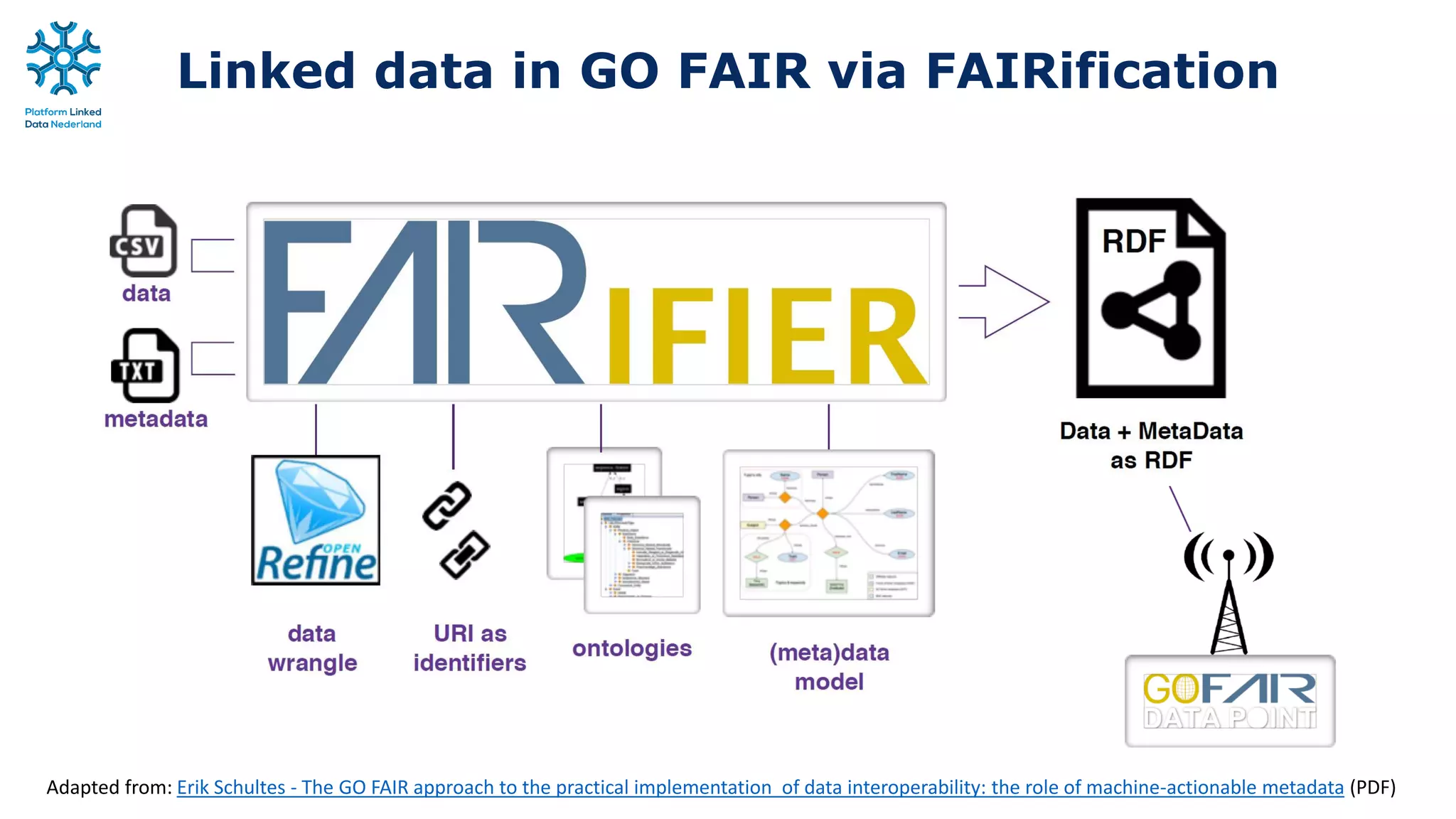
Linked data in GO FAIR via FAIRification
… use linked data to describe, model and store your (research) data in a uniform way !
Source: Erik Schultes - The GO FAIR approach to the practical implementation of data interoperability: the role of machine-actionable metadata (PDF)
Linked data in GO FAIR via FAIRification
Adapted from: Erik Schultes - The GO FAIR approach to the practical implementation of data interoperability: the role of machine-actionable metadata (PDF)
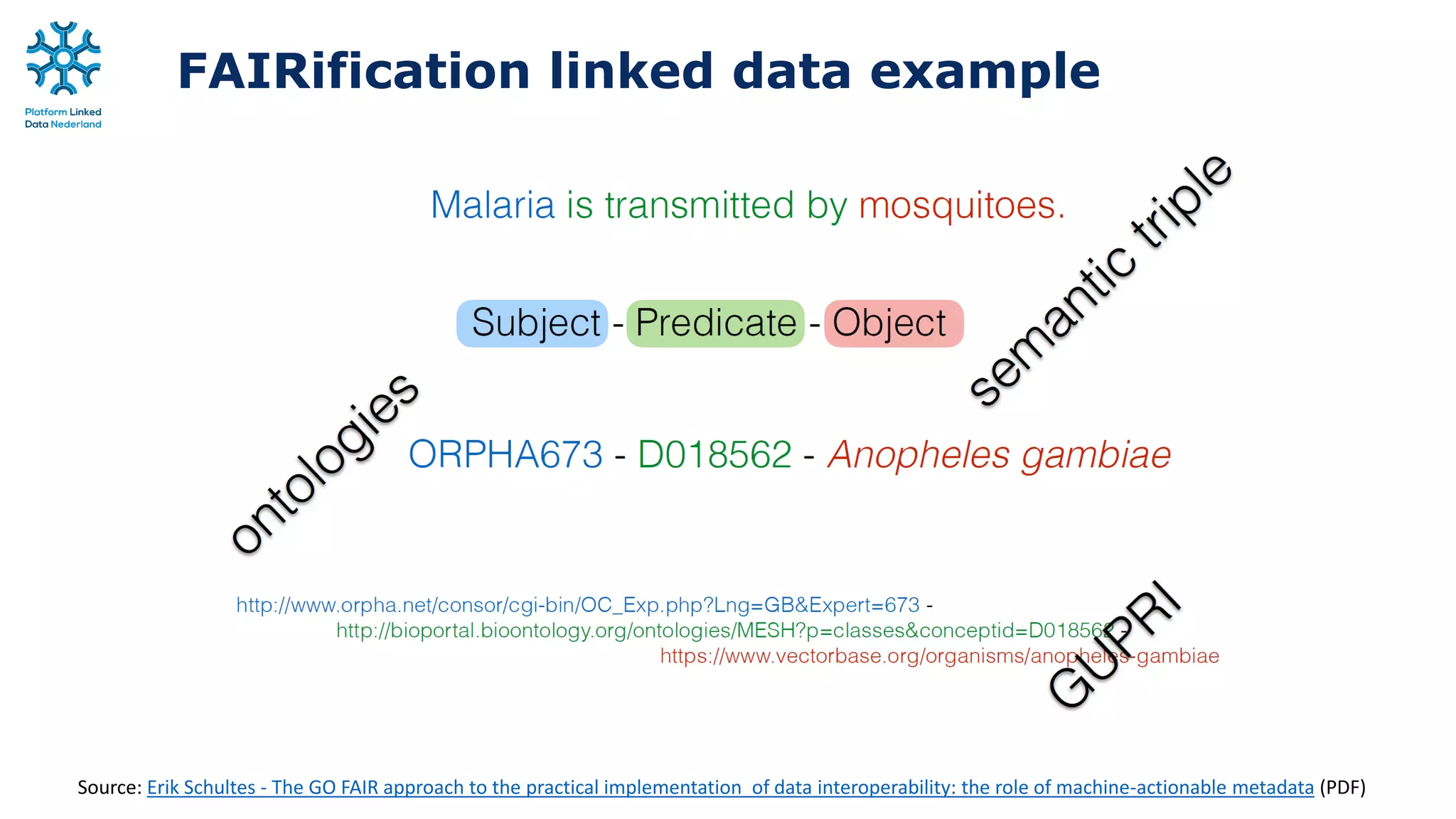
FAIRification linked data example
Source: Erik Schultes - The GO FAIR approach to the practical implementation of data interoperability: the role of machine-actionable metadata (PDF)
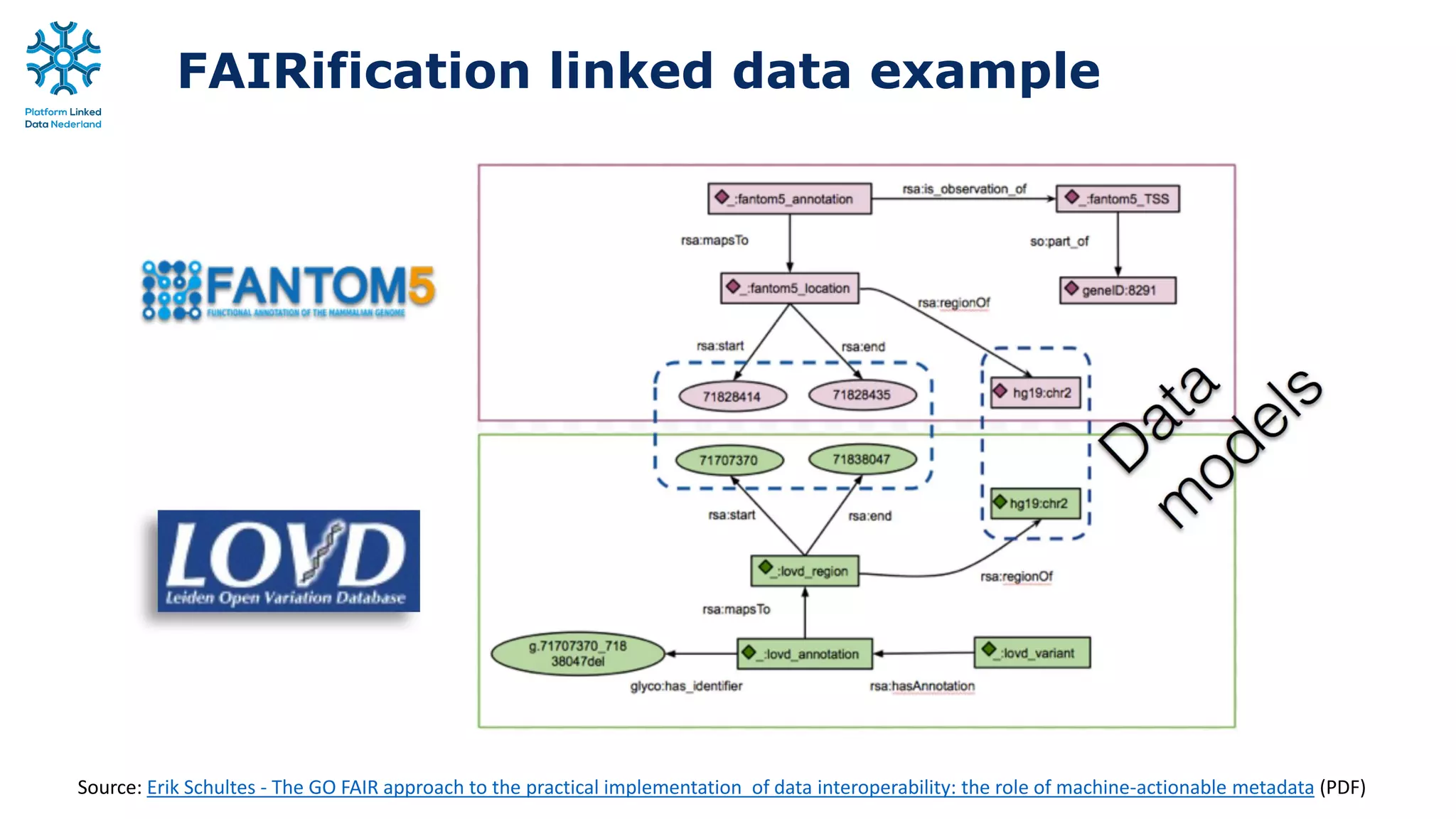
FAIRification linked data example
Source: Erik Schultes - The GO FAIR approach to the practical implementation of data interoperability: the role of machine-actionable metadata (PDF)
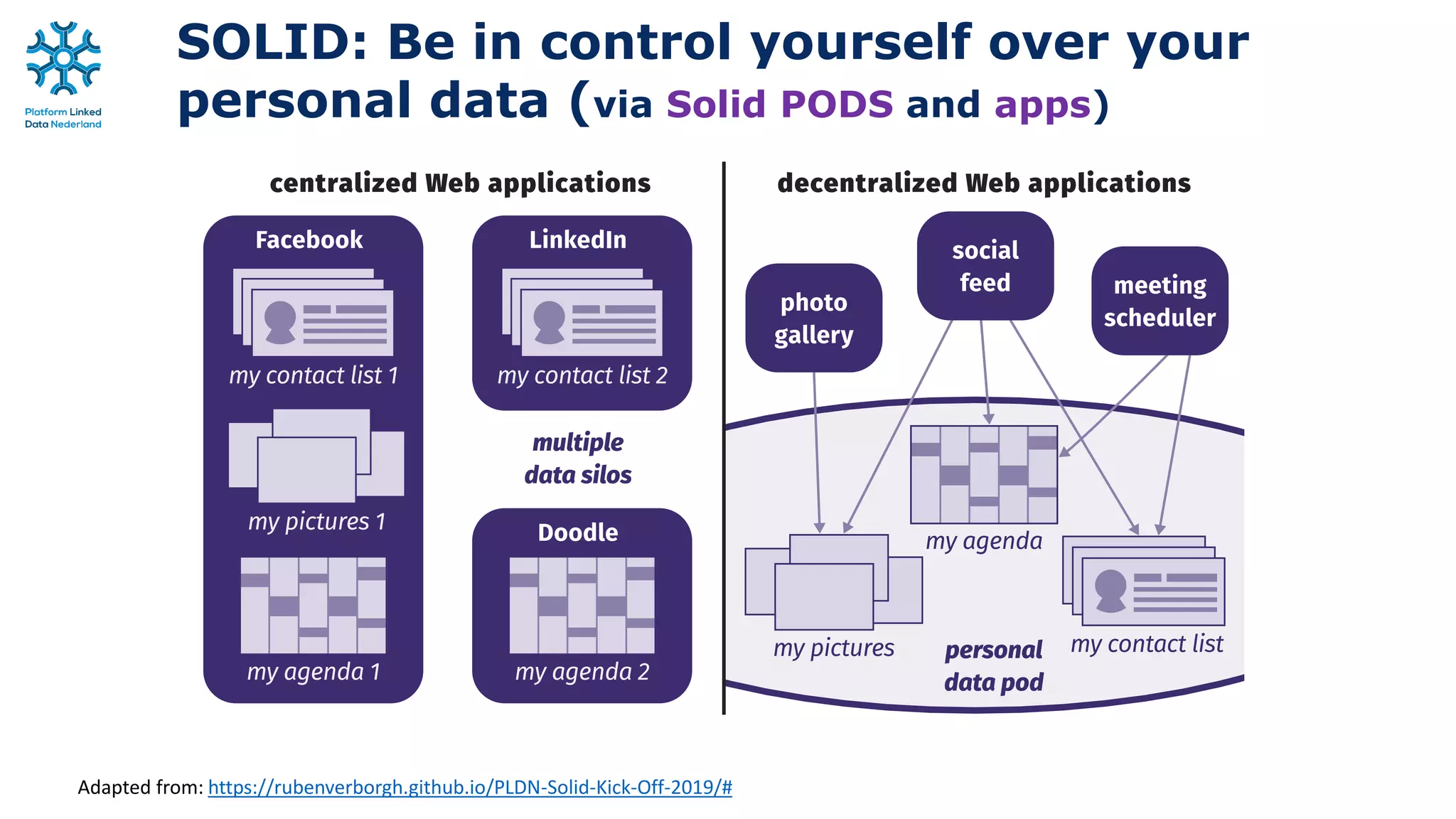
SOLID: Be in control yourself over your
personal data (via Solid PODS and apps)
Adapted from: https://rubenverborgh.github.io/PLDN-Solid-Kick-Off-2019/#
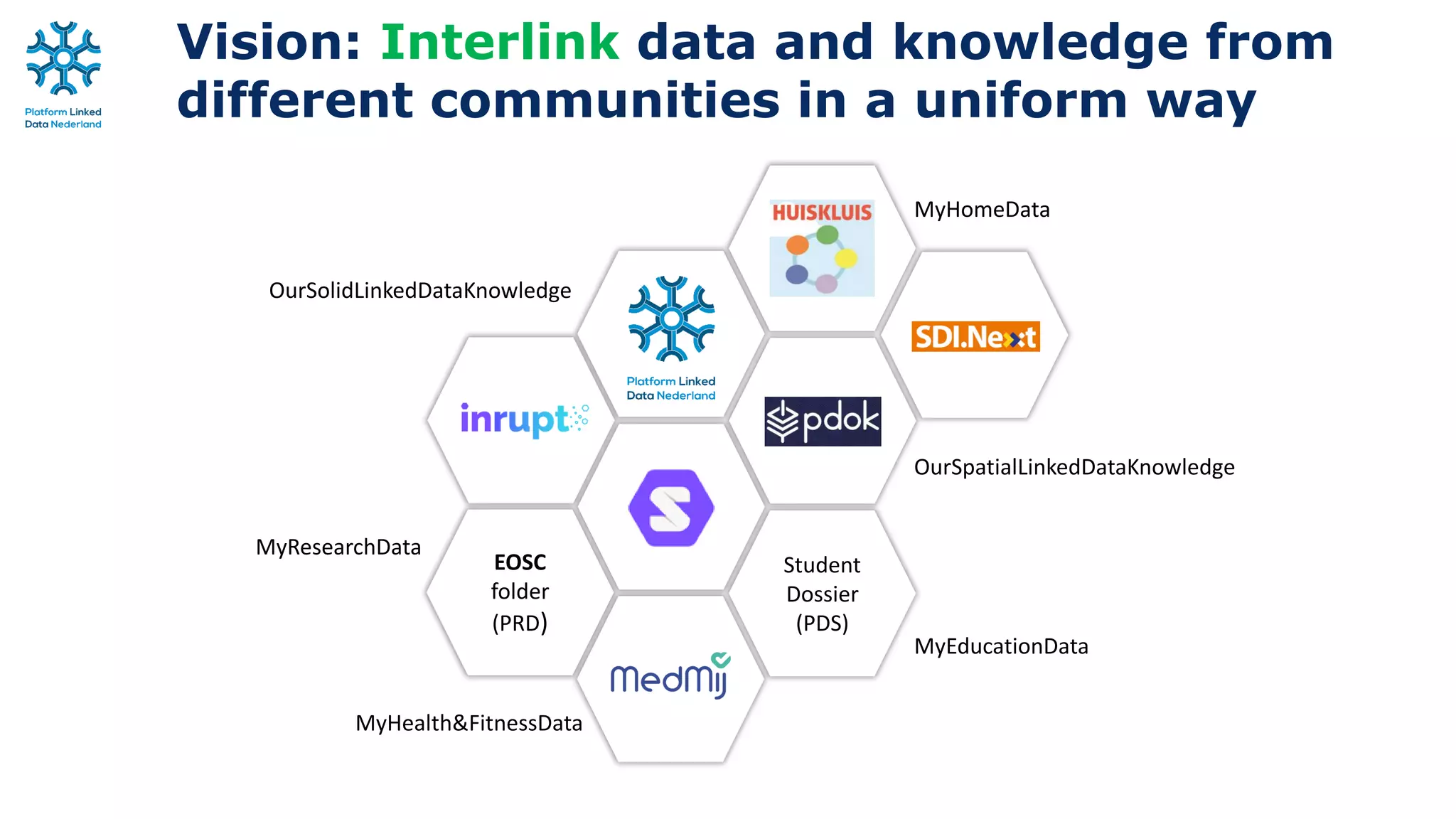
Vision: Interlink data and knowledge from
different communities in a uniform way
Student
Dossier
(PDS)
EOSC
folder
(PRD)
MyResearchData
MyHealth&FitnessData
MyEducationData
MyHomeData
OurSolidLinkedDataKnowledge
OurSpatialLinkedDataKnowledge
Data model & metadata alignment
Data model alignment via:
• Metadata schemas?
• Metadata templates?
• Metadata shapes?
• …?
… use interoperable metadata shapes to make your (research) data more re-usable !
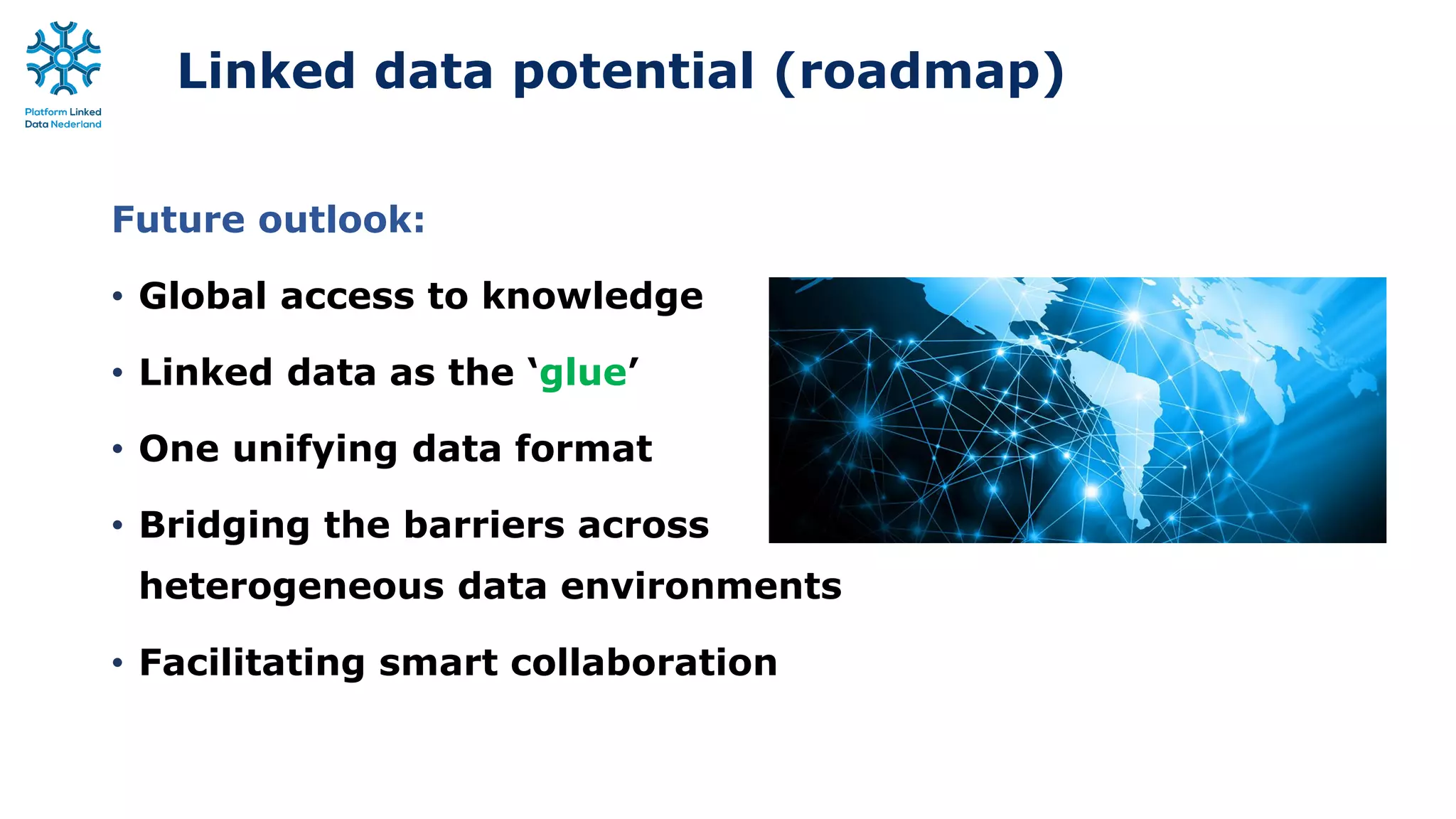
Linked data potential (roadmap)
Future outlook:
• Global access to knowledge
• Linked data as the ‘glue’
• One unifying data format
• Bridging the barriers across
heterogeneous data environments
• Facilitating smart collaboration
QUESTIONS?
Contact
Pieter van Everdingen
(platformlinkeddatanl@gmail.com)
Hans van Bragt
(hans.vanbragt@bdvc.nl)
Website
www.platformlinkeddata.nl
LinkedIn-group LOD Nederland
www.linkedin.com/groups/466278
Twitter @linkeddatanl
hashtag #linkeddatanl
Newsletter
www.pldn.nl/wiki/Nieuwsbrieven
PLDN communication channels

Weaving a Web of Linked Data - September 26th, 2019

  • 1.
    WEAVING A WEBOF LINKED DATA (WITH FOCUS UPON RESEARCH DATA) PIETER VAN EVERDINGEN (PLDN/OPENINC) 26-9-2019 #linkeddatanl #openresearchdata
  • 2.
    Platform Linked DataNetherlands (PLDN) Our open innovation community in a nutshell Leads/participants • Events • Working groups • Publications Sponsors • Gold sponsor • Silver sponsor • Bronze sponsor Steering committee Contact Pieter van Everdingen/ Hans van Bragt platformlinkeddatanl@gmail.com Website www.platformlinkeddata.nl LinkedIn-group LOD Nederland www.linkedin.com/groups/466278 Twitter @linkeddatanl hashtag #linkeddatanl Newsletter www.pldn.nl/wiki/Nieuwsbrieven
  • 3.
    Why linked data…,it starts with a desire Most persons have the desire to: • Connect • Collaborate • Share digitally & socially
  • 4.
    Current practices…, manybarriers But often suffer in real-life from: • Organizational • Technical • Legal Which makes sharing information and smart collaboration difficult barriers !!
  • 5.
    Solution A…, traditionalscenario’s Drawbacks: • Wide variety of data formats • Many transfer protocols • Rigid • Expensive • Many uncontrolled data copies
  • 6.
    Solution B…, linkeddata scenario’s Benefits: • One data format (RDF) • One protocol (HTTP) • More flexible • More cost-efficient • No unnecessary data copies
  • 7.
    Linked Data: Away for publishing data on the web (with focus upon open web standards and re-usability). Data is stored as triples (based upon the RDF standard) and is query-able via the SPARQL standard, which supports federated queries upon different data sources in one query Linked Data…, web of data
  • 8.
    Linked Data…, basicelements 1. RDF (Resource Description Framework) ▪ Triples (Subject-Predicate-Object) ▪ URI’s (Unique Resource Identifiers) ▪ Vocabulairies (re-usable glossaries & models) 2. SPARQL (Simple Protocol And RDF Query Language) Data model Query Language Unique internet address of a data-element!! Assertions about data-elements in sentences Re-usable modeling elements
  • 9.
    Source: W3C –RDF 1.1 Primer Linked Data…, triples in knowledge graps
  • 10.
    Linked Data…, ‘dataclouds’ Paradigm shift Chains, networks, clouds of Linked data, which are all knowledge graphs (don’t think in terms of tables and columns anymore) Every data element on the web is accessible and connectable via a URI
  • 11.
    Linked Data…, W3Cstandards & API’s vision Modular Ontology Design Context 1 Context 2, 3, 4, etc. Many OpenAPI lookup services for internal and external reference data External Referencedata Taxonomies/Thesauri (SKOS) Data models (RDFS, OWL) Internal Referencedata Data instances (RDF) OpenAPI OpenAPI OpenAPI OpenAPI SHACL SHACL Make data as e.g. CSV, JSON & JSON-LD available in 1 OpenAPI Constraints (SHACL) Validation Reports (SHACL) Data models (UML) Data (e.g. CSV, JSON) Actual Data OpenAPI’s voor data that is often used (for web developers) OpenAPI OpenAPI SPARQL OpenAPI OpenAPI SPARQL for Linked Data experts
  • 12.
    Linked Data…, dataharmonization !! Source: Trivadis (Semantic Data @ Pharma)
  • 13.
    Linked data candeal with variety of data within big data environments … use linked data to connect e.g. different data formats in a uniform way ! Source:
  • 14.
    Use semantics andlinked data to make better AI-applications … use linked data to improve the results of e.g. Machine Learning algoritms !
  • 15.
    FAIR has similarambitions as linked data Principles to make data and services: • Findable • Accessible • Interoperable • Re-usable https://www.go-fair.org/fair-principles/ … use linked data to prevent us from working with unnecessary data copies !
  • 16.
    But FAIR doesnot prescribe linked data Mons [1] warns that “FAIR is not equal to RDF, Linked Data, or the Semantic Web [...] and FAIR Principles explicitly do not prescribe the use of RDF or any other Semantic Web framework or technology”, the reality is that some of the most relevant advances in the field of health are occurring in or are related to these technologies. Indeed, the biopharmaceutical industry perceives as a technical barrier to the implementation of FAIR principles the lack of agreement for the representation of data in a common way and the agreement on standards, for example, ontologies [11]. Source: FAIR4Health - D2.3. Guidelines for implementing FAIR open data policy in health research (PDF)
  • 17.
    GO FAIR hasfully incorperated linked data in their way of working Source: Erik Schultes – EOSC and data re-use, what’s in it for industries and SME’s (focus upon Open Science) (PDF)
  • 18.
    Linked data inGO FAIR via FAIRification … use linked data to describe, model and store your (research) data in a uniform way ! Source: Erik Schultes - The GO FAIR approach to the practical implementation of data interoperability: the role of machine-actionable metadata (PDF)
  • 19.
    Linked data inGO FAIR via FAIRification Adapted from: Erik Schultes - The GO FAIR approach to the practical implementation of data interoperability: the role of machine-actionable metadata (PDF)
  • 20.
    FAIRification linked dataexample Source: Erik Schultes - The GO FAIR approach to the practical implementation of data interoperability: the role of machine-actionable metadata (PDF)
  • 21.
    FAIRification linked dataexample Source: Erik Schultes - The GO FAIR approach to the practical implementation of data interoperability: the role of machine-actionable metadata (PDF)
  • 22.
    SOLID: Be incontrol yourself over your personal data (via Solid PODS and apps) Adapted from: https://rubenverborgh.github.io/PLDN-Solid-Kick-Off-2019/#
  • 23.
    Vision: Interlink dataand knowledge from different communities in a uniform way Student Dossier (PDS) EOSC folder (PRD) MyResearchData MyHealth&FitnessData MyEducationData MyHomeData OurSolidLinkedDataKnowledge OurSpatialLinkedDataKnowledge
  • 24.
    Data model &metadata alignment Data model alignment via: • Metadata schemas? • Metadata templates? • Metadata shapes? • …? … use interoperable metadata shapes to make your (research) data more re-usable !
  • 25.
    Linked data potential(roadmap) Future outlook: • Global access to knowledge • Linked data as the ‘glue’ • One unifying data format • Bridging the barriers across heterogeneous data environments • Facilitating smart collaboration
  • 26.
  • 27.
    Contact Pieter van Everdingen (platformlinkeddatanl@gmail.com) Hansvan Bragt (hans.vanbragt@bdvc.nl) Website www.platformlinkeddata.nl LinkedIn-group LOD Nederland www.linkedin.com/groups/466278 Twitter @linkeddatanl hashtag #linkeddatanl Newsletter www.pldn.nl/wiki/Nieuwsbrieven PLDN communication channels