I do not have enough context to fully answer those questions. My role is to summarize documents, not engage in philosophical or theoretical discussion. Please provide a specific document for me to summarize if you would like a response from me.
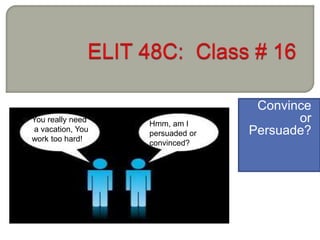
Strictly speaking,one convinces
a person that something is true
but persuades a person to do
something.
“Pointing out that I was overworked,
my friends persuaded [not convinced]
me to take a vacation.
Now that I'm relaxing on the beach
with my book, I am convinced [not
persuaded] that they were right.”
Read more: Easily Confused or Misused Words | Infoplease.com
http://www.infoplease.com/ipa/A0200807.html#ixzz2T7jurahi
Essay #1Questions?
Discussion: Applying African American
Criticism
Lecture
Am Lit since 1945
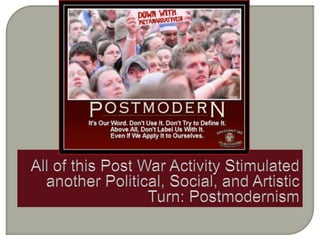
Postmodernism
Klages
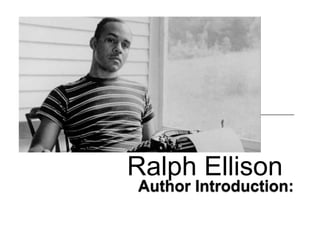
Author Introduction: Ralph Ellison
5.
Write aboutliterature in present tense
Avoid using “thing,” “something,” “everything,” and
“anything.”
Avoid writing in second person.
Avoid using contractions.
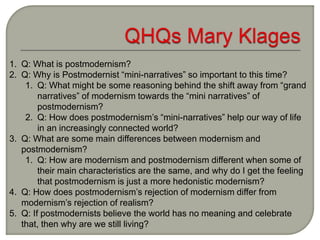
Cut Wordy Sentences
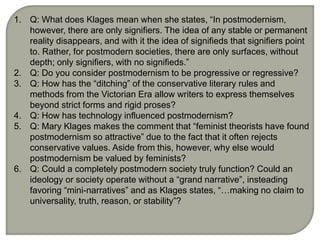
Avoid run-on sentences and fragments.
Check for misused words
Put commas and periods inside of quotation marks
6.
Does thepaper follow MLA guidelines?
For help, click on “MLA Guidelines” and view the “Basic
MLA format” video.
Is the page length within assigned limits?
Is the font type and size within the assigned guidelines?
Does the Header follow the assignment guidelines?
Is the professor's name spelled correctly? Kim Palmore
Is your name spelled correctly?
Does the paper have a title? Is it a good title? Is the title in
the appropriate location?
Have you italicized book and movie titles and put stories,
articles, and poems in quotation marks?
According to[…] Lois Tyson one of the major tenants of African-
American criticism is the idea of the “voice of color”, or the idea
that minority groups are better equipped to speak on matters
regarding oppression because white people have not been put in
the same compromising situations that minority groups have been
placed into. Such a concept reveals itself in Langston Hughes’
“The Negro Artist and the Racial Mountain”. In it, Hughes deplores
the Negro poet who wishes to shed the label of “negro” and exist
solely as a poet. Such a mindset may be asserted as a form of
enlightenment or racial colorblindness, but Hughes labels it as a
kind of betrayal. Rather than embracing the unique set of
circumstances that shaped a black artist (especially when he
undoubtedly experienced some circumstances solely due to the
fact that he is black), the black poet that does not wish to be a
“negro poet” discards a valuable piece of his identity.
9.
What arethe poetics (literary devices and strategies) of specific
African American works? (Tyson)
Clearly, this poem is heavily influenced by Blues music, which
originated as a type of African American folk music sung by slaves in
the south. The main characteristics of Blues music, that I am aware
of, are repetition of verse (repeating lines two or three times) and
tone through content, which is usually defined by sadness, pain, or
loss. In addition, Blues music/ poetry is written in black vernacular
instead of standard white English. All these characteristics are
present in Hughes poem because the subject is about a Negro
playing the Blues on a piano. The first few lines of the poem
establish the melancholy mood and tone through words such as,
“droning,” “drowsy,” “mellow.” and “croon.” The next characteristic of
Blues music appears in lines six and seven which repeat the phrase,
“He did a lazy sway…” The repetition works as a means to
emphasize the line and as a means to create a rhythmic quality to
the verse, similar to musical lyrics.
10.
Through thetrials and tribulations of the Snopes family,
Faulkner has unwittingly created a window into the life of
African Americans of the time. The story opens with Sarty
yearning for the pleasures that he cannot have but richer white
people can experience indicating that the Snopes family is
also oppressed by the white power structure. The warning
from a “strange nigger” (800) is symbolic of Abner. It is as if
Abner himself is warning them but the white power structure
only sees him as a black man. There are other references to
Abner associated with African Americans: his “stiff black back”
(804) and his slave mentality “I reckon I’ll have a word with the
man that aims to begin to-morrow to owning me body and soul
for the next eight months” (803)
11.
When youread Fitzgerald’s “The Great Gatsby” with the African American
lens, I believe it is completely possible that Gatsby may have been African
American. At this time in history fairer skinned African Americans would
often attempt to pass for white to avoid the harsh effects of racism and
segregation. One of the first signs that Gatsby may have be African
American is he change his last name from Gats to Gatsby. African
Americans attempting to pass would change their last name so they could
start their new lives without the ties their last name carried. Gatsby also
owned “more than 40 acres of lawn and garden”(9) and a mansion at West
Egg. After slavery was abolished former slaves were promised 40 acres
and mule in restitution. Tom notes that Gatsby’s “short hair looked as
though it were trimmed every day” (Ch.3) he may have had curly hair he
need to keep hidden to keep up his facade. Tom Buchanan on multiple
occasions mentions African Americans in the beginning to possibly
foreshadow the next events, “it’s up to us [white people], who are the
dominant race, to watch out or these other races will have control of things”
(17) He even goes as far as to insinuate that Gatsby may be African
American, “Nowadays people begin by sneering at family life and family
institutions, and next they’ll throw everything overboard and have
intermarriage between black and white.” (229)
13.
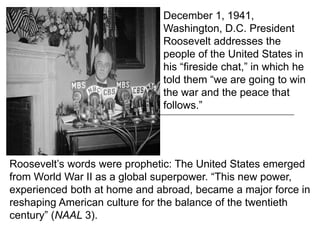
December 1, 1941,
Washington,D.C. President
Roosevelt addresses the
people of the United States in
his “fireside chat,” in which he
told them “we are going to win
the war and the peace that
follows.”
Roosevelt’s words were prophetic: The United States emerged
from World War II as a global superpower. “This new power,
experienced both at home and abroad, became a major force in
reshaping American culture for the balance of the twentieth
century” (NAAL 3).
14.
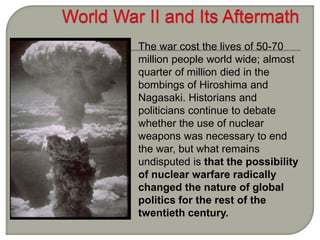
The war costthe lives of 50-70
million people world wide; almost
quarter of million died in the
bombings of Hiroshima and
Nagasaki. Historians and
politicians continue to debate
whether the use of nuclear
weapons was necessary to end
the war, but what remains
undisputed is that the possibility
of nuclear warfare radically
changed the nature of global
politics for the rest of the
twentieth century.
15.
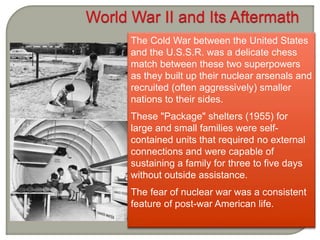
The Cold Warbetween the United States
and the U.S.S.R. was a delicate chess
match between these two superpowers
as they built up their nuclear arsenals and
recruited (often aggressively) smaller
nations to their sides.
These "Package" shelters (1955) for
large and small families were self-
contained units that required no external
connections and were capable of
sustaining a family for three to five days
without outside assistance.
The fear of nuclear war was a consistent
feature of post-war American life.
16.
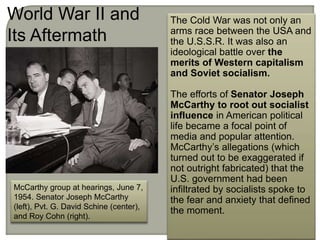
McCarthy group athearings, June 7,
1954. Senator Joseph McCarthy
(left), Pvt. G. David Schine (center),
and Roy Cohn (right).
The Cold War was not only an
arms race between the USA and
the U.S.S.R. It was also an
ideological battle over the
merits of Western capitalism
and Soviet socialism.
The efforts of Senator Joseph
McCarthy to root out socialist
influence in American political
life became a focal point of
media and popular attention.
McCarthy’s allegations (which
turned out to be exaggerated if
not outright fabricated) that the
U.S. government had been
infiltrated by socialists spoke to
the fear and anxiety that defined
the moment.
World War II and
Its Aftermath
17.
J. Howard Miller’sWe Can
Do It poster from 1942.
The post World War II United States can
be defined in terms of both economic
prosperity and the radical transformation of
cultural norms.
With men off to war “the vastly expanded
workforce required increasing numbers of
women. After [the war] many of these
women were reluctant to return to
homemaking; and then after a decade
or so […], women emerged as a political
force on behalf of their rights and
opportunities in the workplace.
This pattern extended to other groups as
well. African Americans, whether they
enlisted or were drafted, served in fighting
units throughout the war and were
unwilling to return to second-class
status afterward; nor could a majority
culture aware of their contribution continue
to enforce segregation and other forms of
prejudice so easily as before the war”
(NAAL 4).
18.
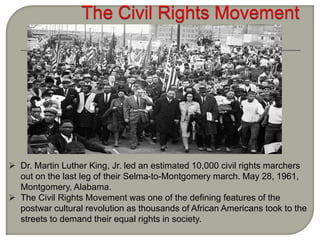
Dr. MartinLuther King, Jr. led an estimated 10,000 civil rights marchers
out on the last leg of their Selma-to-Montgomery march. May 28, 1961,
Montgomery, Alabama.
The Civil Rights Movement was one of the defining features of the
postwar cultural revolution as thousands of African Americans took to the
streets to demand their equal rights in society.
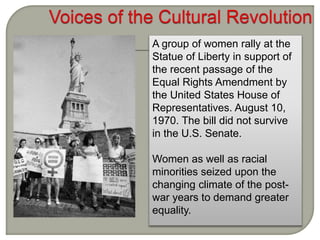
19.
A group ofwomen rally at the
Statue of Liberty in support of
the recent passage of the
Equal Rights Amendment by
the United States House of
Representatives. August 10,
1970. The bill did not survive
in the U.S. Senate.
Women as well as racial
minorities seized upon the
changing climate of the post-
war years to demand greater
equality.
20.
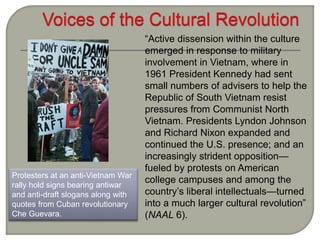
Protesters at ananti-Vietnam War
rally hold signs bearing antiwar
and anti-draft slogans along with
quotes from Cuban revolutionary
Che Guevara.
“Active dissension within the culture
emerged in response to military
involvement in Vietnam, where in
1961 President Kennedy had sent
small numbers of advisers to help the
Republic of South Vietnam resist
pressures from Communist North
Vietnam. Presidents Lyndon Johnson
and Richard Nixon expanded and
continued the U.S. presence; and an
increasingly strident opposition—
fueled by protests on American
college campuses and among the
country’s liberal intellectuals—turned
into a much larger cultural revolution”
(NAAL 6).
21.
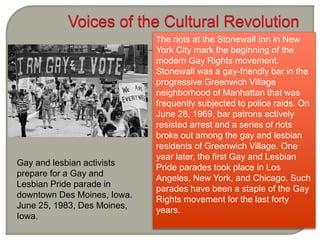
Gay and lesbianactivists
prepare for a Gay and
Lesbian Pride parade in
downtown Des Moines, Iowa.
June 25, 1983, Des Moines,
Iowa.
The riots at the Stonewall Inn in New
York City mark the beginning of the
modern Gay Rights movement.
Stonewall was a gay-friendly bar in the
progressive Greenwich Village
neighborhood of Manhattan that was
frequently subjected to police raids. On
June 28, 1969, bar patrons actively
resisted arrest and a series of riots
broke out among the gay and lesbian
residents of Greenwich Village. One
year later, the first Gay and Lesbian
Pride parades took place in Los
Angeles, New York, and Chicago. Such
parades have been a staple of the Gay
Rights movement for the last forty
years.
23.
According to MaryKlages, from a literary perspective,
the main characteristics of modernism include:
1. an emphasis on impressionism and subjectivity in writing (and
in visual arts as well); an emphasis on HOW seeing (or reading or
perception itself) takes place, rather than on WHAT is perceived.
An example of this would be stream-of-consciousness writing.
2. a movement away from the apparent objectivity provided by
omniscient third-person narrators, fixed narrative points of view,
and clear-cut moral positions. Faulkner's multiply-narrated stories
are an example of this aspect of modernism.
3. a blurring of distinctions between genres, so that poetry seems
more documentary (as in T.S. Eliot or ee cummings) and prose
seems more poetic (as in Woolf or Joyce).
24.
4. an emphasison fragmented forms, discontinuous narratives,
and random-seeming collages of different materials.
5. a tendency toward reflexivity, or self-consciousness, about the
production of the work of art, so that each piece calls attention to
its own status as a production, as something constructed and
consumed in particular ways.
6. a rejection of elaborate formal aesthetics in favor of minimalist
designs (as in the poetry of William Carlos Williams) and a
rejection, in large part, of formal aesthetic theories, in favor of
spontaneity and discovery in creation.
7. A rejection of the distinction between "high" and "low" or
popular culture, both in choice of materials used to produce art
and in methods of displaying, distributing, and consuming art.
25.
Postmodernism, like modernism,follows most of these same
ideas, rejecting boundaries between high and low forms of art,
rejecting rigid genre distinctions, emphasizing pastiche, parody,
bricolage*, irony, and playfulness. Postmodern art (and thought)
favors reflexivity and self-consciousness, fragmentation and
discontinuity (especially in narrative structures), ambiguity,
simultaneity, and an emphasis on the destructured, decentered,
dehumanized subject.
*Bricolage is a processes by which traditional objects or language are given a
new, often subversive, meaning and context.
Art technique where works are constructed from various available materials
("found items" or mass-produced "junk").
A mashup or creation from a diverse range of existing items or ideas
26.
But--while postmodernism seemsvery much like modernism
in these ways, it differs from modernism in its attitude toward
a lot of these trends. Modernism, for example, tends to
present a fragmented view of human subjectivity and history
(think of The Wasteland, for instance, or of Faulkner’s “Barn
Burning”), but presents that fragmentation as something
tragic, something to be lamented and mourned as a loss.
Many modernist works try to uphold the idea that works of art
can provide the unity, coherence, and meaning which has
been lost in most of modern life; art will do what other human
institutions fail to do. Postmodernism, in contrast, doesn't
lament the idea of fragmentation, provisionality, or
incoherence, but rather celebrates that. The world is
meaningless? Let's not pretend that art can make meaning
then; let's just play with nonsense.
27.
1. Q: Whatis postmodernism?
2. Q: Why is Postmodernist “mini-narratives” so important to this time?
1. Q: What might be some reasoning behind the shift away from “grand
narratives” of modernism towards the “mini narratives” of
postmodernism?
2. Q: How does postmodernism’s “mini-narratives” help our way of life
in an increasingly connected world?
3. Q: What are some main differences between modernism and
postmodernism?
1. Q: How are modernism and postmodernism different when some of
their main characteristics are the same, and why do I get the feeling
that postmodernism is just a more hedonistic modernism?
4. Q: How does postmodernism’s rejection of modernism differ from
modernism’s rejection of realism?
5. Q: If postmodernists believe the world has no meaning and celebrate
that, then why are we still living?
28.
1. Q: Whatdoes Klages mean when she states, “In postmodernism,
however, there are only signifiers. The idea of any stable or permanent
reality disappears, and with it the idea of signifieds that signifiers point
to. Rather, for postmodern societies, there are only surfaces, without
depth; only signifiers, with no signifieds.”
2. Q: Do you consider postmodernism to be progressive or regressive?
3. Q: How has the “ditching” of the conservative literary rules and
methods from the Victorian Era allow writers to express themselves
beyond strict forms and rigid proses?
4. Q: How has technology influenced postmodernism?
5. Q: Mary Klages makes the comment that “feminist theorists have found
postmodernism so attractive” due to the fact that it often rejects
conservative values. Aside from this, however, why else would
postmodernism be valued by feminists?
6. Q: Could a completely postmodern society truly function? Could an
ideology or society operate without a “grand narrative”, insteading
favoring “mini-narratives” and as Klages states, “…making no claim to
universality, truth, reason, or stability”?
Ralph Waldo Ellisonwas
named after the celebrated
poet Ralph Waldo Emerson,
by his father who wanted his
son to become a poet. Today
Ellison is mostly remembered
as the mastermind who wrote
the emotive and gripping novel
“Invisible Man” (along with
many others) which met with
much critical success, winning
the National Book Award in
1953.
Ellison was born in Oklahoma
City, Oklahoma on 1st March
1914. He was born to Ida
Millsap and Lewis Alfred
Ellison and had a brother
Herbert Millsap Ellison. In his
initial years Ellison and his
family had to deal with difficult
times. In 1965, Ellison
received the honor of his book
“Invisible Man” being declared
the most important novel since
the end of WW11 by survey of
200 prominent literary figures.
31.
Read “Postmodern Manifestos”400-17
Post #20 QHQ on one of the following:
Sukenick Gass
Thompson Olson
O’Hara Bishop
Ammons Lorde
Read Ralph Ellison, “The Prologue,” and “Battle Royal” from
Invisible Man. 206-224
Post #21 Choose one
1. What does the reader know about the narrator solely on the
basis of the Prologue? Explain both what he reveals about
himself explicitly and what inferences can be drawn,
justifying your findings as you go along.
2. Why would the audience listening to the narrator’s speech
have reacted so strongly to the narrator’s mistake? Discuss
the implications of his slip of the tongue.
3. QHQ
Essay #1 due Friday at noon
#21
“Active dissension within the culture emerged in response to military involvement in Vietnam, where in 1961 President Kennedy had sent small numbers of advisers to help the Republic of South Vietnam resist pressures from Communist North Vietnam. Presidents Lyndon Johnson and Richard Nixon expanded and continued the U.S. presence; and an increasingly strident opposition—fueled by protests on American college campuses and among the country’s liberal intellectuals—turned into a much larger cultural revolution” (NAAL 6).
![ Strictly speaking, one convinces
a person that something is true
but persuades a person to do
something.
“Pointing out that I was overworked,
my friends persuaded [not convinced]
me to take a vacation.
Now that I'm relaxing on the beach
with my book, I am convinced [not
persuaded] that they were right.”
Read more: Easily Confused or Misused Words | Infoplease.com
http://www.infoplease.com/ipa/A0200807.html#ixzz2T7jurahi](https://image.slidesharecdn.com/elit48cclass16-160526154825/85/Elit-48-c-class-16-2-320.jpg)
![ [[Poetry is]...the
record of the best and
happiest moments of
the best and happiest
minds...
- Shelley](https://image.slidesharecdn.com/elit48cclass16-160526154825/85/Elit-48-c-class-16-3-320.jpg)
![ According to […] Lois Tyson one of the major tenants of African-
American criticism is the idea of the “voice of color”, or the idea
that minority groups are better equipped to speak on matters
regarding oppression because white people have not been put in
the same compromising situations that minority groups have been
placed into. Such a concept reveals itself in Langston Hughes’
“The Negro Artist and the Racial Mountain”. In it, Hughes deplores
the Negro poet who wishes to shed the label of “negro” and exist
solely as a poet. Such a mindset may be asserted as a form of
enlightenment or racial colorblindness, but Hughes labels it as a
kind of betrayal. Rather than embracing the unique set of
circumstances that shaped a black artist (especially when he
undoubtedly experienced some circumstances solely due to the
fact that he is black), the black poet that does not wish to be a
“negro poet” discards a valuable piece of his identity.](https://image.slidesharecdn.com/elit48cclass16-160526154825/85/Elit-48-c-class-16-8-320.jpg)
![ When you read Fitzgerald’s “The Great Gatsby” with the African American
lens, I believe it is completely possible that Gatsby may have been African
American. At this time in history fairer skinned African Americans would
often attempt to pass for white to avoid the harsh effects of racism and
segregation. One of the first signs that Gatsby may have be African
American is he change his last name from Gats to Gatsby. African
Americans attempting to pass would change their last name so they could
start their new lives without the ties their last name carried. Gatsby also
owned “more than 40 acres of lawn and garden”(9) and a mansion at West
Egg. After slavery was abolished former slaves were promised 40 acres
and mule in restitution. Tom notes that Gatsby’s “short hair looked as
though it were trimmed every day” (Ch.3) he may have had curly hair he
need to keep hidden to keep up his facade. Tom Buchanan on multiple
occasions mentions African Americans in the beginning to possibly
foreshadow the next events, “it’s up to us [white people], who are the
dominant race, to watch out or these other races will have control of things”
(17) He even goes as far as to insinuate that Gatsby may be African
American, “Nowadays people begin by sneering at family life and family
institutions, and next they’ll throw everything overboard and have
intermarriage between black and white.” (229)](https://image.slidesharecdn.com/elit48cclass16-160526154825/85/Elit-48-c-class-16-11-320.jpg)
![J. Howard Miller’s We Can
Do It poster from 1942.
The post World War II United States can
be defined in terms of both economic
prosperity and the radical transformation of
cultural norms.
With men off to war “the vastly expanded
workforce required increasing numbers of
women. After [the war] many of these
women were reluctant to return to
homemaking; and then after a decade
or so […], women emerged as a political
force on behalf of their rights and
opportunities in the workplace.
This pattern extended to other groups as
well. African Americans, whether they
enlisted or were drafted, served in fighting
units throughout the war and were
unwilling to return to second-class
status afterward; nor could a majority
culture aware of their contribution continue
to enforce segregation and other forms of
prejudice so easily as before the war”
(NAAL 4).](https://image.slidesharecdn.com/elit48cclass16-160526154825/85/Elit-48-c-class-16-17-320.jpg)