20 years of Women’s Studies at
De Anza
Is it really “instant”?
Dirty Face
Shel Silverstein
Where did you get such a dirty face,
My darling dirty-faced child?
I got it from crawling along in the dirt
And biting two buttons off Jeremy’s shirt.
I got it from chewing the roots of a rose
And digging for clams in the yard with my
nose.
I got it from peeking into a dark cave
And painting myself like a Navajo brave.
I got it from playing with coal in the bin
And signing my name in cement with my
chin.
I got if from rolling around on the rug
And giving the horrible dog a big hug.
I got it from finding a lost silver mine
And eating sweet blackberries right off the
vine.
I got it from ice cream and wrestling and
tears
And from having more fun than you’ve had
in years.
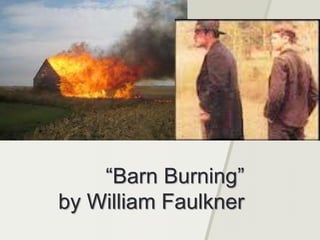
“Barn Burning”
by William Faulkner
Lecture: Historical Context
Any discussion of William Faulkner in a historical
context necessarily involves a discussion of
modernism. In modernism, as we have discussed,
we observe a conscious breaking with traditional
ideas about style, content, and purpose. Faulkner, like
Pound and Fitzgerald, typify the moral atmosphere of
modernism, which could be summed up as despair
over the condition of humanity in the aftermath of the
soul-wrenching and materially devastating First World
War (1914-18).
• Modernism is complex, and while some of these formal
experimenters rejected traditional values (Pound), others
wanted to uphold old values by new means (Eliot).
• Pound's work includes a sustained attack on Judeo-
Christian values and embraces the radical relativism of
philosopher Friedrich Nietzsche (1844-1900).
• Eliot uses his experimentations to plead for the
continued validity of traditional morals in a morally
degenerate world.
• Faulkner is closer to Eliot than to Pound, which means that
he is formally a modernist while being morally and
philosophically a type of traditionalist. Faulkner could even
be called a reactionary—and in truth he was reacting,
negatively, to much of the transformation taking place in the
world of his time.
Q: Why does Faulkner choose to use
a long, hurried syntax with many run-
on sentences? Is this simply his
authorial style, or does it say
something about Sartoris or the world
his lives in?
Style: Syntax
The most noticeable feature of Faulkner's style is his
sentence structure. His sentences tend to be long, full of
interruptions, but work by stringing out seemingly
meandering sequences of clauses.
The second sentence of ‘‘Barn Burning’’ offers an
example: It is 116 words long and contains between
twelve and sixteen clauses, depending on how one
parses it out; its content is fluid and sundry, moving from
Sarty's awareness of the smell of cheese in the general
store through the visual impression made by canned
goods on the shelves to the boy's sense of blood loyalty
with his accused father.
It is the subjectivity of the content—sense impressions,
random emotions and convictions—which reveals the purpose
of the syntax, which is to convey experience in the form of an
intense stream-of-consciousness as recorded by the
protagonist.
The boy, crouched on his nail keg at the back of the crowded
room, knew he smelled cheese, and more: from where he sat he
could see the ranked shelves close-packed with the solid, squat,
dynamic shapes of tin cans whose labels his stomach read, not
from the lettering which meant nothing to his mind but from the
scarlet devils and the silver curve of fish - this, the cheese which
he knew he smelled and the hermetic meat which his intestines
believed he smelled coming in intermittent gusts momentary and
brief between the other constant one, the smell and sense just a
little of fear because mostly of despair and grief, the old fierce pull
of blood.
Style: Point of View
Faulkner was a perspectivist: He tells stories from a particular point of
view—or sometimes, as in the novels, from many divergent points of view,
each with its own insistent emphasis.
‘‘Barn Burning’’ offers a controlled example of perspectivism. Faulkner tells
his story primarily from the point of view of young Sarty, a ten-year-old boy.
This requires that Faulkner gives us the raw reportage of scene and event
that an illiterate ten-year-old would give us, if he could. Thus, Sarty sees the
pictures on the labels of the goods in the general store but cannot
understand the lettering; adults loom over him, so that he feels dwarfed by
them; and he struggles with moral and intellectual categories, as when he
can only see Mr. Harris as an "enemy."
There are few departures from this strict perspectivism, but they are telling,
as when, in the penultimate paragraph of the tale, an omniscient narrator
divulges the truth about Ab’s behavior as a soldier during the Civil War. But
even this is a calculated feature of Faulkner's style: the breaking-in of the
omniscient narrator is another way of fracturing the continuity of the
narrative, of reminding readers that there are many perspectives, including
a transcendental one in which all facts are known to the author. Sharing
Sarty's immediate impressions and judgments forges a strong bond
between the boy and the reader.
Style: Setting
The setting of ‘‘Barn Burning’’ is in the post-Civil War South, in which a defeated
and in many ways humiliated society is trying to hold its own against the
Northern victor. This South has retreated into plantation life and small-town
existence, and it maintains in private the social hierarchy that characterized the
region in its pre-war phase.
Slavery has been abolished, but a vast distance still separates the land-owning
Southern aristocracy from the tenant-farmers and bonded workers who do the
trench-labor required by the plantation economy.
The Snopeses are itinerant sharecroppers, who move from one locale to
another, paying for their habitation in this or that shack by remitting part of the
crop to the landlord. This is a setting of intense vulnerability and therefore of
intense resentment.
“Setting" is a word which needs to be qualified in reference to ‘‘Barn Burning’’
because, as Sarty notes, he has lived in at least a dozen ramshackle buildings
on at least a dozen plantations in his ten short years. In a way, then, the story's
"setting" is the road, or rather the Snopes' constant removal from one place to
another due to Ab's quarreling and violence. The wagon, heaped with miserable
chattel, is the setting, as is Abner's egomaniacal personality and Sarty's
miserable yet rebellious heart.
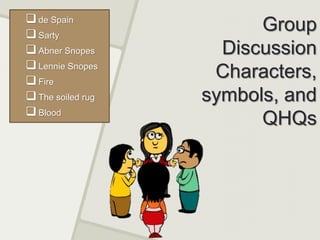
Group
Discussion
Characters,
symbols, and
QHQs
de Spain
Sarty
Abner Snopes
Lennie Snopes
Fire
The soiled rug
Blood
Abner Snopes: character analysis
Abner Snopes is on the bottom of the socioeconomic totem pole,
and has many mouths to feed- his wife, his or his wife’s sister (it
is unclear what side of the family the aunt is from) and four of his
own children. […] It is clear that Abner feels wronged by society
because of the wealth inequality he has experienced between
him and his former landlords. He ‘gets back’ at them by burning
their barns. He shows resentment toward the more economically
fortunate when he says, “‘I don’t figure to stay in a country among
people who…’ he said something unprintable and vile, addressed
to no one” (801) […] Abner’s appearance is described as,
“stiff[ed] back, the stiff and ruthless limp […] a shape black, flat,
and bloodless as though cut from tin” (803). Mr. Snopes is quite
literally a flat character, one who does not change or grow
throughout the novel.
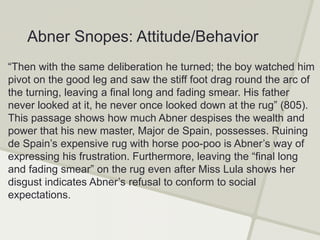
“Then with the same deliberation he turned; the boy watched him
pivot on the good leg and saw the stiff foot drag round the arc of
the turning, leaving a final long and fading smear. His father
never looked at it, he never once looked down at the rug” (805).
This passage shows how much Abner despises the wealth and
power that his new master, Major de Spain, possesses. Ruining
de Spain’s expensive rug with horse poo-poo is Abner’s way of
expressing his frustration. Furthermore, leaving the “final long
and fading smear” on the rug even after Miss Lula shows her
disgust indicates Abner’s refusal to conform to social
expectations.
Abner Snopes: Attitude/Behavior
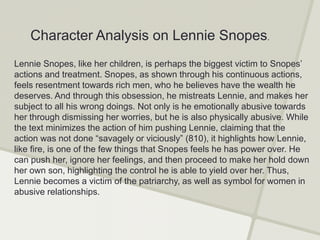
Character Analysis on Lennie Snopes.
Lennie Snopes, like her children, is perhaps the biggest victim to Snopes’
actions and treatment. Snopes, as shown through his continuous actions,
feels resentment towards rich men, who he believes have the wealth he
deserves. And through this obsession, he mistreats Lennie, and makes her
subject to all his wrong doings. Not only is he emotionally abusive towards
her through dismissing her worries, but he is also physically abusive. While
the text minimizes the action of him pushing Lennie, claiming that the
action was not done “savagely or viciously” (810), it highlights how Lennie,
like fire, is one of the few things that Snopes feels he has power over. He
can push her, ignore her feelings, and then proceed to make her hold down
her own son, highlighting the control he is able to yield over her. Thus,
Lennie becomes a victim of the patriarchy, as well as symbol for women in
abusive relationships.
The symbolic
meaning of fire is
certainly variable
per context of
differing
interpretations,
but the most
applicable
explanation for
fire in this story of
self-justification is
as a Christian
metaphor for
cleansing or
purification.
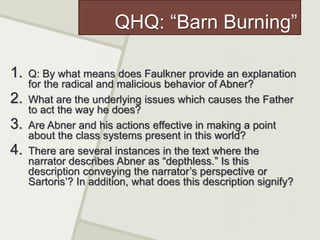
QHQ: “Barn Burning”
1. Q: By what means does Faulkner provide an explanation
for the radical and malicious behavior of Abner?
2. What are the underlying issues which causes the Father
to act the way he does?
3. Are Abner and his actions effective in making a point
about the class systems present in this world?
4. There are several instances in the text where the
narrator describes Abner as “depthless.” Is this
description conveying the narrator’s perspective or
Sartoris’? In addition, what does this description signify?
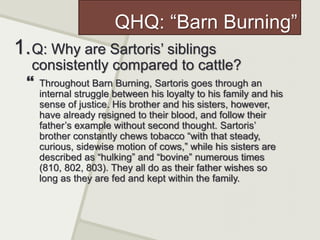
QHQ: “Barn Burning”
1.Q: Why are Sartoris’ siblings
consistently compared to cattle?
 Throughout Barn Burning, Sartoris goes through an
internal struggle between his loyalty to his family and his
sense of justice. His brother and his sisters, however,
have already resigned to their blood, and follow their
father’s example without second thought. Sartoris’
brother constantly chews tobacco “with that steady,
curious, sidewise motion of cows,” while his sisters are
described as “hulking” and “bovine” numerous times
(810, 802, 803). They all do as their father wishes so
long as they are fed and kept within the family.
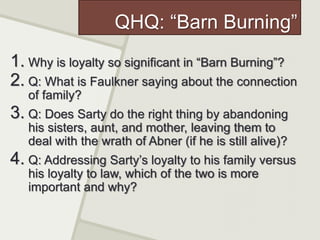
QHQ: “Barn Burning”
1. Why is loyalty so significant in “Barn Burning”?
2. Q: What is Faulkner saying about the connection
of family?
3. Q: Does Sarty do the right thing by abandoning
his sisters, aunt, and mother, leaving them to
deal with the wrath of Abner (if he is still alive)?
4. Q: Addressing Sarty’s loyalty to his family versus
his loyalty to law, which of the two is more
important and why?
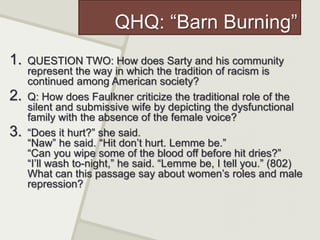
QHQ: “Barn Burning”
1. QUESTION TWO: How does Sarty and his community
represent the way in which the tradition of racism is
continued among American society?
2. Q: How does Faulkner criticize the traditional role of the
silent and submissive wife by depicting the dysfunctional
family with the absence of the female voice?
3. “Does it hurt?” she said.
“Naw” he said. “Hit don’t hurt. Lemme be.”
“Can you wipe some of the blood off before hit dries?”
“I’ll wash to-night,” he said. “Lemme be, I tell you.” (802)
What can this passage say about women’s roles and male
repression?
Adapted from a handout from The Writing
Center, University of North Carolina at
Chapel Hill
Interpretations of fiction are generally
opinions, but not all opinions are equal.
A good, valid, and interesting interpretation will do the
following:
avoid the obvious (in other words, it won’t argue a
conclusion that most readers could reach on their own
from a general knowledge of the story)
support its main points with strong textual evidence from
the story and/or secondary sources.
use careful reasoning to explain how that evidence
relates to the main points of the interpretation.
A good paper begins with the writer having a
solid understanding of the work. Being able to
have the whole text in your head when you
begin thinking through ideas will actually allow
you to write the paper more quickly in the long
run.
 Spend some time just thinking about the story.
Flip back through the book and consider what
interests you about this book—what seemed
strange, new, or important?
Be Familiar with the Text
Explore Potential Topics
Even though you have a list of topics from which to
choose, you must develop your own interpretation.
Consider how you might approach each topic.
What will your answer to each question show about the text?
So what? Why will anyone care?
Try this phrase for each prompt to see if you have an idea: “This
book/poem/play/short story shows ______________________.
This is important because ______________________.”
Narrow down your list of
possible topics by identifying
how much evidence or how
many details you could use
to investigate each potential
issue.
Keep in mind that papers
rely on ample evidence and
that having a lot of details to
choose from can make your
paper easier to write.
Jot down all the events or
elements of the story that
have some bearing on the
two or three topics that
seem most promising.
Don’t launch into a topic
without considering all the
options first because you
may end up with a topic
that seemed promising
initially but that only leads
to a dead end.
Select a Topic with Plenty of Evidence
Make an extended list of evidence
 Once you’ve made your expanded list of
evidence, decide which supporting details are the
strongest.
 First, select the facts which bear the closest relation to
your thesis statement.
 Second, choose the pieces of evidence you’ll be able to
say the most about. Readers tend to be more dazzled
with your interpretations of evidence than with a lot of
quotes from the book.
 Select the details that will allow you to show off your own
reasoning skills and allow you to help the reader see the
story in a way he or she may not have seen it before.
Select your evidence
• Now, go back to your working thesis and refine it
so that it reflects your new understanding of your
topic. This step and the previous step (selecting
evidence) are actually best done at the same
time, since selecting your evidence and defining
the focus of your paper depend upon each other.
Refine your thesis
 Once you have a clear thesis, go back to your list of
selected evidence and group all the similar details
together. The ideas that tie these clusters of evidence
together can then become the claims that you’ll make in
your paper.
 Keep in mind that your claims should not only relate to all
the evidence but also clearly support your thesis.
Once you’re satisfied with the way you’ve grouped your
evidence and with the way that your claims relate to your
thesis, you can begin to consider the most logical way to
organize each of those claims.
Organize your evidence
Avoid the temptation to load your paper with evidence from
your story. Each time you use a specific reference to your
story, be sure to explain the significance of that evidence
in your own words.
To get your readers’ interest, draw their attention to elements
of the story that they wouldn’t necessarily notice or
understand on their own.
If you are quoting passages without interpreting them, you’re
not demonstrating your reasoning skills or helping the reader.
In most cases, interpreting your evidence merely involves
putting into your paper what is already in your head.
Interpret your evidence
Keep in Mind
Don't forget to consider the scope of your
project: What can you reasonably cover in a
paper of that length?
Eliminate wordiness and repetition to ensure that
you have room to make all of your points.
See me if you are lost or confused!
Read: Langston Hughes: “The Negro Speaks of Rivers,” “I, too, sing America,”
and “The Weary Blues”
Post #16: Choose one
• What connections can be made between race and blues music in "The
Weary Blues"?
• What do you think it means to have a soul that is deep as rivers?
• How does “I, too, sing America” make you think about what it means to be
an American? How is "America" presented in this poem, and how does it
make you feel about America?
Read Zora Neale Hurston: “The Eatonville Anthology” 530-38 and “How it Feels
to Be Colored Me” 538-541
Post #17 Choose one
• Community is the primary bond among the stories contained in "The
Eatonville Anthology." How does the image of a front porch act as a symbol
of the social concept of community? Cite specific incidents from the story
that prove this connection.
• How does the narrator's viewpoint direct the reader's understanding and
approval of the citizens presented in "The Eatonville Anthology"? Discuss
specific examples.
• QHQ: “How it Feels to Be Colored Me”
HOMEWORK

Elit 48 c class 14 instant

  • 1.
    20 years ofWomen’s Studies at De Anza
  • 2.
    Is it really“instant”?
  • 4.
    Dirty Face Shel Silverstein Wheredid you get such a dirty face, My darling dirty-faced child? I got it from crawling along in the dirt And biting two buttons off Jeremy’s shirt. I got it from chewing the roots of a rose And digging for clams in the yard with my nose. I got it from peeking into a dark cave And painting myself like a Navajo brave. I got it from playing with coal in the bin And signing my name in cement with my chin. I got if from rolling around on the rug And giving the horrible dog a big hug. I got it from finding a lost silver mine And eating sweet blackberries right off the vine. I got it from ice cream and wrestling and tears And from having more fun than you’ve had in years.
  • 6.
  • 7.
    Lecture: Historical Context Anydiscussion of William Faulkner in a historical context necessarily involves a discussion of modernism. In modernism, as we have discussed, we observe a conscious breaking with traditional ideas about style, content, and purpose. Faulkner, like Pound and Fitzgerald, typify the moral atmosphere of modernism, which could be summed up as despair over the condition of humanity in the aftermath of the soul-wrenching and materially devastating First World War (1914-18).
  • 8.
    • Modernism iscomplex, and while some of these formal experimenters rejected traditional values (Pound), others wanted to uphold old values by new means (Eliot). • Pound's work includes a sustained attack on Judeo- Christian values and embraces the radical relativism of philosopher Friedrich Nietzsche (1844-1900). • Eliot uses his experimentations to plead for the continued validity of traditional morals in a morally degenerate world. • Faulkner is closer to Eliot than to Pound, which means that he is formally a modernist while being morally and philosophically a type of traditionalist. Faulkner could even be called a reactionary—and in truth he was reacting, negatively, to much of the transformation taking place in the world of his time.
  • 9.
    Q: Why doesFaulkner choose to use a long, hurried syntax with many run- on sentences? Is this simply his authorial style, or does it say something about Sartoris or the world his lives in?
  • 10.
    Style: Syntax The mostnoticeable feature of Faulkner's style is his sentence structure. His sentences tend to be long, full of interruptions, but work by stringing out seemingly meandering sequences of clauses. The second sentence of ‘‘Barn Burning’’ offers an example: It is 116 words long and contains between twelve and sixteen clauses, depending on how one parses it out; its content is fluid and sundry, moving from Sarty's awareness of the smell of cheese in the general store through the visual impression made by canned goods on the shelves to the boy's sense of blood loyalty with his accused father.
  • 11.
    It is thesubjectivity of the content—sense impressions, random emotions and convictions—which reveals the purpose of the syntax, which is to convey experience in the form of an intense stream-of-consciousness as recorded by the protagonist. The boy, crouched on his nail keg at the back of the crowded room, knew he smelled cheese, and more: from where he sat he could see the ranked shelves close-packed with the solid, squat, dynamic shapes of tin cans whose labels his stomach read, not from the lettering which meant nothing to his mind but from the scarlet devils and the silver curve of fish - this, the cheese which he knew he smelled and the hermetic meat which his intestines believed he smelled coming in intermittent gusts momentary and brief between the other constant one, the smell and sense just a little of fear because mostly of despair and grief, the old fierce pull of blood.
  • 13.
    Style: Point ofView Faulkner was a perspectivist: He tells stories from a particular point of view—or sometimes, as in the novels, from many divergent points of view, each with its own insistent emphasis. ‘‘Barn Burning’’ offers a controlled example of perspectivism. Faulkner tells his story primarily from the point of view of young Sarty, a ten-year-old boy. This requires that Faulkner gives us the raw reportage of scene and event that an illiterate ten-year-old would give us, if he could. Thus, Sarty sees the pictures on the labels of the goods in the general store but cannot understand the lettering; adults loom over him, so that he feels dwarfed by them; and he struggles with moral and intellectual categories, as when he can only see Mr. Harris as an "enemy." There are few departures from this strict perspectivism, but they are telling, as when, in the penultimate paragraph of the tale, an omniscient narrator divulges the truth about Ab’s behavior as a soldier during the Civil War. But even this is a calculated feature of Faulkner's style: the breaking-in of the omniscient narrator is another way of fracturing the continuity of the narrative, of reminding readers that there are many perspectives, including a transcendental one in which all facts are known to the author. Sharing Sarty's immediate impressions and judgments forges a strong bond between the boy and the reader.
  • 14.
    Style: Setting The settingof ‘‘Barn Burning’’ is in the post-Civil War South, in which a defeated and in many ways humiliated society is trying to hold its own against the Northern victor. This South has retreated into plantation life and small-town existence, and it maintains in private the social hierarchy that characterized the region in its pre-war phase. Slavery has been abolished, but a vast distance still separates the land-owning Southern aristocracy from the tenant-farmers and bonded workers who do the trench-labor required by the plantation economy. The Snopeses are itinerant sharecroppers, who move from one locale to another, paying for their habitation in this or that shack by remitting part of the crop to the landlord. This is a setting of intense vulnerability and therefore of intense resentment. “Setting" is a word which needs to be qualified in reference to ‘‘Barn Burning’’ because, as Sarty notes, he has lived in at least a dozen ramshackle buildings on at least a dozen plantations in his ten short years. In a way, then, the story's "setting" is the road, or rather the Snopes' constant removal from one place to another due to Ab's quarreling and violence. The wagon, heaped with miserable chattel, is the setting, as is Abner's egomaniacal personality and Sarty's miserable yet rebellious heart.
  • 15.
    Group Discussion Characters, symbols, and QHQs de Spain Sarty AbnerSnopes Lennie Snopes Fire The soiled rug Blood
  • 17.
    Abner Snopes: characteranalysis Abner Snopes is on the bottom of the socioeconomic totem pole, and has many mouths to feed- his wife, his or his wife’s sister (it is unclear what side of the family the aunt is from) and four of his own children. […] It is clear that Abner feels wronged by society because of the wealth inequality he has experienced between him and his former landlords. He ‘gets back’ at them by burning their barns. He shows resentment toward the more economically fortunate when he says, “‘I don’t figure to stay in a country among people who…’ he said something unprintable and vile, addressed to no one” (801) […] Abner’s appearance is described as, “stiff[ed] back, the stiff and ruthless limp […] a shape black, flat, and bloodless as though cut from tin” (803). Mr. Snopes is quite literally a flat character, one who does not change or grow throughout the novel.
  • 18.
    “Then with thesame deliberation he turned; the boy watched him pivot on the good leg and saw the stiff foot drag round the arc of the turning, leaving a final long and fading smear. His father never looked at it, he never once looked down at the rug” (805). This passage shows how much Abner despises the wealth and power that his new master, Major de Spain, possesses. Ruining de Spain’s expensive rug with horse poo-poo is Abner’s way of expressing his frustration. Furthermore, leaving the “final long and fading smear” on the rug even after Miss Lula shows her disgust indicates Abner’s refusal to conform to social expectations. Abner Snopes: Attitude/Behavior
  • 19.
    Character Analysis onLennie Snopes. Lennie Snopes, like her children, is perhaps the biggest victim to Snopes’ actions and treatment. Snopes, as shown through his continuous actions, feels resentment towards rich men, who he believes have the wealth he deserves. And through this obsession, he mistreats Lennie, and makes her subject to all his wrong doings. Not only is he emotionally abusive towards her through dismissing her worries, but he is also physically abusive. While the text minimizes the action of him pushing Lennie, claiming that the action was not done “savagely or viciously” (810), it highlights how Lennie, like fire, is one of the few things that Snopes feels he has power over. He can push her, ignore her feelings, and then proceed to make her hold down her own son, highlighting the control he is able to yield over her. Thus, Lennie becomes a victim of the patriarchy, as well as symbol for women in abusive relationships.
  • 23.
    The symbolic meaning offire is certainly variable per context of differing interpretations, but the most applicable explanation for fire in this story of self-justification is as a Christian metaphor for cleansing or purification.
  • 24.
    QHQ: “Barn Burning” 1.Q: By what means does Faulkner provide an explanation for the radical and malicious behavior of Abner? 2. What are the underlying issues which causes the Father to act the way he does? 3. Are Abner and his actions effective in making a point about the class systems present in this world? 4. There are several instances in the text where the narrator describes Abner as “depthless.” Is this description conveying the narrator’s perspective or Sartoris’? In addition, what does this description signify?
  • 25.
    QHQ: “Barn Burning” 1.Q:Why are Sartoris’ siblings consistently compared to cattle?  Throughout Barn Burning, Sartoris goes through an internal struggle between his loyalty to his family and his sense of justice. His brother and his sisters, however, have already resigned to their blood, and follow their father’s example without second thought. Sartoris’ brother constantly chews tobacco “with that steady, curious, sidewise motion of cows,” while his sisters are described as “hulking” and “bovine” numerous times (810, 802, 803). They all do as their father wishes so long as they are fed and kept within the family.
  • 26.
    QHQ: “Barn Burning” 1.Why is loyalty so significant in “Barn Burning”? 2. Q: What is Faulkner saying about the connection of family? 3. Q: Does Sarty do the right thing by abandoning his sisters, aunt, and mother, leaving them to deal with the wrath of Abner (if he is still alive)? 4. Q: Addressing Sarty’s loyalty to his family versus his loyalty to law, which of the two is more important and why?
  • 27.
    QHQ: “Barn Burning” 1.QUESTION TWO: How does Sarty and his community represent the way in which the tradition of racism is continued among American society? 2. Q: How does Faulkner criticize the traditional role of the silent and submissive wife by depicting the dysfunctional family with the absence of the female voice? 3. “Does it hurt?” she said. “Naw” he said. “Hit don’t hurt. Lemme be.” “Can you wipe some of the blood off before hit dries?” “I’ll wash to-night,” he said. “Lemme be, I tell you.” (802) What can this passage say about women’s roles and male repression?
  • 28.
    Adapted from ahandout from The Writing Center, University of North Carolina at Chapel Hill
  • 29.
    Interpretations of fictionare generally opinions, but not all opinions are equal. A good, valid, and interesting interpretation will do the following: avoid the obvious (in other words, it won’t argue a conclusion that most readers could reach on their own from a general knowledge of the story) support its main points with strong textual evidence from the story and/or secondary sources. use careful reasoning to explain how that evidence relates to the main points of the interpretation.
  • 30.
    A good paperbegins with the writer having a solid understanding of the work. Being able to have the whole text in your head when you begin thinking through ideas will actually allow you to write the paper more quickly in the long run.  Spend some time just thinking about the story. Flip back through the book and consider what interests you about this book—what seemed strange, new, or important? Be Familiar with the Text
  • 31.
    Explore Potential Topics Eventhough you have a list of topics from which to choose, you must develop your own interpretation. Consider how you might approach each topic. What will your answer to each question show about the text? So what? Why will anyone care? Try this phrase for each prompt to see if you have an idea: “This book/poem/play/short story shows ______________________. This is important because ______________________.”
  • 32.
    Narrow down yourlist of possible topics by identifying how much evidence or how many details you could use to investigate each potential issue. Keep in mind that papers rely on ample evidence and that having a lot of details to choose from can make your paper easier to write. Jot down all the events or elements of the story that have some bearing on the two or three topics that seem most promising. Don’t launch into a topic without considering all the options first because you may end up with a topic that seemed promising initially but that only leads to a dead end. Select a Topic with Plenty of Evidence
  • 33.
    Make an extendedlist of evidence
  • 34.
     Once you’vemade your expanded list of evidence, decide which supporting details are the strongest.  First, select the facts which bear the closest relation to your thesis statement.  Second, choose the pieces of evidence you’ll be able to say the most about. Readers tend to be more dazzled with your interpretations of evidence than with a lot of quotes from the book.  Select the details that will allow you to show off your own reasoning skills and allow you to help the reader see the story in a way he or she may not have seen it before. Select your evidence
  • 35.
    • Now, goback to your working thesis and refine it so that it reflects your new understanding of your topic. This step and the previous step (selecting evidence) are actually best done at the same time, since selecting your evidence and defining the focus of your paper depend upon each other. Refine your thesis
  • 36.
     Once youhave a clear thesis, go back to your list of selected evidence and group all the similar details together. The ideas that tie these clusters of evidence together can then become the claims that you’ll make in your paper.  Keep in mind that your claims should not only relate to all the evidence but also clearly support your thesis. Once you’re satisfied with the way you’ve grouped your evidence and with the way that your claims relate to your thesis, you can begin to consider the most logical way to organize each of those claims. Organize your evidence
  • 37.
    Avoid the temptationto load your paper with evidence from your story. Each time you use a specific reference to your story, be sure to explain the significance of that evidence in your own words. To get your readers’ interest, draw their attention to elements of the story that they wouldn’t necessarily notice or understand on their own. If you are quoting passages without interpreting them, you’re not demonstrating your reasoning skills or helping the reader. In most cases, interpreting your evidence merely involves putting into your paper what is already in your head. Interpret your evidence
  • 38.
    Keep in Mind Don'tforget to consider the scope of your project: What can you reasonably cover in a paper of that length? Eliminate wordiness and repetition to ensure that you have room to make all of your points. See me if you are lost or confused!
  • 39.
    Read: Langston Hughes:“The Negro Speaks of Rivers,” “I, too, sing America,” and “The Weary Blues” Post #16: Choose one • What connections can be made between race and blues music in "The Weary Blues"? • What do you think it means to have a soul that is deep as rivers? • How does “I, too, sing America” make you think about what it means to be an American? How is "America" presented in this poem, and how does it make you feel about America? Read Zora Neale Hurston: “The Eatonville Anthology” 530-38 and “How it Feels to Be Colored Me” 538-541 Post #17 Choose one • Community is the primary bond among the stories contained in "The Eatonville Anthology." How does the image of a front porch act as a symbol of the social concept of community? Cite specific incidents from the story that prove this connection. • How does the narrator's viewpoint direct the reader's understanding and approval of the citizens presented in "The Eatonville Anthology"? Discuss specific examples. • QHQ: “How it Feels to Be Colored Me” HOMEWORK