ELIT 48C Class 13
Enormous versus Enormity
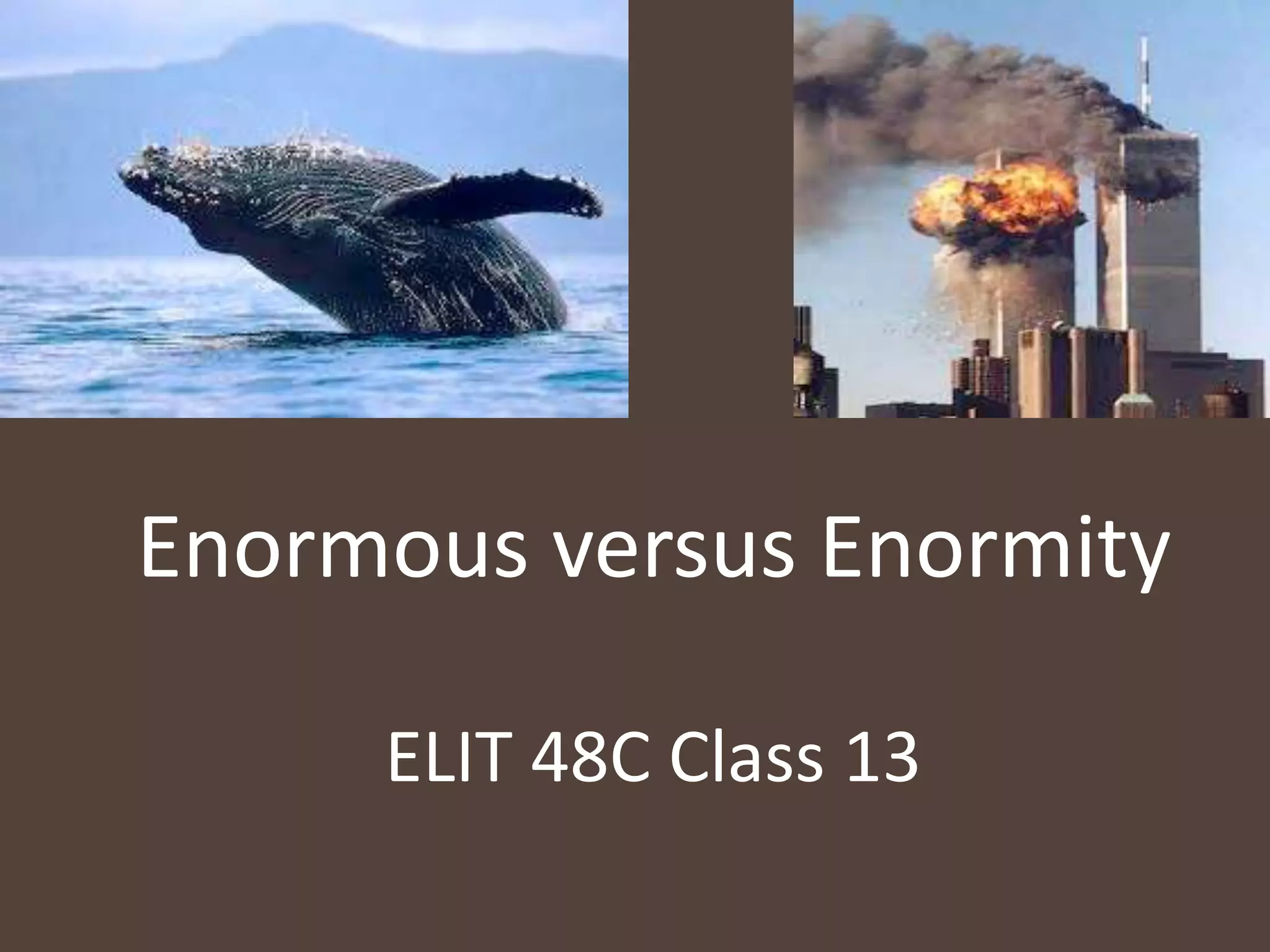
Enormity: 1. The quality of passing all moral
bounds; excessive wickedness or outrageousness.
2. A monstrous offense or evil; an outrage.
Enormous: Great size; immensity
• Strunk and White advise, "Use [enormity] only in
the sense of 'monstrous wickedness.’ [It is]
misleading, if not wrong, when used to express
bigness."
• Bryan Garner's Modern American Usage says,
"The historical differentiation between these
words should not be muddled. Enormousness =
hugeness, vastness. Enormity = outrageousness,
ghastliness."
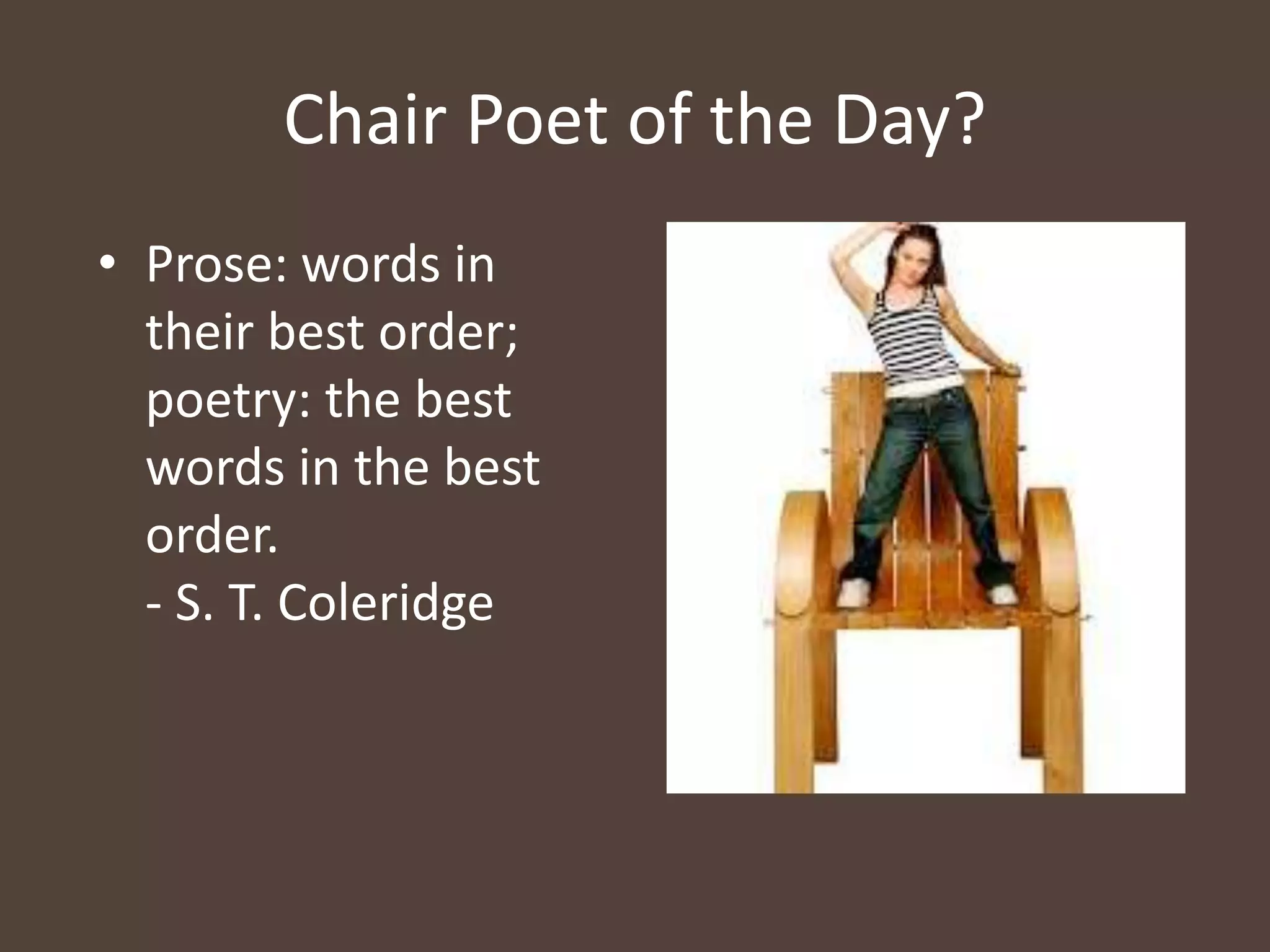
• Prose: words in
their best order;
poetry: the best
words in the best
order.
- S. T. Coleridge
Chair Poet of the Day?
Agenda
Lecture
Introduction to Essay #1
Author Introduction:
o William Faulkner
Midterm Exam
Topics for Essay #1
 There are many essay topics to choose from.
On the webpage, click on “Essay Prompts” and then “Essay #1”
 You will see another list of choices specific to our texts.
Click on any of them to explore topics
 You may write an essay on any of these topics.
 You may write an essay on a topic of your choice, using texts
we read in class.
 You may use fodder from one of your posts.
 The essay is due Friday, week 8 at noon. Please submit it
through Kaizena.
Prompt Introduction
• In this first half of our quarter, we have read and
discussed multiple texts, theories, and opinions on
both literature and literary analysis, and for this
reason, I offer you many choices for your first essay. In
a thesis driven essay of three to six pages, respond to
one of the prompts I have offered or one of your own.
You need only the primary text for this essay, but you
may incorporate other stories, manifestos, or critical
theory as additional support. Remember, you can also
draw on your own experiences and knowledge to
discuss, explain, and analyze your topic.
Essay Topic #2: Notions of Gendered
Space in Trifles
• All of the action in this play takes place in a single setting:
the home of the murdered man and his wife, who the
reader learns is his killer. The men and women who enter
the home after the crime see totally different scenes in
this same setting, though. What each set of characters
sees is limited by his or her gender. The women notice
certain items—preserved fruit, a sewing box, an empty
bird cage—that the men completely overlook because
they consider the domestic space of the woman of the
house to be worthless in terms of offering clues about
the crime. Write an essay in which you define and explain
the two gendered spaces and their significance in the
development of the plot and the play’s outcome.
Topic #7: The Good Ear in
My Antonia
• In a 1915 interview, Cather commented, "No one without a
good ear can write good fiction." In “The Novel Demeuble”
Cather writes, “Whatever is felt upon the page without being
specifically named there—that, it seems to me, is created. It is
the inexplicable presence of the thing not named, of the over-
tone divined by the ear but not heard by it, the verbal mood,
the emotional aura of the fact or the thing or the deed, that
gives high quality to the novel or the drama, as well as to
poetry itself.” What particular passages in My Antonia show
Cather's "good ear" for the sound of language? Which show
her ability to create “the thing not named”? Discuss how and
why these passages capture the moods and themes of the
novel. How do they contribute to the idea of the modernist
novel?
Topic #7 Character Analysis for plot
development in The Great Gatsby
• Do parallel character sketches of Tom
Buchanan and George Wilson; compare them
to show their similarities. Consider using the
information under “writing help” that explains
how to do a character analysis.
WILLIAM FAULKNER
Author Introduction
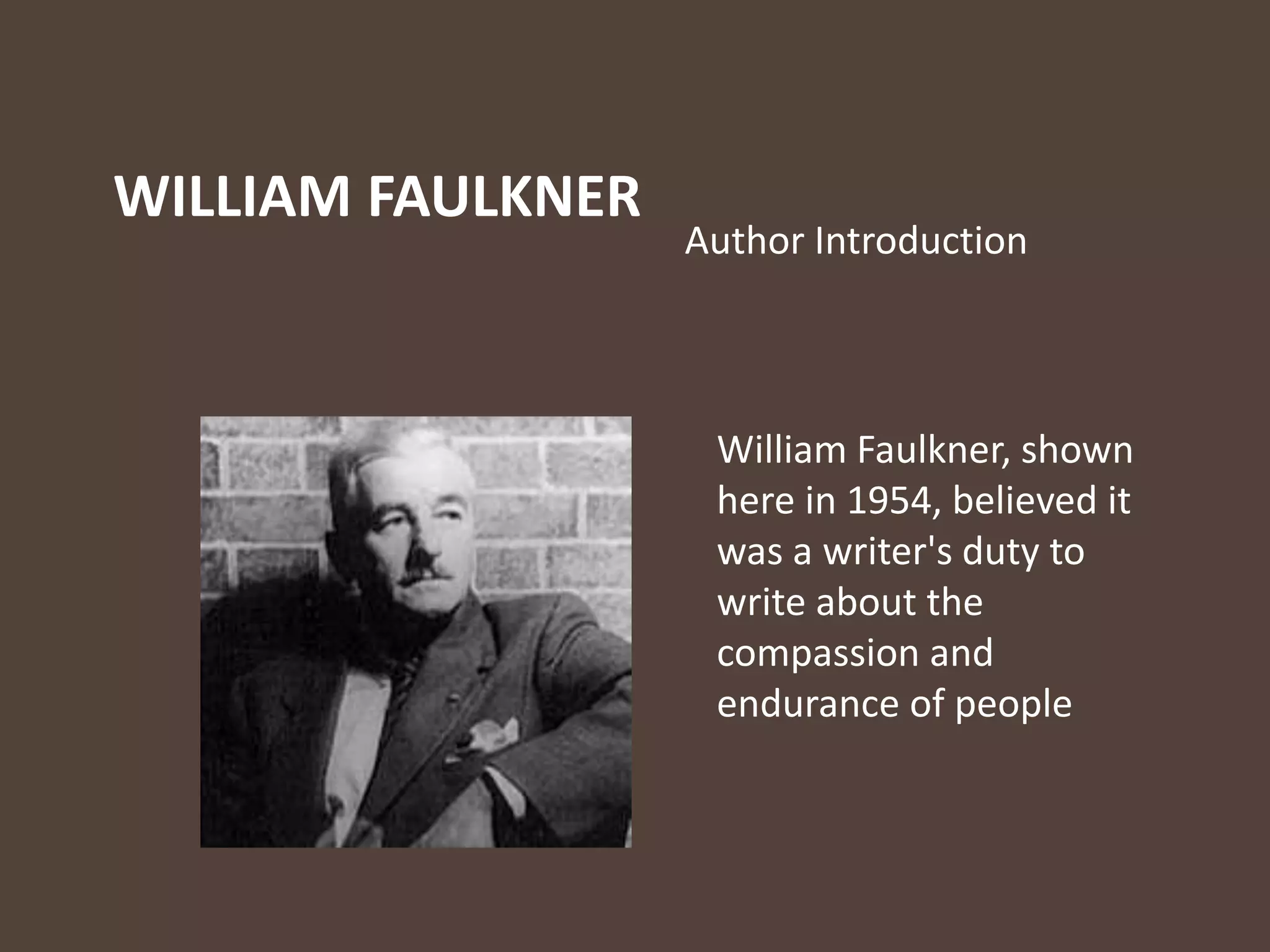
William Faulkner, shown
here in 1954, believed it
was a writer's duty to
write about the
compassion and
endurance of people
Novelist William Faulkner knew the South well. He
spent most of his life there, and wrote with
compassion about family, community, and the people
he knew. Born in New Albany, Mississippi, on
September 25, 1897, Faulkner created the legendary
Yoknapatawpha County. Its fictitious population
includes Southern white aristocrats, merchants,
farmers, poor whites, and persecuted blacks.
Faulkner told how the South is still affected by its
past. "The past is never dead," he wrote. "It's not
even past."
http://www.americaslibrary.gov/jb/progress/jb_progress_fau
lkner_1.html
HOMEWORK
• Read: “Barn Burning” 800-12
• Post #14 QHQ “Barn Burning”
• Post #15 Provide a brief character
analysis or discuss a symbol
(character analysis help under
“writing help” on the webpage).
de Spain Fire
Sarty The soiled rug
Abner Snopes Blood
Lennie Snopes
The Exam
 You have the rest of the
period to take the exam
 Please read the questions
thoroughly
 Please answer the questions
carefully
 Bring your test paper to the
front when you finish.

Elit 48 c class 13 enormous vs enormity exam 1

  • 1.
    ELIT 48C Class13 Enormous versus Enormity
  • 2.
    Enormity: 1. Thequality of passing all moral bounds; excessive wickedness or outrageousness. 2. A monstrous offense or evil; an outrage. Enormous: Great size; immensity • Strunk and White advise, "Use [enormity] only in the sense of 'monstrous wickedness.’ [It is] misleading, if not wrong, when used to express bigness." • Bryan Garner's Modern American Usage says, "The historical differentiation between these words should not be muddled. Enormousness = hugeness, vastness. Enormity = outrageousness, ghastliness."
  • 3.
    • Prose: wordsin their best order; poetry: the best words in the best order. - S. T. Coleridge Chair Poet of the Day?
  • 4.
    Agenda Lecture Introduction to Essay#1 Author Introduction: o William Faulkner Midterm Exam
  • 5.
    Topics for Essay#1  There are many essay topics to choose from. On the webpage, click on “Essay Prompts” and then “Essay #1”  You will see another list of choices specific to our texts. Click on any of them to explore topics  You may write an essay on any of these topics.  You may write an essay on a topic of your choice, using texts we read in class.  You may use fodder from one of your posts.  The essay is due Friday, week 8 at noon. Please submit it through Kaizena.
  • 6.
    Prompt Introduction • Inthis first half of our quarter, we have read and discussed multiple texts, theories, and opinions on both literature and literary analysis, and for this reason, I offer you many choices for your first essay. In a thesis driven essay of three to six pages, respond to one of the prompts I have offered or one of your own. You need only the primary text for this essay, but you may incorporate other stories, manifestos, or critical theory as additional support. Remember, you can also draw on your own experiences and knowledge to discuss, explain, and analyze your topic.
  • 7.
    Essay Topic #2:Notions of Gendered Space in Trifles • All of the action in this play takes place in a single setting: the home of the murdered man and his wife, who the reader learns is his killer. The men and women who enter the home after the crime see totally different scenes in this same setting, though. What each set of characters sees is limited by his or her gender. The women notice certain items—preserved fruit, a sewing box, an empty bird cage—that the men completely overlook because they consider the domestic space of the woman of the house to be worthless in terms of offering clues about the crime. Write an essay in which you define and explain the two gendered spaces and their significance in the development of the plot and the play’s outcome.
  • 8.
    Topic #7: TheGood Ear in My Antonia • In a 1915 interview, Cather commented, "No one without a good ear can write good fiction." In “The Novel Demeuble” Cather writes, “Whatever is felt upon the page without being specifically named there—that, it seems to me, is created. It is the inexplicable presence of the thing not named, of the over- tone divined by the ear but not heard by it, the verbal mood, the emotional aura of the fact or the thing or the deed, that gives high quality to the novel or the drama, as well as to poetry itself.” What particular passages in My Antonia show Cather's "good ear" for the sound of language? Which show her ability to create “the thing not named”? Discuss how and why these passages capture the moods and themes of the novel. How do they contribute to the idea of the modernist novel?
  • 9.
    Topic #7 CharacterAnalysis for plot development in The Great Gatsby • Do parallel character sketches of Tom Buchanan and George Wilson; compare them to show their similarities. Consider using the information under “writing help” that explains how to do a character analysis.
  • 10.
    WILLIAM FAULKNER Author Introduction WilliamFaulkner, shown here in 1954, believed it was a writer's duty to write about the compassion and endurance of people
  • 11.
    Novelist William Faulknerknew the South well. He spent most of his life there, and wrote with compassion about family, community, and the people he knew. Born in New Albany, Mississippi, on September 25, 1897, Faulkner created the legendary Yoknapatawpha County. Its fictitious population includes Southern white aristocrats, merchants, farmers, poor whites, and persecuted blacks. Faulkner told how the South is still affected by its past. "The past is never dead," he wrote. "It's not even past." http://www.americaslibrary.gov/jb/progress/jb_progress_fau lkner_1.html
  • 12.
    HOMEWORK • Read: “BarnBurning” 800-12 • Post #14 QHQ “Barn Burning” • Post #15 Provide a brief character analysis or discuss a symbol (character analysis help under “writing help” on the webpage). de Spain Fire Sarty The soiled rug Abner Snopes Blood Lennie Snopes
  • 13.
    The Exam  Youhave the rest of the period to take the exam  Please read the questions thoroughly  Please answer the questions carefully  Bring your test paper to the front when you finish.