FINAL ASSIGNMENT
Politics in Organizations
C. McGregor
by
Sheri
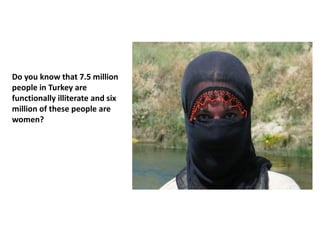
Do you know that 7.5 million
people in Turkey are
functionally illiterate and six
million of these people are
women?
ELIMINATING GENDER DISPARITY
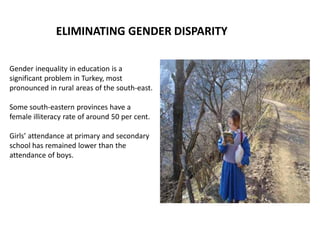
Gender inequality in education is a
significant problem in Turkey, most
pronounced in rural areas of the south-east.
Some south-eastern provinces have a
female illiteracy rate of around 50 per cent.
Girls’ attendance at primary and secondary
school has remained lower than the
attendance of boys.
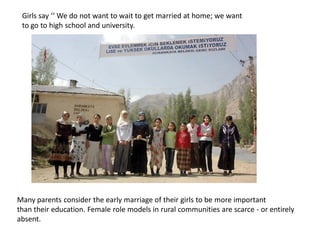
Girls say ‘‘ We do not want to wait to get married at home; we want
to go to high school and university.
Many parents consider the early marriage of their girls to be more important
than their education. Female role models in rural communities are scarce - or entirely
absent.
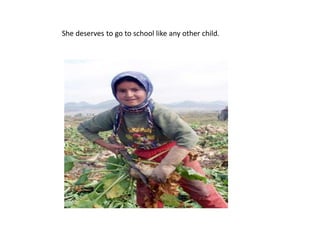
She deserves to go to school like any other child.
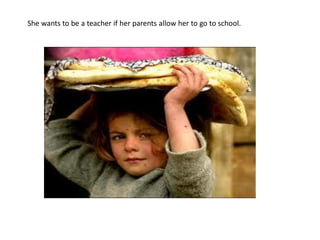
She wants to be a teacher if her parents allow her to go to school.
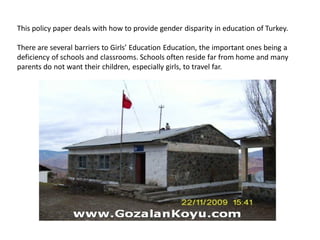
This policy paper deals with how to provide gender disparity in education of Turkey.
There are several barriers to Girls’ Education Education, the important ones being a
deficiency of schools and classrooms. Schools often reside far from home and many
parents do not want their children, especially girls, to travel far.
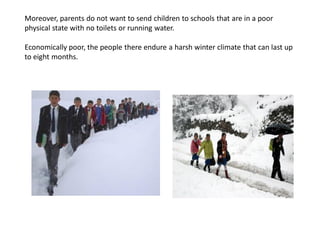
Moreover, parents do not want to send children to schools that are in a poor
physical state with no toilets or running water.
Economically poor, the people there endure a harsh winter climate that can last up
to eight months.
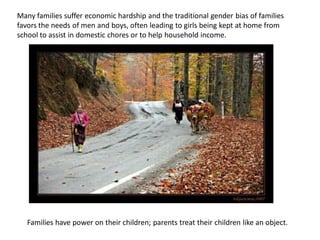
Many families suffer economic hardship and the traditional gender bias of families
favors the needs of men and boys, often leading to girls being kept at home from
school to assist in domestic chores or to help household income.
Families have power on their children; parents treat their children like an object.
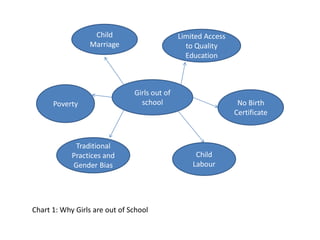
Girls out of
school
Child
Marriage
Poverty
Traditional
Practices and
Gender Bias
Child
Labour
No Birth
Certificate
Limited Access
to Quality
Education
Chart 1: Why Girls are out of School
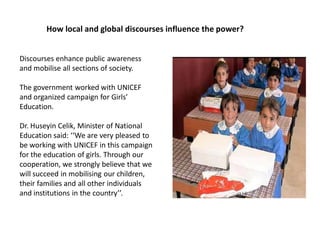
How local and global discourses influence the power?
Discourses enhance public awareness
and mobilise all sections of society.
The government worked with UNICEF
and organized campaign for Girls’
Education.
Dr. Huseyin Celik, Minister of National
Education said: ‘‘We are very pleased to
be working with UNICEF in this campaign
for the education of girls. Through our
cooperation, we strongly believe that we
will succeed in mobilising our children,
their families and all other individuals
and institutions in the country’’.
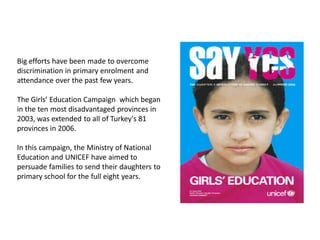
Big efforts have been made to overcome
discrimination in primary enrolment and
attendance over the past few years.
The Girls’ Education Campaign which began
in the ten most disadvantaged provinces in
2003, was extended to all of Turkey's 81
provinces in 2006.
In this campaign, the Ministry of National
Education and UNICEF have aimed to
persuade families to send their daughters to
primary school for the full eight years.
The UNICEF Representative and officials
from the Ministry of National Education
visited all project provinces in 2003 to
review progress and promote the
campaign in the field.
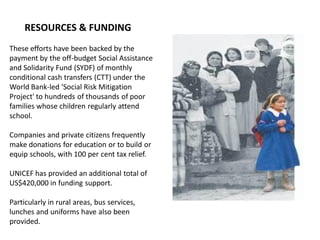
These efforts have been backed by the
payment by the off-budget Social Assistance
and Solidarity Fund (SYDF) of monthly
conditional cash transfers (CTT) under the
World Bank-led 'Social Risk Mitigation
Project' to hundreds of thousands of poor
families whose children regularly attend
school.
Companies and private citizens frequently
make donations for education or to build or
equip schools, with 100 per cent tax relief.
UNICEF has provided an additional total of
US$420,000 in funding support.
Particularly in rural areas, bus services,
lunches and uniforms have also been
provided.
RESOURCES & FUNDING
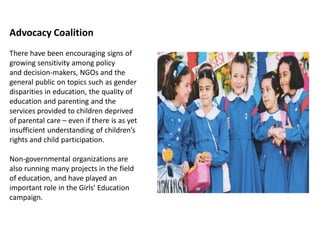
Advocacy Coalition
There have been encouraging signs of
growing sensitivity among policy
and decision-makers, NGOs and the
general public on topics such as gender
disparities in education, the quality of
education and parenting and the
services provided to children deprived
of parental care – even if there is as yet
insufficient understanding of children’s
rights and child participation.
Non-governmental organizations are
also running many projects in the field
of education, and have played an
important role in the Girls' Education
campaign.
Dr Hüseyin Çelik, Minister of National
Education: The solution to the problem of girls’
education is a key to the solution of many
economic, social and cultural problems that
presently affect Turkey.
Dr. Nur Otaran, Researcher in UNICEF Turkey,
said: It’s very much within our power to
change the situation and improve rates of
enrolment.
"Girls' education is more than just reading and
writing and the skills you need to get by in life;
it's about public health," says Edmond
McLoughney, UNICEF's representative in
Turkey. Numerous studies, he says, have shown
that education for girls brings lower birthrates
and infant mortality. "You are affecting not just
education itself, but health and quality of life
in general.
What do the actors think?
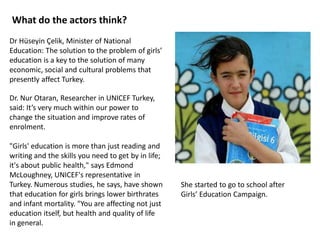
She started to go to school after
Girls’ Education Campaign.
Educated girls grow into educated women --
women who are more likely to participate in
making decisions that affect their lives and the
lives of those they love. And they are more
likely to be healthy, to have smaller families,
and to have healthier and better-educated
children.
To reach our goals for girls’ education, we need
strong national leadership, unshakeable
political commitment, generous financial
support - and an all-out attack on the factors
that help sustain gender discrimination and
violence: poverty, ignorance, and inequity said
Carol Bellamy ,UNICEF Executive Director.
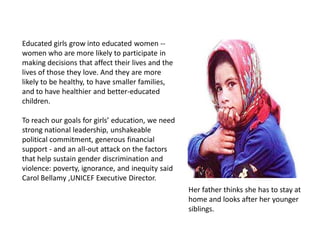
Her father thinks she has to stay at
home and looks after her younger
siblings.
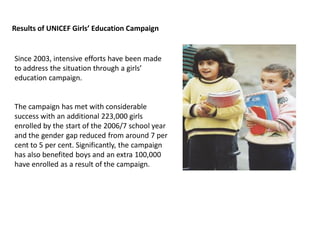
Since 2003, intensive efforts have been made
to address the situation through a girls’
education campaign.
The campaign has met with considerable
success with an additional 223,000 girls
enrolled by the start of the 2006/7 school year
and the gender gap reduced from around 7 per
cent to 5 per cent. Significantly, the campaign
has also benefited boys and an extra 100,000
have enrolled as a result of the campaign.
Results of UNICEF Girls’ Education Campaign
Three main policy measures to resolve the problem of the non-attendance of
girls at school.
First, provide more schools and classrooms and experienced teachers to
underserved rural and urban areas.
Second, address the poverty constraint through the continuation and expansion
of the cash transfer scheme to poor families on condition that their
girls attend school.
Third, address the male-dominated culture through convincing arguments on
the importance of girls’ education.
Implementation of these three policy measures can bring about the twin goals of
gender parity in primary school enrolment and universal primary education.
Solutions
References
Otaran, Nur. (2003). A gender review in education Turkey. UNICEF , 1-40.
UNICEF, (2003). Improving educational opportunities for girls. Lessons from Past Decades, 1-
12.
UNICEF, (2003). Say Yes. The Quarterly Newsletter of Unicef Turkey, 1- 16.

Eliminating gender disparity

  • 1.
    FINAL ASSIGNMENT Politics inOrganizations C. McGregor by Sheri
  • 2.
    Do you knowthat 7.5 million people in Turkey are functionally illiterate and six million of these people are women?
  • 3.
    ELIMINATING GENDER DISPARITY Genderinequality in education is a significant problem in Turkey, most pronounced in rural areas of the south-east. Some south-eastern provinces have a female illiteracy rate of around 50 per cent. Girls’ attendance at primary and secondary school has remained lower than the attendance of boys.
  • 4.
    Girls say ‘‘We do not want to wait to get married at home; we want to go to high school and university. Many parents consider the early marriage of their girls to be more important than their education. Female role models in rural communities are scarce - or entirely absent.
  • 5.
    She deserves togo to school like any other child.
  • 6.
    She wants tobe a teacher if her parents allow her to go to school.
  • 7.
    This policy paperdeals with how to provide gender disparity in education of Turkey. There are several barriers to Girls’ Education Education, the important ones being a deficiency of schools and classrooms. Schools often reside far from home and many parents do not want their children, especially girls, to travel far.
  • 8.
    Moreover, parents donot want to send children to schools that are in a poor physical state with no toilets or running water. Economically poor, the people there endure a harsh winter climate that can last up to eight months.
  • 9.
    Many families suffereconomic hardship and the traditional gender bias of families favors the needs of men and boys, often leading to girls being kept at home from school to assist in domestic chores or to help household income. Families have power on their children; parents treat their children like an object.
  • 10.
    Girls out of school Child Marriage Poverty Traditional Practicesand Gender Bias Child Labour No Birth Certificate Limited Access to Quality Education Chart 1: Why Girls are out of School
  • 11.
    How local andglobal discourses influence the power? Discourses enhance public awareness and mobilise all sections of society. The government worked with UNICEF and organized campaign for Girls’ Education. Dr. Huseyin Celik, Minister of National Education said: ‘‘We are very pleased to be working with UNICEF in this campaign for the education of girls. Through our cooperation, we strongly believe that we will succeed in mobilising our children, their families and all other individuals and institutions in the country’’.
  • 12.
    Big efforts havebeen made to overcome discrimination in primary enrolment and attendance over the past few years. The Girls’ Education Campaign which began in the ten most disadvantaged provinces in 2003, was extended to all of Turkey's 81 provinces in 2006. In this campaign, the Ministry of National Education and UNICEF have aimed to persuade families to send their daughters to primary school for the full eight years.
  • 13.
    The UNICEF Representativeand officials from the Ministry of National Education visited all project provinces in 2003 to review progress and promote the campaign in the field.
  • 14.
    These efforts havebeen backed by the payment by the off-budget Social Assistance and Solidarity Fund (SYDF) of monthly conditional cash transfers (CTT) under the World Bank-led 'Social Risk Mitigation Project' to hundreds of thousands of poor families whose children regularly attend school. Companies and private citizens frequently make donations for education or to build or equip schools, with 100 per cent tax relief. UNICEF has provided an additional total of US$420,000 in funding support. Particularly in rural areas, bus services, lunches and uniforms have also been provided. RESOURCES & FUNDING
  • 15.
    Advocacy Coalition There havebeen encouraging signs of growing sensitivity among policy and decision-makers, NGOs and the general public on topics such as gender disparities in education, the quality of education and parenting and the services provided to children deprived of parental care – even if there is as yet insufficient understanding of children’s rights and child participation. Non-governmental organizations are also running many projects in the field of education, and have played an important role in the Girls' Education campaign.
  • 16.
    Dr Hüseyin Çelik,Minister of National Education: The solution to the problem of girls’ education is a key to the solution of many economic, social and cultural problems that presently affect Turkey. Dr. Nur Otaran, Researcher in UNICEF Turkey, said: It’s very much within our power to change the situation and improve rates of enrolment. "Girls' education is more than just reading and writing and the skills you need to get by in life; it's about public health," says Edmond McLoughney, UNICEF's representative in Turkey. Numerous studies, he says, have shown that education for girls brings lower birthrates and infant mortality. "You are affecting not just education itself, but health and quality of life in general. What do the actors think? She started to go to school after Girls’ Education Campaign.
  • 17.
    Educated girls growinto educated women -- women who are more likely to participate in making decisions that affect their lives and the lives of those they love. And they are more likely to be healthy, to have smaller families, and to have healthier and better-educated children. To reach our goals for girls’ education, we need strong national leadership, unshakeable political commitment, generous financial support - and an all-out attack on the factors that help sustain gender discrimination and violence: poverty, ignorance, and inequity said Carol Bellamy ,UNICEF Executive Director. Her father thinks she has to stay at home and looks after her younger siblings.
  • 18.
    Since 2003, intensiveefforts have been made to address the situation through a girls’ education campaign. The campaign has met with considerable success with an additional 223,000 girls enrolled by the start of the 2006/7 school year and the gender gap reduced from around 7 per cent to 5 per cent. Significantly, the campaign has also benefited boys and an extra 100,000 have enrolled as a result of the campaign. Results of UNICEF Girls’ Education Campaign
  • 19.
    Three main policymeasures to resolve the problem of the non-attendance of girls at school. First, provide more schools and classrooms and experienced teachers to underserved rural and urban areas. Second, address the poverty constraint through the continuation and expansion of the cash transfer scheme to poor families on condition that their girls attend school. Third, address the male-dominated culture through convincing arguments on the importance of girls’ education. Implementation of these three policy measures can bring about the twin goals of gender parity in primary school enrolment and universal primary education. Solutions
  • 20.
    References Otaran, Nur. (2003).A gender review in education Turkey. UNICEF , 1-40. UNICEF, (2003). Improving educational opportunities for girls. Lessons from Past Decades, 1- 12. UNICEF, (2003). Say Yes. The Quarterly Newsletter of Unicef Turkey, 1- 16.