This 80% is a good sign; it tells me that most of
you are using logical forms of evidence to
support your arguments. Make double-sure
that the data you’re using is from a credible
source. Avoid web sources (outside of data
from government agencies and such) as much
as possible.
This number worries me a little, since the
requirements for Unit 2 state: You may only cite
one source that is not a person, a primary source,
or a peer-reviewed journal article or book.
(Statistics and reports from government and
educational entities are considered primary
sources). News articles from places like Huff Post or
CNN are not included in these categories. Use the
articles to find the original primary source for the
data, and cite that. The reason those news sources
aren’t as strong is because all of them have either a
stated or unstated “lean” to the left or right
politically, and those sources hurt the credibility of
your argument because they’re not considered as
objective, even if the information is correct and
reliable. Please ask if you’re not sure—I’m glad to
help you hunt, as are the librarians.
This shows me an opportunity for development. If few of you are
not yet comparing or contrasting to similar problems/solutions to
help build your argument, see if you can do so. This will build both
the logos and ethos of your argument, showing you’re aware of
other contexts and have thought about their impact on your
problem/solution argument.
This also presents an opportunity for
development. If you have not yet addressed
the counterargument(s), do so. Phrases like,
“Some might argue…” are good ways to
introduce that. This builds ethos and logos,
since it demonstrates you are aware of those
who’d disagree with you, why they disagree,
and how you’d refute their argument.
Arguments are made stronger with
counterarguments, so be sure to include (and
challenge) them in your essay.
This is a good sign. Ethos and pathos are used
about the same, but logos is dominating, is a
good sign. We want balance here, and we want
the purpose for the evidence to match the needs
of the audience. Some audiences will be more
persuaded by pathos, but almost every audience
needs ethos and logos to “buy” an argument. 85%
using logos is a good sign. If anything, err toward
more logos and ethos.
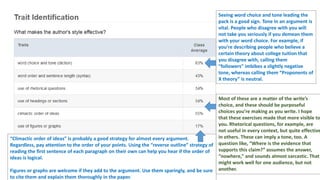
Seeing word choice and tone leading the
pack is a good sign. Tone in an argument is
vital. People who disagree with you will
not take you seriously if you demean them
with your word choice. For example, if
you’re describing people who believe a
certain theory about college tuition that
you disagree with, calling them
“followers” imbibes a slightly negative
tone, whereas calling them “Proponents of
X theory” is neutral.
Most of these are a matter of the write’s
choice, and these should be purposeful
choices you’re making as you write. I hope
that these exercises made that more visible to
you. Rhetorical questions, for example, are
not useful in every context, but quite effective
in others. These can imply a tone, too. A
question like, “Where is the evidence that
supports this claim?” assumes the answer,
“nowhere,” and sounds almost sarcastic. That
might work well for one audience, but not
another.
“Climactic order of ideas” is probably a good strategy for almost every argument.
Regardless, pay attention to the order of your points. Using the “reverse outline” strategy of
reading the first sentence of each paragraph on their own can help you hear if the order of
ideas is logical.
Figures or graphs are welcome if they add to the argument. Use them sparingly, and be sure
to cite them and explain them thoroughly in the paper.

Eli debrief3.21

  • 1.
    This 80% isa good sign; it tells me that most of you are using logical forms of evidence to support your arguments. Make double-sure that the data you’re using is from a credible source. Avoid web sources (outside of data from government agencies and such) as much as possible. This number worries me a little, since the requirements for Unit 2 state: You may only cite one source that is not a person, a primary source, or a peer-reviewed journal article or book. (Statistics and reports from government and educational entities are considered primary sources). News articles from places like Huff Post or CNN are not included in these categories. Use the articles to find the original primary source for the data, and cite that. The reason those news sources aren’t as strong is because all of them have either a stated or unstated “lean” to the left or right politically, and those sources hurt the credibility of your argument because they’re not considered as objective, even if the information is correct and reliable. Please ask if you’re not sure—I’m glad to help you hunt, as are the librarians. This shows me an opportunity for development. If few of you are not yet comparing or contrasting to similar problems/solutions to help build your argument, see if you can do so. This will build both the logos and ethos of your argument, showing you’re aware of other contexts and have thought about their impact on your problem/solution argument.
  • 2.
    This also presentsan opportunity for development. If you have not yet addressed the counterargument(s), do so. Phrases like, “Some might argue…” are good ways to introduce that. This builds ethos and logos, since it demonstrates you are aware of those who’d disagree with you, why they disagree, and how you’d refute their argument. Arguments are made stronger with counterarguments, so be sure to include (and challenge) them in your essay. This is a good sign. Ethos and pathos are used about the same, but logos is dominating, is a good sign. We want balance here, and we want the purpose for the evidence to match the needs of the audience. Some audiences will be more persuaded by pathos, but almost every audience needs ethos and logos to “buy” an argument. 85% using logos is a good sign. If anything, err toward more logos and ethos.
  • 3.
    Seeing word choiceand tone leading the pack is a good sign. Tone in an argument is vital. People who disagree with you will not take you seriously if you demean them with your word choice. For example, if you’re describing people who believe a certain theory about college tuition that you disagree with, calling them “followers” imbibes a slightly negative tone, whereas calling them “Proponents of X theory” is neutral. Most of these are a matter of the write’s choice, and these should be purposeful choices you’re making as you write. I hope that these exercises made that more visible to you. Rhetorical questions, for example, are not useful in every context, but quite effective in others. These can imply a tone, too. A question like, “Where is the evidence that supports this claim?” assumes the answer, “nowhere,” and sounds almost sarcastic. That might work well for one audience, but not another. “Climactic order of ideas” is probably a good strategy for almost every argument. Regardless, pay attention to the order of your points. Using the “reverse outline” strategy of reading the first sentence of each paragraph on their own can help you hear if the order of ideas is logical. Figures or graphs are welcome if they add to the argument. Use them sparingly, and be sure to cite them and explain them thoroughly in the paper.