Finding the Truth in Journalism
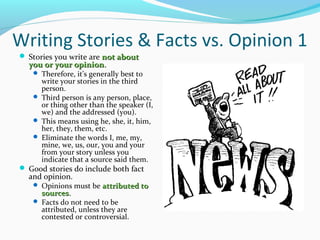
Writing Stories & Facts vs. Opinion 1 
 Stories you write are nnoott aabboouutt 
yyoouu oorr yyoouurr ooppiinniioonn.. 
 Therefore, it’s generally best to 
write your stories in the third 
person. 
 Third person is any person, place, 
or thing other than the speaker (I, 
we) and the addressed (you). 
 This means using he, she, it, him, 
her, they, them, etc. 
 Eliminate the words I, me, my, 
mine, we, us, our, you and your 
from your story unless you 
indicate that a source said them. 
 Good stories do include both fact 
and opinion. 
 Opinions must be aattttrriibbuutteedd ttoo 
ssoouurrcceess.. 
 Facts do not need to be 
attributed, unless they are 
contested or controversial.
FFaacctt 
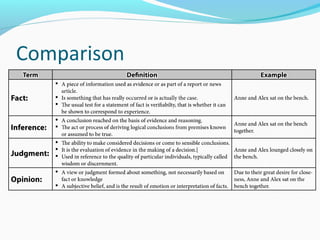
Something that is true about a subject and 
can be tested or proven. 
A statement of fact can theoretically be 
checked for accuracy. 
To see if something is a fact, ask yourself, 
“Can this statement be proved?
FFaacctt 
A fact is a statement that can be proven by direct 
experience or objective verification. 
Evidence may be in the form of: 
The testimony of witnesses 
Agreed-upon observations 
The written records of such testimony and 
observations 
The result of research or investigation
Writing Stories & Facts vs. Opinion 
 Don’t inject your opinion, even if 
it’s in the third person. 
 Good journalists make 
observations, use colorful 
descriptions and interpret 
information. 
 Avoid words suggesting a personal 
judgment or opinion, such as 
should or good. 
 Avoid interpretation not supported 
by fact. 
 Reporters shouldn’t take sides on 
issues. 
 And if it’s a fact, double check it. 
Don’t rely on your teacher, an 
editor or an other student to catch 
mistakes. 
 Mistakes undermine yyoouurr 
ccrreeddiibbiilliittyy and can even lead to 
lawsuits.
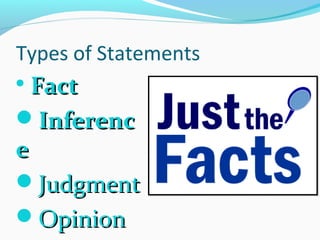
Types of Statements 
 FFaacctt 
IInnffeerreenncc 
ee 
JJuuddggmmeenntt 
OOppiinniioonn
Public View of Facts vs. Opinion 
Pew Research Center for The People and The Press, “Public More Critical of Press, But Goodwill Persists,” June 26, 2005
FFaacctt 
You should know that a statement of fact may 
be found to be untrue. 
When that happens, the statement is no longer a 
fact, it is an error.
IInnffeerreennccee 
A conclusion reached on the basis of evidence and 
reasoning. 
Similar Terms: 
Deduction 
Conclusion 
Reasoning 
Conjecture 
Speculation 
Guess 
Presumption 
Assumption 
Supposition 
Reckoning 
Extrapolation
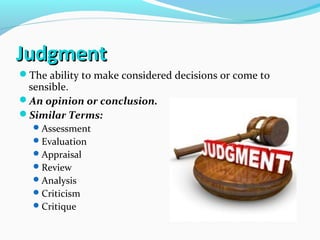
JJuuddggmmeenntt 
The ability to make considered decisions or come to 
sensible. 
An opinion or conclusion. 
Similar Terms: 
Assessment 
Evaluation 
Appraisal 
Review 
Analysis 
Criticism 
Critique
OOppiinniioonnss 
Usually express the feelings, preferences or biases 
that a person has about a subject. 
Are what someone believes or thinks, not necessarily 
can be proven true or false. 
 To check for opinions, ask yourself: 
“Does this tell a thought or feeling?” 
“Would the statement be true all of the time?”
OOppiinniioonnss 
Look for clue words such as: 
Feel 
Believe 
Always 
Never 
None 
Most 
Least 
Best 
Worst
Comparison
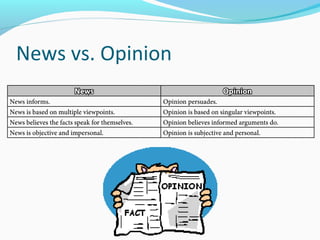
News vs. Opinion
Finding the difference 
WWrriitttteenn ssoouurrccee 
It is important to distinguish between facts and opinions. 
Written materials often contain both facts and opinions such as: 
Articles 
Web site information 
Biographies 
Newspapers 
Being able to tell them apart will help you judge the vvaalliiddiittyy** of 
a writer’s ideas. 
It will also help you choose appropriate sources when doing 
research. 
**vvaalliidd: logically correct; justifiable; well founded in fact
Finding the difference 
DDiirreecctt ssoouurrccee 
It is important to distinguish between facts and 
opinions. 
Direct sources (respondents) often give both facts 
and opinions. 
Being able to tell whether information is fact or not 
will help you judge how to use the information (type 
of quote). 
It will also help you choose appropriate sources 
when doing research.
Attributions 
Giving credit for a source 
Naming a source, respondent, interviewee
Attributions 
All ooppiinniioonnss mmuusstt bbee attributed to a source 
All facts are bbeetttteerr if attributed to a source

Fact vs. opinion stratton 2011

  • 1.
    Finding the Truthin Journalism
  • 2.
    Writing Stories &Facts vs. Opinion 1  Stories you write are nnoott aabboouutt yyoouu oorr yyoouurr ooppiinniioonn..  Therefore, it’s generally best to write your stories in the third person.  Third person is any person, place, or thing other than the speaker (I, we) and the addressed (you).  This means using he, she, it, him, her, they, them, etc.  Eliminate the words I, me, my, mine, we, us, our, you and your from your story unless you indicate that a source said them.  Good stories do include both fact and opinion.  Opinions must be aattttrriibbuutteedd ttoo ssoouurrcceess..  Facts do not need to be attributed, unless they are contested or controversial.
  • 3.
    FFaacctt Something thatis true about a subject and can be tested or proven. A statement of fact can theoretically be checked for accuracy. To see if something is a fact, ask yourself, “Can this statement be proved?
  • 4.
    FFaacctt A factis a statement that can be proven by direct experience or objective verification. Evidence may be in the form of: The testimony of witnesses Agreed-upon observations The written records of such testimony and observations The result of research or investigation
  • 5.
    Writing Stories &Facts vs. Opinion  Don’t inject your opinion, even if it’s in the third person.  Good journalists make observations, use colorful descriptions and interpret information.  Avoid words suggesting a personal judgment or opinion, such as should or good.  Avoid interpretation not supported by fact.  Reporters shouldn’t take sides on issues.  And if it’s a fact, double check it. Don’t rely on your teacher, an editor or an other student to catch mistakes.  Mistakes undermine yyoouurr ccrreeddiibbiilliittyy and can even lead to lawsuits.
  • 6.
    Types of Statements  FFaacctt IInnffeerreenncc ee JJuuddggmmeenntt OOppiinniioonn
  • 7.
    Public View ofFacts vs. Opinion Pew Research Center for The People and The Press, “Public More Critical of Press, But Goodwill Persists,” June 26, 2005
  • 8.
    FFaacctt You shouldknow that a statement of fact may be found to be untrue. When that happens, the statement is no longer a fact, it is an error.
  • 9.
    IInnffeerreennccee A conclusionreached on the basis of evidence and reasoning. Similar Terms: Deduction Conclusion Reasoning Conjecture Speculation Guess Presumption Assumption Supposition Reckoning Extrapolation
  • 10.
    JJuuddggmmeenntt The abilityto make considered decisions or come to sensible. An opinion or conclusion. Similar Terms: Assessment Evaluation Appraisal Review Analysis Criticism Critique
  • 11.
    OOppiinniioonnss Usually expressthe feelings, preferences or biases that a person has about a subject. Are what someone believes or thinks, not necessarily can be proven true or false.  To check for opinions, ask yourself: “Does this tell a thought or feeling?” “Would the statement be true all of the time?”
  • 12.
    OOppiinniioonnss Look forclue words such as: Feel Believe Always Never None Most Least Best Worst
  • 13.
  • 14.
  • 15.
    Finding the difference WWrriitttteenn ssoouurrccee It is important to distinguish between facts and opinions. Written materials often contain both facts and opinions such as: Articles Web site information Biographies Newspapers Being able to tell them apart will help you judge the vvaalliiddiittyy** of a writer’s ideas. It will also help you choose appropriate sources when doing research. **vvaalliidd: logically correct; justifiable; well founded in fact
  • 16.
    Finding the difference DDiirreecctt ssoouurrccee It is important to distinguish between facts and opinions. Direct sources (respondents) often give both facts and opinions. Being able to tell whether information is fact or not will help you judge how to use the information (type of quote). It will also help you choose appropriate sources when doing research.
  • 17.
    Attributions Giving creditfor a source Naming a source, respondent, interviewee
  • 18.
    Attributions All ooppiinniioonnssmmuusstt bbee attributed to a source All facts are bbeetttteerr if attributed to a source