Set up Cornell Notes on pages 73, 75,Set up Cornell Notes on pages 73, 75,
77 & 7977 & 79 Summary section (about 1/3 of the page) on
page 79)
Elements, Compounds
& Mixtures
www.middleschoolscience.com 2008
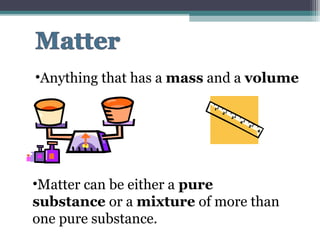
•Anything that has a mass and a volume
•Matter can be either a pure
substance or a mixture of more than
one pure substance.
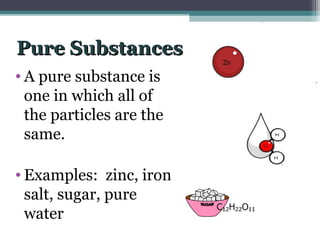
• A pure substance is
one in which all of
the particles are the
same.
• Examples: zinc, iron,
salt, sugar, pure
water
Pure SubstancesPure Substances
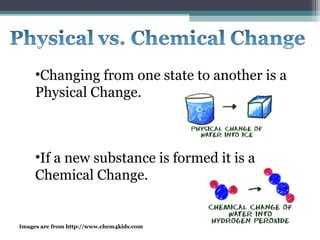
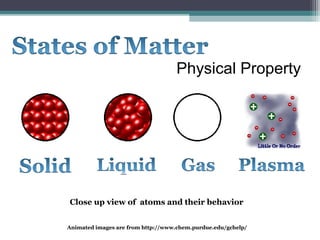
•Changing from one state to another is a
Physical Change.
•If a new substance is formed it is a
Chemical Change.
Images are from http://www.chem4kids.com
Close up view of atoms and their behavior
Animated images are from http://www.chem.purdue.edu/gchelp/
Physical Property
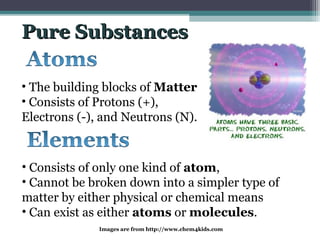
• The building blocks of Matter
• Consists of Protons (+),
Electrons (-), and Neutrons (N).
• Consists of only one kind of atom,
• Cannot be broken down into a simpler type of
matter by either physical or chemical means
• Can exist as either atoms or molecules.
Images are from http://www.chem4kids.com
Pure SubstancesPure Substances
Animated images and notes from http://www.chem.purdue.edu/gchelp/atoms/elements.html
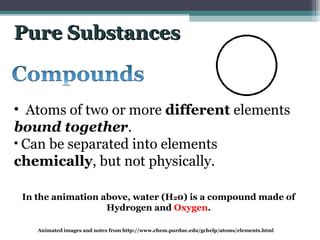
• Atoms of two or more different elements
bound together.
• Can be separated into elements
chemically, but not physically.
In the animation above, water (H20) is a compound made of
Hydrogen and Oxygen.
Pure SubstancesPure Substances
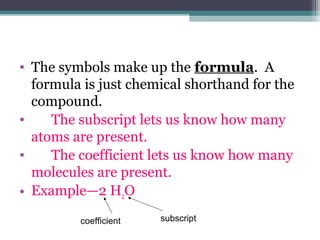
• The symbols make up the formula. A
formula is just chemical shorthand for the
compound.
• The subscript lets us know how many
atoms are present.
• The coefficient lets us know how many
molecules are present.
• Example—2 H2O
coefficient subscript

Elements, compounds, mixtures ipad notes part 1

  • 1.
    Set up CornellNotes on pages 73, 75,Set up Cornell Notes on pages 73, 75, 77 & 7977 & 79 Summary section (about 1/3 of the page) on page 79) Elements, Compounds & Mixtures www.middleschoolscience.com 2008
  • 2.
    •Anything that hasa mass and a volume •Matter can be either a pure substance or a mixture of more than one pure substance.
  • 3.
    • A puresubstance is one in which all of the particles are the same. • Examples: zinc, iron, salt, sugar, pure water Pure SubstancesPure Substances
  • 4.
    •Changing from onestate to another is a Physical Change. •If a new substance is formed it is a Chemical Change. Images are from http://www.chem4kids.com
  • 5.
    Close up viewof atoms and their behavior Animated images are from http://www.chem.purdue.edu/gchelp/ Physical Property
  • 6.
    • The buildingblocks of Matter • Consists of Protons (+), Electrons (-), and Neutrons (N). • Consists of only one kind of atom, • Cannot be broken down into a simpler type of matter by either physical or chemical means • Can exist as either atoms or molecules. Images are from http://www.chem4kids.com Pure SubstancesPure Substances
  • 7.
    Animated images andnotes from http://www.chem.purdue.edu/gchelp/atoms/elements.html • Atoms of two or more different elements bound together. • Can be separated into elements chemically, but not physically. In the animation above, water (H20) is a compound made of Hydrogen and Oxygen. Pure SubstancesPure Substances
  • 8.
    • The symbolsmake up the formula. A formula is just chemical shorthand for the compound. • The subscript lets us know how many atoms are present. • The coefficient lets us know how many molecules are present. • Example—2 H2O coefficient subscript