LET’S
INVESTIGATE:
The Scientific Method
8/30/18
The Scientific
Method? What’s
it all about?
https
://www.youtube.com/watch?v=KI
Fz_-KzURY
https://
www.youtube.com/watch?v=yi0h
wFDQTSQ
• It is the steps someone takes to
identify a question, develop a
hypothesis, design and carry out
steps or procedures to test the
hypothesis, write down data, and
draw a conclusion.
• In other words, it’s a way to
solve a problem.
Scientists take time to think
logically when they are
investigating a question or
problem.
They break things down
into many steps that
make sense.
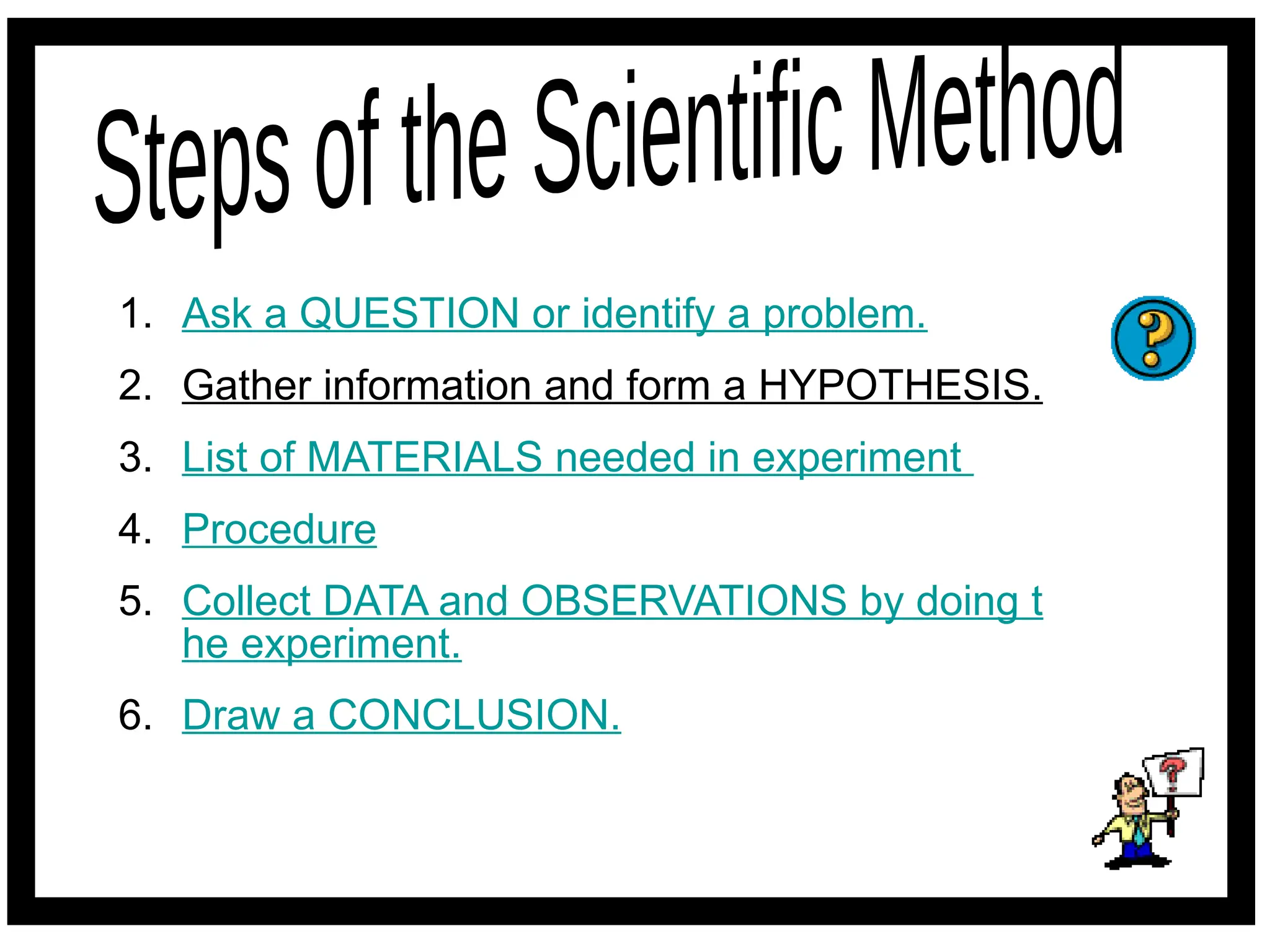
1. Ask a QUESTION or identify a problem.
2. Gather information and form a HYPOTHESIS.
3. List of MATERIALS needed in experiment
4. Procedure
5. Collect DATA and OBSERVATIONS by doing t
he experiment.
6. Draw a CONCLUSION.
Asking questions
All investigations
start with a
question !
Do plants need water
to grow?
Does exercise
make your
heart beat
faster?
What question could these children be
investigating?
What are they predicting will happen?
A HYPOTHESIS is the
same thing as a
prediction. It is an
EDUCATED GUESS or
what you think is going to
happen in your
experiment. Example: I think that
the metal items will be
the best conductors of
heat.
You need to give a
reason why your
hypothesis is correct.
Example:
…..because metal is
used for cooking
utensils.
What are these two finely dressed
children investigating?
What is their HYPOTHESIS?
What do I
need?...
• Complete materials needed.
• Amount for each material must be
given
• Must be listed in column form
• Materials list must be bulleted.
This is the step-by-step,
numbered list of what was
done in the experiment.
Procedure:
1. Start by putting a pot of water on the hot stove.
2. Once the water is good and hot (boiling or near boiling),
carefully place 3 different spoons in the pot – one metal,
one plastic or rubber, and one wooden spoon. Wait a
few minutes for the spoons to heat up.
3. place a little pat of butter on each of the spoons.
4. Observe what will happen.
A key to experiments is
observing what happens
and writing it down.
Gathering information or
data is very important. Write
it down so it is readable and
makes sense to other
people who read it.
After the experiment, you need
to write in detail what
happened in your experiment.
Example:
What happened? The butter on the metal spoon almost immediately melted
away; the butter on the wooden spoon melted some; meanwhile, the butter
on the plastic spoon stayed firm much longer. The heat was transferred by
moving molecules within the spoons
You need to look back at
your HYPOTHESIS and
see if you were correct!
Example:
Are your results what you predicted?
Yes, I thought that metals would be the best conductors of heat and the results of
my experiment proved that this was true.
Your hypothesis
does not have to
be correct!!
Once a scientist
completes an
experiment, they
often repeat it to
see if they get the
same findings
and results.
This is really what we call
verification, or checking things
out to make sure everything is
valid and will happen again and
again.
Scientists share their experiments and
findings with others.
Scientists can learn from each
other and often use someone
else’s experiences to help them
with what they are studying or
doing.

ELEMENTARY SCIENCE Scientific Method.pptx

  • 1.
  • 2.
    The Scientific Method? What’s itall about? https ://www.youtube.com/watch?v=KI Fz_-KzURY https:// www.youtube.com/watch?v=yi0h wFDQTSQ
  • 3.
    • It isthe steps someone takes to identify a question, develop a hypothesis, design and carry out steps or procedures to test the hypothesis, write down data, and draw a conclusion. • In other words, it’s a way to solve a problem.
  • 4.
    Scientists take timeto think logically when they are investigating a question or problem. They break things down into many steps that make sense.
  • 5.
    1. Ask aQUESTION or identify a problem. 2. Gather information and form a HYPOTHESIS. 3. List of MATERIALS needed in experiment 4. Procedure 5. Collect DATA and OBSERVATIONS by doing t he experiment. 6. Draw a CONCLUSION.
  • 6.
    Asking questions All investigations startwith a question ! Do plants need water to grow? Does exercise make your heart beat faster?
  • 7.
    What question couldthese children be investigating? What are they predicting will happen?
  • 8.
    A HYPOTHESIS isthe same thing as a prediction. It is an EDUCATED GUESS or what you think is going to happen in your experiment. Example: I think that the metal items will be the best conductors of heat.
  • 9.
    You need togive a reason why your hypothesis is correct. Example: …..because metal is used for cooking utensils.
  • 10.
    What are thesetwo finely dressed children investigating? What is their HYPOTHESIS?
  • 11.
    What do I need?... •Complete materials needed. • Amount for each material must be given • Must be listed in column form • Materials list must be bulleted.
  • 12.
    This is thestep-by-step, numbered list of what was done in the experiment.
  • 13.
    Procedure: 1. Start byputting a pot of water on the hot stove. 2. Once the water is good and hot (boiling or near boiling), carefully place 3 different spoons in the pot – one metal, one plastic or rubber, and one wooden spoon. Wait a few minutes for the spoons to heat up. 3. place a little pat of butter on each of the spoons. 4. Observe what will happen.
  • 15.
    A key toexperiments is observing what happens and writing it down. Gathering information or data is very important. Write it down so it is readable and makes sense to other people who read it.
  • 16.
    After the experiment,you need to write in detail what happened in your experiment. Example: What happened? The butter on the metal spoon almost immediately melted away; the butter on the wooden spoon melted some; meanwhile, the butter on the plastic spoon stayed firm much longer. The heat was transferred by moving molecules within the spoons
  • 17.
    You need tolook back at your HYPOTHESIS and see if you were correct! Example: Are your results what you predicted? Yes, I thought that metals would be the best conductors of heat and the results of my experiment proved that this was true. Your hypothesis does not have to be correct!!
  • 18.
    Once a scientist completesan experiment, they often repeat it to see if they get the same findings and results. This is really what we call verification, or checking things out to make sure everything is valid and will happen again and again.
  • 19.
    Scientists share theirexperiments and findings with others. Scientists can learn from each other and often use someone else’s experiences to help them with what they are studying or doing.