DESIGN AND IMPLEMENTATION OF AN ELECTRONIC
VOTING SYSTEM USING FINGERPRINT
Presented by
Goummo Nsifa Yves Privat
(FE14A089)
29th August 2018
Supervised by
Mr Fumtchum Achille
Outline of the Presentation

1. PART ONE: GENERAL INTROCUCTION
 Background and context of the study
 Problem Statement and Significance of the study
2. PART TWO: LITTERATURE REVIEW
 Case study of ELECAM
 Case study of companies and institutions.
 Project planning and cost analysis
3. PART THREE: Methodology and design
 Proposed methodology
 Registration and attendance system + Voting machine block diagrams
16
 Addition of Finger and polling
PART FOUR: Simulation and Concluion
Background and context of study
In recent decades, electoral administrators have adopted
several types of techniques into the electoral process. In a
fully electronic electoral management system, the entire
process: Voter registration, verification, ballot production,
electoral logistics; voter identification; voting in polling
stations; vote counting; results transmission; presentation of
final result data. These can all be performed by electronic
and digital equipment and with very limited human
intervention.
Problem Statement
 The problem here is to make an electronic voting system
that will replace the manual voting sytem.
ELECAM
Schools and institutions
Critical path Method Project Planning Technique
Project planning and Cost analysis
Equipment Price/fcfa
Arduino UNO 10,000
Kit Arduino (include electronics components) 30,000
Fingerprint module x2 15,000 x 2 = 30,000
Multimeter 2,500
Total 72,500
HARDWARE REQUIREMENTS
SOFTWARE REQUIREMENTS
Proposed Methodology34
Voter
Registration
Suite
Voting
Machine
Vote
Complete
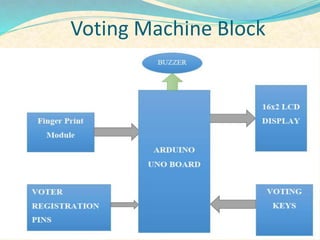
Voting Machine Block
Voter Regitration and attendance block
Voter Picture
+ Profile
information
Voter's Voting
Office
DataBase
Fingerprint Addition
Polling[24]
N
SIMULATION AND CONCLUSION
Simulation
VOTING MACHINE
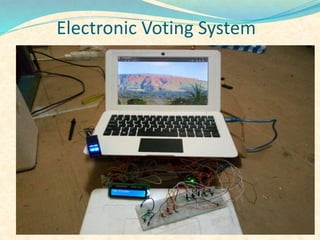
Electronic Voting System
Thanks For Your Kind and Close Attention.
Questions??

Electronic voting system

Editor's Notes

  • #7 eHRPD: evolved high rate packet data
  • #17 Page 34