Fraud Investigation & Control Summit 2012


                     Electronic Evidence
                            in India

Adv. Prashant Mali [BSc.(Phy.), MS(Comp. Sci.), CNA, LLB]
Speaker, Author & Expert
President – Cyber Law Consulting
Cyber Law & Cyber Security Expert
Electronic Evidence
• Mohinder Sharma, a resident of Budhpur in
  northwest Delhi was Sent to 20 years of
  Imprisonment and 1.02 Lakhs Penalty was
  charged.”Electronic Evidence was Relied upon”
• Mohinder Sharma V/S State Delhi HC

• Surveillance with the help of its unique
  international mobile equipment identity (IMEI)
  number and was found being used by Sharma
  with a different SIM. He had destroyed the
  original SIM.
Admissibility of Electronic Records
•  Section 65-B (Admissibility of Electronic Records)
 –any information contained in an electronic record which is printed on a paper,
   stored, recorded or copies in optical or magnetic media produced by a computer
   (hereinafter referred to as the computer output) shall be deemed to be also a
   document
 – Conditions for admissibility
• the computer output containing the information was produced by the computer
   during the period over which the computer was used regularly to store or
   process information for the purposes of any activities regularly carried on over
   that periodby the person having lawful control over the use of the computer;
• during the said period, information of the kind contained in the electronic record
   or of the kind from which the information so contained is derived was regularly
   fedinto the computer in the ordinary course of the said activities;
• throughout the material part of the said period, the computer was operating
   properly or, if not; then in respect of any period in which it was not operating
   properly or was out of operation during that part of the period, was not such as to
   affect the electronic record or the accuracy of its contents;
• the information contained in the electronic record reproduces oris derived from
   such information fed into the computer in the ordinary course of the said
   activities.
Admissibility of Electronic Records
• Section 65-B (Admissibility of Electronic Records)
–Making statements:
    In any proceedings where it is desired to give a statement in evidence
    by virtue of this section, a certificate doing any of the following things,
    that is to say-
(a)identifying the electronic record containing the statement and
    describing the manner in which it was produced;
(b)giving such particulars of any device involved in the production of that
    electronic record as may be appropriate for the purpose of showing
    that the electronic record was produced by a computer;
(c)dealing with any of the matters to which the conditions mentioned in
    sub-section (2) relate,
and purporting to be signed by a person occupying a responsible official
    position in relation to the operation of the relevant device or the
    management of the relevant activities (whichever is appropriate)
shall be evidence of any matter sufficient for a matter to be stated to the
    best of knowledge and belief of the person stating it.
Forensics Labs

• Cyber Forensics Labs where electronic
  records can be taken for obtaining
  certificate:
• –3 Labs at Hyderabad
• –1 Lab at Trivandrum
• –1 Lab at CBI, Delhi
• –1 Lab at Himachal
• –1 Lab at Ahmadabad
• –1 Lab at Mumbai
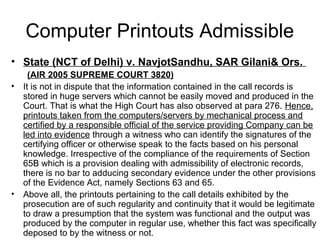
Computer Printouts Admissible
• State (NCT of Delhi) v. NavjotSandhu, SAR Gilani& Ors.
      (AIR 2005 SUPREME COURT 3820)
•   It is not in dispute that the information contained in the call records is
    stored in huge servers which cannot be easily moved and produced in the
    Court. That is what the High Court has also observed at para 276. Hence,
    printouts taken from the computers/servers by mechanical process and
    certified by a responsible official of the service providing Company can be
    led into evidence through a witness who can identify the signatures of the
    certifying officer or otherwise speak to the facts based on his personal
    knowledge. Irrespective of the compliance of the requirements of Section
    65B which is a provision dealing with admissibility of electronic records,
    there is no bar to adducing secondary evidence under the other provisions
    of the Evidence Act, namely Sections 63 and 65.
•   Above all, the printouts pertaining to the call details exhibited by the
    prosecution are of such regularity and continuity that it would be legitimate
    to draw a presumption that the system was functional and the output was
    produced by the computer in regular use, whether this fact was specifically
    deposed to by the witness or not.
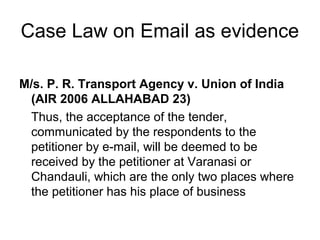
Case Law on Email as evidence

M/s. P. R. Transport Agency v. Union of India
 (AIR 2006 ALLAHABAD 23)
 Thus, the acceptance of the tender,
 communicated by the respondents to the
 petitioner by e-mail, will be deemed to be
 received by the petitioner at Varanasi or
 Chandauli, which are the only two places where
 the petitioner has his place of business
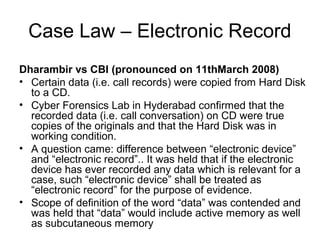
Case Law – Electronic Record
Dharambir vs CBI (pronounced on 11thMarch 2008)
• Certain data (i.e. call records) were copied from Hard Disk
  to a CD.
• Cyber Forensics Lab in Hyderabad confirmed that the
  recorded data (i.e. call conversation) on CD were true
  copies of the originals and that the Hard Disk was in
  working condition.
• A question came: difference between “electronic device”
  and “electronic record”.. It was held that if the electronic
  device has ever recorded any data which is relevant for a
  case, such “electronic device” shall be treated as
  “electronic record” for the purpose of evidence.
• Scope of definition of the word “data” was contended and
  was held that “data” would include active memory as well
  as subcutaneous memory
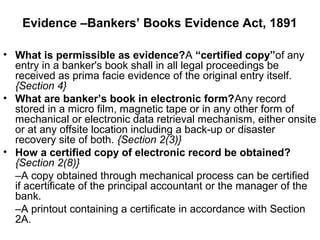
Evidence –Bankers’ Books Evidence Act, 1891

• What is permissible as evidence?A “certified copy”of any
  entry in a banker's book shall in all legal proceedings be
  received as prima facie evidence of the original entry itself.
  {Section 4}
• What are banker’s book in electronic form?Any record
  stored in a micro film, magnetic tape or in any other form of
  mechanical or electronic data retrieval mechanism, either onsite
  or at any offsite location including a back-up or disaster
  recovery site of both. {Section 2(3)}
• How a certified copy of electronic record be obtained?
  {Section 2(8)}
  –A copy obtained through mechanical process can be certified
  if acertificate of the principal accountant or the manager of the
  bank.
  –A printout containing a certificate in accordance with Section
  2A.
Evidence –Bankers’ Books Evidence Act, 1891


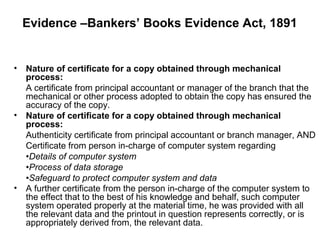
•   Nature of certificate for a copy obtained through mechanical
    process:
    A certificate from principal accountant or manager of the branch that the
    mechanical or other process adopted to obtain the copy has ensured the
    accuracy of the copy.
•   Nature of certificate for a copy obtained through mechanical
    process:
    Authenticity certificate from principal accountant or branch manager, AND
    Certificate from person in-charge of computer system regarding
    •Details of computer system
    •Process of data storage
    •Safeguard to protect computer system and data
•   A further certificate from the person in-charge of the computer system to
    the effect that to the best of his knowledge and behalf, such computer
    system operated properly at the material time, he was provided with all
    the relevant data and the printout in question represents correctly, or is
    appropriately derived from, the relevant data.
Evidence –Bankers’ Books Evidence Act, 1891

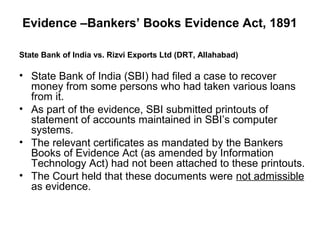
State Bank of India vs. Rizvi Exports Ltd (DRT, Allahabad)

• State Bank of India (SBI) had filed a case to recover
  money from some persons who had taken various loans
  from it.
• As part of the evidence, SBI submitted printouts of
  statement of accounts maintained in SBI’s computer
  systems.
• The relevant certificates as mandated by the Bankers
  Books of Evidence Act (as amended by Information
  Technology Act) had not been attached to these printouts.
• The Court held that these documents were not admissible
  as evidence.
THANKYOU

Adv. Prashant Mali [BSc.(Phy.), MSc.(Computer Sci.),LLB]
President - Cyber Law Consulting
Author, Speaker & Expert
Mob: 09821763157
facebook.com/cyberlawconsultant
Web : www.prashantmali.com
      www.cyberlawconsulting.com

Electronic Evidence fraud conference

  • 1.
    Fraud Investigation &Control Summit 2012 Electronic Evidence in India Adv. Prashant Mali [BSc.(Phy.), MS(Comp. Sci.), CNA, LLB] Speaker, Author & Expert President – Cyber Law Consulting Cyber Law & Cyber Security Expert
  • 2.
    Electronic Evidence • MohinderSharma, a resident of Budhpur in northwest Delhi was Sent to 20 years of Imprisonment and 1.02 Lakhs Penalty was charged.”Electronic Evidence was Relied upon” • Mohinder Sharma V/S State Delhi HC • Surveillance with the help of its unique international mobile equipment identity (IMEI) number and was found being used by Sharma with a different SIM. He had destroyed the original SIM.
  • 3.
    Admissibility of ElectronicRecords • Section 65-B (Admissibility of Electronic Records) –any information contained in an electronic record which is printed on a paper, stored, recorded or copies in optical or magnetic media produced by a computer (hereinafter referred to as the computer output) shall be deemed to be also a document – Conditions for admissibility • the computer output containing the information was produced by the computer during the period over which the computer was used regularly to store or process information for the purposes of any activities regularly carried on over that periodby the person having lawful control over the use of the computer; • during the said period, information of the kind contained in the electronic record or of the kind from which the information so contained is derived was regularly fedinto the computer in the ordinary course of the said activities; • throughout the material part of the said period, the computer was operating properly or, if not; then in respect of any period in which it was not operating properly or was out of operation during that part of the period, was not such as to affect the electronic record or the accuracy of its contents; • the information contained in the electronic record reproduces oris derived from such information fed into the computer in the ordinary course of the said activities.
  • 4.
    Admissibility of ElectronicRecords • Section 65-B (Admissibility of Electronic Records) –Making statements: In any proceedings where it is desired to give a statement in evidence by virtue of this section, a certificate doing any of the following things, that is to say- (a)identifying the electronic record containing the statement and describing the manner in which it was produced; (b)giving such particulars of any device involved in the production of that electronic record as may be appropriate for the purpose of showing that the electronic record was produced by a computer; (c)dealing with any of the matters to which the conditions mentioned in sub-section (2) relate, and purporting to be signed by a person occupying a responsible official position in relation to the operation of the relevant device or the management of the relevant activities (whichever is appropriate) shall be evidence of any matter sufficient for a matter to be stated to the best of knowledge and belief of the person stating it.
  • 5.
    Forensics Labs • CyberForensics Labs where electronic records can be taken for obtaining certificate: • –3 Labs at Hyderabad • –1 Lab at Trivandrum • –1 Lab at CBI, Delhi • –1 Lab at Himachal • –1 Lab at Ahmadabad • –1 Lab at Mumbai
  • 6.
    Computer Printouts Admissible •State (NCT of Delhi) v. NavjotSandhu, SAR Gilani& Ors. (AIR 2005 SUPREME COURT 3820) • It is not in dispute that the information contained in the call records is stored in huge servers which cannot be easily moved and produced in the Court. That is what the High Court has also observed at para 276. Hence, printouts taken from the computers/servers by mechanical process and certified by a responsible official of the service providing Company can be led into evidence through a witness who can identify the signatures of the certifying officer or otherwise speak to the facts based on his personal knowledge. Irrespective of the compliance of the requirements of Section 65B which is a provision dealing with admissibility of electronic records, there is no bar to adducing secondary evidence under the other provisions of the Evidence Act, namely Sections 63 and 65. • Above all, the printouts pertaining to the call details exhibited by the prosecution are of such regularity and continuity that it would be legitimate to draw a presumption that the system was functional and the output was produced by the computer in regular use, whether this fact was specifically deposed to by the witness or not.
  • 7.
    Case Law onEmail as evidence M/s. P. R. Transport Agency v. Union of India (AIR 2006 ALLAHABAD 23) Thus, the acceptance of the tender, communicated by the respondents to the petitioner by e-mail, will be deemed to be received by the petitioner at Varanasi or Chandauli, which are the only two places where the petitioner has his place of business
  • 8.
    Case Law –Electronic Record Dharambir vs CBI (pronounced on 11thMarch 2008) • Certain data (i.e. call records) were copied from Hard Disk to a CD. • Cyber Forensics Lab in Hyderabad confirmed that the recorded data (i.e. call conversation) on CD were true copies of the originals and that the Hard Disk was in working condition. • A question came: difference between “electronic device” and “electronic record”.. It was held that if the electronic device has ever recorded any data which is relevant for a case, such “electronic device” shall be treated as “electronic record” for the purpose of evidence. • Scope of definition of the word “data” was contended and was held that “data” would include active memory as well as subcutaneous memory
  • 9.
    Evidence –Bankers’ BooksEvidence Act, 1891 • What is permissible as evidence?A “certified copy”of any entry in a banker's book shall in all legal proceedings be received as prima facie evidence of the original entry itself. {Section 4} • What are banker’s book in electronic form?Any record stored in a micro film, magnetic tape or in any other form of mechanical or electronic data retrieval mechanism, either onsite or at any offsite location including a back-up or disaster recovery site of both. {Section 2(3)} • How a certified copy of electronic record be obtained? {Section 2(8)} –A copy obtained through mechanical process can be certified if acertificate of the principal accountant or the manager of the bank. –A printout containing a certificate in accordance with Section 2A.
  • 10.
    Evidence –Bankers’ BooksEvidence Act, 1891 • Nature of certificate for a copy obtained through mechanical process: A certificate from principal accountant or manager of the branch that the mechanical or other process adopted to obtain the copy has ensured the accuracy of the copy. • Nature of certificate for a copy obtained through mechanical process: Authenticity certificate from principal accountant or branch manager, AND Certificate from person in-charge of computer system regarding •Details of computer system •Process of data storage •Safeguard to protect computer system and data • A further certificate from the person in-charge of the computer system to the effect that to the best of his knowledge and behalf, such computer system operated properly at the material time, he was provided with all the relevant data and the printout in question represents correctly, or is appropriately derived from, the relevant data.
  • 11.
    Evidence –Bankers’ BooksEvidence Act, 1891 State Bank of India vs. Rizvi Exports Ltd (DRT, Allahabad) • State Bank of India (SBI) had filed a case to recover money from some persons who had taken various loans from it. • As part of the evidence, SBI submitted printouts of statement of accounts maintained in SBI’s computer systems. • The relevant certificates as mandated by the Bankers Books of Evidence Act (as amended by Information Technology Act) had not been attached to these printouts. • The Court held that these documents were not admissible as evidence.
  • 12.
    THANKYOU Adv. Prashant Mali[BSc.(Phy.), MSc.(Computer Sci.),LLB] President - Cyber Law Consulting Author, Speaker & Expert Mob: 09821763157 facebook.com/cyberlawconsultant Web : www.prashantmali.com www.cyberlawconsulting.com