MINI PROJECT
ELECTRONIC DESIGN WORKSHOP
PRESENTED BY :-
Topic : Design of 3khz High Pass Filter
Amit Kumar (ECE/2021/10)
Anuragsinh Singh(ECE/2021/18)
Abhradeep Kanrar(ECE/2021/20)
Sk. Asfakur Rahaman (ECE/2021/23)
Romit Raj Singh (ECE/2021/24)
Sagnik Sanyal(ECE/2021/26)
CONTENT
01
02
03
04
WHAT IS A FILTER?
DESIGN OF FIRST ORDER ACTIVE HIGH PASS FILTER WITH
CUT-OFF FREQUENCY 3KHZ
DESIGN OF SECOND ORDER ACTIVE HIGH PASS FILTER WITH
CUT-OFF FREQUENCY 3KHZ
DISCUSSIONS
WHAT IS A FILTER?
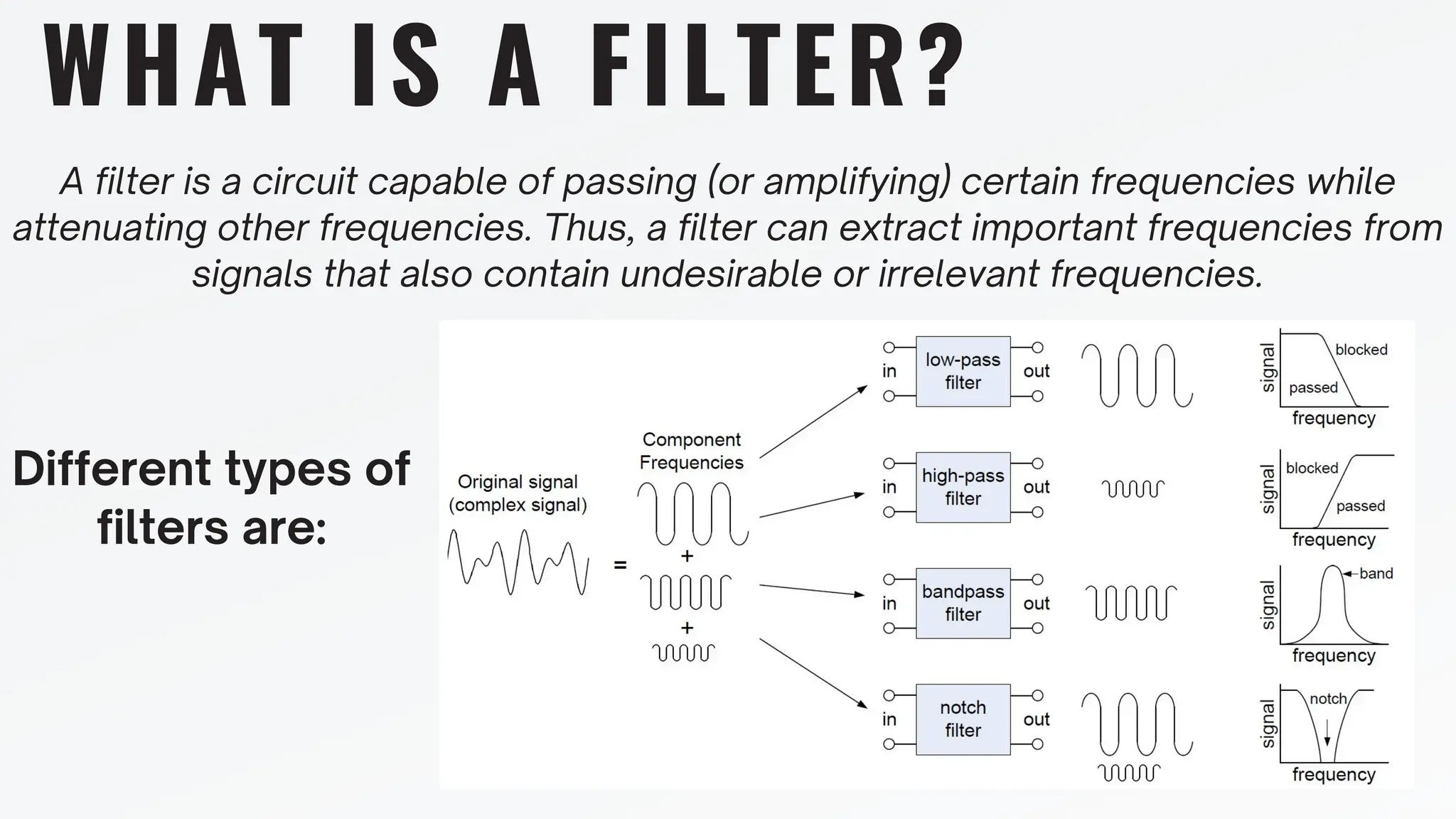
A filter is a circuit capable of passing (or amplifying) certain frequencies while
attenuating other frequencies. Thus, a filter can extract important frequencies from
signals that also contain undesirable or irrelevant frequencies.
Different types of
filters are:
Formulas :
DESIGN OF FIRST ORDER ACTIVE HIGH PASS FILTER WITH
CUT-OFF FREQUENCY 3KHZ
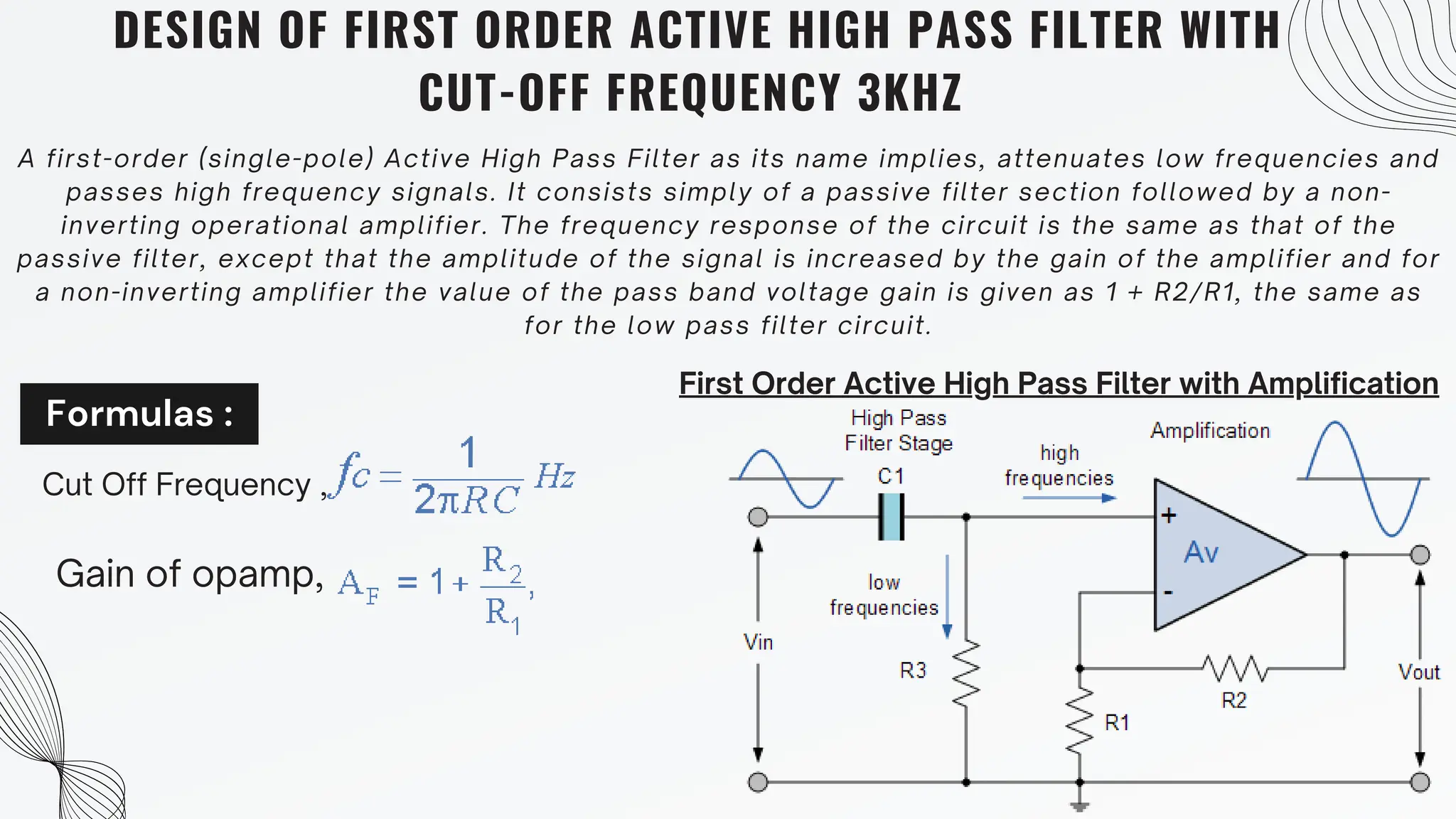
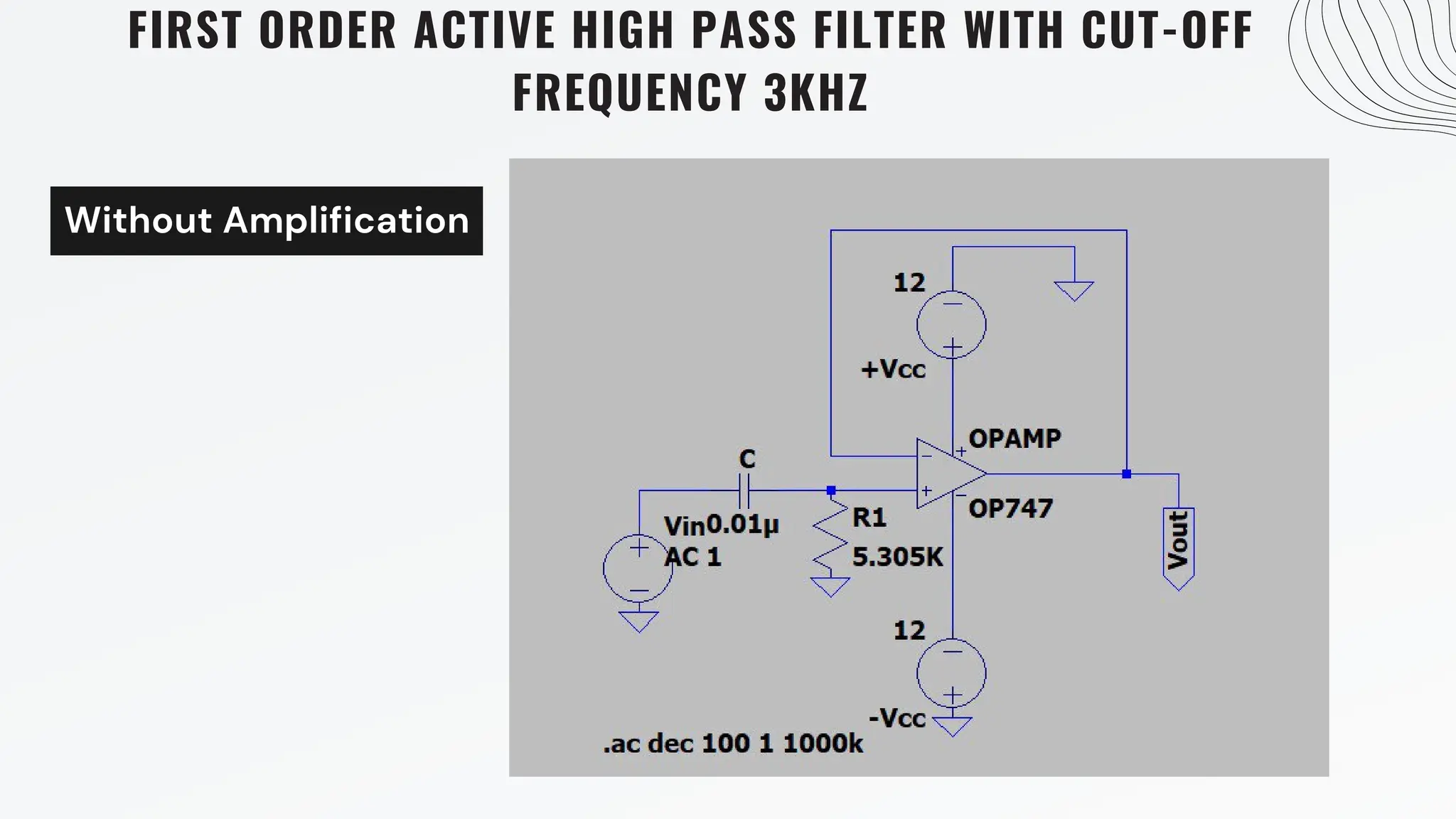
A first-order (single-pole) Active High Pass Filter as its name implies, attenuates low frequencies and
passes high frequency signals. It consists simply of a passive filter section followed by a non-
inverting operational amplifier. The frequency response of the circuit is the same as that of the
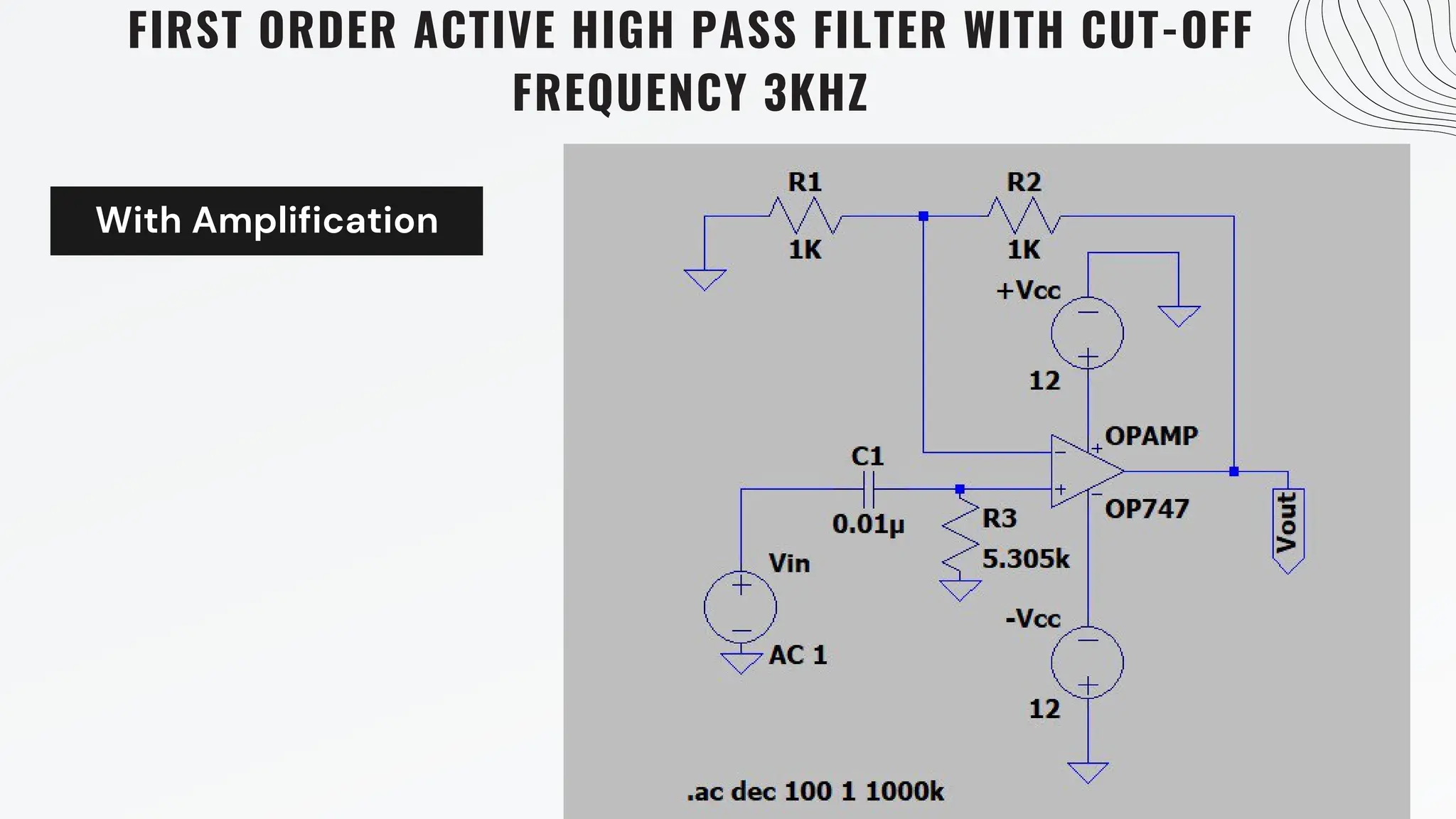
passive filter, except that the amplitude of the signal is increased by the gain of the amplifier and for
a non-inverting amplifier the value of the pass band voltage gain is given as 1 + R2/R1, the same as
for the low pass filter circuit.
First Order Active High Pass Filter with Amplification
Cut Off Frequency ,
Gain of opamp,
CALCULATIONS
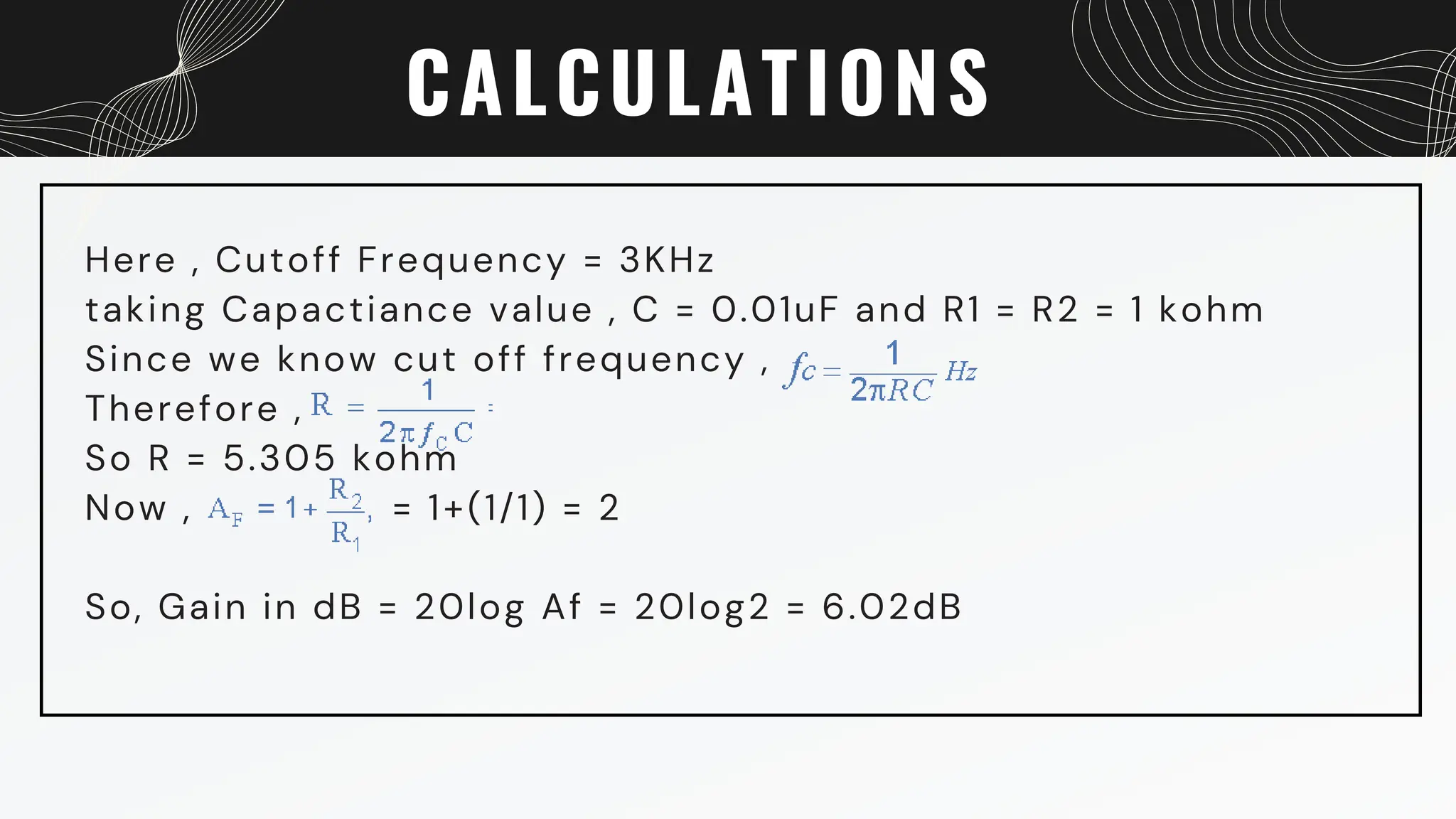
Here , Cutoff Frequency = 3KHz
taking Capactiance value , C = 0.01uF and R1 = R2 = 1 kohm
Since we know cut off frequency ,
Therefore ,
So R = 5.305 kohm
Now , = 1+(1/1) = 2
So, Gain in dB = 20log Af = 20log2 = 6.02dB
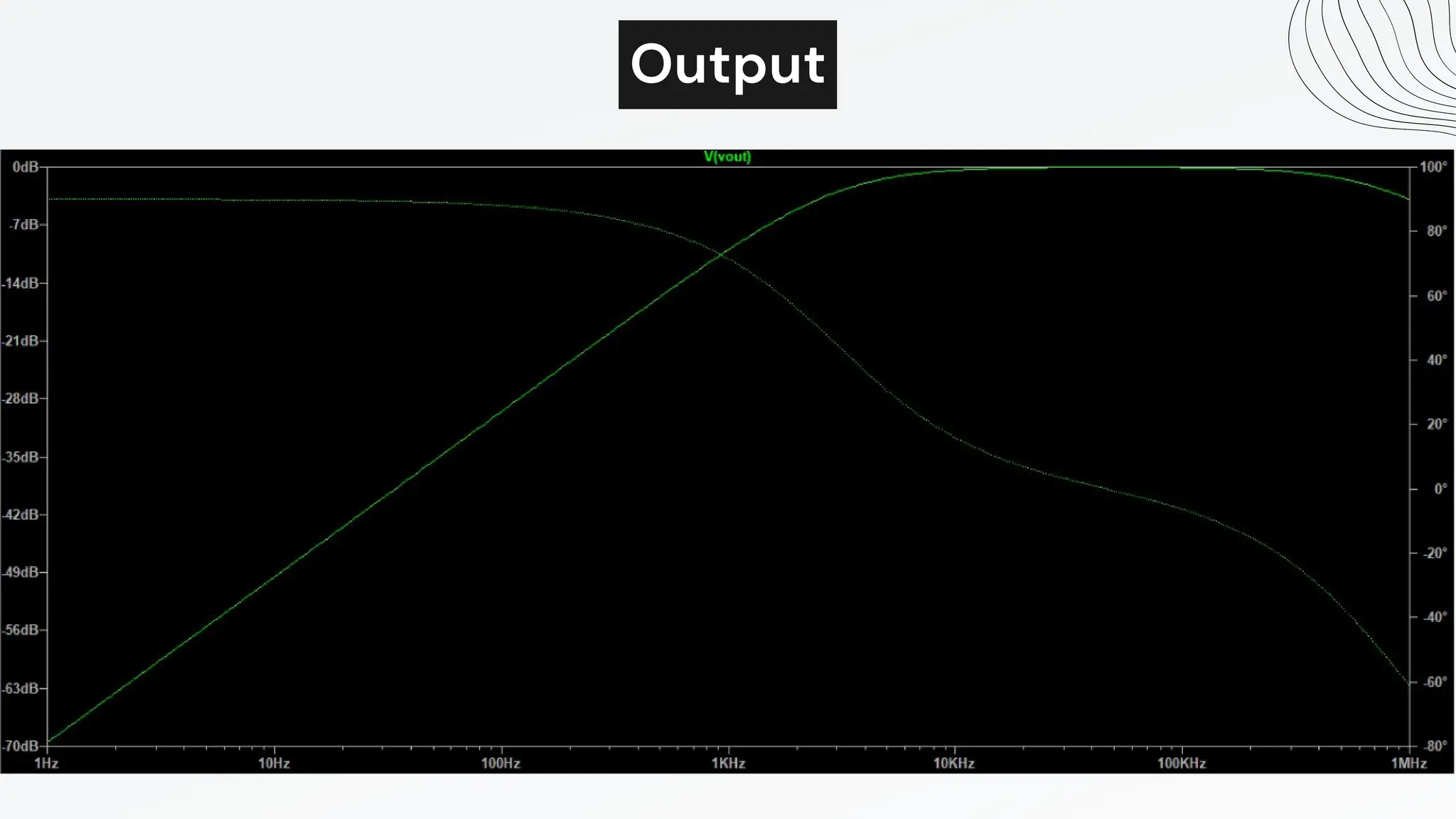
Without Amplification
FIRST ORDER ACTIVE HIGH PASS FILTER WITH CUT-OFF
FREQUENCY 3KHZ
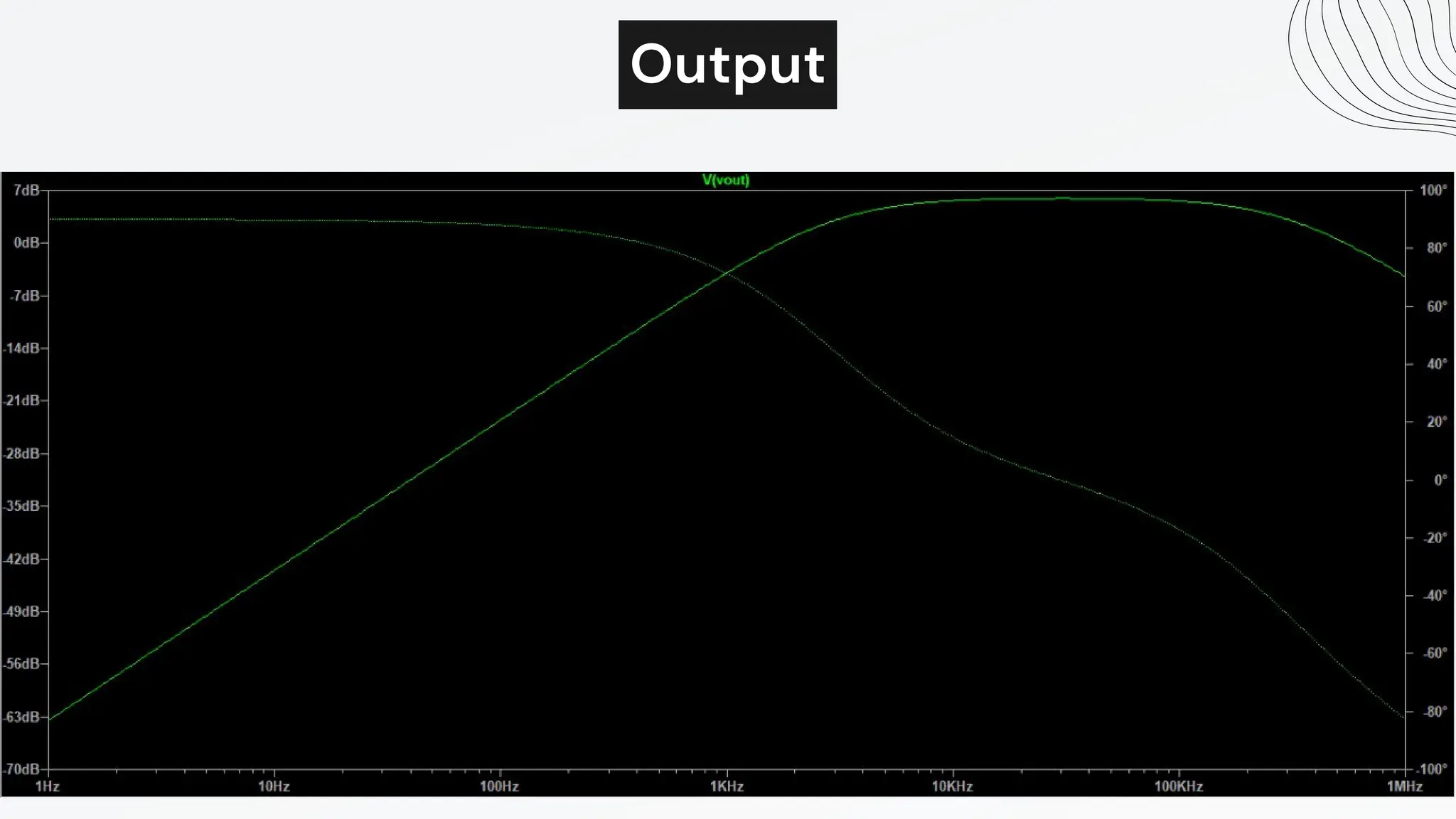
Output
With Amplification
FIRST ORDER ACTIVE HIGH PASS FILTER WITH CUT-OFF
FREQUENCY 3KHZ
Output
Formulas :
DESIGN OF SECOND ORDER ACTIVE HIGH PASS FILTER WITH
CUT-OFF FREQUENCY 3KHZ
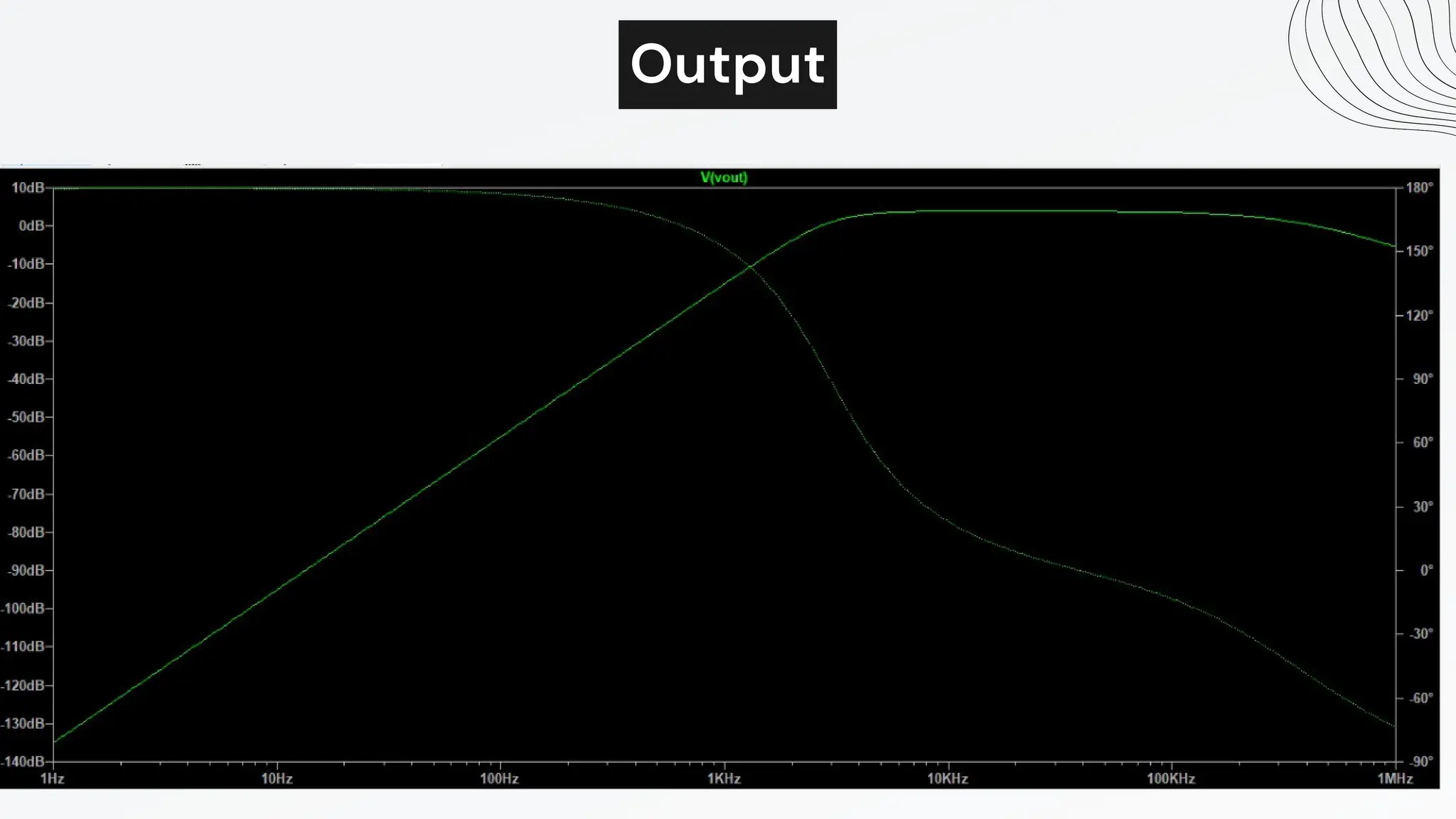
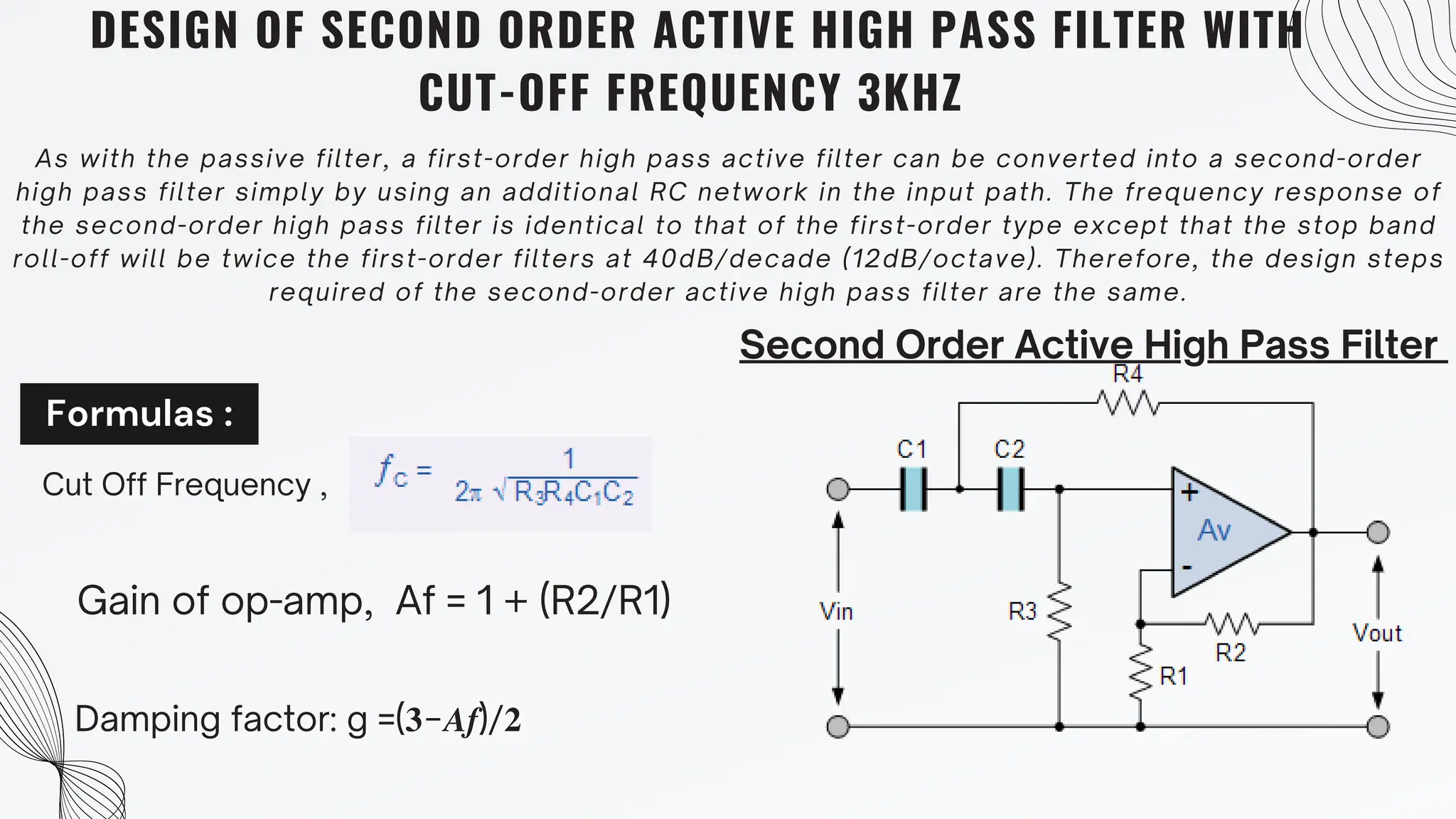
As with the passive filter, a first-order high pass active filter can be converted into a second-order
high pass filter simply by using an additional RC network in the input path. The frequency response of
the second-order high pass filter is identical to that of the first-order type except that the stop band
roll-off will be twice the first-order filters at 40dB/decade (12dB/octave). Therefore, the design steps
required of the second-order active high pass filter are the same.
Second Order Active High Pass Filter
Cut Off Frequency ,
Gain of op-amp, Af = 1 + (R2/R1)
Damping factor: g =(𝟑−𝑨𝒇)/𝟐
CALCULATIONS
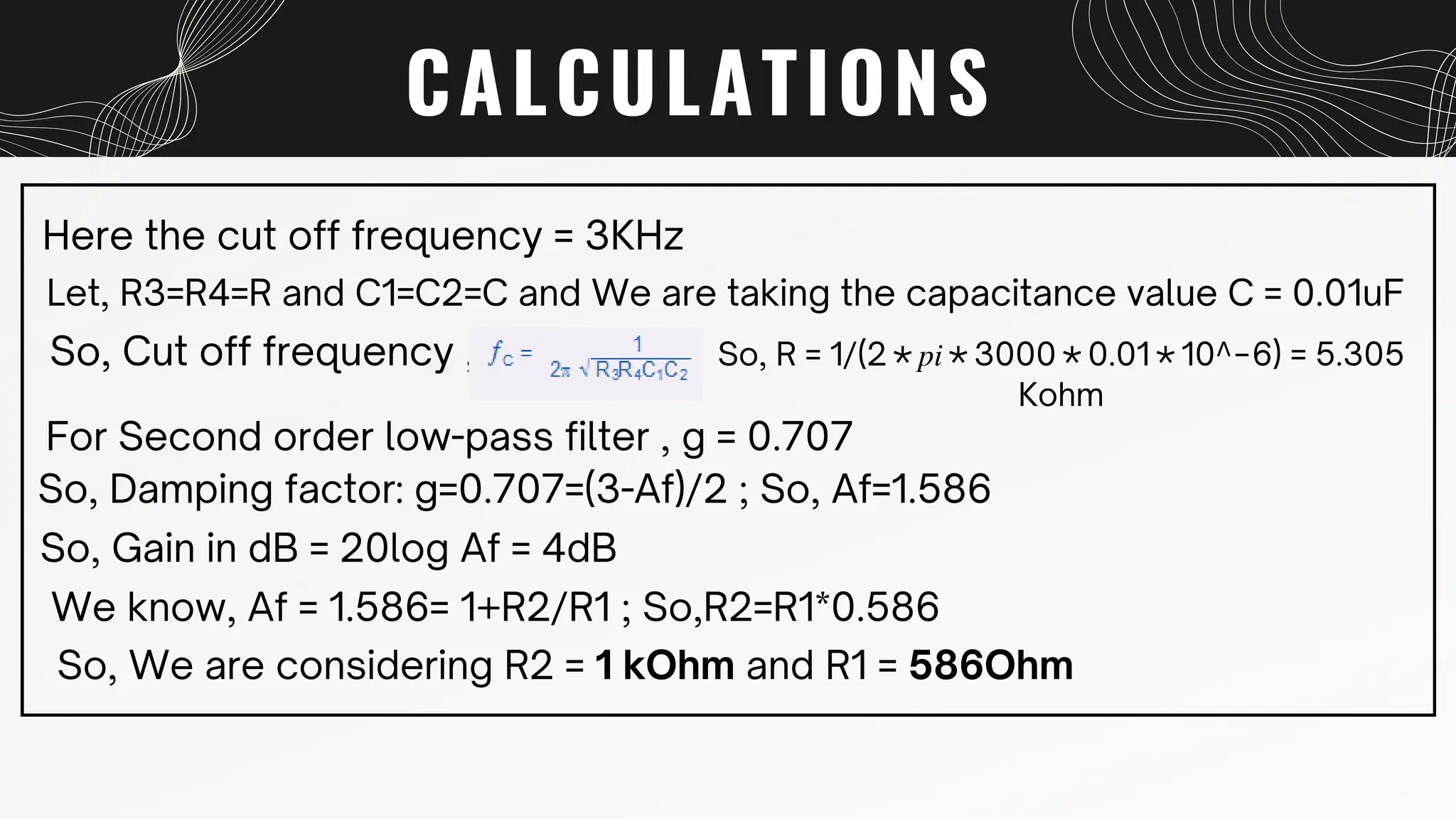
Here the cut off frequency = 3KHz
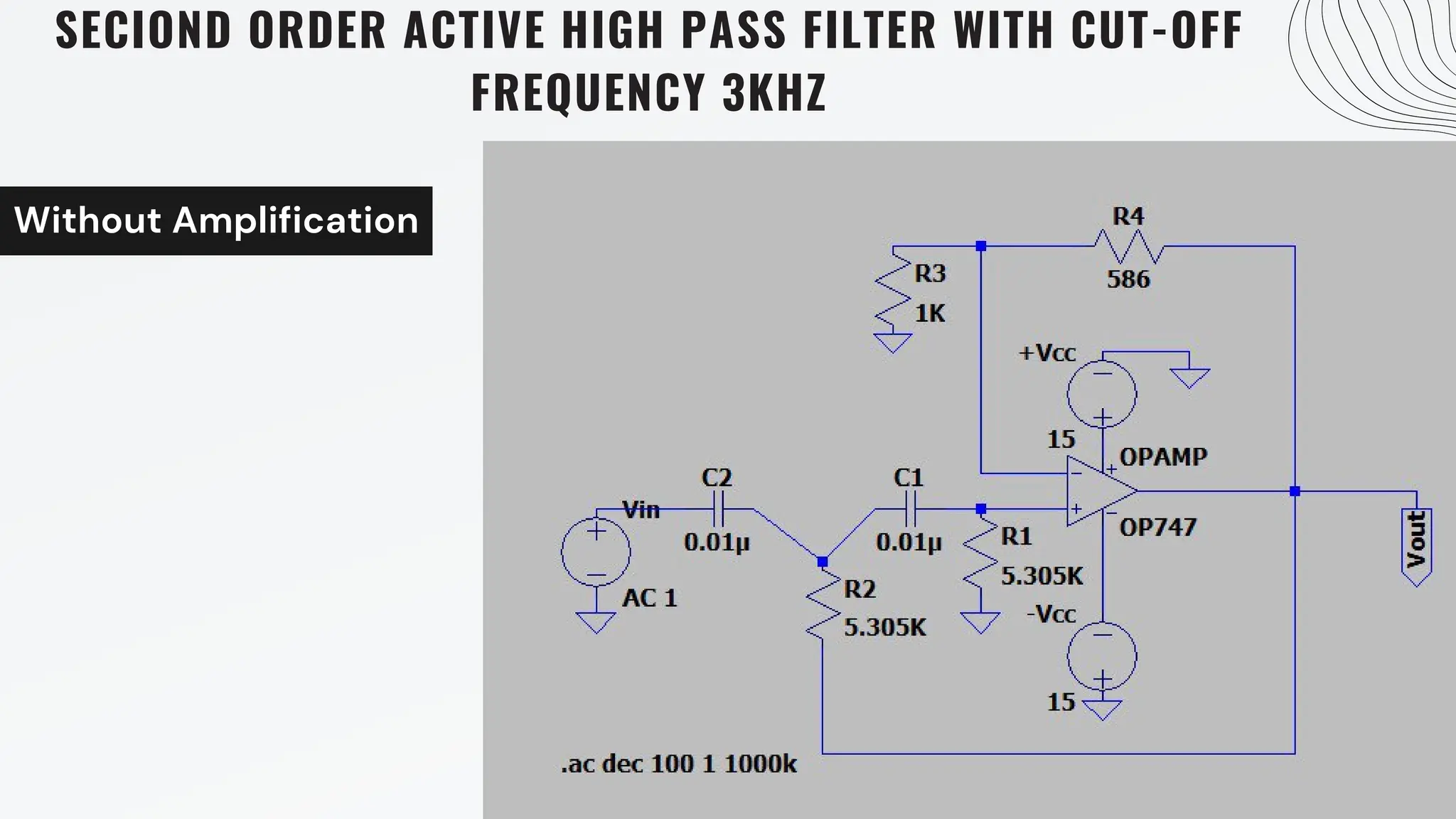
Let, R3=R4=R and C1=C2=C and We are taking the capacitance value C = 0.01uF
So, Cut off frequency , So, R = 1/(2∗𝑝𝑖∗3000∗0.01∗10^−6) = 5.305
Kohm
For Second order low-pass filter , g = 0.707
So, Damping factor: g=0.707=(3-Af)/2 ; So, Af=1.586
So, Gain in dB = 20log Af = 4dB
We know, Af = 1.586= 1+R2/R1 ; So,R2=R1*0.586
So, We are considering R2 = 1 kOhm and R1 = 586Ohm
Without Amplification
SECIOND ORDER ACTIVE HIGH PASS FILTER WITH CUT-OFF
FREQUENCY 3KHZ
Output
DISCUSSIONS
The first-order active high pass filter provides a simple yet effective solution for
filtering out low-frequency signals while allowing high-frequency signals to pass
through. With its straightforward design consisting of just one capacitor and one
resistor, it offers ease of implementation and low cost. However, its roll-off rate
of 20 dB/decade limits its effectiveness in applications requiring steep cutoff
slopes. Nonetheless, for many audio and basic signal conditioning applications,
the first-order active high pass filter proves to be a versatile and reliable choice.
In contrast, the second-order active high pass filter offers a more advanced
solution with a steeper roll-off rate of 40 dB/decade, making it suitable for
applications demanding greater attenuation of low-frequency signals. By
incorporating additional reactive components, such as capacitors and inductors,
this filter achieves enhanced performance in terms of frequency response and
filtering characteristics. Despite being more complex to design and implement
compared to the first-order counterpart, the second-order active high pass filter
is preferred in applications where tighter control over frequency response and
better rejection of unwanted signals are crucial.
THANK'S FOR
WATCHING

Electronic Design/Mini Project workshop (6).pdf

  • 1.
    MINI PROJECT ELECTRONIC DESIGNWORKSHOP PRESENTED BY :- Topic : Design of 3khz High Pass Filter Amit Kumar (ECE/2021/10) Anuragsinh Singh(ECE/2021/18) Abhradeep Kanrar(ECE/2021/20) Sk. Asfakur Rahaman (ECE/2021/23) Romit Raj Singh (ECE/2021/24) Sagnik Sanyal(ECE/2021/26)
  • 2.
    CONTENT 01 02 03 04 WHAT IS AFILTER? DESIGN OF FIRST ORDER ACTIVE HIGH PASS FILTER WITH CUT-OFF FREQUENCY 3KHZ DESIGN OF SECOND ORDER ACTIVE HIGH PASS FILTER WITH CUT-OFF FREQUENCY 3KHZ DISCUSSIONS
  • 3.
    WHAT IS AFILTER? A filter is a circuit capable of passing (or amplifying) certain frequencies while attenuating other frequencies. Thus, a filter can extract important frequencies from signals that also contain undesirable or irrelevant frequencies. Different types of filters are:
  • 4.
    Formulas : DESIGN OFFIRST ORDER ACTIVE HIGH PASS FILTER WITH CUT-OFF FREQUENCY 3KHZ A first-order (single-pole) Active High Pass Filter as its name implies, attenuates low frequencies and passes high frequency signals. It consists simply of a passive filter section followed by a non- inverting operational amplifier. The frequency response of the circuit is the same as that of the passive filter, except that the amplitude of the signal is increased by the gain of the amplifier and for a non-inverting amplifier the value of the pass band voltage gain is given as 1 + R2/R1, the same as for the low pass filter circuit. First Order Active High Pass Filter with Amplification Cut Off Frequency , Gain of opamp,
  • 5.
    CALCULATIONS Here , CutoffFrequency = 3KHz taking Capactiance value , C = 0.01uF and R1 = R2 = 1 kohm Since we know cut off frequency , Therefore , So R = 5.305 kohm Now , = 1+(1/1) = 2 So, Gain in dB = 20log Af = 20log2 = 6.02dB
  • 6.
    Without Amplification FIRST ORDERACTIVE HIGH PASS FILTER WITH CUT-OFF FREQUENCY 3KHZ
  • 7.
  • 8.
    With Amplification FIRST ORDERACTIVE HIGH PASS FILTER WITH CUT-OFF FREQUENCY 3KHZ
  • 9.
  • 10.
    Formulas : DESIGN OFSECOND ORDER ACTIVE HIGH PASS FILTER WITH CUT-OFF FREQUENCY 3KHZ As with the passive filter, a first-order high pass active filter can be converted into a second-order high pass filter simply by using an additional RC network in the input path. The frequency response of the second-order high pass filter is identical to that of the first-order type except that the stop band roll-off will be twice the first-order filters at 40dB/decade (12dB/octave). Therefore, the design steps required of the second-order active high pass filter are the same. Second Order Active High Pass Filter Cut Off Frequency , Gain of op-amp, Af = 1 + (R2/R1) Damping factor: g =(𝟑−𝑨𝒇)/𝟐
  • 11.
    CALCULATIONS Here the cutoff frequency = 3KHz Let, R3=R4=R and C1=C2=C and We are taking the capacitance value C = 0.01uF So, Cut off frequency , So, R = 1/(2∗𝑝𝑖∗3000∗0.01∗10^−6) = 5.305 Kohm For Second order low-pass filter , g = 0.707 So, Damping factor: g=0.707=(3-Af)/2 ; So, Af=1.586 So, Gain in dB = 20log Af = 4dB We know, Af = 1.586= 1+R2/R1 ; So,R2=R1*0.586 So, We are considering R2 = 1 kOhm and R1 = 586Ohm
  • 12.
    Without Amplification SECIOND ORDERACTIVE HIGH PASS FILTER WITH CUT-OFF FREQUENCY 3KHZ
  • 13.
  • 14.
    DISCUSSIONS The first-order activehigh pass filter provides a simple yet effective solution for filtering out low-frequency signals while allowing high-frequency signals to pass through. With its straightforward design consisting of just one capacitor and one resistor, it offers ease of implementation and low cost. However, its roll-off rate of 20 dB/decade limits its effectiveness in applications requiring steep cutoff slopes. Nonetheless, for many audio and basic signal conditioning applications, the first-order active high pass filter proves to be a versatile and reliable choice. In contrast, the second-order active high pass filter offers a more advanced solution with a steeper roll-off rate of 40 dB/decade, making it suitable for applications demanding greater attenuation of low-frequency signals. By incorporating additional reactive components, such as capacitors and inductors, this filter achieves enhanced performance in terms of frequency response and filtering characteristics. Despite being more complex to design and implement compared to the first-order counterpart, the second-order active high pass filter is preferred in applications where tighter control over frequency response and better rejection of unwanted signals are crucial.
  • 15.