Electronic Access and Research
Efficiencies – Some Preliminary Findings
     from the University of Tennessee
   Library’s Return on Investment ROI
                 Analysis

      Electronic Resources & Libraries
              February 1, 2010
          Gayle Baker & Ken Wise
Talk Outline
    Phase I Return-on-investment (ROI)
     project at University of Illinois, Urbana-
     Champaign
    Phase II ROI project
    Results at University of Tennessee
    Phase III
Phase I - Goal
   Demonstrate role of library information
    resources in generating research grant
    income for the institution.
       For every monetary unit spent on the library,
        the university receives “X” monetary units in
        return
Phase I - Data
   Faculty – Survey (quantitative and
    qualitative)
   Grant proposals – University-supplied data,
    faculty survey
   Grant income – University-supplied data
   Library – Total budget (including collections,
    facilities, personnel, etc.)
   Administrative priorities – Personal
    interviews
Phase I
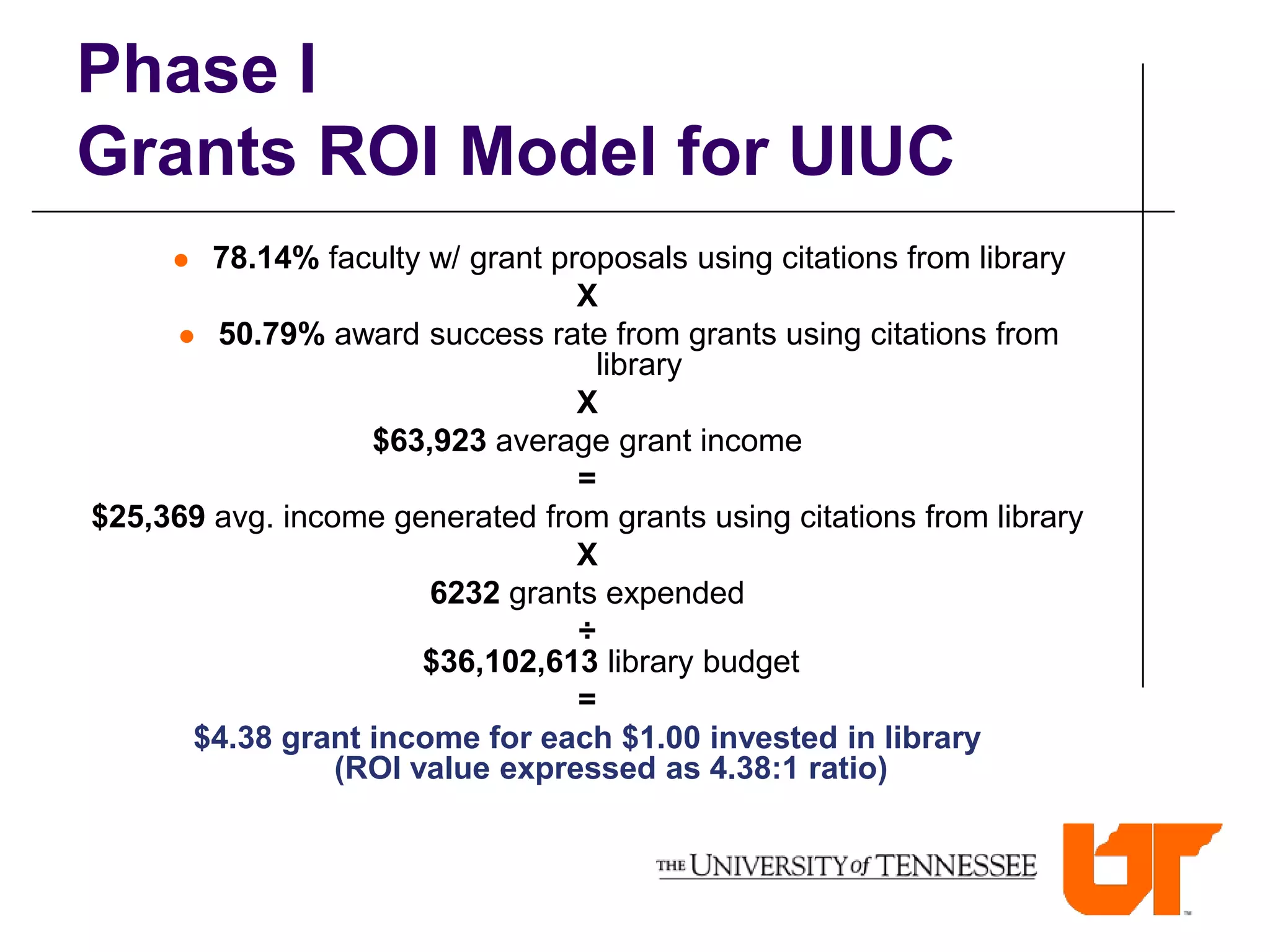
Grants ROI Model for UIUC
       78.14% faculty w/ grant proposals using citations from library
                                  X
      50.79% award success rate from grants using citations from
                                    library
                                  X
                   $63,923 average grant income
                                  =
$25,369 avg. income generated from grants using citations from library
                                  X
                       6232 grants expended
                                  ÷
                       $36,102,613 library budget
                                  =
      $4.38 grant income for each $1.00 invested in library
                 (ROI value expressed as 4.38:1 ratio)
Phase I - ROI Project
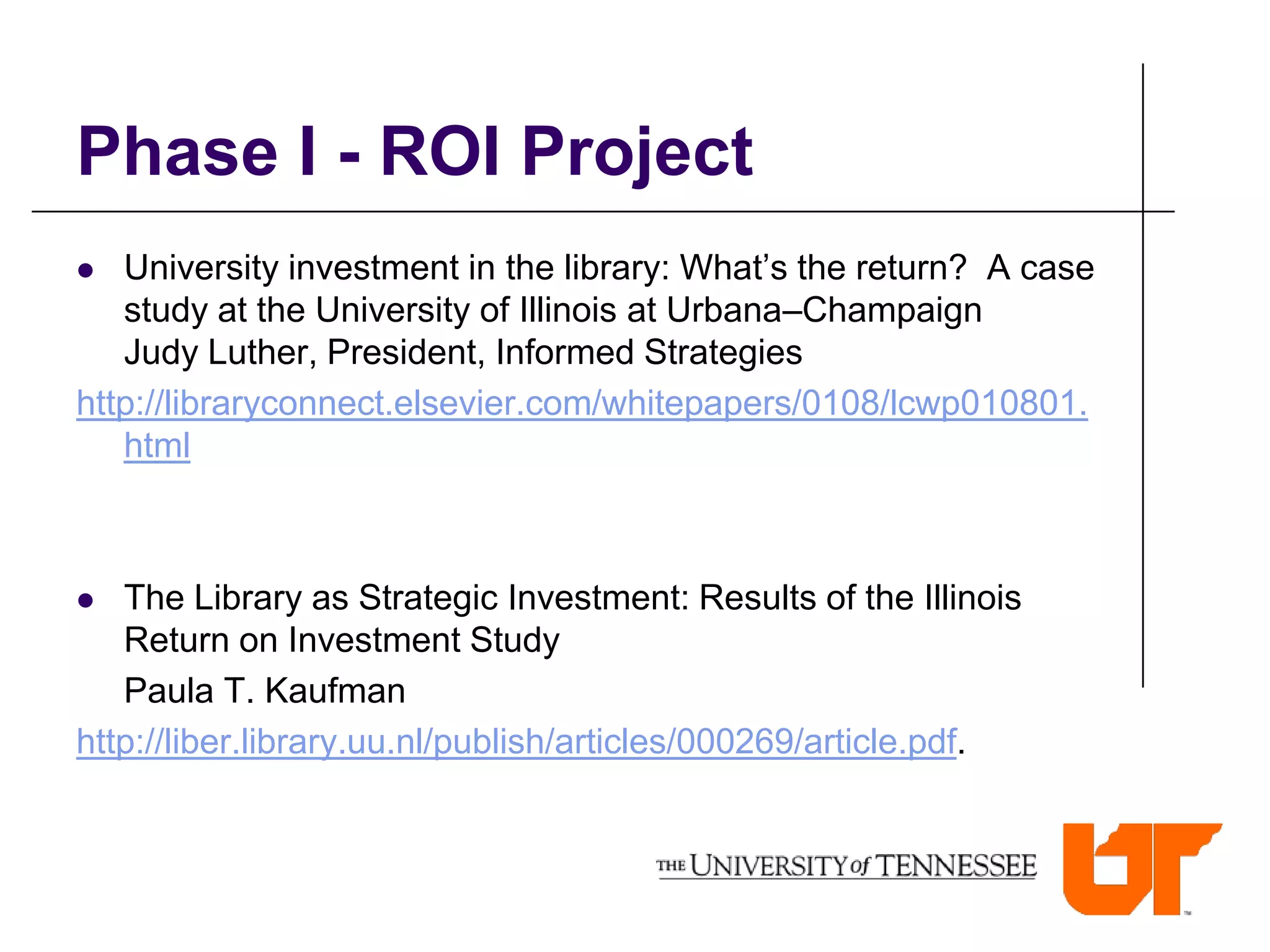
  University investment in the library: What’s the return? A case
   study at the University of Illinois at Urbana–Champaign
   Judy Luther, President, Informed Strategies
http://libraryconnect.elsevier.com/whitepapers/0108/lcwp010801.
   html


  The Library as Strategic Investment: Results of the Illinois
   Return on Investment Study
   Paula T. Kaufman
http://liber.library.uu.nl/publish/articles/000269/article.pdf.
Phase II
   To test Phase I methodology
   8 institutions in 8 different countries
Phase II Results
   Faculty Survey
   Grant ROI
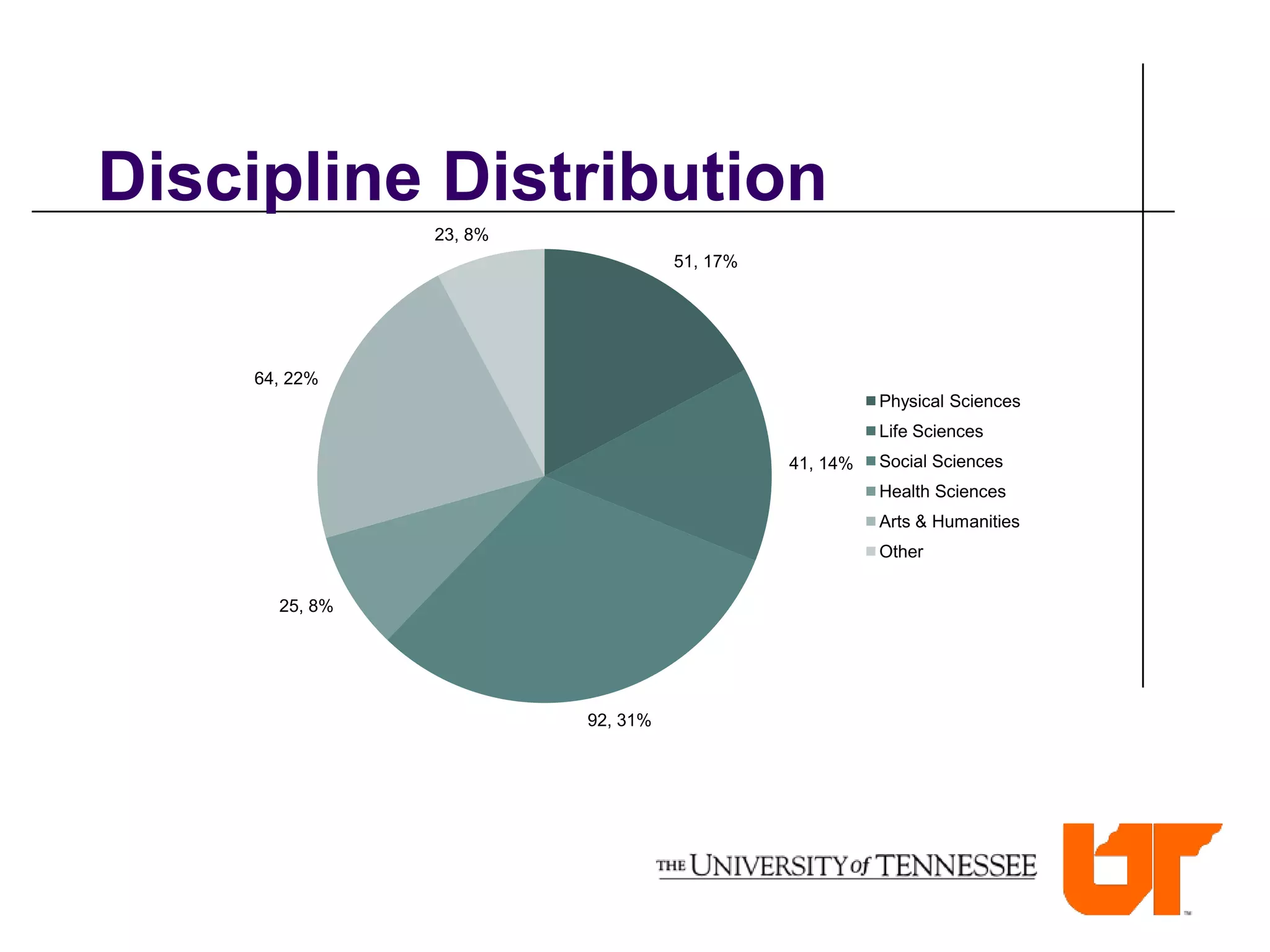
Discipline Distribution
               23, 8%
                                  51, 17%


    64, 22%
                                                      Physical Sciences
                                                      Life Sciences
                                            41, 14%   Social Sciences
                                                      Health Sciences
                                                      Arts & Humanities
                                                      Other


      25, 8%


                        92, 31%
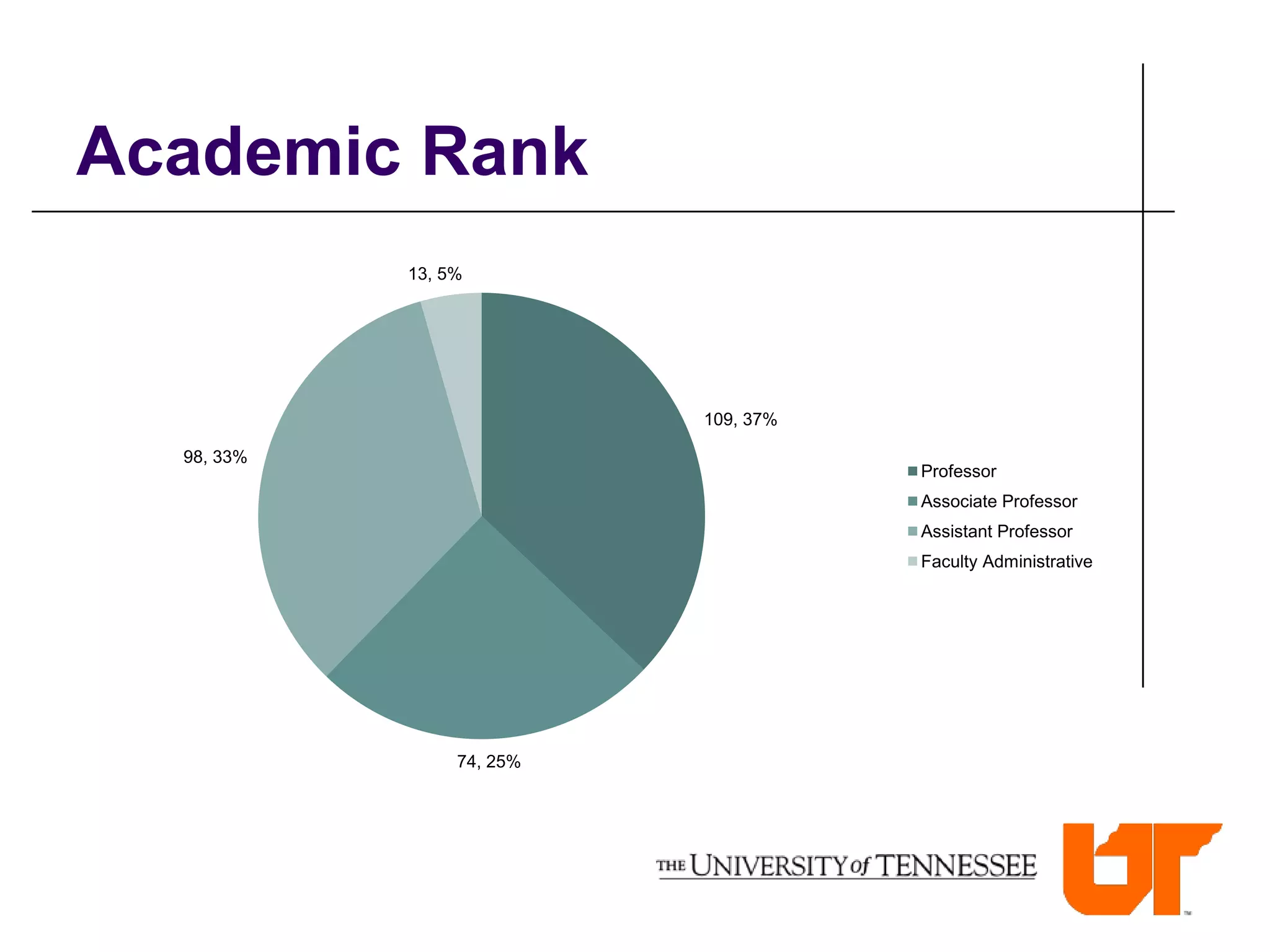
Academic Rank
            13, 5%


                           109, 37%

  98, 33%
                                      Professor
                                      Associate Professor
                                      Assistant Professor
                                      Faculty Administrative


                 74, 25%
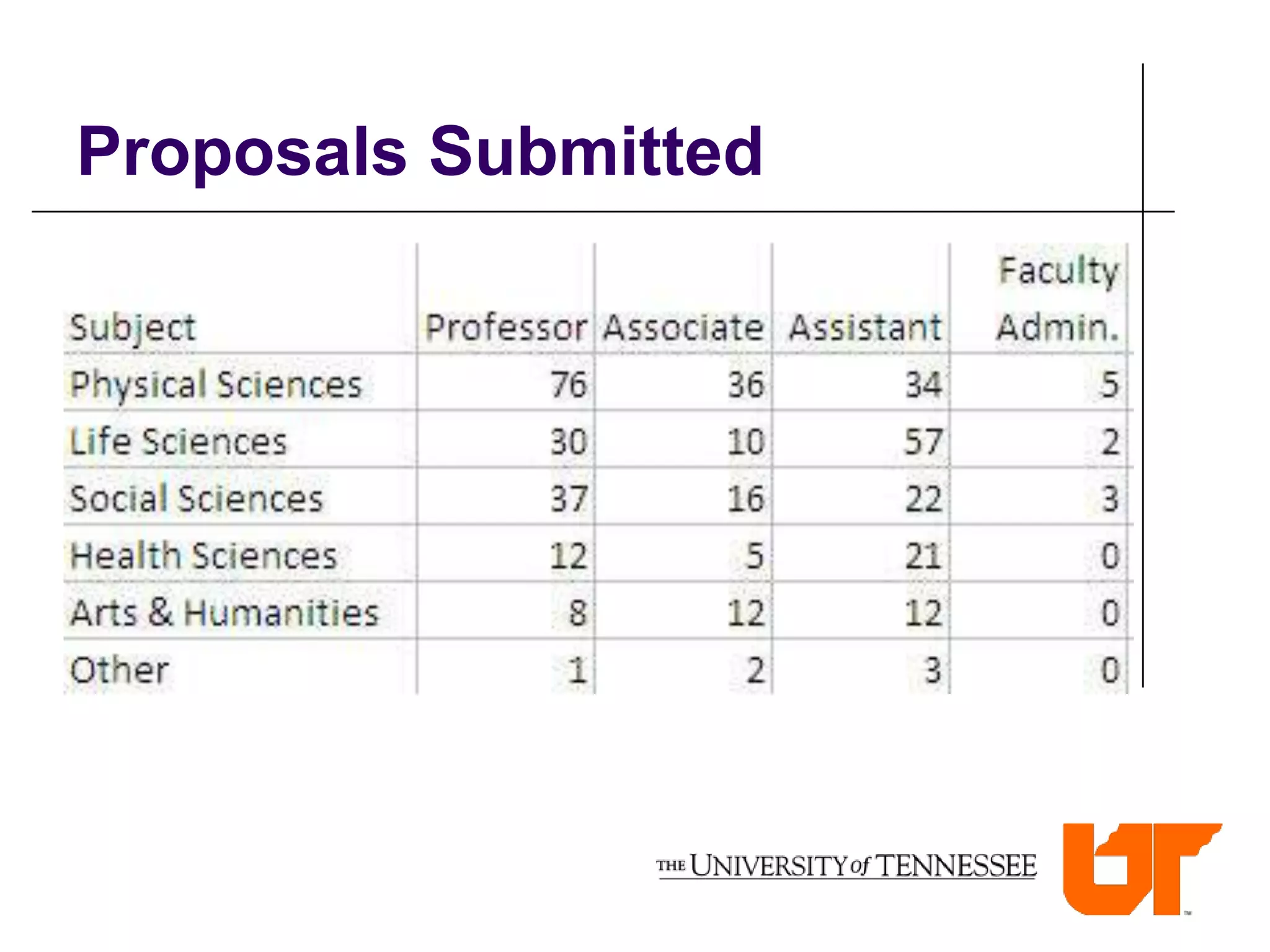
Proposals Submitted
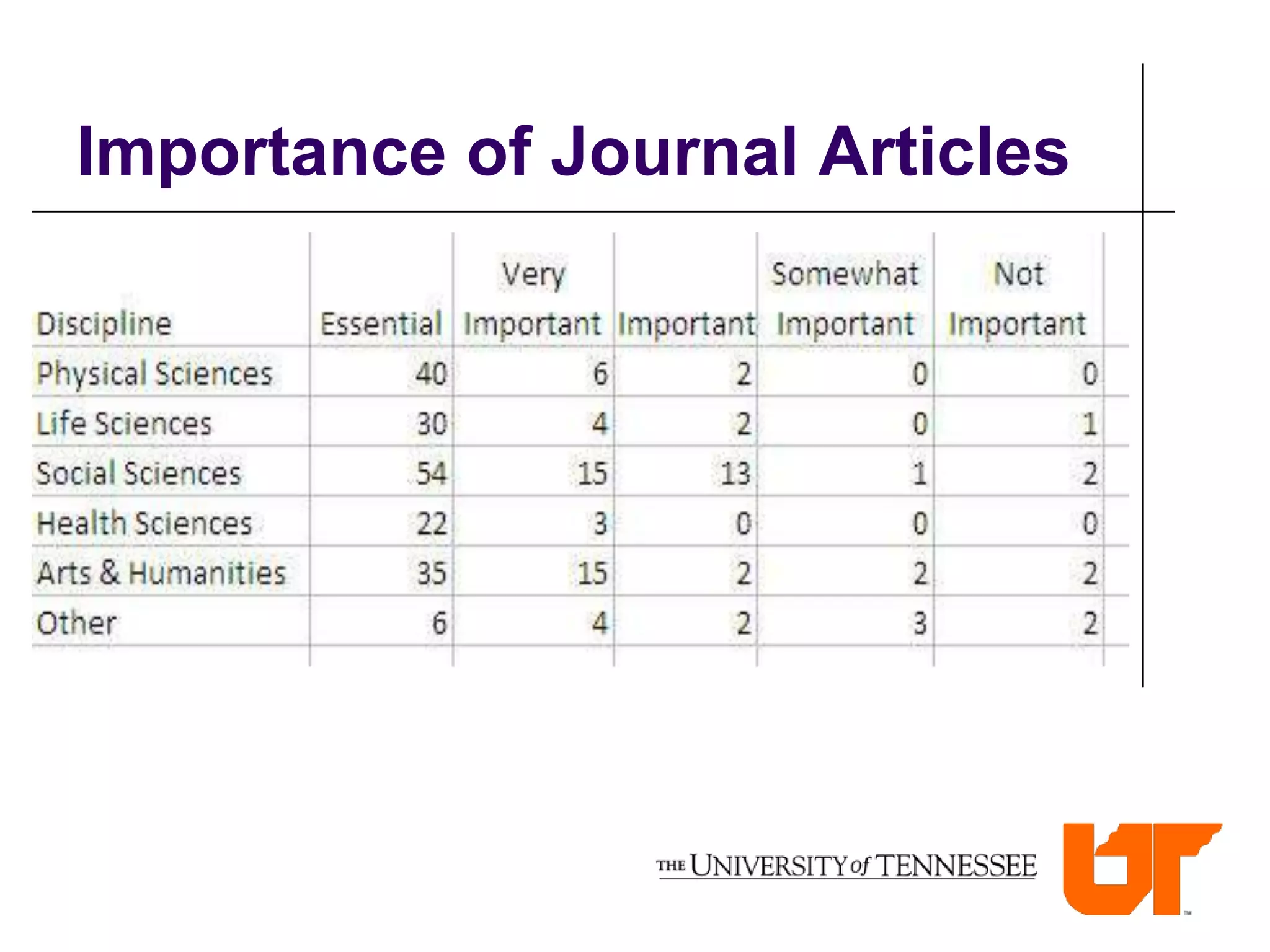
Importance of Journal Articles
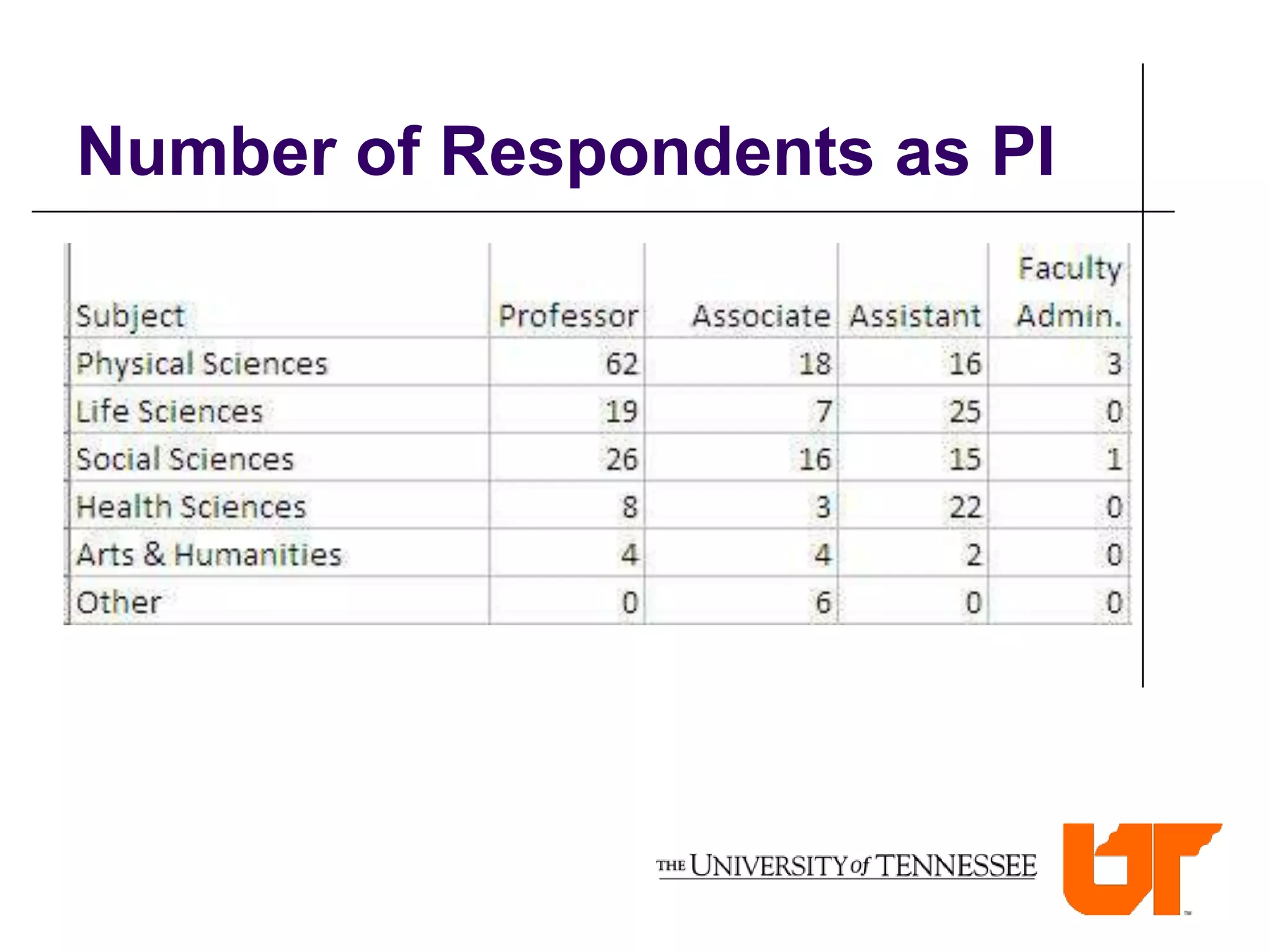
Number of Respondents as PI
Descriptions of coded
responses
   Availability / location
   Efficiency / saves time
   Expands research range
   Timeliness / currency
   Collaboration
   Miscellaneous
   Negative
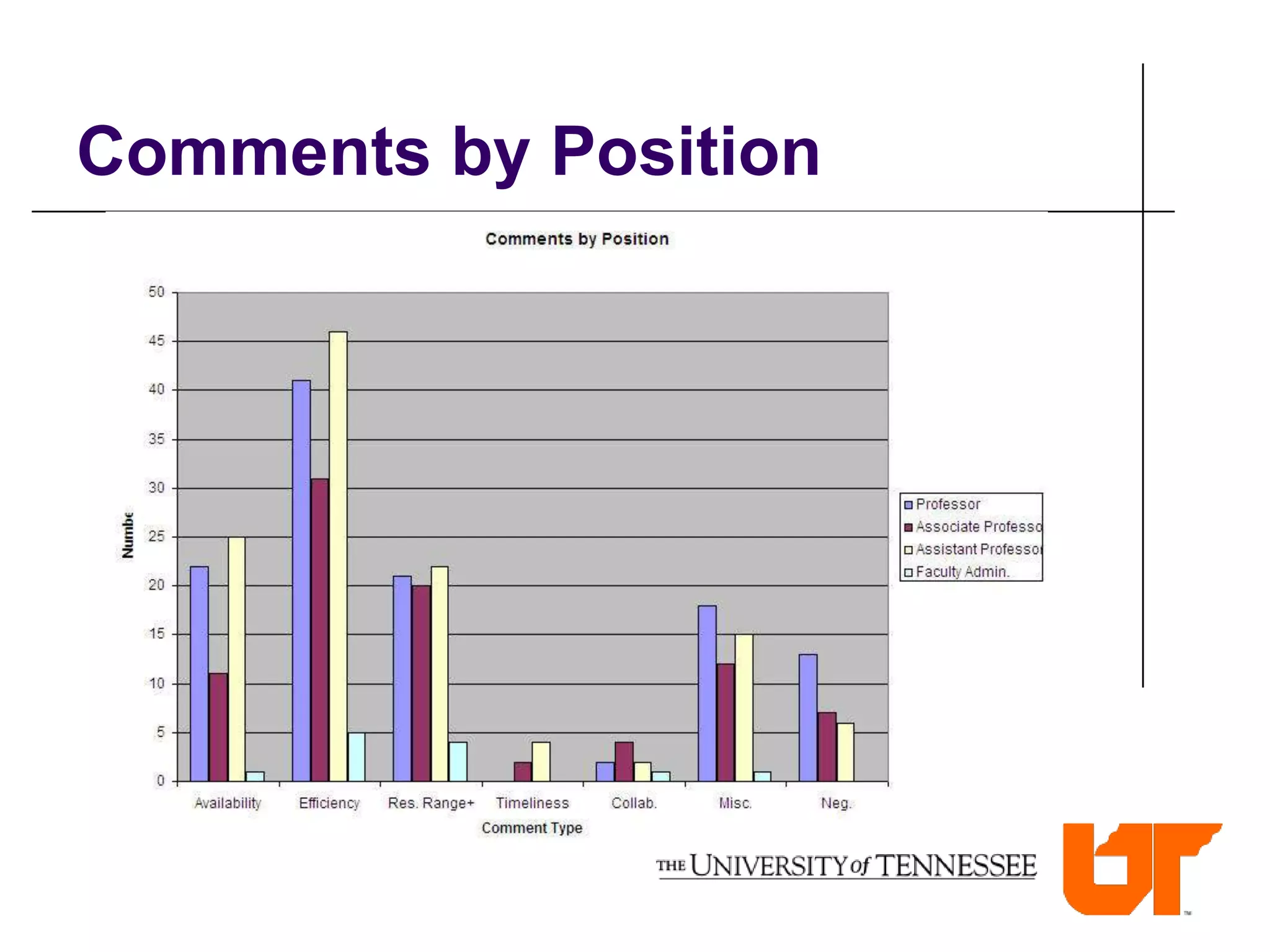
Comments by Position
Comments by Discipline
Examples of comments
   Makes my work significantly more
    efficient. Compared to the time I began
    my career over 25 years ago, I spend
    less than 10% of time on
    finding/accessing information and
    articles. Also, it has likely expanded the
    amount of material available tenfold.
    (Soc. Sci./Admin.)
Examples…
   It has saved me an enormous amount of
    time. Not only is there less need to visit
    the library but because I can get answers
    to questions so quickly I can move on
    with the formulation and re-formulation of
    questions much more rapidly than in the
    past. (Soc. Sci. / Asst. Prof.)
Examples…
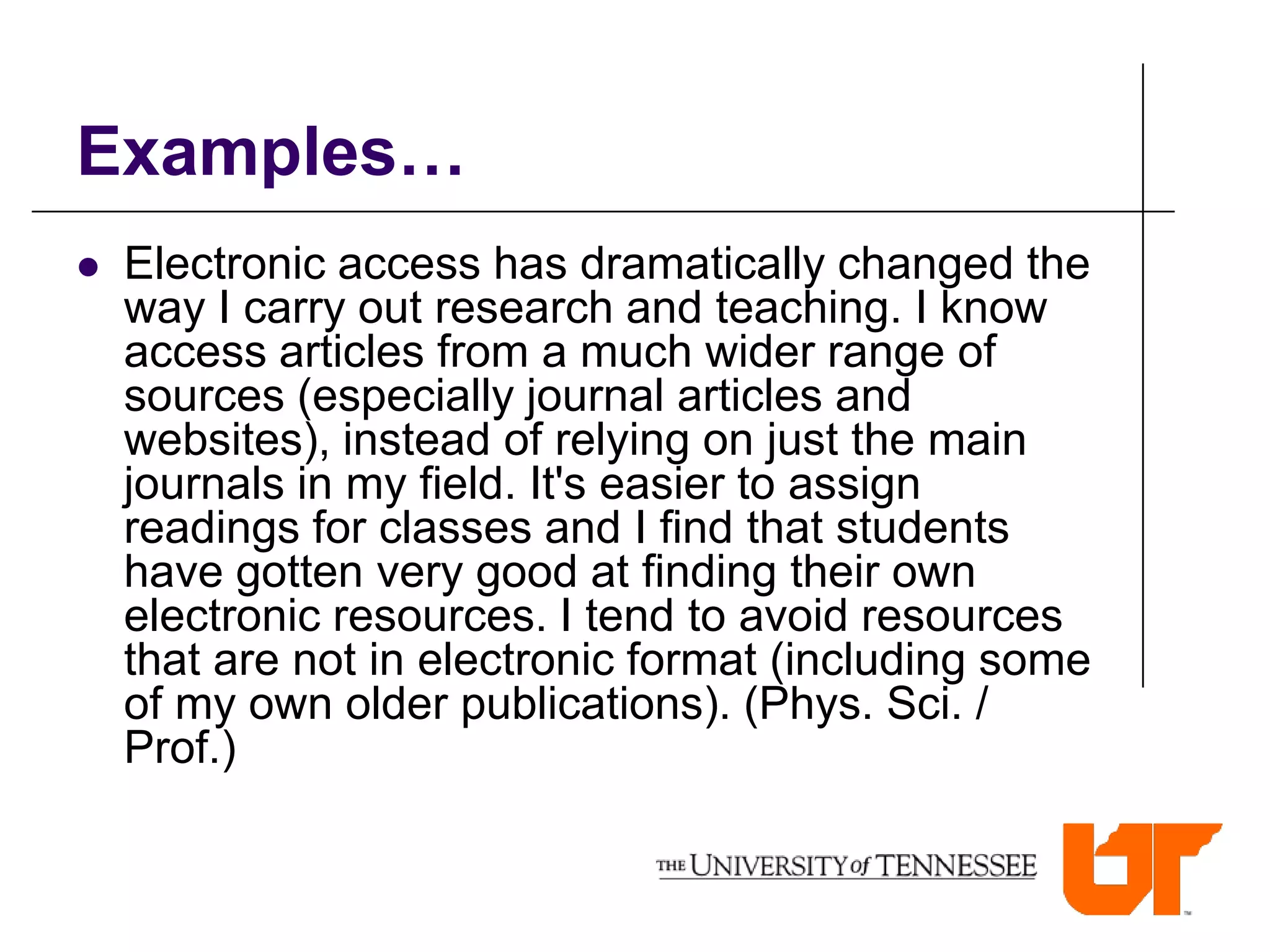
   It has made me much more efficient. I
    can the same work in about 1/10th the
    time. Unfortunately, the literature has
    grown 10-fold, so I am just breaking
    even. I could not keep up with the
    scientific field without electronic access.
    Also much easier to find pertinent
    articles. (Life Sci. / Prof.)
Examples…
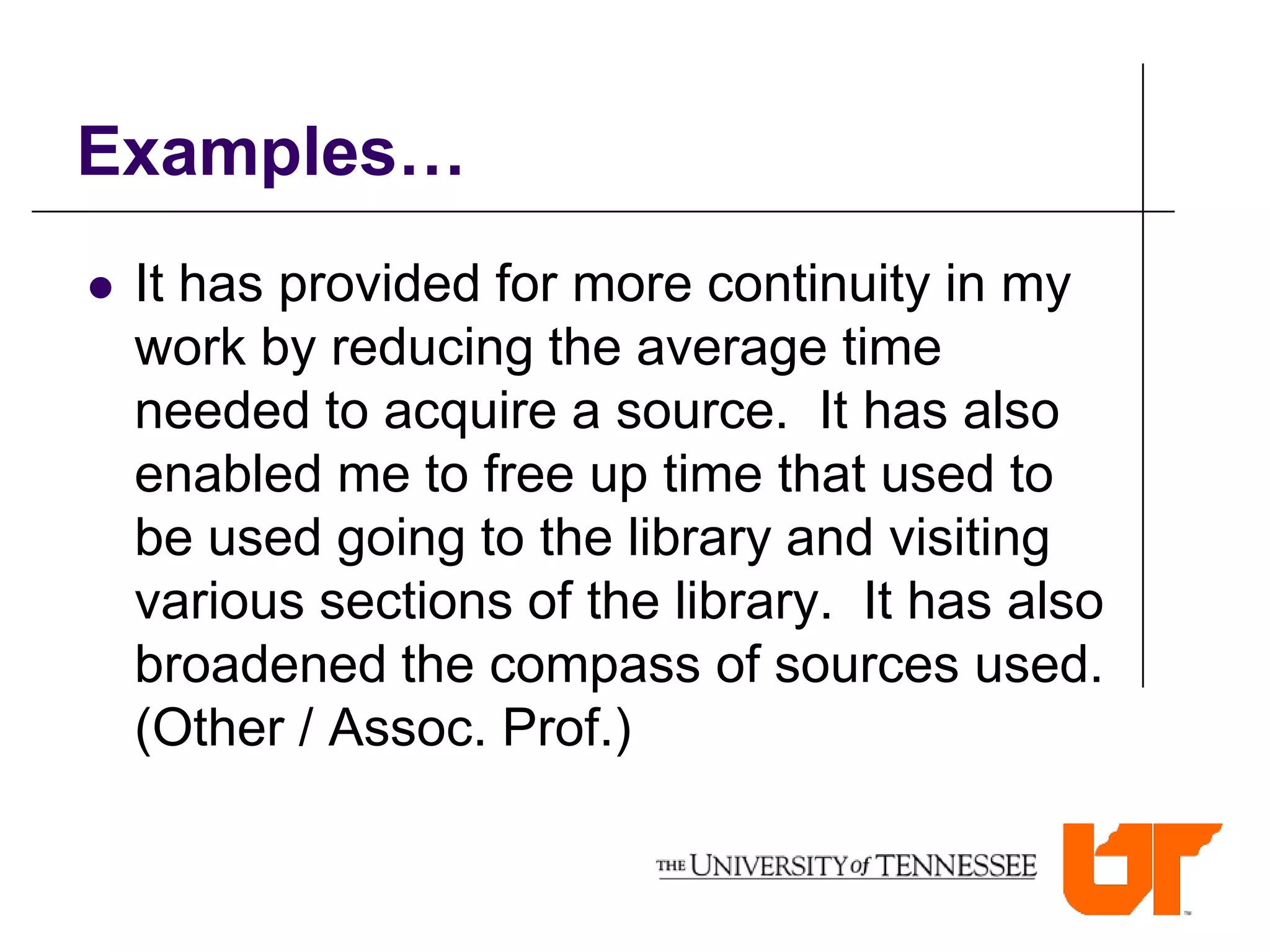
   Electronic access has dramatically changed the
    way I carry out research and teaching. I know
    access articles from a much wider range of
    sources (especially journal articles and
    websites), instead of relying on just the main
    journals in my field. It's easier to assign
    readings for classes and I find that students
    have gotten very good at finding their own
    electronic resources. I tend to avoid resources
    that are not in electronic format (including some
    of my own older publications). (Phys. Sci. /
    Prof.)
Examples…
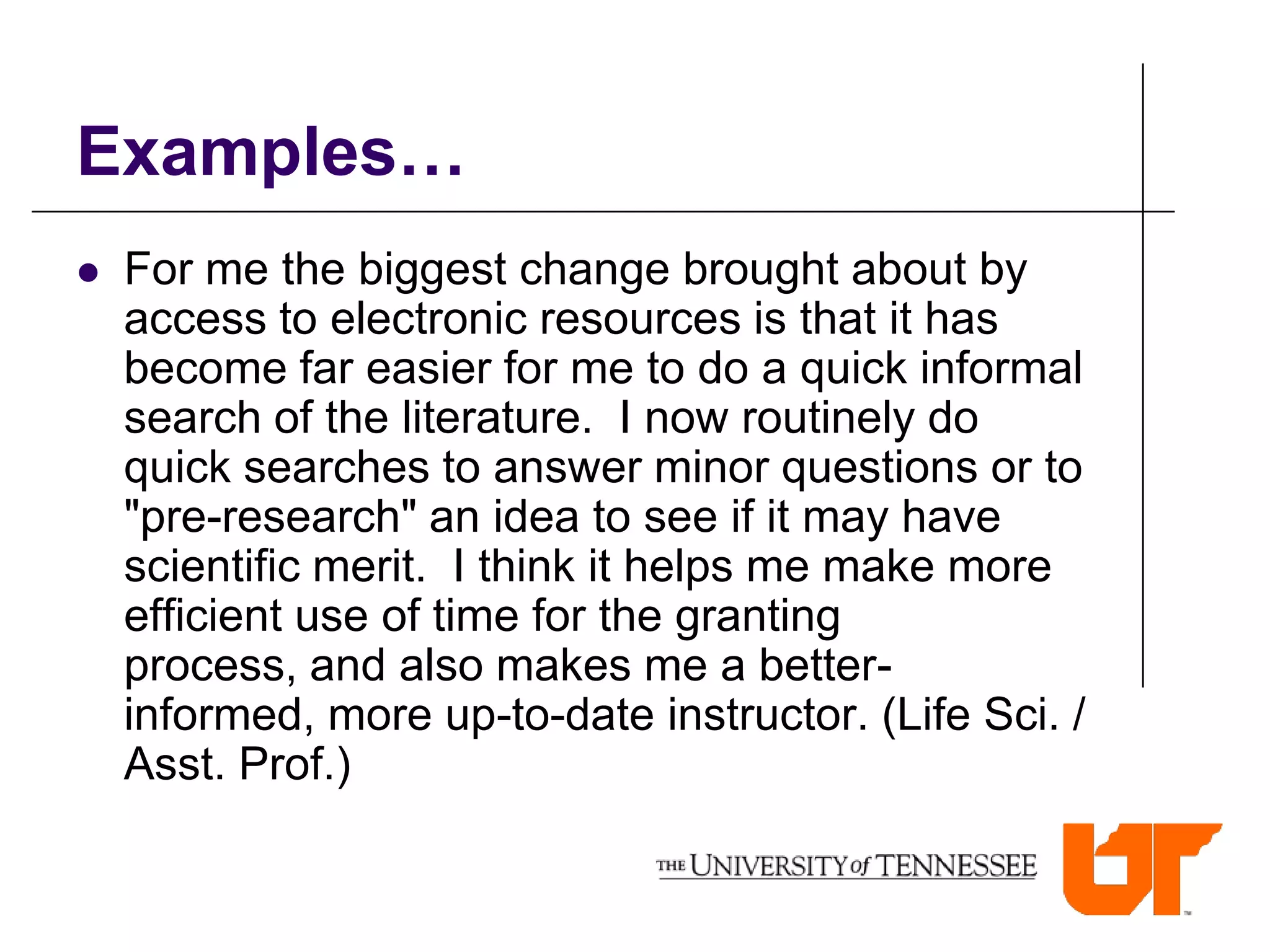
   It has provided for more continuity in my
    work by reducing the average time
    needed to acquire a source. It has also
    enabled me to free up time that used to
    be used going to the library and visiting
    various sections of the library. It has also
    broadened the compass of sources used.
    (Other / Assoc. Prof.)
Examples…
   For me the biggest change brought about by
    access to electronic resources is that it has
    become far easier for me to do a quick informal
    search of the literature. I now routinely do
    quick searches to answer minor questions or to
    "pre-research" an idea to see if it may have
    scientific merit. I think it helps me make more
    efficient use of time for the granting
    process, and also makes me a better-
    informed, more up-to-date instructor. (Life Sci. /
    Asst. Prof.)
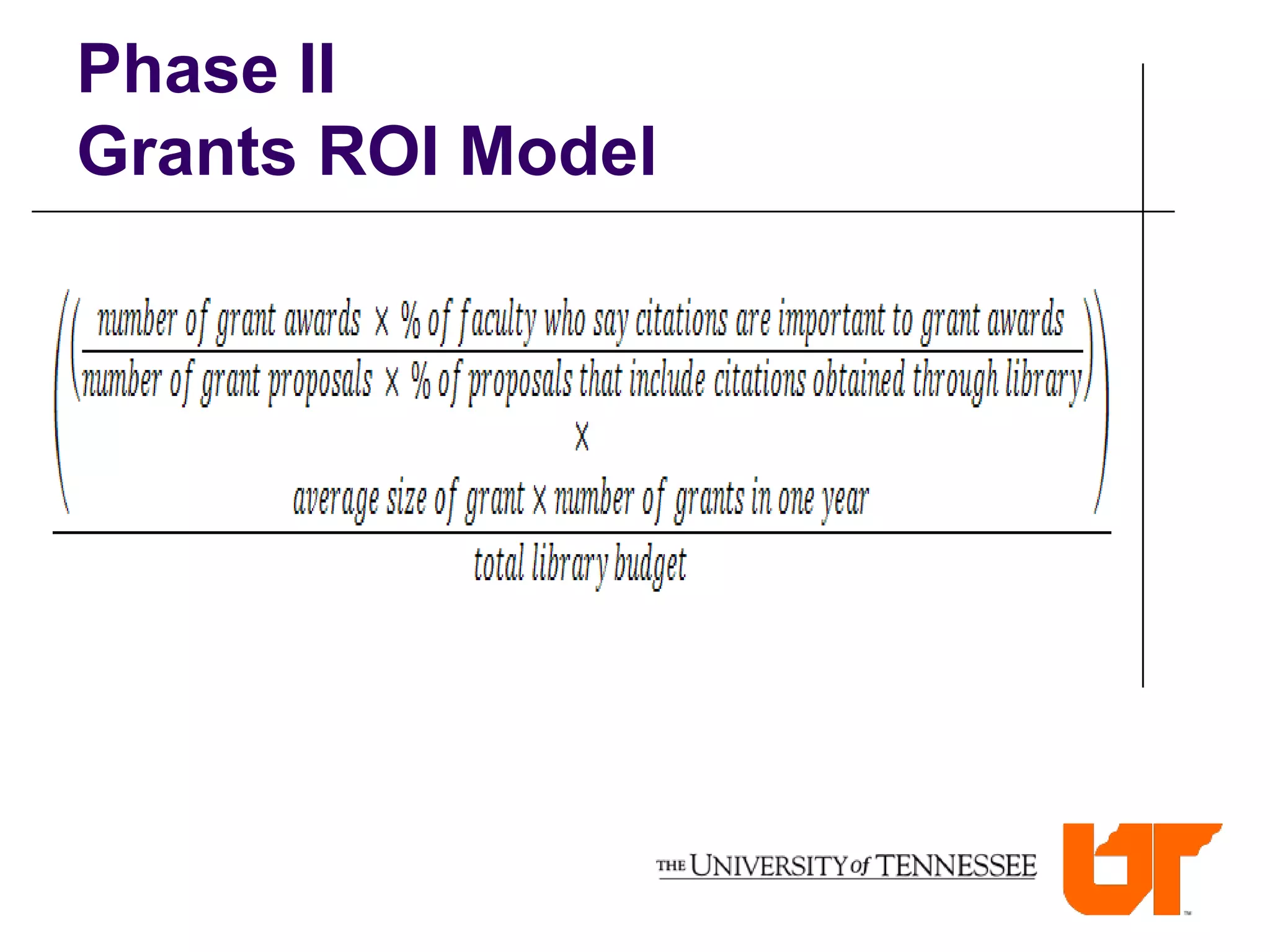
Phase II
Grants ROI Model
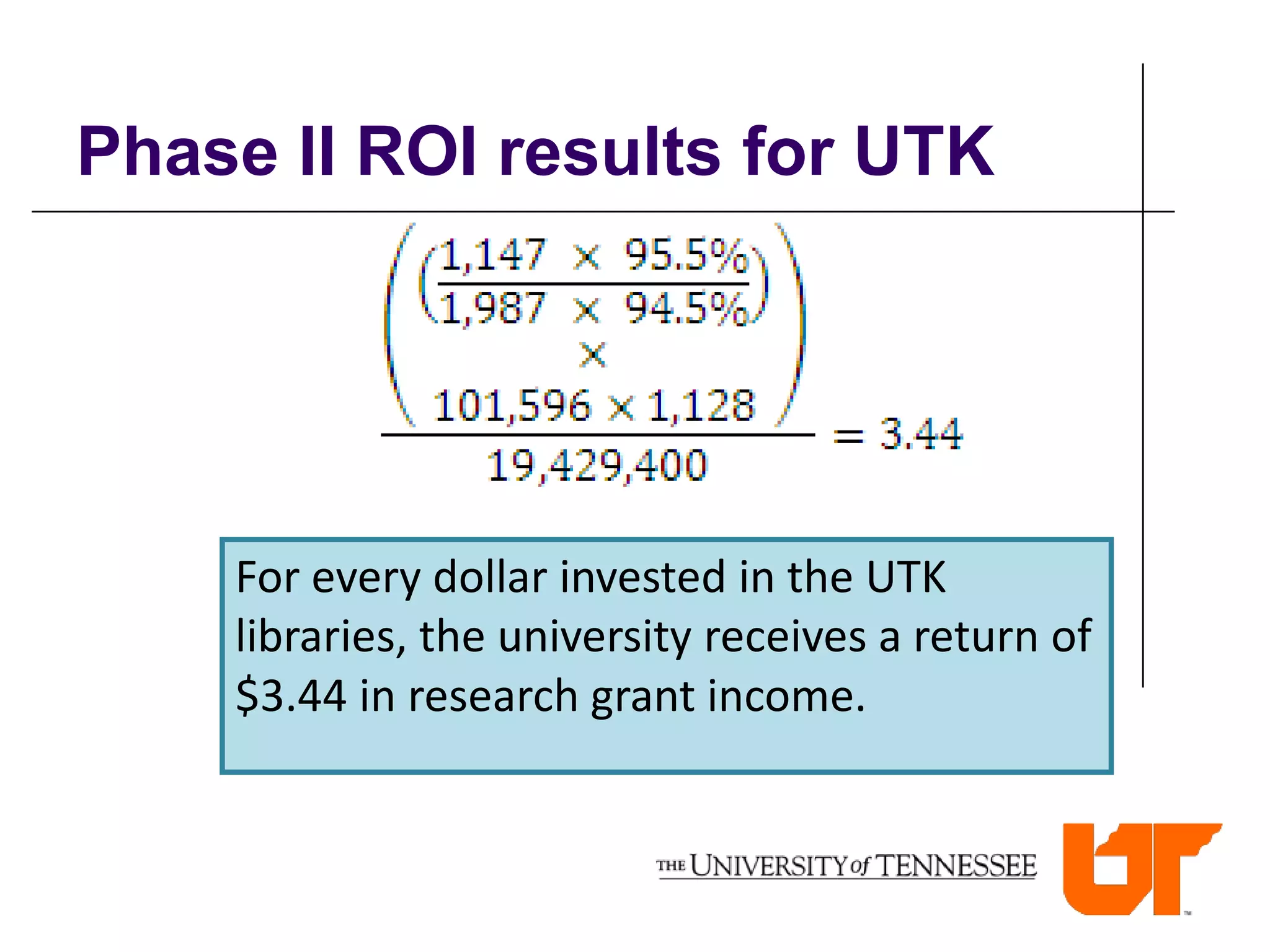
Phase II ROI results for UTK


    For every dollar invested in the UTK
    libraries, the university receives a return of
    $3.44 in research grant income.
Write-up for Phase 2 Study
   http://www.elsevier.com/wps/find/librariansin
    fo.librarians/lc_home
   Available in March 2010
Phase III
IMLS Grant for Lib-Value Study
   IMLS grant for 3 years
   Dr. Carol Tenopir and Paula
    Kaufman, Dean of Libraries, UIUC
   Value, in addition to ROI
Questions?

Electronic Access and Research Efficiencies - Some preliminary findings from the University of Tennessee Library's ROI Analysis - Gayle Baker, Ken Wise

  • 1.
    Electronic Access andResearch Efficiencies – Some Preliminary Findings from the University of Tennessee Library’s Return on Investment ROI Analysis Electronic Resources & Libraries February 1, 2010 Gayle Baker & Ken Wise
  • 2.
    Talk Outline  Phase I Return-on-investment (ROI) project at University of Illinois, Urbana- Champaign  Phase II ROI project  Results at University of Tennessee  Phase III
  • 3.
    Phase I -Goal  Demonstrate role of library information resources in generating research grant income for the institution.  For every monetary unit spent on the library, the university receives “X” monetary units in return
  • 4.
    Phase I -Data  Faculty – Survey (quantitative and qualitative)  Grant proposals – University-supplied data, faculty survey  Grant income – University-supplied data  Library – Total budget (including collections, facilities, personnel, etc.)  Administrative priorities – Personal interviews
  • 5.
    Phase I Grants ROIModel for UIUC  78.14% faculty w/ grant proposals using citations from library X  50.79% award success rate from grants using citations from library X $63,923 average grant income = $25,369 avg. income generated from grants using citations from library X 6232 grants expended ÷ $36,102,613 library budget = $4.38 grant income for each $1.00 invested in library (ROI value expressed as 4.38:1 ratio)
  • 6.
    Phase I -ROI Project  University investment in the library: What’s the return? A case study at the University of Illinois at Urbana–Champaign Judy Luther, President, Informed Strategies http://libraryconnect.elsevier.com/whitepapers/0108/lcwp010801. html  The Library as Strategic Investment: Results of the Illinois Return on Investment Study Paula T. Kaufman http://liber.library.uu.nl/publish/articles/000269/article.pdf.
  • 7.
    Phase II  To test Phase I methodology  8 institutions in 8 different countries
  • 8.
    Phase II Results  Faculty Survey  Grant ROI
  • 9.
    Discipline Distribution 23, 8% 51, 17% 64, 22% Physical Sciences Life Sciences 41, 14% Social Sciences Health Sciences Arts & Humanities Other 25, 8% 92, 31%
  • 10.
    Academic Rank 13, 5% 109, 37% 98, 33% Professor Associate Professor Assistant Professor Faculty Administrative 74, 25%
  • 11.
  • 12.
  • 13.
  • 14.
    Descriptions of coded responses  Availability / location  Efficiency / saves time  Expands research range  Timeliness / currency  Collaboration  Miscellaneous  Negative
  • 15.
  • 16.
  • 17.
    Examples of comments  Makes my work significantly more efficient. Compared to the time I began my career over 25 years ago, I spend less than 10% of time on finding/accessing information and articles. Also, it has likely expanded the amount of material available tenfold. (Soc. Sci./Admin.)
  • 18.
    Examples…  It has saved me an enormous amount of time. Not only is there less need to visit the library but because I can get answers to questions so quickly I can move on with the formulation and re-formulation of questions much more rapidly than in the past. (Soc. Sci. / Asst. Prof.)
  • 19.
    Examples…  It has made me much more efficient. I can the same work in about 1/10th the time. Unfortunately, the literature has grown 10-fold, so I am just breaking even. I could not keep up with the scientific field without electronic access. Also much easier to find pertinent articles. (Life Sci. / Prof.)
  • 20.
    Examples…  Electronic access has dramatically changed the way I carry out research and teaching. I know access articles from a much wider range of sources (especially journal articles and websites), instead of relying on just the main journals in my field. It's easier to assign readings for classes and I find that students have gotten very good at finding their own electronic resources. I tend to avoid resources that are not in electronic format (including some of my own older publications). (Phys. Sci. / Prof.)
  • 21.
    Examples…  It has provided for more continuity in my work by reducing the average time needed to acquire a source. It has also enabled me to free up time that used to be used going to the library and visiting various sections of the library. It has also broadened the compass of sources used. (Other / Assoc. Prof.)
  • 22.
    Examples…  For me the biggest change brought about by access to electronic resources is that it has become far easier for me to do a quick informal search of the literature. I now routinely do quick searches to answer minor questions or to "pre-research" an idea to see if it may have scientific merit. I think it helps me make more efficient use of time for the granting process, and also makes me a better- informed, more up-to-date instructor. (Life Sci. / Asst. Prof.)
  • 23.
  • 24.
    Phase II ROIresults for UTK For every dollar invested in the UTK libraries, the university receives a return of $3.44 in research grant income.
  • 25.
    Write-up for Phase2 Study  http://www.elsevier.com/wps/find/librariansin fo.librarians/lc_home  Available in March 2010
  • 26.
    Phase III IMLS Grantfor Lib-Value Study  IMLS grant for 3 years  Dr. Carol Tenopir and Paula Kaufman, Dean of Libraries, UIUC  Value, in addition to ROI
  • 27.

Editor's Notes

  • #4 Who generates the income? Faculty competing for grants. If they use the library, how can we quantify this?
  • #5 Faculty – demographics; questions about research (proposals submitted/granted, # as PI, amount, etc.) PLUS open-ended questions about their use of e-journals Campus Office of Research - # proposals submitted and awarded, plus $ data over several yearsLibrary – total $Interviews – provost, research, deans…
  • #6 From the data gathered, an ROI value of $4.38 …This model was reviewed by an independent economist who judged the model and calculations were valid.
  • #8 Motivations for UTK Library to participate:Library has been held in high regard on campus for years. (Budget increase of $300-500K for periodicals inflation / Stimulus funds)Competition for funding (from state-supported institution to state-assisted institutions for several years)Need to justify university’s investment – FY11 anticipated to be bad
  • #24 Dr.Tenopir’s team used the model shown
  • #25 Less than UIUC, but comparable