What Are CombinedOperations?
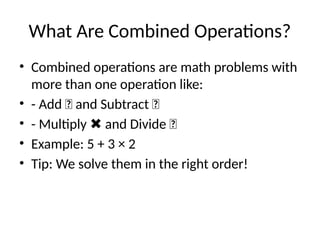
• Combined operations are math problems with
more than one operation like:
• - Add ➕ and Subtract ➖
• - Multiply and Divide ➗
✖
• Example: 5 + 3 × 2
• Tip: We solve them in the right order!
3.
Order of Operations(PEMDAS)
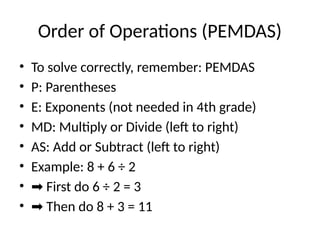
• To solve correctly, remember: PEMDAS
• P: Parentheses
• E: Exponents (not needed in 4th grade)
• MD: Multiply or Divide (left to right)
• AS: Add or Subtract (left to right)
• Example: 8 + 6 ÷ 2
• ➡ First do 6 ÷ 2 = 3
• ➡ Then do 8 + 3 = 11
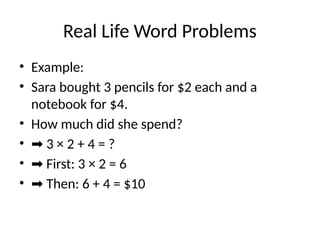
Real Life WordProblems
• Example:
• Sara bought 3 pencils for $2 each and a
notebook for $4.
• How much did she spend?
• ➡ 3 × 2 + 4 = ?
• ➡ First: 3 × 2 = 6
• ➡ Then: 6 + 4 = $10
7.
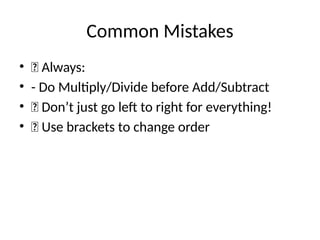
Common Mistakes
• ✅Always:
• - Do Multiply/Divide before Add/Subtract
• ❌ Don’t just go left to right for everything!
• ✅ Use brackets to change order
8.
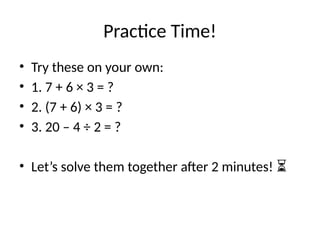
Practice Time!
• Trythese on your own:
• 1. 7 + 6 × 3 = ?
• 2. (7 + 6) × 3 = ?
• 3. 20 – 4 ÷ 2 = ?
• Let’s solve them together after 2 minutes! ⏳
9.
Great Job!
• You’velearned how to:
• - Follow the correct order of operations
• - Use brackets to change solving order
• - Solve word problems with combined
operations
• 🌟 Keep practicing and you'll be a math master!
![Combined Operations in
Mathematics
Let’s learn how to solve more than
one step in a math problem!
Presented by: [Your Name]](https://image.slidesharecdn.com/combinedoperationspresentationgrade4-260119160318-6ed3f0ed/85/Combined_Operations_Presentation_Grade4-pptx-1-320.jpg)
![Combined Operations in
Mathematics
Let’s learn how to solve more than
one step in a math problem!
Presented by: [Your Name]](https://image.slidesharecdn.com/combinedoperationspresentationgrade4-260119160318-6ed3f0ed/75/Combined_Operations_Presentation_Grade4-pptx-1-2048.jpg)