GROUP 1
MEMBERS
MOHD DANIEL HAIQAL
HARISAL BIN ANTO
NICHOLAS ANAK VINCENT SCOTT
ELECTRICAL POWER
GENERATION SYSTEM
CONTENTS
1.1 Introduction To
Electricity Supply System
In Malaysia
1.2 National Grid System
1.4 Comparison Of
Electrical Power
Generation System
1.5 Operating Principle Of
Steam Turbine
1.3 Energy Sources And
Renewable Energy
Generation
1.6 Working Principle The
Simple Gas Turbine Plant
1.7 Types Of Gas Turbine
Plant And Its Use
1.8 Construction Type
Combustion Engine
1.10 Principle Of Hydro-
electric Generation
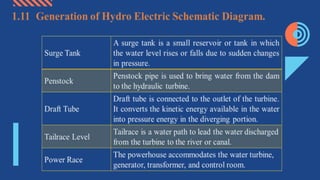
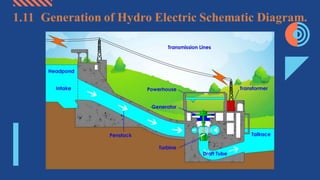
1.11 Generation Of Hydro
Electric Schematic
Diagram
1.9 The Difference Between
Gasoline Engines And
Diesel Engine
1.12 Solar PV Power
Generation Principles
1.13 Hybrid Electrical
Power Generation
1.1 Introduction To Electricity In Malaysia
● 1894 Mr. Loke Yew & Thamboosamy Pillai installed an electric generator for their mining in
Rawang, Selangor.
● 1895 the railway stations in Kuala Lumpur received its first electricity supply.
● 1900 Raub Australian Gold Mining Company built the first power station in Malaya, the Sempam
Hydroelectric Power Station, in Raub town.
● 1 September 1949, the Central Electricity Board of the Federation of Malaya (CEB) was
established for the electrification of Peninsular Malaysia.
● 22 June 1965, CEB was renamed as National Electricity Board of the States of Malaya (NEB or
LLN)
● 1982, the NEB took over the Perak River Hydro Electric Power company (PRHEP) and its
subsidiary Kinta Electrical Distribution Co Ltd (KED). PRHEP which built the hydro-electric
station and dam at Chenderoh, was at one time the largest power supplier in Malaya
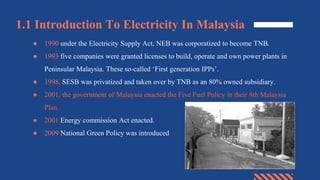
1.1 Introduction To Electricity In Malaysia
● 1990 under the Electricity Supply Act, NEB was corporatized to become TNB.
● 1993 five companies were granted licenses to build, operate and own power plants in
Peninsular Malaysia. These so-called ‘First generation IPPs’.
● 1998, SESB was privatized and taken over by TNB as an 80% owned subsidiary.
● 2001, the government of Malaysia enacted the Five Fuel Policy in their 8th Malaysia
Plan.
● 2001 Energy commission Act enacted.
● 2009 National Green Policy was introduced
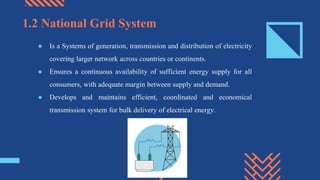
● Is a Systems of generation, transmission and distribution of electricity
covering larger network across countries or continents.
● Ensures a continuous availability of sufficient energy supply for all
consumers, with adequate margin between supply and demand.

● Develops and maintains efficient, coordinated and economical
transmission system for bulk delivery of electrical energy.
1.2 National Grid System
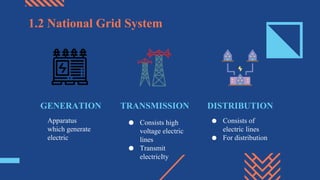
TRANSMISSION
● Consists high
voltage electric
lines
● Transmit
electricIty
DISTRIBUTION
● Consists of
electric lines
● For distribution
Apparatus
which generate
electric
GENERATION
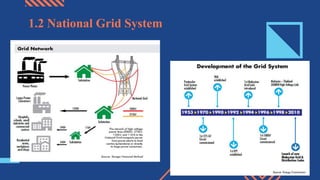
1.2 National Grid System
1.3 Energy Sources & Renewable Energy
Generation
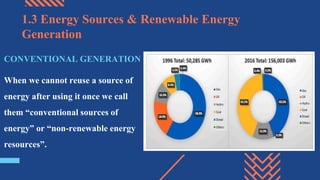
CONVENTIONAL GENERATION
When we cannot reuse a source of
energy after using it once we call
them “conventional sources of
energy” or “non-renewable energy
resources”.
1.3 Energy Sources & Renewable Energy Generation
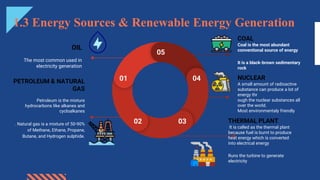
OIL
The most common used in
electricity generation
PETROLEUM & NATURAL
GAS
Petroleum is the mixture
hydrocarbons like alkanes and
cycloalkanes
. Natural gas is a mixture of 50-90%
of Methane, Ethane, Propane,
Butane, and Hydrogen sulphide.
THERMAL PLANT
It is called as the thermal plant
because fuel is burnt to produce
heat energy which is converted
into electrical energy
Runs the turbine to generate
electricity
COAL
Coal is the most abundant
conventional source of energy
It is a black-brown sedimentary
rock
NUCLEAR
A small amount of radioactive
substance can produce a lot of
energy thr
ough the nuclear substances all
over the world.
Most environmentaly friendly
05
01
02 03
04
1.3 Energy Sources & Renewable Energy Generation
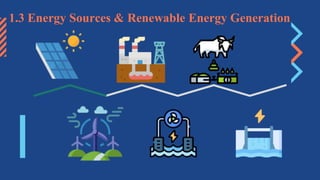
RENEWABLE GENERATION
A renewable energy source means
energy that is sustainable - something
that can't run out, or is endless, like
the sun
1.3 Energy Sources & Renewable Energy Generation
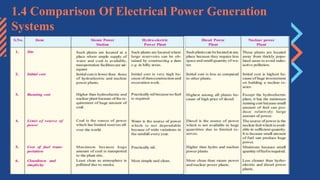
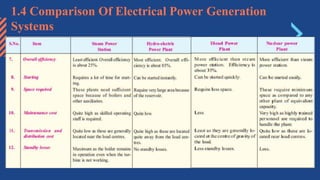
1.4 Comparison Of Electrical Power Generation
Systems
1.4 Comparison Of Electrical Power Generation
Systems
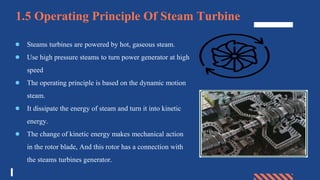
1.5 Operating Principle Of Steam Turbine
● Steams turbines are powered by hot, gaseous steam.
● Use high pressure steams to turn power generator at high
speed
● The operating principle is based on the dynamic motion
steam.
● It dissipate the energy of steam and turn it into kinetic
energy.
● The change of kinetic energy makes mechanical action
in the rotor blade, And this rotor has a connection with
the steams turbines generator.
1.5 Operating Principal Of Steams Turbine
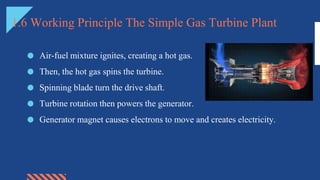
1.6 Working Principle The Simple Gas Turbine Plant
● Air-fuel mixture ignites, creating a hot gas.
● Then, the hot gas spins the turbine.
● Spinning blade turn the drive shaft.
● Turbine rotation then powers the generator.
● Generator magnet causes electrons to move and creates electricity.
1.6 Working Principle The Simple Gas Turbine Plant
1.7 Types Of Gas Turbine Plant And Its Use
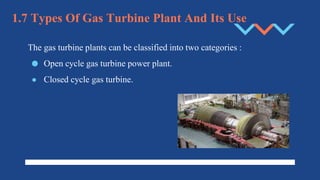
The gas turbine plants can be classified into two categories :
● Open cycle gas turbine power plant.
● Closed cycle gas turbine.
1.7 Types Of Gas Turbine Plant And Its Use
Open cycle gas turbine
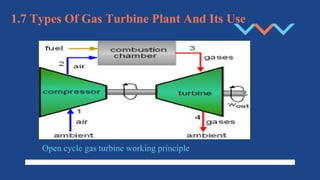
● In this type, ambient air is charged into combustor then
creating a heated gas. The heated gas then passed to the
turbine where it expands doing the mechanical works.
Then the heated gas released to the atmosphere.
● Normally used in electric power generation, aviation
power, and etc.
1.7 Types Of Gas Turbine Plant And Its Use
Open cycle gas turbine working principle
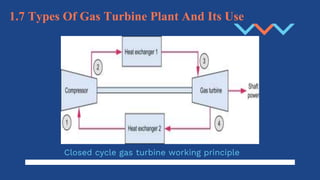
1.7 Types Of Gas Turbine Plant And Its Use
Closed cycle gas turbine
● In this type, air is circulated continuously within the gas
turbine. It performs thermodynamic cycle, which means
working fluid circulated and used continuously without
leaving the system.
● Normally used for wide range of energy sources such as
fossil fuel, concentrated solar power, nuclear, biomass and
waste heat.
1.7 Types Of Gas Turbine Plant And Its Use
Closed cycle gas turbine working principle
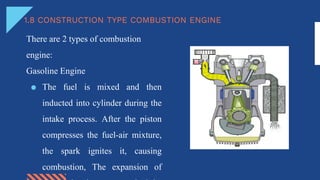
1.8 CONSTRUCTION TYPE COMBUSTION ENGINE
There are 2 types of combustion
engine:
Gasoline Engine
● The fuel is mixed and then
inducted into cylinder during the
intake process. After the piston
compresses the fuel-air mixture,
the spark ignites it, causing
combustion, The expansion of
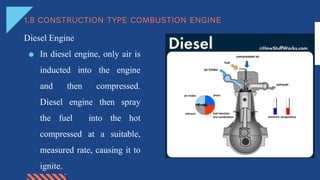
1.8 CONSTRUCTION TYPE COMBUSTION ENGINE
Diesel Engine
● In diesel engine, only air is
inducted into the engine
and then compressed.
Diesel engine then spray
the fuel into the hot
compressed at a suitable,
measured rate, causing it to
ignite.
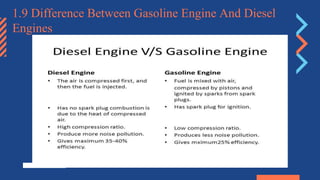
1.9 Difference Between Gasoline Engine And Diesel
Engines
Thank You!

ELECTRICAL POWER GENERATION SYSTEMS IN MALAYSIA.pptx

  • 1.
    GROUP 1 MEMBERS MOHD DANIELHAIQAL HARISAL BIN ANTO NICHOLAS ANAK VINCENT SCOTT
  • 2.
  • 3.
    CONTENTS 1.1 Introduction To ElectricitySupply System In Malaysia 1.2 National Grid System 1.4 Comparison Of Electrical Power Generation System 1.5 Operating Principle Of Steam Turbine 1.3 Energy Sources And Renewable Energy Generation 1.6 Working Principle The Simple Gas Turbine Plant 1.7 Types Of Gas Turbine Plant And Its Use 1.8 Construction Type Combustion Engine 1.10 Principle Of Hydro- electric Generation 1.11 Generation Of Hydro Electric Schematic Diagram 1.9 The Difference Between Gasoline Engines And Diesel Engine 1.12 Solar PV Power Generation Principles 1.13 Hybrid Electrical Power Generation
  • 4.
    1.1 Introduction ToElectricity In Malaysia ● 1894 Mr. Loke Yew & Thamboosamy Pillai installed an electric generator for their mining in Rawang, Selangor. ● 1895 the railway stations in Kuala Lumpur received its first electricity supply. ● 1900 Raub Australian Gold Mining Company built the first power station in Malaya, the Sempam Hydroelectric Power Station, in Raub town. ● 1 September 1949, the Central Electricity Board of the Federation of Malaya (CEB) was established for the electrification of Peninsular Malaysia. ● 22 June 1965, CEB was renamed as National Electricity Board of the States of Malaya (NEB or LLN) ● 1982, the NEB took over the Perak River Hydro Electric Power company (PRHEP) and its subsidiary Kinta Electrical Distribution Co Ltd (KED). PRHEP which built the hydro-electric station and dam at Chenderoh, was at one time the largest power supplier in Malaya
  • 5.
    1.1 Introduction ToElectricity In Malaysia ● 1990 under the Electricity Supply Act, NEB was corporatized to become TNB. ● 1993 five companies were granted licenses to build, operate and own power plants in Peninsular Malaysia. These so-called ‘First generation IPPs’. ● 1998, SESB was privatized and taken over by TNB as an 80% owned subsidiary. ● 2001, the government of Malaysia enacted the Five Fuel Policy in their 8th Malaysia Plan. ● 2001 Energy commission Act enacted. ● 2009 National Green Policy was introduced
  • 6.
    ● Is aSystems of generation, transmission and distribution of electricity covering larger network across countries or continents. ● Ensures a continuous availability of sufficient energy supply for all consumers, with adequate margin between supply and demand. ● Develops and maintains efficient, coordinated and economical transmission system for bulk delivery of electrical energy. 1.2 National Grid System
  • 7.
    1.2 National GridSystem TRANSMISSION ● Consists high voltage electric lines ● Transmit electricIty DISTRIBUTION ● Consists of electric lines ● For distribution Apparatus which generate electric GENERATION
  • 8.
  • 9.
    1.3 Energy Sources& Renewable Energy Generation CONVENTIONAL GENERATION When we cannot reuse a source of energy after using it once we call them “conventional sources of energy” or “non-renewable energy resources”.
  • 10.
    1.3 Energy Sources& Renewable Energy Generation OIL The most common used in electricity generation PETROLEUM & NATURAL GAS Petroleum is the mixture hydrocarbons like alkanes and cycloalkanes . Natural gas is a mixture of 50-90% of Methane, Ethane, Propane, Butane, and Hydrogen sulphide. THERMAL PLANT It is called as the thermal plant because fuel is burnt to produce heat energy which is converted into electrical energy Runs the turbine to generate electricity COAL Coal is the most abundant conventional source of energy It is a black-brown sedimentary rock NUCLEAR A small amount of radioactive substance can produce a lot of energy thr ough the nuclear substances all over the world. Most environmentaly friendly 05 01 02 03 04
  • 11.
    1.3 Energy Sources& Renewable Energy Generation RENEWABLE GENERATION A renewable energy source means energy that is sustainable - something that can't run out, or is endless, like the sun
  • 12.
    1.3 Energy Sources& Renewable Energy Generation
  • 13.
    1.4 Comparison OfElectrical Power Generation Systems
  • 14.
    1.4 Comparison OfElectrical Power Generation Systems
  • 15.
    1.5 Operating PrincipleOf Steam Turbine ● Steams turbines are powered by hot, gaseous steam. ● Use high pressure steams to turn power generator at high speed ● The operating principle is based on the dynamic motion steam. ● It dissipate the energy of steam and turn it into kinetic energy. ● The change of kinetic energy makes mechanical action in the rotor blade, And this rotor has a connection with the steams turbines generator.
  • 16.
    1.5 Operating PrincipalOf Steams Turbine
  • 17.
    1.6 Working PrincipleThe Simple Gas Turbine Plant ● Air-fuel mixture ignites, creating a hot gas. ● Then, the hot gas spins the turbine. ● Spinning blade turn the drive shaft. ● Turbine rotation then powers the generator. ● Generator magnet causes electrons to move and creates electricity.
  • 18.
    1.6 Working PrincipleThe Simple Gas Turbine Plant
  • 19.
    1.7 Types OfGas Turbine Plant And Its Use The gas turbine plants can be classified into two categories : ● Open cycle gas turbine power plant. ● Closed cycle gas turbine.
  • 20.
    1.7 Types OfGas Turbine Plant And Its Use Open cycle gas turbine ● In this type, ambient air is charged into combustor then creating a heated gas. The heated gas then passed to the turbine where it expands doing the mechanical works. Then the heated gas released to the atmosphere. ● Normally used in electric power generation, aviation power, and etc.
  • 21.
    1.7 Types OfGas Turbine Plant And Its Use Open cycle gas turbine working principle
  • 22.
    1.7 Types OfGas Turbine Plant And Its Use Closed cycle gas turbine ● In this type, air is circulated continuously within the gas turbine. It performs thermodynamic cycle, which means working fluid circulated and used continuously without leaving the system. ● Normally used for wide range of energy sources such as fossil fuel, concentrated solar power, nuclear, biomass and waste heat.
  • 23.
    1.7 Types OfGas Turbine Plant And Its Use Closed cycle gas turbine working principle
  • 24.
    1.8 CONSTRUCTION TYPECOMBUSTION ENGINE There are 2 types of combustion engine: Gasoline Engine ● The fuel is mixed and then inducted into cylinder during the intake process. After the piston compresses the fuel-air mixture, the spark ignites it, causing combustion, The expansion of
  • 25.
    1.8 CONSTRUCTION TYPECOMBUSTION ENGINE Diesel Engine ● In diesel engine, only air is inducted into the engine and then compressed. Diesel engine then spray the fuel into the hot compressed at a suitable, measured rate, causing it to ignite.
  • 26.
    1.9 Difference BetweenGasoline Engine And Diesel Engines
  • 37.