Learning Objectives
After completingthis task, you will be able to…
List the different non-renewable energy sources.
Identify and describe the different methods of generating
electricity.
Explain how combustion of fossil fuels results in the
creation of greenhouse gases.
3.
Vocabulary
Generator – adevice that converts mechanical (or chemical) energy into electricity
using electromagnetic induction
Kinetic energy – property of a moving object or particle that depends not only on
its motion but also on its mass
Thermal energy – an example of kinetic energy, as it is due to the motion of
particles, with motion being the key. Thermal energy results in an object or a
system having a temperature that can be measured. Thermal energy can be
transferred from one object or system to another in the form of heat.
Radiant energy – energy that travels by waves or particles, also known as
electromagnetic radiation. Some examples include heat, x-rays, visible light, and
radio waves.
Turbine – a machine for producing continuous power in which a wheel or rotor,
typically fitted with vanes, is made to revolve by a fast-moving flow of water, steam,
gas, air, or other fluid
4.
Watch this short
videoto learn
about the process
of generating
electricity.
https://youtu.be/20Vb6hlLQSg
5.
Electricity and theEnvironment
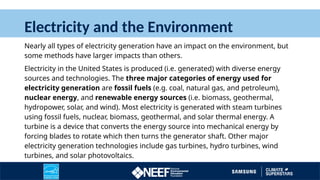
Nearly all types of electricity generation have an impact on the environment, but
some methods have larger impacts than others.
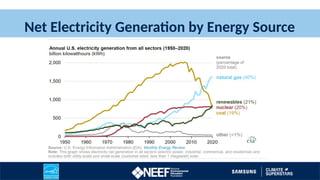
Electricity in the United States is produced (i.e. generated) with diverse energy
sources and technologies. The three major categories of energy used for
electricity generation are fossil fuels (e.g. coal, natural gas, and petroleum),
nuclear energy, and renewable energy sources (i.e. biomass, geothermal,
hydropower, solar, and wind). Most electricity is generated with steam turbines
using fossil fuels, nuclear, biomass, geothermal, and solar thermal energy. A
turbine is a device that converts the energy source into mechanical energy by
forcing blades to rotate which then turns the generator shaft. Other major
electricity generation technologies include gas turbines, hydro turbines, wind
turbines, and solar photovoltaics.
What is aPower Plant?
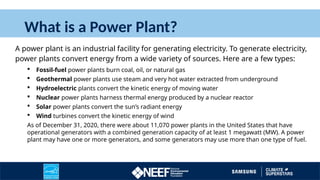
A power plant is an industrial facility for generating electricity. To generate electricity,
power plants convert energy from a wide variety of sources. Here are a few types:
Fossil-fuel power plants burn coal, oil, or natural gas
Geothermal power plants use steam and very hot water extracted from underground
Hydroelectric plants convert the kinetic energy of moving water
Nuclear power plants harness thermal energy produced by a nuclear reactor
Solar power plants convert the sun’s radiant energy
Wind turbines convert the kinetic energy of wind
As of December 31, 2020, there were about 11,070 power plants in the United States that have
operational generators with a combined generation capacity of at least 1 megawatt (MW). A power
plant may have one or more generators, and some generators may use more than one type of fuel.
8.
Action Item
Do someresearch to
learn the following:
Which kind of power
plant supplies
electricity to your
community, school, or
home? Check all that
apply.
How much renewable
energy does your local
power plant or utility
use to produce
electricity?
❏Biomass
❏Fossil fuel
❏Geothermal
❏Hydroelectric
❏Nuclear
❏Solar
❏Wind