1
CHAPTER-1
INTRODUCTION TO ELECTRICAL LOCOMOTIVE
1.1 Introduction:
An electric locomotive is a locomotive powered by electricity from overhead
lines, a third rail or on-board energy storage such as a battery or fuel cell.
Electric locomotives with on-board fuelled prime movers, such as diesel
engines or gas turbines, are classed as diesel-electric or gas turbine-electric
locomotives because the electric generator/motor combination serves only as
a power transmission system. Electricity is used to eliminate smoke and take
advantage of the high efficiency of electric motors, but the cost of electrification
means that usually only heavily used lines can be electrified.
1.2 Characteristics:
One advantage of electrification is the lack of pollution from the locomotives.
Electrification results in higher performance, lower maintenance costs and
lower energy costs.
Power plants, even if they burn fossil fuels, are far cleaner than mobile sources
such as locomotive engines. The power can come from clean or renewable
sources, including geothermal power, hydroelectric power, nuclear power, solar
power and wind turbines. Electric locomotives are quiet compared to diesel
locomotives since there is no engine and exhaust noise and less mechanical
noise. The lack of reciprocating parts means electric locomotives are easier on
the track, reducing track maintenance.
Power plant capacity is far greater than any individual locomotive uses, so
electric locomotives can have a higher power output than diesel locomotives
and they can produce even higher short-term surge power for fast acceleration.
Electric locomotives are ideal for commuter rail service with frequent stops.
They are used on high-speed lines, such as ICE in Germany, Acela in the
2
U.S., Shinkansen in Japan, China Railway High-speed in China and TGV in
France. Electric locomotives are used on freight routes with consistently high
traffic volumes, or in areas with advanced rail networks.
Electric locomotives benefit from the high efficiency of electric motors, often
above 90% (not including the inefficiency of generating the electricity).
Additional efficiency can be gained from regenerative braking, which
allows kinetic energy to be recovered during braking to put power back on the
line. Newer electric locomotives use AC motor-inverter drive systems that
provide for regenerative braking.
The chief disadvantage of electrification is the cost for infrastructure: overhead
lines or third rail, substations, and control systems. Public policy in the U.S.
interferes with electrification: higher property taxes are imposed on privately
owned rail facilities if they are electrified. U.S. regulations on diesel locomotives
are very weak compared to regulations on automobile emissions or power plant
emissions.
In Europe and elsewhere, railway networks are considered part of the national
transport infrastructure, just like roads, highways and waterways, so are often
financed by the state. Operators of the rolling stock pay fees according to rail
use. This makes possible the large investments required for the technically,
and in the long-term also, economically advantageous electrification. Because
railroad infrastructure is privately owned in the U.S., railroads are unwilling to
make the necessary investments for electrification.
1.3 History in India:
A plan for a rail system in India was first put forward in 1832. The first rail line
of the Indian sub-continent came up near Chintadripet Bridge (presently
in Chennai) in Madras Presidency in 1836 as an experimental line. In 1837, a
3.5-mile (5.6 km) long rail line was established between Red Hills and stone
quarries near St. Thomas Mount. In 1844, the Governor-General of India Lord
Hardinge allowed private entrepreneurs to set up a rail system in India.
3
The East India Company (and later the British Government) encouraged new
railway companies backed by private investors under a scheme that would
provide land and guarantee an annual return of up to five percent during the
initial years of operation. The companies were to build and operate the lines
under a 99-year lease, with the government having the option to buy them
earlier.
Two new railway companies, Great Indian Peninsular Railway (GIPR) and East
Indian Railway (EIR), were created in 1853–54 to construct and operate two
'experimental' lines near Mumbai and Kolkata respectively. The first train in
India had become operational on 22 December 1851 for localized hauling of
canal construction material in Roorkee. A year and a half later, on 16 April
1853, the first passenger train service was inaugurated between Bori Bunder in
Mumbai and Thane. Covering a distance of 34 kilometers (21 mi), it was hauled
by three locomotives, Sahib, Sindh, and Sultan. This was soon followed by
opening of the first passenger railway line in North India between Allahabad
and Kanpur on 3 March 1859.
In 1854 Lord Dalhousie, the then Governor-General of India, formulated a plan
to construct a network of trunk lines connecting the principal regions of India.
Encouraged by the government guarantees, investment flowed in and a series
of new rail companies were established, leading to rapid expansion of the rail
system in India. Soon various native states built their own rail systems and the
network spread to the regions that became the modern-day states of Assam,
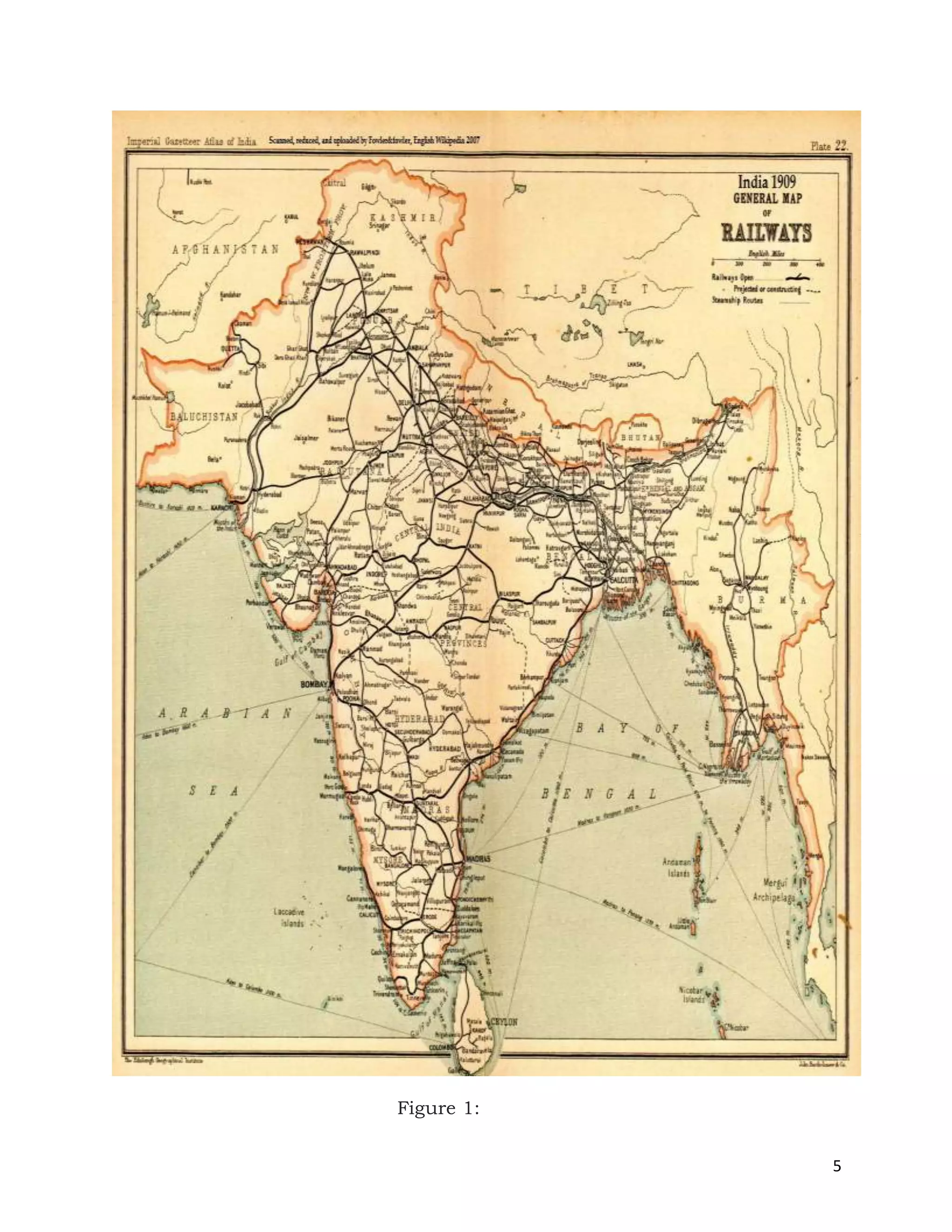
Rajasthan and Andhra Pradesh. The route mileage of this network increased
from 1,349 kilometers (838 mi) in 1860 to 25,495 kilometers (15,842 mi) in
1880–mostly radiating inland from the three major port cities of
Mumbai, Madras, and Calcutta. Most of the railway construction was done by
Indian companies. The railway line from Lahore to Delhi was done B.S.D. Bedi
and Sons (Baba Shib Dayal Bedi), this included the building of the Jamuna
Bridge. By 1895, India had started building its own locomotives, and in 1896
sent engineers and locomotives to help build the Uganda Railway. At the
4
beginning of the twentieth century India had a multitude of rail services with
diverse ownership and management, operating on broad, meter and narrow
gauge networks. In 1900 the government took over the GIPR network, while the
company continued to manage it. With the arrival of the First World War, the
railways were used to transport troops and food grains to the port city of
Mumbai and Karachi en route to UK, Mesopotamia, East Africa etc. By the end
of the First World War, the railways had suffered immensely and were in a poor
state. In 1923, both GIPR and EIR were nationalized with the state assuming
both ownership and management control The Second World War severely
crippled the railways as rolling stock was diverted to the Middle East, and the
railway workshops were converted into munitions workshops After
independence in 1947, forty-two separate railway systems, including thirty-two
lines owned by the former Indian princely states, were amalgamated to form a
single unit named the Indian Railways. The existing rail networks were
abandoned in favor of zones in 1951 and a total of six zones came into being in
1952.
As the economy of India improved, almost all railway production units were
‘indigenized’ (produced in India). By 1985, steam locomotives were phased out
in favor of diesel and electric locomotives. The entire railway reservation system
was streamlined with computerization between 1987 and 1995.
In 2003, the Indian Railways celebrated 150 years of its existence. Various
zones of the railways celebrated the event by running heritage trains on routes
like the ones on which the first trains in the zones ran. The Ministry of
Railways commemorated the event by launching a special logo celebrating the
completion of 150 years of service. Also launched was a new mascot for the
150th year celebrations, named Bholu the guard elephant.
5
Figure 1:
6
CHAPTER-2
TRACTION SYSTEMS FOR LOCOMOTIVES
2.1 Introduction:
Indian Railways use a specialized classification code for identifying its
locomotives. The code is usually three or four letters, followed by a digit
identifying the model (either assigned chronologically or encoding the power
rating of the locomotive).This could be followed by other codes for minor
variations in the base model.
The three (or four) letters are, from left to right, the gauge of tracks on which
the locomotive operates, the type of power source or fuel for the locomotive,
and the kind of operation the locomotive can be used for. The gauge is coded as
'W' for broad gauge, 'Y' for meter gauge, 'Z' for the 762 mm narrow gauge and
'N' for the 610 mm narrow gauge. The power source code is 'D' for diesel, 'A' for
AC traction, 'C' for DC traction and 'CA' for dual traction (AC/DC). The
operation letter is 'G' for freight-only operation, 'P' for passenger trains-only
operation, 'M' for mixed operation (both passenger and freight) and 'S' for
shunting operation. A number alongside it indicates the power rating of the
engine. For example, '4' would indicate the power rating of the above
4,000 hp (2,980 kW) but below 5,000 hp (3,730 kW). A letter following the
number is used to give an exact rating. For instance, 'A' would be an additional
100 horsepower (75 kW); 'B' 200 hp (150 kW) and so on. For example, a WDM-
3D is a broad-gauge, diesel-powered, mixed mode (suitable for both freight and
passenger duties) and has a power rating of 3400 hp (2.5 MW).
The most common diesel engine used is the WDM-2, which entered production
in 1962. This 2,600 hp (1.9 MW) locomotive was designed by Alco and
manufactured by the Diesel Locomotive Works, Varanasi, and is used as a
standard workhorse. It is being replaced by more modern engines, ranging in
power up to 5,500 hp (4.1 MW).
7
There is a wide variety of electric locomotives used, ranging between 2,800 to
6,350 hp (2.1 to 4.7 MW). They also accommodate the different track voltages
in use. Most electrified sections in the country use 25,000 volt AC, but railway
lines around Mumbai use the older 1,500 V DC system. Thus, Mumbai and
surrounding areas are the only places where one can find AC/DC dual
locomotives of the WCAM and WCAG series. All other electric locomotives are
pure AC ones from the WAP, WAG and WAM series. Some specialized EMU
(electric multiple units) are running on Mumbai Suburban System of Central
Railway and Western Railway also use dual-power systems, these are new-age
rakes manufactured in ICF (Integral Coach Factory) in Paramour usually white
and purple livery color. There are also some very rare battery-powered
locomotives, primarily used for shunting and yard work.
The only steam engines still in service in India operate on two heritage lines
(Darjeeling and Ooty), and on the tourist train Palace on Wheels Plans are afoot
to re-convert the Neral-Matheran to steam. The oldest steam engine in the
world in regular service, the Fairy Queen, operates between Delhi and Alwar.
2.2 Types of electric locomotives in Indian Railways:
 Mixed type locomotives; WDM 1 (first mainline diesel electric locomotives
used in India. Introduced in 1957. Imported from ALCO. Out of service
now. 1950hp) WDM2 (Most widely used and first homemade mainline
diesel-electric locomotives in India. Original prototypes were made by
Alco. Introduced in 1962, more than 2700 have been made. Rated at
2600 hp) WDM 2A (Technical variants of WDM 2) WDM2BWDM 3 (Only 8
were imported. They used hydraulic transmission and are currently non-
functional) WDM 3A (Formerly WDM 2C. Another WDM 2 variant. It is
not related to WDM3. 3100 hp) WDM 3C, (higher powered versions of the
WDM 3A) WDM 3DWDM 4 (Entered service along with the WDM 2.
Prototypes designed by General Motors. Though considered superior to
the WDM 2 in many ways, these locomotives weren’t chosen as General
Motors did not agree to a technology transfer agreement. 2600 hp) WDM
8
6 (Very rare class; only two were made; one is being used by Puttalam
Cement Factory in Sri Lanka. Rated at 1200 HP) WDM 7 they were
designed for branch-line duties, but they are now used mostly for
shunting. Rated at 2000hpWDM 5 No locomotive class was designated as
WDM5 in India. Passenger Locomotives: WDP 1WDP 2 (New class name
WDP 3A. Dedicated passenger diesel locomotive. Entered service in 1998.
Powerful locomotive. 3100 hp) WDP 3. These locomotive are actually
prototypes of the class WDP 1 and never entered serial production WDP
4 EMD (former GM-EMD) GT46PAC, fundamentally a passenger version
of the WDG 4 (GT46MAC). 4000 hp WDP 4B EMD (former GM-EMD)
GT46PAC, an improved version of the WDP 4, this is a more powerful
version and has 6 traction motors, just like the WDG 4. Also comes with
wider cabin to aid visibility and minor exterior design changes. 4500 hp
WDP 4D EMD (former GM-EMD) GT46PAC, this is basically a WDP 4B
with twin cabs. Minor changes were made to the locomotive to facilitate
the addition of a second cabin. This locomotive comes with LC
Instrument display and toilet for the drivers. As of now, two units have
been made and are expected to enter full-time service soon. 4500 hp.
 Goods locomotives: WDG 2 New class name WDG 3A. These class is a
technically upgraded form of WDM 2WDG 3B, Technical upgraded forms
of WDG 2 or WDG 3AWDG 3C, WDG 3DWDG 4 New dedicated goods
locomotives. These are General motors GT46MAC models. First units
were imported in 1999. They are numbered from #12000 upward. Local
production started on 2002. 4000 hp Shunting locomotives (Also known
as switching engines): WDS 1 First widely deployed and successful diesel
locomotives used in India. Imported in 1944- 45. Currently out of service.
386 HPWDS 2 Currently out of service WDS 3 All locomotives of this
class were rebuilt and reclassified as WDS 4C in 1976-78. 618 HPWDS
4, Designed by Chittaranjan Locomotive Works. 600-700 hp WDS 4A,
WDS 4B, WDS 4DWDS 4C Rebuilt WDS 3 locos as mentioned above
9
WDS 5 some of these locomotives are used for industrial shunting. A few
are used on Indian Railways. Rated at 1065hpWDS 6 Heavy-haul
shunters made in large numbers for industrial concerns as well as for
Indian Railways Rated at 1200/1350hpWDS 8 Only five of these were
made, and all were transferred to steel works 800hpNote: There is no
electric shunting engine in India. Classes from WDS 1 to WDS 4D have
hydraulic transmission. The WDS 4, 4A, 4B, 4C and 4D are the only still
existing broad-gauge locomotives with the diesel-hydraulic transmission.
Diesel multiple units: A few routes in India currently have Diesel multiple
unit service. Depending on the transmission system they are classified as
the DEMU (diesel-electric transmission) or the DHMU (diesel-hydraulic
transmission). There are diesel railcar services in a few places known as
railbus. DC electric traction Note: These locomotives are, or were used
only in sections around Mumbai which is the only location in India
 Mixed type locomotives: WCM 1 First electric locomotives with the now
familiar Co-Co wheel arrangement to be used in India. 3700 hp WCM 2
520hpWCM 3 600hp - Used in Kolkata, then transferred to Mumbai,
built by Hitachi WCM 4 675hp - Also built by Hitachi WCM 5 Built by
Chittaranjan locomotive works to the RDSOs design specifications.
Auxiliaries by Westinghouse and North Boyce. Built in 1962, these are
India’s first indigenously designed DC electric locomotives. The first was
named Lokamanya after the Congress leader Bal Gangadhar Tilak. 3700
hp WCM 6 A rare and highly powerful class. 5000 hp, only two were
built. Now converted to run on AC power, class name changed to WAM
4Passenger locomotives: WCP 1, WCP 2 are Historically very important
locomotives as these are the very first electric loco (GIPR EA/1 and EA/2
to be used in India. The first locomotive was named as Sir Roger Lumney
and is currently preserved in the National Rail Museum, New Delhi. 2160
hp WCP 3, WCP 4 GIPR EB/1 and EC/1, these are also among the
earliest electric locos used in India Goods locomotives: WCG 1 These are
Swiss crocodile locomotives imported in 1928 from Swiss locomotive
10
works. (GIPR EF/1 These are among the earliest electric locos used in
India. The first locomotive was named as Sir Leslie Wilson and is
currently preserved in the National Rail Museum, New Delhi. 2600-2950
hp WCG 2 Designed by Chittaranjan locomotive works in 1970AC electric
traction. The 25 kV AC system with overhead lines is used throughout
the rest of the country. Mixed type locomotives WAM 1 Among the first
AC electric locomotives used in India. Introduced in 1959. Now out of
service. 3010 hp WAM 2WAM 3WAM 4 Indigenously designed by
Chittaranjan Locomotive Works in 1970. Highly powerful class. One of
the most successful locomotives in India. 3850 hp Passenger locomotives
WAP 1 Designed by Chittaranjan locomotive works in 1980 for the
Kolkata-Delhi Rajdhani Express. A very successful class. 3900 hp WAP 2
Not in use.
 WAP 3 Not in use WAP 4 Upgraded from WAP 1 for higher loads by
Chittaranjan locomotive works in 1994. One of the most successful
locomotives in India. Very powerful class. 5350 hp WAP 5 Imported in
1995 from Switzerland and used on premier express trains. 5450 hp
WAP 6 Only found near Asansol WAP 7 Same design as WAG 9 with
modified gear ratio. Highly powerful class. 6250 hp Goods locomotives
WAG 1WAG 2WAG 3WAG 4WAG 5 The most successful electric
locomotives in India. Designed by Chittaranjan locomotive works in
1984. More than 1100 were made. 3850 hp WAG 5A, Technical variants
of WAG 5WAG 5BWAG 6A Imported from ASEA and Hitachi. 6110 hp
WAG 6B, Variants of WAG 3A. All rated at 6110 hp WAG 6cWAG 7 Very
successful class. Designed by Chittaranjan locomotive works. 5000 hp
WAG 9 Currently the most powerful class in India, rated at 6350 hp.
Same design as WAP 7 with modified gear ratio. Designed by Adtranz,
Switzerland Dual (both AC and DC) traction Note: These locomotives are,
or were used only in sections around Mumbai which is the only location
in India still using DC traction. They can run under AC traction too. The
main purpose behind the manufacture of these types of locomotives was
11
to provide transportation in and out Mumbai area without changing the
engine. Mixed type locomotives: WCAM 1WCAM 2WCAM 3 Designed by
Bharat Heavy Electricals locomotives: WCAG 1 Designed by Bharat heavy
electrical limited. 2930 hp under the DC traction and 4720 hp under the
AC traction. Note there is no dedicated dual current Limited. 4600 hp
under the DC traction and 5000 hp under AC traction Goods passenger
locomotive in India, but in Mumbai area, there are some EMUs which
can run under dual traction.
2.3 Supply Systems for Electric Loco:
Indian Railway has the adopted 25 KV industrial frequency (50 HZ) A.C supply
system for traction purposes. The power supplies are derived from the 220 KV/
132 KV 3 phase transmission system from the various grids.
The basic arrangement constitutes incoming the supply to the Railway traction
substation at a voltage level of 220 KV/132 KV, which normally feeds power
along the track for 35-40 km.
Adjacent traction substation is fed from different phases in rotation to balance
the 3-phase load in its entirety. Neutral sections are provided in between two
adjacent substations to prevent the bridging of different phases while passing
the electric locomotive.
Level of voltage is reduced to 25 KV for the end use of locomotives by 21.6 MVA
signal phase power transformers placed at traction sub stations which are
located at every 30-35 Kms distance along the track.
12
2.4 Traction Motors in Locomotives:
Traction motor refers to an electric motor providing the primary rotational
torque to a machine, usually for conversion into linear motion (traction).
Traction motors are used in electrically powered rail vehicles such as electric
multiple units and electric locomotives, other electric vehicles such as electric
milk floats, elevators, conveyors, and trolleybuses, as well as vehicles with the
electrical transmission systems such as the diesel-electric, the electric hybrid
vehicles and the battery electric vehicles. Additionally, electric motors in other
products (such as the main motor in a washing machine) are described as
traction motors. Traditionally, these were series-wound brushed DC motors,
usually running on approximately 600 volts. The availability of high-powered
semiconductors (such as thyristors and the IGBT) has now made practical the
use of much simpler, higher-reliability AC induction motors known as the
asynchronous traction motors. Synchronous AC motors are also occasionally
used, as in the French TGV.
2.4.1 Mounting of Motors:
Before the mid-20th century, a single large motor was often used to drive
multiple driving wheels through connecting rods that were very similar to those
used on steam locomotives. Examples are the Pennsylvania Railroad
DD1, FF1 and L5 and the various Swiss Crocodiles. It is now standard practice
to provide one traction motor driving each axle through a gear drive.
Usually, the traction motor is three-point suspended between the bogie frame
and the driven axle; this is referred to as a "nose-suspended traction motor".
The problem with such an arrangement is that a portion of the motor's weight
is unsprang, increasing unwanted forces on the track. In the case of the
famous Pennsylvania Railroad GG1, two bogie-mounted motors drove each axle
through a quill drive. The "Bi-Polar" electric locomotives built by General
Electric for the Milwaukee Road had direct drive motors. The rotating shaft of
the motor was also the axle for the wheels. In the case of French TGV power
13
cars, a motor mounted to the power car’s frame drives each axle; a "tripod"
drive allows a small amount of flexibility in the drive train allowing the trucks
bogies to pivot. By mounting the relatively heavy traction motor directly to the
power car's frame rather than to the bogie, better dynamics are obtained
allowing better high-speed operation.
2.4.2 Windings:
The DC motor was the mainstay of electric traction drives on both electric and
diesel-electric locomotives, street-cars/trams and diesel electric drilling rigs for
many years. It consists of two parts, a rotating armature and fixed field
windings surrounding the rotating armature mounted around a shaft. The
fixed field windings consist of tightly wound coils of wire fitted inside the motor
case. The armature is another set of coils wound round a central shaft and is
connected to the field windings through "brushes" which are spring-loaded
contacts pressing against an extension of the armature called the commutator.
The commutator collects all the terminations of the armature coils and
distributes them in a circular pattern to allow the correct sequence of current
flow. When the armature and the field windings are connected in series, the
whole motor is referred to as "series-wound". A series-wound DC motor has a
low resistance field and armature circuit. Because of this, when voltage is
applied to it, the current is high due to Ohm's law. The advantage of high
current is that the magnetic fields inside the motor are strong, producing high
torque (turning force), so it is ideal for starting a train. The disadvantage is that
the current flowing into the motor has to be limited, otherwise the supply could
be overloaded or the motor and its cabling could be damaged. At best, the
torque would exceed the adhesion and the driving wheels would slip.
Traditionally, resistors were used to limit the initial current.
14
2.4.3 Power Control:
As the DC motor starts to turn, interaction of the magnetic fields inside causes
it to generate a voltage internally. This back EMF (electromagnetic force)
opposes the applied voltage and the current that flows is governed by the
difference between the two. As the motor speeds up, the internally generated
voltage rises, the resultant EMF falls, less current passes through the motor
and the torque drops. The motor naturally stops accelerating when the drag of
the train matches the torque produced by the motors. To continue accelerating
the train, series resistors are switched out step by step, each step increasing
the effective voltage and thus the current and torque for a little bit longer until
the motor catches up. This can be heard and felt in older DC trains as a series
of clunks under the floor, each accompanied by a jerk of acceleration as the
torque suddenly increases in response to the new surge of current. When no
resistors are left in the circuit, full line voltage is applied directly to the motor.
The train's speed remains constant at the point where the torque of the motor,
governed by the effective voltage, equals the drag - sometimes referred to as
balancing speed. If the train starts to climb an incline, the speed reduces
because drag is greater than torque and the reduction in speed causes the
back-EMF to fall and thus the effective voltage to rise - until the current
through the motor produces enough torque to match the new drag. The use of
series resistance was wasteful because a lot of energy was lost as heat. To
reduce these losses, electric locomotives and trains (before the advent of power
electronics) were normally equipped for series-parallel control as well.
2.4.4 Dynamic Braking:
If the train starts to descend a grade, the speed increases because the
(reduced) drag is less than the torque. With increased speed, the internally
generated back-EMF voltage rises, reducing the torque until the torque again
balances the drag. Because the field current is reduced by the back-EMF in a
series wound motor, there is no speed at which the back-EMF will exceed the
15
supply voltage, and therefore a single series wound DC traction motor alone
cannot provide dynamic or regenerative braking.
There are, however various schemes applied to provide a retarding force using
the traction motors. The energy generated may be returned to the supply
(regenerative braking), or dissipated by on board resistors (dynamic braking).
Such a system can bring the load to a low speed, requiring relatively little
friction braking to bring the load to a full stop.
2.4.5 Automatic Acceleration:
On an electric train, the train driver originally had to control the cutting out of
resistance manually, but by 1914, automatic acceleration was being used. This
was achieved by an accelerating relay (often called a "notching relay") in the
motor circuit which monitored the fall of current as each step of resistance was
cut out. All the driver had to do was select low, medium or full speed (called
"shunt", "series" and "parallel" from the way the motors were connected in the
resistance circuit) and the automatic equipment would do the rest.
Figure 2:
16
2.5 Three Phase AC Railway Electrification:
Three-phase AC railway electrification was used in Italy, Switzerland and the
United States in the early twentieth century. Italy was the major user, from
1901 until 1976, although lines through two tunnels also used the system;
the Simplon Tunnel in Switzerland from 1906 to 1930, and the Cascade
Tunnel of the Great Northern Railway in the United States from 1909 to 1939.
The first line was in Switzerland, from Burgdorf to Thun (40 km or 25 mi),
since 1899.
2.5.1 Advantages:
The system provides regenerative braking with the power fed back to the
system, so is particularly suitable for mountain railways (provided the grid or
another locomotive on the line can accept the power). The locomotives use
three-phase induction motors. Lacking brushes and commutators, they require
less maintenance. The early Italian and Swiss systems used a low frequency
(16⅔ Hz), and a relatively low voltage (3,000 or 3,600 volts) compared with later
AC systems.
2.5.2 Disadvantages:
The overhead wiring, generally having two separate overhead lines and the rail
for the third phase, was more complicated, and the low-frequency used
required a separate generation or conversion and distribution system. Train
speed was restricted to one to four speeds, with two or four speeds obtained by
pole-changing or cascade operation or both.
17
2.6 Overview of Traction Offerings:
Figure 3: Overview of Traction
[1] Traction transformer
[2] Traction converter
[3] Traction control
[4] Train Control and Monitoring System
[5] Traction motor
[6] Diesel engine generator
[7] Auxiliary converter
[8] Battery charger
[9] Energy storage
2.7 IGBT Traction Converter based Locomotive:
2.7 Introduction:
In the recent past, all over the world the trend has been to switch over
from conventional DC drives to 3-Phase AC drives based on the
Insulated Gate Bipolar Transistor (IGBT) technology. At present, the
flagship locomotive of Indian Railways is the 3-phase locomotive.
Presently, the different variants, viz, WAG9, WAG9H, WAP7 and WAP5 are
18
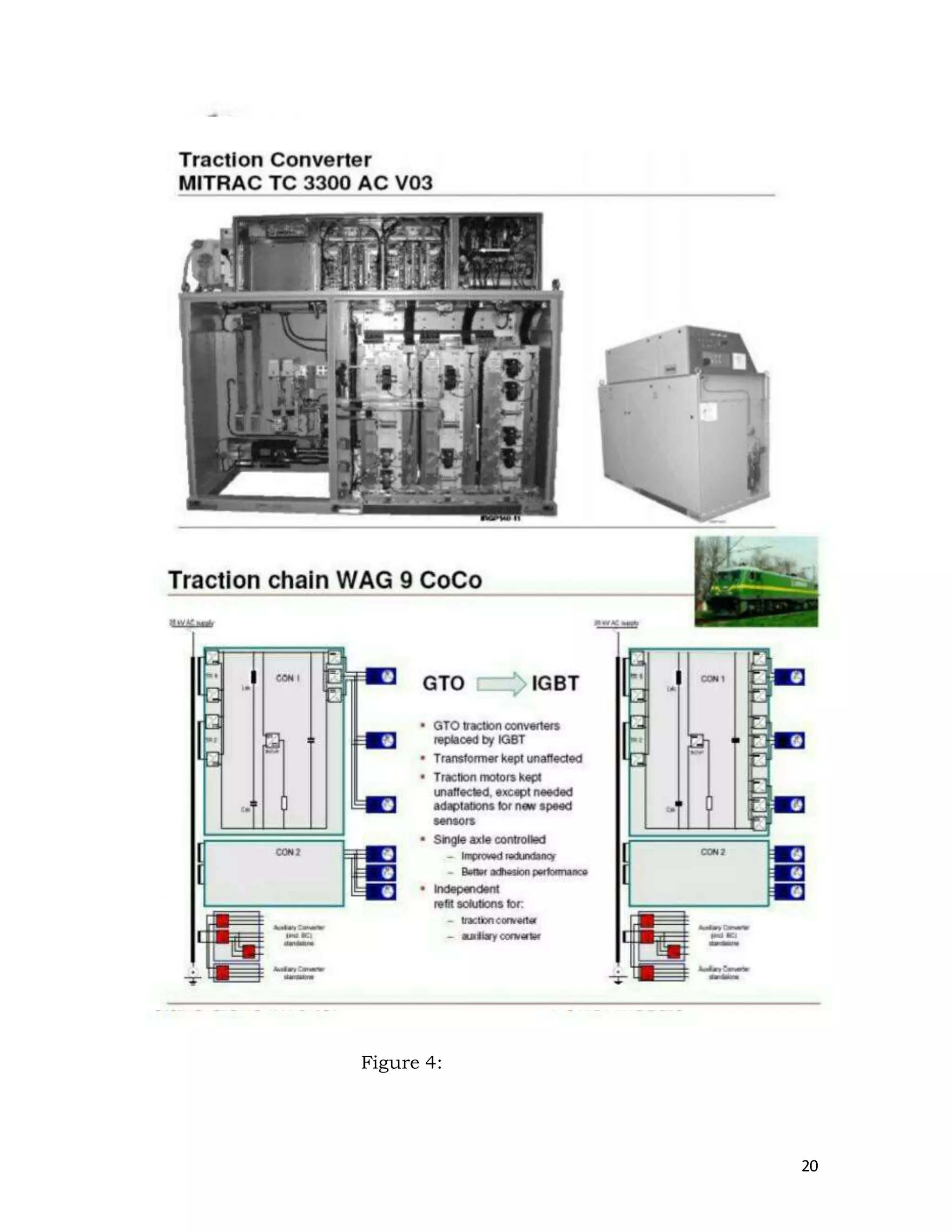
running over Indian Railways. The heart of the locomotive is traction
converter which is responsible for conversion of single phase AC drawn
from OHE to 3-phase AC which drives the traction motor. At present,
switching device used in the traction converter is GTO. Considering the
obsolescence of the GTOs, Indian Railways have embarked on their
ambitious plan to migrate from current Gate Turn Off (GTO) based
system to IGBT based traction propulsion system retaining same
transformer and traction motors, owing to the advantages offered by
IGBT as a power device. GTO being a thyristor device need snubber
circuits, resulting in high losses. GTO’s are sensitive to failures because
of complicated gate drivers. IGBT does not require snubber circuit
(because of di/dt and dv/dt control) and belongs to a power transistor
family, has lesser losses, better control ability, higher performance and
the reliability. Along with this, the control also is changing to open the
standard controls Train Control Network (TCN) confirming to IEC61375.
As the IGBT Traction converter is smaller in size and the liberated space
can be utilized for the installation of the future new equipments like
Hotel load converter, etc. The first locomotive equipped with IGBT based
traction converter flagged of from CLW.
2.7.1 Salient Features:
- The existing GTO based traction converter is a group drive, i.e., all the
traction motors in a bogie are connected in parallel. While, the IGBT
based converter has got single axle drive capability, therefore, in case of
any problem with a particular TM, only that particular TM can be isolated
unlike in the GTO based converter where the whole bogie has to be
isolated.
- Due to single axle drive it has got better adhesion performance.
19
- Because of smaller size of the converter it may be possible to install
additional equipments like hotel load converter in the locomotive.
- To improve the control of the drive, the active type speed sensors have
been provided which have better resolution by incorporating sensors
which can provide strong signals at 200 pulses per revolution.
- This converter has taken full advantage of the advancement in the
processor speed which has paved the way for less number of PCB
cards with better performance at the higher temperatures.
- Power loss reduction by approx. 50% in the comparison with GTO loco
equipment.
- Annual energy saving (considering @ Rs 4.62 / unit) will be approx. Rs.
34 lakhs assuming loco utilization of 85% service per day.
- 40% reduction in weight and compact in size compared to GTO
equipment.
- 60% reduction in usage of electric cards (only 3 major cards compared
to17), hence increasing the loco reliability.
- Sensor less speed control.
- Water cooled system thus safer vis-à-vis oil cooled system.
- Better slip/slide controls, because of the axle control and modern high
speed digital signal processing algorithm.
- Less harmonics because of high switching frequency.
- Designed without using any proprietary ASIC.
- Configured to open the standard controls TCN based network
- Modern design of software using Matlab/Simulink.
20
Figure 4:
21
2.7.2 Main Transformer:
The locomotive is equipped with the main transformer and the main
transformer converts the overhead line voltage (25 kV) to the lower
operating voltages. There are four secondary traction windings (two on
each converter unit, 1269 V), one for feeding the auxiliary circuits (1000 V)
and one for the harmonic filter. The main transformer is installed in an
enclosed, oil-tight aluminum tank together with series resonant choke for
traction converter & 3 DC link chokes for auxiliary converters. This
aluminum tank is divided into two chambers. The larger chamber
contains the main transformer; the smaller chamber accommodates the
series resonant chokes at the bottom and the auxiliary converter chokes
above them. The transformer tank is made entirely of aluminum. This
construction saves weight and, above all, exerts a damping effect on high
frequency magnetic fields
2.7.3 Oil sight glass:
The tank is filled with transformer oil. An oil level sight glass is located in
the machine room. Mineral transformer oil (type Shell Diala DX/Apar oil) is
used for cooling the tank.
The two cooling circuits are provided to cool
transformer tank. The two oil pumps of the
transformer oil circuit are mounted on the
tank. The sensor measures the oil temperature.
The maximum allowable oil temperature is
150ºC.
Figure 5: Oil Sight Glass
22
2.7.4 Main diagram of Traction Converter:
Figure 6: Traction Converter
2.7.5 Traction Motors:
The traction motors are asynchronous squirrel cage motors adapted in
electrical terms to the traction converter providing the power source.
All three traction motors of one bogie are ventilated by one traction motor
blower. The traction motors are connected to the gear box.
Each traction motor is equipped with two temperature sensors and two
motor speed sensors.
23
CHAPTER-3
AUXILIARY MACHINES AND EQUIPMENTS IN ELECTRIC
LOCOMOTIVES
3.1 Introduction:
Electric locos derive tractive effort from Traction Motors which are usually
placed in the bogie of the locomotive. Usually one motor is provided per axle
but in some older generation of locos two axles were driven by a single Traction
Motor also.
However apart from Traction Motors, many other motors and equipment are
provided in electric locos. These motors are collectively known as the
Auxiliaries. The aim of this article is to provide an insight into the various
Auxiliary Machines provided in the Electric Locos operational on the Indian
Railways.
But to understand the reasons why these auxiliaries are needed, it is necessary
to understand the manner in which the electric locos operate. An important
part of the electric loco is the Power Circuit. A short description of the power
circuit of Electric Locos operational on the Indian Railways can be seen here.
The article referred to describes the main components of the Power Circuit of
the Electric Locomotive comprising of the following parts:
24
Figure 7: Auxiliary Circuit Equipment
1. Transformer (including Tap-Changer)
2. Rectifier
3. Smoothing Reactor
4. Traction Motors
5. Main Starting Resistances (in DC Traction on Dual Power Locos only)
6. Dynamic Braking Resistance Cooling Blower
25
A common feature running through all the above electrical equipments is that
these generate a lot of heat during their normal operation. Even when they are
not in use, they might generate a nominal amount of heat. Normally any
electrical equipment generates heat as by-product during operation. But
traction vehicles tend to generate more heat than normal. This is because day-
by-day the demand on traction vehicles is increasing. But an increase in the
power output translates into increased size of the relevant equipments too. But
a major problem with traction vehicles is that you cannot increase their size
beyond a certain limit. This is due to "Loading Gauge Restrictions". Hence, the
power output of the locomotives must be increased indirectly without
increasing their size. This is done by pumping more power through the
equipments and cooling them at a suitable rate at the same time.
Hence the different auxiliaries provided for cooling and other purposes in these
locos is described below. All the motors are of the AC 3 Phase squirrel cage
induction type and require very little maintenance and are simple and robust.
They are described about their relationship to the major power equipment.
3.2 Auxiliaries of The Transformers:
The various type of transformers auxiliaries are as follows:
3.2.1 Transformer Oil Circulating Pump (MPH):
The transformer tank is filled with oil which serves two purposes. It provides
enhanced insulation to the transformer and its surroundings and the oil
absorbs the heat generated in the transformer and takes it away to the
Transformer Oil Cooling Radiator. The circulation of this oil is carried out by
the MPH.
26
A flow valve with an electrical contact is provided in the oil circulating pipe. If
the oil is circulating properly, the contacts on the relay remain closed.
However, in case the MPH fails or stops the relay contacts open which in turn
trips master auxiliary protection relay Q-118. This trips the main circuit-
breaker(DJ) of the loco. Thus, the transformer is protected.
3.2.2 Transformer Oil Cooling Radiator Blower (MVRH):
The MPH circulates the transformer oil through a radiator array on top of the
transformer. Air is blown over the radiator by the MVRH. This discharges the
heat from the radiator into the atmosphere. A flow detecting relay is provided in
the air-stream of the MVRH. The flow detector is a diaphragm type device. The
flow of air presses the diaphragm which closes an electrical contact. This relay
is known as the QVRH. In case the MVRH blower fails the the QVRH releases
and trips the DJ through the relay Q-118.
Figure 8:
27
3.3 Auxiliaries of Rectifier Blocks:
Rectifier Cooling Blowers-MVSI-1 and MVSI-2
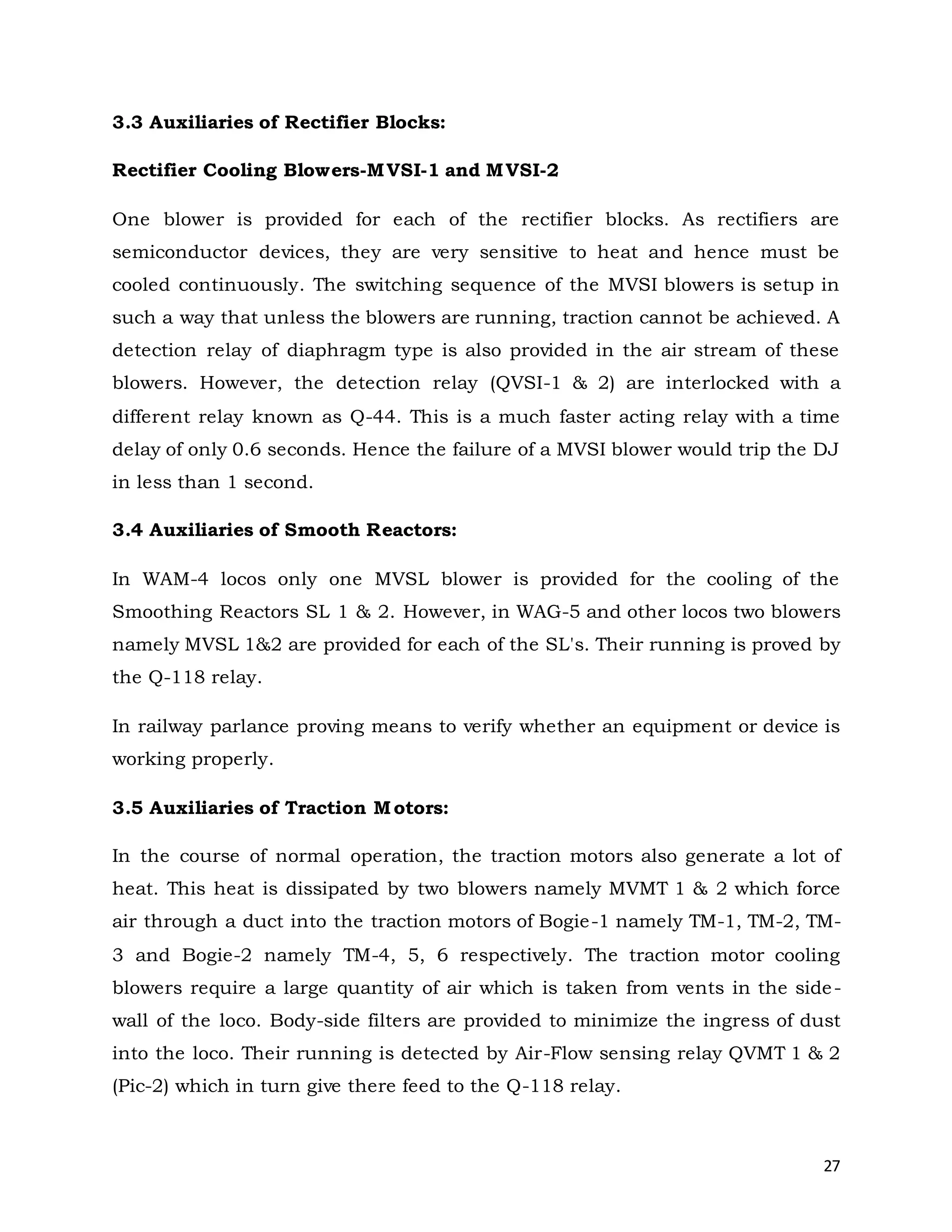
One blower is provided for each of the rectifier blocks. As rectifiers are
semiconductor devices, they are very sensitive to heat and hence must be
cooled continuously. The switching sequence of the MVSI blowers is setup in
such a way that unless the blowers are running, traction cannot be achieved. A
detection relay of diaphragm type is also provided in the air stream of these
blowers. However, the detection relay (QVSI-1 & 2) are interlocked with a
different relay known as Q-44. This is a much faster acting relay with a time
delay of only 0.6 seconds. Hence the failure of a MVSI blower would trip the DJ
in less than 1 second.
3.4 Auxiliaries of Smooth Reactors:
In WAM-4 locos only one MVSL blower is provided for the cooling of the
Smoothing Reactors SL 1 & 2. However, in WAG-5 and other locos two blowers
namely MVSL 1&2 are provided for each of the SL's. Their running is proved by
the Q-118 relay.
In railway parlance proving means to verify whether an equipment or device is
working properly.
3.5 Auxiliaries of Traction Motors:
In the course of normal operation, the traction motors also generate a lot of
heat. This heat is dissipated by two blowers namely MVMT 1 & 2 which force
air through a duct into the traction motors of Bogie-1 namely TM-1, TM-2, TM-
3 and Bogie-2 namely TM-4, 5, 6 respectively. The traction motor cooling
blowers require a large quantity of air which is taken from vents in the side-
wall of the loco. Body-side filters are provided to minimize the ingress of dust
into the loco. Their running is detected by Air-Flow sensing relay QVMT 1 & 2
(Pic-2) which in turn give there feed to the Q-118 relay.
28
Figure 9:
3.6 Other auxiliaries:
There are many other helping machines which are used in locomotives widely.
3.6.1 Air Compressors (MCP 1, MCP-2, MCP-3)
Electric locos need compressed at a pressure ranging from 6 kg/cm2 to 10
kg/cm2. Compressed air is used for the loco's own air brake system as also for
the train brakes, for raising the pantograph, for operating the power switchgear
inside the loco such as the power contactors, change-over switches, windscreen
wipers, sanders, etc.
This compressed air is obtained by providing three air compressors, each
having a capacity to pump 1000 liters of air per minute. However, depending
on the current requirement, more than two compressors are rarely needed.
Figure 10:
29
3.6.2 Vacuum Pumps (MPV 1 & 2):
In locos equipped to haul vacuum braked trains, two vacuum pumps are also
provided of which at least one is running in normal service and sometimes both
may have to be run if train brakes are required to be released in a hurry.
3.6.3 Dynamic Braking Resistance Cooling Blower (MVRF):
In locos equipped with internal dynamic braking resistances, MVRF blower is
provided for cooling the resistances during braking. While all the Auxiliary
machines run on the power supply provided by the Arno converter/Static
Converter/Motor-Alternator set, the MVRF blower runs off the supply derived
from the output of the Traction Motor itself and is connected in parallel to the
Dynamic Braking Resistances.
3.6.4 Main Starting Resistance Cooling Blowers (MVMSR):
These blowers (four in number) are provided in WCAM-1, WCAM-2, WCAM-3
locos and are used during the DC line working to cool the Main Starting
Resistances (MSR). The MSR is used for regulating the voltage supplied to the
Traction Motors during DC line working and carry the whole current of the
traction motors which results in a lot of heat generation which must be
continuously dissipated. The working of the MVMSR's is also proved by
respective sensing relays (QVMSR's) of the diaphragm type which in turn are
interlocked with the relay Q-118.
30
3.7 Power supply:
Depending on the locomotive, power for the auxiliary machines is obtained
through three different methods. A separate power supply arrangement is
needed because the motors require three phase supplies while the OHE supply
is of the single phase type. So, the main requirement of the power supply for
the auxiliary machines is for a device which can convert single phase AC into
three phase AC. It becomes a little more complicated for the dual power
locomotives such as the WCAM-1, WCAM-2, WCAM-3.
The three main types of equipments used to supply power to the auxiliaries are
discussed below.
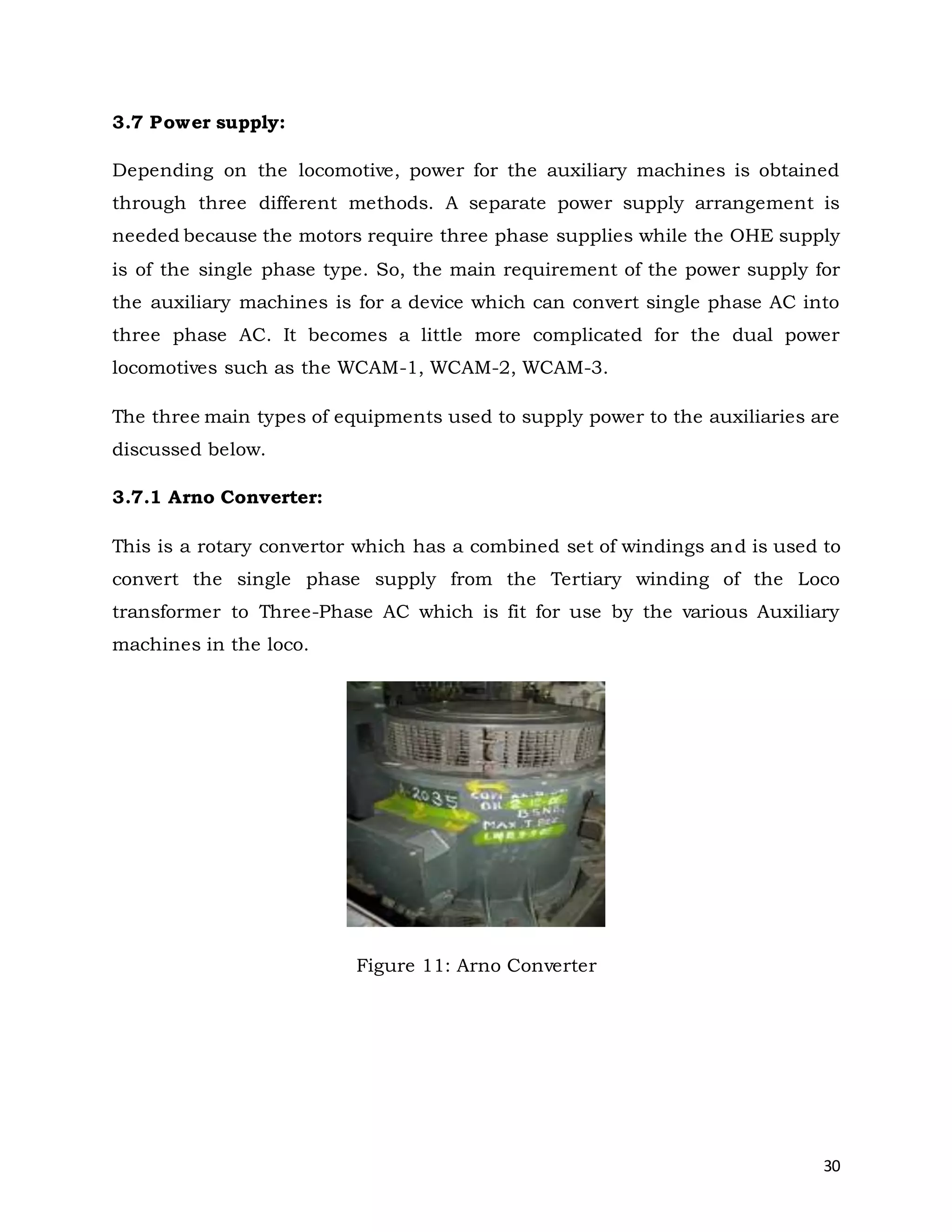
3.7.1 Arno Converter:
This is a rotary convertor which has a combined set of windings and is used to
convert the single phase supply from the Tertiary winding of the Loco
transformer to Three-Phase AC which is fit for use by the various Auxiliary
machines in the loco.
Figure 11: Arno Converter
31
Figure 12: Schematic Diagram of Arno Converter
The Arno is basically a split-phase induction motor with an additional winding
on the stator for the generating phase. In an induction motor the rotating field
of the stator creates a corresponding field in the rotor squirrel cage too which
causes the rotor to start rotating at "slip" speed which is slightly less than the
speed at which the stator field is rotating. However, this rotating field of the
rotor is additionally utilized in the arno to create power in the generating phase
winding which gives the three phase output of the arno convertor. In the stator
winding of the arno, the motoring phases carry the load as well supply currents
of the arno in opposite direction which causes a net reduction in the actual
current carried by the windings in the stator but the generating phase carries
only the load current which causes a voltage drop in the generating phase. To
counteract this, up to 20% more turns are provided in the generating phase
winding.
32
3.7.1.1 Precautions during Arno Starting:
The Arno starts as a split-phase induction motor by inserting a resistance
momentarily in the generating phase winding as shown in the diagram above.
This starting resistance must be removed as the rotor approaches 90% of its
normal speed. If this resistance is left in the circuit, it can cause heating of the
generating phase winding and excessive vibrations. If the starting resistance is
removed prematurely it can take longer for the arno to reach synchronous
speed. Hence, to maintain proper timing two methods could be employed-either
measure the speed of the arno by attaching a tacho-generator or measure the
output voltage of the generating phase.
The voltage measurement method has been found to be more effective and is
used in this system. The voltage between the generating phase and the neutral
of the arno convertor remains at a low value till just before the arno reaches its
synchronous speed when it reaches its full value and is measured by the relay
named QCVAR. It picks up when the voltage rises to near maximum value. The
energisation of the QCVAR causes the starting contactor C-118 to open which
disconnects the starting resistance. The normally open (NO) contacts of the
QCVAR are also interlocked with the Q-118 relay. This interlock is used to
ensure that if the QCVAR fails to operate within 5 seconds, the Q-118 interlock
trips the DJ. A bypass switch named HQCVAR is also provided which can be
used to bypass the HQCVAR relay in the Q-118 branch so that DJ tripping
does not occur but in such a case the Arno must be monitored continuously to
ensure that its not overheating.
33
3.7.2 Static Inverter:
The Arno convertor suffers from various disadvantages chief of which is output
voltage imbalance which can cause heating up of the auxiliary motors, varying
output voltage because of the variations in OHE voltage, problems related to
starting of the Arno, etc. To overcome these shortcomings and to improve loco
reliability, the Indian Railways have started providing Static Inverter power
supply for auxiliary machines in locomotives.
The Static Inverter comprises a force commutated rectifier, a DC link and an
Inverter which is usually composed of six IGBT switches.
The Static Inverter broadly works in the following manner:
The supply from the transformer tertiary winding is fed into the rectifier of the
Inverter which is force commutated and is usually composed of IGBTs. The
rectified supply is fed into the DC link which is a large capacitor and is charged
by the DC supply. The DC link also has an inductor to suppress the AC ripple
left over from the rectification cycle and harmonics generated by the inverter.
Additionally, the DC link maintains the supply to the inverter in case of
temporary supply failure and also absorbs transient voltages generated during
switching heavy loads. In some models if the Static Inverter, an IGBT type
switch is provided which is used to switch the DC link in and out of the circuit
as per requirement.
The DC from the rectifier/DC link is converted into three phase AC by the
Inverter module by switching the IGBTs in proper sequence which creates a
near sine wave AC displaced by 120 degrees. Voltage control is achieved by the
Pulse Width Control (PWM) method. This ensures that the output voltage of the
Static Inverter is near constant irrespective of the input voltage from the
transformer.
34
Apart from improving the reliability of the power supply system, one of the
most important advantages of the Static Inverter is that it has considerably
reduced Auxiliary Motor burnouts due drastic improvement in the power
quality in terms of voltage.
Additionally, the Static Inverter also detects earth faults, single phasing and
overloading hence these functions are no longer needed to be monitored by
external devices.
An electronic control system is provided which monitors the complete
functioning of the Static Inverter. The control system gives the gate firing
impulses to the various IGBTs and also controls the phase angle of the firing
pulse to ensure proper phase sequencing. In addition, it monitors the Static
Inverter for internal and external faults.
3.7.3 Motor-Alternator Set (used only in the WCAM-1 and the WCG-2
locos):
Figure 13: Motor Alternator Set
Motor-alternator set provided in WCAM-1 locos. The MA set is the green
machine to the right. The silver box to the top left is the FRG (Frequency
Regulator). Click for a larger view.
The MA set is used to generate power for the Auxiliary machines in both the AC
as well as DC sections because the Arno cannot run in DC line supply. The MA
35
set comprises of a DC motor coupled to an AC alternator by a mechanical
coupling. When the loco is under AC line supply the DC motor of the MA Set is
fed by the tertiary winding of the transformer via an auxiliary rectifier known
as RSI-3. While running in DC line sections the DC motor of the MA Set is
supplied directly by the OHE line supply. The switching between the AC and
DC modes is determined automatically by the position of the Panto changeover
switch ZPT which in turn determines the position of the Change-Over switches.
A stable AC supply output consists of the two main parameters namely the
frequency and the voltage. The frequency of the output supply is directly
dependent on the speed at which the alternator is running and the output
voltage is dependent on the field excitation voltage of the alternator. Generator
speed tends to fall as the electrical load on the generator increases and vice-
versa. To keep the speed of the alternator near constant a frequency regulator
is provided which continuously monitors the frequency and as per requirement
controls the speed of the alternator by reducing or increasing the field
excitation of the DC motor. A bypass switch for the frequency regulator is also
provided in case the FRG becomes defective.
3.7.4 Auxiliary Converters
Auxiliary Converter System converts single phase power from Locomotive
Transformer to three phase 50Hz power to supply to all auxiliary loads of
Electric locomotive. It is direct replacement of Single phase to three phases
ARNO Converter.
Figure 14:
36
3.7.5 System Description:
Single Phase to Three Phase 180KVA Static Converter will take Single Phase
Supply from the Locomotive main transformer tertiary winding and will use a
Rectifier to derive a stable DC link voltage and unity power factor at input
stage. The DC Link is unaffected by supply voltage variations. This DC link will
be used as input to the three - phase Inverter, which will utilize IGBTs or GTOs
to synthesize the three-phase Sine Weighted PWM waveforms, with the
fundamental voltage of 415Vrms line to line. Since IGBTs are used as switching
devices in the inverter, the system reacts fast to any of the fault conditions and
protects itself and loads from all fault conditions. A Battery Charger is also
built-in to cater to DC loads and to Charge the battery.
3.7.6 Auxiliary Three-Phase Power:
Auxiliary Three-Phase Power contains information regarding the auxiliary
converter systems BUR1, BUR2 and BUR3. The three-phase power required to
power auxiliary loads is supplied by the auxiliary converters (BUR1-3) which
are fed from a secondary winding on the main transformer. The following loads
are connected to the auxiliary converters (BUR1-3), they are as follows;
 Traction motor blowers
 Oil cooler blower
 Scavenge blowers, traction motor and oil cooling blowers
 Transformer oil pumps
 Traction converter oil pumps
 Main compressors
 Battery charger
37
The auxiliary circuits are controlled as required. The traction motor and oil
cooling blowers run only when required. The control electronics adjusts the
blower speeds depending on measured operating temperatures, nominal
traction values and speeds. Transformer and traction converter oil pumps work
continuously whenever the auxiliary converters are operating.
Figure 15:
3.7.7 Three-Phase Power:
Each locomotive is equipped with the two boxes enclosing the static auxiliary
converters system divided as follows;
 BUR-Box_1 contains one auxiliary converter (BUR1)
 BUR-Box_2 contains two auxiliary converters (BUR2 and BUR3) and the
battery charger, which may be fed from one of the auxiliary converters
and which may be considered as a functional part of the converters
system.
38
Three auxiliary converters are designed for connection to the auxiliary services
winding of the main transformer. They feature a short-circuit-proof three-phase
output with a rated voltage of 415V. Each converter is rated for an output
power of 100KVA. The output frequency of the converters BUR1 and BUR2 is
available from 0 to 50Hz, while the output inverter of BUR3 works at 50Hz
(fixed frequency). They can feed inductive and resistive loads.
Under normal conditions, the three-phase auxiliary supply is divided as
follows:
 BUR1is connected to both oil cooling blower units
 BUR2 is connected to both the traction motor blowers, both traction
converter oil pumps and both transformer oil pumps
 BUR3 is connected to both the main compressors, both traction motor
blower/oil cooler scavenge blowers and battery charger.
The battery charger with a rated output of approximately 111V charges the
locomotive batteries and supplies the low voltage loads. The low-voltage output
is electrically insulated from the input and from three-phase output.
The converter requires the externally supplied forced air cooling (5 m/s
approximately). Inside the box, thermostats are located in the power cubicle.
When temperature above 50 degrees Celsius, fans run until the temperature
drops below 35 degrees Celsius. Fans run continually in the electronic cubicle.
Auxiliary converter functions are controlled by the MICAS S2 control
electronics, located in the control electronics modules. Both BUR cabinets and
the three phase output chokes are mounted in the machine rooms. The
cabinets are constructed from stainless steel to provide resistance to corrosion
in salty and humid conditions.
39
The auxiliary converter DC-Link chokes are situated within the transformer
tank. The chokes are cooled by the circulation of transformer oil. The DC-Link
capacitor bank serves as an intermediate storage device for the power supplied
by the rectifier module. The DC-Link serves to smooth the pulsed output from
the rectifier module, and to provide a constant power source to the inverter
modules.
3.7.8 Control and Fault Diagnostic System:
When one auxiliary converter fail, all auxiliaries will be connected to the
remaining auxiliary converters by switching the contactors in a suitable
manner.
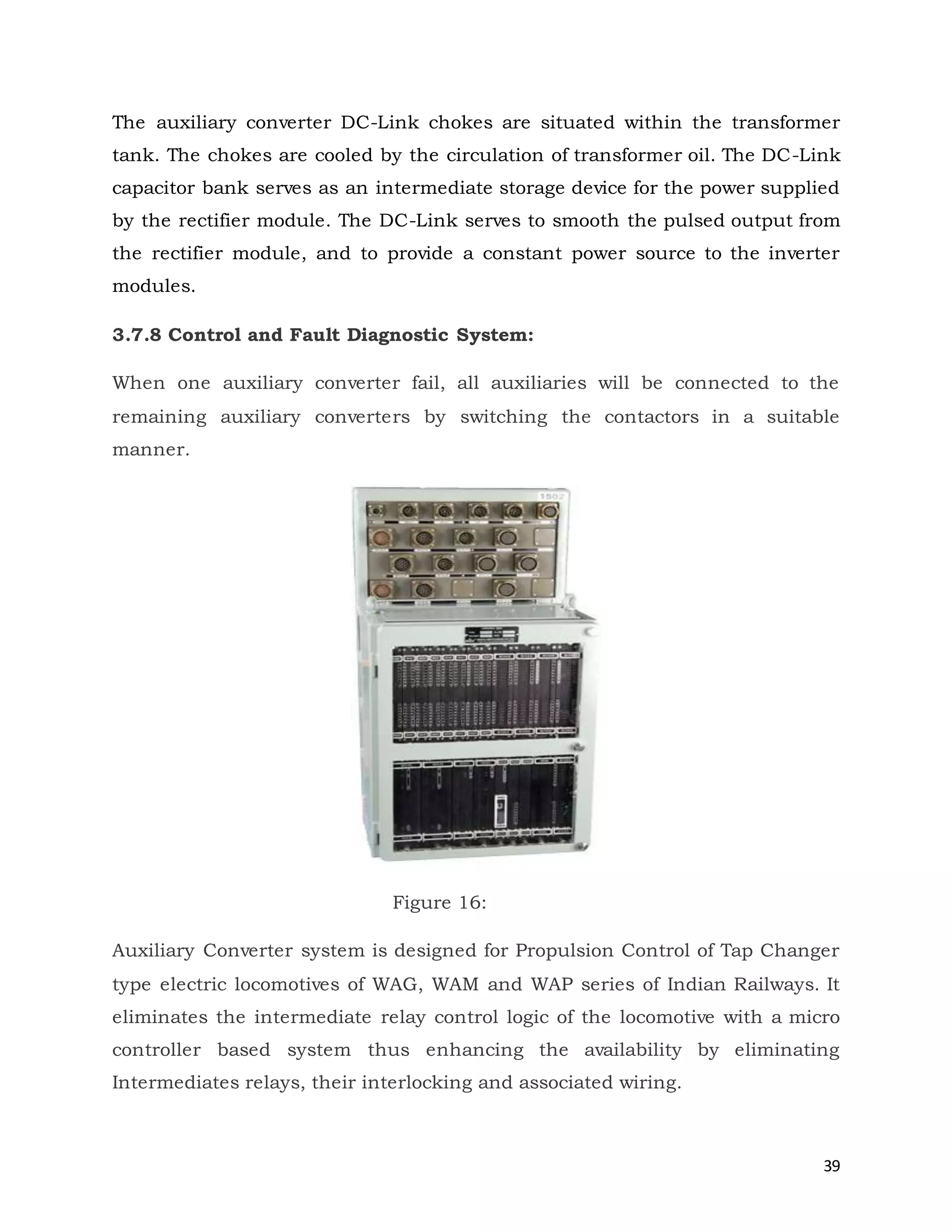
Figure 16:
Auxiliary Converter system is designed for Propulsion Control of Tap Changer
type electric locomotives of WAG, WAM and WAP series of Indian Railways. It
eliminates the intermediate relay control logic of the locomotive with a micro
controller based system thus enhancing the availability by eliminating
Intermediates relays, their interlocking and associated wiring.
40
3.7.9 Tools and Special Tools:
In addition to the conventional railways workshop tools and equipment, the
following items are also required for the procedures described.
 Cathode Ray Oscilloscope for testing the firing pulses and the current
transformers
 Pulse current clamp meter for testing the firing pulses
 Digital voltmeter for testing the current transformer. Alternatively, a
cathode ray oscilloscope may be used
 Crimping pliers
 Dummy plug to test the voltage (suitable for module plug)
 Resistance meter and Capacitance meter
3.8 Before Removal Operations:
Lower the pantograph and isolate the locomotive from the overhead catenary
Earth the locomotive using the key interlocking system. Refer to the Preface of
this Volume.
Ensure the voltage indicators on the BUR cubicles are not flashing. From the
time, the locomotive is powered down, it can take approximately 5 minutes to
completely discharge the capacitors. A flashing voltage indicator shows a
voltage present in the cabinet. No work should be performed until the capacitor
banks have discharged, indicated by no flashing on the voltage indicator.
Isolate the batteries at the battery box isolation switch. Remove the appropriate
pantograph roof hatch from the locomotive.
3.8.1 After Installation:
Reinstall the pantograph roof hatch. Close those battery box isolation switch
and reconnect the locomotive to the overhead, then test the operation of the
auxiliary converters.
41
CONLUSIONS:
By attending the 15 days training in Traction and Auxiliary Converters in
Electric Locomotives at the Electric Loco Shed, Lallaguda, S.C. Railway,
Secunderabad. I conclude that in this overall training of one month I put my
greatest effort to understand & explore more & more about the loco and electric
traction. But the loco is such a complex machine which has so many function
& components which need so much time to understand. But I try my best to
utilize this short span of time to bring out the valuable knowledge about the
loco and electric traction.
REFERENCES:
The training report on “Traction Converters and Auxiliary Converters in
Electric Locomotives” by using following books and websites.
Books
 A course in electrical power by J.B Gupta
 A manual of electric traction
Websites
 www.wikipedia.com
 www.scribd.com
 www.irieen.indianrailway.gov.in
42
43

electric loco shed lalllguda

  • 1.
    1 CHAPTER-1 INTRODUCTION TO ELECTRICALLOCOMOTIVE 1.1 Introduction: An electric locomotive is a locomotive powered by electricity from overhead lines, a third rail or on-board energy storage such as a battery or fuel cell. Electric locomotives with on-board fuelled prime movers, such as diesel engines or gas turbines, are classed as diesel-electric or gas turbine-electric locomotives because the electric generator/motor combination serves only as a power transmission system. Electricity is used to eliminate smoke and take advantage of the high efficiency of electric motors, but the cost of electrification means that usually only heavily used lines can be electrified. 1.2 Characteristics: One advantage of electrification is the lack of pollution from the locomotives. Electrification results in higher performance, lower maintenance costs and lower energy costs. Power plants, even if they burn fossil fuels, are far cleaner than mobile sources such as locomotive engines. The power can come from clean or renewable sources, including geothermal power, hydroelectric power, nuclear power, solar power and wind turbines. Electric locomotives are quiet compared to diesel locomotives since there is no engine and exhaust noise and less mechanical noise. The lack of reciprocating parts means electric locomotives are easier on the track, reducing track maintenance. Power plant capacity is far greater than any individual locomotive uses, so electric locomotives can have a higher power output than diesel locomotives and they can produce even higher short-term surge power for fast acceleration. Electric locomotives are ideal for commuter rail service with frequent stops. They are used on high-speed lines, such as ICE in Germany, Acela in the
  • 2.
    2 U.S., Shinkansen inJapan, China Railway High-speed in China and TGV in France. Electric locomotives are used on freight routes with consistently high traffic volumes, or in areas with advanced rail networks. Electric locomotives benefit from the high efficiency of electric motors, often above 90% (not including the inefficiency of generating the electricity). Additional efficiency can be gained from regenerative braking, which allows kinetic energy to be recovered during braking to put power back on the line. Newer electric locomotives use AC motor-inverter drive systems that provide for regenerative braking. The chief disadvantage of electrification is the cost for infrastructure: overhead lines or third rail, substations, and control systems. Public policy in the U.S. interferes with electrification: higher property taxes are imposed on privately owned rail facilities if they are electrified. U.S. regulations on diesel locomotives are very weak compared to regulations on automobile emissions or power plant emissions. In Europe and elsewhere, railway networks are considered part of the national transport infrastructure, just like roads, highways and waterways, so are often financed by the state. Operators of the rolling stock pay fees according to rail use. This makes possible the large investments required for the technically, and in the long-term also, economically advantageous electrification. Because railroad infrastructure is privately owned in the U.S., railroads are unwilling to make the necessary investments for electrification. 1.3 History in India: A plan for a rail system in India was first put forward in 1832. The first rail line of the Indian sub-continent came up near Chintadripet Bridge (presently in Chennai) in Madras Presidency in 1836 as an experimental line. In 1837, a 3.5-mile (5.6 km) long rail line was established between Red Hills and stone quarries near St. Thomas Mount. In 1844, the Governor-General of India Lord Hardinge allowed private entrepreneurs to set up a rail system in India.
  • 3.
    3 The East IndiaCompany (and later the British Government) encouraged new railway companies backed by private investors under a scheme that would provide land and guarantee an annual return of up to five percent during the initial years of operation. The companies were to build and operate the lines under a 99-year lease, with the government having the option to buy them earlier. Two new railway companies, Great Indian Peninsular Railway (GIPR) and East Indian Railway (EIR), were created in 1853–54 to construct and operate two 'experimental' lines near Mumbai and Kolkata respectively. The first train in India had become operational on 22 December 1851 for localized hauling of canal construction material in Roorkee. A year and a half later, on 16 April 1853, the first passenger train service was inaugurated between Bori Bunder in Mumbai and Thane. Covering a distance of 34 kilometers (21 mi), it was hauled by three locomotives, Sahib, Sindh, and Sultan. This was soon followed by opening of the first passenger railway line in North India between Allahabad and Kanpur on 3 March 1859. In 1854 Lord Dalhousie, the then Governor-General of India, formulated a plan to construct a network of trunk lines connecting the principal regions of India. Encouraged by the government guarantees, investment flowed in and a series of new rail companies were established, leading to rapid expansion of the rail system in India. Soon various native states built their own rail systems and the network spread to the regions that became the modern-day states of Assam, Rajasthan and Andhra Pradesh. The route mileage of this network increased from 1,349 kilometers (838 mi) in 1860 to 25,495 kilometers (15,842 mi) in 1880–mostly radiating inland from the three major port cities of Mumbai, Madras, and Calcutta. Most of the railway construction was done by Indian companies. The railway line from Lahore to Delhi was done B.S.D. Bedi and Sons (Baba Shib Dayal Bedi), this included the building of the Jamuna Bridge. By 1895, India had started building its own locomotives, and in 1896 sent engineers and locomotives to help build the Uganda Railway. At the
  • 4.
    4 beginning of thetwentieth century India had a multitude of rail services with diverse ownership and management, operating on broad, meter and narrow gauge networks. In 1900 the government took over the GIPR network, while the company continued to manage it. With the arrival of the First World War, the railways were used to transport troops and food grains to the port city of Mumbai and Karachi en route to UK, Mesopotamia, East Africa etc. By the end of the First World War, the railways had suffered immensely and were in a poor state. In 1923, both GIPR and EIR were nationalized with the state assuming both ownership and management control The Second World War severely crippled the railways as rolling stock was diverted to the Middle East, and the railway workshops were converted into munitions workshops After independence in 1947, forty-two separate railway systems, including thirty-two lines owned by the former Indian princely states, were amalgamated to form a single unit named the Indian Railways. The existing rail networks were abandoned in favor of zones in 1951 and a total of six zones came into being in 1952. As the economy of India improved, almost all railway production units were ‘indigenized’ (produced in India). By 1985, steam locomotives were phased out in favor of diesel and electric locomotives. The entire railway reservation system was streamlined with computerization between 1987 and 1995. In 2003, the Indian Railways celebrated 150 years of its existence. Various zones of the railways celebrated the event by running heritage trains on routes like the ones on which the first trains in the zones ran. The Ministry of Railways commemorated the event by launching a special logo celebrating the completion of 150 years of service. Also launched was a new mascot for the 150th year celebrations, named Bholu the guard elephant.
  • 5.
  • 6.
    6 CHAPTER-2 TRACTION SYSTEMS FORLOCOMOTIVES 2.1 Introduction: Indian Railways use a specialized classification code for identifying its locomotives. The code is usually three or four letters, followed by a digit identifying the model (either assigned chronologically or encoding the power rating of the locomotive).This could be followed by other codes for minor variations in the base model. The three (or four) letters are, from left to right, the gauge of tracks on which the locomotive operates, the type of power source or fuel for the locomotive, and the kind of operation the locomotive can be used for. The gauge is coded as 'W' for broad gauge, 'Y' for meter gauge, 'Z' for the 762 mm narrow gauge and 'N' for the 610 mm narrow gauge. The power source code is 'D' for diesel, 'A' for AC traction, 'C' for DC traction and 'CA' for dual traction (AC/DC). The operation letter is 'G' for freight-only operation, 'P' for passenger trains-only operation, 'M' for mixed operation (both passenger and freight) and 'S' for shunting operation. A number alongside it indicates the power rating of the engine. For example, '4' would indicate the power rating of the above 4,000 hp (2,980 kW) but below 5,000 hp (3,730 kW). A letter following the number is used to give an exact rating. For instance, 'A' would be an additional 100 horsepower (75 kW); 'B' 200 hp (150 kW) and so on. For example, a WDM- 3D is a broad-gauge, diesel-powered, mixed mode (suitable for both freight and passenger duties) and has a power rating of 3400 hp (2.5 MW). The most common diesel engine used is the WDM-2, which entered production in 1962. This 2,600 hp (1.9 MW) locomotive was designed by Alco and manufactured by the Diesel Locomotive Works, Varanasi, and is used as a standard workhorse. It is being replaced by more modern engines, ranging in power up to 5,500 hp (4.1 MW).
  • 7.
    7 There is awide variety of electric locomotives used, ranging between 2,800 to 6,350 hp (2.1 to 4.7 MW). They also accommodate the different track voltages in use. Most electrified sections in the country use 25,000 volt AC, but railway lines around Mumbai use the older 1,500 V DC system. Thus, Mumbai and surrounding areas are the only places where one can find AC/DC dual locomotives of the WCAM and WCAG series. All other electric locomotives are pure AC ones from the WAP, WAG and WAM series. Some specialized EMU (electric multiple units) are running on Mumbai Suburban System of Central Railway and Western Railway also use dual-power systems, these are new-age rakes manufactured in ICF (Integral Coach Factory) in Paramour usually white and purple livery color. There are also some very rare battery-powered locomotives, primarily used for shunting and yard work. The only steam engines still in service in India operate on two heritage lines (Darjeeling and Ooty), and on the tourist train Palace on Wheels Plans are afoot to re-convert the Neral-Matheran to steam. The oldest steam engine in the world in regular service, the Fairy Queen, operates between Delhi and Alwar. 2.2 Types of electric locomotives in Indian Railways:  Mixed type locomotives; WDM 1 (first mainline diesel electric locomotives used in India. Introduced in 1957. Imported from ALCO. Out of service now. 1950hp) WDM2 (Most widely used and first homemade mainline diesel-electric locomotives in India. Original prototypes were made by Alco. Introduced in 1962, more than 2700 have been made. Rated at 2600 hp) WDM 2A (Technical variants of WDM 2) WDM2BWDM 3 (Only 8 were imported. They used hydraulic transmission and are currently non- functional) WDM 3A (Formerly WDM 2C. Another WDM 2 variant. It is not related to WDM3. 3100 hp) WDM 3C, (higher powered versions of the WDM 3A) WDM 3DWDM 4 (Entered service along with the WDM 2. Prototypes designed by General Motors. Though considered superior to the WDM 2 in many ways, these locomotives weren’t chosen as General Motors did not agree to a technology transfer agreement. 2600 hp) WDM
  • 8.
    8 6 (Very rareclass; only two were made; one is being used by Puttalam Cement Factory in Sri Lanka. Rated at 1200 HP) WDM 7 they were designed for branch-line duties, but they are now used mostly for shunting. Rated at 2000hpWDM 5 No locomotive class was designated as WDM5 in India. Passenger Locomotives: WDP 1WDP 2 (New class name WDP 3A. Dedicated passenger diesel locomotive. Entered service in 1998. Powerful locomotive. 3100 hp) WDP 3. These locomotive are actually prototypes of the class WDP 1 and never entered serial production WDP 4 EMD (former GM-EMD) GT46PAC, fundamentally a passenger version of the WDG 4 (GT46MAC). 4000 hp WDP 4B EMD (former GM-EMD) GT46PAC, an improved version of the WDP 4, this is a more powerful version and has 6 traction motors, just like the WDG 4. Also comes with wider cabin to aid visibility and minor exterior design changes. 4500 hp WDP 4D EMD (former GM-EMD) GT46PAC, this is basically a WDP 4B with twin cabs. Minor changes were made to the locomotive to facilitate the addition of a second cabin. This locomotive comes with LC Instrument display and toilet for the drivers. As of now, two units have been made and are expected to enter full-time service soon. 4500 hp.  Goods locomotives: WDG 2 New class name WDG 3A. These class is a technically upgraded form of WDM 2WDG 3B, Technical upgraded forms of WDG 2 or WDG 3AWDG 3C, WDG 3DWDG 4 New dedicated goods locomotives. These are General motors GT46MAC models. First units were imported in 1999. They are numbered from #12000 upward. Local production started on 2002. 4000 hp Shunting locomotives (Also known as switching engines): WDS 1 First widely deployed and successful diesel locomotives used in India. Imported in 1944- 45. Currently out of service. 386 HPWDS 2 Currently out of service WDS 3 All locomotives of this class were rebuilt and reclassified as WDS 4C in 1976-78. 618 HPWDS 4, Designed by Chittaranjan Locomotive Works. 600-700 hp WDS 4A, WDS 4B, WDS 4DWDS 4C Rebuilt WDS 3 locos as mentioned above
  • 9.
    9 WDS 5 someof these locomotives are used for industrial shunting. A few are used on Indian Railways. Rated at 1065hpWDS 6 Heavy-haul shunters made in large numbers for industrial concerns as well as for Indian Railways Rated at 1200/1350hpWDS 8 Only five of these were made, and all were transferred to steel works 800hpNote: There is no electric shunting engine in India. Classes from WDS 1 to WDS 4D have hydraulic transmission. The WDS 4, 4A, 4B, 4C and 4D are the only still existing broad-gauge locomotives with the diesel-hydraulic transmission. Diesel multiple units: A few routes in India currently have Diesel multiple unit service. Depending on the transmission system they are classified as the DEMU (diesel-electric transmission) or the DHMU (diesel-hydraulic transmission). There are diesel railcar services in a few places known as railbus. DC electric traction Note: These locomotives are, or were used only in sections around Mumbai which is the only location in India  Mixed type locomotives: WCM 1 First electric locomotives with the now familiar Co-Co wheel arrangement to be used in India. 3700 hp WCM 2 520hpWCM 3 600hp - Used in Kolkata, then transferred to Mumbai, built by Hitachi WCM 4 675hp - Also built by Hitachi WCM 5 Built by Chittaranjan locomotive works to the RDSOs design specifications. Auxiliaries by Westinghouse and North Boyce. Built in 1962, these are India’s first indigenously designed DC electric locomotives. The first was named Lokamanya after the Congress leader Bal Gangadhar Tilak. 3700 hp WCM 6 A rare and highly powerful class. 5000 hp, only two were built. Now converted to run on AC power, class name changed to WAM 4Passenger locomotives: WCP 1, WCP 2 are Historically very important locomotives as these are the very first electric loco (GIPR EA/1 and EA/2 to be used in India. The first locomotive was named as Sir Roger Lumney and is currently preserved in the National Rail Museum, New Delhi. 2160 hp WCP 3, WCP 4 GIPR EB/1 and EC/1, these are also among the earliest electric locos used in India Goods locomotives: WCG 1 These are Swiss crocodile locomotives imported in 1928 from Swiss locomotive
  • 10.
    10 works. (GIPR EF/1These are among the earliest electric locos used in India. The first locomotive was named as Sir Leslie Wilson and is currently preserved in the National Rail Museum, New Delhi. 2600-2950 hp WCG 2 Designed by Chittaranjan locomotive works in 1970AC electric traction. The 25 kV AC system with overhead lines is used throughout the rest of the country. Mixed type locomotives WAM 1 Among the first AC electric locomotives used in India. Introduced in 1959. Now out of service. 3010 hp WAM 2WAM 3WAM 4 Indigenously designed by Chittaranjan Locomotive Works in 1970. Highly powerful class. One of the most successful locomotives in India. 3850 hp Passenger locomotives WAP 1 Designed by Chittaranjan locomotive works in 1980 for the Kolkata-Delhi Rajdhani Express. A very successful class. 3900 hp WAP 2 Not in use.  WAP 3 Not in use WAP 4 Upgraded from WAP 1 for higher loads by Chittaranjan locomotive works in 1994. One of the most successful locomotives in India. Very powerful class. 5350 hp WAP 5 Imported in 1995 from Switzerland and used on premier express trains. 5450 hp WAP 6 Only found near Asansol WAP 7 Same design as WAG 9 with modified gear ratio. Highly powerful class. 6250 hp Goods locomotives WAG 1WAG 2WAG 3WAG 4WAG 5 The most successful electric locomotives in India. Designed by Chittaranjan locomotive works in 1984. More than 1100 were made. 3850 hp WAG 5A, Technical variants of WAG 5WAG 5BWAG 6A Imported from ASEA and Hitachi. 6110 hp WAG 6B, Variants of WAG 3A. All rated at 6110 hp WAG 6cWAG 7 Very successful class. Designed by Chittaranjan locomotive works. 5000 hp WAG 9 Currently the most powerful class in India, rated at 6350 hp. Same design as WAP 7 with modified gear ratio. Designed by Adtranz, Switzerland Dual (both AC and DC) traction Note: These locomotives are, or were used only in sections around Mumbai which is the only location in India still using DC traction. They can run under AC traction too. The main purpose behind the manufacture of these types of locomotives was
  • 11.
    11 to provide transportationin and out Mumbai area without changing the engine. Mixed type locomotives: WCAM 1WCAM 2WCAM 3 Designed by Bharat Heavy Electricals locomotives: WCAG 1 Designed by Bharat heavy electrical limited. 2930 hp under the DC traction and 4720 hp under the AC traction. Note there is no dedicated dual current Limited. 4600 hp under the DC traction and 5000 hp under AC traction Goods passenger locomotive in India, but in Mumbai area, there are some EMUs which can run under dual traction. 2.3 Supply Systems for Electric Loco: Indian Railway has the adopted 25 KV industrial frequency (50 HZ) A.C supply system for traction purposes. The power supplies are derived from the 220 KV/ 132 KV 3 phase transmission system from the various grids. The basic arrangement constitutes incoming the supply to the Railway traction substation at a voltage level of 220 KV/132 KV, which normally feeds power along the track for 35-40 km. Adjacent traction substation is fed from different phases in rotation to balance the 3-phase load in its entirety. Neutral sections are provided in between two adjacent substations to prevent the bridging of different phases while passing the electric locomotive. Level of voltage is reduced to 25 KV for the end use of locomotives by 21.6 MVA signal phase power transformers placed at traction sub stations which are located at every 30-35 Kms distance along the track.
  • 12.
    12 2.4 Traction Motorsin Locomotives: Traction motor refers to an electric motor providing the primary rotational torque to a machine, usually for conversion into linear motion (traction). Traction motors are used in electrically powered rail vehicles such as electric multiple units and electric locomotives, other electric vehicles such as electric milk floats, elevators, conveyors, and trolleybuses, as well as vehicles with the electrical transmission systems such as the diesel-electric, the electric hybrid vehicles and the battery electric vehicles. Additionally, electric motors in other products (such as the main motor in a washing machine) are described as traction motors. Traditionally, these were series-wound brushed DC motors, usually running on approximately 600 volts. The availability of high-powered semiconductors (such as thyristors and the IGBT) has now made practical the use of much simpler, higher-reliability AC induction motors known as the asynchronous traction motors. Synchronous AC motors are also occasionally used, as in the French TGV. 2.4.1 Mounting of Motors: Before the mid-20th century, a single large motor was often used to drive multiple driving wheels through connecting rods that were very similar to those used on steam locomotives. Examples are the Pennsylvania Railroad DD1, FF1 and L5 and the various Swiss Crocodiles. It is now standard practice to provide one traction motor driving each axle through a gear drive. Usually, the traction motor is three-point suspended between the bogie frame and the driven axle; this is referred to as a "nose-suspended traction motor". The problem with such an arrangement is that a portion of the motor's weight is unsprang, increasing unwanted forces on the track. In the case of the famous Pennsylvania Railroad GG1, two bogie-mounted motors drove each axle through a quill drive. The "Bi-Polar" electric locomotives built by General Electric for the Milwaukee Road had direct drive motors. The rotating shaft of the motor was also the axle for the wheels. In the case of French TGV power
  • 13.
    13 cars, a motormounted to the power car’s frame drives each axle; a "tripod" drive allows a small amount of flexibility in the drive train allowing the trucks bogies to pivot. By mounting the relatively heavy traction motor directly to the power car's frame rather than to the bogie, better dynamics are obtained allowing better high-speed operation. 2.4.2 Windings: The DC motor was the mainstay of electric traction drives on both electric and diesel-electric locomotives, street-cars/trams and diesel electric drilling rigs for many years. It consists of two parts, a rotating armature and fixed field windings surrounding the rotating armature mounted around a shaft. The fixed field windings consist of tightly wound coils of wire fitted inside the motor case. The armature is another set of coils wound round a central shaft and is connected to the field windings through "brushes" which are spring-loaded contacts pressing against an extension of the armature called the commutator. The commutator collects all the terminations of the armature coils and distributes them in a circular pattern to allow the correct sequence of current flow. When the armature and the field windings are connected in series, the whole motor is referred to as "series-wound". A series-wound DC motor has a low resistance field and armature circuit. Because of this, when voltage is applied to it, the current is high due to Ohm's law. The advantage of high current is that the magnetic fields inside the motor are strong, producing high torque (turning force), so it is ideal for starting a train. The disadvantage is that the current flowing into the motor has to be limited, otherwise the supply could be overloaded or the motor and its cabling could be damaged. At best, the torque would exceed the adhesion and the driving wheels would slip. Traditionally, resistors were used to limit the initial current.
  • 14.
    14 2.4.3 Power Control: Asthe DC motor starts to turn, interaction of the magnetic fields inside causes it to generate a voltage internally. This back EMF (electromagnetic force) opposes the applied voltage and the current that flows is governed by the difference between the two. As the motor speeds up, the internally generated voltage rises, the resultant EMF falls, less current passes through the motor and the torque drops. The motor naturally stops accelerating when the drag of the train matches the torque produced by the motors. To continue accelerating the train, series resistors are switched out step by step, each step increasing the effective voltage and thus the current and torque for a little bit longer until the motor catches up. This can be heard and felt in older DC trains as a series of clunks under the floor, each accompanied by a jerk of acceleration as the torque suddenly increases in response to the new surge of current. When no resistors are left in the circuit, full line voltage is applied directly to the motor. The train's speed remains constant at the point where the torque of the motor, governed by the effective voltage, equals the drag - sometimes referred to as balancing speed. If the train starts to climb an incline, the speed reduces because drag is greater than torque and the reduction in speed causes the back-EMF to fall and thus the effective voltage to rise - until the current through the motor produces enough torque to match the new drag. The use of series resistance was wasteful because a lot of energy was lost as heat. To reduce these losses, electric locomotives and trains (before the advent of power electronics) were normally equipped for series-parallel control as well. 2.4.4 Dynamic Braking: If the train starts to descend a grade, the speed increases because the (reduced) drag is less than the torque. With increased speed, the internally generated back-EMF voltage rises, reducing the torque until the torque again balances the drag. Because the field current is reduced by the back-EMF in a series wound motor, there is no speed at which the back-EMF will exceed the
  • 15.
    15 supply voltage, andtherefore a single series wound DC traction motor alone cannot provide dynamic or regenerative braking. There are, however various schemes applied to provide a retarding force using the traction motors. The energy generated may be returned to the supply (regenerative braking), or dissipated by on board resistors (dynamic braking). Such a system can bring the load to a low speed, requiring relatively little friction braking to bring the load to a full stop. 2.4.5 Automatic Acceleration: On an electric train, the train driver originally had to control the cutting out of resistance manually, but by 1914, automatic acceleration was being used. This was achieved by an accelerating relay (often called a "notching relay") in the motor circuit which monitored the fall of current as each step of resistance was cut out. All the driver had to do was select low, medium or full speed (called "shunt", "series" and "parallel" from the way the motors were connected in the resistance circuit) and the automatic equipment would do the rest. Figure 2:
  • 16.
    16 2.5 Three PhaseAC Railway Electrification: Three-phase AC railway electrification was used in Italy, Switzerland and the United States in the early twentieth century. Italy was the major user, from 1901 until 1976, although lines through two tunnels also used the system; the Simplon Tunnel in Switzerland from 1906 to 1930, and the Cascade Tunnel of the Great Northern Railway in the United States from 1909 to 1939. The first line was in Switzerland, from Burgdorf to Thun (40 km or 25 mi), since 1899. 2.5.1 Advantages: The system provides regenerative braking with the power fed back to the system, so is particularly suitable for mountain railways (provided the grid or another locomotive on the line can accept the power). The locomotives use three-phase induction motors. Lacking brushes and commutators, they require less maintenance. The early Italian and Swiss systems used a low frequency (16⅔ Hz), and a relatively low voltage (3,000 or 3,600 volts) compared with later AC systems. 2.5.2 Disadvantages: The overhead wiring, generally having two separate overhead lines and the rail for the third phase, was more complicated, and the low-frequency used required a separate generation or conversion and distribution system. Train speed was restricted to one to four speeds, with two or four speeds obtained by pole-changing or cascade operation or both.
  • 17.
    17 2.6 Overview ofTraction Offerings: Figure 3: Overview of Traction [1] Traction transformer [2] Traction converter [3] Traction control [4] Train Control and Monitoring System [5] Traction motor [6] Diesel engine generator [7] Auxiliary converter [8] Battery charger [9] Energy storage 2.7 IGBT Traction Converter based Locomotive: 2.7 Introduction: In the recent past, all over the world the trend has been to switch over from conventional DC drives to 3-Phase AC drives based on the Insulated Gate Bipolar Transistor (IGBT) technology. At present, the flagship locomotive of Indian Railways is the 3-phase locomotive. Presently, the different variants, viz, WAG9, WAG9H, WAP7 and WAP5 are
  • 18.
    18 running over IndianRailways. The heart of the locomotive is traction converter which is responsible for conversion of single phase AC drawn from OHE to 3-phase AC which drives the traction motor. At present, switching device used in the traction converter is GTO. Considering the obsolescence of the GTOs, Indian Railways have embarked on their ambitious plan to migrate from current Gate Turn Off (GTO) based system to IGBT based traction propulsion system retaining same transformer and traction motors, owing to the advantages offered by IGBT as a power device. GTO being a thyristor device need snubber circuits, resulting in high losses. GTO’s are sensitive to failures because of complicated gate drivers. IGBT does not require snubber circuit (because of di/dt and dv/dt control) and belongs to a power transistor family, has lesser losses, better control ability, higher performance and the reliability. Along with this, the control also is changing to open the standard controls Train Control Network (TCN) confirming to IEC61375. As the IGBT Traction converter is smaller in size and the liberated space can be utilized for the installation of the future new equipments like Hotel load converter, etc. The first locomotive equipped with IGBT based traction converter flagged of from CLW. 2.7.1 Salient Features: - The existing GTO based traction converter is a group drive, i.e., all the traction motors in a bogie are connected in parallel. While, the IGBT based converter has got single axle drive capability, therefore, in case of any problem with a particular TM, only that particular TM can be isolated unlike in the GTO based converter where the whole bogie has to be isolated. - Due to single axle drive it has got better adhesion performance.
  • 19.
    19 - Because ofsmaller size of the converter it may be possible to install additional equipments like hotel load converter in the locomotive. - To improve the control of the drive, the active type speed sensors have been provided which have better resolution by incorporating sensors which can provide strong signals at 200 pulses per revolution. - This converter has taken full advantage of the advancement in the processor speed which has paved the way for less number of PCB cards with better performance at the higher temperatures. - Power loss reduction by approx. 50% in the comparison with GTO loco equipment. - Annual energy saving (considering @ Rs 4.62 / unit) will be approx. Rs. 34 lakhs assuming loco utilization of 85% service per day. - 40% reduction in weight and compact in size compared to GTO equipment. - 60% reduction in usage of electric cards (only 3 major cards compared to17), hence increasing the loco reliability. - Sensor less speed control. - Water cooled system thus safer vis-à-vis oil cooled system. - Better slip/slide controls, because of the axle control and modern high speed digital signal processing algorithm. - Less harmonics because of high switching frequency. - Designed without using any proprietary ASIC. - Configured to open the standard controls TCN based network - Modern design of software using Matlab/Simulink.
  • 20.
  • 21.
    21 2.7.2 Main Transformer: Thelocomotive is equipped with the main transformer and the main transformer converts the overhead line voltage (25 kV) to the lower operating voltages. There are four secondary traction windings (two on each converter unit, 1269 V), one for feeding the auxiliary circuits (1000 V) and one for the harmonic filter. The main transformer is installed in an enclosed, oil-tight aluminum tank together with series resonant choke for traction converter & 3 DC link chokes for auxiliary converters. This aluminum tank is divided into two chambers. The larger chamber contains the main transformer; the smaller chamber accommodates the series resonant chokes at the bottom and the auxiliary converter chokes above them. The transformer tank is made entirely of aluminum. This construction saves weight and, above all, exerts a damping effect on high frequency magnetic fields 2.7.3 Oil sight glass: The tank is filled with transformer oil. An oil level sight glass is located in the machine room. Mineral transformer oil (type Shell Diala DX/Apar oil) is used for cooling the tank. The two cooling circuits are provided to cool transformer tank. The two oil pumps of the transformer oil circuit are mounted on the tank. The sensor measures the oil temperature. The maximum allowable oil temperature is 150ºC. Figure 5: Oil Sight Glass
  • 22.
    22 2.7.4 Main diagramof Traction Converter: Figure 6: Traction Converter 2.7.5 Traction Motors: The traction motors are asynchronous squirrel cage motors adapted in electrical terms to the traction converter providing the power source. All three traction motors of one bogie are ventilated by one traction motor blower. The traction motors are connected to the gear box. Each traction motor is equipped with two temperature sensors and two motor speed sensors.
  • 23.
    23 CHAPTER-3 AUXILIARY MACHINES ANDEQUIPMENTS IN ELECTRIC LOCOMOTIVES 3.1 Introduction: Electric locos derive tractive effort from Traction Motors which are usually placed in the bogie of the locomotive. Usually one motor is provided per axle but in some older generation of locos two axles were driven by a single Traction Motor also. However apart from Traction Motors, many other motors and equipment are provided in electric locos. These motors are collectively known as the Auxiliaries. The aim of this article is to provide an insight into the various Auxiliary Machines provided in the Electric Locos operational on the Indian Railways. But to understand the reasons why these auxiliaries are needed, it is necessary to understand the manner in which the electric locos operate. An important part of the electric loco is the Power Circuit. A short description of the power circuit of Electric Locos operational on the Indian Railways can be seen here. The article referred to describes the main components of the Power Circuit of the Electric Locomotive comprising of the following parts:
  • 24.
    24 Figure 7: AuxiliaryCircuit Equipment 1. Transformer (including Tap-Changer) 2. Rectifier 3. Smoothing Reactor 4. Traction Motors 5. Main Starting Resistances (in DC Traction on Dual Power Locos only) 6. Dynamic Braking Resistance Cooling Blower
  • 25.
    25 A common featurerunning through all the above electrical equipments is that these generate a lot of heat during their normal operation. Even when they are not in use, they might generate a nominal amount of heat. Normally any electrical equipment generates heat as by-product during operation. But traction vehicles tend to generate more heat than normal. This is because day- by-day the demand on traction vehicles is increasing. But an increase in the power output translates into increased size of the relevant equipments too. But a major problem with traction vehicles is that you cannot increase their size beyond a certain limit. This is due to "Loading Gauge Restrictions". Hence, the power output of the locomotives must be increased indirectly without increasing their size. This is done by pumping more power through the equipments and cooling them at a suitable rate at the same time. Hence the different auxiliaries provided for cooling and other purposes in these locos is described below. All the motors are of the AC 3 Phase squirrel cage induction type and require very little maintenance and are simple and robust. They are described about their relationship to the major power equipment. 3.2 Auxiliaries of The Transformers: The various type of transformers auxiliaries are as follows: 3.2.1 Transformer Oil Circulating Pump (MPH): The transformer tank is filled with oil which serves two purposes. It provides enhanced insulation to the transformer and its surroundings and the oil absorbs the heat generated in the transformer and takes it away to the Transformer Oil Cooling Radiator. The circulation of this oil is carried out by the MPH.
  • 26.
    26 A flow valvewith an electrical contact is provided in the oil circulating pipe. If the oil is circulating properly, the contacts on the relay remain closed. However, in case the MPH fails or stops the relay contacts open which in turn trips master auxiliary protection relay Q-118. This trips the main circuit- breaker(DJ) of the loco. Thus, the transformer is protected. 3.2.2 Transformer Oil Cooling Radiator Blower (MVRH): The MPH circulates the transformer oil through a radiator array on top of the transformer. Air is blown over the radiator by the MVRH. This discharges the heat from the radiator into the atmosphere. A flow detecting relay is provided in the air-stream of the MVRH. The flow detector is a diaphragm type device. The flow of air presses the diaphragm which closes an electrical contact. This relay is known as the QVRH. In case the MVRH blower fails the the QVRH releases and trips the DJ through the relay Q-118. Figure 8:
  • 27.
    27 3.3 Auxiliaries ofRectifier Blocks: Rectifier Cooling Blowers-MVSI-1 and MVSI-2 One blower is provided for each of the rectifier blocks. As rectifiers are semiconductor devices, they are very sensitive to heat and hence must be cooled continuously. The switching sequence of the MVSI blowers is setup in such a way that unless the blowers are running, traction cannot be achieved. A detection relay of diaphragm type is also provided in the air stream of these blowers. However, the detection relay (QVSI-1 & 2) are interlocked with a different relay known as Q-44. This is a much faster acting relay with a time delay of only 0.6 seconds. Hence the failure of a MVSI blower would trip the DJ in less than 1 second. 3.4 Auxiliaries of Smooth Reactors: In WAM-4 locos only one MVSL blower is provided for the cooling of the Smoothing Reactors SL 1 & 2. However, in WAG-5 and other locos two blowers namely MVSL 1&2 are provided for each of the SL's. Their running is proved by the Q-118 relay. In railway parlance proving means to verify whether an equipment or device is working properly. 3.5 Auxiliaries of Traction Motors: In the course of normal operation, the traction motors also generate a lot of heat. This heat is dissipated by two blowers namely MVMT 1 & 2 which force air through a duct into the traction motors of Bogie-1 namely TM-1, TM-2, TM- 3 and Bogie-2 namely TM-4, 5, 6 respectively. The traction motor cooling blowers require a large quantity of air which is taken from vents in the side- wall of the loco. Body-side filters are provided to minimize the ingress of dust into the loco. Their running is detected by Air-Flow sensing relay QVMT 1 & 2 (Pic-2) which in turn give there feed to the Q-118 relay.
  • 28.
    28 Figure 9: 3.6 Otherauxiliaries: There are many other helping machines which are used in locomotives widely. 3.6.1 Air Compressors (MCP 1, MCP-2, MCP-3) Electric locos need compressed at a pressure ranging from 6 kg/cm2 to 10 kg/cm2. Compressed air is used for the loco's own air brake system as also for the train brakes, for raising the pantograph, for operating the power switchgear inside the loco such as the power contactors, change-over switches, windscreen wipers, sanders, etc. This compressed air is obtained by providing three air compressors, each having a capacity to pump 1000 liters of air per minute. However, depending on the current requirement, more than two compressors are rarely needed. Figure 10:
  • 29.
    29 3.6.2 Vacuum Pumps(MPV 1 & 2): In locos equipped to haul vacuum braked trains, two vacuum pumps are also provided of which at least one is running in normal service and sometimes both may have to be run if train brakes are required to be released in a hurry. 3.6.3 Dynamic Braking Resistance Cooling Blower (MVRF): In locos equipped with internal dynamic braking resistances, MVRF blower is provided for cooling the resistances during braking. While all the Auxiliary machines run on the power supply provided by the Arno converter/Static Converter/Motor-Alternator set, the MVRF blower runs off the supply derived from the output of the Traction Motor itself and is connected in parallel to the Dynamic Braking Resistances. 3.6.4 Main Starting Resistance Cooling Blowers (MVMSR): These blowers (four in number) are provided in WCAM-1, WCAM-2, WCAM-3 locos and are used during the DC line working to cool the Main Starting Resistances (MSR). The MSR is used for regulating the voltage supplied to the Traction Motors during DC line working and carry the whole current of the traction motors which results in a lot of heat generation which must be continuously dissipated. The working of the MVMSR's is also proved by respective sensing relays (QVMSR's) of the diaphragm type which in turn are interlocked with the relay Q-118.
  • 30.
    30 3.7 Power supply: Dependingon the locomotive, power for the auxiliary machines is obtained through three different methods. A separate power supply arrangement is needed because the motors require three phase supplies while the OHE supply is of the single phase type. So, the main requirement of the power supply for the auxiliary machines is for a device which can convert single phase AC into three phase AC. It becomes a little more complicated for the dual power locomotives such as the WCAM-1, WCAM-2, WCAM-3. The three main types of equipments used to supply power to the auxiliaries are discussed below. 3.7.1 Arno Converter: This is a rotary convertor which has a combined set of windings and is used to convert the single phase supply from the Tertiary winding of the Loco transformer to Three-Phase AC which is fit for use by the various Auxiliary machines in the loco. Figure 11: Arno Converter
  • 31.
    31 Figure 12: SchematicDiagram of Arno Converter The Arno is basically a split-phase induction motor with an additional winding on the stator for the generating phase. In an induction motor the rotating field of the stator creates a corresponding field in the rotor squirrel cage too which causes the rotor to start rotating at "slip" speed which is slightly less than the speed at which the stator field is rotating. However, this rotating field of the rotor is additionally utilized in the arno to create power in the generating phase winding which gives the three phase output of the arno convertor. In the stator winding of the arno, the motoring phases carry the load as well supply currents of the arno in opposite direction which causes a net reduction in the actual current carried by the windings in the stator but the generating phase carries only the load current which causes a voltage drop in the generating phase. To counteract this, up to 20% more turns are provided in the generating phase winding.
  • 32.
    32 3.7.1.1 Precautions duringArno Starting: The Arno starts as a split-phase induction motor by inserting a resistance momentarily in the generating phase winding as shown in the diagram above. This starting resistance must be removed as the rotor approaches 90% of its normal speed. If this resistance is left in the circuit, it can cause heating of the generating phase winding and excessive vibrations. If the starting resistance is removed prematurely it can take longer for the arno to reach synchronous speed. Hence, to maintain proper timing two methods could be employed-either measure the speed of the arno by attaching a tacho-generator or measure the output voltage of the generating phase. The voltage measurement method has been found to be more effective and is used in this system. The voltage between the generating phase and the neutral of the arno convertor remains at a low value till just before the arno reaches its synchronous speed when it reaches its full value and is measured by the relay named QCVAR. It picks up when the voltage rises to near maximum value. The energisation of the QCVAR causes the starting contactor C-118 to open which disconnects the starting resistance. The normally open (NO) contacts of the QCVAR are also interlocked with the Q-118 relay. This interlock is used to ensure that if the QCVAR fails to operate within 5 seconds, the Q-118 interlock trips the DJ. A bypass switch named HQCVAR is also provided which can be used to bypass the HQCVAR relay in the Q-118 branch so that DJ tripping does not occur but in such a case the Arno must be monitored continuously to ensure that its not overheating.
  • 33.
    33 3.7.2 Static Inverter: TheArno convertor suffers from various disadvantages chief of which is output voltage imbalance which can cause heating up of the auxiliary motors, varying output voltage because of the variations in OHE voltage, problems related to starting of the Arno, etc. To overcome these shortcomings and to improve loco reliability, the Indian Railways have started providing Static Inverter power supply for auxiliary machines in locomotives. The Static Inverter comprises a force commutated rectifier, a DC link and an Inverter which is usually composed of six IGBT switches. The Static Inverter broadly works in the following manner: The supply from the transformer tertiary winding is fed into the rectifier of the Inverter which is force commutated and is usually composed of IGBTs. The rectified supply is fed into the DC link which is a large capacitor and is charged by the DC supply. The DC link also has an inductor to suppress the AC ripple left over from the rectification cycle and harmonics generated by the inverter. Additionally, the DC link maintains the supply to the inverter in case of temporary supply failure and also absorbs transient voltages generated during switching heavy loads. In some models if the Static Inverter, an IGBT type switch is provided which is used to switch the DC link in and out of the circuit as per requirement. The DC from the rectifier/DC link is converted into three phase AC by the Inverter module by switching the IGBTs in proper sequence which creates a near sine wave AC displaced by 120 degrees. Voltage control is achieved by the Pulse Width Control (PWM) method. This ensures that the output voltage of the Static Inverter is near constant irrespective of the input voltage from the transformer.
  • 34.
    34 Apart from improvingthe reliability of the power supply system, one of the most important advantages of the Static Inverter is that it has considerably reduced Auxiliary Motor burnouts due drastic improvement in the power quality in terms of voltage. Additionally, the Static Inverter also detects earth faults, single phasing and overloading hence these functions are no longer needed to be monitored by external devices. An electronic control system is provided which monitors the complete functioning of the Static Inverter. The control system gives the gate firing impulses to the various IGBTs and also controls the phase angle of the firing pulse to ensure proper phase sequencing. In addition, it monitors the Static Inverter for internal and external faults. 3.7.3 Motor-Alternator Set (used only in the WCAM-1 and the WCG-2 locos): Figure 13: Motor Alternator Set Motor-alternator set provided in WCAM-1 locos. The MA set is the green machine to the right. The silver box to the top left is the FRG (Frequency Regulator). Click for a larger view. The MA set is used to generate power for the Auxiliary machines in both the AC as well as DC sections because the Arno cannot run in DC line supply. The MA
  • 35.
    35 set comprises ofa DC motor coupled to an AC alternator by a mechanical coupling. When the loco is under AC line supply the DC motor of the MA Set is fed by the tertiary winding of the transformer via an auxiliary rectifier known as RSI-3. While running in DC line sections the DC motor of the MA Set is supplied directly by the OHE line supply. The switching between the AC and DC modes is determined automatically by the position of the Panto changeover switch ZPT which in turn determines the position of the Change-Over switches. A stable AC supply output consists of the two main parameters namely the frequency and the voltage. The frequency of the output supply is directly dependent on the speed at which the alternator is running and the output voltage is dependent on the field excitation voltage of the alternator. Generator speed tends to fall as the electrical load on the generator increases and vice- versa. To keep the speed of the alternator near constant a frequency regulator is provided which continuously monitors the frequency and as per requirement controls the speed of the alternator by reducing or increasing the field excitation of the DC motor. A bypass switch for the frequency regulator is also provided in case the FRG becomes defective. 3.7.4 Auxiliary Converters Auxiliary Converter System converts single phase power from Locomotive Transformer to three phase 50Hz power to supply to all auxiliary loads of Electric locomotive. It is direct replacement of Single phase to three phases ARNO Converter. Figure 14:
  • 36.
    36 3.7.5 System Description: SinglePhase to Three Phase 180KVA Static Converter will take Single Phase Supply from the Locomotive main transformer tertiary winding and will use a Rectifier to derive a stable DC link voltage and unity power factor at input stage. The DC Link is unaffected by supply voltage variations. This DC link will be used as input to the three - phase Inverter, which will utilize IGBTs or GTOs to synthesize the three-phase Sine Weighted PWM waveforms, with the fundamental voltage of 415Vrms line to line. Since IGBTs are used as switching devices in the inverter, the system reacts fast to any of the fault conditions and protects itself and loads from all fault conditions. A Battery Charger is also built-in to cater to DC loads and to Charge the battery. 3.7.6 Auxiliary Three-Phase Power: Auxiliary Three-Phase Power contains information regarding the auxiliary converter systems BUR1, BUR2 and BUR3. The three-phase power required to power auxiliary loads is supplied by the auxiliary converters (BUR1-3) which are fed from a secondary winding on the main transformer. The following loads are connected to the auxiliary converters (BUR1-3), they are as follows;  Traction motor blowers  Oil cooler blower  Scavenge blowers, traction motor and oil cooling blowers  Transformer oil pumps  Traction converter oil pumps  Main compressors  Battery charger
  • 37.
    37 The auxiliary circuitsare controlled as required. The traction motor and oil cooling blowers run only when required. The control electronics adjusts the blower speeds depending on measured operating temperatures, nominal traction values and speeds. Transformer and traction converter oil pumps work continuously whenever the auxiliary converters are operating. Figure 15: 3.7.7 Three-Phase Power: Each locomotive is equipped with the two boxes enclosing the static auxiliary converters system divided as follows;  BUR-Box_1 contains one auxiliary converter (BUR1)  BUR-Box_2 contains two auxiliary converters (BUR2 and BUR3) and the battery charger, which may be fed from one of the auxiliary converters and which may be considered as a functional part of the converters system.
  • 38.
    38 Three auxiliary convertersare designed for connection to the auxiliary services winding of the main transformer. They feature a short-circuit-proof three-phase output with a rated voltage of 415V. Each converter is rated for an output power of 100KVA. The output frequency of the converters BUR1 and BUR2 is available from 0 to 50Hz, while the output inverter of BUR3 works at 50Hz (fixed frequency). They can feed inductive and resistive loads. Under normal conditions, the three-phase auxiliary supply is divided as follows:  BUR1is connected to both oil cooling blower units  BUR2 is connected to both the traction motor blowers, both traction converter oil pumps and both transformer oil pumps  BUR3 is connected to both the main compressors, both traction motor blower/oil cooler scavenge blowers and battery charger. The battery charger with a rated output of approximately 111V charges the locomotive batteries and supplies the low voltage loads. The low-voltage output is electrically insulated from the input and from three-phase output. The converter requires the externally supplied forced air cooling (5 m/s approximately). Inside the box, thermostats are located in the power cubicle. When temperature above 50 degrees Celsius, fans run until the temperature drops below 35 degrees Celsius. Fans run continually in the electronic cubicle. Auxiliary converter functions are controlled by the MICAS S2 control electronics, located in the control electronics modules. Both BUR cabinets and the three phase output chokes are mounted in the machine rooms. The cabinets are constructed from stainless steel to provide resistance to corrosion in salty and humid conditions.
  • 39.
    39 The auxiliary converterDC-Link chokes are situated within the transformer tank. The chokes are cooled by the circulation of transformer oil. The DC-Link capacitor bank serves as an intermediate storage device for the power supplied by the rectifier module. The DC-Link serves to smooth the pulsed output from the rectifier module, and to provide a constant power source to the inverter modules. 3.7.8 Control and Fault Diagnostic System: When one auxiliary converter fail, all auxiliaries will be connected to the remaining auxiliary converters by switching the contactors in a suitable manner. Figure 16: Auxiliary Converter system is designed for Propulsion Control of Tap Changer type electric locomotives of WAG, WAM and WAP series of Indian Railways. It eliminates the intermediate relay control logic of the locomotive with a micro controller based system thus enhancing the availability by eliminating Intermediates relays, their interlocking and associated wiring.
  • 40.
    40 3.7.9 Tools andSpecial Tools: In addition to the conventional railways workshop tools and equipment, the following items are also required for the procedures described.  Cathode Ray Oscilloscope for testing the firing pulses and the current transformers  Pulse current clamp meter for testing the firing pulses  Digital voltmeter for testing the current transformer. Alternatively, a cathode ray oscilloscope may be used  Crimping pliers  Dummy plug to test the voltage (suitable for module plug)  Resistance meter and Capacitance meter 3.8 Before Removal Operations: Lower the pantograph and isolate the locomotive from the overhead catenary Earth the locomotive using the key interlocking system. Refer to the Preface of this Volume. Ensure the voltage indicators on the BUR cubicles are not flashing. From the time, the locomotive is powered down, it can take approximately 5 minutes to completely discharge the capacitors. A flashing voltage indicator shows a voltage present in the cabinet. No work should be performed until the capacitor banks have discharged, indicated by no flashing on the voltage indicator. Isolate the batteries at the battery box isolation switch. Remove the appropriate pantograph roof hatch from the locomotive. 3.8.1 After Installation: Reinstall the pantograph roof hatch. Close those battery box isolation switch and reconnect the locomotive to the overhead, then test the operation of the auxiliary converters.
  • 41.
    41 CONLUSIONS: By attending the15 days training in Traction and Auxiliary Converters in Electric Locomotives at the Electric Loco Shed, Lallaguda, S.C. Railway, Secunderabad. I conclude that in this overall training of one month I put my greatest effort to understand & explore more & more about the loco and electric traction. But the loco is such a complex machine which has so many function & components which need so much time to understand. But I try my best to utilize this short span of time to bring out the valuable knowledge about the loco and electric traction. REFERENCES: The training report on “Traction Converters and Auxiliary Converters in Electric Locomotives” by using following books and websites. Books  A course in electrical power by J.B Gupta  A manual of electric traction Websites  www.wikipedia.com  www.scribd.com  www.irieen.indianrailway.gov.in
  • 42.
  • 43.