E-Learning 3.0
 anyone, anywhere, anytime, and AI


 Learning Networks
Neil Rubens
Active Intelligence Group
Knowledge Systems Lab   /

University of Electro-Communications
Tokyo, Japan
http://ActiveIntelligence.org


                                                                       http://www.flickr.com/photos/lifeinverted/5651315924/


SPeL 2011: International Workshop on Social and Personal Computing for Web-Supported
Learning Communities
Evolution of eLearning: eLearning 1.0
eLearning uses technology to enhance Learning

To understand where the eLearning might be going, we need to take a quick
look at where it's been

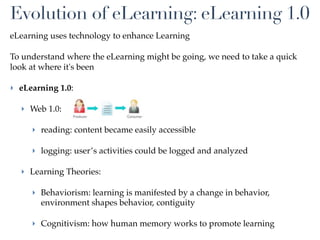
‣ eLearning 1.0:

  ‣ Web 1.0:

     ‣ reading: content became easily accessible

     ‣ logging: user’s activities could be logged and analyzed

  ‣ Learning Theories:

     ‣ Behaviorism: learning is manifested by a change in behavior,
       environment shapes behavior, contiguity

     ‣ Cognitivism: how human memory works to promote learning
Evolution of eLearning: eLearning 2.0
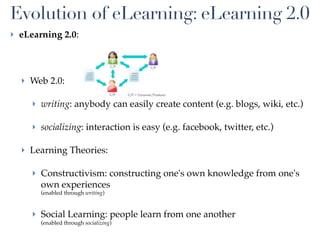
‣ eLearning 2.0:


  ‣ Web 2.0:

     ‣ writing: anybody can easily create content (e.g. blogs, wiki, etc.)

     ‣ socializing: interaction is easy (e.g. facebook, twitter, etc.)

  ‣ Learning Theories:

     ‣ Constructivism: constructing one's own knowledge from one's
       own experiences
       (enabled through writing)


     ‣ Social Learning: people learn from one another
       (enabled through socializing)
eLearning 3.0?


                 http://www.flickr.com/photos/christian78/2960519381
Review of Evolution of Systems
          Predictions: eLearning 3.0


                                                       Contextual

                                                 Personal            Intelligent

E-Learning 2.0                       Connected              Integrated

                         Collaborative
                                             Social/Communicative
                    Dynamic
                                  Databases/RSS
E-LearningInteractive
           1.0

                        Multimedia
  Static
             HTML- or Text                                               Greller, 2011
Review of Predictions: eLearning 3.0

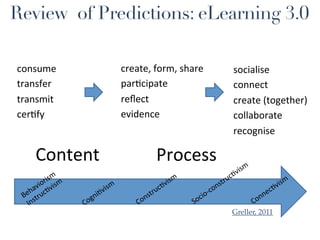
consume(                                   create,(form,(share(                              socialise(
transfer(                                  par.cipate((                                      connect(
transmit(                                  reflect(                                           create((together)(
cer.fy(                                    evidence(                                         collaborate(
                                                                                             recognise(

     Content(                                           Process(                                   m(
                                                                                               vis
             m( (                                                 m(                       uc
                                                                                             .
          ris m                                               vis                       str                                 m(
       vio vis                        m(                   c.                      on                                   vis
    ha uc.                        vis                  tru                                                       ec
                                                                                                                      .
 Be tr                         i.                    s                     i   o ?c                            n
                          gn                    on                       oc                               on
   Ins              C   o                     C                        S                                C
                                                                                          Greller,(2011(
                                                                                           Greller, 2011
Review of Predictions: eLearning 3.0
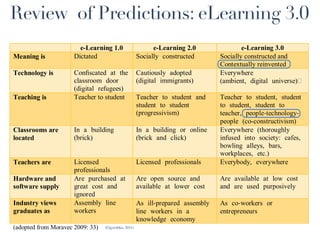
                        e-Learning 1.0                     e-Learning 2.0                 e-Learning 3.0
Meaning is            Dictated                       Socially constructed         Socially constructed and
                                                                                  Contextually reinvented
Technology is         Confiscated at the             Cautiously adopted           Everywhere
                      classroom door                 (digital immigrants)         (ambient, digital universe)
                      (digital refugees)
Teaching is           Teacher to student             Teacher to student and       Teacher to student, student
                                                     student to student           to student, student to
                                                     (progressivism)              teacher, people-­‐technology-­‐
                                                                                  people (co-constructivism)
Classrooms are        In a building                  In a building or online      Everywhere (thoroughly
located               (brick)                        (brick and click)            infused into society: cafes,
                                                                                  bowling alleys, bars,
                                                                                  workplaces, etc.)
Teachers are          Licensed                       Licensed professionals       Everybody, everywhere
                      professionals
Hardware and          Are purchased at               Are open source and          Are available at low cost
software supply       great cost and                 available at lower cost      and are used purposively
                      ignored
Industry views        Assembly line                  As ill-­‐prepared assembly   As co-­‐workers or
graduates as          workers                        line workers in a            entrepreneurs
                                                     knowledge economy
(adopted from Moravec 2009: 33)   (Ogorshko, 2011)
Our Predictions: eLearning 3.0
Typical predictions of eLearning 3.0:

Learning -> Technologies

  Limitation: Needed technologies may not be available


Our Predictions:

Technologies -> Learning

  ‣ What new technologies will become available?

  ‣ What aspects of Learning Theories could be activated by using and
    extending new technologies?
Why do we need eL 3.0?
                                                              Whats Wrong with 2.0?


http://etc.usf.edu/clipart/28000/28015/tower_pisa_28015.htm
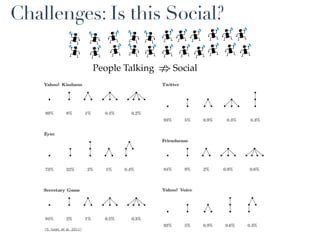
Challenges: Is this6=Social?

                             People Talking   ; Social


    (S. Goel, et al. 2011)
Limitations: Broken Knowledge Cycle
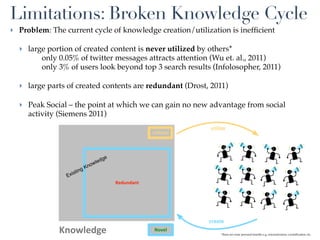
‣ Problem: The current cycle of knowledge creation/utilization is inefficient !

  ‣ large portion of created content is never utilized by others*
        only 0.05% of twitter messages attracts attention (Wu et. al., 2011)
        only 3% of users look beyond top 3 search results (Infolosopher, 2011)

  ‣ large parts of created contents are redundant (Drost, 2011)

  ‣ Peak Social – the point at which we can gain no new advantage from social
    activity (Siemens 2011)
                                                                   utilize
                                                         U0lized


                                    d   ge
                           no   wle
                          K
                  is ting
                Ex
                                             Redundant


                                                                   create
              Knowledge                                  Novel
                                                                        *there are some personal benefits e.g. externalization, crystallization, etc.
Information
Overload
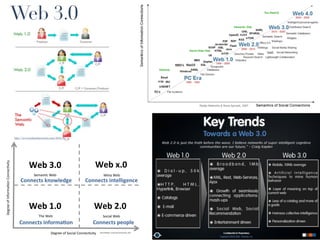
Web 3.0


                                                                                                                                               Radar Networks & Nova Spivack, 2007


                                    http://www.technodiscoveries.com/2010/01


                                               Web$3.0$                                    Web$x.0$
Degree(of(Informa&on(Connec&vity(


                                                   Seman&c(Web(                                     Meta(Web(
                                        Connects$knowledge$                          Connects$intelligence$


                                               Web$1.0$                                    Web$2.0$
                                                       The(Web(                                    Social(Web(
                                        Connects$informa6on$                              Connects$people$
                                                                Degree(of(Social(Connec&vity(   Steve(Wheeler,(University(of(Plymouth,(2011(
AI is poised to Play a Major Role
 ‣ AI has been successful in ‘restricted’ domains e.g. chess

 ‣ In more open domains (e.g. eLearning) success of AI has been
   limited:

   ‣ More Complexity -> More Parameters -> More Data, More
     Computational Resources

      ‣ Large scale data and computational resources have not been
        easily available

 ‣ Things are changing:

   ‣ Large-scale data is becoming available (BIG/Open data)

   ‣ Large-scale Computational resources are becoming accessible
     (cloud computing)
                                                       * more specifically Machine Learning
BIG/Open data
‣ Open data: freely available to everyone to use and republish as they wish;
  e.g. wikipedia, twitter, data.gov, etc.

‣ Big data:

  ‣ amount of data generated is growing by 58% per year                       (Gantz, 2011)


  ‣ pieces of content shared on Facebook 30 billion/month                        (McKinsey, 2011)


‣ Big Data in eLearning

  ‣ KDD Cup 2010: 36 Million ITS records (PSLC, CMU)

  ‣ Learning Dataset: > 30 Million tweets (Rubens & Louvigne et. al., 2011)

     ‣ includes data on how users learn outside of the classroom
       (not typically available)
Data Science
   Large data sets can potentially provide a much deeper understanding of both nature and society. Social scientists are
   getting to the point in many areas at which enough information exists to understand and address major previously
   intractable problems. (Science, 2011)

‣ Traditional:

   ‣ Hypothesis -> Model -> Validation (data)

        ‣ Limitations

            ‣ Sometimes is disconnected from the reality

            ‣ Validation data is often biased by the initial hypothesis

            ‣ Time Consuming: model must be explicitly programmed

‣ Data-driven

   ‣ Data -> Model

        ‣ Advantages

            ‣ model is constructed automatically by utilizing AI methods

            ‣ large number of dimensions could be analyzed

            ‣ can handle complexity well
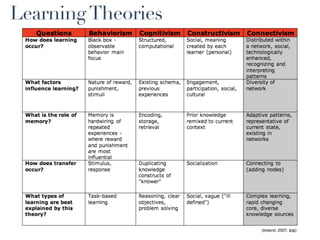
Learning Theories


                    (Ireland, 2007, link)
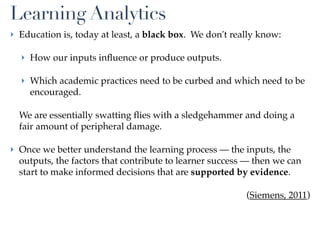
Learning Analytics
‣ Education is, today at least, a black box. We don't really know:

  ‣ How our inputs influence or produce outputs.

  ‣ Which academic practices need to be curbed and which need to be
    encouraged.

  We are essentially swatting flies with a sledgehammer and doing a
  fair amount of peripheral damage.

‣ Once we better understand the learning process — the inputs, the
  outputs, the factors that contribute to learner success — then we can
  start to make informed decisions that are supported by evidence.

                                                         (Siemens, 2011)
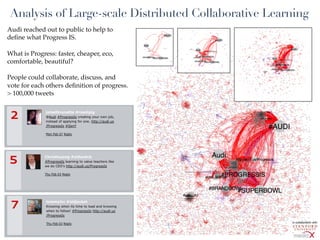
Analysis of Large-scale Distributed Collaborative Learning
Audi reached out to public to help to
define what Progress IS.

What is Progress: faster, cheaper, eco,
comfortable, beautiful?

People could collaborate, discuss, and
vote for each others definition of progress.
> 100,000 tweets


                                                       In collaboration with:
eLearning 3.0


‣ Automatically discover new Learning Models

  ‣ by applying AI methods

  ‣ to BIG data

e-learning 3.0 and AI

  • 1.
    E-Learning 3.0 anyone,anywhere, anytime, and AI Learning Networks Neil Rubens Active Intelligence Group Knowledge Systems Lab / University of Electro-Communications Tokyo, Japan http://ActiveIntelligence.org http://www.flickr.com/photos/lifeinverted/5651315924/ SPeL 2011: International Workshop on Social and Personal Computing for Web-Supported Learning Communities
  • 2.
    Evolution of eLearning:eLearning 1.0 eLearning uses technology to enhance Learning To understand where the eLearning might be going, we need to take a quick look at where it's been ‣ eLearning 1.0: ‣ Web 1.0: ‣ reading: content became easily accessible ‣ logging: user’s activities could be logged and analyzed ‣ Learning Theories: ‣ Behaviorism: learning is manifested by a change in behavior, environment shapes behavior, contiguity ‣ Cognitivism: how human memory works to promote learning
  • 3.
    Evolution of eLearning:eLearning 2.0 ‣ eLearning 2.0: ‣ Web 2.0: ‣ writing: anybody can easily create content (e.g. blogs, wiki, etc.) ‣ socializing: interaction is easy (e.g. facebook, twitter, etc.) ‣ Learning Theories: ‣ Constructivism: constructing one's own knowledge from one's own experiences (enabled through writing) ‣ Social Learning: people learn from one another (enabled through socializing)
  • 4.
    eLearning 3.0? http://www.flickr.com/photos/christian78/2960519381
  • 5.
    Review of Evolutionof Systems Predictions: eLearning 3.0 Contextual Personal Intelligent E-Learning 2.0 Connected Integrated Collaborative Social/Communicative Dynamic Databases/RSS E-LearningInteractive 1.0 Multimedia Static HTML- or Text Greller, 2011
  • 6.
    Review of Predictions:eLearning 3.0 consume( create,(form,(share( socialise( transfer( par.cipate(( connect( transmit( reflect( create((together)( cer.fy( evidence( collaborate( recognise( Content( Process( m( vis m( ( m( uc . ris m vis str m( vio vis m( c. on vis ha uc. vis tru ec . Be tr i. s i o ?c n gn on oc on Ins C o C S C Greller,(2011( Greller, 2011
  • 7.
    Review of Predictions:eLearning 3.0 e-Learning 1.0 e-Learning 2.0 e-Learning 3.0 Meaning is Dictated Socially constructed Socially constructed and Contextually reinvented Technology is Confiscated at the Cautiously adopted Everywhere classroom door (digital immigrants) (ambient, digital universe) (digital refugees) Teaching is Teacher to student Teacher to student and Teacher to student, student student to student to student, student to (progressivism) teacher, people-­‐technology-­‐ people (co-constructivism) Classrooms are In a building In a building or online Everywhere (thoroughly located (brick) (brick and click) infused into society: cafes, bowling alleys, bars, workplaces, etc.) Teachers are Licensed Licensed professionals Everybody, everywhere professionals Hardware and Are purchased at Are open source and Are available at low cost software supply great cost and available at lower cost and are used purposively ignored Industry views Assembly line As ill-­‐prepared assembly As co-­‐workers or graduates as workers line workers in a entrepreneurs knowledge economy (adopted from Moravec 2009: 33) (Ogorshko, 2011)
  • 8.
    Our Predictions: eLearning3.0 Typical predictions of eLearning 3.0: Learning -> Technologies Limitation: Needed technologies may not be available Our Predictions: Technologies -> Learning ‣ What new technologies will become available? ‣ What aspects of Learning Theories could be activated by using and extending new technologies?
  • 9.
    Why do weneed eL 3.0? Whats Wrong with 2.0? http://etc.usf.edu/clipart/28000/28015/tower_pisa_28015.htm
  • 10.
    Challenges: Is this6=Social? People Talking ; Social (S. Goel, et al. 2011)
  • 11.
    Limitations: Broken KnowledgeCycle ‣ Problem: The current cycle of knowledge creation/utilization is inefficient ! ‣ large portion of created content is never utilized by others* only 0.05% of twitter messages attracts attention (Wu et. al., 2011) only 3% of users look beyond top 3 search results (Infolosopher, 2011) ‣ large parts of created contents are redundant (Drost, 2011) ‣ Peak Social – the point at which we can gain no new advantage from social activity (Siemens 2011) utilize U0lized d ge no wle K is ting Ex Redundant create Knowledge Novel *there are some personal benefits e.g. externalization, crystallization, etc.
  • 12.
  • 13.
    Web 3.0 Radar Networks & Nova Spivack, 2007 http://www.technodiscoveries.com/2010/01 Web$3.0$ Web$x.0$ Degree(of(Informa&on(Connec&vity( Seman&c(Web( Meta(Web( Connects$knowledge$ Connects$intelligence$ Web$1.0$ Web$2.0$ The(Web( Social(Web( Connects$informa6on$ Connects$people$ Degree(of(Social(Connec&vity( Steve(Wheeler,(University(of(Plymouth,(2011(
  • 14.
    AI is poisedto Play a Major Role ‣ AI has been successful in ‘restricted’ domains e.g. chess ‣ In more open domains (e.g. eLearning) success of AI has been limited: ‣ More Complexity -> More Parameters -> More Data, More Computational Resources ‣ Large scale data and computational resources have not been easily available ‣ Things are changing: ‣ Large-scale data is becoming available (BIG/Open data) ‣ Large-scale Computational resources are becoming accessible (cloud computing) * more specifically Machine Learning
  • 15.
    BIG/Open data ‣ Opendata: freely available to everyone to use and republish as they wish; e.g. wikipedia, twitter, data.gov, etc. ‣ Big data: ‣ amount of data generated is growing by 58% per year (Gantz, 2011) ‣ pieces of content shared on Facebook 30 billion/month (McKinsey, 2011) ‣ Big Data in eLearning ‣ KDD Cup 2010: 36 Million ITS records (PSLC, CMU) ‣ Learning Dataset: > 30 Million tweets (Rubens & Louvigne et. al., 2011) ‣ includes data on how users learn outside of the classroom (not typically available)
  • 16.
    Data Science Large data sets can potentially provide a much deeper understanding of both nature and society. Social scientists are getting to the point in many areas at which enough information exists to understand and address major previously intractable problems. (Science, 2011) ‣ Traditional: ‣ Hypothesis -> Model -> Validation (data) ‣ Limitations ‣ Sometimes is disconnected from the reality ‣ Validation data is often biased by the initial hypothesis ‣ Time Consuming: model must be explicitly programmed ‣ Data-driven ‣ Data -> Model ‣ Advantages ‣ model is constructed automatically by utilizing AI methods ‣ large number of dimensions could be analyzed ‣ can handle complexity well
  • 17.
    Learning Theories (Ireland, 2007, link)
  • 18.
    Learning Analytics ‣ Educationis, today at least, a black box. We don't really know: ‣ How our inputs influence or produce outputs. ‣ Which academic practices need to be curbed and which need to be encouraged. We are essentially swatting flies with a sledgehammer and doing a fair amount of peripheral damage. ‣ Once we better understand the learning process — the inputs, the outputs, the factors that contribute to learner success — then we can start to make informed decisions that are supported by evidence. (Siemens, 2011)
  • 19.
    Analysis of Large-scaleDistributed Collaborative Learning Audi reached out to public to help to define what Progress IS. What is Progress: faster, cheaper, eco, comfortable, beautiful? People could collaborate, discuss, and vote for each others definition of progress. > 100,000 tweets In collaboration with:
  • 20.
    eLearning 3.0 ‣ Automaticallydiscover new Learning Models ‣ by applying AI methods ‣ to BIG data