Panel Presentation and Discussion: Rural Health Equity and the Social Determinants of Health 2011 Virginia Rural Health Summit Michael O. Royster, MD, MPH Director, Office of Minority Health and Health Equity Virginia Department of Health
Objectives Describe the health equity framework and its relevance to rural Virginia Present health, social, and economic data to contextualize health disparities/inequities in rural Virginia Share best practices and lessons learned to address rural health equity and the social determinants of health
Definitions Health Disparities-   “a population where there is a significant disparity [difference] in the overall rate of disease incidence, prevalence, morbidity, mortality, or survival rates in the population as compared to the health status of the general population.”-   Minority Health and Health Disparities Research and Education Act, 2000 Health Inequities-   “Disparities in health [or health care] that is systematic and avoidable and unjust.”-   CDC
Definition of Health Equity Achieving the highest level of health for all people. Health equity entails focused  societal efforts  to address avoidable inequalities by equalizing  the conditions for health  for all groups, especially for those who have experienced  socioeconomic disadvantage or historical injustices . Healthy People 2020, US DHHS
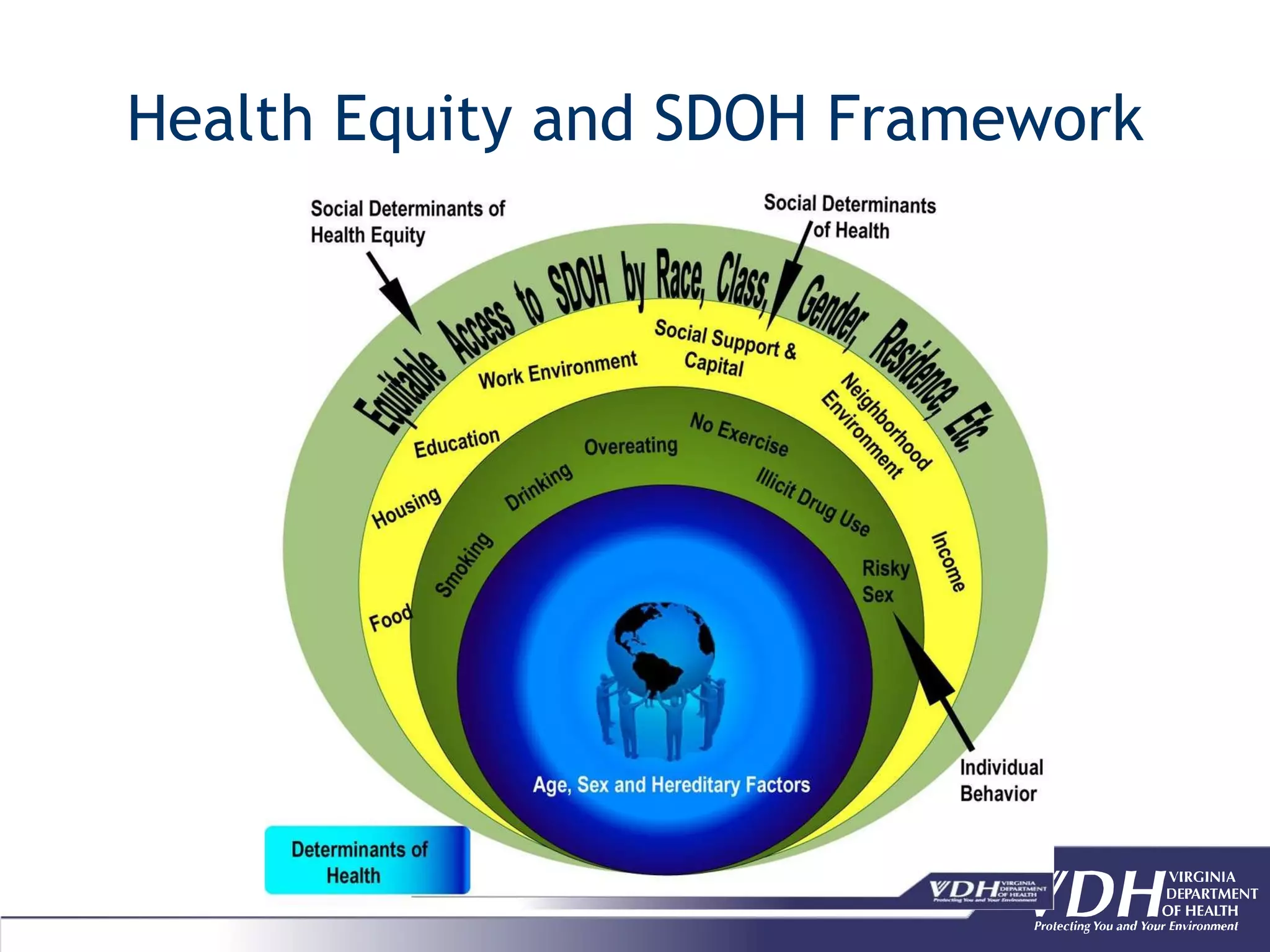
Health Equity and SDOH Framework
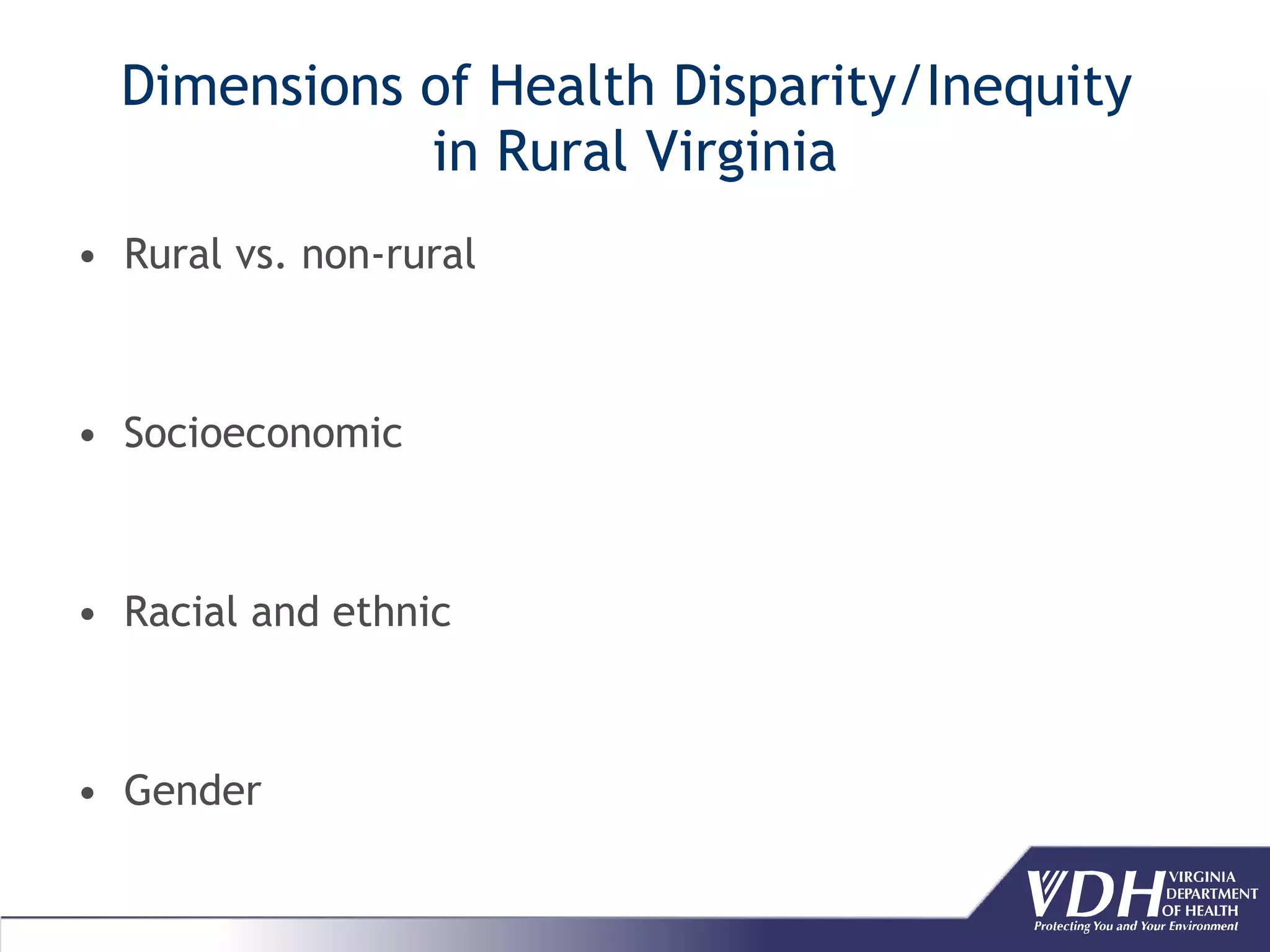
Dimensions of Health Disparity/Inequity  in Rural Virginia Rural vs. non-rural Socioeconomic  Racial and ethnic Gender
All rural Virginians should have the opportunity to make choices that allow them to live long, healthy lives, regardless of their education, income, race, ethnicity, place of residence, gender…

Health Equity

  • 1.
    Panel Presentation andDiscussion: Rural Health Equity and the Social Determinants of Health 2011 Virginia Rural Health Summit Michael O. Royster, MD, MPH Director, Office of Minority Health and Health Equity Virginia Department of Health
  • 2.
    Objectives Describe thehealth equity framework and its relevance to rural Virginia Present health, social, and economic data to contextualize health disparities/inequities in rural Virginia Share best practices and lessons learned to address rural health equity and the social determinants of health
  • 3.
    Definitions Health Disparities- “a population where there is a significant disparity [difference] in the overall rate of disease incidence, prevalence, morbidity, mortality, or survival rates in the population as compared to the health status of the general population.”- Minority Health and Health Disparities Research and Education Act, 2000 Health Inequities- “Disparities in health [or health care] that is systematic and avoidable and unjust.”- CDC
  • 4.
    Definition of HealthEquity Achieving the highest level of health for all people. Health equity entails focused societal efforts to address avoidable inequalities by equalizing the conditions for health for all groups, especially for those who have experienced socioeconomic disadvantage or historical injustices . Healthy People 2020, US DHHS
  • 5.
    Health Equity andSDOH Framework
  • 6.
    Dimensions of HealthDisparity/Inequity in Rural Virginia Rural vs. non-rural Socioeconomic Racial and ethnic Gender
  • 7.
    All rural Virginiansshould have the opportunity to make choices that allow them to live long, healthy lives, regardless of their education, income, race, ethnicity, place of residence, gender…

Editor's Notes

  • #2 Good morning, I’m Mike Royster, the director of OMHHE within the VDH and I will be the moderator for this session.
  • #4 Disparities are differences Inequities are differences that are: Systemic  patterned and predictable Avoidable  not inevitable, but socially produced
  • #5 Definition of health equity, which is the goal in eliminating health inequities. Societal efforts  beyond individual knowledge and behavior change The conditions for health include what we refer to as the SDOH. As defined by the CDC, Social determinants of health (SDOH) are the complex, integrated, and overlapping social structures and economic systems that include the social environment, physical environment, and health services and structural and societal factors that are responsible for most health inequities. SDOH are shaped by the distribution of money, power and resources which are themselves influenced by policy choices. With a specific focus on populations that have experienced socioeconomic disadvantage and historical injustice, which has resulted in systematic differences in access to the SDOH among racial/ethnic minority and low income populations. Such disadvantage creates unequal opportunities to be healthy.
  • #6 This diagram visually depicts the concept of health equity and the SDOH. Inner circle  Individual determinants Next circle  Behaviors; usually the focus of our efforts Outer circle  SDOH that influence behaviors including…access to health care Outer most circle  SDoHE, are those policy decisions, economic conditions, and social structures that shape the distribution of SDOH among SES groups; R/E groups; gender; residence (urban-rural); etc. Efforts to reduce health inequities usually focus on the individual behavior ring of the diagram. However, the outer 2 rings must be focused on as well to effectively promote rural health equity.
  • #7 In Rural Virginia, there are multiple dimensions of health inequities: The most obvious being rural vs. urban But within rural areas, there are also inequities among subpopulations; most prominently along SES, R/E, and gender; but also sexual orientation, ability, etc.
  • #8 So this panel presentation and discussion are about promoting rural health equity, which is really about assuring that all Virginians…whether those choices are to purchase healthy foods in your neighborhood, or to live in a healthy neighborhood with many opportunities to be healthy, including high performing schools, job opportunities, freedom from environmental toxins or violence. Introduce the panel